Cellulose Acetate Market Overview
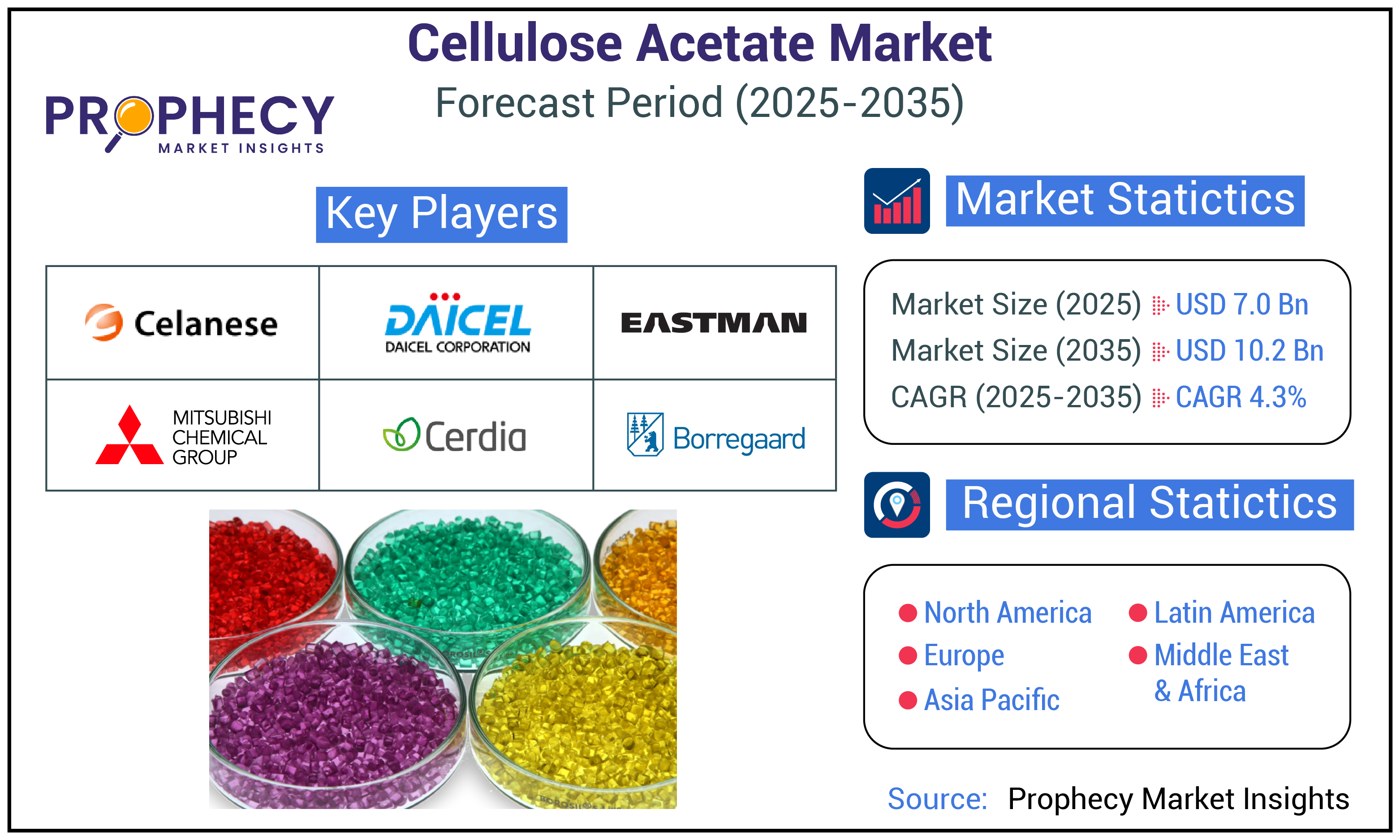
- Cellulose acetate market size is expected to develop at a rate of USD 10.2 Billion, by 2035.
- In 2024, the target market valuation was USD 6.8 Billion.
- Cellulose acetate market is growing at a CAGR of 4.3%.
Cellulose acetate is non-flammable thermoplastic polymer made by acetylating cellulose, used as the basis of artificial fibers and plastic. It is cellulose with its hydroxyl groups partially or completely acetylated. It is a widely used, versatile material derived from cellulose, offering numerous advantages due to its biocompatibility, biodegradability, and low cost. It's used in various applications, including textiles, films, membranes, and even eyeglasses, with advantages such as low fouling tendency, high permeability, and selective separation capabilities.
The global cellulose acetate market is experiencing growth due to increasing demand in various industries, including textiles and apparel, packaging, and consumer goods, increasing awareness of environmental issues and the growing demand for biodegradable materials, increasing cigarette smoking population and the use of cellulose acetate in cigarette filters.
The market’s expansion is also skyrocketed by ongoing research and development in manufacturing processes and formulation are leading to improved cellulose acetate products with enhanced properties, further expanding its market application, and cellulose acetate’s versatility and ability to be used in various applications, including packaging and consumer goods.
Recession Risk and Tariff Analysis:
- The cellulose acetate market is vulnerable to recessions since it depends on consumer-driven industries such as tobacco and textiles. Reduced demand in certain sectors may result from economic downturns, which might impact the use of cellulose acetate. Furthermore, manufacturing and distribution might be hampered by supply chain interruptions and regulatory obstacles during recessions, which can affect market stability.
- According to tariff study, cellulose acetate import taxes differ by area. Non-plasticized cellulose acetate (HS code 3912.11) normally has a 6.5% third-country tariff in the EU. Preferential trade agreements, however, can lower or do away with these levies for certain nations. A baseline customs duty of 10% is often applied to cellulose acetate items in India, in addition to other taxes such as IGST and social welfare levies. Global trade dynamics and sourcing choices in the cellulose acetate industry are influenced by these tariff arrangements.
Impact of Generative AI on Cellulose Acetate Market:
- By speeding up product creation and streamlining supply chains, generative AI is having a beneficial effect on the cellulose acetate business. Advanced formulations of biodegradable cellulose acetate products with improved performance in textile, packaging, and medicinal applications can be created by AI algorithms. By facilitating effective resource planning and predictive maintenance, it lowers waste and downtime in industrial operations.
- Furthermore, generative AI assists in determining new customer preferences and market trends, enabling businesses to customize its products and obtain a competitive edge. This promotes innovation and expansion in the cellulose acetate sector.
Cellulose Acetate Market Drivers & Restraints
Key Drivers:
Rising Smoking Population is Skyrocketing the Market Expansion
The growing number of smokers worldwide, especially in emerging nations, is a major factor propelling the cellulose acetate market's expansion. Cigarette filters, which are found in a significant portion of cigarettes consumed worldwide, are mostly made of cellulose acetate. Cigarette filters and cellulose acetate are in greater demand as smoking rates rise, particularly in low- and middle-income nations that are seeing significant economic expansion and population growth. It is anticipated that this tendency will continue, supporting the growth of the cellulose acetate market.
- For instance, according to the data published by Our World in Data, one of the biggest health issues in the globe is tobacco use. As a result, millions of individuals suffer from bad health. According to research, smoking causes over 8 million premature deaths annually. It has been a significant health issue for many years. It is believed that smoking caused the early deaths of almost 100 million individuals throughout the 20th century, the majority of whom lived in wealthy nations. The number of smokers worldwide is declining, which is one of the best things for global health as smoking is currently one of the biggest health issues.
Restraints:
The Environmental Impact of Cellulose Acetate is Hindering the Market Expansion
The environmental effect of the cellulose acetate market is one of its main drawbacks, particularly with regard to cigarette filters, which are slow to break down and greatly increase the amount of plastic waste in the world. Although cellulose acetate filters are made from plants, these include plasticizers that prevent it from biodegrading quickly, which raises environmental issues. Non-decomposed filter buildup damages animals and disturbs biological balance in soil and marine environments. This environmental problem has raised public and governmental attention, casting doubt on the sustainability promises made for cellulose acetate goods.
- Counterbalance Statements: Bioavailability can be improved by creating sophisticated drug delivery systems, such as nanocarriers or sustained-release implants. Enhancing formulations with mucoadhesive compounds may potentially increase the efficacy and retention of drugs.
Opportunities & Trends:
Advancements in Cellulose Acetate is Unlocking Growth Opportunities in the Impending Years
The cellulose acetate market is expected to increase rapidly in the upcoming years due to advancements in cellulose acetate technology. The material's qualities have been improved by advancements in production techniques, making it more adaptable and appropriate for a wider range of uses. For example, due to its softness, ability to absorb moisture, and silk-such as feel, fiber-grade cellulose acetate has been more widely used in textiles and clothing. Furthermore, the creation of biodegradable cellulose acetate substitutes responds to environmental issues related to conventional polymers and is consistent with worldwide sustainability trends. New possibilities in packaging and medical applications are being made possible by the incorporation of smart technology into cellulose acetate products, such as sensors and indications within films.
Cellulose Acetate Market Segmentations & Regional Insights
The cellulose acetate market is segmented into product type, application, and region.
By Product Type:
Depending upon product type, the market is pigeonholed into fiber, plastic, and others. The fiber segment is holding the superior position in the cellulose acetate market share. This is due to its inherent properties, such as breathability, softness, and good dye ability, make it attractive for clothing and home textiles. The relatively low cost and good draping qualities also contribute to its popularity, especially in the textile sector.
The plastic segment is the second superior product type, in the target market. This is due to its biodegradability and sustainability, excellent optical properties, and its applications in cigarette filters and textile industry.
By Application:
On the basis of application, the market is divided into cigarette filters, LCD & photographic films, textiles & apparels, tapes & labels, and others. The cigarette filters segment is dominating the cellulose acetate market share. This is due to cellulose acetate's excellent filtration properties, which make it an ideal material for removing tar and nicotine from cigarette smoke, while maintaining airflow and providing a pleasing taste. Additionally, cellulose acetate's biodegradability is a significant advantage, as it contributes to a more environmentally friendly alternative to traditional filter materials.
The textiles & apparels segment is the second dominating application, in the cellulose acetate market. This is due to the increasing demand for biodegradable and cost-effective textiles, as cellulose acetate offers a good balance of these properties.
Regional Insights:
Geographically, the market is analyzed across North America, Europe, Asia Pacific, Latin America, and the Middle East & Africa.
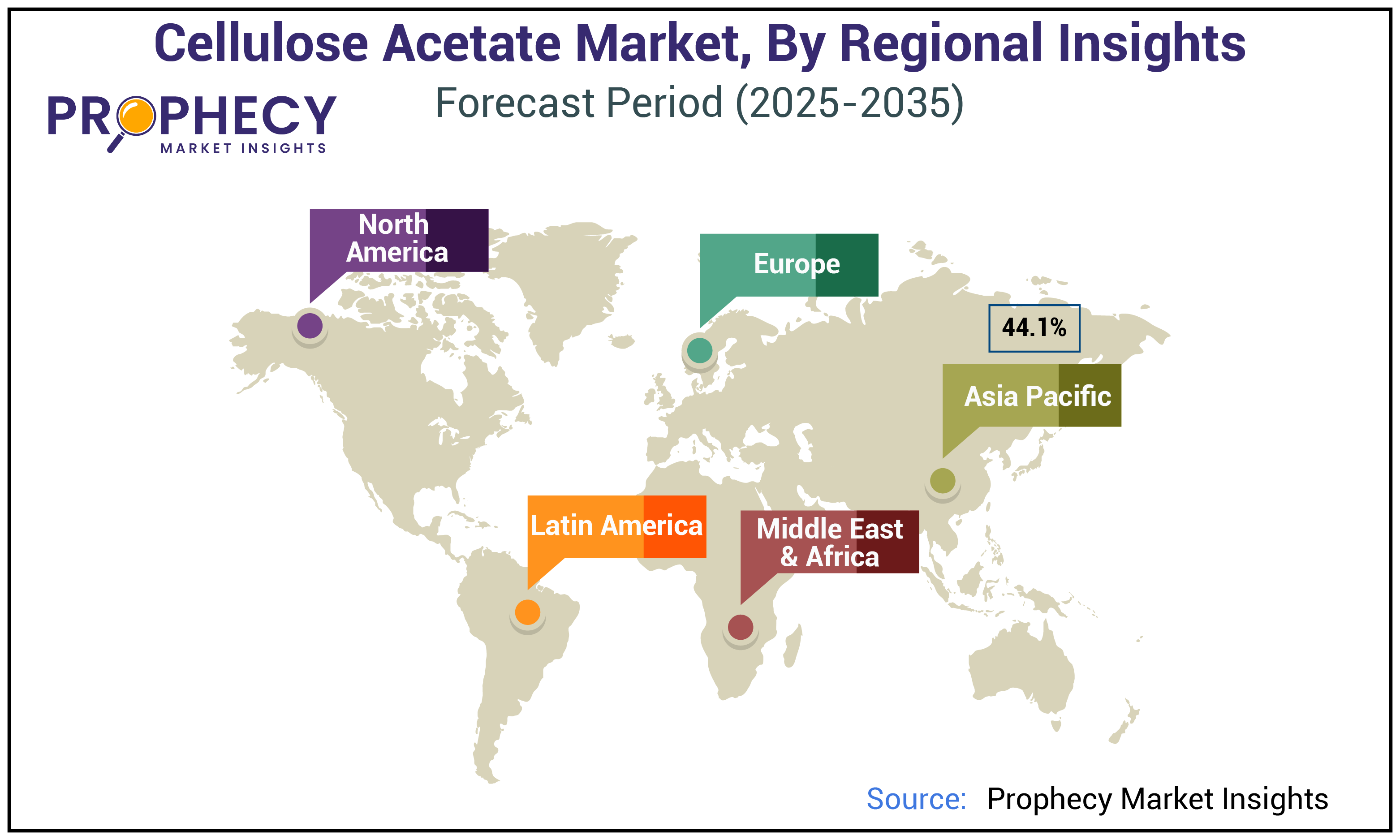
Asia Pacific: This is the region which has the most leading cellulose acetate market, with a projected share of approximately 44.1%, in the recent years. This is due to a confluence of factors, such as, this region’s rapid industrialization and urbanization, leading to increased demand for cellulose acetate in diverse industries, including textiles, packaging, and consumer goods, growing consumption of cellulose acetate in applications such as cigarette filters, textiles & apparel, photographic films, and tapes & labels, strong government support and infrastructure projects, and major emerging economies.
- China Cellulose Acetate Market Insights:
The cellulose acetate market in China is the most ruling market, in the recent years. This is due to this country’s largest tobacco producer and consumer, with over 350 million smokers, a large and diverse plastic industry with many producers, including state-owned, local government-owned, private, and foreign-funded companies, and China has significant investments in the plastic industry, including new factories such as BASF's engineering plastic plant, further expanding production capacity. Additionally, China's substantial plastic industry, with over 12,000 producers, and continuous investments in the sector, further fuel the demand for cellulose acetate in various applications such as films and packaging.
Europe: This is the region which has the cellulose acetate market, growing with the fastest growth rate, during the forecast period, in the recent years. This is due to a number of factors, such as, this region’s major consumer of cellulose acetate, seeking sustainable and luxurious alternatives such as those that mimic silk, focus on reducing plastic waste and promoting biodegradable materials has boosted demand for cellulose acetate in various applications, including packaging and consumer goods, growing awareness of environmental issues which has led to a preference for natural and sustainable fibers, the significant application of cellulose acetate as cigarette filter.
- Germany Cellulose Acetate Market Insights:
The cellulose acetate market in Germany is growing with the fastest growth rate, during the forecast period, in the recent years. This is due to its robust industrial base, advanced manufacturing capabilities, and strong demand across various applications. The country's emphasis on sustainability and environmental regulations further drives the adoption of cellulose acetate in packaging and textiles. Additionally, Germany's well-established chemical industry infrastructure supports efficient production and innovation in cellulose acetate products.
North America: The region which has the cellulose acetate market, growing considerably, in the recent years, is North America. This is due to a combination of factors, such as, this region’s significant consumer of cigarettes, and cellulose acetate is a key material in cigarette filters, the growing textile & apparel industry in this region, innovations in manufacturing and processing, including more efficient and environmentally friendly production methods, and the increasing consumer awareness of plastic pollution and the benefits of biodegradable alternatives such as cellulose acetate.
- U.S. Cellulose Acetate Market Insights:
The cellulose acetate market in the U.S. is the market which is growing significantly, in the recent years. This is due to this country’s robust industrial infrastructure, including manufacturing facilities that produce and utilize cellulose acetate, a significant consumer of cellulose-based products, which contributes to the overall demand for cellulose acetate, and the Northeast region within the U.S. holds the largest market share due to its concentration of manufacturing and industrial activity.
Cellulose Acetate Market Report Scope:
|
Attribute |
Details |
|
Market Size 2025 |
USD 7.0 Billion |
|
Projected Market Size 2035 |
USD 10.2 Billion |
|
CAGR Growth Rate |
4.3% (2025-2035) |
|
Base year for estimation |
2024 |
|
Forecast period |
2025 – 2035 |
|
Market representation |
Revenue in USD Billion & CAGR from 2025 to 2035 |
|
Regional scope |
North America - U.S. and Canada Europe – Germany, U.K., France, Russia, Italy, Spain, Netherlands, and Rest of Europe Asia Pacific – China, India, Japan, Australia, Indonesia, Malaysia, South Korea, and Rest of Asia-Pacific Latin America - Brazil, Mexico, Argentina, and Rest of Latin America Middle East & Africa – GCC, Israel, South Africa, and Rest of Middle East & Africa |
|
Report coverage |
Revenue forecast, company share, competitive landscape, growth factors, and trends |
Segmentation:
By Product Type:
- Fiber
- Plastic
- Others
By Application:
- Cigarette Filters
- LCD & Photographic Films
- Textiles & Apparels
- Tapes & Labels
- Others
By Region:
- North America
- U.S.
- Canada
- Europe
- Germany
- U.K.
- France
- Russia
- Italy
- Spain
- Netherlands
- Rest of Europe
- Asia Pacific
- China
- India
- Japan
- Australia
- Indonesia
- Malaysia
- South Korea
- Rest of Asia Pacific
- Latin America
- Brazil
- Mexico
- Argentina
- Rest of Latin America
- Middle East & Africa
- GCC
- Israel
- South Africa
- Rest of Middle East & Africa
Cellulose Acetate Market Competitive Landscape & Key Players
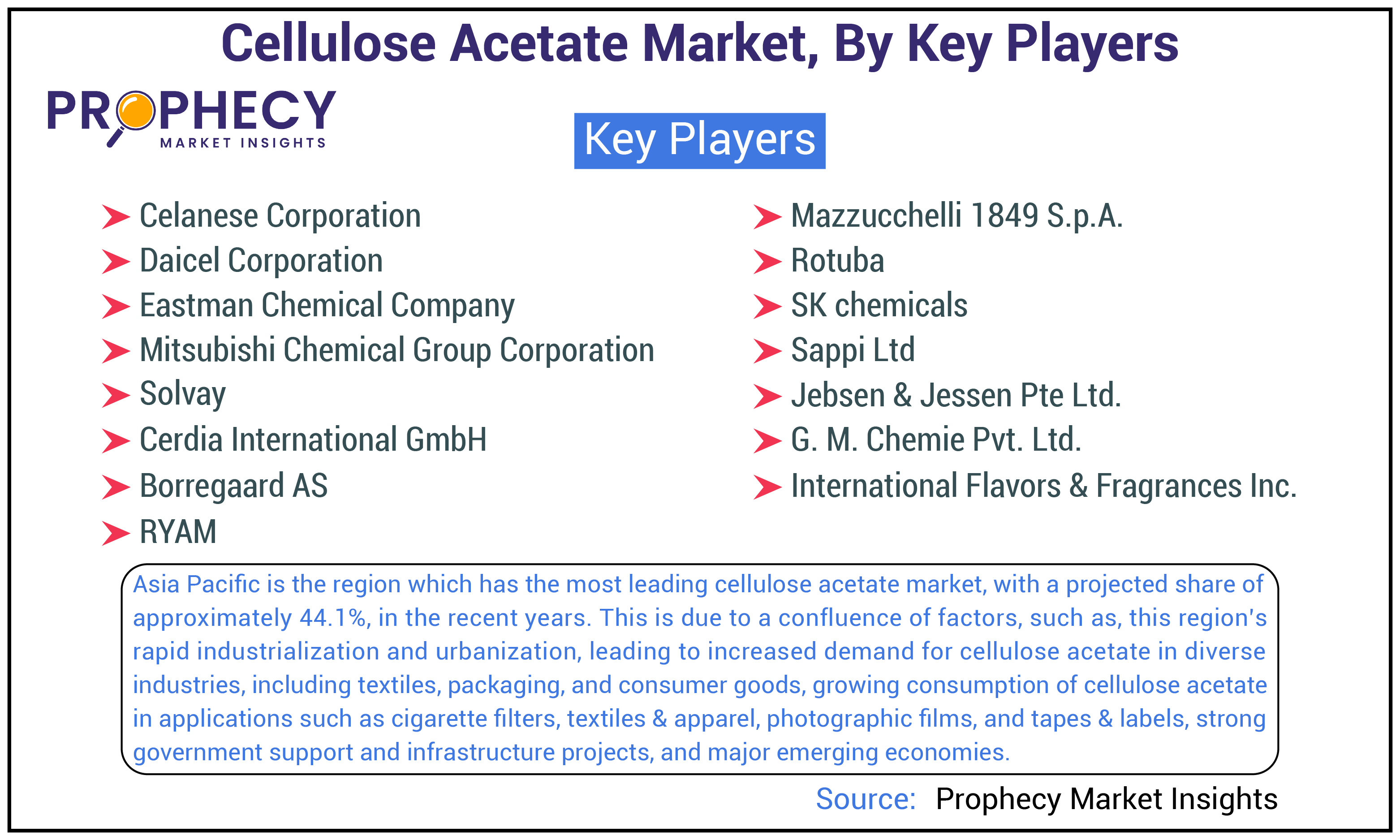
The key players operating in the market include, Celanese Corporation, Daicel Corporation, Eastman Chemical Company, and others. These key players are adopting strategies including new product development, expansion into new markets, partnerships, and mergers and acquisitions. These companies also focus on research and development, investing in innovative solutions and expanding its product portfolios. Additionally, companies are increasingly emphasizing sustainability and circular economy initiatives, aligning its product offerings with environmental concerns, for driving cellulose acetate market growth.
Cellulose Acetate Market Companies:
- Celanese Corporation
- Daicel Corporation
- Eastman Chemical Company
- Mitsubishi Chemical Group Corporation
- Solvay
- Cerdia International GmbH
- Borregaard AS
- RYAM
- Mazzucchelli 1849 S.p.A.
- Rotuba
- SK chemicals
- Sappi Ltd
- Jebsen & Jessen Pte Ltd.
- G. M. Chemie Pvt. Ltd.
- International Flavors & Fragrances Inc.
View an Additional List of Companies in the Cellulose Acetate Market
Cellulose Acetate Market Recent News
- In July 2024, Greenbutts and 22nd Century Group had teamed up to create a novel cigarette filter solution. Greenbutts provided a proprietary method that used water-soluble, completely biodegradable filters in lieu of single-use plastic ones. The solution offers the same smoking experience as existing filters and is plant-based, 100% biodegradable, and water-dispersing, differing from the plastic cellulose acetate. The technique aims to promote sustainable methods in the tobacco business and lessen the harm caused by nicotine.
- In April 2024, a lightweight, biodegradable tray that can be used with current commercial food packaging equipment has been introduced by Eastman and Sealed Air as a drop-in substitute for conventional polystyrene foam trays in protein packaging. The tray is now operating well in a number of commercial applications. Both residential and commercial settings are suitable for composting the tray. These new trays, which are mostly made of cellulose acetate generated from wood pulp, may be broken down by bacteria that are naturally present.
- In October 2020, Celanese Corporation, a global chemical and speciality materials company, demonstrated its dedication to sustainable product development and initiatives by introducing a novel cellulose-based material that is both bio-based and widely compostable, in line with ESG and circular economy goals. Celanese has announced the commercial availability of its BlueRidge Cellulosic Pellets, a sustainability-inspired product designed to serve as a substitute for traditional plastics, both opaque and transparent, in consumer applications that are challenging to recycle.
Analyst View:
The demand for cellulose acetate is rising across a number of industries, such as consumer goods, packaging, textiles and clothing, and environmental awareness. Additionally, the use of cellulose acetate in cigarette filters and the growing number of people smoking cigarettes are driving growth in the global cellulose acetate market. The market's growth is also being driven by continuous research and development in formulation and manufacturing techniques, which is producing better cellulose acetate products with better qualities, increasing its market use and cellulose acetate's adaptability and use in a variety of products, such as consumer goods and packaging.
More Related Reports
Nanocellulose Market
Cellulose Ester Market
Microcrystalline Cellulose Market
Food Fiber Market
Fibre Optics Market
Cellulose Acetate Market Company Profile
|
Company Name |
Celanese Corporation |
|
Headquarter |
Irving, Texas, United States |
|
CEO |
Mr. Scott Richardson |
|
Employee Count (2024) |
12,200 Employees |
Cellulose Acetate Market Highlights
FAQs
Cellulose acetate market size was valued at USD 7.0 Billion in 2025 and is expected to reach USD 10.2 Billion by 2035 growing at a CAGR of 4.3%.
Product type, application, and region are the segmentation for the target market.
North America, Asia Pacific, Europe, Latin America, and the Middle East & Africa. Asia Pacific is expected to dominate the market.
The key players operating in the cellulose acetate market include Celanese Corporation, Daicel Corporation, Eastman Chemical Company, Mazzucchelli 1849 S.p.A., Mitsubishi Chemical Group Corporation, Solvay, Cerdia International GmbH, Borregaard AS, RYAM, Rotuba, SK chemicals, Sappi Ltd, Jebsen & Jessen Pte Ltd., G. M. Chemie Pvt. Ltd., and International Flavors & Fragrances Inc.