Global Plastic Waste Management Market Overview
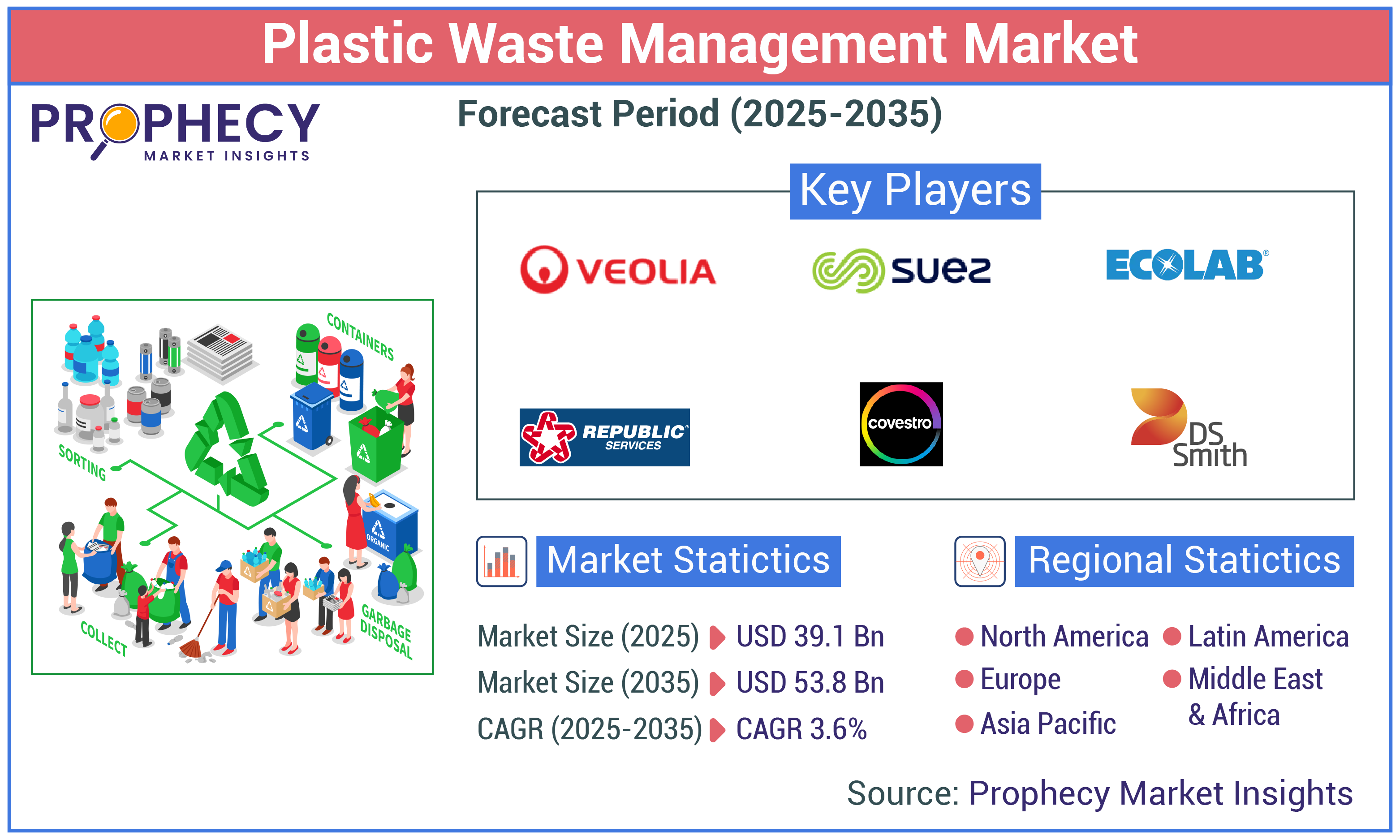
- Plastic waste management market size is expected to expand at a rate of USD 53.8 Billion, by 2035.
- In 2024, the market valuation was USD 38.0 Billion.
- Plastic waste management market is growing at a CAGR of 3.6%.
Plastic waste management refers to the systematic handling of discarded plastic materials, encompassing collection, processing, recycling, and ultimate disposal. It's a crucial aspect of environmental protection, aiming to minimize the negative impacts of plastic pollution on air, water, and land. This includes strategies including recycling, reuse, and developing alternatives to reduce plastic usage. It reduces pollution, conserves resource, saves landfill space, and can even generate economic benefits through recycling and job creation. By managing plastic waste effectively, we can minimize its impact on the environment, promote a circular economy, and create more sustainable practices.
The growth of the plastic waste management market is driven by a confluence of factors, including escalating plastic waste crisis, coupled with rising consumption and inadequate waste management infrastructure, growing environmental awareness among governments, companies, and end-users, rapid urbanization and industrialization, and stringent regulations aimed at curbing single-use plastics, promoting recycling, and reducing landfilling of plastic waste are driving demand for waste management services and recycling technologies.
The market’s expansion is also pitched by technological advancements in plastic waste management, such as AI-enabled sorting machines, innovations in recycling technologies and materials are enabling the creation of new products from recycled plastics, and development of new and improved waste management infrastructure and technologies is essential for meeting the growing demand for sustainable waste management solutions.
Recession Risk and Tariff Analysis:
- There are serious threats to the market for plastic waste management during a recession. Consumer spending may decline during economic downturns, which would lower the market for recycled plastics. Virgin plastics are less expensive due to lower oil costs, which reduces the economics of recycling. Problems are made worse by expensive infrastructure and insufficient waste management systems, particularly in developing nations. Notwithstanding these obstacles, the market is anticipated to expand due to technical breakthroughs and environmental initiatives.
- In the plastic waste management market, tariff research evaluates import-export taxes on raw materials, recycling equipment, and plastic trash. While lower tariffs promote global commerce and investment, higher tariffs may make it more difficult to obtain technologies. Globally, strategic tariff policies may encourage sustainable plastic waste management techniques and assist regional recycling sectors.
Impact of Generative AI on Plastic Waste Management Market:
- Through the optimization of recycling procedures, increased accuracy in trash sorting, and the ability to perform predictive maintenance on recycling equipment, generative AI is revolutionizing the market for plastic waste management. It facilitates the creation of sustainable products by simulating plastic lifecycle scenarios and designing environmentally appropriate packaging.
- Supply chain efficiency and waste reduction strategy decision-making are improved by AI-driven insights. Additionally, it facilitates data analysis and automated reporting to assist regulatory compliance. In general, generative AI speeds up sustainability and innovation in the way that governments and companies handle plastic waste.
Global Plastic Waste Management Market Drivers & Restraints
Key Drivers:
Rising Urbanization is Fostering the Market Expansion
The plastic waste management market is expanding due to rising urbanization, which increases the use of plastic in crowded places. Growing cities need effective garbage collection, segregation, and recycling systems as it produces more plastic waste from homes, businesses, and industries. Urban areas also draw investments in cutting-edge technology and infrastructure for garbage management. Urban governments also impose more stringent environmental laws, which promote sustainable behaviors. Innovation and industry growth are driven by the increasing need for efficient solutions to plastic waste.
- For instance, according to the data published by World Bank Group, in order to fulfill the World Bank's purpose of eradicating poverty and promoting shared prosperity on a habitable world, more livable cities must be built. Currently, 4.4 billion people, or more than half of the world's population, reside in urban areas. This trend is predicted to continue, with nearly seven out of ten people living in cities by 2050, when the urban population is predicted to more than quadruple.
Restraints:
The Inconsistent and Inefficient Segregation of Plastic Waste is Limiting the Market Expansion
The uneven and ineffective separation of plastic trash at the source is a significant drawback of the plastic waste management industry. Mixed waste streams increase landfill usage, complicate recycling procedures, and lower the quality of recyclable items. Public ignorance, a lack of standardized labelling, and a lack of infrastructure for independent collecting all contribute to this difficulty. Therefore, even recyclable plastics frequently wind up in landfills or incinerated, which undermines sustainability initiatives and lowers the overall efficacy of waste management systems.
- Counterbalance Statements: Source-level sorting can be improved by enforcing obligatory segregation legislation, putting standardized labelling on plastic items, and raising public awareness through education programs. Furthermore, making color-coded bins more widely available and providing incentives for appropriate disposal methods can simplify recycling processes, boosting productivity and lowering contamination in the process of managing plastic trash.
Opportunities & Trends:
Integrating Artificial Intelligence with Plastic Waste Management is Opening Up Growth Opportunities in the Future Generations
Growth in the plastic waste management market is fueled by the use of artificial intelligence (AI), which improves sorting accuracy, automates recycling procedures, and lowers human error. By effectively identifying and separating various plastic kinds, AI-powered sensors and robots improve material quality and recycling rates. By optimizing equipment maintenance and garbage collection routes, predictive analytics raises operational efficiency. AI also facilitates data-driven policymaking and environmental monitoring. These developments draw capital, encourage creativity, and propel the growth of efficient, technologically advanced plastic waste management systems on a worldwide scale.
- For instance, according to the data published by Elsevier, Artificial Intelligence (AI) has immense promise for advancing sustainable recycling and management of plastic waste. AI has improved the accuracy of plastic type sorting and identification, thereby lowered contamination rates and increased processing efficiency. By precisely anticipating and managing reaction conditions that optimize product output and quality, these algorithms not only enhance thermochemical conversion techniques but also optimize the identification process using advanced optical sensors and infrared spectroscopy. AI aids in the creation of bioconversion techniques that maximize the activity of certain enzymes and microbial processes involved in the breakdown of plastic.
Global Plastic Waste Management Market Segmentations & Regional Insights
The plastic waste management market is segmented into service, material, source, end-use industry, and region.
By Service
Dependent on service, the market is divided into collection, recycling, incineration, and disposal. The disposal segment is holding the superior position in the plastic waste management market share. This is due to the fact that landfills are often the most readily available and affordable option for waste disposal, especially in areas with limited recycling or incineration infrastructure.
The incineration segment is the second superior service, in the target market. This is due to the fact that landfills and incinerators are the primary methods for dealing with plastic waste when recycling or other advanced treatment methods are unavailable or less efficient.
By Material:
According to material, the market is categorized into polyethylene, polypropylene, polyethylene terephthalate, polystyrene and others. The Polyethylene segment is dominating the plastic waste management market share. This is due to its widespread usage in various applications such as packaging, construction, and electronics. Polyethylene is also the most widely produced and consumed polymer globally, with high-density polyethylene (HDPE), low-density polyethylene (LDPE), and linear low-density polyethylene (LLDPE) accounting for a significant portion of the market.
The Polypropylene segment is the second dominating material, in the target market. This is due to its widespread use across various industries and its cost-effectiveness, leading to a high volume of waste requiring management.
By Source:
On the foundation of source, the market is bifurcated into industrial waste and municipal waste. The municipal waste segment is expected to rule over the plastic waste management market size. This is due to the higher volume of plastic generated by manufacturing and industrial processes, and stringent environmental regulations requiring proper waste disposal.
The industrial waste segment is the second largest source, in the target market. This is due to the significant amount of plastic waste generated by manufacturing and industrial processes. The rapid growth of industries, particularly in developing economies, drives increased plastic consumption and subsequent waste.
By End-Use Industry:
Contingent to end-use industry, the market is pigeonholed into packaging, building & construction, and others. The packaging segment is the governing end-use industry in the plastic waste management market share. This is due to the high volume of plastic used in packaging materials, which generates a significant amount of waste requiring management and recycling.
The building & construction segment is the fastest growing end-use industry, in the target market. This is due to the generation of significant amount of plastic waste from the use of plastic materials in construction applications, such as roofing, insulation, and pipes.
Regional Insights:
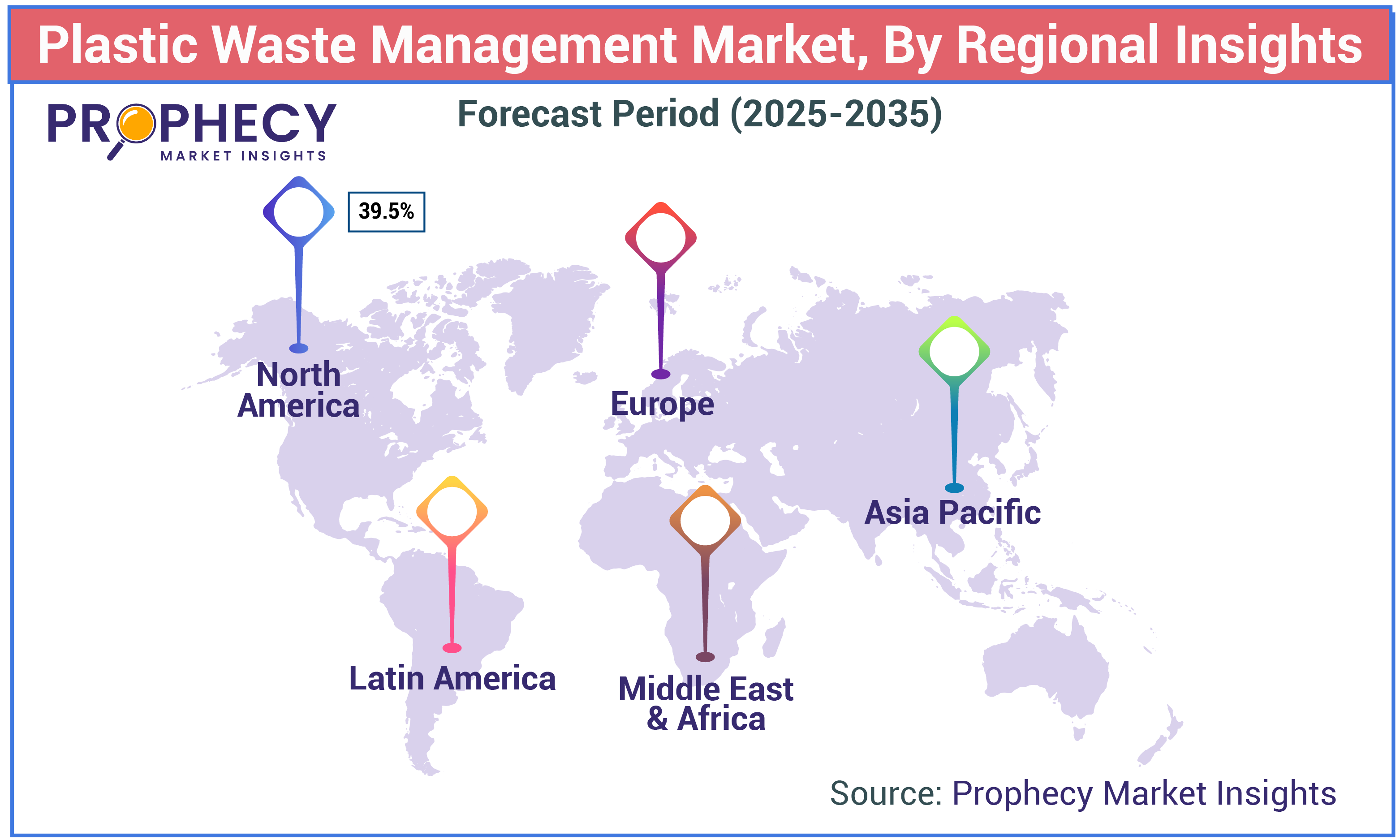
Geographically, the market is analyzed across North America, Europe, Asia Pacific, Latin America, and the Middle East & Africa.
North America: This is the region which has the biggest plastic waste management market share, by approximately, 39.5%, in the recent years. This is due to a combination of factors, such as, this region’s well-developed solid waste management infrastructure, stringent government regulations and policies, including bans, recycling mandates, and extended producer responsibility programs, increased public awareness and concerns about plastic pollution are influencing consumer behavior, ongoing advancements in waste management technologies, increasing focus on circular economy, and the presence of key market players in this region.
- U.S. Plastic Waste Management Market Insights:
The plastic waste management market in the U.S. is the most influential market, in the recent years. This is due to this country’s large population, a well-developed waste management infrastructure, with numerous companies involved in solid waste management, government regulations and initiatives aimed at reducing plastic waste, promoting recycling, and encouraging waste management practices, extended producer responsibility programs, and favorable recycling initiatives, which encourage residents to recycle plastic waste.
Europe: This is the region which has the plastic waste management market, growing with the fastest growth rate, during the forecast period, in the recent years. This is due to a confluence of factors, such as, this region’s established regulations aimed at reducing plastic waste and promoting recycling, emphasis on a circular economy encourages better product design to facilitate reuse and recycling, high plastic waste generation, innovation in the plastic waste management sector, implementation of specific policies to minimize plastic waste and encourage sustainable practices, and increasing consumer awareness about plastic pollution.
- Germany Plastic Waste Management Market Insights:
The plastic waste management market in Germany is growing with the highest CAGR, during the forecast period, in the recent years. This is due to this country’s robust system for managing waste, a high municipal waste recycling rate, with approximately 69.2% of its waste recycled, making it a world leader in waste recycling efforts, government’s adoption of five-point plan to minimize plastic waste, increasing focus on circular economy, and increasing investments in technological advancements.
Asia Pacific: The region which has the plastic waste management market, growing significantly, in the recent years is Asia Pacific. This is due to several factors, such as, this region’s rapid urbanization and industrialization, implementation of regulations and policies to address plastic waste issues by government, increased public awareness about the environmental impact of plastic pollution, adoption of advanced technologies in recycling and waste management, increasing investment in infrastructure, and presence of key market players in this region.
- China Plastic Waste Management Market Insights:
The plastic waste management market in China is experiencing considerate amount of growth, in the recent years. This is due to this country’s large amount of waste generated annually, rapid growth of industries and cities in China, active persuasion of sustainability goals and has implemented regulations to manage plastic waste more effectively by the Chinese government, and the large amount of plastic waste generated and the government's focus on sustainable practices.
Plastic Waste Management Market Report Scope:
|
Attribute |
Details |
|
Market Size 2025 |
USD 39.1 Billion |
|
Projected Market Size 2035 |
USD 53.8 Billion |
|
CAGR Growth Rate |
3.6% (2025-2035) |
|
Base year for estimation |
2024 |
|
Forecast period |
2025 – 2035 |
|
Market representation |
Revenue in USD Billion & CAGR from 2025 to 2035 |
|
Regional scope |
North America - U.S. and Canada Europe – Germany, U.K., France, Russia, Italy, Spain, Netherlands, and Rest of Europe Asia Pacific – China, India, Japan, Australia, Indonesia, Malaysia, South Korea, and Rest of Asia-Pacific Latin America - Brazil, Mexico, Argentina, and Rest of Latin America Middle East & Africa – GCC, Israel, South Africa, and Rest of Middle East & Africa |
|
Report coverage |
Revenue forecast, company share, competitive landscape, growth factors, and trends |
Segmentation:
By Service:
- Collection
- Recycling
- Incineration
- Industrial
By Material:
- Polyethylene
- Polypropylene
- Polyethylene Terephthalate
- Polystyrene
- Others
By Source:
- Industrial Waste
- Municipal Waste
By End-Use Industry:
- Packaging
- Building & Construction
- Others
By Region:
- North America
- U.S.
- Canada
- Europe
- Germany
- U.K.
- France
- Russia
- Italy
- Spain
- Netherlands
- Rest of Europe
- Asia Pacific
- China
- India
- Japan
- Australia
- Indonesia
- Malaysia
- South Korea
- Rest of Asia Pacific
- Latin America
- Brazil
- Mexico
- Argentina
- Rest of Latin America
- Middle East & Africa
- GCC
- Israel
- South Africa
- Rest of Middle East & Africa
Global Plastic Waste Management Market Competitive Landscape & Key Players
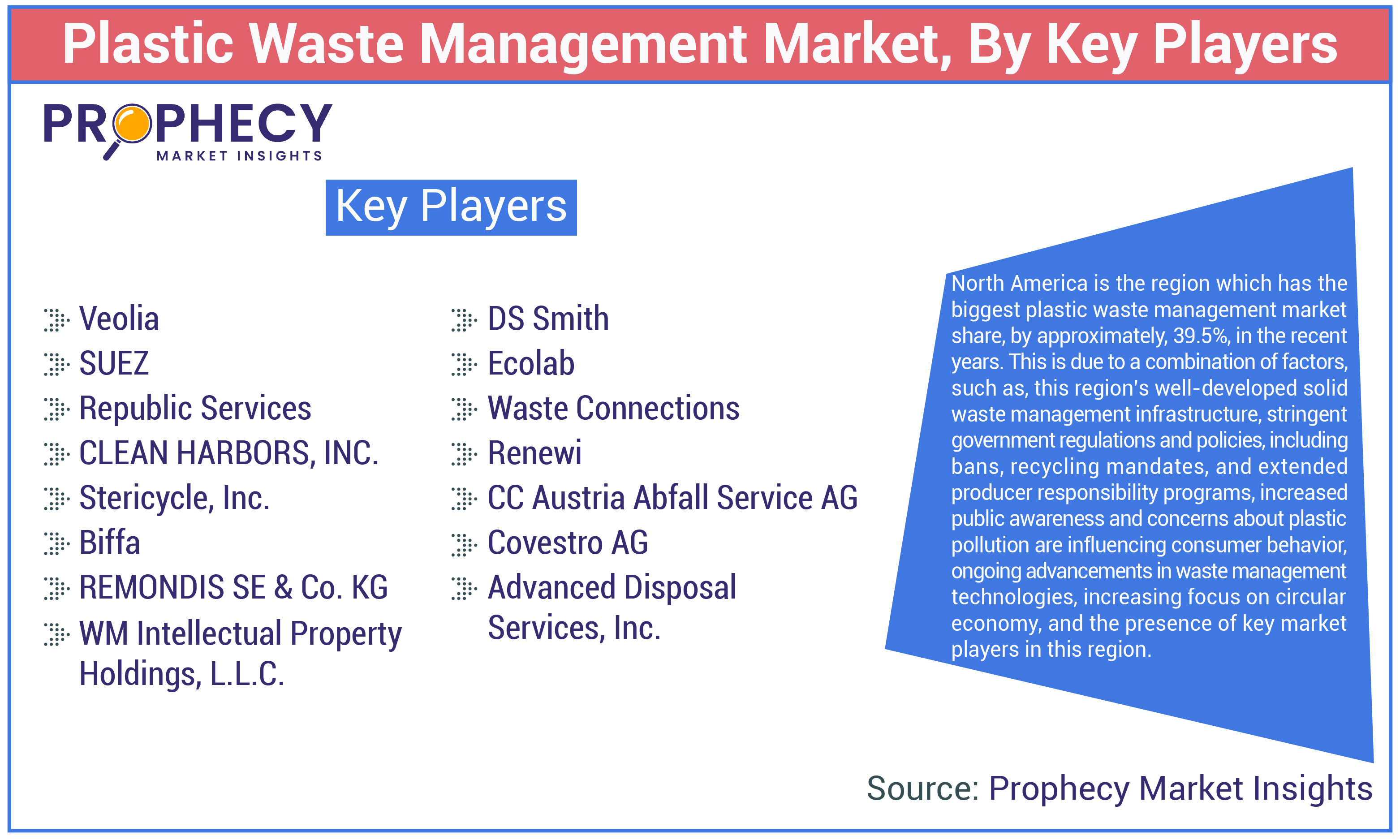
The key players operating in the market include, Veolia, SUEZ, WM Intellectual Property Holdings, L.L.C., and others. These key players are using a variety of strategies to drive growth, including innovation, partnerships, and digital solutions. These strategies aim to improve efficiency, reduce waste, and increase recycling rates, for driving plastic waste management market growth.
List of Key Players in the Market:
- Veolia
- SUEZ
- WM Intellectual Property Holdings, L.L.C.
- Republic Services
- CLEAN HARBORS, INC.
- Stericycle, Inc.
- Biffa
- REMONDIS SE & Co. KG
- DS Smith
- Ecolab
- Advanced Disposal Services, Inc.
- Waste Connections
- Renewi
- CC Austria Abfall Service AG
- Covestro AG
Global Plastic Waste Management Market Recent News
- In January 2025, The Chandigarh-based circular economy start-up PolyCycl announced the release of its patented technology, which turns difficult-to-recycle plastics into sustainable fuels, renewable chemicals, and food-grade polymers. Following ten years of research and development, the entirely indigenous Contiflow Cracker Generation VI chemical recycling pyrolysis technology aids in the management of trash from products such as single-use grocery bags and packaging contaminated with food.
- In July 2024, in partnership with Empower, a leading supplier of cutting-edge traceability solutions, MVW Lechtenberg Projektentwicklungs- und Beteiligungsgesellschaft GmbH, the premier consulting firm specializing in alternative fuels for the cement and related industries, is thrilled to announce the start of a game-changing plastic waste management project in the Kingdom of Saudi Arabia.
- In May 2024, Ulsan College (UC) and the Ulsan International Development Cooperation Centre (UIDCC), in collaboration with the United Nations Environment Programme's (UNEP) International Environmental Technology Centre, successfully organized a five-day capacity building program in Ulsan, Republic of Korea, as part of an ambitious effort to address the growing plastic waste crisis in the Asia Pacific region. The purpose of the May 6–10 event was to exchange cutting-edge methods, tools, and regulations to improve plastic waste management and advance the circular economy in developing nations.
- In March 2024, Saudi Arabia started a plastic waste management initiative that will process about 3 million tonnes of plastic garbage yearly to create refuse-derived fuels in order to meet its environmental sustainability goals, reduce pollution, and safeguard natural resources. Empower, a Norwegian solution provider, and MVW Lechtenberg and Partner, a German environmental consulting business, collaborated on the plastic waste management project. It was anticipated to cut annual carbon emissions by around 1,791,300 tonnes.
Analyst View:
The plastic waste management market is expanding due to a number of factors, such as the growing crisis of plastic waste, increased consumption, and insufficient waste management infrastructure; increased environmental consciousness among governments, businesses, and end users; rapid urbanization and industrialization; and strict laws intended to reduce the use of single-use plastics, encourage recycling, and lessen the amount of plastic waste that ends up in landfills. Technological developments in plastic waste management, such as AI-enabled sorting machines, are also driving the market's growth. New materials and technologies for recycling are making it possible to create new products from recycled plastics, and the development of new and improved waste management infrastructure and technologies is crucial to satisfying the rising demand for environmentally friendly waste management solutions.
More Related Reports
Plastic Components Market
Plastic Additives Market
Plastic Films and Sheet Market
Plastic Recycling Market
Engineering Plastics Market
Global Plastic Waste Management Market Company Profile
|
Company Name |
Veolia |
|
Headquarter |
Aubervilliers, France |
|
CEO |
Mrs. Estelle Brachlianoff |
|
Employee Count (2024) |
215,000 Employees |
Global Plastic Waste Management Market Highlights
FAQs
Plastic waste management market size was valued at USD 39.1 Billion in 2025 and is expected to reach USD 53.8 Billion by 2035 growing at a CAGR of 3.6%.
Service, material, source, end-use industry, and region are the segmentation for the target market.
North America, Asia Pacific, Europe, Latin America, and the Middle East & Africa. North America is expected to dominate the market.
The key players operating in the plastic waste management market include Veolia, SUEZ, WM Intellectual Property Holdings, L.L.C., DS Smith, Republic Services, CLEAN HARBORS, INC., Stericycle, Inc., Biffa, REMONDIS SE & Co. KG, Ecolab, Advanced Disposal Services, Inc., Waste Connections, Renewi, CC Austria Abfall Service AG, and Covestro AG.