Whole Exome Sequencing Market Overview
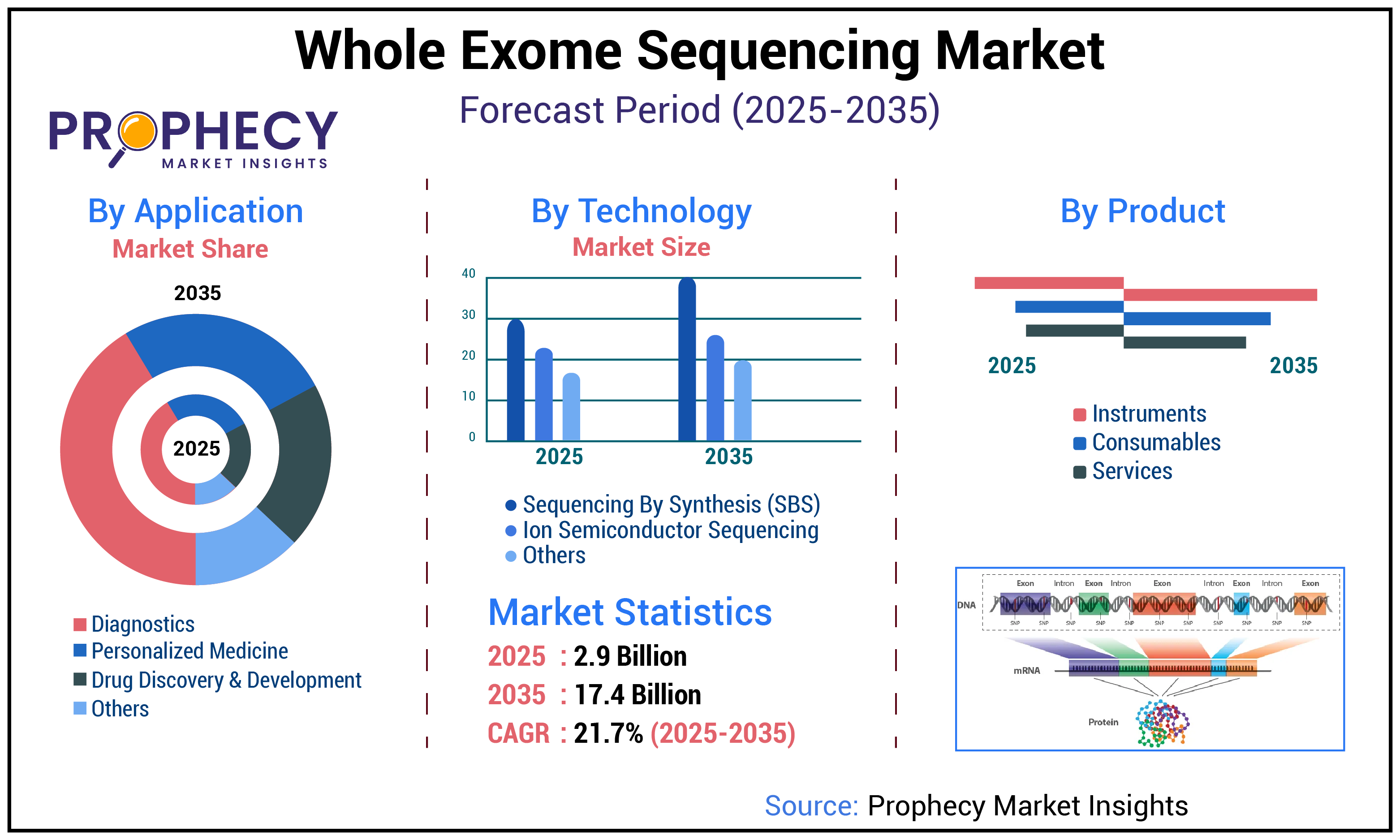
- 2024 Market Size: USD 2.5 Billion
- 2035 Projected Market Size: USD 21.21 Billion
- CAGR (2025-2035): 21.7%
- North America: Largest Market in 2024
Whole exome sequencing (WES) is a genome-wide selective sequencing method that targets all protein-encoding regions (exons) of the genome, accounting for roughly 1–2% of the human genome but holding around 85% of the mutation-causing diseases. WES allows to efficiently and cheaply discover the genetic variants which are the cause of the hereditary disorders, the oncological diseases, and the others. The positive side of it is that it provides a very accurate diagnosis, delivers results quicker than whole-genome sequencing, simplifies the data, and offers valuable contributions to personalized medicine, drug development, and targeted therapies.
One of the principal reasons for the exponential growth of the whole exome sequencing market is the rising demand for accurate and cost-effective genetic testing. Furthermore, the rise in genetics disorders and cancer, the progression of the next-generation sequencing technology, have greatly facilitated the expansion of this market. Besides, personalized medicine being one of the main factors for the tailored medication, wide genomics research, and favorable government policies and funding for genomic studies are some of the rationale for the widespread market adoption in various geographical regions of healthcare, pharma and research sectors.
Clinical Criteria of Whole Exome Sequencing:
- Whole Exome Sequencing (WES) clinical criteria focus on identifying patients with a high probability of disease caused by mutations in exonic regions.
- Usually WES is utilized to solve mysteries of rare or complicated genetic diseases in children or adults, cases of strongly suspected inherited diseases, developmental delays, congenital anomalies, or 'gene panel' negative cancers.
- Besides, if family history information hints at a hereditary condition, or genetic data are required for treatment optimization, prognosis, or reproductive planning, WES may be a suitable option.
Current Industry Dynamics & Insights:
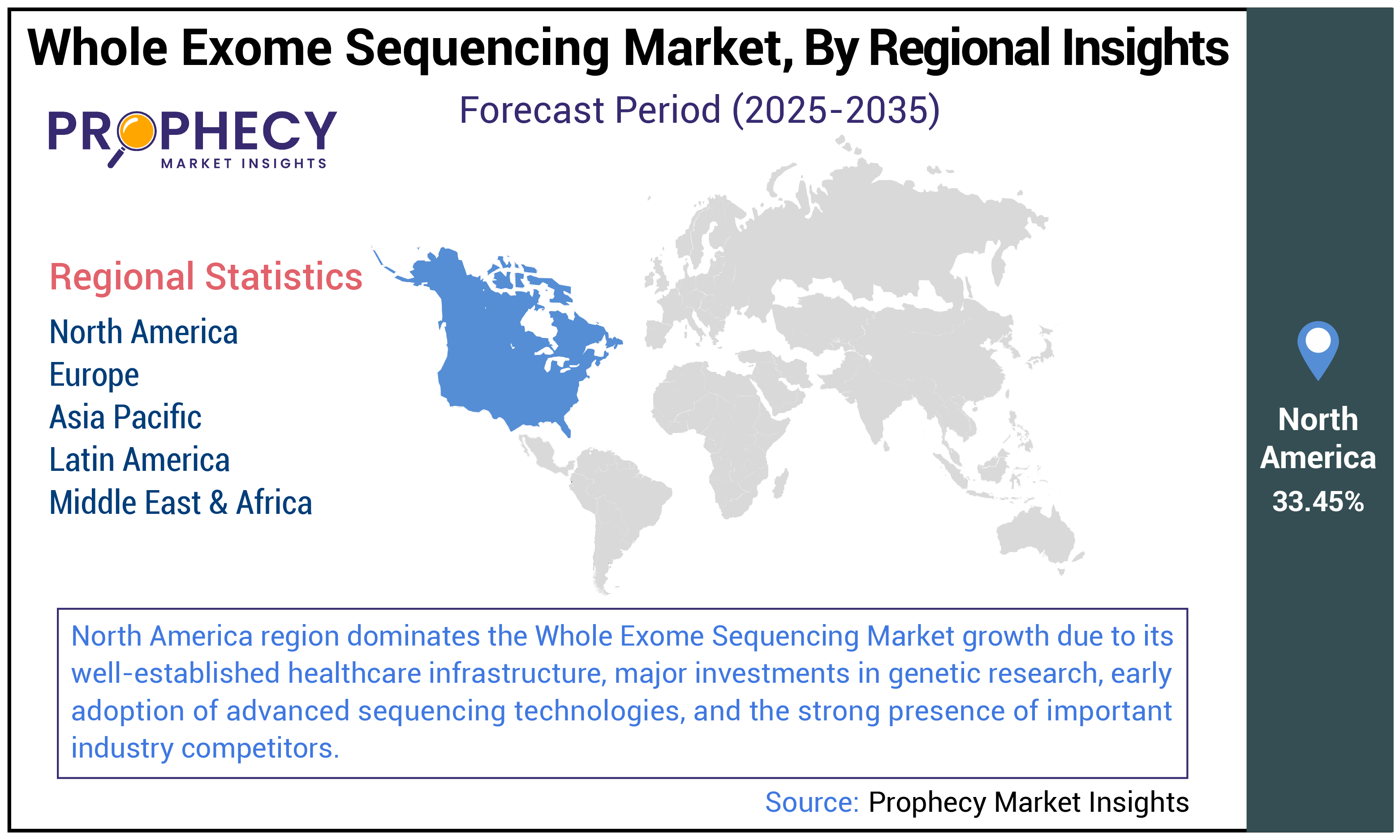
- North America has the largest regional share in the market, with almost 33.45%.
- Europe is second dominating region in the market.
- By product type, instruments dominates the whole exome sequencing market growth.
Whole Exome Sequencing Market Drivers & Restraints
Drivers and Restraints:
|
Drivers |
Restraints |
Opportunities & Trends |
|
|
|
Key Drivers:
Rising Prevalence of Genetic Disorders and Cancers
One of the main reasons for the rising demand for the Whole Exome Sequencing market is the increasing occurrence of genetic disorders and cancer that require early and accurate genetic diagnoses. WES can find novel mutations to a disease, which is the basis for personalized medicine, the patient's early cure, and targeted therapies. As the patient population needing exact genomic solution for the right handling of diseases grows, healthcare providers and research institutions are committing WES more and more, thus driving the market growth all over the world.
- For Instance, according to data published by Genehome, There are an estimated 10,000 different types of single-gene diseases (also called monogenic diseases), which are diseases caused by mutations in a single gene. The World Health Organization estimates that 10 out of every 1000 people are affected. This means that between 70 million and 80 million people in the world are living with one of these diseases.
Restraints:
Complex Data Interpretation
One major limitation that controls the expansion of the Whole Exon Sequencing market is the prohibitive nature of data interpretation. WES produces enormous data, hence only organizations equipped with the requisite bioinformatics skills can effectively process such data. As a result, numerous hospital laboratories find it quite difficult to use the data, thus the slower turnaround time. Such a situation can discourage the uptake of technology, particularly in under-resourced areas.
- Counterbalance Statements: The deployment of sophisticated AI-empowered bioinformatics resources and the use of automated platforms for data analysis which accelerate variant interpretation, increase correctness, and lower the reliance on highly skilled professionals, are a viable measure for alleviating this constraint and hence enabling a broader market penetration.
Opportunities & Trends:
Shift toward Clinical Adoption
It is evident that the change toward clinical acceptance is a prominent next trend that is setting the path of the Whole Exome Sequencing market in the future. The main reason lies with the fact that WES is being more and more used by clinicians as a standard diagnostic tool for rare genetic disorders, cancers, and personalized medicine.
WES is gaining ground as a standard hospital and diagnostic laboratory instrument as it moves from research applications to these settings, powered by the evolution of clinical guidelines and the improvement of reimbursement policies. This move will likely widen patient access, hence the increase in demand for sequencing services, using the market will grow faster and become more widespread globally.
Whole Exome Sequencing Market Segmentations & Regional Insights
Product type, technology, application, end user, and region are the divisions of the whole exome sequencing market.
By Product Type:
Instruments, consumables, and services are product type on which Whole Exome Sequencing Market is segmented. The Instruments segment dominates the whole exome sequencing market share since sequencing platforms and library preparation devices are required for WES, and ongoing technological advancements have increased their efficiency, throughput, and adoption in research and clinical laboratories.
The consumables market is the second-largest, driven by the recurring need for exome capture kits, reagents, and sequencing chips needed for each sequencing run, providing manufacturers with a continuous income stream.
By Technology:
Based on the technology, the whole exome sequencing market is divided into sequencing by synthesis (SBS), ion semiconductor sequencing, and others. Sequencing by Synthesis (SBS) dominates the whole exome sequencing market share due to its high accuracy, repeatability, and throughput, making it the favored choice for clinical and scientific applications globally.
Ion Semiconductor Sequencing is the second most popular technology due to its faster run times and cheaper upfront instrument costs, making it appealing for focused applications and smaller laboratories; nevertheless, it is less generally used than SBS for large-scale sequencing projects.
By Application:
The whole exome sequencing market, on the account of application can categorized into diagnostics, drug discovery & development, personalized medicine, and others. Diagnostics dominates the whole exome sequencing market size given that it is widely utilized to identify genetic abnormalities causing uncommon diseases, developmental problems, and malignancies, allowing for accurate diagnosis and early management.
Personalized Medicine is the second-most popular application due to WES helps personalize treatment approaches based on individual genetic profiles, resulting in targeted therapy and better patient results, however its popularity is still expanding in comparison to traditional diagnostic use.
By End User:
Academic & research institutes, hospitals & clinics, pharmaceutical & biotechnology companies, and others are end users of the whole exome sequencing market. Academic and research institutes dominate the whole exome sequencing market share due to their significant usage of WES for genetic research, disease mutation detection, and innovative treatment development.
Hospitals and clinics are the second-largest end users, as they increasingly use WES for clinical diagnostics, particularly in oncology and rare genetic disorders, despite having a slightly lower market share than research-focused institutions due to the higher costs and infrastructure requirements for clinical Data Analysis & Interpretation.
Regional Insights:
Geographically, the whole exome sequencing market is studied across North America, Europe, Asia Pacific, Latin America, and the Middle East & Africa.
North America: This region dominates the whole exome sequencing market growth due to its well-established healthcare infrastructure, major investments in genetic research, early adoption of advanced sequencing technologies, and the strong presence of important industry competitors.
- U.S. Whole Exome Sequencing Market Insights:
North America's whole exome sequencing market is dominated by the U.S. due to its advanced healthcare infrastructure, significant genomics R&D investments, and the presence of major sequencing technology companies.
Europe: This is the second-largest region, supported by supporting government initiatives, increased research funding, and rising clinical usage of WES for diagnostics and customized treatment, while market growth is significantly slower than in North America.
- Germany Whole Exome Sequencing Market Insights:
Germany leads the European market, owing to significant government support for genetic research, well-established healthcare and diagnostic facilities, and expanding WES usage in clinical and personalized medicine applications.
Asia Pacific: The whole exome sequencing (WES) market in APAC is expanding as a result of increased investments in healthcare infrastructure, increased awareness of genetic illnesses, expanded research activities, and a greater emphasis on customized medicine.
- China Whole Exome Sequencing Market Insights:
China is the region's dominant country, driven by large-scale genomic research efforts, government backing for biotechnology, rising healthcare spending, and the presence of modern sequencing facilities, making it a crucial hub for WES adoption in Asia-Pacific.
Whole Exome Sequencing Market Report Scope:
|
Attribute |
Details |
|
Market Size 2025 |
USD 2.98 Billion |
|
Projected Market Size 2035 |
USD 21.21 Billion |
|
CAGR Growth Rate |
21.7% (2025-2035) |
|
Base year for estimation |
2024 |
|
Forecast period |
2025 – 2035 |
|
Market representation |
Revenue in USD Billion & CAGR from 2025 to 2035 |
|
Regional scope |
North America - U.S. and Canada Europe – Germany, U.K., France, Russia, Italy, Spain, Netherlands, and Rest of Europe Asia Pacific – China, India, Japan, Australia, Indonesia, Malaysia, South Korea, and Rest of Asia-Pacific Latin America - Brazil, Mexico, Argentina, and Rest of Latin America Middle East & Africa – GCC, Israel, South Africa, and Rest of Middle East & Africa |
|
Company Landscape |
Market Share Analysis of Companies Heat Map Analysis Company Overview, Products Overview Financial Information, Key Highlights Business Strategies Overview SWOT Analysis |
|
Report coverage |
Revenue forecast, company share, competitive landscape, growth factors, and trends |
|
Value Added Data Infosets |
Besides fundamental market insights such as the size of the market, growth rate, segmentation, regional study, and key players, our reports carry value-added data sets such as trade flow (import-export) analysis, production and consumption overview, price trend evaluation, supply and value chain mapping, and raw material availability. Moreover, we provide strategic tools as PESTLE and Porter’s Five Forces analysis, examination of the regulatory landscape, as well as monitoring of technology and innovation thereby providing a comprehensive overview which facilitates sensible and anticipatory decision-making. |
Segmentation:
By Product Type:
- Instruments
- Sequencers
- Library Preparation Instruments
- Others
- Consumables
- Exome Capture Kits
- Reagents & Enzymes
- Others
- Services
- Data Analysis & Interpretation
- Consulting Services
- Others
By Technology:
- Sequencing by Synthesis (SBS)
- Ion Semiconductor Sequencing
- Others
By Application:
- Diagnostics
- Drug Discovery & Development
- Personalized Medicine
- Others
By End User:
- Academic & Research Institutes
- Hospitals & Clinics
- Pharmaceutical & Biotechnology Companies
- Others
By Region:
- North America
- U.S.
- Canada
- Europe
- Germany
- U.K.
- France
- Russia
- Italy
- Spain
- Netherlands
- Rest of Europe
- Asia Pacific
- China
- India
- Japan
- Australia
- Indonesia
- Malaysia
- South Korea
- Rest of Asia Pacific
- Latin America
- Brazil
- Mexico
- Argentina
- Rest of Latin America
- Middle East & Africa
- GCC
- Israel
- South Africa
- Rest of Middle East & Africa
Whole Exome Sequencing Market Competitive Landscape & Key Players
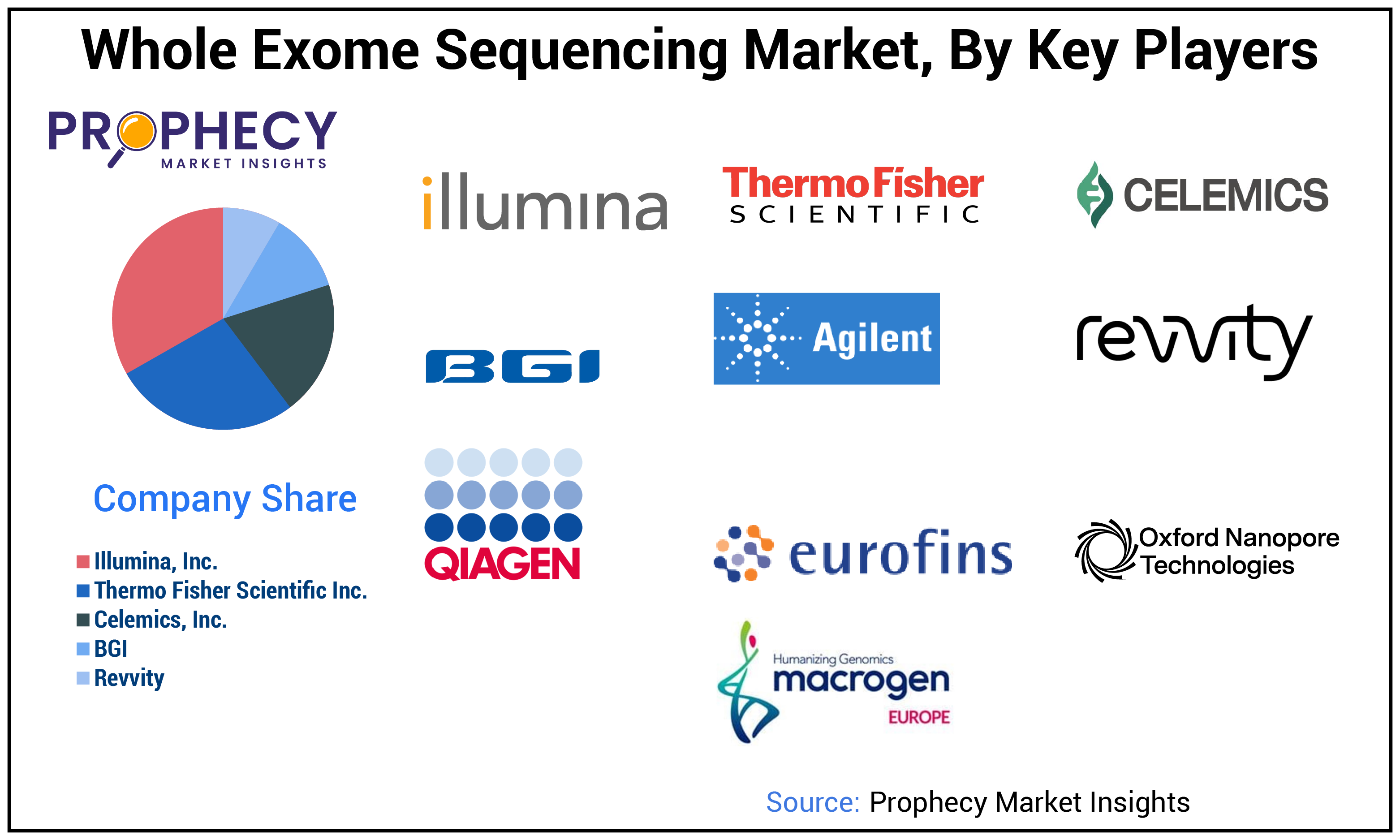
The key players operating in the whole exome sequencing market include, Thermo Fisher Scientific Inc., Oxford Nanopore Technologies plc., BGI, and others. Key growth strategies for Whole Exome Sequencing (WES) companies include investing in advanced sequencing technologies, expanding clinical and research service offerings, forming strategic partnerships with hospitals and research institutes, improving bioinformatics capabilities, and entering emerging markets to increase WES solutions' global accessibility and adoption.
Whole Exome Sequencing Market Companies:
- Illumina, Inc.
- Thermo Fisher Scientific Inc.
- Celemics, Inc.
- BGI
- Revvity
- Agilent Technologies, Inc.
- Oxford Nanopore Technologies plc.
- Macrogen Europe BV
- Fulgent Genetics
- CeGaT GmbH
- Congenica Ltd
- QIAGEN
- Eurofins Genomics
- GeneDx?, LLC
- Novogene Co., Ltd.
View an Additional List of Companies in the Whole Exome Sequencing Market
Whole Exome Sequencing Market Recent News
- In May 2024, Baylor Genetics, a clinical diagnostic laboratory at the forefront of genetic testing, has announced the release of RNAseq, a novel RNA sequencing test for Whole Exome and Whole Genome Sequencing (WE/WGS). The company also decreased the typical turnaround time for WES and WGS to three weeks and continues to offer quick testing with written reports in as little as five days.
Analyst View:
Whole Exome Sequencing (WES) is a low-cost genomic approach that targets all protein-coding areas to detect disease-causing genetic variations, resulting in more accurate diagnoses, faster results, and support for personalized treatment and drug discovery. The WES industry is quickly expanding as a result of rising demand for precise genetic testing, rising rates of genetic diseases and cancer, advances in next-generation sequencing, expanded genomics research, and supporting government policies and financing.
Analysis of Sources:
Primary Sources:
- In-depth interviews
- Company-specific data
- Surveys and questionnaires
- Focus group discussions (FGDs)
- Others
Secondary Sources:
- National Institutes of Health (NIH)
- National Center for Biotechnology Information (NCBI)
- Centers for Disease Control and Prevention (CDC)
- European Medicines Agency (EMA)
- Others
More Related Reports
Next-Generation Sequencing Informatics Market
Whole Slide Imaging Market
Single-Cell Genome Sequencing Market
Microbiome Sequencing Services Market
Sequencing Reagent Market
Whole Exome Sequencing Market Company Profile
|
Company Name |
Product Portfolio |
|
Thermo Fisher Scientific Inc. |
Whole Exome Sequencing with Next-Generation Sequencing |
|
Illumina, Inc. |
Whole-exome Sequencing |
|
Revvity. |
Whole Genome Sequencing Kit |
|
BGI |
Whole Exome Sequencing |
|
QIAGEN |
Whole Exome Sequencing |
Whole Exome Sequencing Market Highlights
FAQs
Whole exome sequencing market size was valued at USD 2.98 Billion in 2025 and is expected to reach USD 21.21 Billion by 2035 growing at a CAGR of 21.7%.
Product type, technology, application, end user, and region are the segmentation for the whole exome sequencing market.
Increasing prevalence of genetic disorders, advancements in sequencing technologies, and the growing demand for personalized medicine, and so on are some of the whole exome sequencing market growth drivers.
North America, Asia Pacific, Europe, Latin America, and the Middle East & Africa. North America is expected to dominate the whole exome sequencing Market.
The key players operating the whole exome sequencing market include Illumina, Inc., Thermo Fisher Scientific Inc., Celemics, Inc., BGI, Revvity, Agilent Technologies, Inc., Oxford Nanopore Technologies plc., Macrogen Europe BV, SilexPro, CeGaT GmbH, Congenica Ltd, QIAGEN, Eurofins Genomics, GeneDx?, LLC, and Novogene Co., Ltd.