Us Blue Ammonia Market Overview
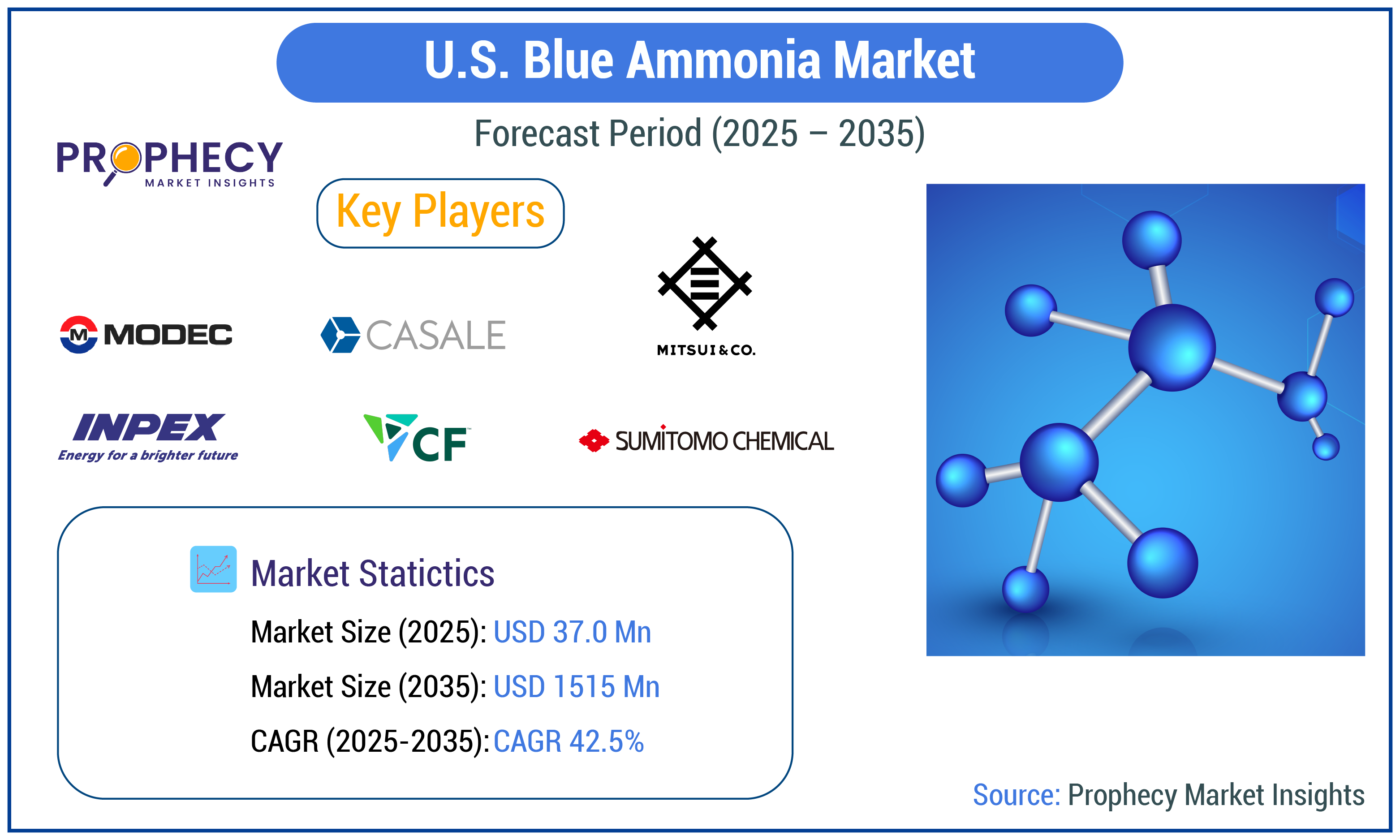
- By 2035, the U.S. blue ammonia market size is contemplated to enlarge at a valuation of USD 1232 Million.
- In 2025, the U.S. blue ammonia market valuation was USD 37.0 Million.
- U.S. blue ammonia market is developing at a CAGR of 42.68%.
When blue ammonia (NH?) is created, it comes from hydrogen that's sourced from natural gas, and during this process, carbon dioxide emissions are captured and stored thanks to carbon capture and storage (CCS) technology. This makes blue ammonia a low-carbon alternative to traditional ammonia. Its main advantages include reduced greenhouse gas emissions, serving as a clean fuel for generating electricity, and the ability to transport hydrogen safely for various energy and industrial uses, especially as we move towards a cleaner energy future.
U.S. blue ammonia market is booming, driven by a growing appetite for low-carbon energy solutions, advancements in carbon capture and storage (CCS) technology, and strong government support for decarbonization initiatives. Blue ammonia leverages existing ammonia production and transportation infrastructure, making it a practical option for reducing greenhouse gas emissions. Its role as a hydrogen carrier makes it particularly attractive for clean fuel uses in power generation and marine shipping. Additionally, global partnerships in clean energy trade and an increasing interest in hydrogen economies around the world are accelerating investment and growth in the U.S. blue ammonia market.
Government incentives such as the IRA's 45Q tax credits and technological breakthroughs in carbon capture and reformation systems will lead to a promising future for the U.S. blue ammonia market through large-scale low-carbon investments. The industry will thrive due to current gas infrastructure together with global interest in clean hydrogen transport while the United States seeks to become a main exporter to Japan and other markets. The coming decade will witness increased production capacity and enhanced hydrogen value chain connectivity and expanded usage across industrial, shipping and power sectors.
Recession Risk and Tariff Analysis:
- U.S. blue ammonia market could experience difficulties due to rising economic threats along with trade pressures. Project costs will increase while implementation will become more difficult due to higher import taxes which specifically affect carbon capture systems.
- The economic impact of trade tensions together with tariff-related inflation could lessen domestic demand and investment in blue ammonia while potentially causing slower economic advancement and possible mild recession during late 2025. The consequences will be reduced because of strong government incentives which include 45Q and 45V tax credits that lower production expenses while sustaining interest toward low-carbon hydrogen and ammonia projects.
Impact of Generative AI on U.S. Blue Ammonia Market:
- Through AI-based workflows which minimize R&D duration while enhancing ammonia synthesis outcomes generative AI drives innovation potential for U.S. blue ammonia market.
- The GenAI solutions enhance operational performance along the hydrogen-to-amia chain by predicting maintenance needs and optimizing carbon capture technologies and streamlining decisions through massive data analysis leading to reduced costs and enhanced system reliability.
Us Blue Ammonia Market Drivers & Restraints
Key Drivers:
Growing Need for Low-Carbon Energy Alternatives to Fuel Market Expansion
Businesses and governments pursuing decarbonization targets use cleaner fuels which drives expanding demand for low-carbon energy options in the U.S. The production process of blue ammonia utilizes natural gas with carbon capture and storage (CCS) to generate a lower-emission alternative that replaces conventional ammonia and fossil fuels in hydrogen transportation and power generation and shipping systems. Blue ammonia serves as an operational and scalable low-carbon energy choice as it operates with current infrastructure which enables faster implementation. The worldwide net-zero targets together with regulatory restrictions create an immediate need to transition toward sustainable energy alternatives.
- For Instance, according to the data published by Center for Strategic & International Studies, Over the past two decades, the United States has led the world in reducing greenhouse gas emissions as markets have shifted toward lower-carbon power generation and innovation has reduced the cost of new technologies. This progress is reflected in the 21% decline in net emissions in the United States from 2005 to 2020.
Restrains:
Green Ammonia Competition will slow down Market Development
U.S. blue ammonia market encounters strong market rivalry because green ammonia production uses electrolysis and renewable power sources to create an entirely carbon-neutral replacement which better satisfies future sustainability goals and net-zero targets. The falling costs of renewable energy together with advancements in green hydrogen technology make green ammonia increasingly attractive to investors as well as governmental entities.
- Counterbalance Statements: The practical solution emerges from using blue ammonia as a stepping stone fuel as it reduces emissions when compared with grey ammonia and allows rapid deployment through current infrastructure systems. The U.S. can maintain immediate feasibility and long-term climate targets through a phased decarbonization approach that combines blue and green ammonia while nurturing technological progress in both fields.
Opportunities & Trends:
Future Market Opportunities can be Revealed by the Technological Advances
Technological progress drives the U.S. blue ammonia market by making production more efficient and lowering prices and reducing emissions. CCS technology advancements have introduced pre-combustion techniques and scalable high-efficiency ATR plants which boost CO? capture rates while lowering operational expenses. The Haber-Bosch process benefits from AI-driven catalyst design because this technology accelerates energy efficiency and reduces development time while selecting optimal catalysts for ammonia production. The technical advancements in blue ammonia production enhance its market competitiveness and scalability while making it environmentally sustainable to better serve industrial and decarbonizing energy needs.
Us Blue Ammonia Market Segmentations & Regional Insights
Technology purity, application, end-user industry are the divisions of the U.S. blue ammonia market.
By Technology:
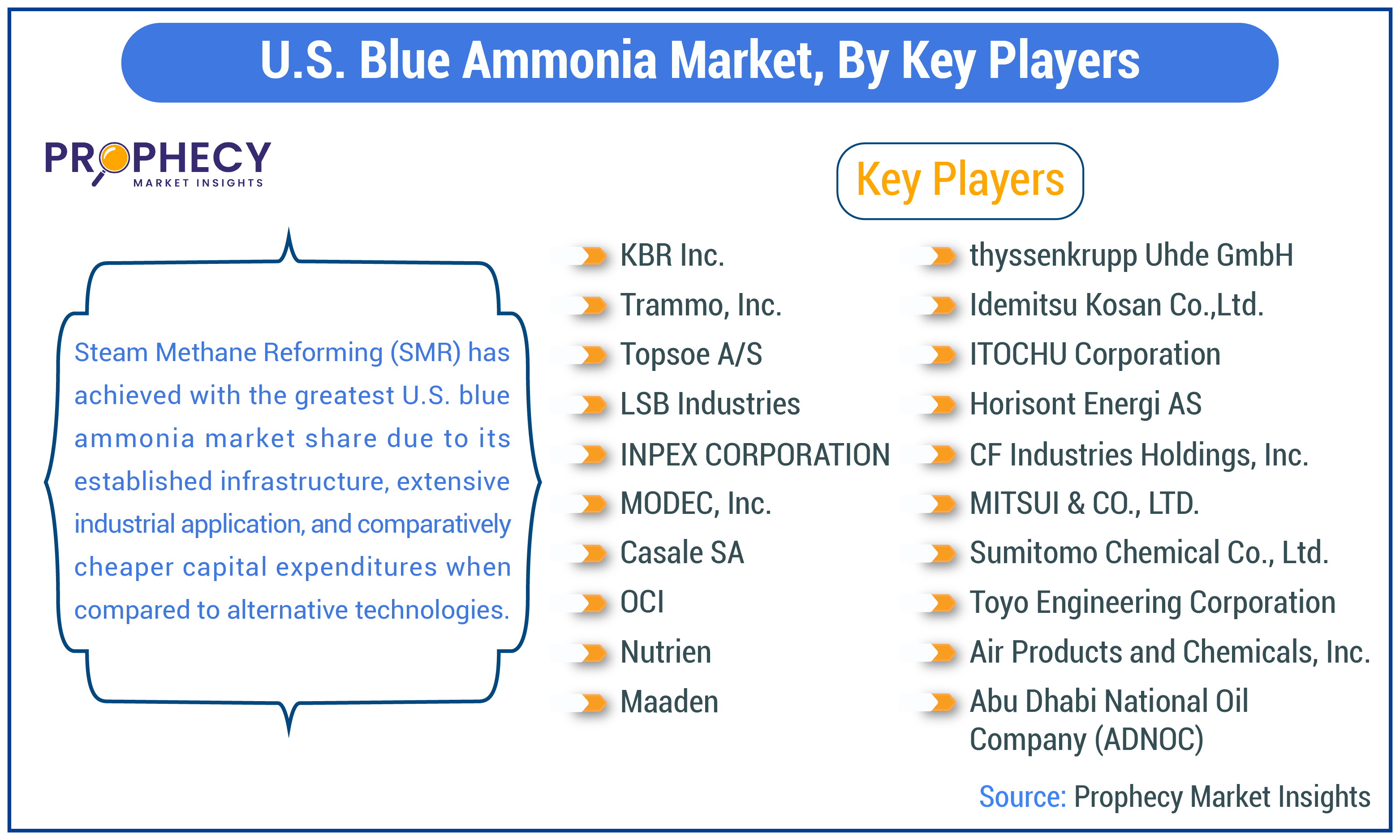
Steam methane reforming, autothermal reforming, and gas partial oxidation are technology including in the U.S. blue ammonia market. Steam Methane Reforming (SMR) has achieved with the greatest U.S. blue ammonia market share due to its established infrastructure, extensive industrial application, and comparatively cheaper capital expenditures when compared to alternative technologies.
The second-dominant technique, autothermal reforming (ATR), has been gaining momentum owing to its superior compatibility with CCS systems and raised more carbon capture effectiveness.
By Purity:
99.99% Purity, 99.9% Purity, and 99% Purity are purity for which market is categorized. 99.9% purity maintains a substantial overall market share in the U.S. blue ammonia market given that it represents the best combination of performance, expenses associated with production, and suitableness for significant applications such industrial feedstock, power generation, and shipping fuel.
The second-dominant business sector, 99.99% purity, is primarily employed in trained professionals’ operations where ultra-pure ammonia is indispensable, such as chemical manufacture and complicated fuel systems.
By Application:
Power generation, transportation, industrial feedstock, and others are application of the U.S. blue ammonia market. Industrial feedstock encompasses the greatest U.S. blue ammonia market share considering ammonia was originally employed for the manufacture of chemicals, fertilizers, and other industrial goods.
The second most frequent application is power generation, particularly is underpinned by increasing curiosity in cofiring ammonia with coal to cut impurities or making use of it as a hydrogen transporter and combustion fuel in gas turbines.
By End-User Industry:
U.S. blue ammonia market is categorized into agriculture, utilities, oil & gas, and logistics, on the account of end-user industry. Considering ammonia is a vital component of nitrogen-based fertilizers the fact that are frequently utilized in the cultivation of crops, the agricultural industry has the highest U.S. blue ammonia market share.
Between the expanding consumption of blue ammonia as a clean-burning fuel for electricity generation and its purpose as a hydrogen carrier in the energy grid's decarbonization, the utilities sector is the second-largest end consumer.
U.S. Blue Ammonia Market Report Scope:
|
Attribute |
Details |
|
Market Size 2025 |
USD 37.0 Million |
|
Projected Market Size 2035 |
USD 1515 Million |
|
CAGR Growth Rate |
42.5% (2025-2035) |
|
Base year for estimation |
2024 |
|
Forecast period |
2025 – 2035 |
|
Market representation |
Revenue in USD Million & CAGR from 2025 to 2035 |
|
Report coverage |
Revenue forecast, company share, competitive landscape, growth factors, and trends |
Segmentation:
By Technology:
- Steam Methane Reforming
- Autothermal Reforming
- Gas Partial Oxidation
By Purity:
- 99.99% Purity
- 99.9% Purity
- 99% Purity
By Application:
- Power Generation
- Transportation
- Industrial Feedstock
- Others
By End-User Industry:
- Agriculture
- Utilities
- Oil & Gas
- Logistics
Us Blue Ammonia Market Competitive Landscape & Key Players
By putting money into revolutionary CCS technology that decreases emissions and expenditures, and by forming cooperation agreements through partnership agreements with prominent businesses in energy and carbon capture, U.S. blue ammonia manufacturers are propelling the company's expansion. The key players operating in the U.S. blue ammonia market include KBR Inc., Air Products and Chemicals, Inc., Trammo, Inc., and others.
U.S. Blue Ammonia Market Companies:
- KBR Inc.
- Air Products and Chemicals, Inc.
- Trammo, Inc.
- Topsoe A/S
- Abu Dhabi National Oil Company (ADNOC)
- LSB Industries
- INPEX CORPORATION
- MODEC, Inc.
- Casale SA
- OCI
- Nutrien
- Maaden
- thyssenkrupp Uhde GmbH
- Idemitsu Kosan Co.,Ltd.
- ITOCHU Corporation
- Horisont Energi AS
- CF Industries Holdings, Inc.
- MITSUI & CO., LTD.
- Sumitomo Chemical Co., Ltd.
- Toyo Engineering Corporation
Us Blue Ammonia Market Recent News
- In May 2022, Mitsui & Co., Ltd., one of the leading ammonia marketers in the world, and CF Industries Holdings, Inc., the world’s largest producer of ammonia, announced their intention to jointly develop a greenfield ammonia production facility in the U. S. The new facility will produce blue ammonia by leveraging carbon capture and sequestration processes to reduce carbon emissions by more than 60% compared to conventional ammonia.
Analyst View:
U.S. blue ammonia market continues to grow significantly given that it is a low-carbon alternative for standard ammonia and is generated from natural gas with carbon emissions collected by CCS technology. Decreased greenhouse gas emissions, clean fuel uses in transportation and electricity, and its ability to transport hydrogen safely represent a few of the primary advantages it offers. Advances in technology in carbon capture and recycling, substantial government subsidies including the IRA's 45Q tax credits, and increasing consumer appetite for environmentally friendly energy solutions internationally are among the primary causes of this development. In the ten years that follow, the U.S. is anticipated to become an important export country with strengthening capacity for manufacturing and much bigger manufacturing and electrical consumption through exploiting its current infrastructure and growing its international connections, especially with nations including Japan.
More Related Reports
U.S Ammonia Market
Bluetooth Speaker Market
Bluetooth Beacons Market
Asia Pacific Blue Ammonia Market
Ammonia Market
Us Blue Ammonia Market Company Profile
|
Company Name |
CF Industries Holdings, Inc. |
|
Headquarter |
Northbrook, Illinois |
|
CEO |
Tony Will |
|
Employee Count |
3,000 Employees |
FAQs
U.S. blue ammonia market size was valued at USD 37.0 Million in 2025 and is expected to reach USD 1232 Million by 2035 growing at a CAGR of 42.68%.
Technology, purity, application, and end-user industry are the segmentation for the target market.
The key players operating the U.S. blue ammonia market include KBR Inc., Air Products and Chemicals, Inc., Trammo, Inc., Topsoe A/S, Abu Dhabi National Oil Company (ADNOC), LSB Industries, INPEX CORPORATION, MODEC, Inc., Casale SA, OCI, Nutrien, Maaden, thyssenkrupp Uhde GmbH, Idemitsu Kosan Co.,Ltd., ITOCHU Corporation, Horisont Energi AS, CF Industries Holdings, Inc., MITSUI & CO., LTD., Sumitomo Chemical Co., Ltd., and Toyo Engineering Corporation.