Retrieval Augmented Generation Rag Market Overview
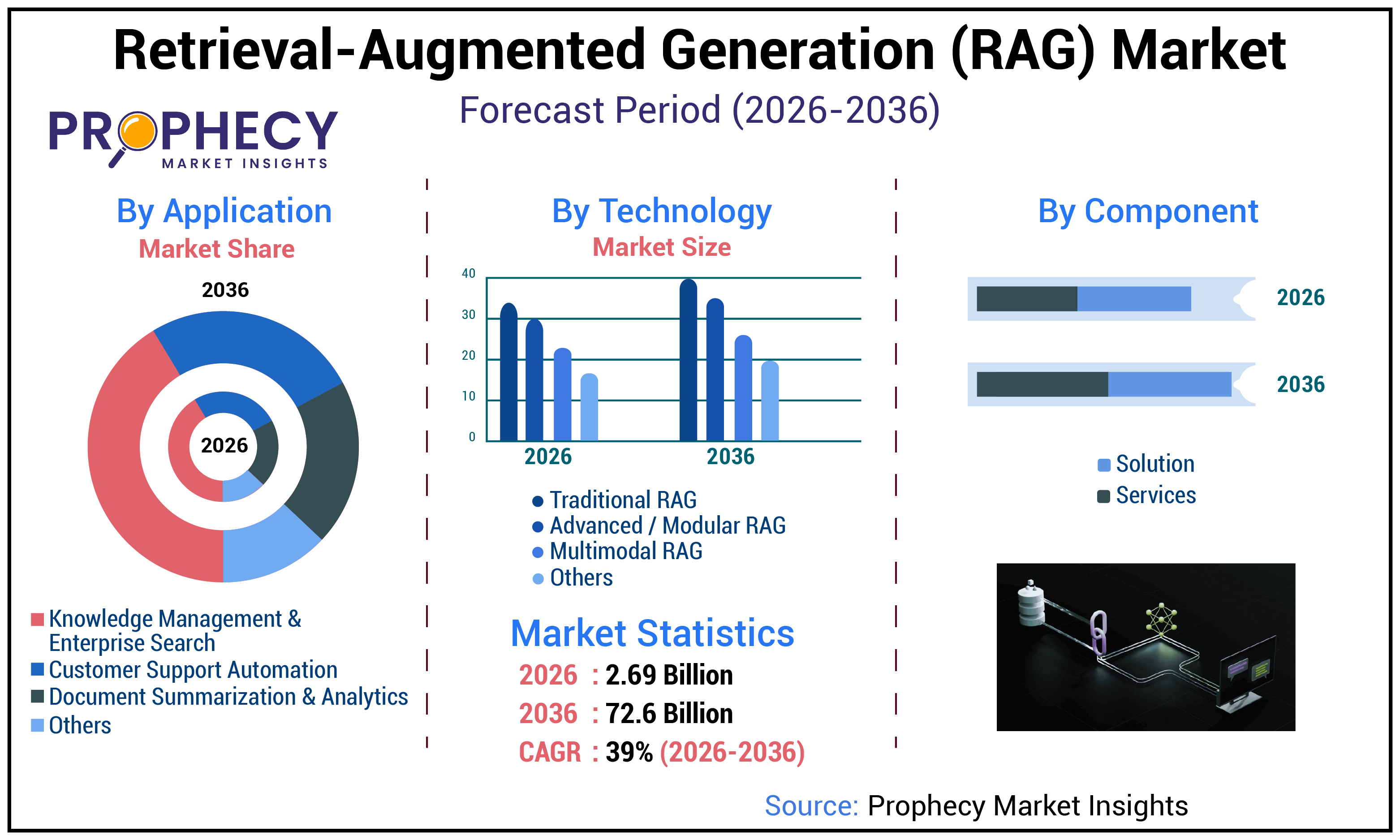
- 2025 Market Size: USD 1.94 Billion
- 2035 Projected Market Size: USD 72.6 Billion
- CAGR (2026-2036): 39%
- North America: Largest Market in 2025
Retrieval-Augmented Generation (RAG) is an AI framework that makes large language models more effective by fetching the most relevant and latest pieces of information from external knowledge sources (as databases, documents, or the internet) prior to generating a response. The main benefits of the method are fewer hallucinations, better precision, and possibility of being always up-to-date with real facts, and use of domain-specific knowledge without having to re-train large models. Therefore, RAG produces outputs with lower risks of errors, richer in context, cheaper, and easily scalable, which is a great use of the models for tasks such as search, analytics, customer support, and enterprise knowledge management.
The retrieval-augmented generation (RAG) market is expanding fast time is it is essentially a byproduct of the enterprise demand for AIs with the qualities of accuracy and low hallucination that are moreover able to use real internal knowledge. The usage of RAG has become a trend in enterprises to improve decision making, to automate knowledge-intensive tasks, and to give support to customers at a lesser cost as compared to that of re-training large models. Besides that, the escalating volume of unstructured data, the propagation of vector databases, and the increasing requirement for safe, domain-specific AI solutions have all contributed to the penetration of RAG becoming a momentum that is beyond different industries to each other.
Fundamental Algorithms of Retrieval-Augmented Generation:
- The core algorithms of retrieval-augmented generation are based on dense and sparse retrieval methods, where models as BM25 or bi-encoders process queries and documents into vectors to find the most relevant information.
- Vector search algorithms as FAISS, HNSW, or ANN (Approximate Nearest Neighbor) are implemented to efficiently find semantically closest embeddings in vast databases.
- The reranking algorithms, typically cross-encoders, get the retrieved results back refining them for higher precision.
- To sum up, generation algorithms in large language models combine the retrieved context with the user query through attention mechanisms, thus allowing the LLM to generate grounded, factual, and context-aware responses.
Current Industry Dynamics & Insights:
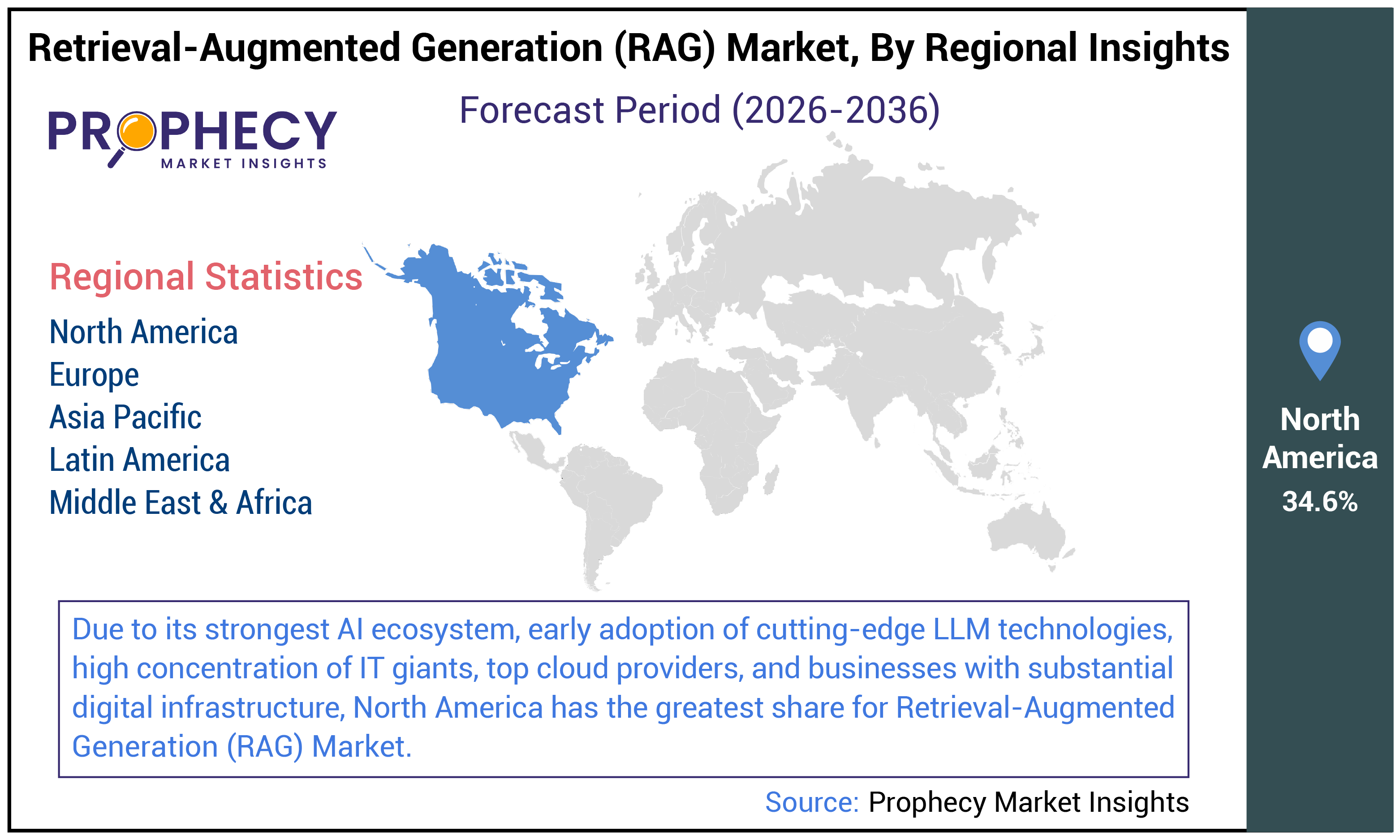
- North America has the largest regional share in the market, with almost 34.6%.
- Europe is second dominating region in the market.
- By component, solution dominates the retrieval-augmented generation (RAG) market share.
Retrieval Augmented Generation Rag Market Drivers & Restraints
Drivers and Restraints:
|
Drivers |
Restraints |
Opportunities & Trends |
|
|
|
Key Drivers:
Adoption of AI Automation
By facilitating the streamlining of knowledge-heavy workflows, AI automation implemented in RAG is the main driver of RAG market growth to which the reduction of manual research time and the faster, more accurate insights delivery across operations also contribute. As companies carry out the automation of customer support, document processing, compliance checks, and analytics, they become more dependent on RAG systems to offer responses that are grounded and context-rich whereas traditional LLMs cannot.
Hence, this transformation not only raises productivity and decision-making skills but also decreases operational costs thus making RAG-based automation a viable solution for enterprises looking for scalable, high-accuracy AI capabilities.
- For Instance, according to data published by SmartDev, the global AI sector is projected to reach approximately US $254.5 billion in 2025, growing at a ~36.9% CAGR toward 2031. Similarly, the long-term productivity opportunity of AI is estimated at US $4.4 trillion in added growth potential from corporate use cases.
Restraints
Data Privacy and Governance Challenges
Data privacy and governance issues are a major factor in holding back the RAG market expansion. As a considerable number of organizations are reluctant to implement retrieval-based AI systems that entail storing, indexing, and processing of sensitive internal data. The threats of data leaks, unauthorized access, and regulatory non-compliance are among the reasons that make enterprises so conservative in their moves towards the deployment of RAG at the scale level.
- Counterbalance Statements: The way to the solution is through the use of secure architectures as the on-premise or hybrid deployments, the application of encryption, and role-based access controls, the use of privacy-preserving vectorization methods, and the implementation of strict data governance frameworks. These steps not only facilitate compliance but also ensure the security of sensitive information and, hence, the building of trust which is indispensable for the safe and large-scale deployment of RAG systems.
Opportunities & Trends:
Rise of RAG-as-a-Service and Cloud-Native RAG Platforms
The emergence of RAG-as-a-Service and cloud-native RAG platforms is turning out to be a significant future trend in the next few years. As they provide a way for organizations to install powerful retrieval-augmented systems without the need to handle complex infrastructure or a specialized machine learning pipeline.
By enabling scalable vector search, real-time retrieval, and effortless integration with enterprise data, cloud-based RAG solutions decrease the time of deployment, reduce the costs, and bring advanced AI capabilities within the reach of even those small businesses that hitherto could not afford them. As cloud providers and AI vendors keep on enhancing the performance, safety, and personalization features, RAG-as-a-Service will be the main driver of a large adoption network and thus, the market will experience a rapid growth over the long term.
Retrieval Augmented Generation Rag Market Segmentations & Regional Insights
Component, technology, application, end user, and region are the divisions of the retrieval-augmented generation (RAG) market.
By Component:
Solution, and services are component on which retrieval-augmented generation (RAG) market is segmented. As businesses mostly invest in core RAG platforms, vector databases, retrieval systems, and orchestration tools that serve as the basis for their AI applications, solutions have the biggest retrieval-augmented generation (RAG) market share. These solutions are the most in-demand since they provide the crucial features semantic search, knowledge grounding, and LLM integration that boost performance and accuracy.
In order to overcome deployment difficulty and guarantee secure, optimal implementation, enterprises are increasingly in need of consultation, integration, modification, and managed RAG services, making services the second-largest market. Demand for both solution deployment and continuing support keeps rising as RAG usage spreads throughout sectors.
By Technology:
From the perspective of technology, the retrieval-augmented generation (RAG) market is divided into traditional RAG, advanced / modular RAG, multimodal RAG, and others. Since it is the most popular architecture and provides straightforward, affordable retrieval and grounding capabilities that businesses can readily include into current LLM workflows, Traditional RAG presently has the biggest retrieval-augmented generation (RAG) market share. It is the standard option for early and mid-stage AI implementations due to its maturity, reduced complexity, and wide interoperability with vector databases.
Organizations looking for improved accuracy, multi-vector retrieval, reranking, memory integration, and more reliable pipelines for intricate enterprise use cases are driving the second-dominant sector, Advanced/Modular RAG. Although demand is moving toward modular and intelligent designs as RAG systems develop, traditional RAG continues to lead due to its familiarity, scalability, and simplicity of implementation.
By Application:
Customer support automation, knowledge management & enterprise search, document summarization & analytics, and others are application of the retrieval-augmented generation (RAG) Market. Knowledge management & Enterprise Search has the biggest retrieval-augmented generation (RAG) market share as businesses are emphasizing AI systems that can precisely retrieve, organize, and use large internal knowledge bases to enhance decision-making and operational effectiveness. RAG is particularly useful for this use case since it can ground replies in confidential data, which has led to its widespread adoption across companies.
The second most popular category is customer support automation, as businesses use RAG-powered chatbots and assistants more frequently to lower support expenses, give precise answers, and manage complicated questions using real-time data. Even while document summarization and analytics are expanding quickly, they are still not as prevalent as the high-impact use cases of customer service and enterprise knowledge access.
By End User:
IT & telecom, BFSI, healthcare & life sciences, retail & e-commerce, and others are end users of the retrieval-augmented generation (RAG) Market. As IT and telecom are early adopters of advanced AI technologies and need robust retrieval and automation solutions to handle complex documentation, technical support, network operations, and large-scale knowledge bases, they hold the largest retrieval-augmented generation (RAG) market share. RAG systems are implemented more quickly due to their robust digital infrastructure and ongoing innovation.
Due to financial institutions' growing reliance on RAG for compliance monitoring, fraud detection, secure information retrieval, and customer service automation, BFSI is the second-dominant segment. RAG is particularly useful in the BFSI sector due to the requirements for accuracy, regulatory alignment, and real-time data availability.
Regional Insights:
Geographically, the retrieval-augmented generation (RAG) market is studied across North America, Europe, Asia Pacific, Latin America, and the Middle East & Africa.
North America: Due to its strongest AI ecosystem, early adoption of cutting-edge LLM technologies, high concentration of IT giants, top cloud providers, and businesses with substantial digital infrastructure, North America has the greatest share for retrieval-augmented generation (RAG) market. RAG deployment is further accelerated by the region's investments in enterprise automation, vector databases, and AI research.
- U.S. Retrieval-Augmented Generation (RAG) Market Insights:
Since it is home to top AI companies, significant LLM developers, cloud hyperscalers, vector database creators, and big businesses that quickly adopt cutting-edge AI technology, the United States leads the RAG market in North America. Additionally, the United States has a robust startup ecosystem, significant R&D investment, and extensive digital transformation projects that hasten the adoption of RAG.
Europe: This is the second-dominant region due to the rapid adoption of enterprise search, automation, and data governance-focused RAG systems under stringent regulatory environments consisting of GDPR, as well as the strong demand for secure, compliant, and explainable AI solutions, particularly in industries comparable to banking, healthcare, and manufacturing.
- Germany Retrieval-Augmented Generation (RAG) Market Insights:
Due to its robust industrial base, significant adoption of AI in manufacturing, automotive, and corporate automation, and stringent data governance regulations that promote the deployment of safe, retrieval-based AI systems, Germany dominates the European market. Germany is leading the way in RAG adoption in Europe with to its technologically advanced businesses and emphasis on compliant AI deployment.
Asia Pacific: The growing demand for precise, real-time information retrieval across industries that include BFSI, telecom, retail, and healthcare, as well as the accelerating digital transformation, growing adoption of AI in businesses, and expanding cloud infrastructure are all contributing to the rapid growth of the Retrieval-Augmented Generation (RAG) market in Asia. RAG usage is further strengthened by the region's increase in unstructured data as well as the use of vector databases and LLM-based business automation.
- China Retrieval-Augmented Generation (RAG) Market Insights:
By virtue of its robust AI innovation environment, significant government and private sector investment in AI infrastructure, sizable population of tech-driven businesses, and quick rollout of intelligent search, automation, and LLM-powered apps across industries, China leads the APAC market.
Retrieval-Augmented Generation (RAG) Market Report Scope:
|
Attribute |
Details |
|
Market Size 2026 |
USD 2.69 Billion |
|
Projected Market Size 2036 |
USD 72.6 Billion |
|
CAGR Growth Rate |
39% (2026-2036) |
|
Base year for estimation |
2025 |
|
Forecast period |
2026- 2036 |
|
Market representation |
Revenue in USD Billion & CAGR from 2026 to 2036 |
|
Regional scope |
North America - U.S. and Canada Europe – Germany, U.K., France, Russia, Italy, Spain, Netherlands, and Rest of Europe Asia Pacific – China, India, Japan, Australia, Indonesia, Malaysia, South Korea, and Rest of Asia-Pacific Latin America - Brazil, Mexico, Argentina, and Rest of Latin America Middle East & Africa – GCC, Israel, South Africa, and Rest of Middle East & Africa |
|
Company Landscape |
Market Share Analysis of Companies Heat Map Analysis Company Overview, Products Overview Financial Information, Key Highlights Business Strategies Overview SWOT Analysis |
|
Report coverage |
Revenue forecast, company share, competitive landscape, growth factors, and trends |
|
Value Added Data Infosets |
Besides fundamental market insights such as the size of the market, growth rate, segmentation, regional study, and key players, our reports carry value-added data sets such as trade flow (import-export) analysis, production and consumption overview, price trend evaluation, supply and value chain mapping, and raw material availability. Moreover, we provide strategic tools as PESTLE and Porter’s Five Forces analysis, examination of the regulatory landscape, as well as monitoring of technology and innovation thereby providing a comprehensive overview which facilitates sensible and anticipatory decision-making. |
Segmentation:
By Component:
- Solution
- RAG platforms
- Vector databases
- Others
- Services
- Deployment & Integration Services
- Consulting & System Design
- Others
By Technology:
- Traditional RAG
- Advanced / Modular RAG
- Multimodal RAG
- Others
By Application:
- Customer Support Automation
- Knowledge Management & Enterprise Search
- Document Summarization & Analytics
- Others
By End User:
- IT & Telecom
- BFSI
- Healthcare & Life Sciences
- Retail & E-commerce
- Others
By Region:
- North America
- U.S.
- Canada
- Europe
- Germany
- U.K.
- France
- Russia
- Italy
- Spain
- Netherlands
- Rest of Europe
- Asia Pacific
- China
- India
- Japan
- Australia
- Indonesia
- Malaysia
- South Korea
- Rest of Asia Pacific
- Latin America
- Brazil
- Mexico
- Argentina
- Rest of Latin America
- Middle East & Africa
- GCC
- Israel
- South Africa
- Rest of Middle East & Africa
Retrieval Augmented Generation Rag Market Competitive Landscape & Key Players
Expanding cloud-based and RAG-as-a-Service offerings to reach a wider enterprise audience, investing in research and development to improve multimodal and domain-specific RAG capabilities, and establishing strategic partnerships with cloud providers, AI platforms, and industry leaders are important growth strategies for Retrieval-Augmented Generation (RAG) companies.
Additionally, businesses are concentrating on enhancing data security, governance, and compliance capabilities to draw in regulated industries; providing managed services and consulting to facilitate deployment; and focusing on new regions particularly APAC for high adoption potential..
Retrieval-Augmented Generation (RAG) Market Companies:
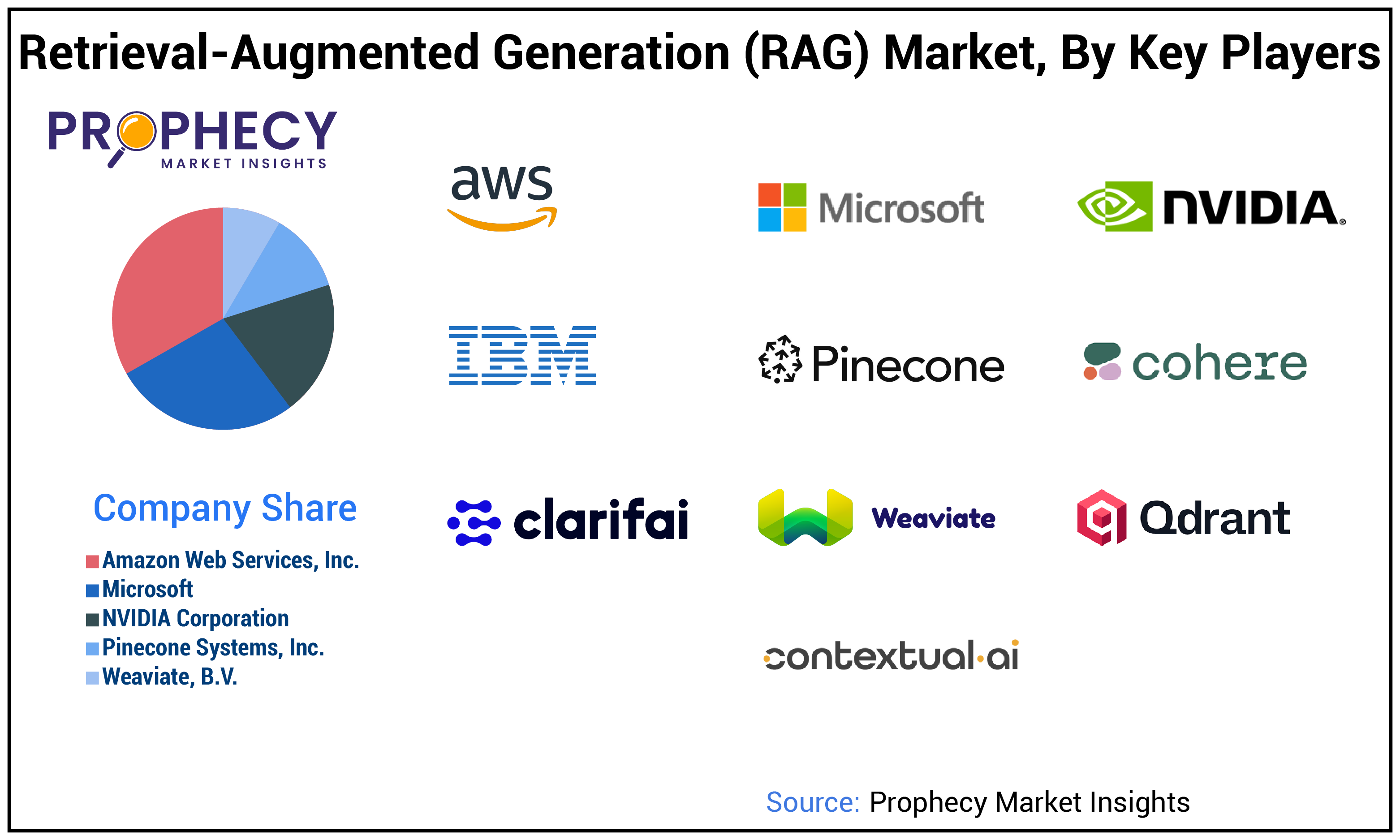
- Amazon Web Services, Inc.
- Microsoft
- NVIDIA Corporation
- Pinecone Systems, Inc.
- Weaviate, B.V.
- Zilliz
- Elasticsearch B.V.
- MongoDB, Inc.
- Contextual AI
- Cohere
- IBM
- Clarifai, Inc.
- RAGIE
- Qdrant
- Progress Software Corporation
View an Additional List of Companies in the Retrieval-Augmented Generation (RAG) Market
Retrieval Augmented Generation Rag Market Recent News
- In November 2024, to help businesses effectively utilize generative AI (GenAI), Infinidat, a top supplier of enterprise storage solutions, unveiled its Retrieval-Augmented Generation (RAG) workflow deployment architecture. With current, confidential data from various company data sources, including unstructured data and structured data, including databases from current Infinidat platforms, this significantly increases the precision and applicability of AI models.
Analyst View:
An AI framework called Retrieval-Augmented Generation (RAG) improves large language models by obtaining the most current and pertinent data from external knowledge sources prior to producing responses. This increases accuracy, decreases hallucinations, and permits domain-specific insights without the need for retraining.
Due to increased enterprise need for accurate, low-error AI that can automate knowledge-intensive processes, leverage internal information, support decision-making, and lower costs, the RAG market is expanding quickly. The growing amount of unstructured data, the growth of vector databases, and the demand for safe, domain-specific AI solutions across a range of businesses all contribute to its adoption.
Analysis of Sources:
Primary Sources:
- In-depth interviews
- Company-specific data
- Surveys and questionnaires
- Focus group discussions (FGDs)
- Others
Secondary Sources:
- Eurostat
- European Commission
- Others
More Related Reports
Power Generation Carbon Capture and Storage Market
Hydrogen Generation Market
Next-Generation Anode Materials Market
Next-Generation Sequencing Informatics Market
Next- Generation Storage Market
Retrieval Augmented Generation Rag Market Company Profile
|
Company Name |
Product Portfolio |
|
Microsoft |
Retrieval Augmented Generation (RAG) |
|
NVIDIA Corporation |
Retrieval-Augmented Generation |
|
Pinecone Systems, Inc. |
Retrieval-Augmented Generation (RAG) |
|
Zilliz |
Retrieval Augmented Generation (RAG) |
|
Weaviate, B.V. |
Retrieval Augmented Generation (RAG) |
Retrieval Augmented Generation Rag Market Highlights
FAQs
Retrieval-augmented generation (RAG) market size was valued at USD 2.69 Billion in 2026 and is expected to reach USD 72.6 Billion by 2036 growing at a CAGR of 39%.
Component, technology, application, end user, and region are the segmentation for the retrieval-augmented generation (RAG) market.
Need for more accurate, context-aware, and trustworthy AI outputs in enterprise applications, the rapid digital transformation of businesses, advancements in related technologies, and so on are some of the retrieval-augmented generation (RAG) market growth drivers.
North America, Asia Pacific, Europe, Latin America, and the Middle East & Africa. North America is expected to dominate the retrieval-augmented generation (RAG) Market.
The key players operating the retrieval-augmented generation (RAG) market include Amazon Web Services, Inc., Microsoft, NVIDIA Corporation, PINECONE SYSTEMS, INC., Weaviate, B.V., Zilliz, Elasticsearch B.V., MongoDB, Inc., SilexPro, Cohere, IBM, CLARIFAI, INC., Ragie, Qdrant, and Progress Software Corporation.