Quadruped Robot Market Overview
- 2025 Market Size: USD 2.61 Billion
- 2036 Projected Market Size: USD 17.72 Billion
- CAGR (2026-2036): 19%
- North America: Largest Market in 2025
A quadruped robot is essentially a robotic system with four legs that is engineered to imitate the locomotion and equilibrium of animals such as dogs or horses, thereby making it capable of going through difficult and rugged terrains with a high degree of balance and dexterity. Among its main advantages are better stability than wheeled robots, continuous operation capability in harsh environments as construction sites, areas hit by natural disasters, or remote industrial locations, and increased mobility through which it can ascend stairs, go over obstacles, and even disarmingly maintain its balance if it gets a push.
Besides these, the robots in question also raise the safety standard by taking over risky works, are useful in carrying extra loads, and may be fitted with sensors for inspection, surveillance, and data gathering purposes.
The quadruped robot market is expanding chiefly as the increasing need for highly mobile solutions in various sectors, where the use of traditionally wheeled robots is not feasible, for example, in defense, construction, oil & gas, mining, and disaster response industries. These robots are getting popular due to the increased investment in automation, improved AI and sensor technologies, and the need for safer inspection and surveillance in hazardous or remote areas.
Besides, their function to carry payloads, move on rough terrains, and operate without human intervention make them very attractive to both the commercial and industrial sectors, thus, the market growth is being propelled further.
Walking Strategies of Quadruped Robot:
- Quadruped robots implement multiple walking methods to guarantee stability, effectiveness, and capability at different terrains. Among the methods, there is static gait, which keeps at least three legs on the ground for very high stability (e.g., crawl gait), and dynamic gait, in which the moments of reduced ground contact are allowed for quicker movement (e.g., trot or bound).
- Besides, they have compliant walking, during which the legs can change their stiffness to absorb the shocks, and adaptive gait, which gets sensor data in real time and thus can change step length, foot placement, and speed depending on the terrain.
- Some robots utilize model predictive control (MPC) and reinforcement learning algorithms to balance, save energy, and negotiate obstacles in a way that is smooth and efficient, even when the surface is uneven or unpredictable.
Current Industry Dynamics & Insights:
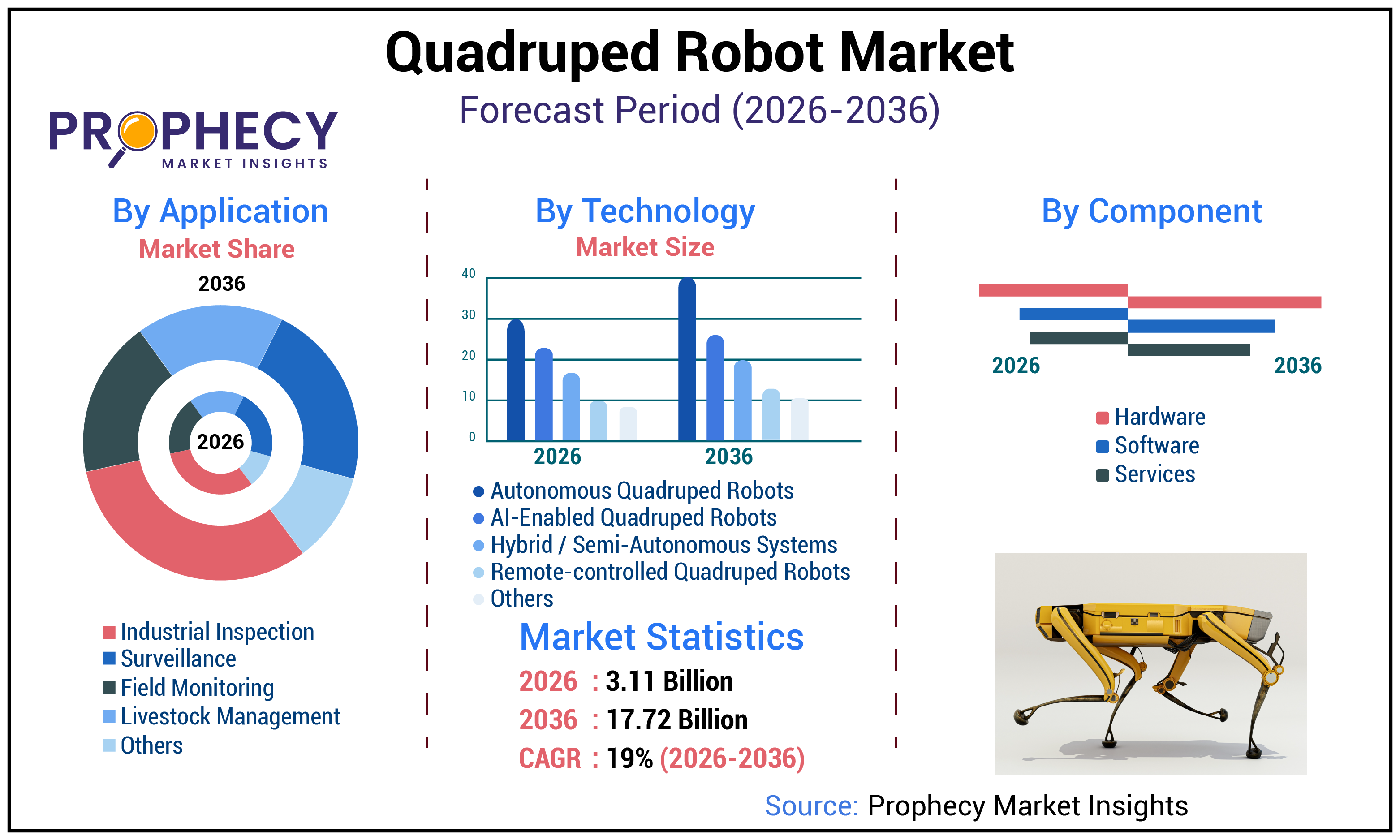
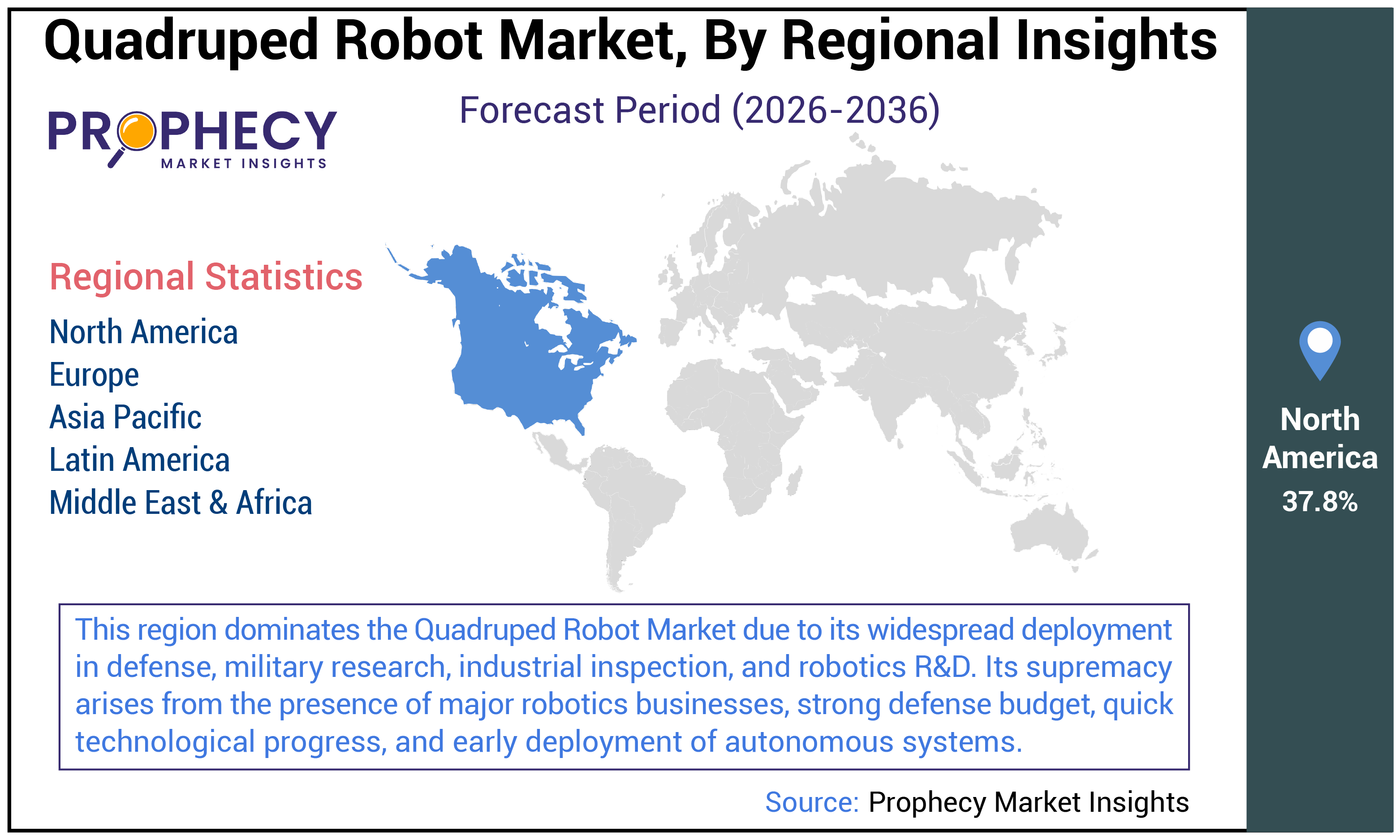
- North America has the largest regional share in the market, with almost 37.8%.
- Europe is second dominating region in the target market growth.
- By component, hardware dominates the quadruped robot market size.
Quadruped Robot Market Drivers & Restraints
Drivers and Restraints:
|
Drivers |
Restraints |
Opportunities & Trends |
|
|
|
Key Drivers:
Demand for Automation
One of the major factors contributing to the expansion of the quadruped robot market is the rising need for automation. This need has pushed various industries to install intelligent and autonomous systems that are capable of performing tasks more efficiently and safely than human labor. In the same way, sectors as oil & gas, mining, construction, and defense are increasingly depending on automated solutions for inspection, surveillance, and operational support.
Meanwhile, quadruped robots are the ones that provide the required mobility and versatility to navigate difficult terrains where traditional robots are incapable. The transition to automation is instrumental in lessening human involvement in dangerous places, enhancing the flow of work, and giving the possibility of uninterrupted operations. Therefore, the Deployment & Integration of advanced quadruped robots is being fast-tracked in different industries.
- For Instance, according to data published by IFR, annual robot installation moved sideways to 542,076 units, which is +0.1% compared to 2023. Operational stock increased to 4,663,773 robots (+8.9%) and the largest countries in terms of operational stock are China (43.5%), Japan (9.7%), United States (8.4%), Republic of Korea (8.4%) and Germany (6.0%).
Restraints:
Higher Risk of Mechanical Wear due to Legged Movement
One of the main reasons that the growth of the quadruped robots market is limited is that these robots have a higher risk of mechanical wear due to their continuous legged movement, frequent joint articulation, and exposure to harsh terrains, which in turn leads to increased maintenance costs, reduced operational reliability, and shortened robot lifespan.
- Counterbalance Statements: Nevertheless, this problem can be alleviated by the application of advanced durable materials, the improvement of joint sealing, the utilization of predictive maintenance systems, and the redesign of the actuator mechanisms that reduce friction and load stress. Furthermore, the use of AI-based diagnostics for real-time wear monitoring helps avoid unexpected failures, thus increasing the lifespan of the devices, decreasing the total cost of ownership, and enabling a larger market for quadruped robots.
Opportunities & Trends:
Advancements in Human–Robot Interaction for Field Operations
The progress made in human-robot interaction is identified as a major trend that will drive the quadruped robot market in the next few years. Such interactions will form the basis of more intuitive, safer, and efficient cooperation between operators and robots in field operations. Developments as voice commands, gesture control, augmented reality interfaces, and smarter situational awareness all contribute to the ease with which human teams can direct quadruped robots even without intensive training, and this applies to complex and dangerous environments as well.
In fact, the improved interaction capacity of robots with humans makes the latter's deployment in inspection, security, rescue, and industrial tasks more rapid, thereby enhancing the usability of robots, reducing the number of mistakes made during operations, and speeding up the use of quadruped robots in different sectors.
Quadruped Robot Market Segmentations & Regional Insights
Component, technology, payload capacity, application, end user, and region are the divisions of the quadruped robot market.
By Component:
Hardware, software, and services are component on which Quadruped Robot Market is segmented. Hardware dominates the quadruped robot market since it includes the essential physical components such as sensors, cameras, actuators, control units, batteries, and mechanical leg systems which account for the majority of the robot's cost. High manufacturing complexity, precision engineering, and the necessity for long-lasting materials all contribute significantly to hardware value as compared to other components.
The second most important category is software, which is being pushed by the increased importance of AI algorithms, navigation systems, gait control, vision, and autonomous decision-making skills. As quadruped robots get smarter and more autonomous, software plays an increasingly important role in improving performance, flexibility, and real-time response, making it the second largest contributor to market growth following hardware.
By Technology:
Based on the technology, the quadruped robot market is divided into autonomous quadruped robots, remote-controlled quadruped robots, hybrid / semi-autonomous systems, AI-enabled quadruped robots, and others. Autonomous quadruped robots have the biggest quadruped robot market share since industries increasingly demand robots that can navigate, examine, and operate with little human assistance, particularly in hazardous or distant areas such as oil and gas sites, defense operations, and industrial inspection. Their ability to make judgments in real time, avoid barriers, and complete tasks independently makes them the most commercially useful.
AI-enabled quadruped robots are the second most popular group, since sophisticated AI improves perception, locomotion, mapping, and predictive analytics, allowing robots to adapt more effectively to complex terrains and dynamic situations. The growing demand for intelligent field operations, as well as continual developments in Autonomous Quadruped Robots and vision systems, are hastening the deployment of AI-powered quadruped robots, which are now second only to completely autonomous models.
By Payload Capacity:
Up to 10 kg, 10–30 kg, 30–60 kg, and above 60 kg are payload capacity of the quadruped robot market. Quadruped robots with payload capacities of up to 10 kg have the biggest quadruped robot market share, owing to their dominance in commercial, research, and light-industrial applications such as surveillance, inspection, mapping, and academic research and development. These robots are smaller, less expensive, easier to deploy, and frequently used by universities, tech startups, and inspection service providers, resulting in increased overall sales volume.
The second-largest payload category is 10-30 kg, driven by rising demand in defense, construction, and utilities sectors where moderate payloads are required for sensors, communication equipment, and mission-critical tools. This mid-range segment strikes a mix between mobility, strength, and cost, making it increasingly appealing for advanced field operations.
By Application:
The quadruped robot market, on the account of application can categorized into industrial inspection, surveillance, field monitoring, livestock management, and others. Industrial inspection accounts for the majority of the quadruped robot market growth, as these robots are increasingly used in oil and gas facilities, power plants, factories, construction sites, and mining operations, where they can navigate hazardous, uneven, or confined areas more safely and efficiently than humans. Their ability to carry sensors, collect real-time data, and operate autonomously makes them extremely useful for minimizing risk and increasing operational uptime.
Surveillance is the second most popular application, driven by increased need for defense, security, and border surveillance. Quadruped robots provide greater mobility, 360° vision, and continuous patrolling capabilities, making them perfect for security operations requiring mobility and situational awareness.
By End User:
Oil & Gas, energy & utilities, defense & military, public safety & firefighting, and others are end users of the quadruped robot market. Defense & military has the greatest quadruped robot market share in the quadruped robot market as these robots are frequently used for reconnaissance, surveillance, payload carrying, and negotiating difficult terrains where human soldiers face significant risks. Their ability to operate independently, transport mission equipment, and function in hostile and unpredictable situations makes them extremely valuable in current military operations, resulting in enormous investment and deployment.
Oil and gas is the second-largest end user, with quadruped robots increasingly being employed for remote inspection of pipelines, rigs, refineries, and hazardous areas. Their mobility and capacity to perform continuous monitoring decrease operational downtime, improve safety, and lower inspection costs, resulting in widespread use across the industry.
Regional Insights:
Geographically, the quadruped robot market is studied across North America, Europe, Asia Pacific, Latin America, and the Middle East & Africa.
North America: This region dominates the quadruped robot market due to its widespread deployment in defense, military research, industrial inspection, and robotics R&D. Its supremacy arises from the presence of major robotics businesses, strong defense budget, quick technological progress, and early deployment of autonomous systems.
- U.S. Quadruped Robot Market Insights:
The U.S. leads the quadruped robot market in North America due to its high defense spending, advanced robotics ecosystem, and large industry companies producing quadruped systems for military, industrial, and research applications. The United States also leads in AI innovation, testing facilities, and the use of autonomous inspection technologies, all of which drive market growth.
Europe: This is the second-largest region, driven by the increasing use of quadruped robots in industrial inspection, energy and utilities, public safety, and advanced research projects, which are supported by strong government and academic initiatives. Both locations benefit from strong robotics ecosystems and major investments in automation and AI-powered field operations.
- Germany Quadruped Robot Market Insights:
Germany is Europe's dominant country, owing to its strong engineering and manufacturing foundation, advanced research institutes, and growing usage of quadruped robots in industrial inspection, automation, and public safety. Germany's proactive investment in robotics R&D and Industry 4.0 projects strengthens its position in the region.
Asia Pacific: The quadruped robot market in APAC is quickly expanding due to rising industrial automation, increased demand for inspection robots in oil and gas, utilities, and manufacturing, and strong government backing for robotics and AI development. The region's developing construction, mining, and infrastructure sectors necessitate the use of robots that can navigate rough, uneven terrains. .
- China Quadruped Robot Market Insights:
China dominates the APAC market by virtue of its vast robotics manufacturing base, strong government-backed AI and automation programs, and widespread usage of quadruped robots for security, industrial inspection, and commercial applications. China's rapid technological innovation and cost-effective production make it the most important contributor to regional market growth.
Quadruped Robot Market Report Scope:
|
Attribute |
Details |
|
Market Size 2026 |
USD 3.11 Billion |
|
Projected Market Size 2036 |
USD 17.72 Billion |
|
CAGR Growth Rate |
19% (2026-2036) |
|
Base year for estimation |
2025 |
|
Forecast period |
2026 – 2036 |
|
Market representation |
Revenue in USD Billion & CAGR from 2026 to 2036 |
|
Regional scope |
North America - U.S. and Canada Europe – Germany, U.K., France, Russia, Italy, Spain, Netherlands, and Rest of Europe Asia Pacific – China, India, Japan, Australia, Indonesia, Malaysia, South Korea, and Rest of Asia-Pacific Latin America - Brazil, Mexico, Argentina, and Rest of Latin America Middle East & Africa – GCC, Israel, South Africa, and Rest of Middle East & Africa |
|
Company Landscape |
Market Share Analysis of Companies Heat Map Analysis Company Overview, Products Overview Financial Information, Key Highlights Business Strategies Overview SWOT Analysis |
|
Report coverage |
Revenue forecast, company share, competitive landscape, growth factors, and trends |
|
Value Added Data Infosets |
Besides fundamental market insights such as the size of the market, growth rate, segmentation, regional study, and key players, our reports carry value-added data sets such as trade flow (import-export) analysis, production and consumption overview, price trend evaluation, supply and value chain mapping, and raw material availability. Moreover, we provide strategic tools as PESTLE and Porter’s Five Forces analysis, examination of the regulatory landscape, as well as monitoring of technology and innovation thereby providing a comprehensive overview which facilitates sensible and anticipatory decision-making. |
Segmentation:
By Component:
- Hardware
- Sensors
- Actuators & Motors
- Others
- Software
- Navigation & Path-Planning
- AI & ML Algorithms
- Others
- Services
- Deployment & Integration
- Training & Consulting
- Others
By Technology:
- Autonomous Quadruped Robots
- Remote-controlled Quadruped Robots
- Hybrid / Semi-Autonomous Systems
- AI-enabled Quadruped Robots
- Others
By Payload Capacity:
- Up to 10 kg
- 10–30 kg
- 30–60 kg
- Above 60 kg
By Application:
- Industrial Inspection
- Surveillance
- Field Monitoring
- Livestock Management
- Others
By End User:
- Oil & Gas
- Energy & Utilities
- Defense & Military
- Public Safety & Firefighting
- Others
By Region:
- North America
- U.S.
- Canada
- Europe
- Germany
- U.K.
- France
- Russia
- Italy
- Spain
- Netherlands
- Rest of Europe
- Asia Pacific
- China
- India
- Japan
- Australia
- Indonesia
- Malaysia
- South Korea
- Rest of Asia Pacific
- Latin America
- Brazil
- Mexico
- Argentina
- Rest of Latin America
- Middle East & Africa
- GCC
- Israel
- South Africa
- Rest of Middle East & Africa
Quadruped Robot Market Competitive Landscape & Key Players
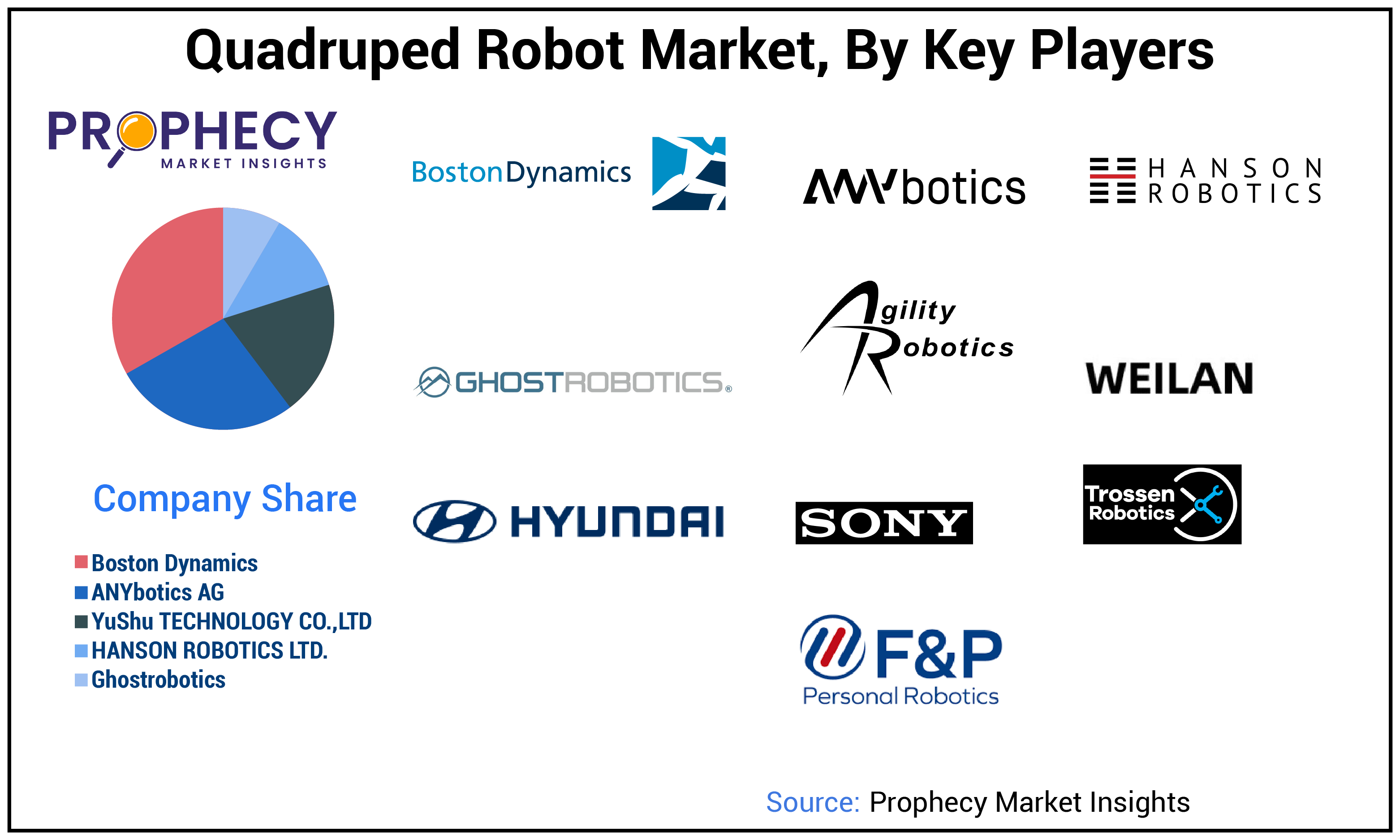
The key players operating in the Quadruped Robot Market include, ANYbotics AG, Agility Robotics, HANSON ROBOTICS LTD., and others. Key growth strategies for quadruped robot companies include increasing R&D to improve autonomy, durability, and AI-driven perception; forming strategic alliances with defense agencies, industrial firms, and technology companies to accelerate adoption; and focusing on cost optimization to make robots more affordable for commercial applications. Companies are also investing more on software upgrades, Up to 10 kg monitoring, and predictive maintenance capabilities to boost operational efficiency.
Quadruped Robot Market Companies:
- Boston Dynamics
- ANYbotics AG
- YuShu TECHNOLOGY CO.,LTD
- HANSON ROBOTICS LTD.
- Ghostrobotics
- Hangzhou Yun Shenchu ??Technology Co., Ltd.
- Agility Robotics
- WEILAN Co., Ltd.
- Trossen Robotics
- Sony Group Corporation
- F&P Robotics
- KAWADA ROBOTICS CORPORATION
- Hyundai Motor Company
View an Additional List of Companies in the Quadruped Robot Market
Quadruped Robot Market Recent News
- In November 2025, China Telecom, in collaboration with ZTE and DeepRobotics, has revolutionized the paradigm with a groundbreaking 5G-powered quadruped robot emergency rescue solution that has already demonstrated its effectiveness in a variety of real-world crisis scenarios. By combining 5G networks' high-speed, low-latency capabilities with the all-terrain adaptability of biomimetic quadruped robots, the solution has achieved intelligent, unmanned operations in high-risk environments, delivering significant economic and social value while injecting new technological momentum into China's emergency response system.
- In October 2023, Hangzhou-DEEP Robotics Company, a global leader in the development and industrial application of quadrupedal robots, has announced the release of its X30 quadruped robot, a flagship product designed to meet core industry needs in a variety of fields, including power station, factory, pipeline corridor inspection, emergency rescue, fire detection, scientific research, and more.
Analyst View:
Quadruped robots are four-legged robotic systems that replicate animal movement, allowing them to cross tough and uneven terrains with exceptional balance, agility, and stability. Their capacity to climb stairs, overcome barriers, and maintain stability even when pushed makes them perfect for use in hazardous locations such as building sites, disaster zones, and distant industrial areas.
The market is expanding significantly because to increased demand for highly mobile robotic solutions in industries such as military, oil and gas, mining, and inspection, where wheeled robots are less effective. Advancements in AI, sensors, and autonomous capabilities, combined with the desire to increase safety and eliminate human involvement in risky jobs, are driving wider acceptance and market growth.
Analysis of Sources:
Primary Sources:
- In-depth interviews
- Company-specific data
- Surveys and questionnaires
- Focus group discussions (FGDs)
- Others
Secondary Sources:
- European Commission
- U.S. National Aeronautics and Space Administration
- Networking and Information Technology Research and Development
- Others
More Related Reports
Robotic Process Automation Market
Europe Robotic Lawn Mower Market
Surgical Robots Market
Robotics Market
Humanoid Robot Market
Quadruped Robot Market Company Profile
|
Company Name |
Product Portfolio |
|
Boston Dynamics |
The Agile Mobile Robot |
|
YuShu TECHNOLOGY CO.,LTD |
High-Performance Quadrupedal Robot |
|
Ghostrobotics. |
Quadrupedal Unmanned Ground Vehicle |
|
Hangzhou Yun Shenchu ??Technology Co., Ltd. |
Quadruped Robot |
|
WEILAN Co., Ltd. |
AlphaDog (Best Quadruped Robot Platform) |
Quadruped Robot Market Highlights
FAQs
Quadruped robot market size was valued at USD 3.11 Billion in 2025 and is expected to reach USD 17.72 Billion by 2035 growing at a CAGR of 19%.
Component, technology, payload capacity, application, end user, and region are the segmentation for the quadruped robot market.
Increasing demand for automation, particularly in hazardous or complex environments for tasks as inspection and disaster response, and so on are some of the quadruped robot market growth drivers.
North America, Asia Pacific, Europe, Latin America, and the Middle East & Africa. North America is expected to dominate the quadruped robot market.
The key players operating the quadruped robot market include Boston Dynamics, ANYbotics AG, YuShu TECHNOLOGY CO.,LTD, HANSON ROBOTICS LTD., Ghostrobotics, Hangzhou Yun Shenchu Technology Co., Ltd., Agility Robotics, WEILAN Co., Ltd., Sony Group Corporation, F&P Robotics, KAWADA ROBOTICS CORPORATION, and Hyundai Motor Company.