North America Electric Vehicle Ev Fluids Market Overview
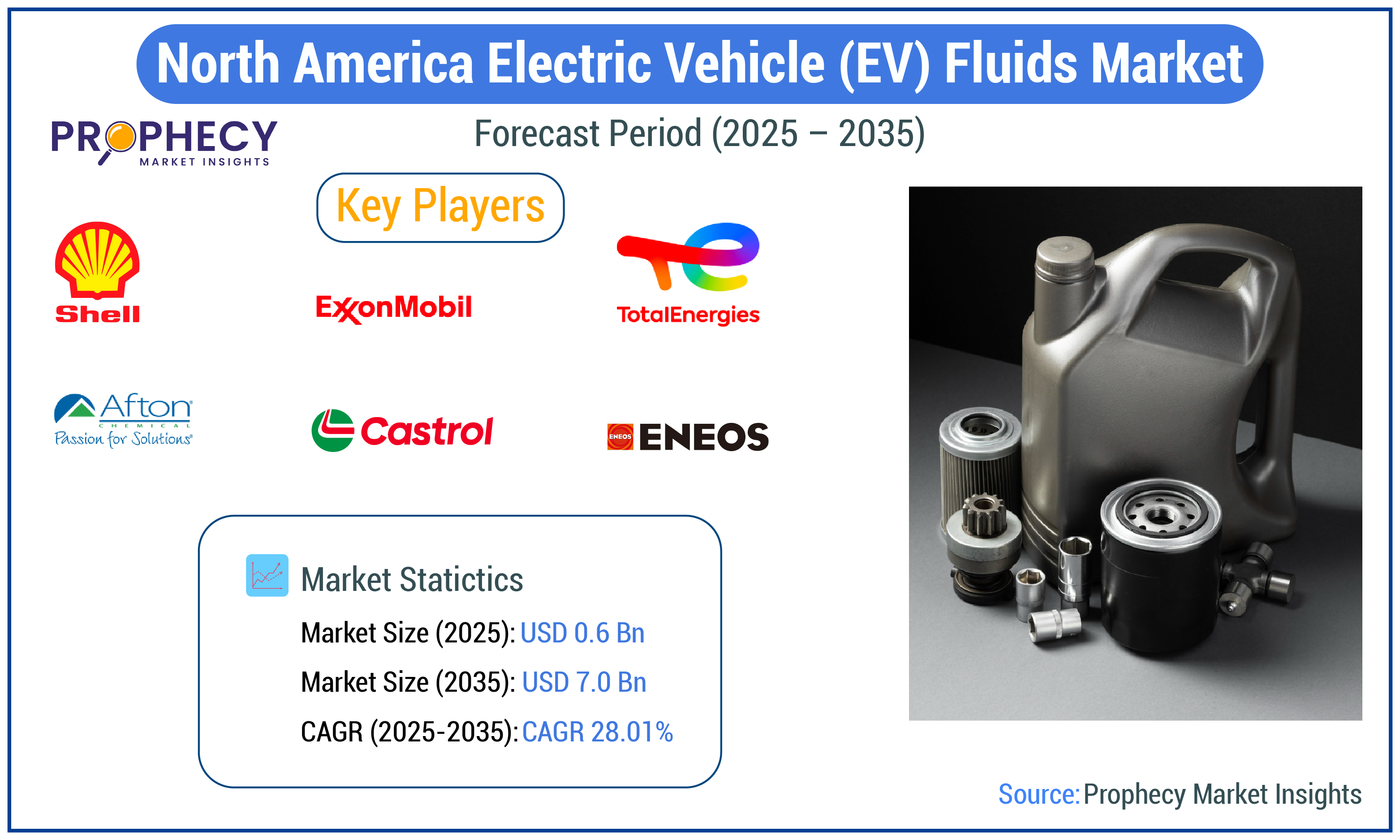
- By 2035, the North America electric vehicle (EV) fluids market size is contemplated to enlarge at a valuation of USD 7.0 Billion.
- In 2025, the North America electric vehicle (EV) fluids market valuation was USD 0.6 Billion.
- North America electric vehicle (EV) fluids market is developing at a CAGR of 28.01%.
Electric Vehicle (EV) fluids consist of specifically developed liquids which function to enhance the performance and safety of different vehicle parts while maximizing efficiency and extending their lifespan. The unique fluid requirements of electric vehicles stem from their electric powertrains combined with high-voltage systems and thermal management needs which differ from conventional internal combustion engine (ICE) vehicles.
Electric vehicle market (EV) fluid growth is operated by many other factors related to widespread EV ecosystem. When the adoption of electric vehicles due to policy support, demand from customers and OEM electrification responsibilities, increases the need for advanced fluid solutions. EV liquid plays a crucial role in thermal management, electrical insulation and efficient drivetrain operation which is becoming more complex as battery techniques and power electronics develop. In addition, as the age of EV and their service requirements increases, the latter is also expanding for EV-specific fluid.
Key trends shaping electric vehicles (EV) fluids include increasing load on thermal management, the rise and durable formulation of dielectric fluid techniques. With fast charging and progression in high-energy-density batteries, there are focus on fluid that can effectively manage heat without compromising safety or electrical operations. This leads to the development of low monarchy, high-stability coolant and immersion cooling fluids corresponding to the EV application.
Key Indicators:
- For instance, The OECD guidelines for chemical safety and UNEC's upcoming GTR20 presses for environmental compliance which retaliate biodegradable fluid formulations and uniform regulations across global car safety frames. UNECES update is expected at the end of 2025.
Impact of Generative AI on North America Electric Vehicle (EV) Fluids Market:
- Generative AI technology now influences the electric vehicle (EV) fluids market through faster research and formulation and testing stages. Fluid engineers use Generative AI through advanced simulation and data-driven modeling to develop new formulations that correspond to the changed thermal electrical and mechanical needs of EV components.
- OEMs together with fluid suppliers implement AI-powered platforms to predict long-term performance along with degradation forecasts and compatibility issues for new materials and components. In addition to R&D, generative AI affects product adaptation, digital twin development and automated test protocols, creating opportunities for more efficient, targeted and sustainable EV -fluid solutions.
Recession Risk and Tariff Analysis:
- The electric vehicle (EV) fluids market stands vulnerable to economic instability because increased recession risks create possible market challenges. A decline in consumer buying power together with reduced industrial output and decreased vehicle sales mainly in North America will push back EV adoption schedules which will impact the market for EV-specific fluids used in manufacturing and servicing.
- The development of new tariff arrangements and trade regulations creates additional challenges for worldwide supply networks. The rising trade tariffs between the United States and important trading nations about electric vehicles and automotive parts might affect the costs of importing base chemicals and finished fluids thus generating price instability and sourcing difficulties.
North America Electric Vehicle Ev Fluids Market Drivers & Restraints
Key Drivers:
Surging Global EV Sales Drive Demand for Advanced Electric Vehicle Fluids
The primary factor propelling the expansion of the EV fluids market stems from the fast-growing sales of electric vehicles especially battery electric vehicles and plug-in hybrid electric vehicles. Governments promoting clean transportation alongside automotive manufacturers accelerating electrification efforts have created rising demand for specific fluids that meet electric drivetrain requirements. BEVs and PHEVs require advanced thermal control and electrical insulation, such as conventional fluids used in combustion engine (ICE) vehicles cannot provide.
- For instance, according to IEA's global EV prospects, nearly 14 million new electric cars were registered worldwide in 2023 - an increase of 35% over 2022 - which reduced rapid global EV adaptation. Their Outlook from 2025 additional projects that EVs can represent a quarter of all new car sales by this year.
Restraints:
High EV Costs Hinder Adoption, Slowing Demand for Specialized EV Fluids
The major factor restricting electric vehicle fluid market expansion stems from electric vehicle initial prices which result from expensive lithium-ion battery costs alongside manufacturing processes that have not yet reached optimal economies of scale. Despite falling battery prices over time, EV -is more expensive than colleagues for the internal combustion engine in many markets. This price gap can deter cost -sensitive consumers from switching to electric vehicles, thus slowing total adoption rates.
- Counterbalance Statements: However, a continued decline in battery costs and increasing production scales gradually limit the price gap between EV and conventional vehicles. Government incentives and tax credit facilitate the financial burden for consumers further. As reasonably improved, the EV adoption is expected - and consequently the demand for EV fluids - to accelerate.
Opportunities & Trends:
Automotive Industry Accelerates Shift Toward Eco-Friendly EV Fluids Amid Sustainability Push
There is an increasing emphasis on the development of environmentally friendly EV fluids when the automotive industry aligns with wider sustainability and circular economy -goals. Manufacturers are becoming more and more transferred to bio-based, biodegradable and non-toxic formulation, which reduces environmental influence without compromising influence. This trend is executed not only by regulatory pressure, but also by customer and OEM demand of the components of the green vehicle during the supply chain.
- For instance, international bodies such as SLOCAT and the World Benchmarking Alliance emphasized the risks of underinvestment—transport needs roughly USD 2.7?trillion by 2050 to align with low-carbon goals.
North America Electric Vehicle Ev Fluids Market Segmentations & Regional Insights
Product, propulsion type, application, distribution channel, and country are the divisions of the North America electric vehicle (EV) fluids market.
By Product:
Engine Oil, coolant, transmission fluid, greases, and others are given segments in Product. Coolants have emerged as the dominant product segment in the North America electric vehicle market share. This is mostly since thermal control is crucial in electric cars, where it is necessary to maintain the ideal battery temperature for life expectancy, performance and safety. Unlike combustion engines, EV is dependent on precise cooling systems to regulate battery packs, electric motors and power electronics.
Another impressive product as second dominant in segment transmission in the EV liquid market is fluid, especially composed for e-axles and integrated electric drive units. Unlike the traditional automatic transmission fluid used in internal combustion vehicles, the combination of lubrication, cooling and electrical insulation must be delivered to protect EV transmission liquid high-speed gears and sensitive electronic components.
By Propulsion Type:
North America electric vehicle (EV) fluids market is separated into two segments based on propulsion type that includes hybrid electric vehicle (HEV’s)/ plug-in hybrid electric vehicle (PHEV’s), and battery electric vehicle (BEV’s). Battery electric vehicle (BEV’s) represent the dominant type of propulsion that runs demand in the EV fluid market. Unlike hybrids, Bev -er is completely dependent on electrical power, requiring more extensive thermal control systems to regulate battery packs, electric motors and power electronics.
Plug-in hybrid electric vehicles (PHEVS)/ hybrid electric vehicles (HAVS) form the second dominant propulsion segment that affects the EV fluid market. These vehicles combine combustion engines with electric powertrains, resulting in a double demand for both conventional fluids and traditional transmission fluids.
By Application:
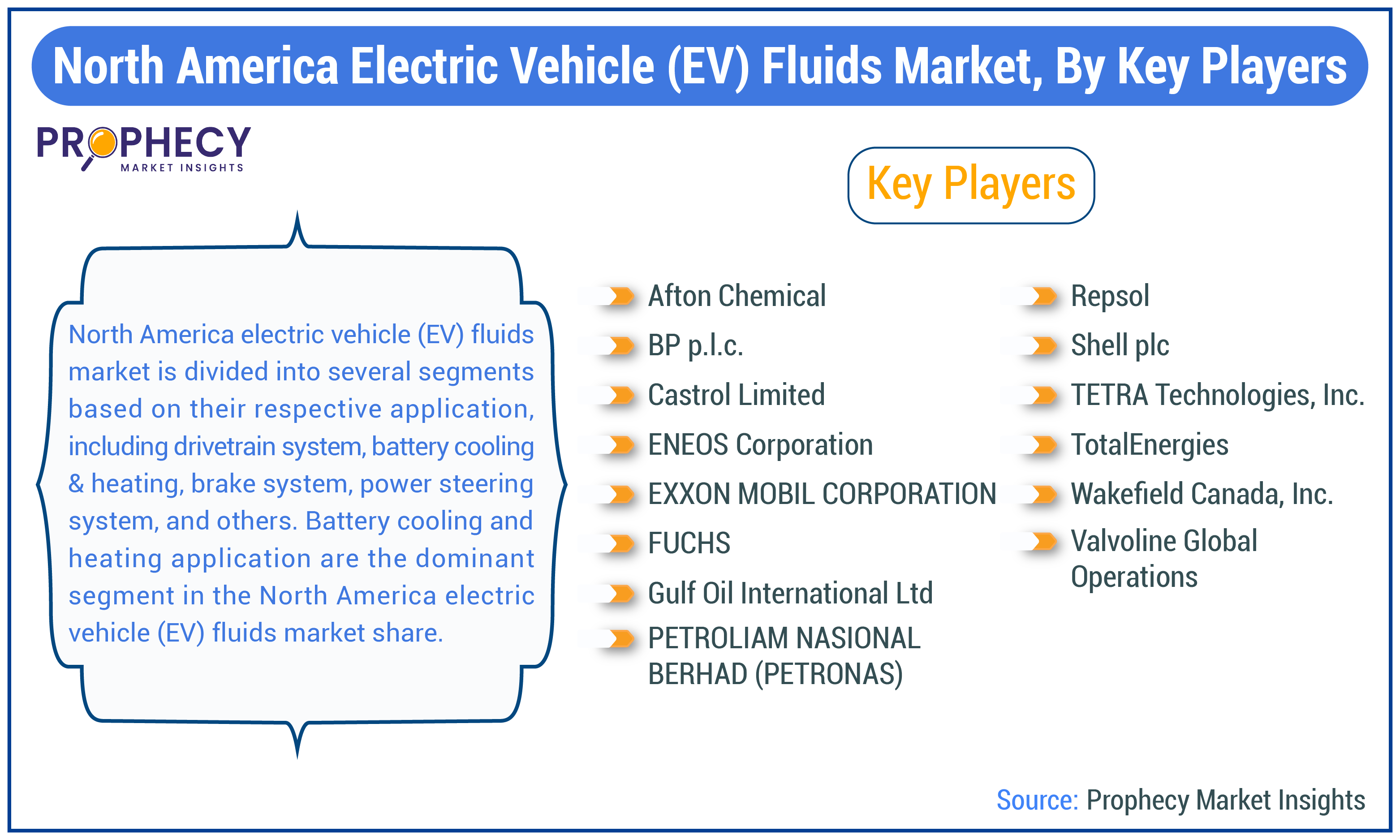
North America electric vehicle (EV) fluids market is divided into several segments based on their respective application, including drivetrain system, battery cooling & heating, brake system, power steering system, and others. Battery cooling and heating application are the dominant segment in the North America electric vehicle (EV) fluids market share. Effective thermal control is crucial to maintaining battery safety, performance and lifetime, especially when EV -s move towards faster charging and higher energy density.
The Drivetrain system is the second dominant application segment in the EV Fluids market. As EVs use high-speed electric motors and compact e-axles, there is an increasing need for specialized transmission fluids and lubricants that provide both cooling and insulation.
By Distribution Channel:
North America electric vehicle (EV) fluids market distribution channel includes OEMs (original equipment manufacturers), and aftermarket. OEMs (original equipment manufacturers) represent the dominant distribution channel in the North America electric vehicle (EV) fluids market size. Most EV fluids are originally filled with mounting vehicles, making OEMs the primary demand source, especially for products such as battery ball, e-axis coolants and dielectric lubricants.
Aftermarket is the second dominant distribution channel in the North America electric vehicle fluid market growth with its significance constantly growing as the global EV fleet ages. As several EVs when decay and starting guarantee periods, independent service providers and dealers begin to play a larger role in fluid service.
By Country:
On the virtue of country, the market is categorized into U.S. and Canada. With the greatest regional market share, the U.S. leads the North America electric vehicle (EV) fluids market size. The U.S. quick rise in EV adoption it reached a 9.1% market share in 2023 with over 1.4 million new EV sales is what propels this leadership. Major OEMs and fluid manufacturers such as ExxonMobil, Valvoline, and Shell are based in the nation and are making significant investments in EV-specific fluids designed for electric drivetrains and thermal management.
North America Electric Vehicle (EV) Fluids Market Report Scope:
|
Attribute |
Details |
|
Market Size 2025 |
USD 0.6 Billion |
|
Projected Market Size 2035 |
USD 7.0 Billion |
|
CAGR Growth Rate |
28.01% (2025-2035) |
|
Base year for estimation |
2024 |
|
Forecast period |
2025 – 2035 |
|
Market representation |
Revenue in USD Billion & CAGR from 2025 to 2035 |
|
Regional scope |
North America - U.S. and Canada |
|
Report coverage |
Revenue forecast, company share, competitive landscape, growth factors, and trends |
Segmentation:
By Product:
- Engine Oil
- Coolant
- Transmission Fluid
- Greases
- Others
By Propulsion Type:
- Battery Electric Vehicle (BEV’s)
- Hybrid Electric Vehicle (HEV’s)/ Plug-in Hybrid Electric Vehicle (PHEV’s
By Application:
- Drivetrain System
- Battery Cooling & Heating
- Brake System
- Power Steering System
- Others
By Distribution Channel:
- OEMs (Original Equipment Manufacturers)
- Aftermarket
By Country:
- U.S.
- Canada
North America Electric Vehicle Ev Fluids Market Competitive Landscape & Key Players
The key players operating in the North America electric vehicle (EV) fluids market include, Afton Chemical, BP p.l.c.?, Repsol, EXXON MOBIL CORPORATION, FUCHS, and others. North American companies are making heavy investments in R&D to develop Battery cooling, e-axels and high-voltage insulation for high-voltage insulation. Automakers, strategic cooperation with product innovation and stability initiatives are major competitive strategies; while emerging regional players are gaining land through cost -effective and environmentally friendly offerings.
North America Electric Vehicle (EV) Fluids Market Companies:
- Afton Chemical
- BP p.l.c.
- Castrol Limited
- ENEOS Corporation
- EXXON MOBIL CORPORATION
- FUCHS
- Gulf Oil International Ltd
- PETROLIAM NASIONAL BERHAD (PETRONAS)
- Repsol
- Shell plc
- TETRA Technologies, Inc.
- TotalEnergies
- Valvoline Global Operations
- Wakefield Canada, Inc.
North America Electric Vehicle Ev Fluids Market Recent News
- In July 2025, TotalEnergies Marketing Canada launched this advanced synthetic EV fluid, and became the first major supplier in Canada which is TotalEnergies Quartz EV?Drive?R 3.1 to offer such a product that is specially tailored for electrical drive systems.
- In October 2024, Prestone products introduced three new cooling agents with low fitness for electrified vehicles (including GVs, PHEVs and hydrogen fuel cell cars) on Battery Show Detroit. These fluids are designed to improve safety by reducing thermal running risk and preventing corrosion in high voltage power electronics.
- In July 2022, Wakefield Canada Inc. announced the launch of Castrol ON, Castrol's new range of e-Fluids for electric mobility, including e-Greases, e-Thermal Fluids, and e-Transmission Fluids. The new Castrol ON range offers OEM partners and consumers a full range of advanced e-Fluids to meet the challenging technical demands of current and future electric vehicles.
Analyst View:
EV fluids market as a fast -growing segment, which is ready for long -term growth, which is driven by a global shift to electricity. The market is still at an early stage compared to traditional lubricants; industry experts highlight the increasing demand for high specific formulations that consider the unique thermal and electrical requirements of EV systems. Analysts also note that when OEM is pushing for faster charging, higher performance and extended battery life, the role of the fluid in system efficiency and safety will be even more critical.
More Related Reports
Electric Vehicle (EV) Fluids Market
Silicone in Electric Vehicles Market
Electric Vehicle Battery Market
Electric Commercial Vehicle Market
Asia Pacific Electric Vehicle (EV) Fluids Market
North America Electric Vehicle Ev Fluids Market Company Profile
|
Company Name |
CASTROL LIMITED |
|
Headquarter |
Boston, |
|
CEO |
H. Lawrence Culp Jr. |
|
Employee Count |
125,000 Employees |
FAQs
North America electric vehicle (EV) fluids market size was valued at USD 0.6 Billion in 2025 and is expected to reach USD 7.0 Billion by 2035 growing at a CAGR of 28.01%.
Product, propulsion type, application, distribution channel and country are the segmentation for the target market.
The market is segmented by countries U.S., and Canada. U.S. is expected to dominate the Market.
The key players operating the North America electric vehicle (EV) fluids market include Afton Chemical, BP p.l.c., Castrol Limited, ENEOS Corporation, EXXON MOBIL CORPORATION, FUCHS, Gulf Oil International Ltd, PETROLIAM NASIONAL BERHAD (PETRONAS), Repsol, BP p.l.c., Shell plc, TETRA Technologies, Inc., TotalEnergies, Valvoline Global Operations, and Wakefield Canada, Inc.