Asia Pacific Electric Vehicle Ev Fluids Market Overview
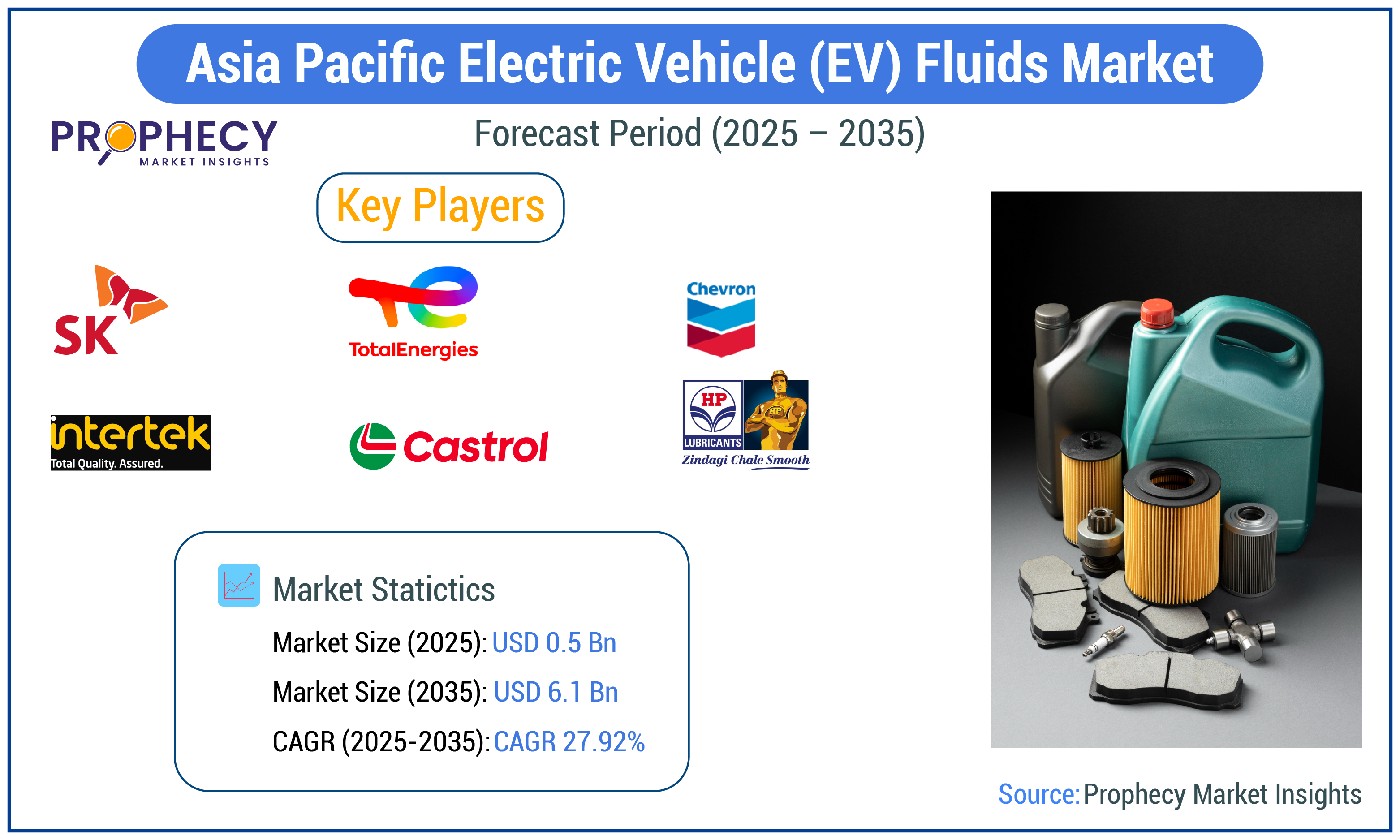
- By 2035, the Asia Pacific electric vehicle (EV) fluids market size is contemplated to enlarge at a valuation of USD 6.1 Billion.
- In 2025, the Asia Pacific electric vehicle (EV) fluids market valuation was USD 0.5 Billion.
- Asia Pacific electric vehicle (EV) fluids market is developing at a CAGR of 27.92%.
Electric Vehicle (EV) fluids are very complex liquids made for special purposes. They are the main tools to cool, isolate and lubricate the parts of EV like electric motors, batteries, and power electronics. In contrast to standard fluids, they have a unique design for working in systems with high voltage and high efficiency to manage heat, reduce friction and protect the most sensitive parts from a short circuit. The benefits of EV fluids are not limited to maintenance EV fluids are the leading system to improve vehicle life, better charging, and safety and reliability for electric mobility in.
The Asia-Pacific electric vehicle (EV) fluids market is booming. This is because people in countries such as China, India, and Thailand are buying many electric cars. The governments of these countries are giving money and making rules that help the electric car market. Companies are making new kinds of fluids that are good for the earth and use a little bit of nanotechnology. These new fluids help electric cars to run better and use less power. Additionally, expanding EV infrastructure and China's leadership in EV production is promoting consumer confidence and causing large -scale demand for high -performing fluids throughout the region.
The future of the Asia-Pacific electric vehicle (EV) fluid market is highly promising, which is inspired by the leadership of the region in EV production, strong government support and advanced thermal and driving liquids. Countries such as China, India and Japan are investing in the next generation battery and fast-charging techniques, causing high performance, increasing requirement of heat-resistant fluids. Hotter climate and urban pollution concerns are also intensifying innovation in thermal management solutions, region's position for strong market growth in the coming years.
Recession Risk and Tariff Analysis:
- The Asia-Pacific electric vehicle (EV) fluid markets face challenges due to the risk of recession and global tariff pressure. Slowing economic growth in the region is reducing consumer expenses and EV demand, while the U.S. and Europe are motivated by the U.S. and Europe to move high tariff Chinese vehicle manufacturers to move production in Southeast Asia, leading to overcapacity and pricing pressure. These factors can cause short-term instability in the regional EV market, which affect the stable increase of demand for EV fluid despite long -term adopted trends.
Impact of Generative AI on Asia Pacific Electric Vehicle (EV) Fluids Market:
- Generative Al is leading the way in the Asia-Pacific electric vehicle (EV) fluids market, transforming it with the rapid development of cutting-edge, region-specific fluids. Al is being employed by businesses for the effective and quick simulation of fluid properties which in turn enhances thermal performance, efficiency, and eco-friendliness.
- Such a feature is particularly beneficial in the APAC region, where the climate varies widely. It allows producers to provide bespoke, top-grade electric vehicle fluids that not only satisfy the rising need but also are made with less effort.
Asia Pacific Electric Vehicle Ev Fluids Market Drivers & Restraints
Key Drivers:
High EV Production Capacity are One of the Factor on which Market is Dependent for the Growth
High EV production capacity in the Asia-Pacific region, particularly in countries such as China, Japan and South Korea, is one of the primary factors driving the Asia Pacific electric vehicle (EV) fluids market to a large-scale demand for specialized fluids for use in manufacturing. Because these countries are acting as the global centers for EV assembly and exports, the requirement for coolants, lubricants, and thermal management fluids is increasing along with vehicle output. This manufacturing volume is great for OEM partnerships with fluid suppliers, but it also energizes the regional innovation and large volume procurement, in the end leading to the quickening of fluid consumption and market spread throughout the region.
- For Instance, according to the data published by S&P Global Mobility, India’s 2024 passenger EV production has increased by 22.5% year-over-year, to about 125,500 units. Total electric passenger vehicle production in India to surge to approximately 1.33 million units by 2030, accounting for about 20% of total passenger vehicle production in the country.
Restrains:
The Market Growth can be Restricted by lack of Awareness about EV-Specific Fluids
EV-specific fluid knowledge absence in the Asia Pacific area consumer, mechanic, and service center tripled is one of the main reasons for faulty maintenance of electric cars and the inability of these vehicles to perform at their best. The majority of users are still accustomed to believing merely that traditional automotive fluids are enough, which causes the electric vehicle to lose its efficiency, to be exposed to safety risks, and to have worn components of the vehicle.
- Counterbalance Statements: Product education campaigns by vehicle manufacturers, and fluid companies should be designed to teach technicians. They should also be supported by technician instruction, a labeling system that is easier to comprehend, and usage guidelines. Working with dealers and the after-sales market to disseminate the needed information about electric vehicle fluids will help assure that the correct use and replacement of these special products will continue, thus making the vehicle stay healthy and the user trusts more.
Opportunities & Trends:
The Market can Experiencing Steady Growth in Upcoming Years due to Growth of Aftermarket Services
The expanding use of the aftermarket is developing as a significant trend for the Asia Pacific electric vehicle (EV) fluids market, with numerous electric vehicles being the primary drivers needing maintenance after the original fluid fill by the manufacturer. Maintenance demand for service-fill lubricants, coolants, and other fluids is increasing remarkably as the EV ownership cycle gets longer in the region. This trend is also endorsed by enlarging service networks and escalating consumer consciousness about the necessity of EV-specific fluid replacement, thereby transforming the aftermarket into a key contributor to the long-term growth of the market.
Asia Pacific Electric Vehicle Ev Fluids Market Segmentations & Regional Insights
Product, propulsion type, application, distribution channel, and country are the divisions of the Asia Pacific electric vehicle (EV) fluids market.
By Product:
Engine oil, coolant, transmission fluid, greases, and others are product including in the Asia Pacific electric vehicle (EV) fluids market. Since coolants are crucial for controlling the high heat produced by EV batteries, power electronics, and motors particularly in the hotter climates of India, Thailand, and Southeast Asia they occupy the biggest Asia Pacific electric vehicle (EV) fluids market share. Since many EVs still need specialist lubricants for single-speed and multi-speed gear systems to reduce friction and maintain smooth power delivery especially in high-traffic metropolitan situations including those found in Asia transmission fluids are the second-dominant market.
By Propulsion Type:
Battery electric vehicle (BEV’s), and hybrid electric vehicle (HEV’s)/ plug-in hybrid electric vehicle (PHEV’s) are propulsion type for which Asia Pacific electric vehicle (EV) fluids market is categorized. Battery Electric Vehicles (BEVs) have the largest Asia Pacific electric vehicle (EV) fluids market share for the reason of the region's vigorous push toward complete electrification, particularly in China, where BEVs account for the majority of new energy vehicle sales.
In places including Japan and India, where hybrids are a transitional technology, the second-dominant group is made up of hybrid and plug-in hybrid electric vehicles, or HEVs/PHEVs.
By Application:
Drivetrain system, battery cooling & heating, brake system, power steering system, and others are application of the Asia Pacific electric vehicle (EV) fluids market. Battery cooling and heating accounts for the biggest Asia Pacific electric vehicle (EV) fluids market share given that thermal management is essential to preserving battery longevity, safety, and efficiency, particularly in the region's diverse and frequently hot climates.
The second-dominant use is the drivetrain system since EVs still need certain transmission fluids and lubricants to reduce friction and provide smooth power delivery, especially in crowded cities with plenty of stop-and-go traffic.
By Distribution Channel:
By distribution channel, the market is categorized into OEMs (original equipment manufacturers), and aftermarket. In the Asia Pacific electric vehicle (EV) fluids market, OEMs (Original Equipment Manufacturers) retain the greatest Asia Pacific electric vehicle (EV) fluids market share, since most EV fluids are initially supplied during vehicle assembly to match manufacturer criteria for performance, warranty, and safety.
As the local EV fleet ages and needs regular fluid replacement and maintenance, the aftermarket the second-dominant channel is expanding quickly.
By Country:
On the virtue of country, the market is categorized into China, India, Japan, Australia, Indonesia, Malaysia, South Korea, and Rest of Asia Pacific. China's dominance in EV production, sales, and infrastructure has led to it holding the largest Asia Pacific electric vehicle (EV) fluids market share. There is a huge need for specialist fluids including coolants, lubricants, and thermal interface materials since China is the largest EV market in the world and leads in the adoption of both passenger and commercial EVs.
Asia Pacific Electric Vehicle (EV) Fluids Market Report Scope:
|
Attribute |
Details |
|
Market Size 2025 |
USD 0.5 Billion |
|
Projected Market Size 2035 |
USD 6.1 Billion |
|
CAGR Growth Rate |
27.92% (2025-2035) |
|
Base year for estimation |
2024 |
|
Forecast period |
2025 – 2035 |
|
Market representation |
Revenue in USD Billion & CAGR from 2025 to 2035 |
|
Regional scope |
Asia Pacific – China, India, Japan, Australia, Indonesia, Malaysia, South Korea, and Rest of Asia Pacific |
|
Report coverage |
Revenue forecast, company share, competitive landscape, growth factors, and trends |
Segmentation:
By Product:
- Engine Oil
- Coolant
- Transmission Fluid
- Greases
- Others
By Propulsion Type:
- Battery Electric Vehicle (BEV’s)
- Hybrid Electric Vehicle (HEV’s)/ Plug-in Hybrid Electric Vehicle (PHEV’s)
By Application:
- Drivetrain System
- Battery Cooling & Heating
- Brake System
- Power Steering System
- Others
By Distribution Channel:
- OEMs (Original Equipment Manufacturers)
- Aftermarket
By Country:
- China
- India
- Japan
- Australia
- Indonesia
- Malaysia
- South Korea
- Rest of Asia-Pacific
Asia Pacific Electric Vehicle Ev Fluids Market Competitive Landscape & Key Players
Investing in R&D for sophisticated, climate-specific formulations, establishing alliances with regional EV manufacturers, growing regional production facilities, and focusing on the rapidly expanding aftermarket segment through service network partnerships and consumer education are some of the key growth strategies for electric vehicle (EV) fluids companies in the Asia Pacific region. The key players operating in the Asia Pacific electric vehicle (EV) fluids market include, GS Caltex India?, HP LUBRICANTS, TotalEnergies, ENEOS Corporation, and others.
Asia Pacific Electric Vehicle (EV) Fluids Market Companies:
- SK Inc.
- GS Caltex India
- S-OIL
- Idemitsu Kosan Co., Ltd.
- TotalEnergies
- ENEOS Corporation
- Chevron
- Gulf Oil International Ltd
- HP Lubricants
- Castrol
- Intertek Group plc
- Valvoline Global Operations
- Petroliam Nasional Berhad (PETRONAS)
Asia Pacific Electric Vehicle Ev Fluids Market Recent News
- In November 2022, A subsidiary of TotalEnergies, TotalEnergies Marketing India Private Limited (TEMIPL), is introducing new EV Fluid lines for electric and hybrid vehicles as well as electric motorcycles in India. The new product lines, Hi-Perf EV Fluid for bikes and Quartz EV Fluid for automobiles, were created especially for use with batteries, e-motors, e-transmissions, and drivetrain reducers in electric and hybrid vehicles.
Analyst View:
Electric vehicle (EV) fluids are sophisticated, specially made liquids that are intended to cool, insulate, and lubricate important EV parts, such as motors and batteries, improving longevity, safety, and efficiency. The market for EV fluids is expanding quickly in the Asia-Pacific area as a result of rising EV adoption in nations such as China, India, and Thailand, which is aided by growing infrastructure and government incentives. Businesses are experimenting with environmentally friendly and nanotechnology-based fluids to boost energy efficiency and performance. The area is well-positioned for robust, long-term market expansion due to increased investments in fast-charging systems and improved batteries as well as issues with pollution and the climate.
More Related Reports
Electric Vehicle (EV) Fluids Market
Silicone in Electric Vehicles Market
Electric Vehicle Battery Market
Electric Commercial Vehicle Market
EV Charging Software Market
Asia Pacific Electric Vehicle Ev Fluids Market Company Profile
|
Company Name |
HP Lubricants |
|
Headquarter |
Mumbai, India |
|
CEO |
Deep Malhotra |
|
Employee Count |
8,504 Employees |
FAQs
Asia Pacific electric vehicle (EV) fluids market size was valued at USD 0.5 Billion in 2025 and is expected to reach USD 6.1 Billion by 2035 growing at a CAGR of 27.92%.
Product, propulsion type, application, distribution channel, and country are the segmentation for the target market.
The market is segmented by countries China, India, Japan, Australia, Indonesia, Malaysia, South Korea, and Rest of Asia Pacific. China region is expected to dominate the Market.
The key players operating the Asia Pacific electric vehicle (EV) fluids market include SK Inc., GS Caltex India, S-OIL, Idemitsu Kosan Co., Ltd., TotalEnergies, ENEOS Corporation, Chevron, Gulf Oil International Ltd, HP Lubricants, Castrol, Intertek Group plc, Inspire Fitness, Valvoline Global Operations, and Petroliam Nasional Berhad (PETRONAS).