Nano Metal Oxide Market Overview
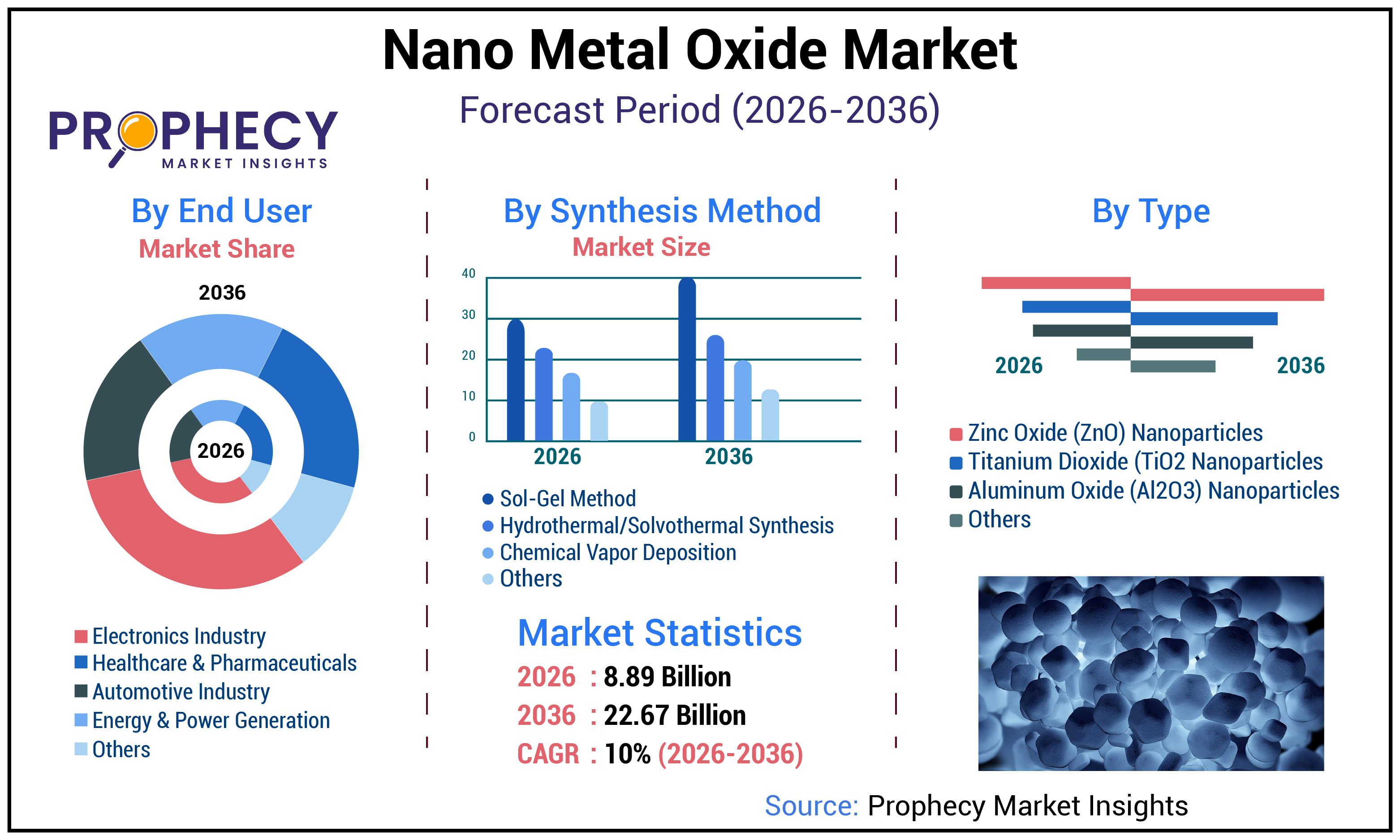
- 2025 Market Size: USD 8.08 Billion
- 2036 Projected Market Size: USD 22.67 Billion
- CAGR (2026-2036): 10%
- Asia Pacific: Largest Market in 2025
One of the indispensable parts of nanotech is nanometal oxides—ultra-fine metal oxide particles that generally vary from 1 to 100 nanometers in size and have better physical, chemical, and mechanical properties than their bulk equivalents. Here are a few examples ZnO—nano zinc oxide, TiO?—titanium dioxide, and Fe?O?—iron oxide that, together with other substances, give a vast number of advantages such as a high surface area, strong catalytic activity, and excellent UV protection, good electrical and thermal conductivity, and enhanced antimicrobial and photocatalytic properties. Consequently, they are becoming a necessity in a vast number of application sectors such as electronics, energy storage, coatings, healthcare, and the environment.
The rise of a nano metal oxide market is basically a consequence of a higher demand for advanced materials of a superior performance in a wide range of industries, for instance, electronics, energy, healthcare, and coatings. The huge consumption in application areas such as sensors, batteries, sunscreens, and catalysts along with fast industrialization, miniaturization of devices, and the overall trend of green technologies is the market expansion.
Besides that, there are a lot of factors such as the progress in nanotechnology, the increase in R&D investments, and the global request for high-efficient, eco-friendly materials that are contributing to the growth of this market all over the world.
Advance Green Approaches for Nano Metal Oxide:
- Advanced green approaches to the production of nano metal oxides involve the development of environmentally safe and sustainable methods of synthesis that avoid the use of toxic chemicals and limit energy consumption.
- Among these are biosynthesis methods that utilize plant extracts, microorganisms, and natural polymers as reducing and stabilizing agents, as well as sol–gel and hydrothermal processes performed under mild conditions.
- These environmentally friendly measures, in addition to lessening the impact on the environment, enable a finer control of particle size, shape, and purity.
- The implementation of these green methods is in line with the increasing need for sustainable nanomaterial in such industries as healthcare, energy, and environmental remediation.
Current Industry Dynamics & Insights:
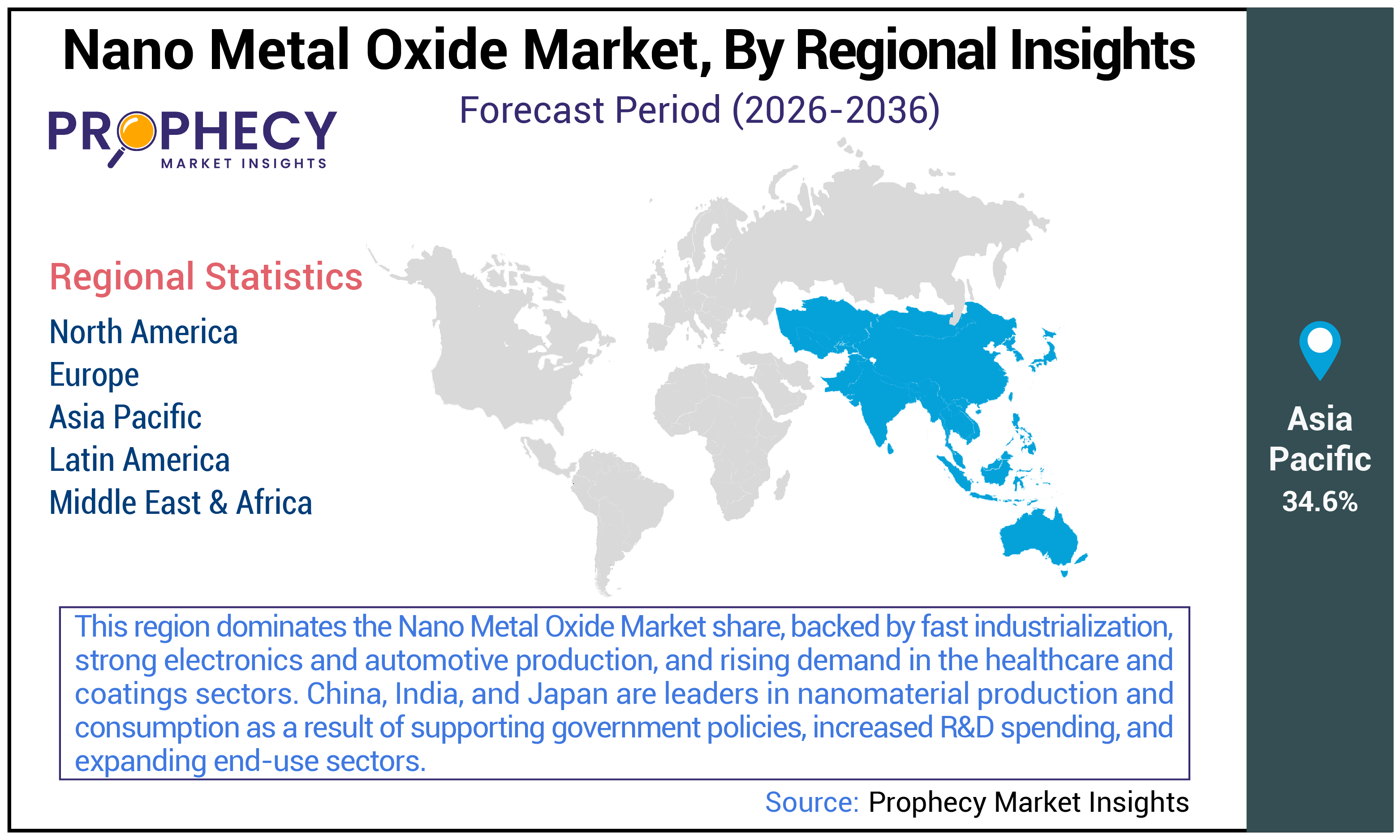
- Asia Pacific has the largest regional share in the market, with almost 34.6%.
- North America is second dominating region in the market.
- By type, zinc oxide (ZnO) nanoparticles dominates the nano metal oxide market share.
Nano Metal Oxide Market Drivers & Restraints
Drivers and Restraints:
|
Drivers |
Restraints |
Opportunities & Trends |
|
|
|
Key Drivers:
Rapid Industrialization in Emerging Economies
Following the fast industrialization in the developing countries, the nano metal oxide market is positively influenced as the need for advanced materials in various sectors such as electronics, automotive, energy, and construction is raised. The growing manufacturing hubs and infrastructure projects in India, China, and Brazil are generating a robust demand for performance-enhancing coatings, catalysts, and sensors that are made using nano metal oxides.
Moreover, the higher expenditure on R&D, the increased awareness among consumers, and the government programs encouraging the use of eco-friendly technologies are some of the factors that are leading to the rapid deployment of these materials in the industries and the commercial sectors.
- For Instance, according to the data published by United Nations Industrial Development Organization, globally, there was a 2.3% growth in industrial sectors, encompassing manufacturing, mining, electricity, water supply, waste management, and other utilities, signaling a post-pandemic recovery. Manufacturing accounted for most of this dynamism, with an increase of 3.2%, while the combined mining and utilities sector—the largest contributor to the economy in low-income countries—contracted by 8.89%.
Restraints:
Complex Regulatory and Safety Frameworks
Various regulatory and safety frameworks that are intricately designed tend to slow down the growth of the Nano Metal Oxide market by the reason that they create barriers for commercialization, lengthen approval timelines, and increase compliance costs for manufacturers. The strict regulation sets related to toxicity, environmental impact, and human exposure that it becomes quite difficult to develop and market new nanomaterial anywhere in the world.
- Counterbalance Statements: Yet, this restriction may be overcome by means of safety assessments that are standardized, by the international harmonization of the regulations applicable to nanomaterial and by the increased openness of the research data. The collaboration between industry, governments, and research institutions can, therefore, also contribute to the establishment of safety protocols that are clear, thus facilitating the responsible development and at the same time, supporting the expansion of the market.
Opportunities & Trends:
Rising Use in Smart Textiles and Advanced Packaging
Among the most notable future trends that will heavily influence the market is the growing application of nano metal oxides in smart textiles and advanced packaging. The trend is largely driven by their unique antibacterial, UV-protective, and barrier-enhancing properties. For instance, nano metal oxides such as ZnO and TiO in smart textiles help achieve the functionalities of self-cleaning, odor resistance, and temperature regulation, thereby fabric performance gets enhanced.
Thus, these materials not only make the fabric self-cleaning but also render it odor-resistant and temperature-regulating. Alongside these, the nano metal oxides impart strength to the material adding to its durability. Likewise, they are used in packaging to extend the shelf life of products, provide antimicrobial protection, and improve packaging material's mechanical strength.
Nano Metal Oxide Market Segmentations & Regional Insights
Type, synthesis method, end user, and region are the divisions of the nano metal oxide market.
By Type:
Based on the type, the nano metal oxide market is divided into zinc oxide (ZnO) nanoparticles, titanium dioxide (TiO?) nanoparticles, aluminum oxide (Al?O?) nanoparticles, and others. Zinc Oxide (ZnO) nanoparticles have the greatest nano metal oxide market share due to its widespread use in electronics, cosmetics, and coatings, which are fueled by outstanding UV-blocking, antibacterial, and photo catalytic capabilities. Their widespread use in the sunscreen, paint, and rubber sectors reinforces their supremacy.
Titanium Dioxide (TiO?) nanoparticles are the second most common form. They are widely used in photocatalysis, solar cells, environmental purification, UV protection, and self-cleaning coatings. ZnO and TiO? are widely used and approved in several industries.
By Synthesis Method:
On the account of synthesis method, the nano metal oxide market can be categorized into sol-gel method, hydrothermal/solvothermal synthesis, chemical vapor deposition, and others. The Sol-Gel technology dominates the nano metal oxide market share due to its low cost, simplicity, and ability to manufacture homogeneous nanoparticles of high purity and regulated size at low temperatures. It is commonly used to synthesize oxides such as TiO?, ZnO, and Al?O? for coatings, sensors, and catalysts.
The Hydrothermal/Solvothermal synthesis process is ranked second since it provides perfect control over particle morphology and crystallinity, making it appropriate for high-performance applications in energy storage, catalysis, and electronics. Its scalability and environmentally beneficial qualities contribute to its expanding industrial adoption.
By End User:
Electronics industry, automotive industry, healthcare & pharmaceuticals, energy & power generation, and others are end users of the nano metal oxide market. The Electronics industry dominates the nano metal oxide market share, owing to the widespread usage of materials as ZnO, TiO?, and Al?O? nanoparticles in semiconductors, sensors, transparent conductive films, and electronic coatings. Their excellent electrical, optical, and thermal qualities make them indispensable for compact and high-performance electronic devices.
The Healthcare & Pharmaceuticals sector is the second-largest end user, driven by the growing use of nano metal oxides in medication delivery, imaging, diagnostics, and antimicrobial coatings. Growing healthcare breakthroughs and biocompatibility developments are driving up usage in this segment.
Regional Insights:
Geographically, the nano metal oxide market is studied across North America, Europe, Asia Pacific, Latin America, and the Middle East & Africa.
Asia Pacific: This region dominates the nano metal oxide market share, backed by fast industrialization, strong electronics and automotive production, and rising demand in the healthcare and coatings sectors. China, India, and Japan are leaders in nanomaterial production and consumption as a result of supporting government policies, increased R&D spending, and expanding end-use sectors.
- China Nano Metal Oxide Market Insights:
China leads the Asia-Pacific Nano Metal Oxide market due to its large-scale manufacturing capabilities, huge electronics and automotive sectors, and strong government funding for nanotechnology research and industrial applications.
North America: This is the second most important region, due to superior technological infrastructure, widespread acceptance of nano-enabled goods in electronics, energy, and healthcare, and a strong emphasis on innovation and sustainability in materials science.
- U.S. Nano Metal Oxide Market Insights:
North America's market is dominated by the United States, which is fueled by advanced R&D infrastructure, widespread adoption of nano-enabled materials in healthcare, electronics, and energy, and a strong presence of leading market participants investing in breakthrough nanomaterial technology.
Europe: The nano metal oxide market in Europe is expanding due to rising demand for sophisticated materials in electronics, automotive, energy storage, and healthcare, as well as strong governmental backing for environmentally acceptable nanomaterial.
- Germany Nano Metal Oxide Market Insights:
Germany dominates the European market due to its strong industrial foundation, leadership in automotive and electronics manufacture, and considerable research and development in nanotechnology applications.
Nano Metal Oxide Market Report Scope:
|
Attribute |
Details |
|
Market Size 2026 |
USD 8.89 Billion |
|
Projected Market Size 2036 |
USD 22.67 Billion |
|
CAGR Growth Rate |
10% (2026-2036) |
|
Base year for estimation |
2025 |
|
Forecast period |
2026 – 2036 |
|
Market representation |
Revenue in USD Billion & CAGR from 2026 to 2036 |
|
Regional scope |
North America - U.S. and Canada Europe – Germany, U.K., France, Russia, Italy, Spain, Netherlands, and Rest of Europe Asia Pacific – China, India, Japan, Australia, Indonesia, Malaysia, South Korea, and Rest of Asia-Pacific Latin America - Brazil, Mexico, Argentina, and Rest of Latin America Middle East & Africa – GCC, Israel, South Africa, and Rest of Middle East & Africa |
|
Company Landscape |
Market Share Analysis of Companies Heat Map Analysis Company Overview, Products Overview Financial Information, Key Highlights Business Strategies Overview SWOT Analysis |
|
Report coverage |
Revenue forecast, company share, competitive landscape, growth factors, and trends |
|
Value Added Data Infosets |
Besides fundamental market insights such as the size of the market, growth rate, segmentation, regional study, and key players, our reports carry value-added data sets such as trade flow (import-export) analysis, production and consumption overview, price trend evaluation, supply and value chain mapping, and raw material availability. Moreover, we provide strategic tools as PESTLE and Porter’s Five Forces analysis, examination of the regulatory landscape, as well as monitoring of technology and innovation thereby providing a comprehensive overview which facilitates sensible and anticipatory decision-making. |
Segmentation:
By Type:
- Zinc Oxide (ZnO) Nanoparticles
- Titanium Dioxide (TiO?) Nanoparticles
- Aluminum Oxide (Al?O?) Nanoparticles
- Others
By Synthesis Method:
- Sol-Gel Method
- Hydrothermal/Solvothermal Synthesis
- Chemical Vapor Deposition
- Others
By End User:
- Electronics Industry
- Automotive Industry
- Healthcare & Pharmaceuticals
- Energy & Power Generation
- Others
By Region:
- North America
- U.S.
- Canada
- Europe
- Germany
- U.K.
- France
- Russia
- Italy
- Spain
- Netherlands
- Rest of Europe
- Asia Pacific
- China
- India
- Japan
- Australia
- Indonesia
- Malaysia
- South Korea
- Rest of Asia Pacific
- Latin America
- Brazil
- Mexico
- Argentina
- Rest of Latin America
- Middle East & Africa
- GCC
- Israel
- South Africa
- Rest of Middle East & Africa
Nano Metal Oxide Market Competitive Landscape & Key Players
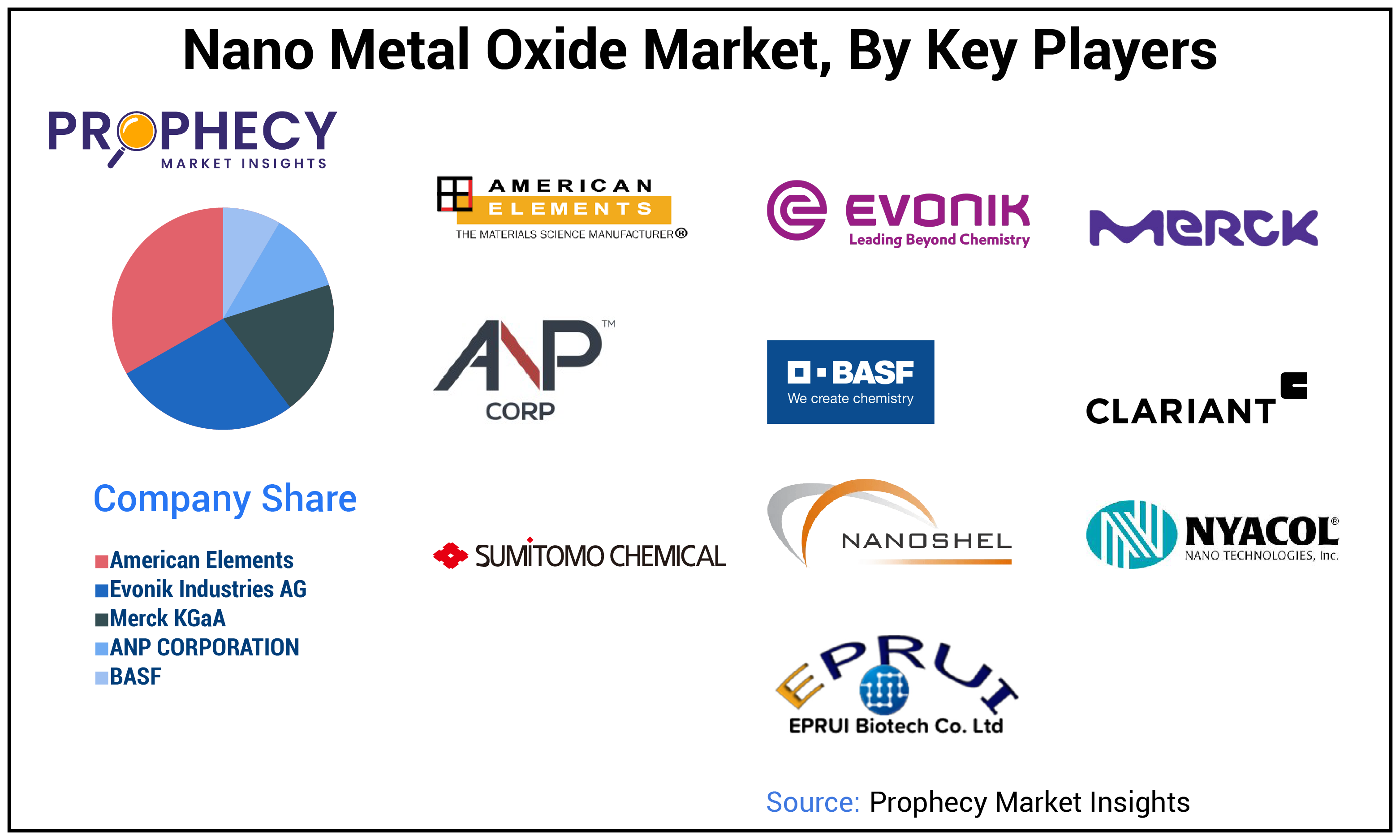
Nano metal oxide companies' key growth strategies include investing in R&D to develop high-performance and eco-friendly nanoparticles, using green and cost-effective synthesis methods, and expanding product portfolios to serve a wide range of end-use industries such as electronics, healthcare, and energy. Companies can also pursue strategic alliances, mergers, and acquisitions to improve technological capabilities and market reach, while focusing on new regions with rapid industrialization.
Nano Metal Oxide Market Companies:
- American Elements
- Evonik Industries AG
- Merck KGaA
- ANP CORPORATION
- BASF
- Ssnano.com
- US Research Nanomaterials, Inc.
- Nanoshel LLC
- Hongwu International Group Ltd
- NYACOL Nano Technologies Inc.
- Nanostructured & Amorphous Materials, Inc.
- CLARIANT
- Sumitomo Chemical Co., Ltd.
- EPRUI Biotech Co.,Ltd.
- Cerion, LLC
View an Additional List of Companies in the Nano Metal Oxide Market
Nano Metal Oxide Market Recent News
- In November 2025, the researchers created a novel chemical called CDV-CeO2 NPs by loading cidofovir onto green-synthesized cerium oxide nanoparticles (nanoceria). This technique combines the drug's antiviral and anticancer capabilities with nanoceria's biological activity, which is known for its antioxidant, anti-inflammatory, and tumor-targeting abilities. To avoid harmful chemicals, the nanoparticles were manufactured with quince fruit peel extract, making the method more environmentally friendly and appropriate for medical purposes.
Analyst View:
Nano metal oxides, such as ZnO, TiO?, and Fe?O?, are ultra-fine particles (1-100 nm) with excellent physical, chemical, and mechanical properties. These include high surface area, catalytic activity, UV protection, conductivity, and antibacterial effects.
Their superior performance drives extensive adoption in electronics, energy storage, coatings, healthcare, and environmental applications. Rising demand for sophisticated, high-efficiency, and environmentally friendly materials, greater industrialization, device miniaturization, green technology adoption, and increasing R&D investments in nanotechnology are driving market expansion.
Analysis of Sources:
Primary Sources:
- In-depth interviews
- Company-specific data
- Surveys and questionnaires
- Focus group discussions (FGDs)
- Others
Secondary Sources:
- European Chemicals Agency (ECHA)
- U.S. Food and Drug Administration (FDA)
- U.S. Environmental Protection Agency (EPA)
- Others
More Related Reports
Nanosatellite and Microsatellite Market
Nanocellulose Market
Nanosensor Market
Carbon Nanotubes Market
Polymer Nanocomposite Market
Nano Metal Oxide Market Company Profile
|
Company Name |
Product Portfolio |
|
Evonik Industries AG |
Metal Oxides |
|
American Elements |
Aluminum Oxide Nanoparticles / Nanopowder |
|
Hongwu International Group Ltd |
Metal Nanoparticles, Oxide Nanoparticles |
|
BASF |
Nickel Cobalt Aluminum oxide and Nickel Cobalt Manganese oxide |
|
Nanoshel LLC |
Metal Oxide Nanoparticles |
Nano Metal Oxide Market Highlights
FAQs
Nano metal oxide market size was valued at USD 8.89 Billion in 2026 and is expected to reach USD 22.67 Billion by 2036 growing at a CAGR of 10%.
Type, synthesis method, end user, and region are the segmentation for the nano metal oxide market.
The expansion of electric vehicles and renewable energy systems, increasing urbanization, and the unique properties of nano metal oxides that enhance product performance, such as improved thermal stability, conductivity, and catalytic activity, and so on are some of the nano metal oxide market growth drivers.
North America, Asia Pacific, Europe, Latin America, and the Middle East & Africa. Asia Pacific is expected to dominate the nano metal oxide market.
The key players operating the nano metal oxide market include American Elements, BYD Europe B.V., Merck KGaA, ANP CORPORATION, BASF, Ssnano.com, US Research Nanomaterials, Inc., Nanoshel LLC, SilexPro, NYACOL Nano Technologies Inc., Nanostructured & Amorphous Materials, Inc., CLARIANT, Sumitomo Chemical Co., Ltd., EPRUI Biotech Co.,Ltd., and Cerion, LLC.