Mountain Bike Market Overview
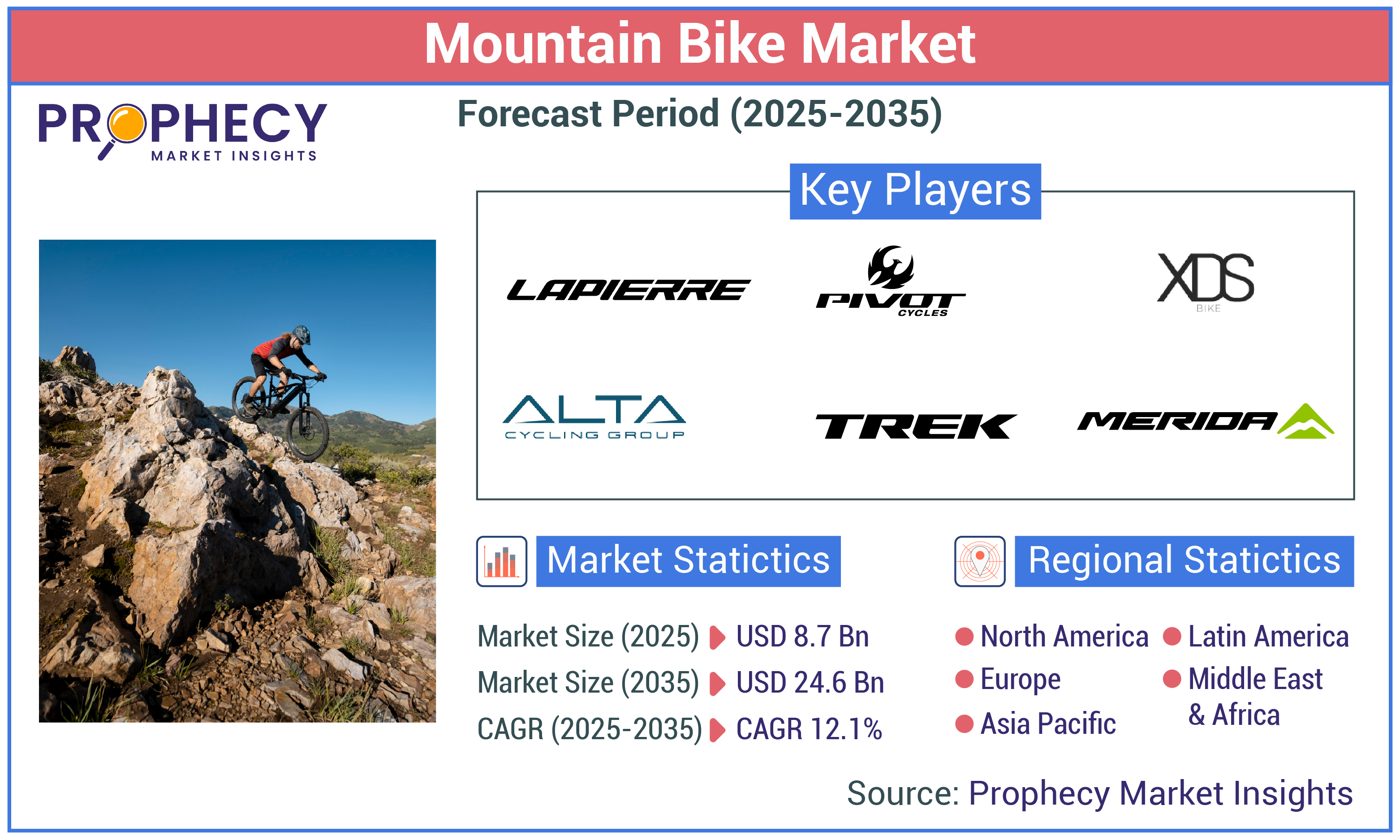
- By 2035, the mountain bike market size is contemplated to enlarge at a valuation of USD 24.6 Billion.
- In 2024, the mountain bike market valuation was USD 7.9 Billion.
- Mountain bike market is developing at a CAGR of 12.1%.
A mountain bike is a rugged bicycle designed for trails, dirt paths and off-road cycling on some area. It usually facilitates a strong frame, wide knob tire for better grip and suspension system to absorb shock. The benefits of mountain biking include improved heart health, increased power and endurance, better balance and coordination, stress reduction, and an opportunity to connect with nature enjoying a courageous and challenging form of exercise.
The mountain bike market has increased due to many convergence trends such as increasing interest in outdoor adventure and tourism, increasing health and environmental awareness, and increased disposable income to draw riders attracting riders in especially emerging economies. Progress in technology Lightweight carbon frames, better suspension, 1 × drivetrain, and e -MTB have increased by extending, extending, extending, comfort and access. Meanwhile, the expansion of trail infrastructure and organized programs continues to promote community and tourism development, further driving market expansion.
The future of the mountain bike market is booming by the increasing demand for electric mountain bikes (E-MTB), which increases consumer interest in customized and smart features such as GPS tracking and app-controlled suspension, and focuses on increasing stability. The progress in light content and battery technology with extended trail networks and outdoor tourism is also promoting global development-especially in North America, Europe and Asia-Pacific.
Recession Risk & Tariff Analysis:
- Mountain bike market is facing challenges from growing tariffs especially in the U.S., where import duties on bikes and components of countries such as China and Taiwan have increased significantly.
- Combined with comprehensive economic uncertainty and low consumer expenses, these tariffs are pressurizing manufacturers and retailers. As a result, bike prices are climbing, shipment is delayed, and industry experts warns a potential cycling market recession in the late 2020s.
Impact of Generative AI on Mountain Bike Market:
- Generative AI is beginning to impact the mountain bike market by streamlining generic AI design, adaptation and marketing. Brand AIs are used rapidly and to test frame geometry, optimize aerodynamics, and personalize the bike based on rider data. AI-operated equipment also enhances customer engagement through sewn product recommendations, immersive virtual tri-on and predictive maintenance alerts.
- Additionally, the generic AI supply chain accelerates modeling and tendency forecast, which helps manufacturers to customize quickly to market demands and helps reduce production costs - smarter, promoting industry for rapid innovation.
Mountain Bike Market Drivers & Restraints
Key Drivers:
The Market can be Foster by Increased Disposable Income in Developing Regions
Increased disposable income in developing areas allows more consumers to spend on entertaining and lifestyle products, including mountain bikes, which were previously considered as luxury or non-necessary objects. As an increase in income, people are more inclined to invest in health, fitness and external activities, leading to high demand for quality bikes and goods. This financial flexibility enables consumers to detect premium features such as electric-assist models, better suspension systems, and branded gear-encouraging local retailers and manufacturers to fulfill this growing customer segment.
- For Instance, according to a Euromonitor in November 2024, growth in Asia Pacific and North America is the main drivers of the 8.8% increase in worldwide disposable income in 2023. Disposable income is expected to increase by 2.6% by 2040, with rising and developing nations driving the increases. Compared to North America, Asia Pacific's consumer expenditure grew by 49.8% in real terms between 2023 and 2040. Although they will still lag behind China, developed Asian countries such as South Korea and Japan are predicted to lead a large increase in investment. The number of affluent people worldwide increased by 6.4% in 2023, mostly due to the influx of 2.4 billion people from the United States, Germany, the United Kingdom, and France.
Restraints:
The Market can be Disturb by Supply Chain Disruptions
Disintegration of supply chain in mountain bike market due to global events such as epidemic, trade war, or delay in shipping may lack major components such as frames, brakes, and drivetrains, resulting in delayed production and high retail prices. These issues often deteriorate with heavy dependence on suppliers in limited areas such as China or Taiwan.
- Counterbalance Statements: A potential solution is diversification of suppliers’ base in many countries, investing in local or regional manufacturing, and adopting digital supply chain technologies for better forecasts, inventory management and accountability demand for change.
Opportunities & Trends:
The Market will Experience Steady Growth in Future by Rapid e?MTB Innovation
The rapid innovation in the electric mountain bike (E-MTB) is changing the market by making the bike more powerful, light and efficient. The new model has high-torque motors, such as 120nm DJI AMFLOW Pl, and advanced lithium-ion batteries that expand the range and reduce charging time. These reform riders allow riders to deal with hard terrain with low efforts, appealing for a wide range of users, including older or less experienced bicycles. As motor and battery technologies continue to grow, e-MTBs are more integrated, greasy in design, and are better for both casual riders and serious off-road enthusiasts.
Mountain Bike Market Segmentations & Regional Insights
Product type, drive type, price range, application, distribution channel, and region are the divisions of the Mountain Bike Market.
By Product Type:
Cross country bikes, all mountain bikes, downhill bikes, freeride bikes, dirt jumping bikes, and others are product type on which mountain bike market is segmented. The market share of cross-country mountain bikes is the greatest in the world as they are lightweight, effective, and affordable for a variety of riders, from novices to experienced athletes. This makes them perfect for long-distance trail riding, and they have gained popularity via competitive XC events.
Just behind XC versions, All-Mountain bikes are the second-largest class. They appeal to riders who want adaptability on a variety of terrain by balancing climbing efficiency with superior downhill performance.
By Drive Type:
Based on the drive type, the mountain bike market is divided into standard mountain bikes, and electric mountain bikes (e-MTBs). Standard mountain bikes keep monopolizing the market given that they are the preferred option for both novices and die-hard aficionados for the reason to their price, ease of use, greater trail access, and appropriateness for workouts and technical riding.
Although they are somewhat constrained by higher price points and trail-use restrictions, electric mountain bikes (e-MTBs) are the second-largest segment and are growing quickly due to advancements in motor and battery technology that make them more capable, enjoyable, and accessible, especially for older or less experienced riders.
By Price Range:
Budget/entry-level, mid-range, and premium/pro-level are price range of the mountain bike market. Since the mid-range price range offers the best balance between price and performance, it has the biggest mountain bike market share, accounting for almost 50% of total sales. Without having to pay the high price of pro-tier bikes, riders in this bracket may enjoy high-quality parts including air suspension, disc brakes, and lighter frames.
With about 30–40% of unit sales, entry-level/budget is the second-largest sector, particularly in emerging economies. New riders and casual users looking for entry-level bikes at reasonable costs are drawn to these reasonably priced models.
By Application:
Leisure & adventure riding, sports & racing, freestyle & stunt riding, and others are application of the Mountain Bike Market. The leisure and adventure riding has the most mountain bike market share given that it appeals to a wider range of consumers, such as families, casual riders, and fitness enthusiasts who ride for fun, relaxation, and discovery rather than competitiveness.
Due to the prominence of organized events and riders purchasing performance-focused bikes for disciplines including XC, DH, and enduro, sports & racing (competition applications) is the second-largest market.
By Distribution Channel:
The mountain bike market on the account of distribution channels are categorized into online retail, and offline retail. Due to the nature of the product especially for mid-range and luxury bikes customers frequently want to physically examine, test ride, and obtain professional advice before making a purchase, which is why offline retail has the greatest market share in the mountain bike market.
Online shopping is the second-largest channel and is expanding quickly as e-commerce platforms provide more choice, competitive pricing, and convenience, especially for accessory and low-budget purchases.
Regional Insights:
Geographically, the mountain bike market is studied across North America, Europe, Asia Pacific, Latin America, and the Middle East & Africa.
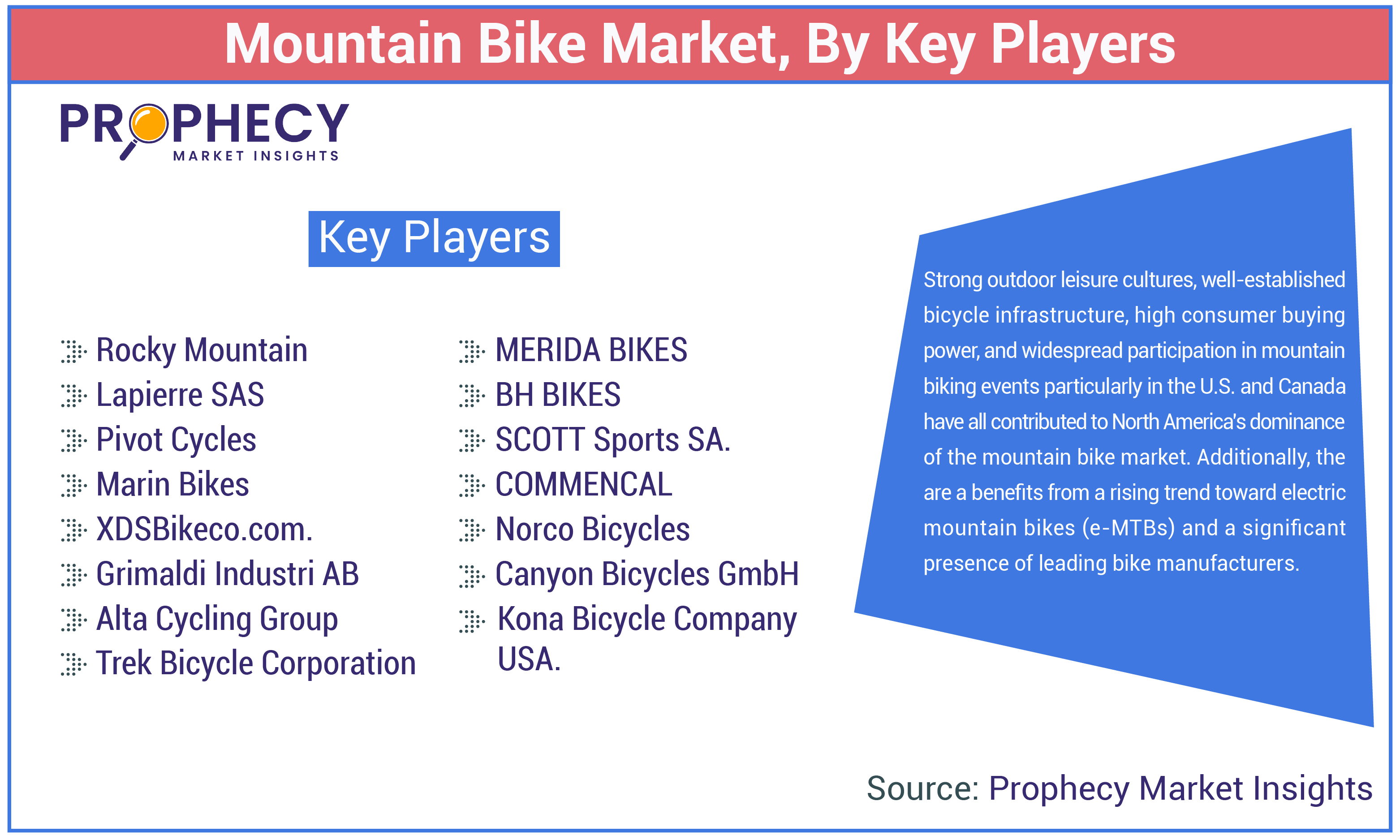
North America: Strong outdoor leisure cultures, well-established bicycle infrastructure, high consumer buying power, and widespread participation in mountain biking events particularly in the U.S. and Canada have all contributed to North America's dominance of the mountain bike market. Additionally, the area benefits from a rising trend toward electric mountain bikes (e-MTBs) and a significant presence of leading bike manufacturers.
- U.S. Mountain Bike Market Insights:
The U.S. leads the mountain bike market throughout North America owing to its extensive network of bike trails, robust outdoor sports culture, high consumer purchasing power, and the existence of well-known brands including Trek and Specialized. The United States is also in the forefront of the adoption of electric mountain bikes, or e-MTBs, thanks to new government incentives and a greater focus on exercise and health.
Europe: The second-largest market is in Europe, driven by growing environmental consciousness, government encouragement of bicycling as a sustainable mode of transportation, and an increase in the number of bike routes in nations notably Germany, France, and Switzerland. Europe's emphasis on fitness and health enhances its market position.
- Germany Mountain Bike Market Insights:
Germany is the most popular country in Europe as a result of its sophisticated industrial base, long history of riding, and extensive usage of e-bikes. Germany's market supremacy is further supported by its ecologically concerned customers, well-maintained trail system, and supporting government legislation.
Asia Pacific: The mountain bike market in Asia Pacific is expanding quickly as a result of increased disposable incomes, greater fitness and health consciousness, and younger people's growing interest in outdoor leisure. Cycling is becoming more popular as a recreational activity and a sustainable mode of transportation due to urbanization and changes in lifestyle.
- China Mountain Bike Market Insights:
The main reasons China leads the APAC market are its enormous production capacity, sizable domestic customer base, growing middle class, and rising demand for electric mountain bikes (e-MTBs). Furthermore, China has an advantage over other countries in the area due to its emphasis on environmentally friendly transportation and bicycle-friendly urban planning.
Mountain Bike Market Report Scope:
|
Attribute |
Details |
|
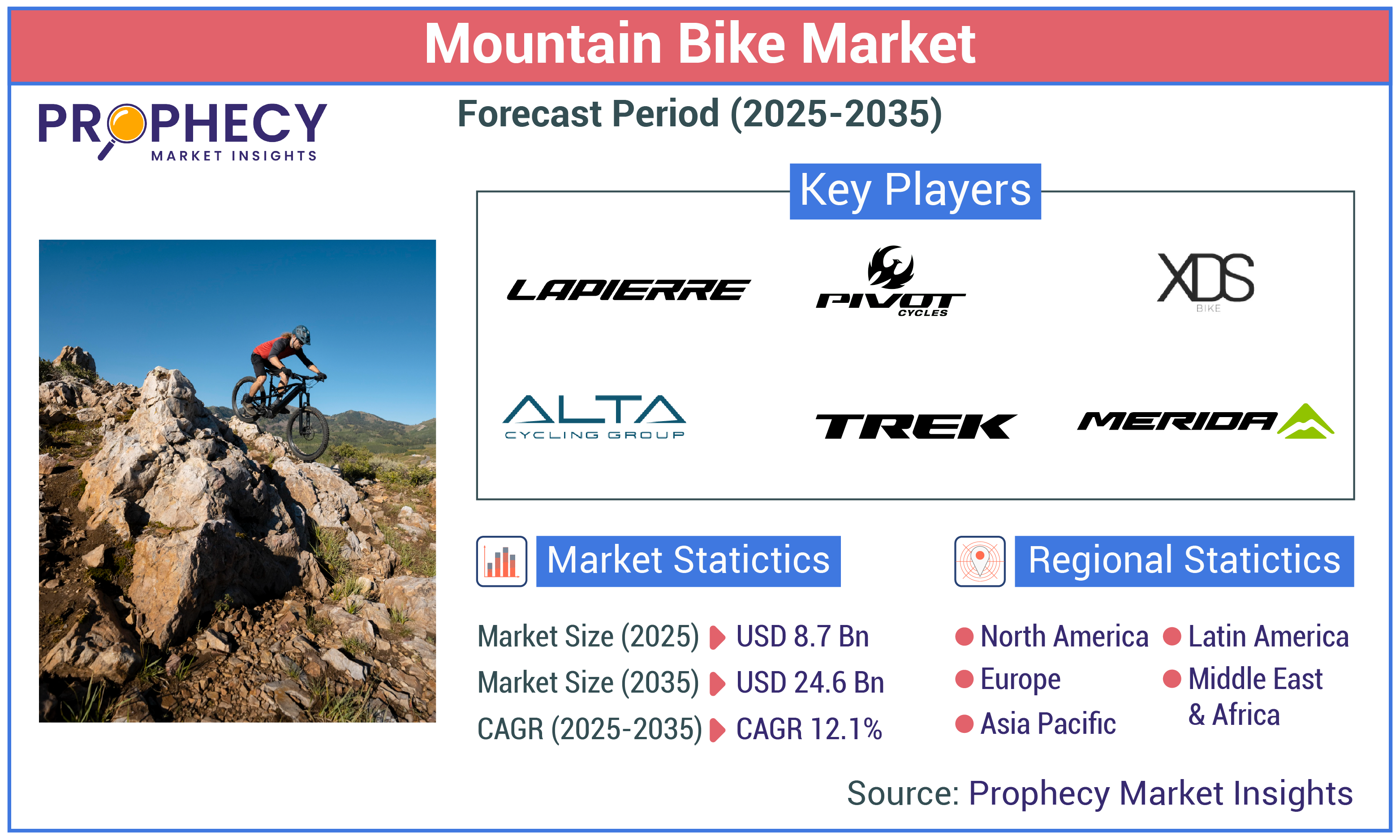
Market Size 2025 |
USD 8.7 Billion |
|
Projected Market Size 2035 |
USD 24.6 Billion |
|
CAGR Growth Rate |
12.1% (2025-2035) |
|
Base year for estimation |
2024 |
|
Forecast period |
2025 – 2035 |
|
Market representation |
Revenue in USD Billion & CAGR from 2025 to 2035 |
|
Regional scope |
North America - U.S. and Canada Europe – Germany, U.K., France, Russia, Italy, Spain, Netherlands, and Rest of Europe Asia Pacific – China, India, Japan, Australia, Indonesia, Malaysia, South Korea, and Rest of Asia-Pacific Latin America - Brazil, Mexico, Argentina, and Rest of Latin America Middle East & Africa – GCC, Israel, South Africa, and Rest of Middle East & Africa |
|
Report coverage |
Revenue forecast, company share, competitive landscape, growth factors, and trends |
Segmentation:
By Product Type:
- Cross Country Bikes
- All Mountain Bikes
- Downhill Bikes
- Freeride Bikes
- Dirt Jumping Bikes
- Others
By Drive Type:
- Standard Mountain Bikes
- Electric Mountain Bikes (e-MTBs)
By Price Range:
- Budget/Entry-level
- Mid-range
- Premium/Pro-level
By Application:
- Leisure & Adventure Riding
- Sports & Racing
- Freestyle & Stunt Riding
- Others
By Distribution Channel:
- Online Retail
- Offline Retail
By Region:
- North America
- U.S.
- Canada
- Europe
- Germany
- U.K.
- France
- Russia
- Italy
- Spain
- Netherlands
- Rest of Europe
- Asia Pacific
- China
- India
- Japan
- Australia
- Indonesia
- Malaysia
- South Korea
- Rest of Asia Pacific
- Latin America
- Brazil
- Mexico
- Argentina
- Rest of Latin America
- Middle East & Africa
- GCC
- Israel
- South Africa
- Rest of Middle East & Africa
Mountain Bike Market Competitive Landscape & Key Players
In order to spur development, mountain bike makets are concentrating on e-MTB innovation, smart features, sustainable materials, and entering new markets with reasonably priced models. The key players operating in the mountain bike market include, Rocky Mountain, Lapierre SAS, MERIDA BIKES, XDSBikeco.com., Grimaldi Industri AB, and others.
List of Key Players in the Market:
- Rocky Mountain
- Lapierre SAS
- Pivot Cycles
- Marin Bikes
- XDSBikeco.com.
- Grimaldi Industri AB
- Alta Cycling Group
- Trek Bicycle Corporation
- MERIDA BIKES
- BH BIKES
- SCOTT Sports SA.
- COMMENCAL
- Norco Bicycles
- Kona Bicycle Company USA.
- Canyon Bicycles GmbH
View an Additional List of Companies in the Mountain bike Market
Mountain Bike Market Recent News
Recent Developments:
- In May 2024, Audi has added a new enduro-style electric mountain bike (eMTB) to its lineup of e-mobility products. With its Fantic-powered design and livery evoking the Dakar-winning Audi RS Q e-tron, this limited-edition bike is Audi's most recent foray into electric-assisted two-wheel mobility accessible via Audi Genuine Accessories.
Analyst View:
Growing interest in outdoor adventure, environmental and health consciousness, and increased disposable income particularly in emerging economies are driving the demand for mountain bikes. Comfort, performance, and accessibility are being enhanced by technological innovations such as electric mountain bikes (e-MTBs), lightweight carbon frames, and better suspension. With the high demand for e-MTBs, smart technologies such as GPS and app-controlled suspension, and growing trail infrastructure, especially in North America, Europe, and Asia-Pacific, the future appears bright.
More Related Reports
Carbon Fiber Bike Market
Bike-Sharing Marke
Indoor Cycling Market
Electric Vehicle Sound Generator Market
Electric Vehicle Power Inverter Market
Mountain Bike Market Company Profile
|
Company Name |
Rocky Mountain |
|
Headquarter |
Saint-Georges, QC |
|
CEO |
Katy Bond |
|
Employee Count |
150-200 Employees |
Mountain Bike Market Highlights
FAQs
Mountain bike market size was valued at USD 8.7 Billion in 2025 and is expected to reach USD 24.6 Billion by 2035 growing at a CAGR of 12.1%.
Product type, drive type, application, application, distribution channel, and region are the segmentation for the Mountain bike market.
North America, Asia Pacific, Europe, Latin America, and the Middle East & Africa. North America is expected to dominate the market.
The key players operating the mountain bike market include Rocky Mountain, Lapierre SAS, Pivot Cycles, Marin Bikes, XDSBikeco.com., Grimaldi Industri AB, Alta Cycling Group, TREK BICYCLE CORPORATION, MERIDA BIKES, BH BIKES, SCOTT Sports SA., COMMENCAL, Norco Bicycles, Kona Bicycle Company USA., and Canyon Bicycles GmbH.