Marine Renewable Energy Market Overview
- 2024 Market Size: USD 1.4 Billion
- 2035 Projected Market Size: USD 10.7 Billion
- CAGR (2025-2035): 20.5%
- Europe: Largest Market in 2024
Marine renewable energy (MRE) refers to a clean and renewable energy system that utilizes various ocean-based sources as tidal currents, waves, ocean thermal gradients, and salinity differences. The technology harvests nearly limitless energy from the seas and oceans; hence, there are no greenhouse gas emissions, which results in lower use of fossil fuels. The key benefits of MRE can be enumerated as a reliable and foreseeable energy supply, an almost negligible environmental footprint, the possibility of delivering energy to coastal and Island areas without any interruption, and facilitating a halt in the climate crisis by being a clean energy source alternative.
The marine renewable energy market is growing due to the increase in the need for clean and sustainable energy all over the globe, favorable government policies implementation and the offer of incentives for the use of renewable energy, and technological progress that not only boosts the efficiency of marine energy systems but also reduces their costs. Besides that, the transition to clean energy sources, concerns about energy security, and the rising need for electricity in remote coastal and Island areas are the primary reasons for the capital injection and the proliferation of tidal, wave, and ocean thermal projects at various places all over the world.
International Advancements of Marine Renewable Energy:
- International breakthroughs in Marine renewable energy (MRE) have gained pace as countries are investing in research, demonstration projects, and the commercial-scale use to unlock the energy potential of the oceans.
- Europe has taken the lead with its large-scale tidal and wave projects in the U.K., France, and Norway, whereas North America, mainly the U.S. and Canada, are concentrating on establishing offshore tidal and wave energy test sites.
- Some of the Asia-Pacific countries which are involved in the development of marine renewable energy are China, South Korea, and Japan, who are progressively deploying ocean thermal energy and floating wave technologies.
- Worldwide, efforts to standardize technologies, bring down costs, and integrate grids are leading to a greater level of ingenuity and making MRE more and more feasible as a clean and dependable energy source.
Current Industry Dynamics & Insights:
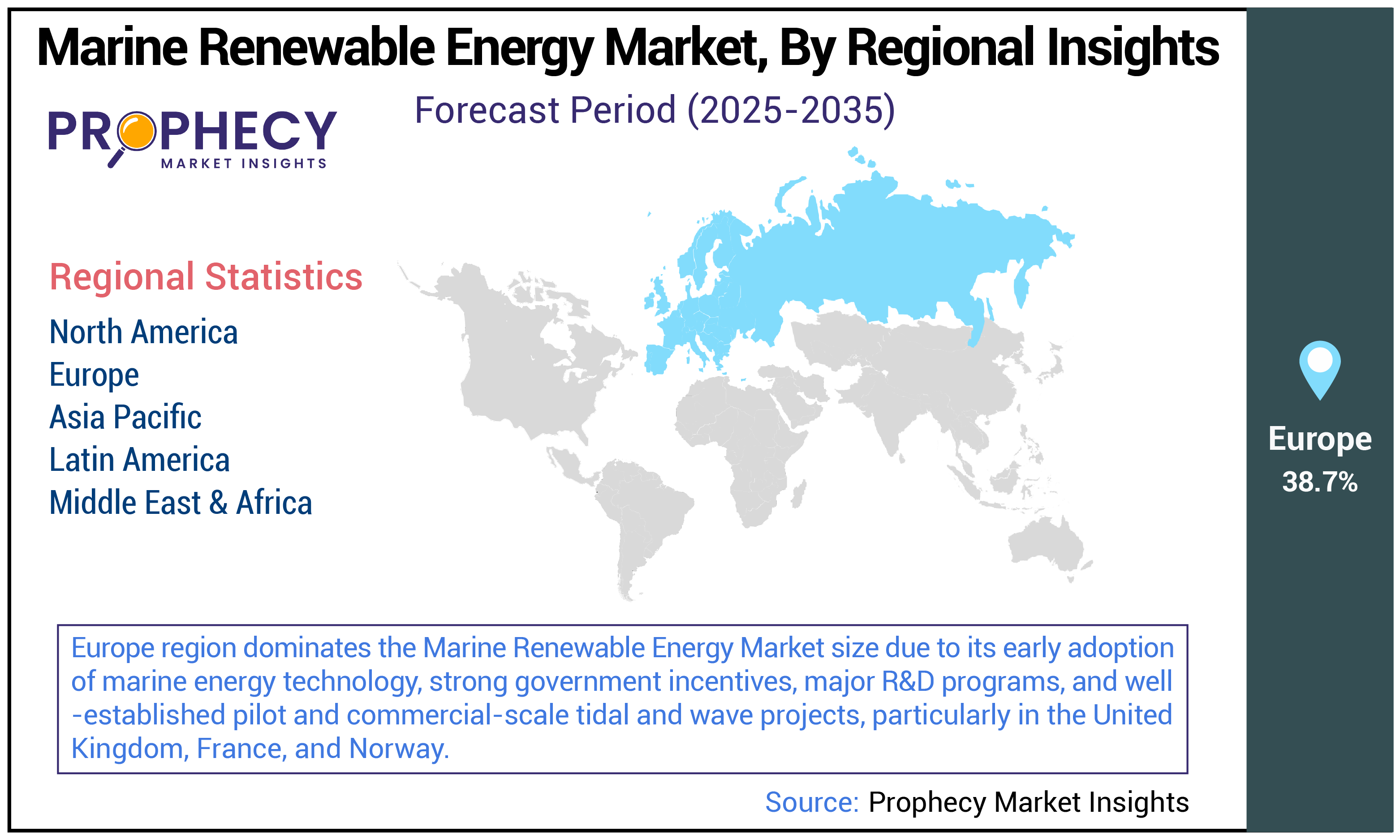
- Europe has the largest regional share in the market, with almost 38.7%.
- Asia Pacific is second dominating region in the market.
- By technology, tidal energy dominate the marine renewable energy market size.
Marine Renewable Energy Market Drivers & Restraints
Drivers and Restraints:
|
Drivers |
Restraints |
Opportunities & Trends |
|
|
|
Key Drivers:
Rising Adoption of Renewable Energy
Renewable energy is being adopted more and more all over the world. As a result, these changes have made governments, utilities, and private companies among others, explore several clean energy sources such as marine renewable energy to satisfy future energy demand. While countries set their emissions targets, aim at becoming carbon neutral, and ensure that they have a stable energy supply, they are turning to marine energy technologies as tidal, wave and ocean thermal systems which are not only dependable but also sustainable. The increasing use of renewables in national grids and offshore energy portfolios is the main driver for technological advancement, project implementation, and general market growth in Marine Renewable Energy.
- For Instance, according to the data published by IEA, the use of renewable energy in the transportation, heating, and electricity sectors would rise by over 60% between 2024 and 2030. By 2030, the proportion of renewable energy in total energy consumption will have increased from 13% in 2023 to about 20%. Due to the ongoing governmental support in over 130 countries, falling costs, and the growing usage of electricity for heat pumps and road transportation, more than three-quarters of the total increase is attributable to electricity generated from renewable energy sources.
Restraints:
Environmental and Ecological Concerns
The slow market growth is the possible concern about environmental and ecological damage caused by ocean renewable energy facilities to marine life, habitats, and coastal ecosystems. Such a fear will result in longer waiting times for approvals and higher project costs.
- Counterbalance Statements: To cope with this challenge developers have a number of actions they can carry out. Among these activities are designing facilities that are environmentally compatible, doing complete impact assessments, and applying the selected site as a mitigation measure, using noise reduction technologies and installing monitoring programs. These measures not only allow the reduction of the ecological disruption but also, by protecting the environment, facilitate the sustainable growth of the Marine Renewable Energy market.
Opportunities & Trends:
Development of Hybrid Systems
One of the major future market trends is going to be the development of marine hybrid renewable energy systems that integrate various technologies such as tidal, wave, and ocean thermal energy conversion. Such merged systems can yield higher energy output, give steadiness, and solve the problem of intermittency that is common with installations of a single source. By using resources in a cost-effective manner and reducing operating costs, hybrids are expected to raise the economic viability and power of sea energy projects, thus easing the sector's adoption and advancement.
Marine Renewable Energy Market Segmentations & Regional Insights
Technology, installation type, application, end user, and region are the divisions of the marine renewable energy market.
By Technology:
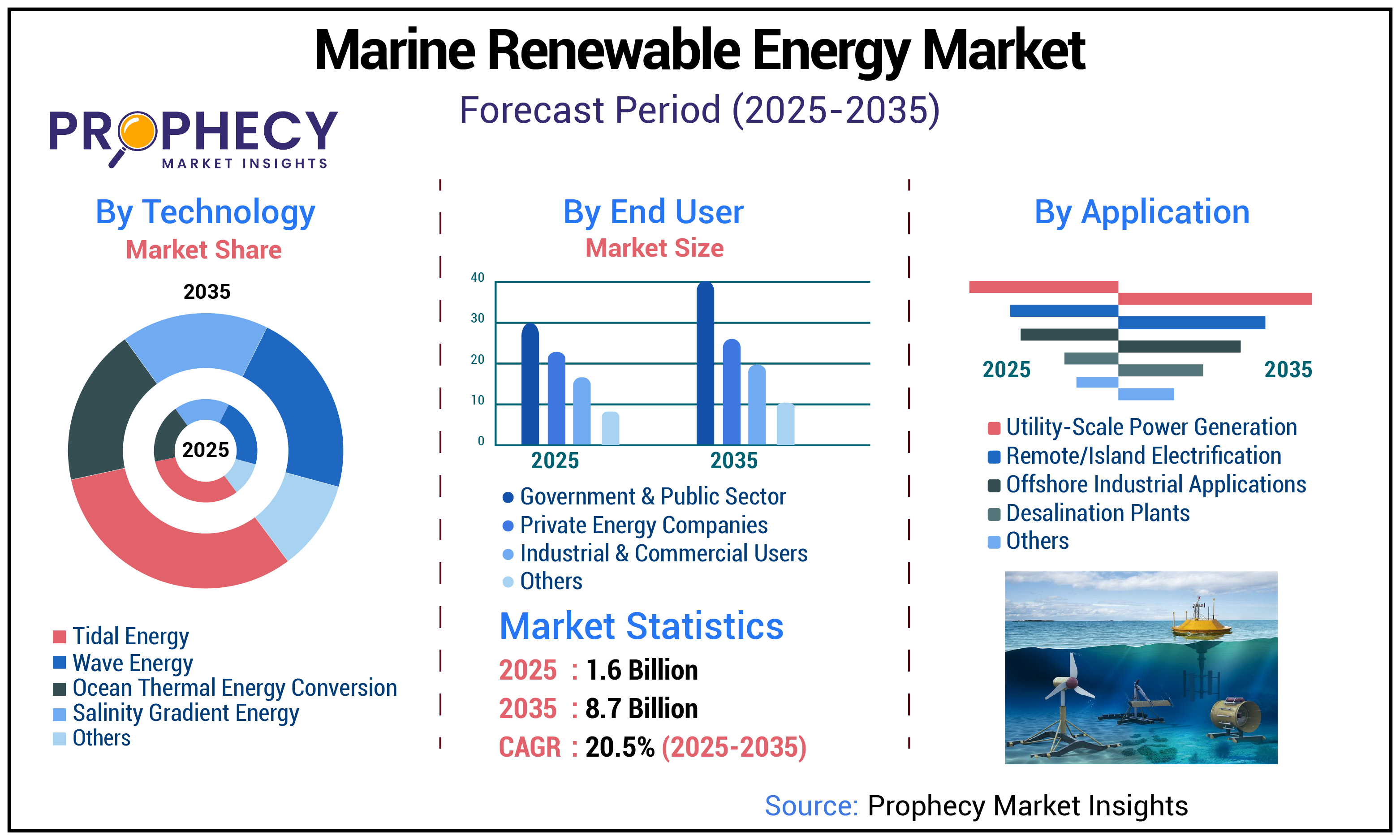
Based on the technology, the marine renewable energy market is divided into tidal energy, wave energy, ocean thermal energy conversion, salinity gradient energy, and others. Tidal energy now has the biggest marine renewable energy market share, owing to its predictable and steady energy generation, well-established technology, and growing adoption in nations such as the United Kingdom, South Korea, and France.
Wave energy is the second most prominent technology, due to huge worldwide wave resources and continual technological developments that enhance efficiency and lower prices, although it still confronts higher unpredictability and developmental hurdles than tidal systems.
By Installation Type:
The marine renewable energy market is categorized into offshore, and nearshore/onshore on the account of installation type. Offshore installations have the marine renewable energy market share since they have access to more powerful and constant tidal and wave resources, allowing for more energy generation and scalability.
Nearshore/onshore installations are the second most popular as they are more accessible, have lower installation and maintenance costs, and are close to existing grid infrastructure, making them appealing for smaller-scale and community-based projects despite having lower energy potential than offshore sites.
By Application:
Utility-Scale power generation, desalination plants, offshore industrial applications, remote/island electrification, and others are application of the marine renewable energy market. Utility-scale power generation has the marine renewable energy market share since it allows for huge amounts of electricity to be generated and integrated into national grids, making projects economically viable and appealing to governments and energy firms.
Remote and island electrification is the second most popular application, as marine energy provides a dependable and sustainable power supply for remote settlements with limited access to conventional grids, promoting energy security and lowering dependency on diesel or fossil fuels.
By End User:
The marine renewable energy market on the account of end user is categorized government & public sector, private energy companies, industrial & commercial users, and others. Government and public sector institutions dominate the marine renewable energy market growth, as they frequently lead funding, policy support, and deployment of large-scale maritime energy projects to satisfy renewable energy objectives and climate goals.
Private energy firms are the second most important end consumers, investing in commercial projects and technology advances to meet the growing demand for clean energy, diversify their renewable portfolios, and realize long-term economic and sustainability gains.
Regional Insights:
Geographically, the marine renewable energy market is studied across North America, Europe, Asia Pacific, Latin America, and the Middle East & Africa.
Europe: This region dominates the marine renewable energy market size due to its early adoption of marine energy technology, strong government incentives, major R&D programs, and well-established pilot and commercial-scale tidal and wave projects, particularly in the United Kingdom, France, and Norway.
- U.K. Marine Renewable Energy Market Insights:
The U.K. leads Europe's Marine Renewable generating sector due to good tidal conditions, strong government support, significant R&D investments, and well-established commercial-scale tidal and wave generating facilities.
Asia Pacific: This is the second most dominant region, driven by rising energy demand, supportive policies, and significant investments in countries such as China, Japan, and South Korea, with a focus on ocean thermal, tidal, and wave energy development to improve energy security and reduce carbon emissions.
- China Marine Renewable Energy Market Insights:
China dominates the Asia-Pacific market due to its extensive coastline, rising energy demand, government incentives for renewable energy, and major investments in tidal, wave, and ocean thermal energy projects to improve energy security and reduce dependency on fossil fuels.
North America: The marine renewable energy market in North America is expanding as a result of increased investments in clean energy, favorable federal and state policies, and rising demand for sustainable power to minimize carbon emissions. Technological breakthroughs and pilot initiatives are also accelerating market acceptance.
- U.S. Marine Renewable Energy Market Insights:
U.S. dominates the region, thanks to its extensive coastline, strong government incentives, active research and development in tidal and wave energy, and strategic initiatives to integrate marine energy into the national grid for energy security and sustainability.
Marine Renewable Energy Market Report Scope:
|
Attribute |
Details |
|
Market Size 2025 |
USD 1.66 Billion |
|
Projected Market Size 2035 |
USD 10.7 Billion |
|
CAGR Growth Rate |
20.5% (2025-2035) |
|
Base year for estimation |
2024 |
|
Forecast period |
2025 – 2035 |
|
Market representation |
Revenue in USD Billion & CAGR from 2025 to 2035 |
|
Regional scope |
North America - U.S. and Canada Europe – Germany, U.K., France, Russia, Italy, Spain, Netherlands, and Rest of Europe Asia Pacific – China, India, Japan, Australia, Indonesia, Malaysia, South Korea, and Rest of Asia-Pacific Latin America - Brazil, Mexico, Argentina, and Rest of Latin America Middle East & Africa – GCC, Israel, South Africa, and Rest of Middle East & Africa |
|
Company Landscape |
Market Share Analysis of Companies Heat Map Analysis Company Overview, Products Overview Financial Information, Key Highlights Business Strategies Overview SWOT Analysis |
|
Report coverage |
Revenue forecast, company share, competitive landscape, growth factors, and trends |
|
Value Added Data Infosets |
Besides fundamental market insights such as the size of the market, growth rate, segmentation, regional study, and key players, our reports carry value-added data sets such as trade flow (import-export) analysis, production and consumption overview, price trend evaluation, supply and value chain mapping, and raw material availability. Moreover, we provide strategic tools as PESTLE and Porter’s Five Forces analysis, examination of the regulatory landscape, as well as monitoring of technology and innovation thereby providing a comprehensive overview which facilitates sensible and anticipatory decision-making. |
Segmentation:
By Technology:
- Tidal Energy
- Wave Energy
- Ocean Thermal Energy Conversion
- Salinity Gradient Energy
- Others
By Installation Type:
- Offshore
- Nearshore/Onshore
By Application:
- Utility-Scale Power Generation
- Desalination Plants
- Offshore Industrial Applications
- Remote/Island Electrification
- Others
By End User:
- Government & Public Sector
- Private Energy Companies
- Industrial & Commercial Users
- Others
By Region:
- North America
- U.S.
- Canada
- Europe
- Germany
- U.K.
- France
- Russia
- Italy
- Spain
- Netherlands
- Rest of Europe
- Asia Pacific
- China
- India
- Japan
- Australia
- Indonesia
- Malaysia
- South Korea
- Rest of Asia Pacific
- Latin America
- Brazil
- Mexico
- Argentina
- Rest of Latin America
- Middle East & Africa
- GCC
- Israel
- South Africa
- Rest of Middle East & Africa
Marine Renewable Energy Market Competitive Landscape & Key Players
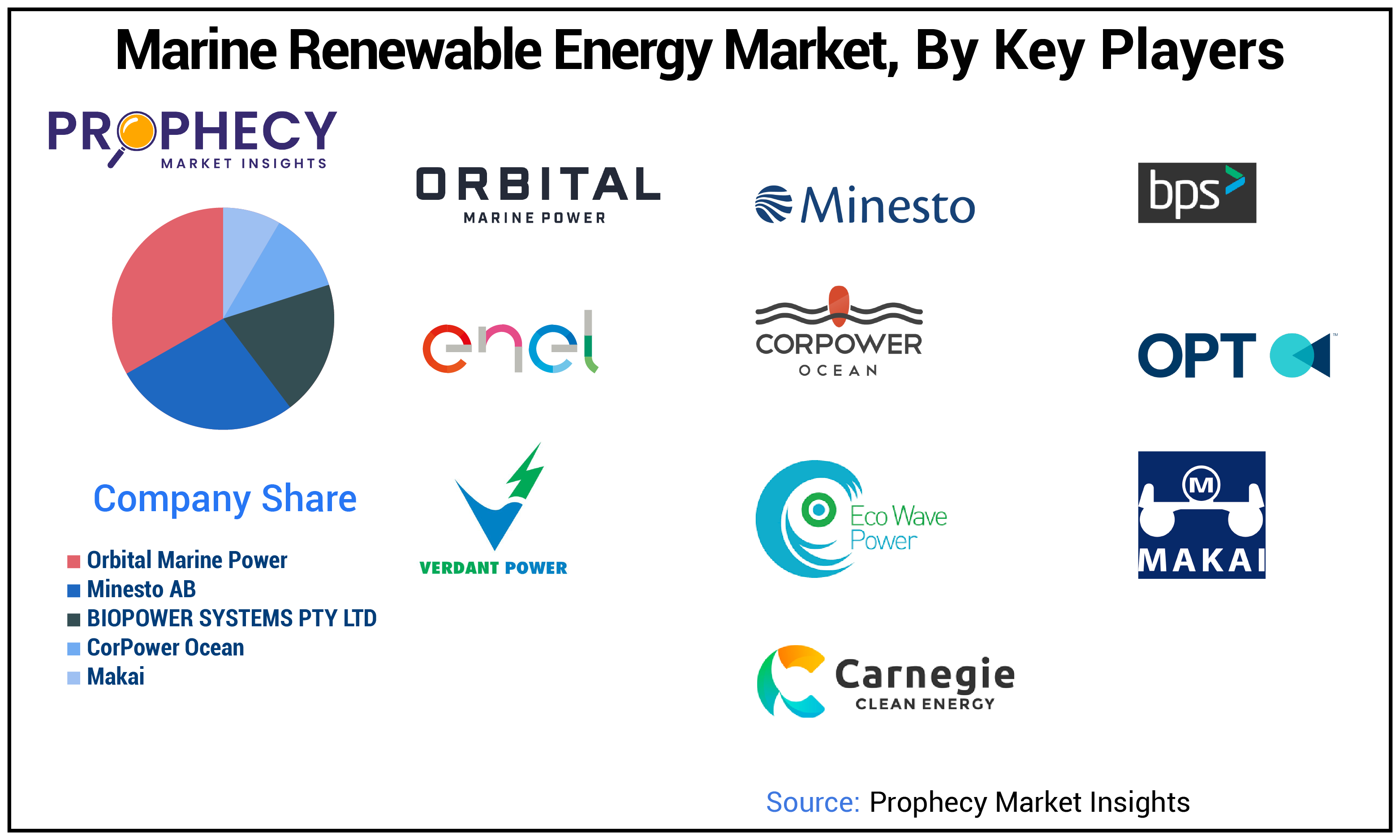
Marine Renewable Energy companies' key growth strategies include investing in advanced and efficient technologies, developing hybrid and modular systems to maximize energy output, forming strategic partnerships with governments and private stakeholders, expanding into emerging markets with high marine energy potential, and focusing on environmentally sustainable designs to reduce ecological impact.
Marine Renewable Energy Market Companies:
- Orbital Marine Power
- Minesto AB
- BIOPOWER SYSTEMS PTY LTD
- CorPower Ocean
- Makai
- CHN ENERGY Investment Group Co.,Ltd
- Nova
- ORPC, Inc.
- SSE plc
- Carnegie Clean Energy
- SINN Power GmbH
- Enel Spa
- Ocean Power Technologies
- Verdant Power, Inc.
- Eco Wave Power
View an Additional List of Companies in the Marine Renewable Energy Market
Marine Renewable Energy Market Recent News
- In October 2025, BOA has reported the successful deployment of three floating substructures for the EOLMED Offshore Wind Project. This project represents a significant step forward in France's renewable energy ambitions, as well as the advancement of floating offshore wind in the Mediterranean.
- In September 2025, Eco Wave Power established its first wave energy project in the United States at the Port of Los Angeles, which was built in conjunction with AltaSea and Shell Marine Renewable Energy (MRE). This project is the first onshore wave energy installation in the United States, demonstrating Eco Wave Power's unique technology and paving the way for large-scale wave energy deployment along America's coastlines.
Analyst View:
The marine renewable energy (MRE) market is growing since it uses ocean-based sources such as tides, waves, and thermal gradients to provide clean, reliable, and sustainable power with low environmental effect. Growing global demand for renewable energy, supporting government regulations, technology improvements, and energy security concerns are all driving investment in MRE projects. Furthermore, its potential to provide continuous electricity to coastal and island regions makes it an important contribution to the global shift to low-carbon energy sources.
Analysis of Sources:
Primary Sources:
- In-depth interviews
- Company-specific data
- Surveys and questionnaires
- Focus group discussions (FGDs)
- Others
Secondary Sources:
- International Renewable Energy Agency (IRENA)
- European Commission
- Others
More Related Reports
Leisure Boat Marine Coatings Market
Marine Lubricants Market
Marine Collagen Market
Marine Freight Market
Renewable Energy Storage Market
Marine Renewable Energy Market Company Profile
|
Company Name |
Product Portfolio |
|
Orbital Marine Power |
Tidal Energy Technology |
|
Nova |
Tidal Energy |
|
ORPC, Inc. |
Earth Observation Satellite Systems and Services |
|
CorPower Ocean |
Marine Energy Technology |
Marine Renewable Energy Market Highlights
FAQs
Marine renewable energy market size was valued at USD 1.66 Billion in 2025 and is expected to reach USD 10.7 Billion by 2035 growing at a CAGR of 20.5%.
Technology, installation type, application, end user, and region are the segmentation for the marine renewable energy market.
Increasing demand for clean energy, climate change concerns, government support through funding and policies, technological advancements in tidal, wave, and offshore wind technologies, and so on are some of the marine renewable energy market growth drivers.
North America, Asia Pacific, Europe, Latin America, and the Middle East & Africa. Europe is expected to dominate the marine renewable energy market.
The key players operating the marine renewable energy market include Orbital Marine Power, Minesto AB, BIOPOWER SYSTEMS PTY LTD, CorPower Ocean, Makai, Nova, ORPC, Inc., Carnegie Clean Energy, SINN Power GmbH, Enel Spa, Ocean Power Technologies, Verdant Power, Inc., and Eco Wave Power.