Lithium Sulfur Battery Market Overview
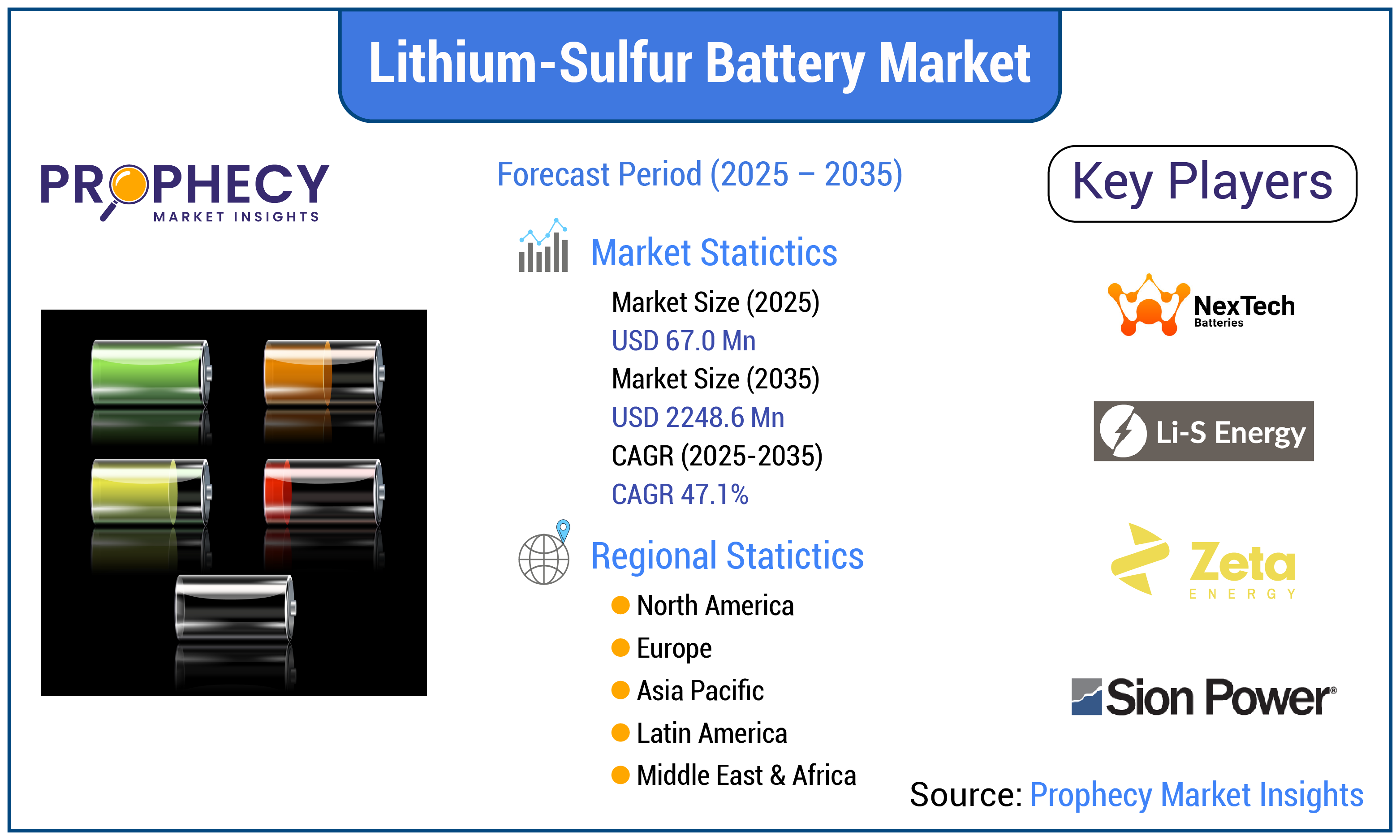
- By 2035, the lithium-sulfur battery market size is contemplated to enlarge at a valuation of USD 2248.6 Million.
- In 2024, the lithium-sulfur battery market valuation was USD 48.4 Million.
- Lithium-sulfur battery market is developing at a CAGR of 47.1%.
Lithium-sulfur (Li-S) batteries are a rechargeable battery that has lithium as an anode and sulfur as a cathode and has a very high theoretical energy density higher when compared to Semi-Solid lithium-ion batteries. Li-S batteries major advantages are they are lighter, cheaper due to the abundance of sulfur, and has a greater energy-to-weight ratio which can be useful for applications such as electric vehicles, drones, and aerospace applications. They also ranked relatively environmentally friendly and have the potential to give longer range and performance with some disadvantages such as limited cycle-life and limited stability, both of which are still under development.
Many factors are driving the momentum in the lithium-sulfur battery market, significant demand from electric vehicles wanting lighter, higher energy storage for extended driving ranges; increased demand for grid-scale batteries for renewable energy integration; and a push for low-cost, cobalt-free alternatives. Governments and investors are pouring capital into R&D and pilot manufacturing such as nanostructured cathodes, solid-state designs, and polymer electrolytes that are making steady improvement in stability and cycle lives.
The projection for the lithium-sulfur (Li-S) battery market looks clearly optimistic as strong market growth is expected due to increasing technology improvements to boost battery life, stability, and scalability being demonstrated. Critical trends, including the emergence of solid-state and nanomaterial-based designs; the strong investments being made by companies such as Lyten and Stellantis; and growing demand for lithium batteries in industries such as electric vehicles, aerospace, and energy storage. As manufacturing capabilities grow and costs improve, Li-S batteries are expected to transition from niche applications to more mainstream applications over the next 5–10 years particularly through applications in Asia-Pacific and North America.
Recession Risk & Tariff Analysis:
- Lithium-sulfur battery market recession risks increasing tariffs, investment slowdown, and production cost increase, and commercialization delay. A global economic slowdown would reduce demand for these sectors where the major contributors are the EV and energy storage sectors.
- Tariffs on materials and components for batteries mainly in the U.S. would increase costs along supply chains besides adding uncertainty. Although Li-S batteries depend less on some critical minerals overall, trade policies and protectionism may drive firms to diversify suppliers or localize production as a risk mitigator.
Impact of Generative AI on Lithium-Sulfur Battery Market:
- Generative AI is changing the lithium-sulfur battery market by speeding up the process of discovering materials, making designs better, and improving how well they are made. It helps find parts that work better, makes life of batteries longer with predictions, and allows for much smarter watching in of production. This tech greatly shortens times for making Li-S batteries available and helps bring them to market on a large scale.
Lithium Sulfur Battery Market Drivers & Restraints
Key Drivers:
Rising Adoption of Electric Vehicles has caused the Market to Develop Considerably
The rising use of electric cars is a primary driver for the growth and development of Li-S battery market, since these batteries provide much better energy concentration and are lighter than standard Li-ion batteries- allowing for longer distances that can be driven and better vehicle performance. As worldwide EV rules grow and car makers look for advanced battery options, money in Li-S tech is quickening bringing it nearer to commercial usefulness and mass production.
- For Instance, according to the data published by Global Change Data Lab, Globally, over 1-in-5 (22%) of new cars sold were electric in 2024. This share was 92% in Norway, and in China, it was almost 50%. There are now almost 60 million electric cars in use globally, and this is growing quickly. In 2022, this figure was just 26 million.
Restraints:
Performance Sensitivity could Affect Market Development
Performance sensitivity in lithium-sulfur (Li–S) batteries is related to their tendency to experience efficiency and stability problems under diverse environmental conditions, such as temperature, pressure or operating stress. Unpredictable reactions of the electrolyte and sulfur components occur at high or low temperatures, resulting in reduced conductivity, faster degradation, and safety risks. Charge/discharge rates and cycle life are also influenced by this sensitivity.
- Counterbalance Statements: To overcome this challenge advanced electrolytes (e.g. solid state or polymer based) thermally stable separators and encapsulated sulfur cathodes that ensure high Effectiveness over a broad temperature window have been developed to improve the reliability of Li-S batteries in practical Uses.
Opportunities & Trends:
Advancements in Battery Technology could be used to Investigate Future Market Prospects
Developments in battery technology as scientists and producers concentrate on resolving current limits such as limited cycle life low conductivity and safety concerns, tech are an important future trend fueling the expansion of the lithium-sulfur (LiS) battery market. Innovations clearly improve the constancy of solid electrolytes, nanostructured cathodes tender li anodes, and advanced polymeric coatings. Send strength and concentration of LiS batteries. For Applications in electric cars, aviation, and grid storage, these advances are making LiS batteries more economically feasible. Arsenic engineering keeps developing these improvements that can expedite the movement from research labs to mass production.
Lithium Sulfur Battery Market Segmentations & Regional Insights
Component, state, capacity, application, and region are the divisions of the lithium-sulfur battery market.
By Component:
Cathode, anode, electrolyte, and others are component on which lithium-sulfur battery market is segmented. The cathode sector dominates the lithium sulfur battery market share since it is essential in defining the energy density, performance, and cost-effectiveness of the battery.
The electrolyte portion is the second most dominant one since it is crucial in controlling the polysulfide shuttle effect and so guaranteeing battery stability and safety.
By State:
Based on the state, the lithium-sulfur battery market is divided into Anode, semi-solid, and solid. The Anode state component dominates the lithium-sulfur battery market share right now as it is the most mature and thoroughly studied configuration, offering comparatively simpler manufacture and greater ionic conductivity.
Due to its capacity to solve serious problems such as leakage, flammability, and the polysulfide shuttle effect, the solid-state segment is the second dominating market and is quickly gaining traction.
By Capacity:
Below 500 MAH, 500-1000 MAH, and above 1000MAH are capacity of the lithium-sulfur battery market. The segment of over 1000 MAH has highest lithium-sulfur battery market share. It is mostly due to the batteries in this segment are well-suited to high-capacity applications, including but not limited to electric vehicles, aerospace, and military drones, which are all part of the industry demanding energy solutions that are both lightweight and long-lasting.
The 500-1000 MAH segment follows the previous as the second in the lithium-sulfur battery market share and the leader for batteries that can be used in portable electronics and early-stage prototypes in research and development.
By Application:
The lithium-sulfur battery market on the account of application is categorized into aerospace, automotive & transportation, consumer electronics, power, medical, and others. Lithium-sulfur batteries, lead in the market of the aerospace hand due to the great demand for lightweights, high energy density cells which are capable of seriously reducing the weight of the payload and yet prolong the duration of the mission.
The automotive and transportation sector is the second-most popular application, mainly due to an increased focus on electric vehicles (EVs).
Regional Insights:
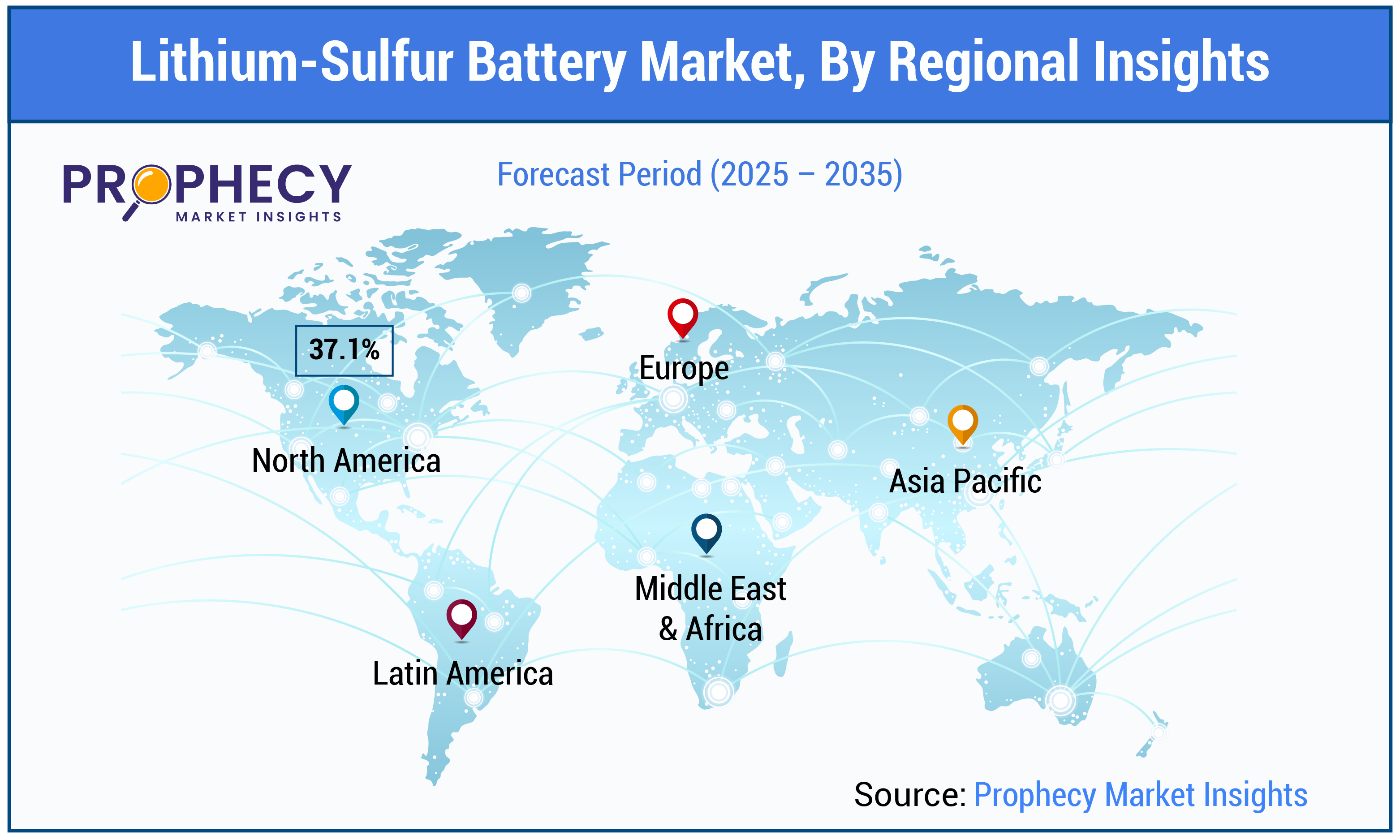
Geographically, the lithium-sulfur battery market is studied across North America, Europe, Asia Pacific, Latin America, and the Middle East & Africa.
North America: This region particularly U.S., is at the forefront of the lithium-sulfur battery market due to the combination of support by the federal government, significant research and development funding, and the presence of important companies such as Lyten and Zeta Energy. Furthermore, the huge advancements made by the region in the space, military and electric vehicle sector and the initiatives to cut foreign supply chain dependence have not only quickened up the development of Li-S batteries but they have also resulted in the early commercialization of the technology.
- U.S. Lithium-Sulfur Battery Market Insights:
In North America, the lithium-sulfur battery market has the highest in the U.S. due to the innovation system of the country is strong, there is government backing for the companies that research and develop advanced energy storage technologies, and there are leading companies such as Lyten and Zeta Energy that are the pioneers of Li-S battery development for electric vehicles, aerospace, and defense. Besides the U.S. gains from the policy of bringing the battery chains closer to the sources and curbing the dependence on imports that are of a critical nature.
Asia Pacific: This is the second-dominating region that is due to the dynamic electronics and electric vehicle industries in the region, most importantly in countries such as China, Japan and South Korea. They are the nations that are really pouring the money into the development of batteries and production facilities, thus making Asian-Pacific the epicenter of the fast-paced growth of advanced energy storage solutions.
- China Lithium-Sulfur Battery Market Insights:
In the Asia-Pacific region, it is China that plays the role of a market leader and that is all thanks to its enormous electric vehicle and consumer electronics sectors, consistent and strong government programs that encourage researchers and private sector in developing batteries and massive investments in the R&D and manufacturing of cells. China's abundant supply chain resources and clear concentration on storage of energy have made it to be the leading country in Li-S battery development in Asia.
Europe: The lithium-sulfur battery market in Europe is driven by aggressive decarbonization goals, an intensive push for transportation electrification, mostly focusing on the automotive and aerospace sectors, and a significant amount of public and private funding for R&D under the programs such as the European Battery Alliance and the aviation projects HELIS and LISA.
- Germany Lithium-Sulfur Battery Market Insights:
The Europe Li–S market is mostly governed by the Germany are the owners of almost 35% of the market due to the highly developed automotive industry, significant battery research investments from entities such as Fraunhofer and Helmholtz, and the existence of the OEMs (e.g. BMW and VW) and domestic research bodies collaborative aspect.
Lithium-Sulfur Battery Market Report Scope:
|
Attribute |
Details |
|
Market Size 2025 |
USD 67.0 Million |
|
Projected Market Size 2035 |
USD 2248.6 Million |
|
CAGR Growth Rate |
47.1% (2025-2035) |
|
Base year for estimation |
2024 |
|
Forecast period |
2025 – 2035 |
|
Market representation |
Revenue in USD Million & CAGR from 2025 to 2035 |
|
Regional scope |
North America - U.S. and Canada Europe – Germany, U.K., France, Russia, Italy, Spain, Netherlands, and Rest of Europe Asia Pacific – China, India, Japan, Australia, Indonesia, Malaysia, South Korea, and Rest of Asia-Pacific Latin America - Brazil, Mexico, Argentina, and Rest of Latin America Middle East & Africa – GCC, Israel, South Africa, and Rest of Middle East & Africa |
|
Report coverage |
Revenue forecast, company share, competitive landscape, growth factors, and trends |
Segmentation:
By Component:
- Cathode
- Anode
- Electrolyte
- Others
By State:
- Liquid
- Semi-Solid
- Solid
By Capacity:
- Below 500 MAH
- 500-1000 MAH
- Above 1000MAH
By Application:
- Aerospace
- Automotive & Transportation
- Consumer Electronics
- Power
- Medical
- Others
By Region:
- North America
- U.S.
- Canada
- Europe
- Germany
- U.K.
- France
- Russia
- Italy
- Spain
- Netherlands
- Rest of Europe
- Asia Pacific
- China
- India
- Japan
- Australia
- Indonesia
- Malaysia
- South Korea
- Rest of Asia Pacific
- Latin America
- Brazil
- Mexico
- Argentina
- Rest of Latin America
- Middle East & Africa
- GCC
- Israel
- South Africa
- Rest of Middle East & Africa
Lithium Sulfur Battery Market Competitive Landscape & Key Players
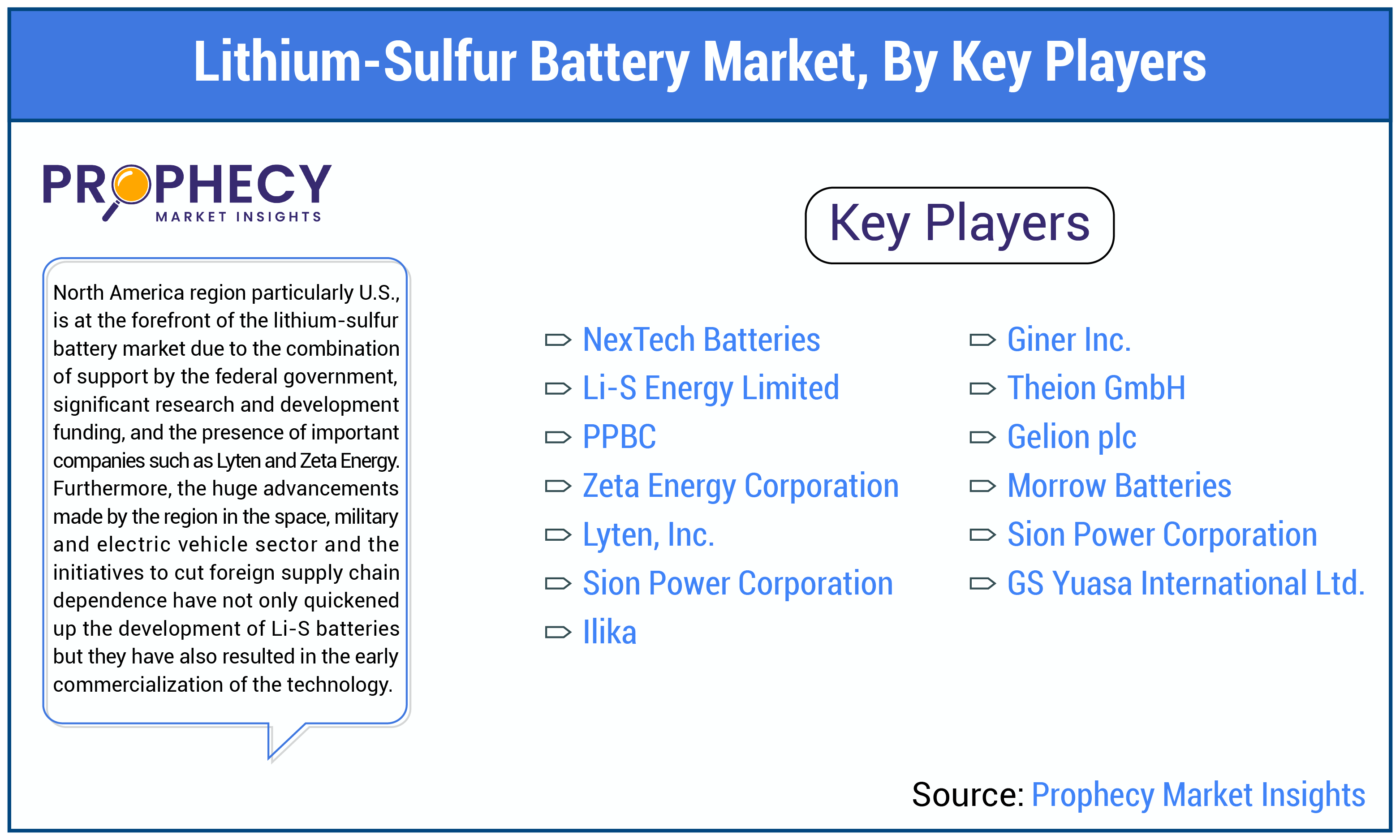
The key players operating in the lithium-sulfur battery market include, NexTech Batteries, Li-S Energy Limited, Giner Inc., Lyten, Inc., and others. Companies engaged in the development and production of lithium sulfur batteries are indeed growing and the vast majority of them are taking actions to enable growth, such as cooperation or collaboration with academic institutions, scaling manufacturing, signing contracts with the government for financial assistance, building strong relationships with their supply chains to speed up the processes of marketing and meeting the increased demand.
Lithium-Sulfur Battery Market Companies:
- NexTech Batteries
- Li-S Energy Limited
- PPBC
- Zeta Energy Corporation
- Lyten, Inc.
- Sion Power Corporation
- Ilika
- Giner Inc.
- Theion GmbH
- Gelion plc
- Morrow Batteries
- Sion Power Corporation
- GS Yuasa International Ltd.
View an Additional List of Companies in the Lithium-Sulfur Battery Market
Lithium Sulfur Battery Market Recent News
- In October 2024, the world leader in lithium-sulfur batteries and a supermaterial applications business, Lyten, announced intentions to invest over USD 1 billion to construct the first lithium-sulfur battery gigafactory in history. At full capacity, the factory, which will be close to Reno, Nevada, will be able to generate up to 10 GWh of batteries a year. The facility's first phase is expected to be operational in 2027.
- In November 2021, GS Yuasa Corporation celebrated the successful completion of verification testing of a 400Wh/kg-class lithium-sulfur battery by its subsidiary GS Yuasa International Ltd. This accomplishment was one of GS Yuasa's short-term goals for its research and development of aircraft lightweight storage batteries. This research and development project is being carried out by GS Yuasa as part of the New Energy and Industrial Technology Development Organization's (NEDO) "Research and Development Project for Advanced Aircraft Systems toward Practical Application", which focuses on Next-Generation Electrical Propulsion Systems.
Analyst View:
Compared to conventional lithium-ion batteries, lithium-sulfur (Li-S) batteries are more affordable, lightweight, and eco-friendly. They also have a greater energy density and are appropriate for use in EVs, drones, and aircraft. Growing demand for grid-scale energy storage, cobalt-free solutions, and longer-range electric vehicles is propelling market expansion. Performance and stability are being enhanced by ongoing research and development in solid-state architectures and nanomaterial. Within the next five to ten years, Li-S batteries are anticipated to transition from niche to mainstream use, particularly in North America and Asia-Pacific, thanks to significant investments and technical improvements.
More Related Reports
Zinc Battery Market
Lithium Hydride Market
Lithium Ion Battery Market
Lithium-ion Capacitor Market
Automotive Battery Market
Lithium Sulfur Battery Market Company Profile
|
Company Name |
Theion GmbH |
|
Headquarter |
Berlin, Germany |
|
CEO |
Dr. Ulrich Ehmes |
|
Employee Count |
26 Employees |
Lithium Sulfur Battery Market Highlights
FAQs
Lithium-sulfur battery market size was valued at USD 67.0 Million in 2025 and is expected to reach USD 2248.6 Million by 2035 growing at a CAGR of 47.1%.
Component, state, capacity, application, and region are the segmentation for the target market.
North America, Asia Pacific, Europe, Latin America, and the Middle East & Africa. North America is expected to dominate the market.
The key players operating the lithium-sulfur battery market include NexTech Batteries, Li-S Energy Limited, PPBC, Zeta Energy Corporation, Lyten, Inc., Sion Power Corporation, ILIKA, Giner Inc., Theion GmbH, Gelion plc, Morrow Batteries, Sion Power Corporation, and GS Yuasa International Ltd.