Industrial Carbon Neutral Heat Solutions Market Overview
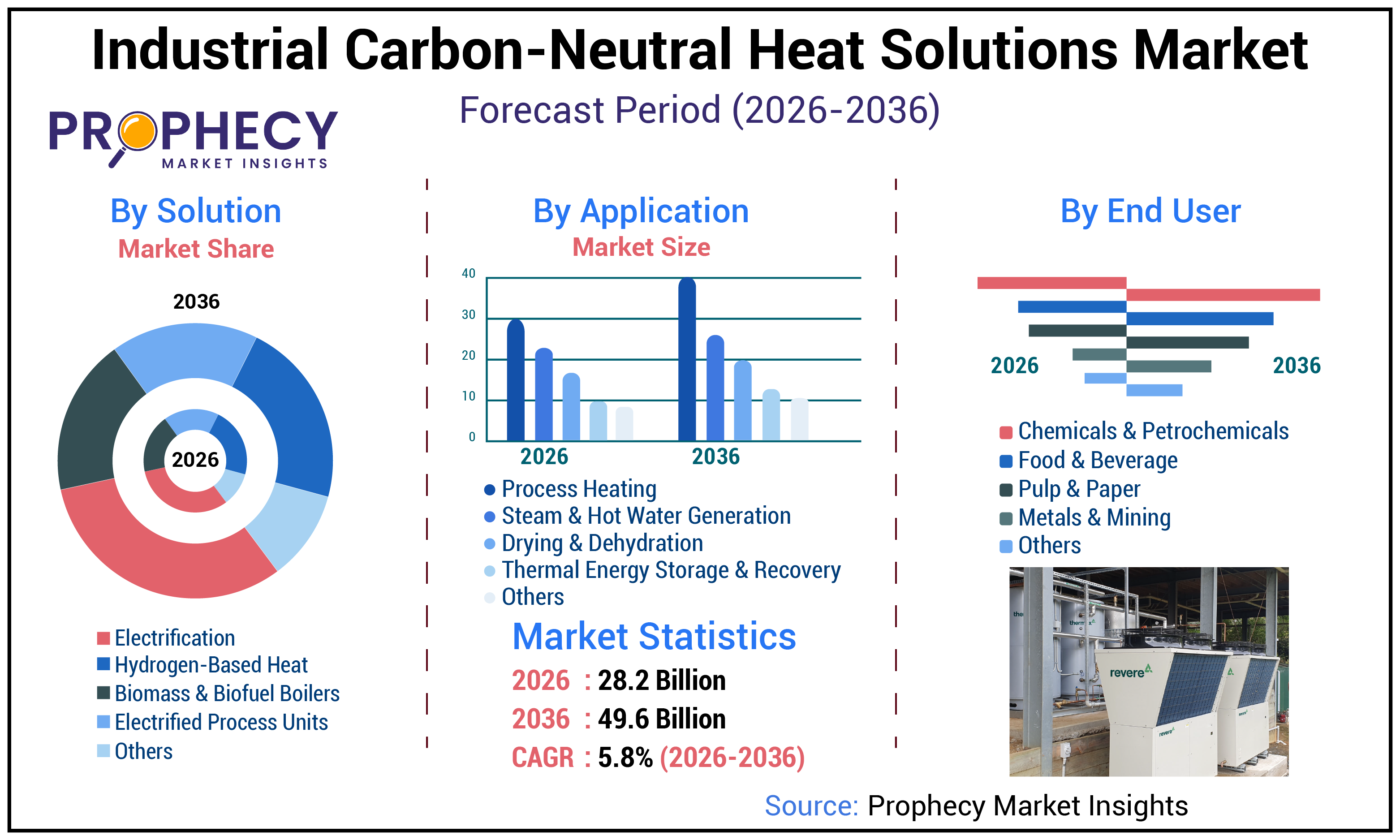
- 2025 Market Size: USD 26.8 Billion
- 2036 Projected Market Size: USD 49.6 Billion
- CAGR (2026-2036): 5.8%
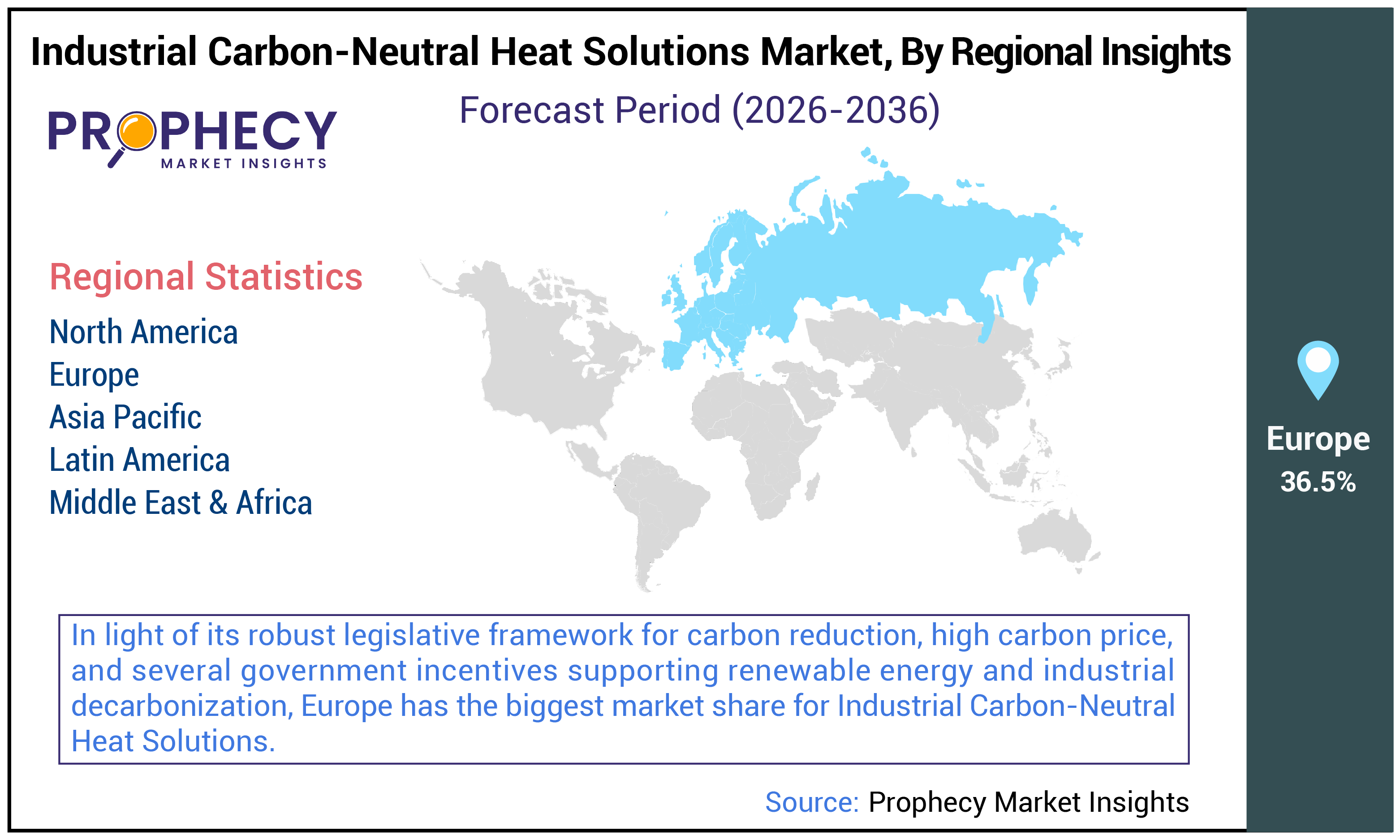
- Europe: Largest Market in 2025
Industrial Carbon-Neutral Heat Solutions are clean energy technologies and associated equipment that are used to generate or provide heat for industrial processes without the emission of carbon dioxide in the atmosphere. Typically, they operate on renewable electricity, green hydrogen, sustainably sourced biomass, geothermal energy, or waste heat recovery rather than fossil fuels.
These solutions give the possibility to industry sectors to get rid of high-energy operations that require the generation of steam, drying, and heating of the process to mention a few. The essential advantages are the substantial decrease of greenhouse gas emissions, the improvement of energy efficiency, the savings of money for the long-term period due to less fuel consumption, the easier compliance with environmental standards, and the strengthening of the sustainability position of the companies which are committed to net-zero goals.
The carbon-neutral industrial heat market is affected mostly by the necessity to lessen the environmental impact of the industry. In addition to that, the rise of the carbon-neutral industrial heat market is a result of strict regulations imposed by governments and the pricing of carbon, as well as the increasing number of companies that make net-zero pledges.
Advances in electrification, green hydrogen, and the creation of very efficient heat pump technologies are some of the factors that make clean heat solutions more viable and less costly. Furthermore, the industry is being supported in its transition by the price instability of fossil fuels, the increasing availability of renewable energy, and the introduction of policies and incentives that facilitate a sustainable industrial transition which is also taking place in sectors as chemicals, food, paper, and metals.
Solution-oriented Strategies for Industrial Carbon-Neutral Heat Solutions:
- Solution-oriented strategies to advance Industrial Carbon-Neutral Heat Solutions largely focus on the implementation of renewable energy sources, electrification, and energy recovery systems in the industry.
- To top performance, firms are purchasing state-of-the-art electric boilers and heat pumps, changing their furnaces to green hydrogen or biofuels, and using waste-heat recovery and thermal energy storage.
- The cooperation with technology providers, utilities, and financiers is easing the "Heat-as-a-Service"" model transition that is lowering the initial investment and thus, speeding up the rollout.
- Besides that, digital energy management and process optimization tools are enabling industries to accurately measure, control, and reduce heat-related emissions, thus, creating a realistic way to achieve carbon-neutral production.
Current Industry Dynamics & Insights:
- Europe has the largest regional share in the market, with almost 36.5%.
- Asia Pacific is second dominating region in the market.
- By type, electrification dominates the industrial carbon-neutral heat solutions market growth.
Industrial Carbon Neutral Heat Solutions Market Drivers & Restraints
Drivers and Restraints:
|
Drivers |
Restraints |
Opportunities & Trends |
|
|
|
Key Drivers:
Increasing Renewable Energy Availability
The availability of renewable energy on a large scale is one of the main factors that is pushing the market for carbon-neutral heat solutions in the industrial sector. As renewable energy is a clean, stable, and relatively cheap source of power, which can be used to electrolyze the process of heating with electrified heating technologies such as heat pumps, electric boilers, and furnaces. With the global expansion of solar, wind, and other renewables, industries can now have access to low-carbon electricity that will replace fossil fuels for process heat, thus cutting emissions drastically.
In addition, the falling renewable energy prices and the better grid integration are giving carbon-neutral heat systems a new economic attractiveness that is picking up their adoption rate in the manufacturing and processing sectors which are looking for sustainable ways of operating.
- For Instance, according to the data published by IEA, the use of renewable energy in the transportation, heating, and electricity sectors would rise by over 60% between 2024 and 2030. By 2030, the proportion of renewable energy in total energy consumption will have increased from 13% in 2023 to about 20%.
- Due to the ongoing governmental support in over 130 countries, falling costs, and the growing usage of electricity for heat pumps and road transportation, more than three-quarters of the total increase is attributable to electricity generated from renewable energy sources.
Restraints:
Lack of Standardized Regulations
The absence of standardized rules has been a major hurdle for the Industrial Carbon-Neutral Heat Solutions market, as it creates a situation where there is a lack of clarity around technology requirements, certification, and carbon accounting. This disparity leads to a decrease in the number of investments, a slowdown in the technology uptake and an increase in the difficulty of industries to compare or verify carbon-neutral solutions in different regions.
- Counterbalance Statements: One definite way to resolve this issue is the establishment of well-defined, harmonized global and national standards that specify performance benchmarks, emission metrics and verification frameworks. Having such consistent regulations in place would definitely attract investor confidence, make it easier and quicker to get the green light for projects and hence, a broader industrial use of the low-carbon heat technologies would be realized.
Opportunities & Trends:
Expansion of “Heat-as-a-Service” and Energy-as-a-Service Models
The spreading of “Heat-as-a-Service” (HaaS) and Energy-as-a-Service (EaaS) models is turning out to be a major very-far-off-future trend in the Industrial Carbon-Neutral Heat Solutions market. This is mainly due to these models allow the industrial sector to cut down on carbon emissions without making a massive upfront investment. In such models, the service providers own, operate, and maintain the carbon-neutral heat systems, e.g., electric boilers, heat pumps, or hydrogen-based units, while the customers pay only for the heat or energy used.
The method lowers the financial risk, provides for cost stability, and helps in speeding up the transition to clean technologies. Since industries are demanding solutions that are flexible and performance-based, HaaS and EaaS are likely to become the principal business models that will lead to the extensive use of carbon-neutral heat all over the world.
Industrial Carbon Neutral Heat Solutions Market Segmentations & Regional Insights
Solution, temperature range, application, end user, and region are the divisions of the industrial carbon-neutral heat solutions market.
By Solution:
In the power of solution, the industrial carbon-neutral heat solutions market is divided into electrification, hydrogen-based heat, biomass & biofuel boilers, electrified process units, and others. In terms of its technological maturity, scalability, and compatibility with the current renewable power infrastructure, electrification currently has the most industrial carbon-neutral heat solutions market share.
Due to their high efficiency, ease of retrofitting, and reduced operating emissions when fueled by renewable energy, electric boilers and industrial heat pumps are becoming more and more popular in medium- and low-temperature applications in industries including food, textiles, and chemicals.
Since electrification is still difficult in high-temperature processes include the manufacturing of metal, cement, and glass, hydrogen-based heat is becoming the second most popular method. Hydrogen is a crucial long-term option for difficult-to-abate businesses due to its capacity to produce combustion-like heat without producing carbon emissions.
By Temperature Range:
Characterized by temperature range, the industrial carbon-neutral heat solutions market can be categorized into low temperature (<100°C), medium temperature (100–400°C), and high temperature (>400°C). Recognizing that it encompasses a wide range of industrial applications including drying, distillation, sterilization, and process heating used in industries including food, paper, and chemicals, the medium-temperature range (100–400°C) has the biggest industrial carbon-neutral heat solutions market share.
Due to its suitability for space heating, hot water generation, and low-grade process heat, where electrification and renewable heat integration are already widely used and financially feasible, the low-temperature range (<100°C) is the second-dominant segment.
By Application:
Process heating, steam & hot water generation, drying & dehydration, thermal energy storage & recovery, and others are application in the industrial carbon-neutral heat solutions market. Due to the fact that it is the most energy-intensive and widely used application across industries including chemicals, petrochemicals, food processing, and manufacturing, process heating has the biggest industrial carbon-neutral heat solutions market share.
Since steam and hot water generation is necessary for utilities, cleaning, sterilizing, and general plant operations, it is the second most popular application. Its rapid rise is attributed to its wide applicability across almost all industrial sectors and the viability of switching from fossil fuel boilers to electric or biofuel systems.
By End User:
Chemicals & petrochemicals, food & beverage, pulp & paper, metals & mining, and others are end users of the industrial carbon-neutral heat solutions market. Knowing that it is one of the most energy-intensive industries and needs a lot of process heat for reactions, distillation, and refining, the chemicals and petrochemicals sector has the biggest industrial carbon-neutral heat solutions market size.
Due to its substantial need for medium- and low-temperature heat for cooking, drying, and sterilizing, the food and beverage industry is the second-dominant sector. Electric boilers, heat pumps, and biomass systems provide affordable and convenient clean heat solutions.
Regional Insights:
Geographically, the industrial carbon-neutral heat solutions market is studied across North America, Europe, Asia Pacific, Latin America, and the Middle East & Africa.
Europe: In light of its robust legislative framework for carbon reduction, high carbon price, and several government incentives supporting renewable energy and industrial decarbonization, Europe has the biggest market share for industrial carbon-neutral heat solutions. Leading nations in electrification, hydrogen adoption, and renewable energy-powered district heating projects include Germany, the Netherlands, and the Nordic region.
- Germany Industrial Carbon-Neutral Heat Solutions Market Insights:
In spite of its robust industrial base, aggressive climate goals, and significant investments in hydrogen infrastructure, electrification, and renewable integration, Germany leads the European industrial carbon-neutral heat solutions market. Clean heat technology adoption is accelerated by the nation's strong legislative backing, which includes money for industrial decarbonization and carbon pricing.
Asia Pacific: Rapid industrialization, rising investments in clean energy infrastructure, and ambitious net-zero targets set by major economies including China, South Korea, and Japan which are increasingly implementing hydrogen and electrified heat technologies to modernize their industrial sectors have made the Asia-Pacific (APAC) region the second-dominant market.
- China Industrial Carbon-Neutral Heat Solutions Market Insights:
Due to its early adoption of hydrogen-based systems, cutting-edge energy efficiency technology, and government-backed programs encouraging industrial decarbonization, Japan leads the Asia-Pacific (APAC) market. Japan is leading the way in implementing carbon-neutral heat solutions due to its robust R&D skills and emphasis on sustainable manufacturing.
North America: Due to strong corporate sustainability commitments, significant government incentives for clean energy, and the growth of renewable power generation that supports industrial electrification, the North American industrial carbon-neutral heat solutions market is expanding quickly.
- U.S. Industrial Carbon-Neutral Heat Solutions Market Insights:
Through its vast and varied industrial sector, significant R&D investments in low-carbon technologies, and supportive policies as tax credits and grants under the Inflation Reduction Act, which encourage industries to switch to carbon-neutral heat systems, the U.S. leads the market in North America.
Industrial Carbon-Neutral Heat Solutions Market Report Scope:
|
Attribute |
Details |
|
Market Size 2026 |
USD 28.2 Billion |
|
Projected Market Size 2036 |
USD 49.6 Billion |
|
CAGR Growth Rate |
5.8% (2026-2036) |
|
Base year for estimation |
2025 |
|
Forecast period |
2026 – 2036 |
|
Market representation |
Revenue in USD Billion & CAGR from 2026 to 2036 |
|
Regional scope |
North America - U.S. and Canada Europe – Germany, U.K., France, Russia, Italy, Spain, Netherlands, and Rest of Europe Asia Pacific – China, India, Japan, Australia, Indonesia, Malaysia, South Korea, and Rest of Asia-Pacific Latin America - Brazil, Mexico, Argentina, and Rest of Latin America Middle East & Africa – GCC, Israel, South Africa, and Rest of Middle East & Africa |
|
Company Landscape |
Market Share Analysis of Companies Heat Map Analysis Company Overview, Products Overview Financial Information, Key Highlights Business Strategies Overview SWOT Analysis |
|
Report coverage |
Revenue forecast, company share, competitive landscape, growth factors, and trends |
|
Value Added Data Infosets |
Besides fundamental market insights such as the size of the market, growth rate, segmentation, regional study, and key players, our reports carry value-added data sets such as trade flow (import-export) analysis, production and consumption overview, price trend evaluation, supply and value chain mapping, and raw material availability. Moreover, we provide strategic tools as PESTLE and Porter’s Five Forces analysis, examination of the regulatory landscape, as well as monitoring of technology and innovation thereby providing a comprehensive overview which facilitates sensible and anticipatory decision-making. |
Segmentation:
By Solution:
- Electrification
- Hydrogen-based Heat
- Biomass & Biofuel Boilers
- Electrified Process Units
- Others
By Temperature Range:
- Low temperature (<100°C)
- Medium temperature (100–400°C)
- High temperature (>400°C)
By Application:
- Process Heating
- Steam & Hot Water Generation
- Drying & Dehydration
- Thermal Energy Storage & Recovery
- Others
By End User:
- Chemicals & Petrochemicals
- Food & Beverage
- Pulp & Paper
- Metals & Mining
- Others
By Region:
- North America
- U.S.
- Canada
- Europe
- Germany
- U.K.
- France
- Russia
- Italy
- Spain
- Netherlands
- Rest of Europe
- Asia Pacific
- China
- India
- Japan
- Australia
- Indonesia
- Malaysia
- South Korea
- Rest of Asia Pacific
- Latin America
- Brazil
- Mexico
- Argentina
- Rest of Latin America
- Middle East & Africa
- GCC
- Israel
- South Africa
- Rest of Middle East & Africa
Industrial Carbon Neutral Heat Solutions Market Competitive Landscape & Key Players
Developing in cutting-edge technologies including electrified furnaces, hydrogen-ready boilers, and high-temperature heat pumps is one of the main growth methods used by Industrial Carbon-Neutral Heat Solutions companies to broaden their solution portfolios and meet a variety of industrial needs.
To speed up large-scale adoption, businesses are also establishing strategic alliances with governments, technological companies, and energy providers. It is essential to implement "Heat-as-a-Service" business models, improve digitalization for energy monitoring and optimization, and concentrate on regional growth in markets with robust decarbonization regulations.
Industrial Carbon-Neutral Heat Solutions Market Companies:
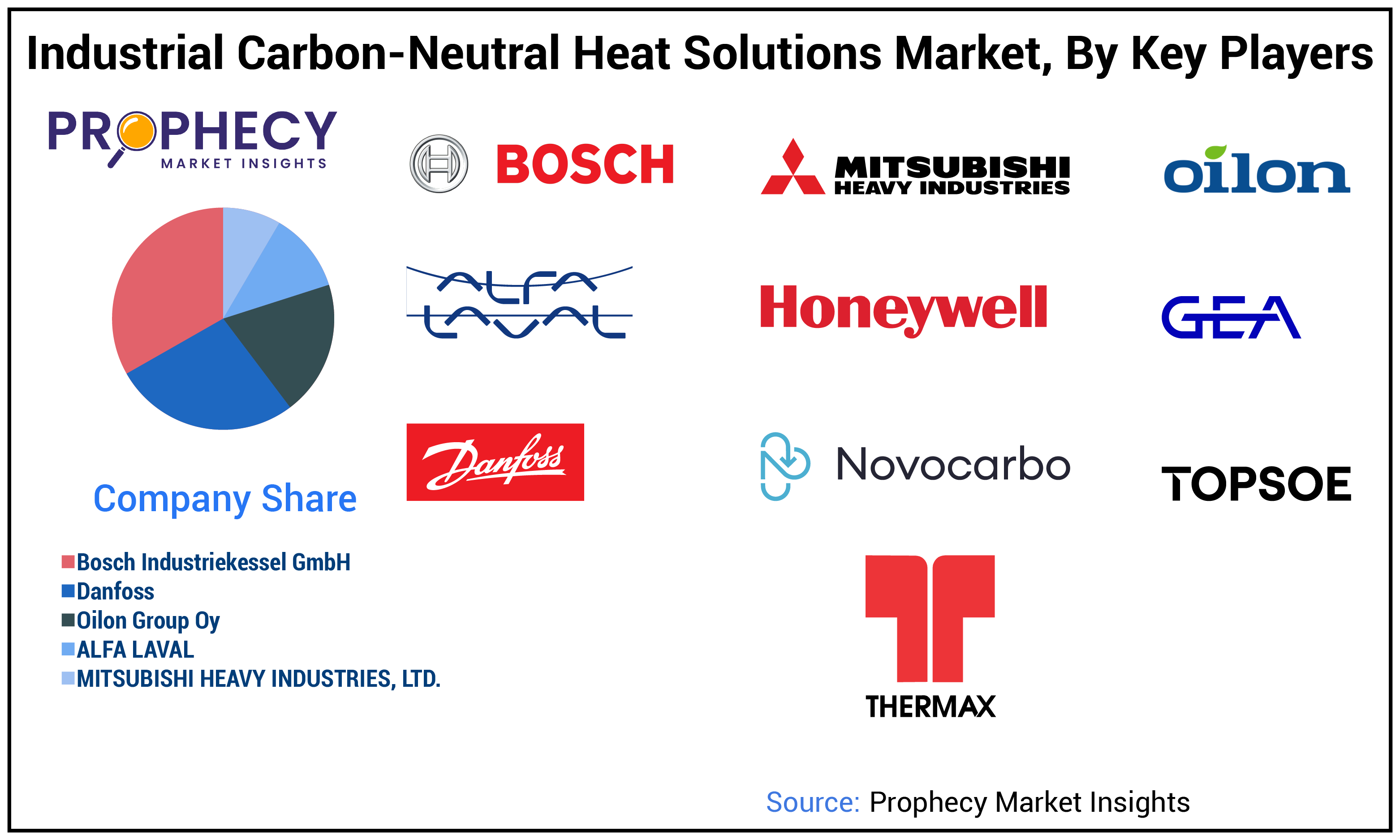
- Bosch Industriekessel GmbH
- Danfoss
- Oilon Group Oy
- ALFA LAVAL
- MITSUBISHI HEAVY INDUSTRIES, LTD.
- Heaten
- Thermax Limited
- GEA Group Aktiengesellschaft
- Topsoe A/S
- Honeywell International Inc.
- FIVES
- SAACKE GmbH
- Novocarbo GmbH
- Equans SAS
- NIBE Industrier AB
View an Additional List of Companies in the Industrial Carbon-Neutral Heat Solutions Market
Industrial Carbon Neutral Heat Solutions Market Recent News
- In October 2025, For the European market, Mitsubishi Heavy Industries Thermal Systems, Ltd. (MHI Thermal Systems), a division of Mitsubishi Heavy Industries (MHI) Group, has added two new models to its "Hydrolution EZY" series of air-to-water (ATW) heat pumps that use R290 (propane). This natural refrigerant is highly energy-efficient and has little effect on the environment. The two models are slated for sale this winter and have capacities of 6kW and 7.1kW.
- In September 2022, the U.S. Department of Energy (DOE) announced the start of the Industrial Heat Shot, a new initiative designed to significantly lower the cost, energy consumption, and carbon emissions related to the heat used to produce everything from steel and cement to food. The Industrial Heat Shot, the most recent DOE Energy Earthshots Initiative, aims to create affordable industrial heat solutions with at least 85% fewer greenhouse gas emissions by 2035.
Analyst View:
Industrial Carbon-Neutral Heat Solutions are clean technologies that replace fossil fuels with renewable electricity, green hydrogen, biomass, geothermal energy, or waste-heat recovery to produce industrial heat without producing carbon emissions. They assist businesses in decarbonizing high-energy processes such process heating, drying, and steam production. The need to lessen environmental effect, stringent government restrictions, carbon pricing, and business net-zero commitments are what are driving market growth.
Technological developments in heat pumps and electrification, as well as the growth of renewable energy sources and policies that support them, are making these solutions more cost-effective, efficient, and extensively used in important industries as metals, chemicals, food, and paper.
Analysis of Sources:
Primary Sources:
- In-depth interviews
- Company-specific data
- Surveys and questionnaires
- Focus group discussions (FGDs)
- Others
Secondary Sources:
- International Energy Agency (IEA)
- International Renewable Energy Agency (IRENA)
- United Nations Industrial Development Organization (UNIDO)
- Organization for Economic Co-operation and Development (OECD)
- World Bank
- Others
More Related Reports
Industrial Lubricants Market
Industrial Sugar Market
Industrial Microwave Heating Equipment Market
Industrial Internet of Things Market
Industrial Boiler Market
Industrial Carbon Neutral Heat Solutions Market Company Profile
|
Company Name |
Product Portfolio |
|
Danfoss |
Sustainable and Energy Efficient Cooling and Heating Solutions |
|
Bosch Industriekessel GmbH |
Carbon-Neutral Heat and Steam Generation |
|
Thermax Limited |
Absorption Cooling and Heating Solutions |
|
GEA Group Aktiengesellschaft |
Carbon Capture Solutions |
|
Novocarbo GmbH |
Heat-as-a-Service Solution |
Industrial Carbon Neutral Heat Solutions Market Highlights
FAQs
Industrial carbon-neutral heat solutions market size was valued at USD 28.2 Billion in 2026 and is expected to reach USD 49.6 Billion by 2036 growing at a CAGR of 5.8%.
Solution, temperature range, application, end user, and region are the segmentation for the industrial carbon-neutral heat solutions market.
Increasing pressure from environmental regulations, rising corporate sustainability goals, and technological advancements that enhance the efficiency and application of carbon-neutral heating technologies, and so on are some of the industrial carbon-neutral heat solutions market growth drivers.
North America, Asia Pacific, Europe, Latin America, and the Middle East & Africa. Europe is expected to dominate the industrial carbon-neutral heat solutions market.
The key players operating the industrial carbon-neutral heat solutions market include Bosch Industriekessel GmbH, BYD Europe B.V., Oilon Group Oy, ALFA LAVAL, MITSUBISHI HEAVY INDUSTRIES, LTD., Heaten, Thermax Limited, GEA Group Aktiengesellschaft, SilexPro, Honeywell International Inc., FIVES, SAACKE GmbH, Novocarbo GmbH, Equans SAS, and NIBE Industrier AB.