Hydrogen Storage Tanks And Transportation Market Overview
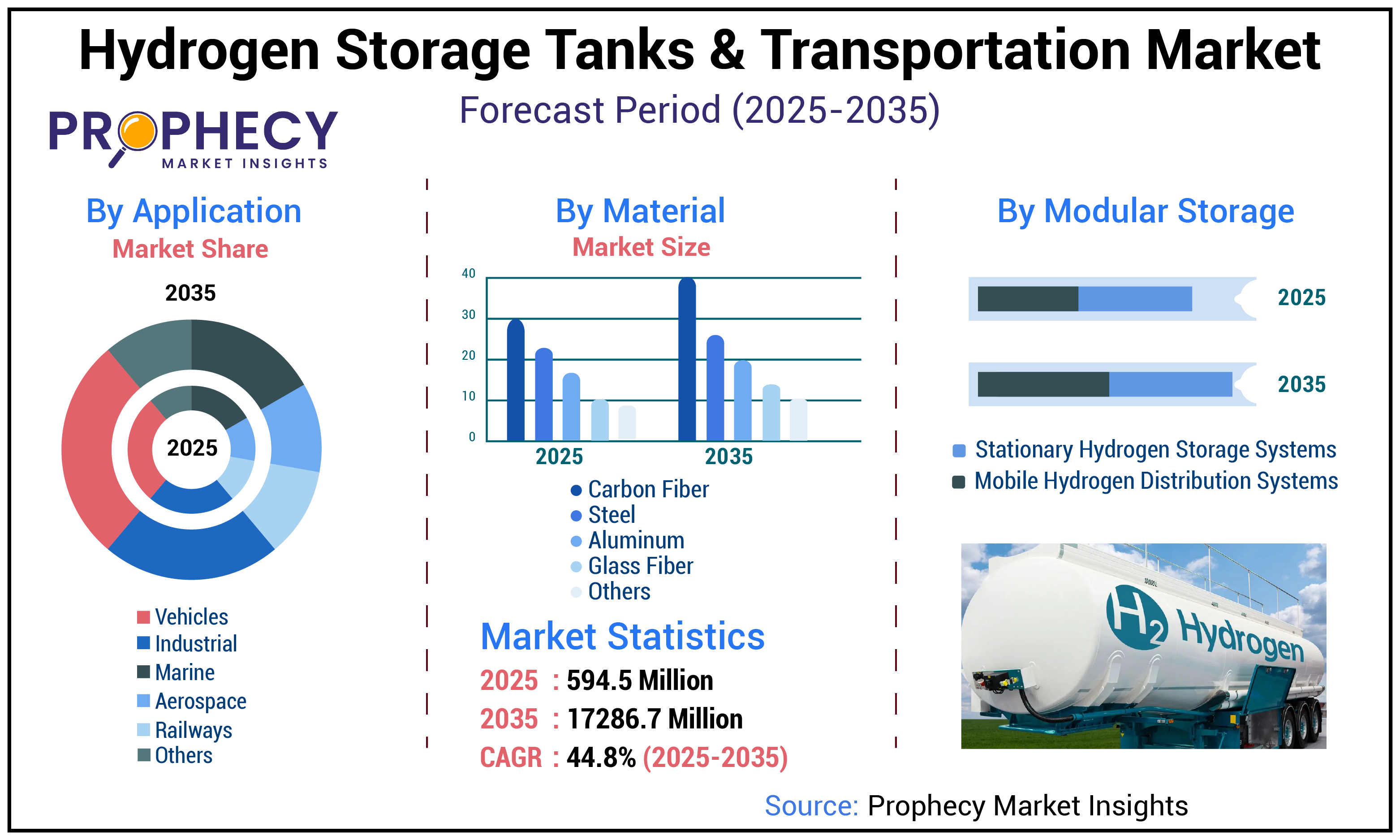
- 2024 Market Size: USD 402 Million
- 2035 Projected Market Size: USD 17286.7 Million
- CAGR (2025-2035): 44.8%
- North America: Largest Market in 2024
Hydrogen storage and transportation are the methods of capturing hydrogen in a solid state, under high pressure or at low temperature in a safe way, and then transporting it to the location where it is needed through pipelines, trucks, or ships. These systems enable the pure and efficient use of hydrogen as a carrier of energy, thus being an excellent complement to fuel cell vehicles, the industry, and power generation. Among the benefits that get by using such technology are the lowering of the emissions of greenhouse gases, contributing to the area's energy sustainability by storing the renewable energy surplus, allowing the distribution of hydrogen at large scales, and simplifying the decarbonization of the economy.
One major factor to the growth of the hydrogen storage tanks and transportation market is the craving for environment-friendly energy, the rising adoption of the fuel cells cars, and the backing by public authorities through their clean energy/zero-emission policies. The trend of innovation in the storage sector, demand for energy delivery at the highest efficiency rate and the global struggle against greenhouse gas emissions are additional motivators that bring about the market expansion since the industrial and transport sectors are modifying their energy consumption patterns to greener fuels.
Development of Standards of Hydrogen Storage and Transportation:
- Developing standards for both the storage and transport of hydrogen is really a must. Such standards are the basis for safety, the achievement of the highest possible levels of efficiency and, most importantly, they are the means for the global compatibility of the hydrogen value chain.
- Several international organizations as ISO, IEC, and SAE are the ones who set the specifications for hydrogen purity, pressure levels, materials compatibility, and leak prevention.
- Along with these standards, there are also regulations for storage in the forms of gas under compression, liquid, and chemical, as well as for transport through pipelines, trailers, and ships.
- The adoption of common standards contributes to minimizing the risk of explosion or leakage, provides a legal basis for the development of infrastructure, and, even more significantly, enables the implementation of hydrogen on a global scale as a clean energy carrier.
- Furthermore, the same standards allow for the free movement of goods across borders and markets, and, thus, very importantly, they become the enablers of the global-scale deployment of hydrogen as a clean energy carrier for all.
Current Industry Dynamics & Insights:
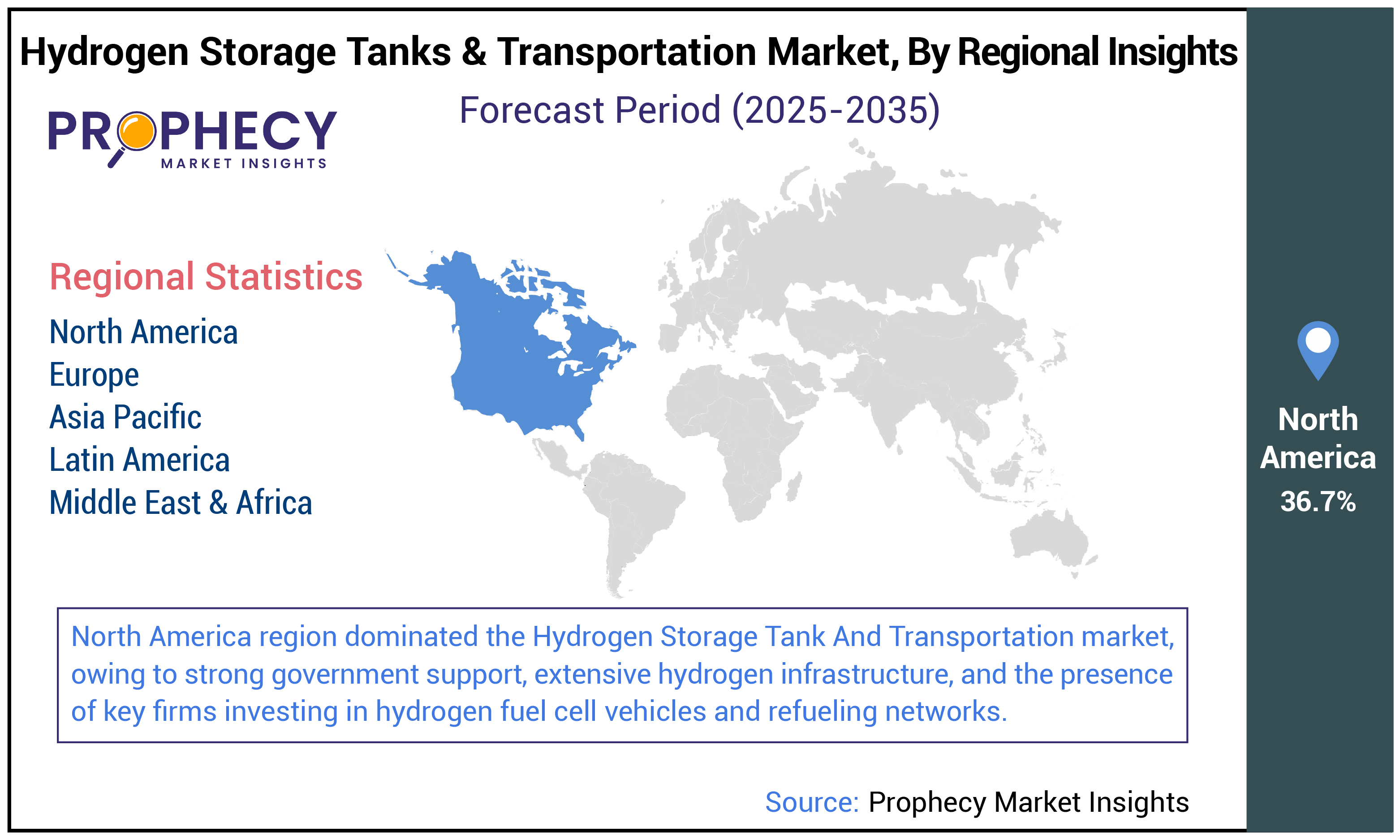
- North America has the largest regional share in the market, with almost 36.7%.
- Europe is second dominating region in the market.
- By tank type, type 4 tanks dominate the hydrogen storage tanks and transportation market.
Hydrogen Storage Tanks And Transportation Market Drivers & Restraints
Drivers and Restraints:
|
Drivers |
Restraints |
Opportunities & Trends |
|
|
|
Key Drivers:
Decarbonization Goals
The decarbonization objective, which entails the cutting down of carbon emissions by both governments and industries, is among the key factors that have a substantial influence on the hydrogen storage tanks and transportation market. They are striving not only to reach lower emissions but also to switch to cleaner energy sources. Electrolytic hydrogen and in particular green hydrogen is a practically zero-emission solution for the sectors of transport, energy, and heavy industry that are hard to electrify. To satisfy the net-zero targets, countries are making investments in hydrogen production, storage, and transport which are leading to the demand growth in the market. Adhering to these climate policies propels the market to be embraced by a larger audience, enhances the technology development, thus, more investors, who together give the pace of market expansion, are attracted.
Restraints:
Regulatory / Standardization Gaps Across Regions
Differences in regulation and standardization between different areas also limit the market for hydrogen storage and transportation by leading to the inconsistency of safety codes, pressure limits, material requirements, and certification procedures. Such dissimilarities impede trade at the international level, slow down the approval process of projects, and increase the costs of manufacturers who are required to design systems in accordance with several different regional standards.
- Counterbalance Statements: Moreover, the lack of unified regulations results in the postponement of large-scale infrastructure development as well as cross-border hydrogen transport. One of the main remedies might be the setting of common global standards through cooperation between organizations like ISO and IEC as well as regional entities such as CEN and SAE, which are supported by government synchronization and international partnerships that guarantee interoperability, safety and cost savings along the hydrogen value chain.
Opportunities & Trends:
Growth in Cross-Border Hydrogen Trade
The cross-border hydrogen trade is among the essential future trends that have been arising, and the main drivers are the global clean energy emphasis and the uneven distribution of renewable resources. Countries such as Australia, Chile, and the Middle East with the potential for solar and wind energy on a large scale are making significant investments in green hydrogen production to supply it to energy-intensive regions as Europe, Japan, and South Korea.
As a result, the development of large-scale liquefied hydrogen carriers, ammonia-based transport systems, and also international pipeline networks is getting higher. The expansion of international hydrogen trade will revive energy security, establish novel business relationships, and facilitate the emergence of an integrated global hydrogen market.
Hydrogen Storage Tanks And Transportation Market Segmentations & Regional Insights
Tank type, pressure, material, modular storage, application, transportation mode, and Country are the divisions of the hydrogen storage tanks and transportation market.
By Tank Type:
Hydrogen storage tanks and transportation market is split based on foundation types such as Type 1, Type 2, Type 3, Type 4, and Others. Type 4 tanks dominate the hydrogen storage tanks and transportation market share due to their lightweight composite structure, high-pressure capability, and greater safety, making them excellent for transportation applications such as fuel cell vehicles and commercial hydrogen distribution.
Type 3 tanks are the second most prevalent, combining metal liners with composite overwraps to give a fair balance of strength, durability, and cost-effectiveness for stationary storage and mid-range transportation, catering to both industrial and commercial hydrogen storage needs.
By Pressure:
The hydrogen storage tanks and transportation market is segmented by pressure: below 200 bar, 200-500 bar, and above 500 bar. The 200-500 Bar pressure category leads the hydrogen storage tanks and transportation market share since it offers the best balance of storage capacity, safety, and cost, making it suitable for both hydrogen fuel cell automobiles and industrial applications.
Above 500 Bar is the second most dominant category, driven by increased demand for high-pressure storage in new transportation solutions and long-range fuel cell cars, where more energy density is required despite higher pricing and technological challenges.
By Material:
The hydrogen storage tanks and transportation market includes materials such as steel, aluminum, carbon fiber, glass fiber, and others. Carbon fiber tanks dominate the hydrogen storage tank and transportation market size due to its high strength-to-weight ratio, higher pressure resistance, and safety, making them ideal for both transportation and mobile hydrogen applications such fuel cell automobiles.
Steel tanks are the second most common because they are sturdy, cost-effective, and quick to construct, making them excellent for stationary storage and industrial usage, even if they are heavier than composite counterparts.
By Modular Storage:
The hydrogen storage tanks and transportation market's modular storage includes stationary hydrogen storage systems as well as mobile hydrogen distribution systems. Stationary hydrogen storage systems dominate the hydrogen storage tank and transportation market share as they are widely utilized for industrial applications, power production, and renewable energy integration, resulting in stable, large-capacity storage with simplified safety management.
Despite higher costs and technological limits than stationary systems, mobile hydrogen distribution systems are the second most popular, driven by the growing use of hydrogen fuel cell vehicles and the need for flexible transportation and delivery solutions.
By Application:
The hydrogen storage tanks and transportation market is divided into several categories, including cars, railways, marine, aerospace, and industrial. The Vehicles application dominates the hydrogen storage tanks and transportation market share due to the widespread adoption of hydrogen fuel cell vehicles, buses, and trucks, which has been supported by government subsidies, expanded refueling infrastructure, and stricter emissions rules.
The second most prevalent application is industrial, as hydrogen is widely used in chemical processing, refining, and energy storage, all of which require large-scale storage and consistent delivery to assure continuous operation.
By Transportation Mode:
The hydrogen storage tanks and transportation market is divided into several transportation modes, including tube trailers, cryogenic tankers, pipelines, and other options. Pipelines dominate the hydrogen storage tank and transportation market size as they provide a continuous, cost-effective, and safe means of transporting large amounts of hydrogen across long distances, especially for industrial and utility uses.
Tube Trailers are the second most common, providing flexible, smaller-scale transportation alternatives for filling stations, distant areas, and short-distance deliveries, but having higher per-unit transport costs than pipelines.
Regional Insights:
Geographically, the hydrogen storage tanks and transportation market is studied across North America, Europe, Asia Pacific, Latin America, and the Middle East & Africa.
North America: This region dominated the hydrogen storage tank and transportation market, owing to strong government support, extensive hydrogen infrastructure, and the presence of key firms investing in hydrogen fuel cell vehicles and refueling networks.
- U.S. Hydrogen Storage Tanks And Transportation Market Insights:
The U.S. dominates the hydrogen storage tank and transportation business in North America, thanks to significant federal and state investments in hydrogen infrastructure, incentives for fuel cell vehicles, and active R&D in high-pressure and cryogenic storage technology.
Europe: This is the second-largest region, driven by strict carbon reduction targets, large-scale green hydrogen projects, and strong policy frameworks under the European Hydrogen Strategy, which encourage the development of cross-border hydrogen infrastructure and sustainable transportation solutions.
- Germany Hydrogen Storage Tanks And Transportation Market Insights:
Germany leads the market in Europe, owing to its ambitious national hydrogen strategy, strong industrial demand from the steel and chemical sectors, and large-scale green hydrogen production and distribution projects funded by the EU, as well as a focus on decarbonizing transportation and energy-intensive industries.
Asia Pacific: This region hydrogen storage tanks and transportation market is quickly expanding as a result of increased expenditures in green hydrogen production, government regulations that promote clean energy, and increased hydrogen use in the industrial, transportation, and energy sectors. Rapid urbanization and the push for decarbonization in heavy sectors drive up demand for efficient hydrogen storage and transportation options.
- Japan Hydrogen Storage Tanks And Transportation Market Insights:
Japan is the region's leading country due to its early adoption of hydrogen fuel cell vehicles, excellent refueling infrastructure, significant government incentives, and strategic plans for hydrogen imports and storage technologies to assist a low-carbon energy transition.
Hydrogen Storage Tanks And Transportation Market Report Scope:
|
Attribute |
Details |
|
Market Size 2025 |
USD 594.5 Million |
|
Projected Market Size 2035 |
USD 17286.7 Million |
|
CAGR Growth Rate |
44.8% (2025-2035) |
|
Base year for estimation |
2024 |
|
Forecast period |
2025 – 2035 |
|
Market representation |
Revenue in USD Million & CAGR from 2025 to 2035 |
|
Countryal scope |
North America - U.S. and Canada Europe – Germany, U.K., France, Russia, Italy, Spain, Netherlands, and Rest of Europe Asia Pacific – China, India, Japan, Australia, Indonesia, Malaysia, South Korea, and Rest of Asia-Pacific Latin America - Brazil, Mexico, Argentina, and Rest of Latin America Middle East & Africa – GCC, Israel, South Africa, and Rest of Middle East & Africa |
|
Company Landscape |
Market Share Analysis of Companies Heat Map Analysis Company Overview, Products Overview Financial Information, Key Highlights Business Strategies Overview SWOT Analysis |
|
Report coverage |
Revenue forecast, company share, competitive landscape, growth factors, and trends |
|
Value Added Data Infosets |
Besides fundamental market insights such as the size of the market, growth rate, segmentation, Countryal study, and key players, our reports carry value-added data sets such as trade flow (import-export) analysis, production and consumption overview, price trend evaluation, supply and value chain mapping, and raw material availability. Moreover, we provide strategic tools as PESTLE and Porter’s Five Forces analysis, examination of the regulatory landscape, as well as monitoring of technology and innovation thereby providing a comprehensive overview which facilitates sensible and anticipatory decision-making. |
Segmentation:
By Tank Type
- Type 1
- Type 2
- Type 3
- Type 4
- Others
By Pressure:
- Below 200 Bar
- 200–500 Bar
- Above 500 Bar
By Material:
- Steel
- Aluminum
- Carbon Fiber
- Glass Fiber
- Others
By Modular Storage:
- Stationary Hydrogen Storage Systems
- Mobile Hydrogen Distribution Systems
By Application:
- Vehicles
- Railways
- Marine
- Aerospace
- Industrial
- Others
By Transportation Mode:
- Tube Trailers
- Cryogenic Tankers
- Pipelines
- Others
By Region:
- North America
- U.S.
- Canada
- Europe
- Germany
- U.K.
- France
- Russia
- Italy
- Spain
- Netherlands
- Rest of Europe
- Asia Pacific
- China
- India
- Japan
- Australia
- Indonesia
- Malaysia
- South Korea
- Rest of Asia Pacific
- Latin America
- Brazil
- Mexico
- Argentina
- Rest of Latin America
- Middle East & Africa
- GCC
- Israel
- South Africa
- Rest of Middle East & Africa
Hydrogen Storage Tanks And Transportation Market Competitive Landscape & Key Players
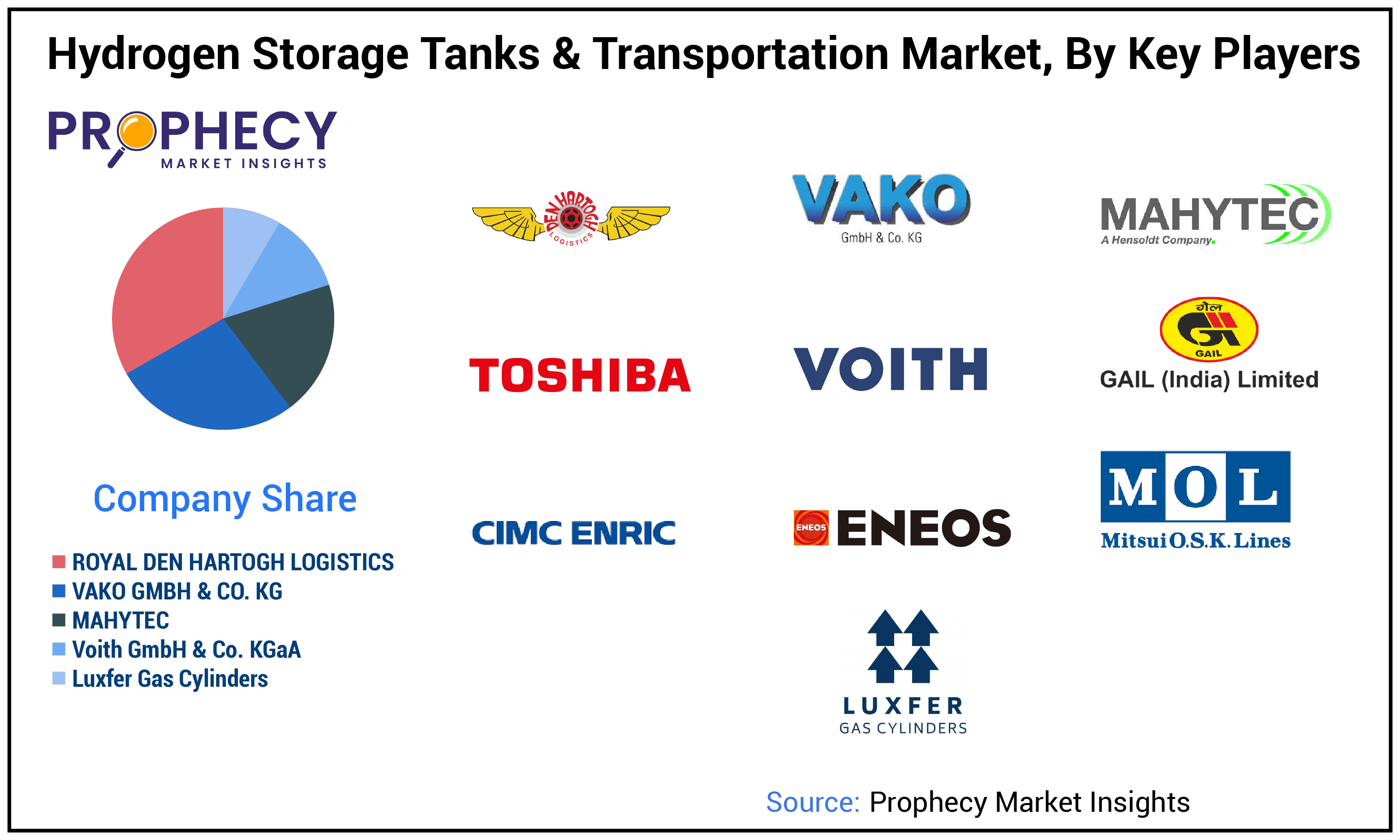
Hydrogen storage tanks and transportation's key growth initiatives include increasing hydrogen infrastructure, such as refueling stations and pipelines, investing in advanced storage technologies as Type 4 and composite tanks, and forming public-private partnerships to accelerate implementation. Companies are also focusing on cross-border collaboration for hydrogen trading, strengthening safety regulations, and combining renewable energy sources into green hydrogen production.
Hydrogen Storage Tanks and Transportation Market Companies:
- ROYAL DEN HARTOGH LOGISTICS
- VAKO GMBH & CO. KG
- MAHYTEC
- Voith GmbH & Co. KGaA
- Luxfer Gas Cylinders
- NPROXX
- Toshiba Energy Systems & Solutions Corporation
- Mitsui O.S.K.Lines
- Beijing SinoHytec Co.,Ltd.
- Sinosynergy
- Beijing Tianhai Industry Co., Ltd.
- EKC
- GAIL
- Iwatani Corporation
- ENEOS Holdings, Inc.
- CIMC ENRIC
View an Additional List of Companies in the Hydrogen Storage Tanks and Transportation Market
Hydrogen Storage Tanks And Transportation Market Recent News
- In April 2025, STEF Group, the European leader in transport and logistics services for temperature-controlled food products, has recently launched two hydrogen projects with Toyota Material Handling Europe, a supplier of hydrogen fuel cell material handling equipment, and Plug Power, a provider of end-to-end green hydrogen systems. The two projects are based in Athis-Mons, France, and Torrejón de Ardoz, Spain. This endeavor is a key step toward creating a comprehensive hydrogen ecosystem that includes both H2 generation and H2-powered material handling equipment.
- In September 2024, Eurotainer, a global leader in tank container leasing, has joined forces with Hexagon Purus, a world pioneer in zero-emission infrastructure and mobility solutions, to launch Type 4 hydrogen storage solutions in support of Norway's ambitious aim of becoming a low-emission society by 2050. This is the first time that these advanced hydrogen storage systems will be available for lease to industrial customers in Norway, including Norwegian Hydrogen.
- In December 2023, In Europe, the rule UNECE R 134 governs type certification for H2 tank systems. For the first time, a Type IV 700 bar and 350 liter hydrogen tanks has been approved for road use under the United Nations Economic Commission for Europe criteria. Voith Composites' ank with unprecedented proportions is now ready for use in heavy-duty trucks and other commercial vehicle applications. This is a significant milestone in expanding the zero-emission heavy goods transportation market.
Analyst View:
Hydrogen storage and transportation are the procedures of safely absorbing hydrogen in high-pressure, low-temperature, or solid-state containers and transporting it to its final destination via pipelines, vehicles, or ships. The need for clean energy, increased use of fuel cell vehicles, and government support through hydrogen infrastructure plans are all important causes driving the development of Europe's hydrogen storage tanks and transportation sector.
Other drivers of market expansion include advancements in storage technology, the quest of efficient energy distribution, and the global fight against CO2 emissions, as the industrial and transportation sectors alter their energy consumption habits to more environmentally friendly fuels.
Analysis of Sources:
Primary Sources:
- In-depth interviews
- Company-specific data
- Surveys and questionnaires
- Focus group discussions (FGDs)
- Others
Secondary Sources:
- European Commission (EC)
- European Environment Agency (EEA)
- U.S. Department of Energy
- U.S. Environmental Protection Agency
- International Energy Agency
- International Organization for Standardization
- Others
More Related Reports
Hydrogen Storage Tanks and Transportation Market
Clean Hydrogen Market
Merchant Hydrogen Market
Hydrogen Trucks Market
Asia Pacific Hydrogen Storage Tanks And Transportation Market
Hydrogen Storage Tanks And Transportation Market Company Profile
|
Company Name |
Product Portfolio |
|
VAKO GMBH & CO. KG |
Hydrogen Tanks |
|
MAHYTEC |
Hydrogen Storage Solutions |
|
NPROXX |
Transport & Stationary Storage |
|
Luxfer Gas Cylinders |
Hydrogen Fuel Systems |
|
Voith GmbH & Co. KGaA |
Hydrogen Storage System |
Hydrogen Storage Tanks And Transportation Market Highlights
FAQs
Hydrogen storage tanks and transportation market size was valued at USD 594.5 Million in 2025 and is expected to reach USD 17286.7 Million by 2035 growing at a CAGR of 44.8%.
Tank type, pressure, material, modular storage, application, transportation mode, and region are the segmentation for the hydrogen storage tanks and transportation market.
Technological advancements in storage and distribution, ambitious decarbonization goals, massive investments in green hydrogen infrastructure, strict environmental regulations, and the increasing demand for hydrogen-powered vehicles and industrial applications, and so on are some of the hydrogen storage tanks and transportation market growth drivers.
North America, Asia Pacific, Europe, Latin America, and the Middle East & Africa. North America is expected to dominate the hydrogen storage tanks and transportation market.
The key players operating the hydrogen storage tanks and transportation market include ROYAL DEN HARTOGH LOGISTICS, VAKO GMBH & CO. KG, MAHYTEC, Voith GmbH & Co. KGaA, Luxfer Gas Cylinders, NPROXX, Toshiba Energy Systems & Solutions Corporation, Mitsui O.S.K.Lines, Beijing SinoHytec Co.,Ltd., Sinosynergy, Beijing Tianhai Industry Co., Ltd., EKC, GAIL, Iwatani Corporation, ENEOS Holdings, Inc., and CIMC ENRIC.