Hydrogen Ships Market Overview
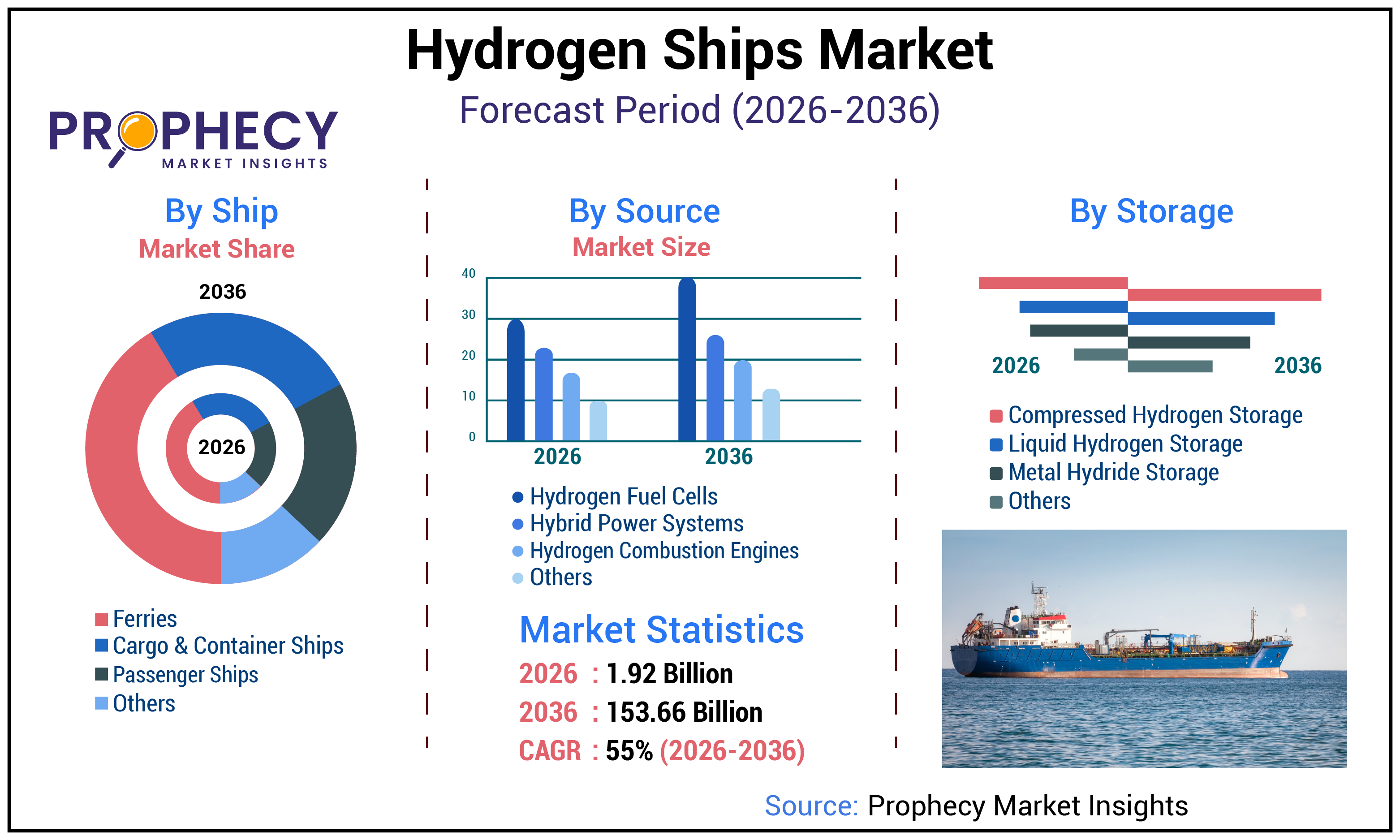
- 2025 Market Size: USD 1.24 Billion
- 2036 Projected Market Size: USD 153.66 Billion
- CAGR (2026-2036): 55%
- Europe: Largest Market in 2025
Hydrogen ships are vessels that are powered by hydrogen fuel cells or hydrogen-based engines that do not emit any harmful substances while generating electricity. In place of fossil fuels, hydrogen is used to produce clean energy, thus making them a viable option for eco-friendly shipping. Among their advantages are the absence of carbon dioxide emissions, less air and noise pollution, increased energy efficiency, and being in line with upcoming environmental regulations. Moreover, they contribute to the reduction of the use of traditional marine fuels, thus paving the way for a cleaner and more sustainable maritime industry.
One of the main factors that increase the demand for hydrogen ships is the worldwide inclination marine transportation to be clean and the imposition of stringent regulations to curtail emissions from the shipping industry. The fear of climate change, coupled with the use of renewable energy and green hydrogen, is pushing shipbuilders and operators to go for technologies that emit zero carbon.
Authorities and businesses are pumping a lot of money into the development of hydrogen facilities, and at the same time, there are significant improvements in fuel cells and storage units that make hydrogen-powered vessels the viable and are efficient. As a result of all these factors working together, the use of hydrogen ships is becoming popular in different parts of the world.
The Regulation of Hydrogen Fuel Propulsion in Maritime Vessels:
- Rules for hydrogen fuel cell-powered ships mainly center on the aspects of safety, respect for the environment and standardized functioning as the use of this clean technology expands.
- Different regulations at different levels, such as those of the International Maritime Organization (IMO), have been set up to address the issues of hydrogen storage, handling, ventilation, fire safety, and fuel-cell systems for ships.
- These rules are designed to reduce hazards resulting from the high flammability of hydrogen, while at the same time encouraging its use as a fuel with zero emissions.
- Several countries are also working on national strategies, certification procedures and standards for port facilities compatible with ships running on hydrogen in order to guarantee the safe takeoff and hassle-free integration into the international shipping industry.
Current Industry Dynamics & Insights:
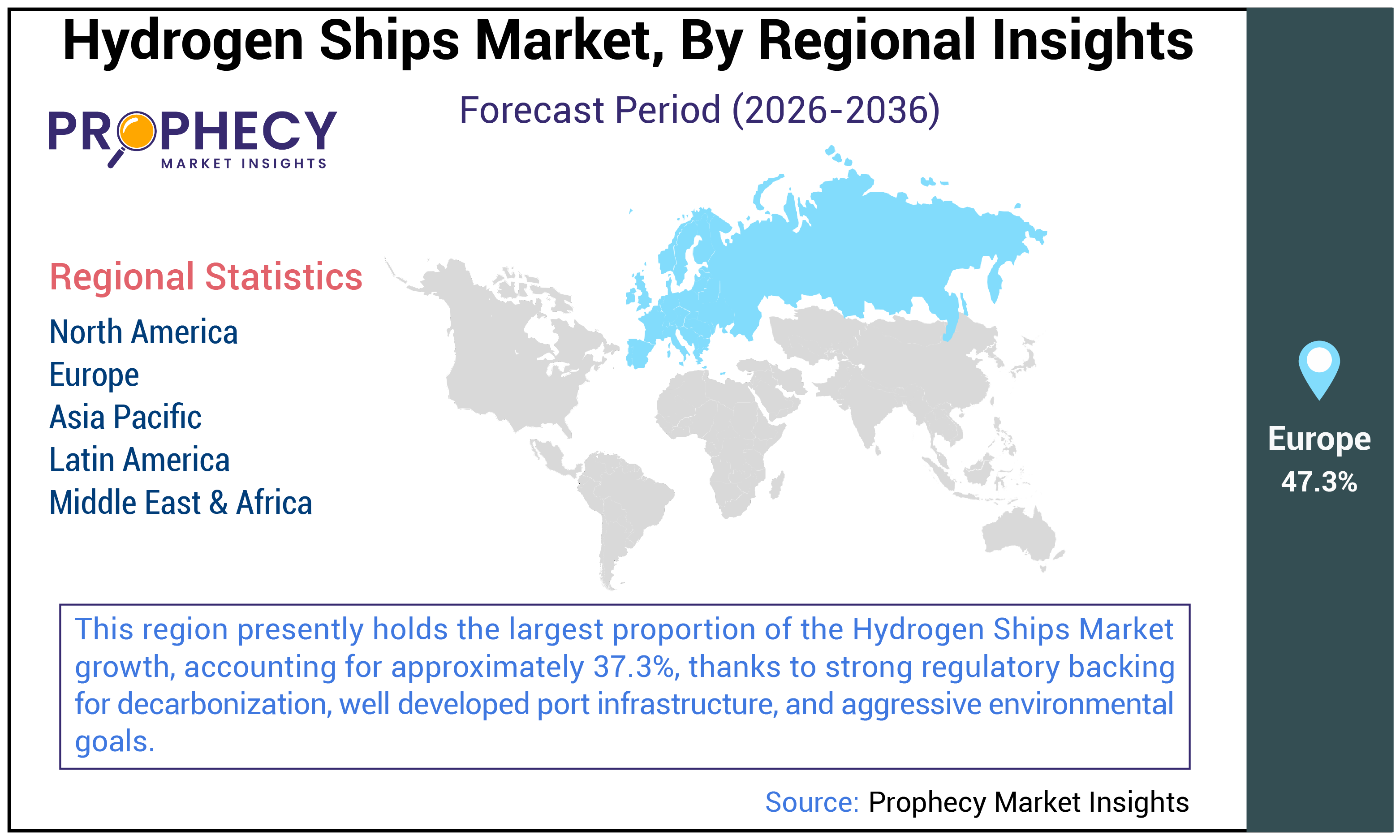
- Europe has the largest regional share in the market, with almost 37.3%.
- Asia Pacific is second dominating region in the market.
- By ship type, passenger ships dominate the hydrogen ships market share.
Hydrogen Ships Market Drivers & Restraints
Drivers and Restraints:
|
Drivers |
Restraints |
Opportunities & Trends |
|
|
|
Key Drivers:
Growth in Renewable Energy
The hydrogen ships market is positively impacted by growth in renewable energy. One of the main reasons is that renewable energies make possible the large-scale production of green hydrogen, which is the clean fuel necessary for zero-emission vessels.
The expansion of solar, wind, and other renewables contributes to the availability of a large amount of low-cost electricity that can be utilized to produce hydrogen by electrolysis, thus making it cheaper and more accessible.
This process has a positive effect on the whole hydrogen supply chain, thus raising the chances of investment in hydrogen infrastructure and making it easier for shipping companies to change their fuel sources from fossil fuels to clean energy. Therefore, the rise in renewable energy is instrumental in the longer-term use of hydrogen-powered ships and speeds up the maritime industry's transition to sustainability.
- For instance, according to the data published by IEA, by 2030, the proportion of renewable energy in total energy consumption will have increased from 13% in 2023 to about 20%. Due to the ongoing governmental support in over 130 countries, falling costs, and the growing usage of electricity for heat pumps and road transportation, more than three-quarters of the total increase is attributable to electricity generated from renewable energy sources.
Restraints:
High Initial Cost of Hydrogen-Powered Vessels
The hydrogen ships market expansion is constrained by the expensive first-time purchase of a hydrogen-powered vessel since the advanced fuel cells, the hydrogen storage systems, and the safety technologies are still way more costly than the traditional marine engines. As, shipowners become reluctant to put their money in, particularly when the hydrogen infrastructure is at its early stages, and the returns on investments are still uncertain.
- Counterbalance Statements: One major way to tackle this problem is by governments increasing their incentives, subsidies, and green financing programs geared towards cutting down the upfront costs. By way of technology getting better and production increasing, the prices of the equipment will be going down by themselves making hydrogen vessels more affordable and thus more people willing to use them.
Opportunities & Trends:
Expansion of Pilot Projects and Demonstration Hydrogen Ships
Essentially the future of hydrogen shippings is the broadening of pilot projects and demonstration hydrogen vessels as these enable actual testing of hydrogen techs in different usage scenarios. Those trials mitigate risks associated with technology, give a chance to confirm performance and safety features through experience, and create a dialogue between the innovators, users, and regulators.
Being a proof of concept, these projects lower the barriers to entry and open the gate for further investments in the sector as well as facilitate the release of the regulatory framework. The gradual advent of more demonstration ships in turn leads to modernization and expansion of the necessary infrastructure along with a great number of investors' participation and thus it becomes a positive cycle of the hydrogen maritime sector's shortening time to the tipping point for popular real market applications. In this way, they constitute a lever for the acceleration of the growth of the hydrogen ship sector in a relatively short time.
Hydrogen Ships Market Segmentations & Regional Insights
Ship type, source, storage type, end user, and region are the divisions of the hydrogen ships market.
By Ship Type:
Passenger ships, cargo & container ships, ferries, and others are type on which hydrogen ships market is segmented. Ferries/passenger vessels currently dominate the hydrogen ship market share as they operate on shorter, well-defined routes (such as urban waterways or island links), making them ideal for hydrogen fuel cells and receiving strong support from governments focused on clean public transportation.
Cargo or container ships are the second-largest market, driven by high fuel use and the potential to decarbonize commercial shipping, creating a considerable need for hydrogen bunkering infrastructure.
By Source:
Based on the source, the hydrogen ships market is divided into hydrogen fuel cells, hydrogen combustion engines, hybrid power systems, and others. Hydrogen fuel cell systems now account for the majority of the hydrogen ship market share since they provide the best energy efficiency (60-70%), as well as zero hazardous emissions, making them suitable for sustainable maritime propulsion.
The second-largest market is hybrid power systems (fuel cells paired with batteries or other sources), which provide operational flexibility, enable peak-load control, and lessen reliance on continuous hydrogen supply particularly helpful in commercial and passenger vessels.
By Storage Type:
The hydrogen ships market is categorized into compressed hydrogen storage, liquid hydrogen storage, metal hydride storage, and others on the account of application. Compressed hydrogen storage currently dominates the hydrogen ships market size given that to its maturity, cost-effectiveness, and widespread availability, as well as existing industrial experience and simpler storage tank designs. It is easy to integrate into early-stage hydrogen vessels, making it the best option for pilot and commercial applications.
The second most common type of storage is liquid hydrogen storage, which has a substantially higher energy density, allowing for longer sailing ranges and making it acceptable for larger ships. Although cryogenic requirements make it more complex and expensive, the benefits of long-distance maritime operations are pushing its increased usage.
By End User:
The hydrogen ships market on the account of end user is categorized shipping companies, port authorities, defense organizations, offshore energy operators, and others. Shipping corporations are the major end users of hydrogen ships since they directly control the boats and are under intense regulatory and commercial pressure to decarbonize their fleets. Their need to fulfill pollution targets and transition to clean fuels positions them as main demand drivers.
Port authorities are the second-largest group because they invest heavily in bunkering infrastructure and hydrogen refueling facilities, allowing for wider use of hydrogen-powered vessels.
Regional Insights:
Geographically, the hydrogen ships market is studied across North America, Europe, Asia Pacific, Latin America, and the Middle East & Africa.
Europe: This region presently holds the largest proportion of the hydrogen market growth, accounting for approximately 37.3%, thanks to strong regulatory backing for decarbonization, well developed port infrastructure, and aggressive environmental goals.
- Netherlands Hydrogen Ships Market Insights:
In Europe, the Netherlands is a leading country in the hydrogen-ships market, due to its strong port infrastructure (as Rotterdam), aggressive decarbonization policies, and pilot projects such as the H2ESTIA liquid-hydrogen cargo ship.
Asia Pacific: This is the second largest region in target market growth, driven by increasing expenditures in hydrogen infrastructure, major shipbuilding centers (such as China, Japan, and South Korea), and rising demand for clean fuels in maritime transport.
Japan Hydrogen Ships Market Insights:
In the Asia-Pacific, Japan is dominant because of its pioneering role in liquid-hydrogen shipping exemplified by the “Suiso Frontier” carrier backed by strong government strategy and investment in hydrogen trade.
North America: The hydrogen ships market size in this region is driven by strong clean-hydrogen legislation, huge expenditures in renewable hydrogen production, and the creation of hydrogen hubs under federal schemes as the U.S.
- U.S. Hydrogen Ships Market Insights:
The U.S. leads this market in North America due to ample funding for hydrogen production, a well-developed energy infrastructure (particularly along the Gulf Coast), and active support for hydrogen research and implementation in transportation sectors.
Hydrogen Ships Market Report Scope:
|
Attribute |
Details |
|
Market Size 2026 |
USD 1.92 Billion |
|
Projected Market Size 2036 |
USD 153.66 Billion |
|
CAGR Growth Rate |
55% (2026-2036) |
|
Base year for estimation |
2025 |
|
Forecast period |
2026 – 2036 |
|
Market representation |
Revenue in USD Billion & CAGR from 2026 to 2036 |
|
Regional scope |
North America - U.S. and Canada Europe – Germany, U.K., France, Russia, Italy, Spain, Netherlands, and Rest of Europe Asia Pacific – China, India, Japan, Australia, Indonesia, Malaysia, South Korea, and Rest of Asia-Pacific Latin America - Brazil, Mexico, Argentina, and Rest of Latin America Middle East & Africa – GCC, Israel, South Africa, and Rest of Middle East & Africa |
|
Company Landscape |
Market Share Analysis of Companies Heat Map Analysis Company Overview, Products Overview Financial Information, Key Highlights Business Strategies Overview SWOT Analysis |
|
Report coverage |
Revenue forecast, company share, competitive landscape, growth factors, and trends |
|
Value Added Data Infosets |
Besides fundamental market insights such as the size of the market, growth rate, segmentation, regional study, and key players, our reports carry value-added data sets such as trade flow (import-export) analysis, production and consumption overview, price trend evaluation, supply and value chain mapping, and raw material availability. Moreover, we provide strategic tools as PESTLE and Porter’s Five Forces analysis, examination of the regulatory landscape, as well as monitoring of technology and innovation thereby providing a comprehensive overview which facilitates sensible and anticipatory decision-making. |
Segmentation:
By Ship Type:
- Passenger Ships
- Cargo & Container Ships
- Ferries
- Others
By Source:
- Hydrogen Fuel Cells
- Hydrogen Combustion Engines
- Hybrid Power Systems
- Others
By Storage Type:
- Compressed Hydrogen Storage
- Liquid Hydrogen Storage
- Metal Hydride Storage
- Others
By End User:
- Shipping Companies
- Port Authorities
- Defense Organizations
- Others
By Region:
- North America
- U.S.
- Canada
- Europe
- Germany
- U.K.
- France
- Russia
- Italy
- Spain
- Netherlands
- Rest of Europe
- Asia Pacific
- China
- India
- Japan
- Australia
- Indonesia
- Malaysia
- South Korea
- Rest of Asia Pacific
- Latin America
- Brazil
- Mexico
- Argentina
- Rest of Latin America
- Middle East & Africa
- GCC
- Israel
- South Africa
- Rest of Middle East & Africa
Hydrogen Ships Market Competitive Landscape & Key Players
Hydrogen ship firms' key growth plans include investing in enhanced fuel-cell technologies and improved hydrogen storage systems to increase vessel efficiency and range. Companies are also collaborating with energy providers, shipyards, and port authorities to create integrated hydrogen ecosystems that include bunkering and refueling infrastructure. Expanding pilot projects and demonstration vessels helps confirm performance and attract investors, while targeting ferries, coastal routes, and short-sea shipping generates early commercial potential.
Hydrogen Ships Market Companies:
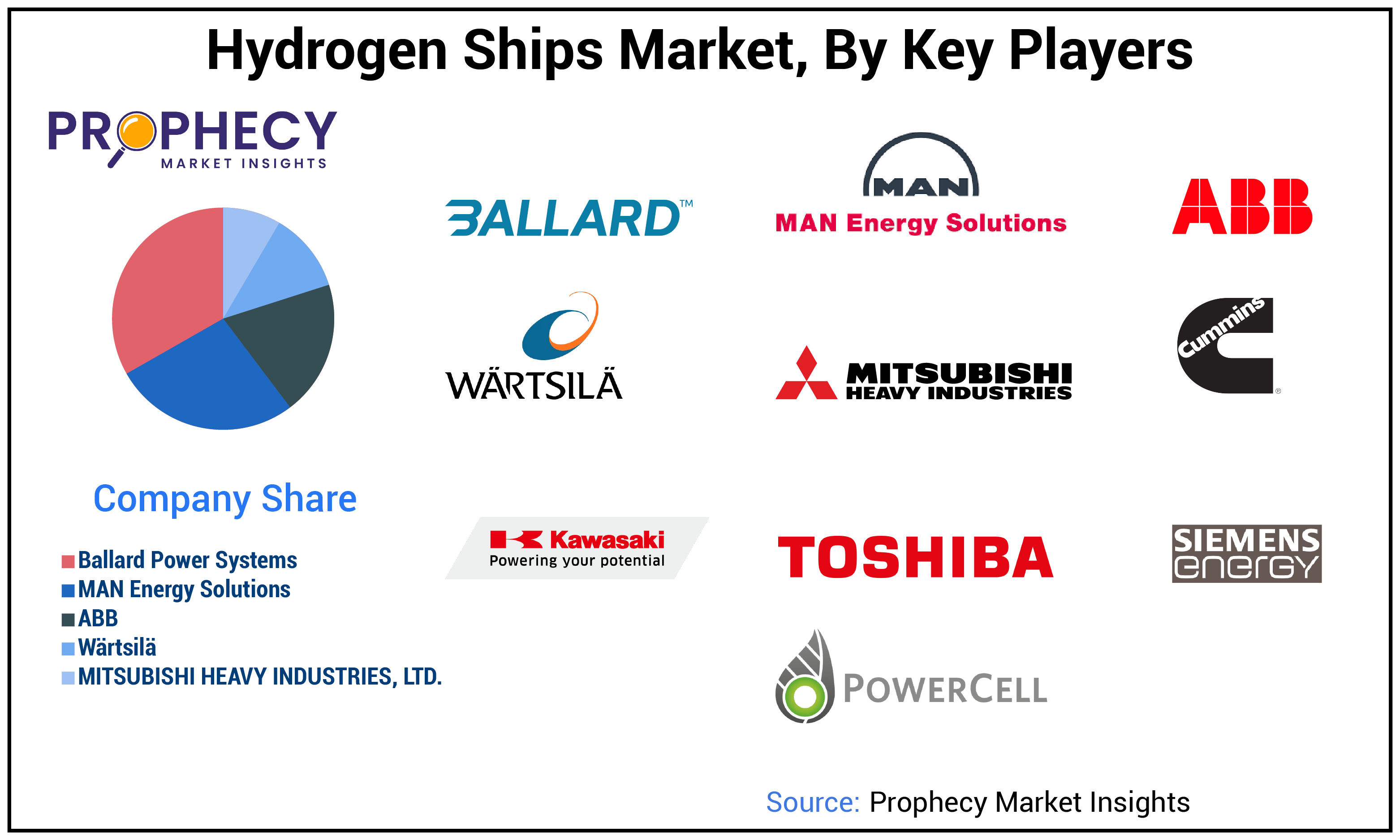
- Ballard Power Systems
- MAN Energy Solutions
- ABB
- Wärtsilä
- MITSUBISHI HEAVY INDUSTRIES, LTD.
- Kawasaki Heavy Industries, Ltd.
- Norled
- PowerCell Sweden AB
- Cummins Inc.
- Siemens Energy
- Toshiba America Inc
- CMB.TECH nv
- HYDROGENIOUS MARITIME
- Zero Emission Industries
- Sydrogen Energy Pte. Ltd.
View an Additional List of Companies in the Hydrogen Ships Market
Hydrogen Ships Market Recent News
- In April 2025, Fincantieri and Viking revealed the "Viking Libra," the world's first cruise ship powered by hydrogen stored onboard for both propulsion and electricity generating. The ship is currently being built at the Fincantieri Ancona shipyard, with delivery anticipated for late 2026.
Analyst View:
Hydrogen ships employ hydrogen fuel cells or hydrogen-based engines to provide clean energy with no harmful emissions, providing benefits such as zero carbon output, reduced pollution, increased efficiency, and compliance with future environmental regulations. Their demand is increasing as a result of the global effort for cleaner marine transportation, stricter pollution restrictions, and growing awareness about climate change. Expanding renewable energy, more investment in hydrogen infrastructure, and breakthroughs in fuel cell and storage technologies are all speeding up acceptance, making hydrogen ships a more realistic and sustainable option for the marine industry.
Analysis of Sources:
Primary Sources:
- In-depth interviews
- Company-specific data
- Surveys and questionnaires
- Focus group discussions (FGDs)
- Others
Secondary Sources:
- U.S. DOE Hydrogen Program Plan
- U.S. Maritime Energy & Emissions Action Plan
- European Commission
- Others
More Related Reports
Clean Hydrogen Market
Hydrogen Generation Market
Hydrogen Fuel Cell Vehicle Market
Hydrogen Market
Hydrogen Trucks Market
Hydrogen Ships Market Company Profile
|
Company Name |
Product Portfolio |
|
MITSUBISHI HEAVY INDUSTRIES, LTD. |
Ship & Ocean |
|
MAN Energy Solutions |
Hydrogen Power Solutions |
|
ABB |
Fuel Cell Systems for Ships |
|
Wärtsilä |
Hybrid Marine System |
|
Norled |
Hydrogen Ferry |
Hydrogen Ships Market Highlights
FAQs
Hydrogen ships market size was valued at USD 1.92 Billion in 2026 and is expected to reach USD 153.66 Billion by 2036 growing at a CAGR of 55%.
Ship type, source, storage type, end user, and region are the segmentation for the hydrogen ships market.
Strict environmental regulations, the push for decarbonization in the maritime sector, and the increasing demand for clean energy solutions, and so on are some of the hydrogen ships market growth drivers.
North America, Asia Pacific, Europe, Latin America, and the Middle East & Africa. Europe is expected to dominate the hydrogen ships market.
The key players operating the hydrogen ships market include Ballard Power Systems, MAN Energy Solutions, ABB, Wärtsilä, MITSUBISHI HEAVY INDUSTRIES, LTD., Kawasaki Heavy Industries, Ltd., Norled, PowerCell Sweden AB, Siemens Energy, Toshiba America Inc, CMB.TECH nv, HYDROGENIOUS MARITIME, Zero Emission Industries, and Sydrogen Energy Pte. Ltd.