Europe Smart Textile Market Overview
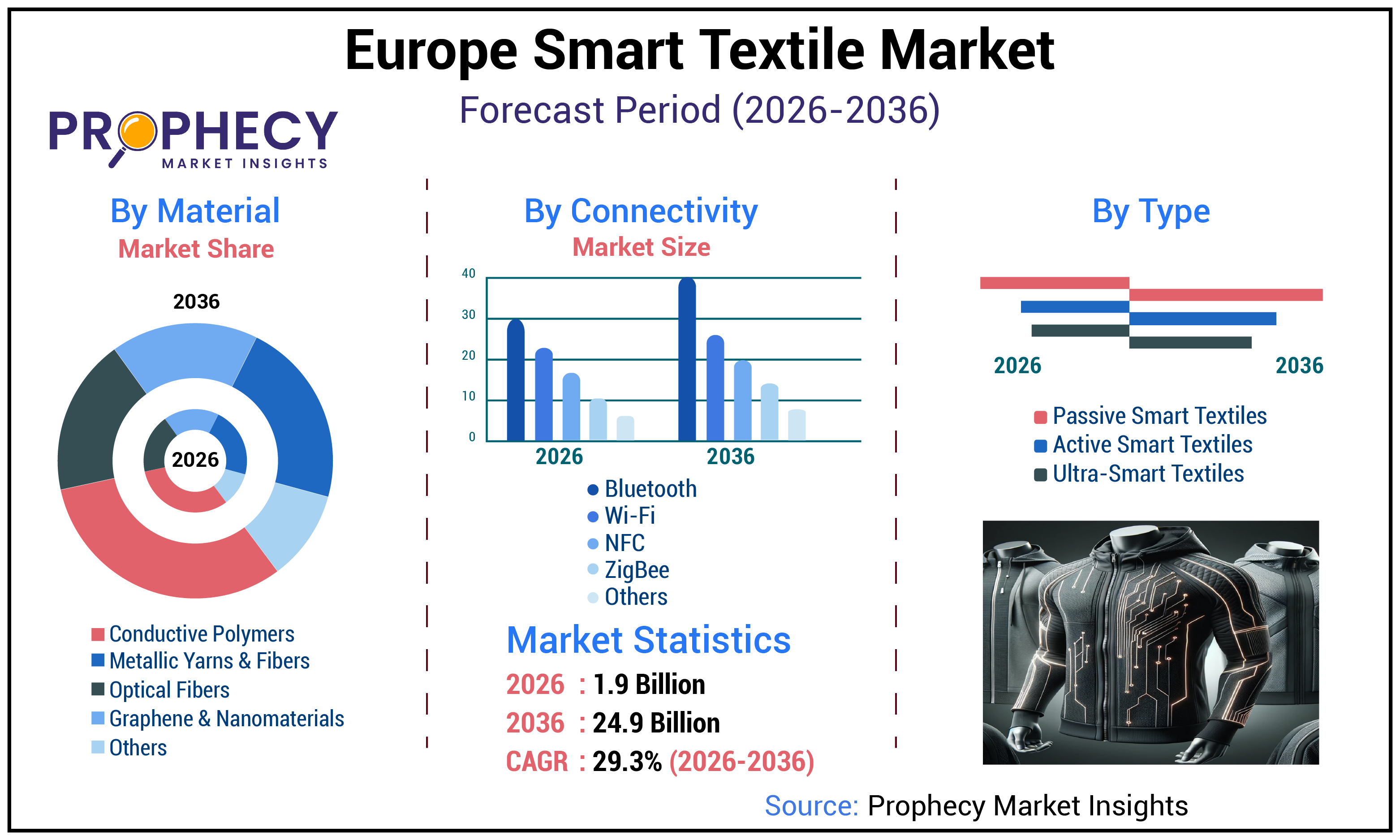
- 2026 Market Size: USD 1.9 Billion
- 2036 Projected Market Size: USD 24.9 Billion
- CAGR (2026-2036): 29.3%
Smart textiles are technically advanced fabrics, which have been outfitted with digital elements such as sensors, actuators, or conductive materials that give them the ability to detect, respond, and adjust to the surroundings or biological conditions. These fabrics are able to track body temperature, movement, or pulse and are being utilized in different areas as medical care, sports, armed forces and clothing. The integration of conventional fabric features with cutting-edge technology makes smart textiles capable of delivering additional benefits, bettering the user's experience and increasing their efficiency.
One of the major factors that contributed to the expansion of the Europe smart textile market was the increasing use of wearable technology. A positive aspect of the situation is the research and innovation in advanced materials, which resulted in a high-quality product. Hence, the demand by the healthcare, and the sports industries, for performance-improving and health-monitoring fabrics have also increased, contributing to the Europe smart textile market growth.
There is also more energy and zeal among governments to change the industry into a more sustainable and high-tech one, which is another positive factor contributing to the development of the market in the entire region. In addition, a growing number of consumers being aware of the comfortable and functional clothing they are buying, is still another factor that is spreading the Smart Textile Market throughoutEurope.
The Future of Technical and Smart Fabrics in Europe:
- Technical and smart fabrics powered by innovative technologies will remain in demand in Europe in the near future.
- Their development is largely influenced by the objectives of sustainability and integration of digital technologies in the textile industry.
- Through research and development, manufacturers in Europe are committed to the production of eco-friendly, multifunctional fabrics that meet the user’s requirements for comfort and durability and provide connectivity as well.
- The increasing use of smart fabrics for medical purposes, the defense sector, the automotive industry, and the fashion industry combined with the region’s firm commitment to a circular economy and high-tech production processes will make Europe a leading player in the global market for next-generation textile technologies.
Europe Smart Textile Market Drivers & Restraints
Drivers and Restraints:
|
Drivers |
Restraints |
Opportunities & Trends |
|
|
|
Key Drivers:
Urban Lifestyle Changes and Higher Disposable Incomes
The change of urban lifestyle and the increase of disposable incomes are the main factors behind the expansion of the Europe smart textile market as consumers are looking for innovative, convenient, and multifunctional clothing that is in line with the modern, tech-oriented way of living. As a result, people with higher spending power are more inclined to spend on technology-integrated fabrics for fitness, health monitoring, and fashion.
Moreover, the emphasis on comfort, performance, and personalized experiences by the urban population is becoming a source of the rising demand for smart textiles in the sportswear, healthcare, and everyday apparel segments.
- For Instance, according to the data published by EuroNews, Disposable household income per capita in Europe's top economies crept up by 0.2% to 3.4% in the first three months of 2024. During the same period, real GDP per capita also saw growth across most European countries. Poland experienced the largest increase in disposable income per capita, rising by 10.2% compared with a decrease of 2.7% in the last quarter of 2023.
Restraints:
Short Product Life Cycle due to Technological Obsolescence
The limited product life cycle due to the fast technological obsolescence is a major factor that restrains the expansion of the smart textile market as the frequent advancements quickly make the existing products outdated, thus increasing the costs on both the manufacturers and the consumers. This problem hampers commitment to use the product in the long term and also raises issues of sustainability because of the increase in waste.
- Counterbalance Statements: One of the ways to solve this problem is to create modular or upgradable smart textiles in which the electronic components can be replaced or updated without the need to discard the whole product, at the same time as there are efforts of standardization to guarantee compatibility with technologies that are constantly changing.
Opportunities & Trends:
Expansion of E-Textiles in Medical and Sports Performance Monitoring
The use of e-textiles for medical and sports performance monitoring is becoming the major future trend of the Europe smart textile market, which is primarily influenced by the rising demand for live and continuous health and fitness data. In fact, these materials with sensors and conductive fibers integrated can monitor essential physiological parameters as the heartbeat, the breathing process, and the electrical activity of muscles, thus allowing the diagnosis to be made early and the athletic performance to be improved.
When the healthcare industry is transitioning to a more personalized and remote monitoring approach, and athletes are looking for ways to enhance their performance through data, the implementation of e-textiles in wearable devices is the most probably scenario, hence the expansion of this sector and the rise of the market will be the consequences.
Europe Smart Textile Market Segmentations & Regional Insights
Type, material, connectivity, functionality, end user, and country are the divisions of the Europe smart textile market.
By Type:
Passive smart textiles, active smart textiles, and ultra-smart textiles are type on which Europe smart textile market is segmented. Due to their affordability, ease of production, and widespread use in sportswear, defense uniforms, and fashion due to their capacity to sense and respond to external stimuli without complicated electronic integration, passive smart textiles currently hold the largest Europe smart textile market share.
Active smart textiles, which use integrated actuators and sensors to detect and react to environmental changes, is the second-dominant market. They are becoming the next big market driver due to their increasing application in military equipment, high-performance athletics, and healthcare monitoring.
By Material:
Based on the material, the Europe smart textile market is divided into conductive polymers, metallic yarns and fibers, optical fibers, graphene and nanomaterials, and others. Conductive polymers have most Europe smart textile market share since they are lightweight, flexible, and simple to incorporate into fabrics without sacrificing comfort or style. They are perfect for wearable electronics, sensors, and health-monitoring applications as they provide superior electrical conductivity while retaining breathable qualities.
Metallic yarns and fibers, which are prized for their exceptional resilience and conductivity, are the second most popular material. They are being utilized more and more in industrial, medical, and defense applications where robustness and high-performance electrical transmission are crucial.
By Connectivity:
The Europe smart textile market is categorized into Bluetooth, Wi-Fi, NFC, ZigBee, and others on the account of connectivity. Bluetooth connectivity has the most Europe smart textile market share given that to its low power consumption, simple integration, and dependable short-range communication, which makes it perfect for wearable technology used in consumer electronics, fitness, and healthcare.
Wi-Fi is the second most popular kind of connectivity since it allows for continuous real-time monitoring and high-speed data transfer, which is especially useful for industrial and medical smart textile applications that need reliable, long-distance communication.
By Functionality:
Sensing, energy harvesting, thermoelectric & heating, luminescent/illuminating, and others are functionality of the Europe smart textile market. Sensing functionality has the most Europe smart textile market share since it is the basis for the majority of smart textile applications, allowing fabrics to track motion, environmental factors, and physiological indicators. For real-time data collecting and performance analysis, this feature is extensively used in the defense, sports, and healthcare industries.
Thermoelectric & heating is the second most popular feature, driven by the increasing need for clothing that can regulate its temperature and heats itself in cold climes, outdoor activities, and military use, where thermal management and comfort are crucial.
By End User:
The Europe smart textile market on the account of end user is categorized individuals / consumers, commercial enterprises, defense & government agencies, and others. Due to the growing use of wearable technology and smart clothing for fashion, fitness tracking, and health monitoring, individuals and consumers have the biggest Europe smart textile market share. The region's consumer demand has been further stimulated by rising disposable incomes and the growing appeal of tech-enhanced lifestyle products.
Defense and government agencies are the second-largest end customer, investing more in cutting-edge smart textiles for military uniforms, protective gear, and communication-enabled textiles that improve soldier safety, situational awareness, and operational effectiveness.
By Country:
By country, the market is categorized into Germany, U.K., France, Russia, Italy, Spain, Netherlands, and Rest of Europe. Due to its robust industrial foundation, cutting-edge R&D skills, and leadership in wearable technology and technical textiles, Germany has the biggest Europe smart textiles market share. Smart fabric solutions are actively incorporated by the nation's well-established automotive, healthcare, and military industries, and partnerships between academic institutions, research centers, and tech companies further expedite product development.
Europe Smart Textile Market Report Scope:
|
Attribute |
Details |
|
Market Size 2026 |
USD 1.9 Billion |
|
Projected Market Size 2036 |
USD 24.9 Billion |
|
CAGR Growth Rate |
29.3% (2026-2036) |
|
Base year for estimation |
2025 |
|
Forecast period |
2026 – 2036 |
|
Market representation |
Revenue in USD Billion & CAGR from 2026 to 2036 |
|
Regional scope |
Europe – Germany, U.K., France, Russia, Italy, Spain, Netherlands, and Rest of Europe |
|
Company Landscape |
Market Share Analysis of Companies Heat Map Analysis Company Overview, Products Overview Financial Information, Key Highlights Business Strategies Overview SWOT Analysis |
|
Report coverage |
Revenue forecast, company share, competitive landscape, growth factors, and trends |
|
Value Added Data Infosets |
Besides fundamental market insights such as the size of the market, growth rate, segmentation, regional study, and key players, our reports carry value-added data sets such as trade flow (import-export) analysis, production and consumption overview, price trend evaluation, supply and value chain mapping, and raw material availability. Moreover, we provide strategic tools as PESTLE and Porter’s Five Forces analysis, examination of the regulatory landscape, as well as monitoring of technology and innovation thereby providing a comprehensive overview which facilitates sensible and anticipatory decision-making. |
Segmentation:
By Type:
- Passive Smart Textiles
- Active Smart Textiles
- Ultra-Smart Textiles
By Material:
- Conductive Polymers
- Metallic Yarns and Fibers
- Optical Fibers
- Graphene and Nanomaterials
- Others
By Connectivity:
- Bluetooth
- Wi-Fi
- NFC
- ZigBee
- Others
By Functionality:
- Sensing
- Energy Harvesting
- Thermoelectric & Heating
- Luminescent/Illuminating
- Others
By End User:
- Individuals / Consumers
- Commercial Enterprises
- Defense & Government Agencies
- Others
By Country:
- Germany
- U.K.
- France
- Russia
- Italy
- Spain
- Netherlands
- Rest of Europe
Europe Smart Textile Market Competitive Landscape & Key Players
Investing in R&D to improve fabric functionality and durability, establishing strategic alliances with tech firms and academic institutions to incorporate IoT and AI solutions, and concentrating on recyclable and sustainable materials to satisfy EU environmental regulations are all important growth strategies for smart textile producers in Europe.
Europe Smart Textile Market Companies:
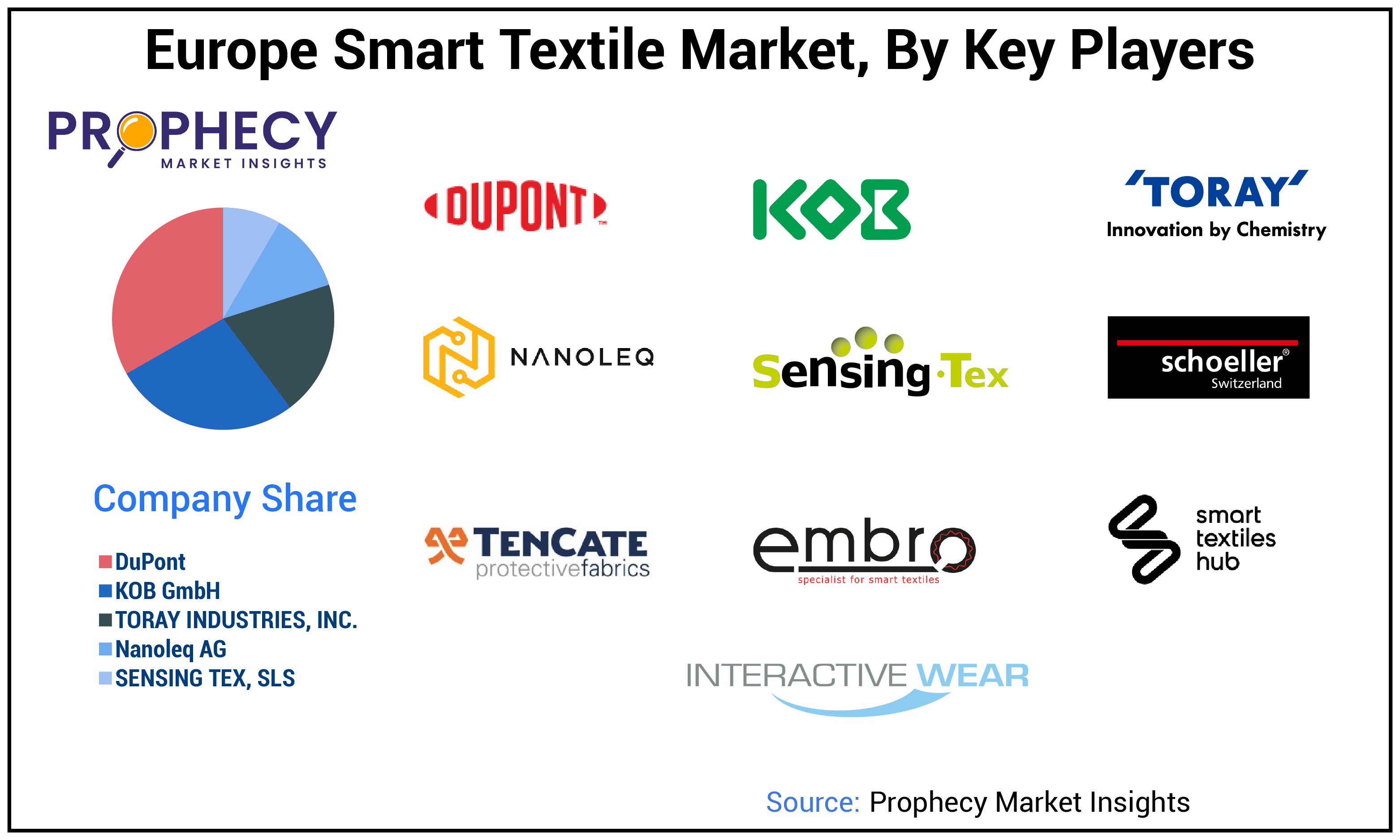
- DuPont
- KOB GmbH
- TORAY INDUSTRIES, INC.
- Nanoleq AG
- SENSING TEX, SLS
- INTERACTIVE WEAR AG
- Schoeller Switzerland
- Textile ETP
- Embro GmbH
- TenCate Protective Fabrics
- ANDRITZ
- TEXIBLE
- Born Germany GmbH
- Smart Textiles Hub GmbH
- ZSK Stickmaschinen GmbH
Europe Smart Textile Market Recent News
- In October 2024, to fill the educational gaps in the rapidly expanding sector of smart textiles, the SmartINNO project formerly known as Advancing Knowledge & Innovation in European Smart Textiles Education was formally established. Funded by a €60,000 grant under the Erasmus+ Small-scale Partnerships in Vocational Education and Training (KA210-VET), this 12-month project aims to transform textile education by promoting knowledge transfer between educational institutions and industry practitioners.
Analyst View:
The expanding use of wearable technology, ongoing innovation in cutting-edge materials, and increased demand for performance-enhancing and health-monitoring fabrics from the sports and healthcare industries are all contributing factors to the Europe Smart Textile Market's rapid growth. The market is expanding throughout the region due to supportive government measures that encourage high-tech production and sustainability, as well as increased consumer awareness of the comfort and usefulness of clothes.
Analysis of Sources:
Primary Sources:
- In-depth interviews
- Company-specific data
- Surveys and questionnaires
- Focus group discussions (FGDs)
- Others
Secondary Sources:
- World Intellectual Property Organization (WIPO)
- European Commission (EC)
- Others
More Related Reports
Smart Classroom Market
Smart Weapons Market
Smart Healthcare Products Market
Smart Home Market
Asia Pacific Smart Textile Market
Europe Smart Textile Market Company Profile
|
Company Name |
Product Portfolio |
|
DuPont |
Smart Textiles for Wellness Monitoring |
|
SENSING TEX, SLS |
Smart Textile |
|
KOB GmbH |
Smart Medical Textiles |
|
TEXIBLE |
Smart Textiles Solutions |
|
Embro GmbH |
Technical Textiles |
FAQs
Europe smart textile market size was valued at USD 1.9 Billion in 2026 and is expected to reach USD 24.9 Billion by 2036 growing at a CAGR of 29.3%.
Type, material, connectivity, functionality, end user, and country are the segmentation for the Europe smart textile market.
A strong emphasis on sustainability and circular economy initiatives within the EU, continuous technological advancements in areas as AI, nanotechnology, and sensing, and the rising trend of wearable technology and its integration into everyday life, and so on are some of the Europe Smart Textile Market growth drivers.
The key players operating the Europe smart textile market include DuPont, KOB GmbH, TORAY INDUSTRIES, INC., Nanoleq AG, SENSING TEX, SLS, Schoeller Switzerland, Textile ETP, TenCate Protective Fabrics, ANDRITZ, TEXIBLE, Born Germany GmbH, Smart Textiles Hub GmbH, and ZSK Stickmaschinen GmbH.