Europe Immersive Technologies Market Overview
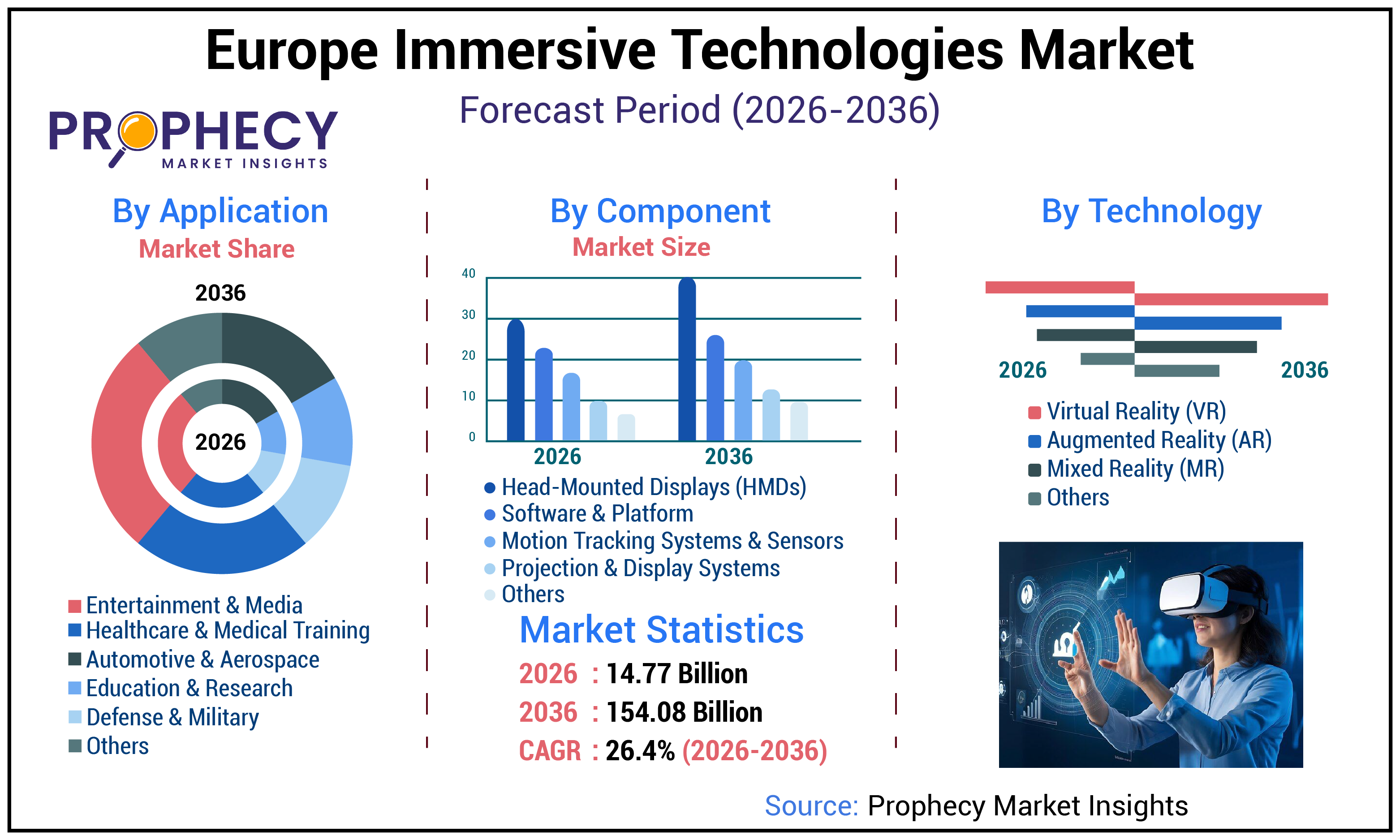
- 2026 Market Size: USD 14.77 Billion
- 2036 Projected Market Size: USD 154.08 Billion
- CAGR (2026-2036): 26.4%
Immersive technologies are digital blends of the real and the virtual, physically indistinguishable, highly interactive, lifelike experiences. Their major advantages are increased user involvement and learning through realistic simulations, improved efficiency by using advanced visualization, cost savings by the use of virtual instead of physical prototypes, and the creation of safe, controlled environments for the performance of difficult, risky, or complex tasks.
Strong digital transformation initiatives, widespread 5G rollout, and increasing adoption of AR/VR across the major sectors such as automotive, manufacturing, healthcare, education, and entertainment are the major factors that have been driving the Europe Immersive Technologies Market to expand at an impressive pace. The region is turning into a smart factory powered by Industry 4.0 where government investments in digital skills development and other related areas are attracting companies to use immersive technologies for training, simulation, and remote collaboration.
Moreover, Europe's booming gaming and creative industries, together with the increasing demand for virtual tourism, cultural experiences, and e-commerce visualization, are the major factors that have led to the market growth. The region is also benefitting from the growing startup ecosystem, research collaboration, and safety and quality standards that are helping to innovate and speed up the uptake across the region.
Privacy Risk of Concern in Developing Immersive Technologies:
- Privacy risks associated with immersive technologies negatively impact the development of such technologies as soon as AR, VR, MR, and XR systems require collection of extremely sensitive and detailed data related to the users.
- Among other things, this data includes eye movements, facial expressions, biometrics, voice patterns, spatial mapping, and real-time behavioral interactions.
- In order to provide realistic experiences, these technologies usually keep track of the users constantly, which, in turn, leads to the increased possibility of unauthorized data collection, profiling, or surveillance.
- Apart from that, immersive platforms may collect information about the environment, other people, and private areas without the provision of clear consent.
- Inadequate data governance, lack of clarity regarding sensor-generated data ownership, and the presence of cloud-connected XR device vulnerabilities can, in fact, make it possible for users to be exposed to breaches and misuse.
- The elimination of such risks necessitates the existence of strong data protection frameworks, transparent consent mechanisms, secure device design, and strict adherence to privacy regulations such as GDPR.
Europe Immersive Technologies Market Drivers & Restraints
Drivers and Restraints:
|
Drivers |
Restraints |
Opportunities & Trends |
|
|
|
Key Drivers:
Expansion of Immersive Learning Tools in Schools and Universities
Europe immersive technologies market is being significantly influenced by the growth of immersive learning tools that are being widely implemented in schools and universities. As educational institutions are going to great lengths to adopt AR/VR as a means of making students more involved, raising learning outcomes, and updating the methods of teaching.
With the help of immersive simulations, learners can now grasp difficult ideas, carry out virtual experiments, and "live" situations from the "real" world that may be hard or too costly to make physically. Thus this becomes a means of supporting STEM education, vocational training, language learning, and remote instruction, at the same time complying with Europe's digital education strategies and government-funded programs for innovation.
Restraints:
Skills Shortage in Immersive Content Development and System Integration
The shortage of skills in immersive content development and system integration is a major factor hindering the growth of the European market. A significant number of organizations do not have professionals who are skilled in 3D modelling, XR programming, spatial design, as well as the integration of AR/VR systems into existing digital infrastructures.
This gap results in slowdowns in project deployment, increases in development costs, and companies being forced to depend on external vendors for the delivery of services, which is not conducive to scalability. Furthermore, the rapid development of XR tools leads to an ongoing demand for updated technical skills, which a majority of institutions are not able to keep up with.
- Counterbalance Statements: The answer is to have more specialized training programs, university–industry partnerships, and government-supported digital skills initiatives that together can create a strong XR talent pipeline. In addition to this, the promotion of standardized development frameworks, low-code XR platforms, and easy-to-use content creation tools can also help in reducing the complexity and thus empowering more organizations to adopt immersive technologies in a productive manner.
Opportunities & Trends:
AI-Powered Personalization of Immersive Training and Simulations
AI-powered personalization of immersive training and simulations is attracting a lot of attention as a major future trend in the market of immersive technologies in Europe. This is mainly because it allows learning experiences that change automatically and instantly according to the behavior, skill level, and performance of each user. When AI is combined with AR/VR environments, training modules can receive the user interactions, figure out the user's strengths and weaknesses, and from there, change the level, speed, and even the content of the training to make sure the user gets the most out of the learning process. So naturally, this leads to ultra-personalized simulations for example, in medical, engineering, military skill, or corporate skill training.
Moreover, AI can also make the training more lifelike through the use of smart virtual assistants, predictive analytics, and scenario generation techniques which are fully automated, thus, the training becomes more efficient and can be extended to a wider audience. As companies turn to the most effective means of workforce development, AI-driven personalization will be the leading force behind next-generation immersive learning platforms in the entire region.
Europe Immersive Technologies Market Segmentations & Regional Insights
Component, technology, application, and country are the divisions of the Europe immersive technologies market.
By Component:
Based on the component, the Europe immersive technologies market is divided into head-mounted displays (HMDs), projection & display systems, motion tracking systems & sensors, software & platform, and others. As the main interface for VR, AR, and MR experiences, head-mounted displays (HMDs) have the biggest Europe immersive technologies market share. Their use is growing quickly in gaming, education, healthcare, and business training. The availability of advanced, ergonomic, and freestanding HMDs, combined with the region’s strong consumer and enterprise demand for immersive experiences, supports this supremacy.
The second-largest component is software & platforms, as immersive applications, content production tools, simulation software, and cloud-based XR platforms are necessary to create meaningful experiences. Growing demand for localized content, enterprise-grade applications, and educational simulations assures software remains a major revenue driver after HMDs.
By Technology:
On the account of Technology, the Europe immersive technologies market can be categorized into augmented reality (AR), virtual reality (VR), mixed reality (MR), and others. Due to its extensive use in gaming, entertainment, healthcare training, and workplace simulations all of which require completely immersive experiences for engagement and skill development, virtual reality (VR) has the greatest Europe immersive technologies market share. VR’s capacity to deliver realistic, regulated environments for education, professional training, and complex industrial processes makes it highly relevant across numerous sectors.
Augmented Reality (AR), which improves user experience, product presentation, and operational efficiency by superimposing digital information onto the actual world, is the second most popular technology due to its expanding use in retail, e-commerce, tourist, and industrial applications. Another factor contributing to AR's quick uptake in both consumer and business markets is its interoperability with tablets and mobile devices.
By Application:
Architecture, engineering & construction (AEC), automotive & aerospace, healthcare & medical training, education & research, defense & military, entertainment & media, retail & e-commerce, and others are application of the Europe immersive technologies market. Due to the region's robust gaming sector, expanding virtual events, and high levels of consumer interaction with VR/AR content, entertainment and media have the greatest Europe immersive technologies market share. The need for immersive experiences in gaming, live concerts, virtual tourism, and interactive media promotes wider adoption among both consumers and content creators.
The second-largest application is healthcare & medical training, as hospitals, medical schools, and research organizations increasingly use VR and AR for surgical simulations, patient care training, and medical education. The requirement for realistic, risk-free training environments, paired with increased healthcare investments and digital health initiatives, makes this industry a key contributor after entertainment.
By Country:
By country, the market is categorized into Germany, U.K., France, Russia, Italy, Spain, Netherlands, and Rest of Europe. Germany is dominating the Europe immersive technologies market size owing to its strong industrial base, advanced digital infrastructure, and early adoption of AR/VR in manufacturing, automotive, and engineering industries. The nation gains from significant government funding for digital innovation projects, Industry 4.0, and smart factories, which motivate businesses to include immersive training, simulation, and process optimization solutions.
Europe Immersive Technologies Market Report Scope:
|
Attribute |
Details |
|
Market Size 2026 |
USD 14.77 Billion |
|
Projected Market Size 2036 |
USD 154.08 Billion |
|
CAGR Growth Rate |
26.4% (2026-2036) |
|
Base year for estimation |
2025 |
|
Forecast period |
2026 – 2036 |
|
Market representation |
Revenue in USD Billion & CAGR from 2026 to 2036 |
|
Regional scope |
Europe – Germany, U.K., France, Russia, Italy, Spain, Netherlands, and Rest of Europe |
|
Company Landscape |
Market Share Analysis of Companies Heat Map Analysis Company Overview, Products Overview Financial Information, Key Highlights Business Strategies Overview SWOT Analysis |
|
Report coverage |
Revenue forecast, company share, competitive landscape, growth factors, and trends |
|
Value Added Data Infosets |
Besides fundamental market insights such as the size of the market, growth rate, segmentation, regional study, and key players, our reports carry value-added data sets such as trade flow (import-export) analysis, production and consumption overview, price trend evaluation, supply and value chain mapping, and raw material availability. Moreover, we provide strategic tools as PESTLE and Porter’s Five Forces analysis, examination of the regulatory landscape, as well as monitoring of technology and innovation thereby providing a comprehensive overview which facilitates sensible and anticipatory decision-making. |
Segmentation:
By Component:
- Head-Mounted Displays (HMDs)
- Projection & Display Systems
- Motion Tracking Systems & Sensors
- Software & Platform
- Others
By Technology:
- Augmented Reality (AR)
- Virtual Reality (VR)
- Mixed Reality (MR)
- Others
By Application:
- Architecture, Engineering & Construction (AEC)
- Automotive & Aerospace
- Healthcare & Medical Training
- Education & Research
- Defense & Military
- Entertainment & Media
- Retail & E-Commerce
- Others
By Country:
- Germany
- U.K.
- France
- Russia
- Italy
- Spain
- Netherlands
- Rest of Europe
Europe Immersive Technologies Market Competitive Landscape & Key Players
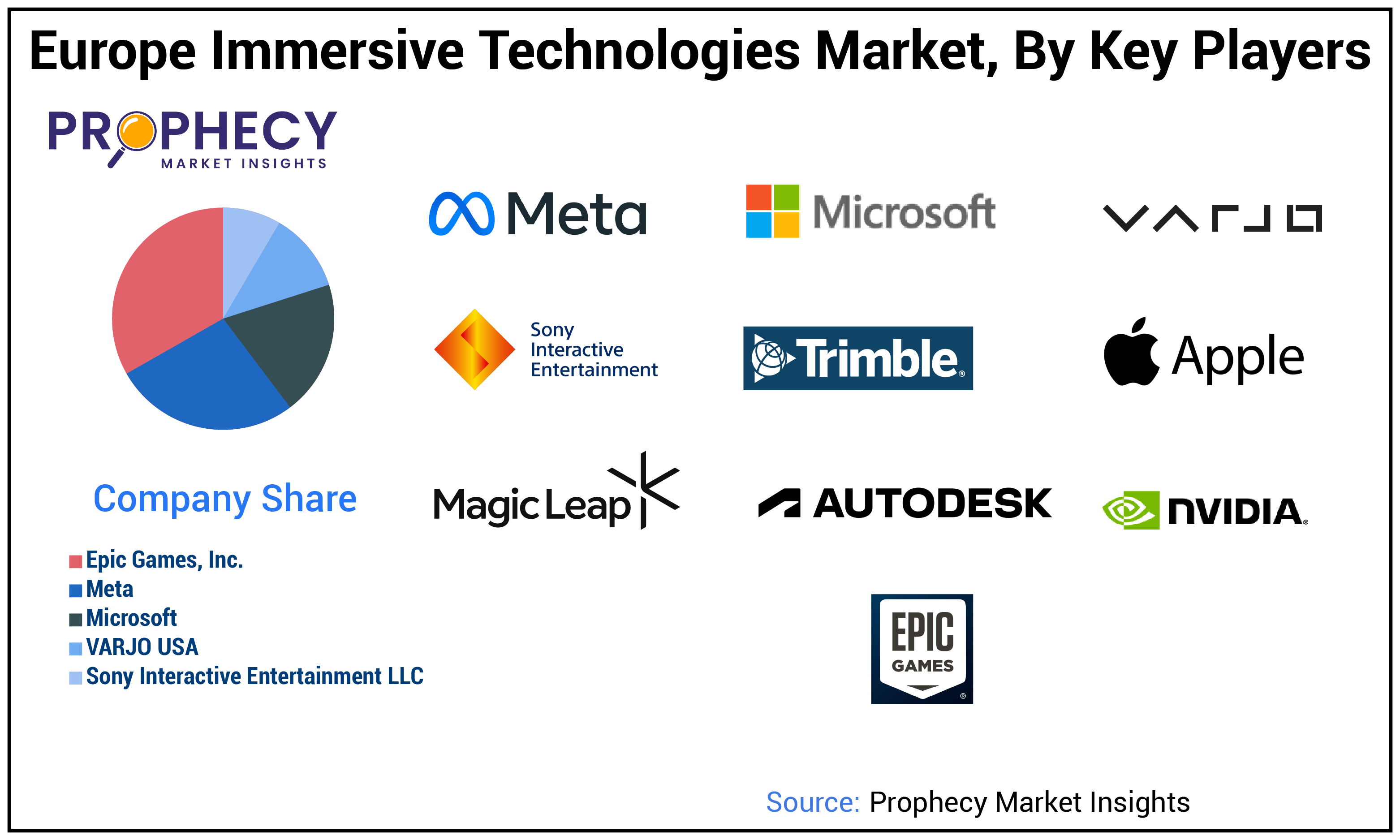
Key growth strategies for immersive technology companies in Europe include developing lightweight, ergonomic, and affordable AR/VR devices to increase accessibility for consumers and enterprises, while investing in localized content and applications for gaming, education, healthcare, and industrial training. To improve corporate solutions and operational efficiency, businesses are also utilizing digital twins, cloud-based XR platforms, and AI integration.
Europe Immersive Technologies Market Companies:
- Epic Games, Inc.
- Meta
- Microsoft
- VARJO USA
- Sony Interactive Entertainment LLC
- Apple Inc.
- NVIDIA Corporation
- Magic Leap, Inc.
- Niantic Spatial, Inc.
- Trimble Inc.
- Autodesk, Inc.
- BENTLEY systems, incorporated
- Dassault Systèmes
- Accenture
Europe Immersive Technologies Market Recent News
- In February 2021, London South Bank University has teamed with London College of Communication, UAL to develop a 3-month acceleration programme for small and medium enterprises (SMEs) interested in leveraging immersive technology. London-based SMEs and start-ups will have the chance to get committed assistance from scholars, consultants, and business professionals as they investigate how immersive technologies as augmented reality (AR) and virtual reality (VR) might help them grow their operations and access new markets.
Analyst View:
By combining real and virtual environments, immersive technologies offer highly interactive, lifelike experiences that improve learning through realistic simulations, increase productivity with sophisticated visualization, lower costs by substituting physical prototypes, and allow the safe completion of difficult or dangerous tasks.
The Europe Immersive Technologies Market is rising significantly due to strong digital transformation initiatives, extensive 5G rollout, and increasing acceptance of AR/VR in automotive, industrial, healthcare, education, and entertainment sectors. Innovation and market adoption are accelerating throughout the region thanks to government investments in Industry 4.0 and digital skills, a booming gaming and creative sector, growing demand for virtual tourism and e-commerce visualization, and a strong startup and research ecosystem.
Analysis of Sources:
Primary Sources:
- In-depth interviews
- Company-specific data
- Surveys and questionnaires
- Focus group discussions (FGDs)
- Others
Secondary Sources:
- National Science Foundation (NSF)
- European Commission
- Eurostat
- Others
More Related Reports
E-Passport Technologies Market
Pharmaceutical Anti-counterfeiting Technologies Market
Water-Energy Nexus Technologies Market
Education Technology (Ed Tech) and Smart Classrooms Market
Asia Pacific Immersive Technologies Market
Europe Immersive Technologies Market Company Profile
|
Company Name |
Product Portfolio |
|
Meta |
Immersive Technologies |
|
Microsoft |
Immersive Experiences in Education |
|
Apple Inc. |
Immersive Art Experience |
|
VARJO USA |
Immersive Technology |
FAQs
Europe immersive technologies market size was valued at USD 14.77 Billion in 2026 and is expected to reach USD 154.08 Billion by 2036 growing at a CAGR of 26.4%.
Component, technology, application, and country are the segmentation for the Europe immersive technologies market.
Increased demand for enhanced entertainment and gaming, widespread enterprise adoption in sectors as manufacturing and healthcare for training and simulation, and government support for digital transformation, and so on are some of the Europe immersive technologies market growth drivers.
The key players operating the Europe immersive technologies market include Epic Games, Inc., BYD Europe B.V., Microsoft, VARJO USA, Sony Interactive Entertainment LLC, Apple Inc., NVIDIA Corporation, Magic Leap, Inc., SilexPro, Trimble Inc., Autodesk, Inc., bentley systems, incorporated, Dassault Systèmes, and Accenture.