Commercial Refrigeration Equipment Market Overview
- 2024 Market Size: USD 43.0 Billion
- 2035 Projected Market Size: USD 71.8 Billion
- CAGR (2025-2035): 5.3%
- Asia Pacific: Largest Market in 2024
Commercial refrigeration equipment includes products such as refrigerators, freezers, display cases, and cold storage units that are specifically designed for the use of restaurants, supermarkets, hotels, hospitals, and other commercial facilities to keep food items that are perishable. The most important advantages are that food safety and quality can be preserved since products are kept at the appropriate temperature, the amount of spoilage and waste can be minimized, a safety standard in the food and medical industries can be ensured, and an increase in operational effectiveness can be achieved as a result of large storage and easy supply chain management.
One of the major reasons that commercial refrigeration equipment market has been growing is the increasing demand for processed and frozen foods. Moreover, the foodservice and retail sectors have been expanding at a quick pace which also raises the need for commercial refrigeration equipment. Furthermore, the rising use of energy-saving and environmentally friendly frigorific systems, along with the stringent government regulations regarding food safety and storage, have contributed to the growth of the commercial refrigeration equipment market.
Commercial Refrigerator Import Data:
|
HSN |
Product Description |
Origin |
Destination |
|
0000 |
Commercial Refrigerator, Commercial Upright Freezer, Commercial Refrigerator Spare Parts, West Cooker Spare Parts |
Colombia |
U.S. |
|
0000 |
Refrigerated Showcase (For Commercial Use), Origin Thailand |
Singapore |
U.S. |
|
0000 |
Commercial Refrigerators Hs Code:8418500000 |
China |
U.S. |
|
0000 |
Refrigerated Showcase (For Commercial Use), Origin Thailand |
Singapore |
U.S. |
Commercial Refrigerator Import Data:
|
HS Code |
Description |
No of Shipments |
|
8418 |
Refrigerators, Freezers and Other Refrigerating or Freezing Equipment, Electric or Other; Heat Pumps Other than Air Can |
-- |
|
84189900 |
Other |
8 |
|
8414 |
Air or Vacuum Pumps, Air or Othe Gas Compress-Sors and Fnas; Ventilating or Recycling Hoods Incorporating a Fan |
-- |
|
84143000 |
Compressors of a Kind used in Refrigerating Equipment |
382 |
Current Industry Dynamics & Insights:
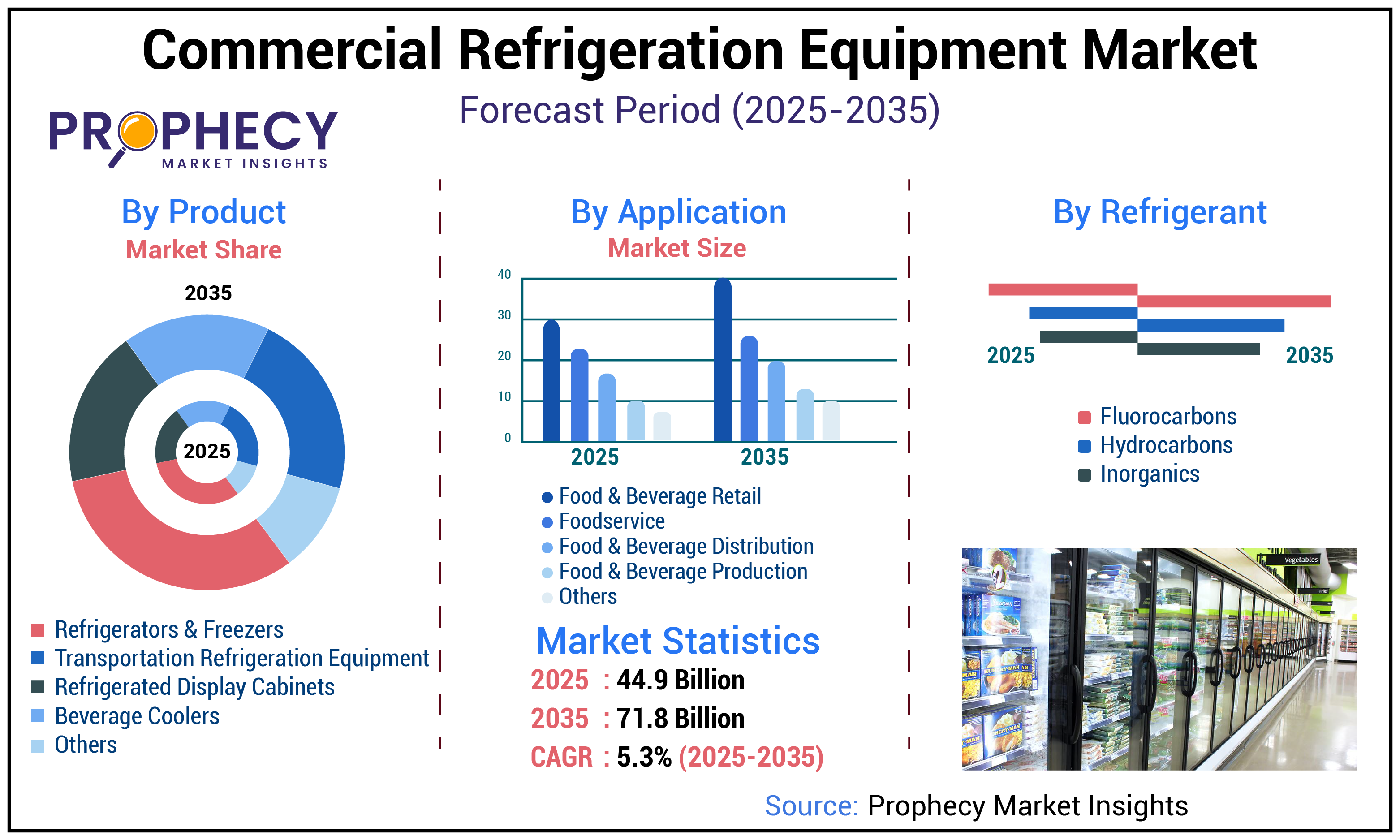
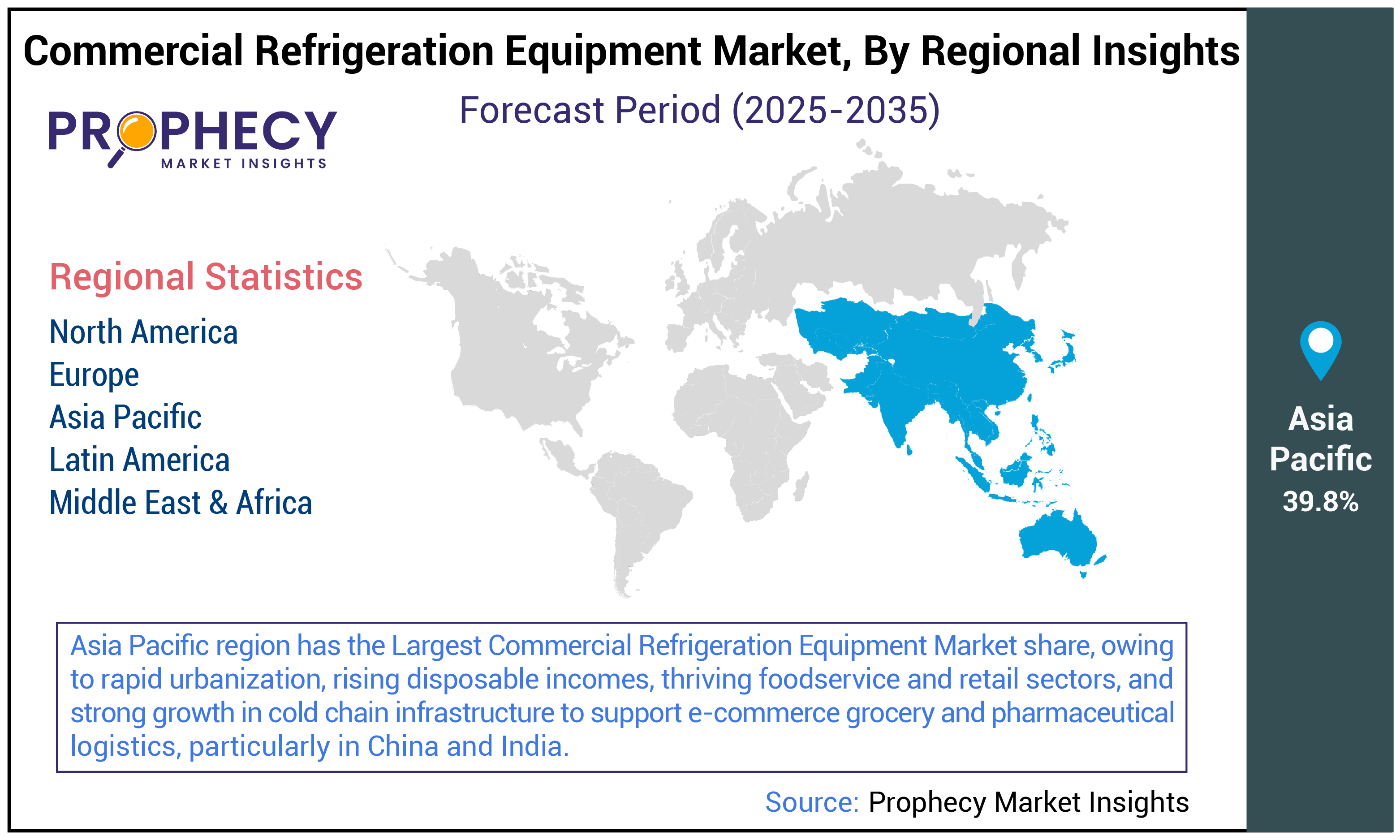
- Asia Pacific has the largest commercial refrigeration equipment market share in the market, with almost 39.8%.
- North America is second dominating region in the market.
- By product type, refrigerators & freezers dominate the commercial refrigeration equipment market.
Commercial Refrigeration Equipment Market Drivers & Restraints
Drivers and Restraints:
|
Drivers |
Restraints |
Opportunities & Trends |
|
|
|
Key Drivers:
Urbanization and Rising Disposable Incomes
The expansion of urban areas and the increase of disposable incomes are the two main factors that influence the commercial refrigeration equipment market to grow. The reason is that the consumers' demand for fresh, frozen, and processed foods increases, as urban lifestyles are more inclined towards convenience and the use of ready-to-eat products.
As the middle-class populations have been growing, and these populations have been earning more, it has been observed that they are spending more money on dining out, supermarkets, and modern retail formats. In this case, the advanced refrigeration solutions have been considered to be a must to maintain the food safety and quality. The change has boosted the need for commercial refrigeration in the foodservice and retail industries besides that it has also increased the pace of adoption of energy-saving and tech-savvy systems.
- For Instance, according to the data published by World Bank Group, in order to fulfill the World Bank's purpose of eradicating poverty and promoting shared prosperity on a habitable world, more livable cities must be built. Currently, 4.4 billion people, or more than half of the world's population, reside in urban areas.
- For Instance, according to the data published by Euromonitor, global disposable income rise by 8.8% in 2023, driven by growth in Asia Pacific and North America. By 2040, disposable income growth is projected by 2.6% with emerging and developing regions leading the expansion. In Asia Pacific, real growth of 49.8% in consumer spending over 2023-2040, which is higher than North America. Developed Asian nations such as Japan and South Korea are expected to drive a significant increase in spending, though still covering behind China.
Restraints:
Environmental Concerns Related to Refrigerants with High GWP (Global Warming Potential
The commercial refrigeration equipment market is constrained by environmental concerns related to the use of refrigerants with a high global warming potential (GWP), such as hydrofluorocarbons (HFCs). The reason being that tougher rules and the achievement of sustainability objectives compel companies to discontinue these gases that are harmful to the environment, which in turn causes them to incur higher compliance costs and to undergo technology changes.
- For instance, according to the data published by NOAA Climate.gov, Earth’s temperature has risen by an average of 0.11° Fahrenheit (0.06° Celsius) per decade since 1850, or about 2° F in total. The rate of warming since 1982 is more than three times as fast: 0.36° F (0.20° C) per decade. The global average surface temperature was 2.32 Fahrenheit (1.29 degrees Celsius) above the 20th-century average (57.0 degrees Fahrenheit, or 13.9 degrees Celsius) and 2.63 degrees Fahrenheit (1.46 degrees Celsius) above the pre-industrial average (56.7 degrees Fahrenheit, or 13.7 degrees Celsius), which NOAA defines as the period from 1850-1900.
- Counterbalance Statements: As a solution, the use of natural refrigerants such as CO2, ammonia, and hydrocarbons is going to be the main trend for manufacturers. In addition to that they are also focusing on creating energy-efficient, low-GWP systems that not only comply with environmental standards but also cut Master-Biltn on their operating costs in the long run and contribute to sustainable development.
Opportunities & Trends:
E-Commerce Expansion
One of the major contributors to the commercial refrigeration equipment market is the fast-growing e-commerce sector, particularly the online grocery and food delivery services. Such businesses have to store a large amount of perishable goods in refrigerated warehouses and cold storage facilities, which in turn has increased the demand for these kinds of solutions to maintain product safety and quality during last-mile deliveries.
Ordering perishables has become the preference of consumers and as such retailers alongside logistics providers are embracing cutting-edge refrigeration solutions. This is to ensure effective cold chain management, minimize wastage, and delight clients with prompt and dependable delivery thus stimulating the market expansion.
- For Instance, according to the data published by SellersCommerce, there are 2.77 billion global online shoppers. In 2025, 21% of retail purchases are expected to take place online, and this share will rise to 22.6% by 2027. Ecommerce sales will surpass $6.8 trillion in 2025. There are over 28 million eCommerce stores globally.
Commercial Refrigeration Equipment Market Segmentations & Regional Insights
Product type, system type, refrigerant type, application, and region are the divisions of the commercial refrigeration equipment market.
By Product Type:
Refrigerators & freezers, transportation refrigeration equipment, refrigerated display cabinets, beverage coolers, and others are type on which commercial refrigeration equipment market is segmented. Refrigerators and freezers have the largest commercial refrigeration equipment market share as they are required in restaurants, supermarkets, hotels, hospitals, and convenience stores to store a variety of perishable goods, making them the foundation of food and healthcare storage solutions.
The second largest segment is transportation refrigeration equipment, which is being driven by the rapid expansion of cold chain logistics, e-commerce grocery delivery, and pharmaceutical distribution, where maintaining product integrity during transit is critical to meeting global demand for fresh food and medicines.
By System Type:
Based on the system type, the commercial refrigeration equipment market is divided into self-contained systems, and remote systems. Self-contained systems dominate the commercial refrigeration equipment market share due to its compact size, ease of installation, minimal initial investment, and widespread use in small to medium-sized retail shops, restaurants, and convenience stores.
Remote systems are the second most popular sector, owing to their appropriateness for big supermarkets, hypermarkets, and warehouses, where increased cooling capacity, improved energy efficiency, and reduced in-store heat and noise are critical for large-scale operations.
By Refrigerant Type:
On the account of refrigerant type, the commercial refrigeration equipment market is categorized into fluorocarbons, hydrocarbons, and inorganics. Fluorocarbons have the biggest commercial refrigeration equipment market share due to their extensive use, low cost, and excellent chilling performance, making them the preferred choice for retail, restaurant, and cold chain applications despite environmental concerns.
Hydrocarbons are the second most popular group, gaining traction as a sustainable alternative since they are energy-efficient, have a low Global Warming Potential (GWP), and comply with increasingly stringent environmental requirements, pushing their usage in eco-friendly refrigeration systems.
By Application:
The commercial refrigeration equipment market on the account of application is categorized into food & beverage retail, foodservice, food & beverage distribution, food & beverage production, and others. Food & beverage Retail accounts for the largest commercial refrigeration equipment market size due to supermarkets, hypermarkets, and convenience stores rely heavily on refrigerators, freezers, and display cabinets to store and showcase a wide range of perishable products, making them the primary users of such equipment.
Foodservice is the second most important segment, driven by the global expansion of restaurants, cafés, quick-service outlets, and hotels, where food safety, freshness, and quality are crucial to fulfilling expanding consumer demand for eating out and ready-to-eat meals.
Regional Insights:
Geographically, the commercial refrigeration equipment market is studied across North America, Europe, Asia Pacific, Latin America, and the Middle East & Africa.
Asia Pacific: This region has the largest commercial refrigeration equipment market share, owing to rapid urbanization, rising disposable incomes, thriving foodservice and retail sectors, and strong growth in cold chain infrastructure to support e-commerce grocery and pharmaceutical logistics, particularly in China and India.
- China commercial refrigeration equipment market Insights:
China leads the Asia-Pacific commercial refrigeration equipment market since to its vast retail and foodservice industry, fast urbanization, strong industrial base, and government expenditures in cold chain logistics to support fresh food and e-commerce development.
North America: This is the second most dominant area, due to the existence of established supermarket chains, superior cold chain operations, widespread use of energy-efficient refrigeration systems, and severe food safety standards that fuel ongoing demand for contemporary refrigeration solutions.
- U.S. commercial refrigeration equipment market Insights:
North America's market is led by the United States, which has well-established supermarket and restaurant chains, advanced cold storage infrastructure, strong demand for frozen and processed foods, and strict food safety regulations that drive the adoption of advanced refrigeration technologies.
Europe: The commercial refrigeration equipment market in Europe is expanding as a result of rising demand for frozen and processed foods, the expansion of supermarket and hypermarket chains, strict EU regulations encouraging energy-efficient and environmentally friendly refrigeration systems, and the growing need for advanced cold storage in pharmaceuticals and food distribution.
- Germany commercial refrigeration equipment market Insights:
Germany leads the market in Europe as to its large retail and foodservice sectors, widespread adoption of sustainable refrigeration technology, and prominent role in Europe's cold chain logistics and distribution networks.
Commercial Refrigeration Equipment Market Report Scope:
|
Attribute |
Details |
|
Market Size 2025 |
USD 44.9 Billion |
|
Projected Market Size 2035 |
USD 71.8 Billion |
|
CAGR Growth Rate |
5.3% (2025-2035) |
|
Base year for estimation |
2024 |
|
Forecast period |
2025 – 2035 |
|
Market representation |
Revenue in USD Billion & CAGR from 2025 to 2035 |
|
Regional scope |
North America - U.S. and Canada Europe – Germany, U.K., France, Russia, Italy, Spain, Netherlands, and Rest of Europe Asia Pacific – China, India, Japan, Australia, Indonesia, Malaysia, South Korea, and Rest of Asia-Pacific Latin America - Brazil, Mexico, Argentina, and Rest of Latin America Middle East & Africa – GCC, Israel, South Africa, and Rest of Middle East & Africa |
|
Company Landscape |
Market Share Analysis of Companies Heat Map Analysis Company Overview, Products Overview Financial Information, Key Highlights Business Strategies Overview SWOT Analysis |
|
Report coverage |
Revenue forecast, company share, competitive landscape, growth factors, and trends |
|
Value Added Data Infosets |
Besides fundamental market insights such as the size of the market, growth rate, segmentation, regional study, and key players, our reports carry value-added data sets such as trade flow (import-export) analysis, production and consumption overview, price trend evaluation, supply and value chain mapping, and raw material availability. Moreover, we provide strategic tools as PESTLE and Porter’s Five Forces analysis, examination of the regulatory landscape, as well as monitoring of technology and innovation thereby providing a comprehensive overview which facilitates sensible and anticipatory decision-making. |
Segmentation:
By Product Type:
- Refrigerators & Freezers
- Transportation Refrigeration Equipment
- Refrigerated Display Cabinets
- Beverage Coolers
- Others
By System Type:
- Self-Contained Systems
- Remote Systems
By Refrigerant Type:
- Fluorocarbons
- Hydrocarbons
- Inorganics
By Application:
- Food & Beverage Retail
- Foodservice
- Food & Beverage Distribution
- Food & Beverage Production
- Others
By Region:
- North America
- U.S.
- Canada
- Europe
- Germany
- U.K.
- France
- Russia
- Italy
- Spain
- Netherlands
- Rest of Europe
- Asia Pacific
- China
- India
- Japan
- Australia
- Indonesia
- Malaysia
- South Korea
- Rest of Asia Pacific
- Latin America
- Brazil
- Mexico
- Argentina
- Rest of Latin America
- Middle East & Africa
- GCC
- Israel
- South Africa
- Rest of Middle East & Africa
Commercial Refrigeration Equipment Market Competitive Landscape & Key Players
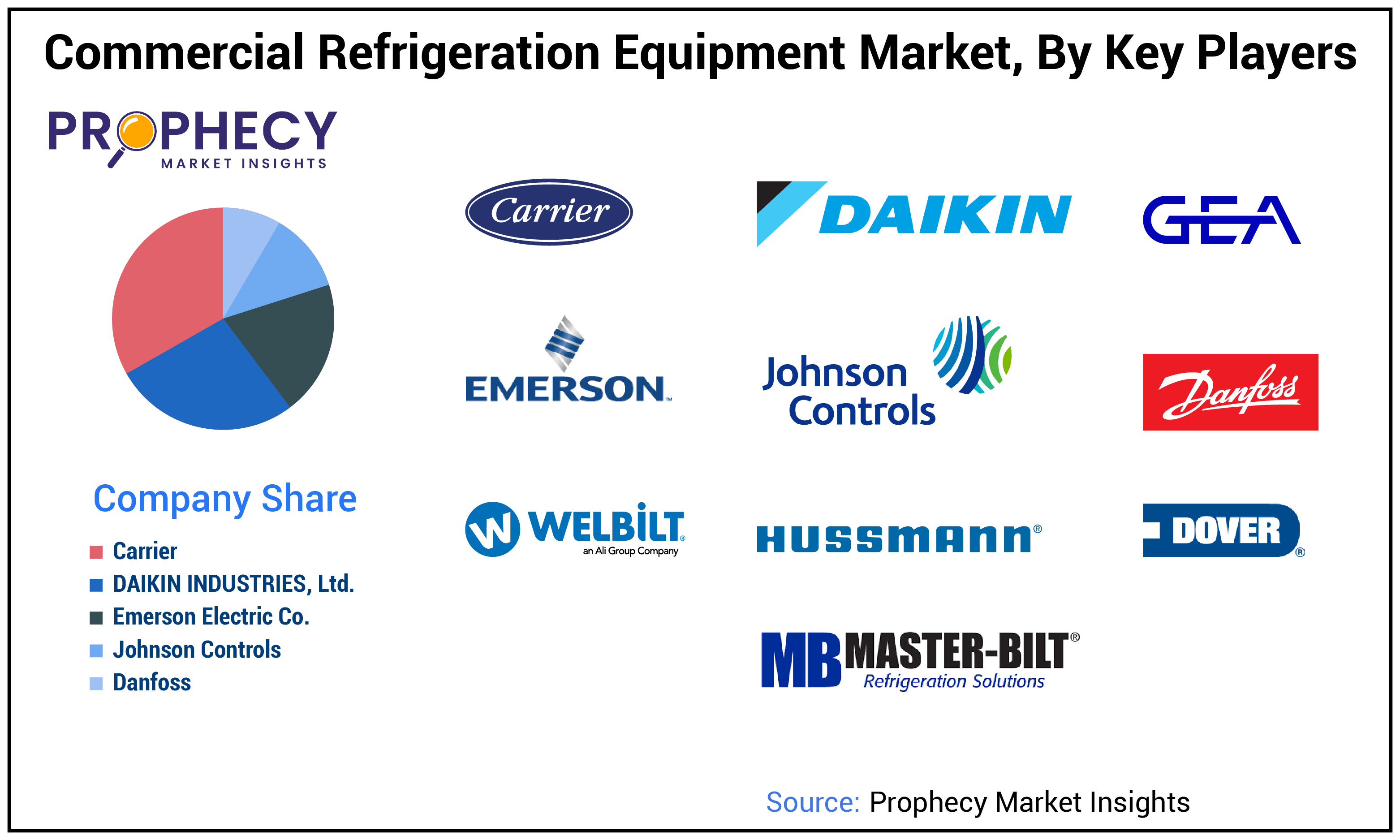
The key players operating in the commercial refrigeration equipment market include, DAIKIN INDUSTRIES, Ltd., WELBILT INC, Johnson Controls, and others. Commercial refrigeration equipment firms thrive by developing environmentally friendly, energy-efficient solutions, implementing smart technology, expanding into growing markets, and strengthening alliances and acquisitions.
Commercial Refrigeration Equipment Market Companies:
- Carrier
- DAIKIN INDUSTRIES, Ltd.
- Emerson Electric Co.
- Johnson Controls
- Danfoss
- GEA Group Aktiengesellschaft
- WELBILT INC
- Dover Corporation
- Hussmann Corporation
- Master-Bilt
- Norlake
- FUJIMAK CORPORATION
- Ali Group Worldwide
View an Additional List of Companies in the Commercial Refrigeration Equipment Market
Commercial Refrigeration Equipment Market Recent News
- In June 2025, Panasonic Heating & Cooling has announced the debut of its most complete commercial refrigeration line to date, which includes the iCORE and iCOOL product portfolios. The new lines represent a strategic expansion in refrigeration following Panasonic's acquisition of Area Cooling Solutions in December 2024 (excluding the compressor division) and the formation of Panasonic Cold Chain Poland (PCCPL).
- In April 2025, Blue Star Limited has announced the launch of a wide selection of commercial refrigeration solutions for the summer of 2025, particularly designed to fulfill a variety of refrigeration requirements. With a strong focus on expansion, the company intends to expand its commercial refrigeration industry and capitalize on the country's expanding potential.
- In March 2025, Voltas Limited from Tata House showcases its energy-efficient commercial refrigeration equipment at AAHAR 2025. With high-quality and cutting-edge solutions, the firm assists businesses in lowering operational costs, improving environmental impact, and optimizing their cold chain and refrigeration systems.
- In September 2023, Carrier Commercial Refrigeration, a leading provider of high-efficiency refrigeration systems and services to the food retail and cold storage industries, has partnered with relayr, inc. to provide clients a unique Refrigeration-as-a-Service (RaaS) product. Food merchants will no longer need to make upfront expenditures in refrigeration equipment and infrastructure thanks to the jointly designed RaaS solution. Instead, customers pay monthly for refrigeration performance as the device is in use.
Analyst View:
Commercial refrigeration equipment, such as refrigerators, freezers, display cases, and cold storage units, is required in restaurants, supermarkets, hotels, and hospitals to ensure food safety, prevent spoilage, and increase supply chain efficiency. Rising demand for processed and frozen foods, fast development of the foodservice and retail sectors, increased use of energy-efficient, eco-friendly technologies.
Analysis of Sources:
Primary Sources:
- In-depth interviews
- Company-specific data
- Surveys and questionnaires
- Focus group discussions (FGDs)
- Others
Secondary Sources:
- Organization for Economic Co-operation and Development (OECD)
- United Nations Environment Programme (UNEP)
- European Union (EU)
- Community Research and Development Information Service (CORDIS)
- Others
More Related Reports
Electric Commercial Vehicle Market
Commercial and Corporate Cards Market
Commercial Insulation Market
Commercial Aircraft Wet Lease ACMI Market
Commercial Vehicles Market
Commercial Refrigeration Equipment Market Company Profile
|
Company Name |
Product Portfolio |
|
Carrier |
Commercial Refrigeration |
|
Johnson Controls |
Variable Refrigerant Flow (VRF) Systems, Water Source Heat Pumps, Others |
|
Danfoss |
Commercial Refrigerators and Freezers |
|
GEA Group Aktiengesellschaft |
Compressors |
|
Master-Bilt |
Cooler & Freezer, and So On |
Commercial Refrigeration Equipment Market Highlights
FAQs
Commercial refrigeration equipment market size was valued at USD 44.9 Billion in 2025 and is expected to reach USD 71.8 Billion by 2035 growing at a CAGR of 5.3%.
Product type, system type, refrigerant type, application, and region are the segmentation for the commercial refrigeration equipment market.
Rising consumer demand for frozen, chilled, and processed foods, fueled by changing lifestyles and urbanization, and so on are some of the commercial refrigeration equipment market growth drivers.
North America, Asia Pacific, Europe, Latin America, and the Middle East & Africa. Asia Pacific is expected to dominate the commercial refrigeration equipment market.
Generative AI benefits the commercial refrigeration sector by optimizing designs, increasing energy efficiency, allowing predictive maintenance, and boosting smart IoT refrigeration systems.
The key players operating the commercial refrigeration equipment market include Carrier, DAIKIN INDUSTRIES, Ltd., Emerson Electric Co., Johnson Controls, Danfoss, GEA Group Aktiengesellschaft, WELBILT INC, Dover Corporation, International Paper, Master-Bilt, Norlake, FUJIMAK CORPORATION, and Ali Group Worldwide.