Chemical Intermediates Market Overview
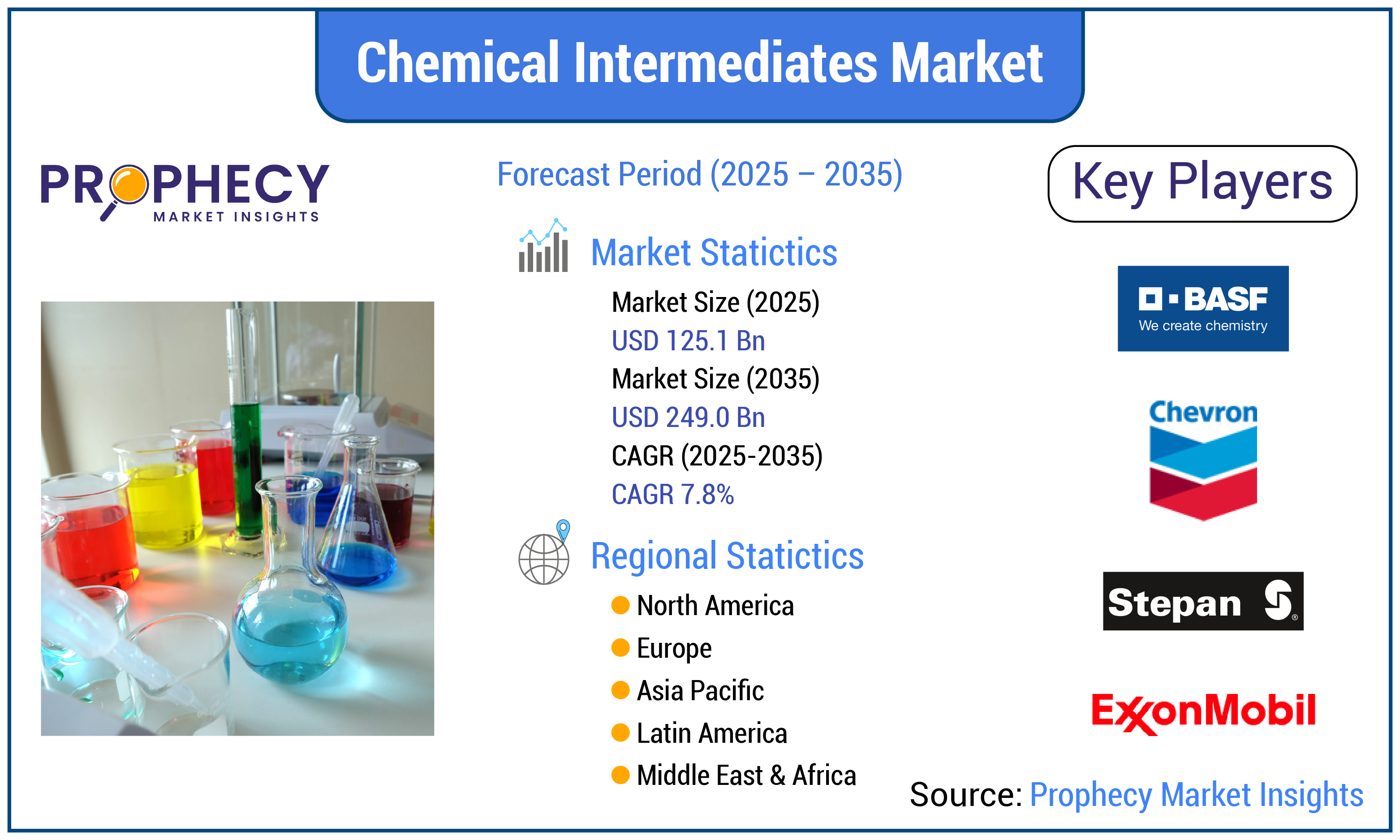
- By 2035, the chemical intermediates market size is contemplated to enlarge at a valuation of USD 249.0 Billion.
- In 2024, the chemical intermediates market valuation was USD 118 Billion.
- Chemical intermediates market is developing at a CAGR of 7.8%.
Chemical intermediates are substances that are manufactured during the production of a final chemical product, mostly used in the production of pharmaceuticals, dyes, plastics, agrochemicals, and other industrial products. They confer a number of advantages such as cheaper and more efficient production and purer and well-yielded products and also give flexibility in chemical synthesis for a wide range of industrial uses.
The chemical intermediates market has been witnessing a significant increase in the demand for pharmaceuticals, agrochemicals, automotive, and construction industries. Moreover, the dramatic development of the market becomes evident through the growth of industrialization in countries with emerging economies where Asia-Pacific is the leader. The introduction of new technologies in the sectors of automation, biocatalysis, and continuous-flow production has turned some development circles in their favor to improve productivity and minimize expenses. To add on, regulatory and consumer efforts to achieve overall sustainability have surged the change to cleaner and renewable intermediates, in turn, giving the chemical intermediates market a great push that shares in the total growth of the market.
Achieving faster decarbonization of the chemical intermediates market using green hydrogen will be the determinants of industrial change as circular chemistry, electrification, and digital transformation such as AI, IoT, continuous-flow processing, and digital twins for higher efficiency and cost savings are increasingly becoming more useful. The industry is also on the verge of moving from fossil-based and non-sustainable chemical intermediates to a bio-based and environmentally friendly product group which is also being supported by the various regions’ and local authorities’ decision of the APAC region to raise the transition flag as well as the increase in the amount of money set aside for the development of breakthrough in innovation and resiliency of the supply chain.
Recession Risk & Tariff Analysis:
- Unprecedented financial risks due to possible economic downturn and freshly imposed tariffs in the U.S. and India are the key obstacles for the chemical intermediates market. The escalating duties, reaching even 54% for imported Chinese goods, are the primary reasons for cost of production rises, profit reduction, and the establishment of new heavy market chains.
- Indian tariffs may hurt chemical exports and bring the inflow of cheap imports, hence doubling local rivalry therein. In general, such economic and trade pressures go as far as making the industry margins undergo the worst situation, making the investment get postponed, and even impeding the preservation of a stable growth trend.
Impact of Generative AI on Chemical Intermediates Market:
- The chemical intermediates market is already leveraging generative AI to accelerate molecule discovery, enhances production efficiencies, and reduce R&D costs and time. The ability to predictive model and simulate compounds with rapid development potential for high-performing chemical intermediates, let alone companies already integrated with AI, provide the potential for market players to predict the most advantageous, safe and rapid effective synthesis processes for all involved.
- Safety and operational efficiencies are key. Thus, the generative AI element is expected to exponentially grow in the intermediates market, promoting innovative, sustainable approaches with enhanced efficiencies, competitiveness, and decreased times to market for new chemical alternatives.
Chemical Intermediates Market Drivers & Restraints
Key Drivers:
Rapid Industrialization to Propel Market Development
Chemical Intermediates market grows from industrialization. Industrialized countries, developing nations experiencing industrialization, find a higher demand for manufacturing-related chemicals and construction (and automotive, textile, pharmaceutical, consumer goods) activities. A larger, more diverse industrial marketplace necessitates more raw materials for years to come; intermediates can serve as the necessary and appropriate raw material for many processes. Industrialization equals industrialized development, revenue increases in initial investment from the chemical market, and increased technological advances regarding acquisition of chemical processing. In addition, chemical intermediates are in higher demand via government-sponsored incentives, construction of urban centers, and increased gross national income resulting in higher disposable incomes of citizens generating increased demand for internationalized products and associated chemicals.
- For Instance, according to the data published by United Nations Industrial Development Organization, Globally, there was a 2.3% growth in industrial sectors, encompassing manufacturing, mining, electricity, water supply, waste management, and other utilities, signaling a post-pandemic recovery.
Restraints:
Volatile Raw Material Price Concern Could Affect Market Development
Chemical Intermediates market faces unstable prices for raw materials based on the increase and decrease of crude oil, natural gas and other petrochemical feedstock acquired from global sources and their related tensions, shifts in supply and demand and fluctuation in currency. Unstable prices for raw materials translate to increased production costs internally, reduced profits and additional price fluctuations for the end consumer.
- Counterbalance Statements: Solutions to this challenge include those offered by the market such as broadening a supplier network, developing and sourcing bio-based or other sustainable raw materials for the long-term, establishing long-term sourcing agreements and relying on price stabilization forecasting and possible hedging where opportunities arise.
Opportunities & Trends:
Technological Advancements can Drive Growth of the Market in Future
Technological advancements continue to shape the future of the chemical intermediates market by allowing the most efficient, sustainable, and cost-effective productions. New innovations such as continuous-flow manufacturing, catalyst optimization, molecule design through AI, and automation have been credited with improving yields, reducing wastes, and shortening development cycles. The more the industry leans toward greener alternatives, the greener chemistry and bio-based synthesis technologies gain popularity. With such advancements not only quality products are ensured but also scalability is made possible while becoming a step toward meeting regulatory requirements and sustainability goals—future market competitiveness and growth will be here driven.
Chemical Intermediates Market Segmentations & Regional Insights
Type, end user, and region are the divisions of the chemical intermediates market.
By Type:
Reactive and non-reactive are type on which chemical intermediates market is segmented. Non-reactive chemical intermediates (such as alcohols, amines, ketones, and building blocks) occupy the largest chemical intermediates market share approximately 35–40% as they are important stable feedstocks in different directions of the mainline industries such as pharmaceuticals, agrochemicals, and plastics.
The second-largest segment is reactive intermediates (e.g., reactive diluents), which is growing steadily due to increasing demand in specialized usage such as coatings, adhesives, and composites; this niche gains from both rapid industrialization and sustainability trends particularly in Asia-Pacific.
By End User:
Based on the end user, the chemical intermediates market is divided into energy & power, healthcare, chemical & petrochemical, agriculture, and others. The chemical and petrochemical industry dominates the chemical intermediates market share as it consumes huge amounts of intermediates. These are essential for making a variety of downstream products such as polymers, solvents, dyes, surfactants, and specialty chemicals.
Healthcare comes in as the second-largest user. This is mainly due to growing demand for active pharmaceutical ingredients (APIs) and drug formulations.
Regional Insights:
Geographically, the chemical intermediates market is studied across North America, Europe, Asia Pacific, Latin America, and the Middle East & Africa.
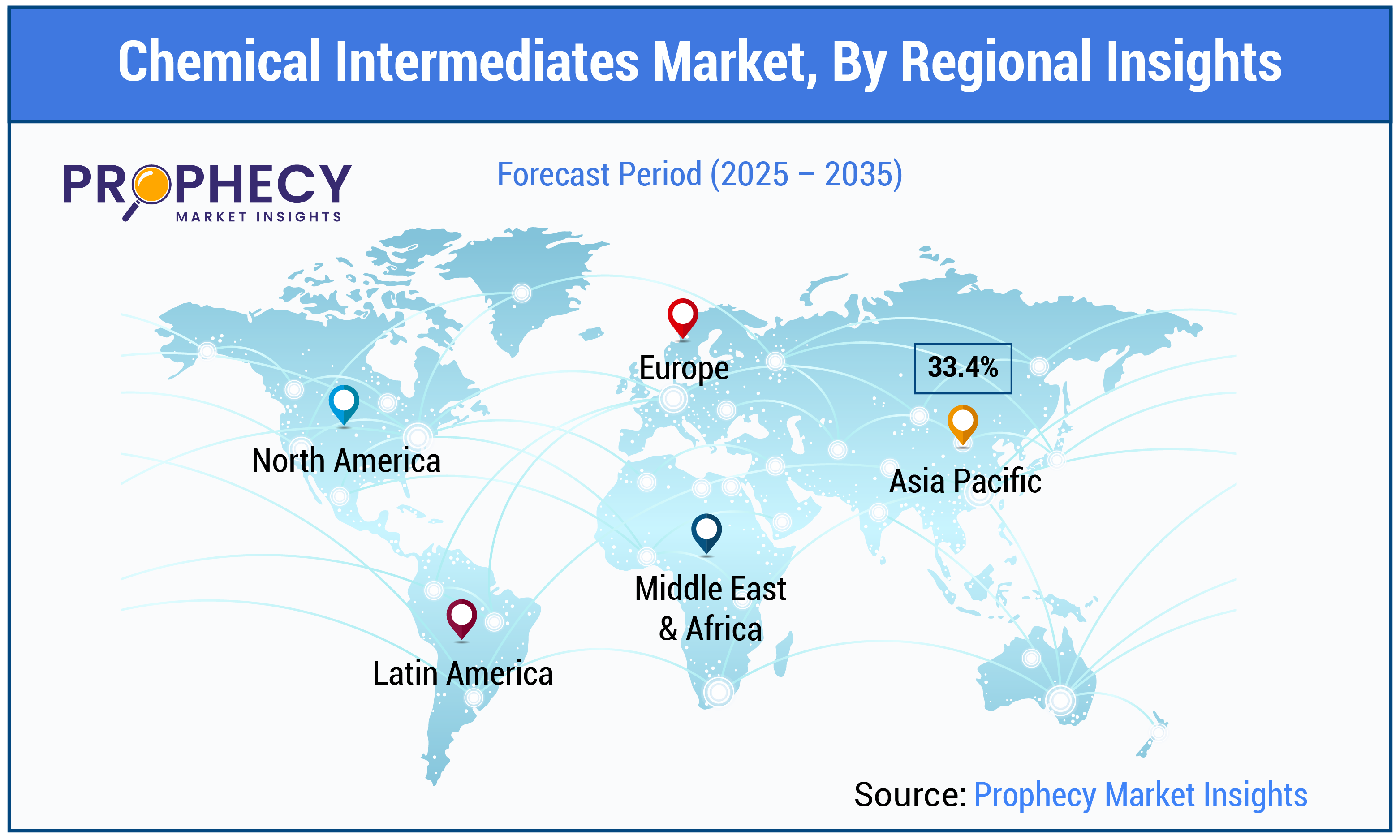
Asia Pacific: This region dominates the chemical intermediates market share. This is largely due to its fast industrial growth, solid manufacturing base, and strong demand from sectors such as chemicals, pharmaceuticals, textiles, and agriculture. China and India stand out as major producers and consumers. They benefit from low production costs, a large labor pool, and supportive government incentives.
- China Chemical Intermediates Market Insights:
In the Asia-Pacific region, China dominates the chemical intermediate market due to its large-scale industrial base, large-scale production capabilities and strong demand in areas such as pharmaceuticals, textiles, agrochemicals and construction. The country's government policies, low -cost labor, and comprehensive supply chains support their leadership status.
North America: This region is the second-largest market, due to its solid chemical infrastructure, high research and development spending, and strong needs from the pharmaceutical and petrochemical sectors. The U.S. also gets a boost from shale gas, which helps keep feedstock prices low and production efficient.
- U.S. Chemical Intermediates Market Insights:
In North America, the U.S. leads the market due to its advanced chemical manufacturing infrastructure, high investment in R&D and strong demand from healthcare, energy and petrochemical fields. U.S. Also benefits from access to shell gas, which provides a cost -effective feedstock for chemical production, increasing its competition globally.
Europe: This region chemical intermediate markets are growing due to strict stability and energy-evil regulations, a strong change towards green and spherical chemistry, growing demand and increasing exports in agricultural industries and increasing exports.
- Germany Chemical Intermediates Market Insights:
Germany leads the field due to green synthesis and automation in its strong industrial ecosystem, high R&D investment, and BASF driving innovation such as BASF driving innovation. France and UK Follows, Pharmaceutical and Specialty Chemical Sectors who invest in digitization and bio-based intermediate.
Chemical Intermediates Market Report Scope:
|
Attribute |
Details |
|
Market Size 2025 |
USD 125.1 Billion |
|
Projected Market Size 2035 |
USD 249.0 Billion |
|
CAGR Growth Rate |
7.8% (2025-2035) |
|
Base year for estimation |
2024 |
|
Forecast period |
2025 – 2035 |
|
Market representation |
Revenue in USD Billion & CAGR from 2025 to 2035 |
|
Regional scope |
North America - U.S. and Canada Europe – Germany, U.K., France, Russia, Italy, Spain, Netherlands, and Rest of Europe Asia Pacific – China, India, Japan, Australia, Indonesia, Malaysia, South Korea, and Rest of Asia-Pacific Latin America - Brazil, Mexico, Argentina, and Rest of Latin America Middle East & Africa – GCC, Israel, South Africa, and Rest of Middle East & Africa |
|
Report coverage |
Revenue forecast, company share, competitive landscape, growth factors, and trends |
Segmentation:
By Type:
- Reactive
- Carbocations
- Free Radicals
- Carbenes
- Others
- Non-Reactive
- Stable Radicals
- Organometallic Compounds
- Others
By End User:
- Energy & Power
- Healthcare
- Chemical & Petrochemical
- Agriculture
- Others
By Region:
- North America
- U.S.
- Canada
- Europe
- Germany
- U.K.
- France
- Russia
- Italy
- Spain
- Netherlands
- Rest of Europe
- Asia Pacific
- China
- India
- Japan
- Australia
- Indonesia
- Malaysia
- South Korea
- Rest of Asia Pacific
- Latin America
- Brazil
- Mexico
- Argentina
- Rest of Latin America
- Middle East & Africa
- GCC
- Israel
- South Africa
- Rest of Middle East & Africa
Chemical Intermediates Market Competitive Landscape & Key Players
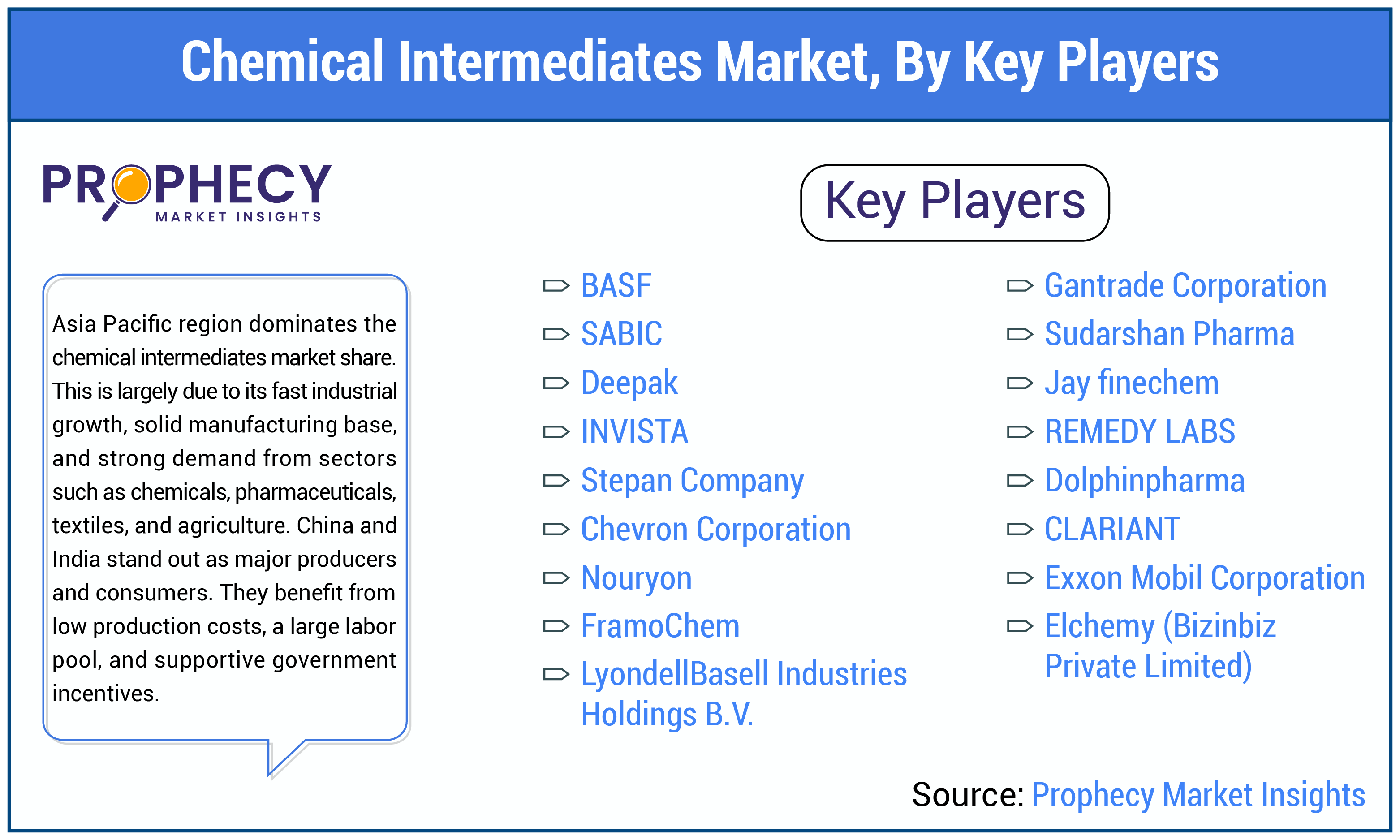
Major development strategies for chemical intermediate companies include investing in R&D for sustainable and bio-based products, expanding emerging markets, forming strategic partnerships and joint enterprises, increasing supply chain flexibility and adopting digital techniques such as AI and Automation to reduce costs and reduce costs. The key players operating in the chemical intermediates market include, BASF, SABIC, FramoChem, INVISTA, Stepan Company, and others.
Chemical Intermediates Market Companies:
- BASF
- SABIC
- LyondellBasell Industries Holdings B.V.
- Deepak
- INVISTA
- Stepan Company
- Chevron Corporation
- Nouryon
- FramoChem
- Elchemy (Bizinbiz Technologies Private Limited)
- Gantrade Corporation
- Sudarshan Pharma
- Jay finechem
- REMEDY LABS
- Dolphinpharma
- CLARIANT
- Exxon Mobil Corporation
View an Additional List of Companies in the Chemical Intermediates Market
Chemical Intermediates Market Recent News
- In September 2023, the 2-chloro-4-methanesulfonyl-3-[(2,2,2-trifluoroethoxy) methyl] benzoic acid project, a tembotrione intermediate, was launched by the Chinese agrochemical business Limin Co., Ltd. With an investment of RMB60 million, the project will produce 600 tons of 2-chloro-4-methanesulfonyl-3-[(2,2,2-trifluoroethoxy) methyl] benzoic acid annually when it is finished, giving the group's clients and subsidiaries a stable and high-quality intermediate.
- In March 2022, at its Oita Works (Oita City, Oita Prefecture, Japan), Sumitomo Chemical Co., Ltd. will build a new production facility for active pharmaceutical ingredients (APIs) and intermediates for small molecule medications. The goal of this initiative is to increase the company's ability to meet the growing demand for small molecule pharmaceuticals by providing a range of high-quality APIs and intermediates. September 2024 is when the new plant is expected to go online.
Analyst View:
Chemical intermediate markets are experiencing strong growth inspired by growing demand from industries such as pharmaceuticals, agrochemicals, automotive and construction, especially in emerging economies such as them in the Asia-Pacific region. This growth is supported by progress in technologies such as automation, biocalis and continuous-proof production, which increases efficiency and reduces costs. Additionally, regulatory and consumer focusing on stability is intensifying changes towards bio-based and renewable intermediates. With Green Hydrogen, Circular Chemistry, and Digital Innovations such as AI and IOT, the future of the market is being shaped, leading transition through significant investment in innovation and supply chain flexibility.
More Related Reports
Construction Chemicals Market
Electronic Chemicals Market
Leather Chemicals Market
Chemical Vapor Deposition Market
Crop Protection Chemical (Pesticide) Market
Chemical Intermediates Market Company Profile
|
Company Name |
BASF |
|
Headquarter |
Ludwigshafen, Germany |
|
CEO |
Dr. Markus Kamieth |
|
Employee Count |
111,991 Employees |
Chemical Intermediates Market Highlights
FAQs
Chemical intermediates market size was valued at USD 125.1 Billion in 2025 and is expected to reach USD 249.0 Billion by 2035 growing at a CAGR of 7.8%.
Type, end user, and region are the segmentation for the target market.
North America, Asia Pacific, Europe, Latin America, and the Middle East & Africa. Asia Pacific is expected to dominate the market.
The key players operating the chemical intermediates market include BASF, SABIC, LyondellBasell Industries Holdings B.V., Deepak, INVISTA, Stepan Company, Chevron Corporation, NOURYON, FramoChem, Elchemy (Bizinbiz Technologies Private Limited), Gantrade Corporation, Sudarshan Pharma, Jay finechem, REMEDY LABS, CLARIANT, and Exxon Mobil Corporation.