Global Crop Protection Chemical Pesticide Overview
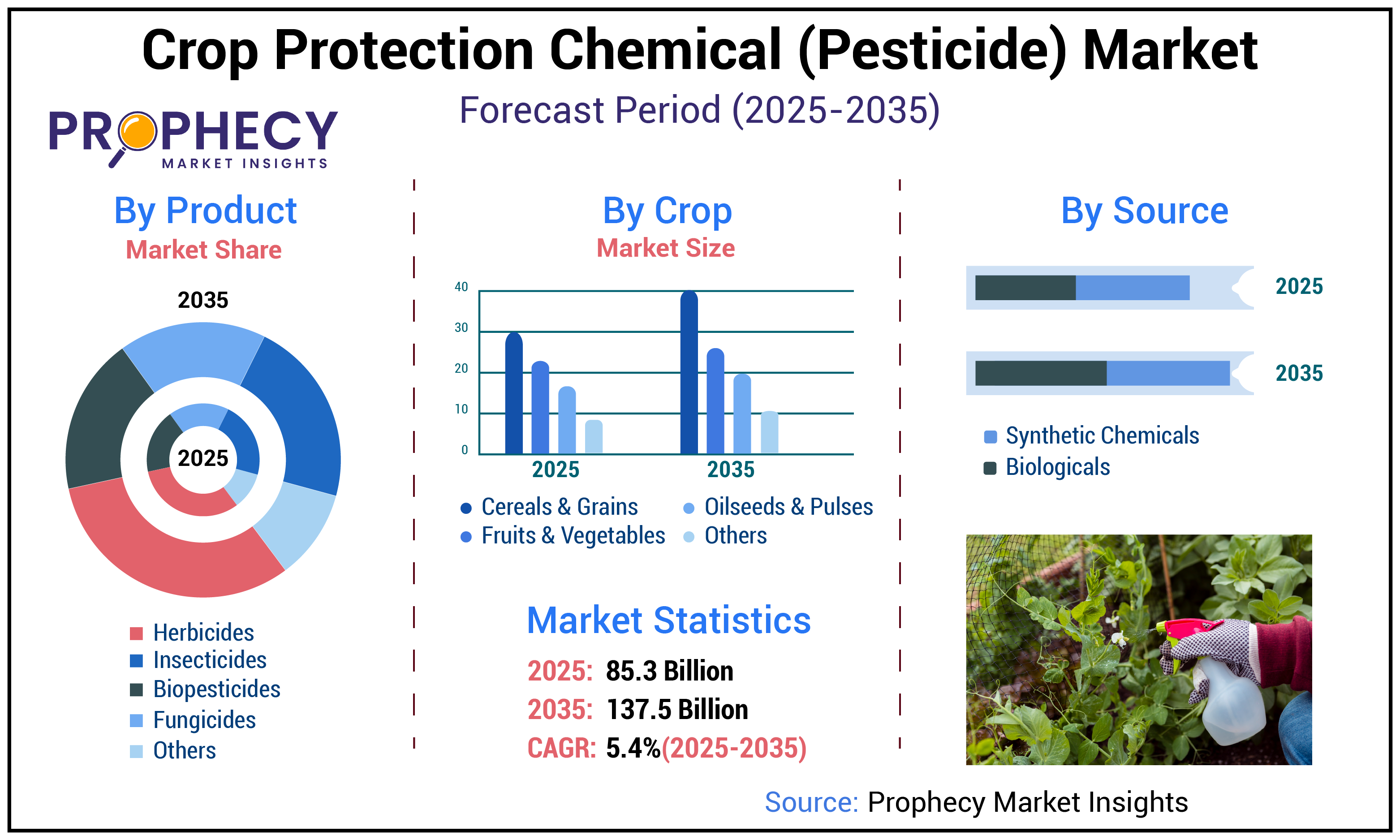
- Crop protection chemical (pesticide) market size is predictable to advance at a rate of USD 137.5 Billion, by 2035.
- Crop protection chemical (pesticide) market valuation was USD 81.3 Billion, in 2024.
- The market is rising at a CAGR 5.4%.
Crop protection chemicals, commonly known as pesticides, are the substances or mixtures used to prevent, destroy, repel, or control pests that can harm crops. These chemicals are crucial in modern agriculture as it can help to prevent crops from insects, weeds, fungi, bacteria, rodents, and other harmful organisms. By reducing crop losses, pesticides play a key role in ensuring food security, increasing agricultural productivity, and supporting the global food supply chain. Pesticides are chemical based or biological, can help to poisoning insect, fungi, by disrupting their reproductive system or damaging their nervous system.
Growing population is increasing demand for food, and farmers are heavily relying on pesticides for crop protection from insects, weeds, fungi, and rodents, is anticipated to drive crop protection chemicals market growth. Climate changing is increasingly spread of pests, diseases, government support & subsidies, and continuous need of herbicide resistance, is expected to pitch crop protection market growth.
The growing demand for eco-friendly, organic farming solutions, and growth in emerging markets, cam represent future opportunities for crop protection chemicals market share. The growing adoption of integrated pest management, integration of digital agriculture technology, and public-privet partnerships, or R&D investment, is projected to fuel crop protection chemicals market growth.
Recession Risk & Tarriff Analysis of Crop Protection Chemical (Pesticide) Market:
- The crop protection chemicals market faces moderate recession risk. The food demand remains relatively stable during economic downturns making agriculture slightly recession-resistant, in which farmers may reduce spending on premium or branded pesticides in favor of cheaper, generic alternatives. Prolonged recessions can disrupt supply chains, delay government subsidies, and limit investments in R&D, especially for newer, sustainable products such as biopesticides.
- Tariff policies significantly impact the crop protection chemicals market, especially in raw material imports and cross-border trade of finished products. Many countries impose import tariffs on pesticides to protect domestic manufacturers, which can raise costs for local farmers.
Impact of Generative AI on Crop Protection Chemical (Pesticide) Market:
- AI models can analyze massive datasets, including molecular structures, environmental conditions, and pest behavior to design more effective and safer pesticide compounds faster than traditional methods. AI algorithms can help to create digital twins of crops and ecosystems, which allows for simulations that predict pesticide performance under varying climatic or soil conditions, thus improving precision agriculture.
- AI-generated recommendations can be integrated into farm management systems, guiding optimal pesticide type, dosage, and timing. This can help to companies to tailor their solutions to regional pest issues and resistance patterns.
Global Crop Protection Chemical Pesticide Drivers & Restraints
Key Drivers:
Increasing Food Demand is Anticipated to Drive Target Market Growth
The rising global population, is rises the demand for food, which puts pressure on agriculture to produce more food from limited arable land. To meet this challenge, farmers increasingly rely on crop protection chemicals, such as herbicides, insecticides, fungicides, and biopesticides, to maximize productivity per hectare.
These inputs help reduce losses, protect investments, and maintain consistent harvests, especially in regions with intensive farming or multiple growing seasons. Rising food demand is also reflects changing dietary preferences, such as higher consumption of fruits, vegetables, and protein-rich crops, which are often more susceptible to pests and diseases. This trend fuels demand for targeted and innovative crop protection solutions. The growing need to ensure food security and rising global demand makes crop protection chemicals viable, resulting to drive crop protection chemicals market growth.
Restraints:
Market Hindered by Environmental & Public Health Concerns
Improper or excessive use of these chemicals can lead to soil degradation, water contamination, and harm to non-target organisms, including beneficial insects such as bees and aquatic life. Persistent residues in food products can also pose health risks to humans, including potential risk to cancer, hormonal disruption, and neurological effects. The widespread chemical use contributes to pest resistance, biodiversity loss, and ecological imbalance, resulting to limits crop protection chemical (pesticide) market growth.
- Counterbalance Statements: To address these concerns, the industry is shifting toward safer, more sustainable alternatives such as biopesticides, which are derived from natural sources and have lower toxicity and environmental impact. The growing adoption of Integrated Pest Management (IPM) strategies, combining biological control, cultural practices, and minimal chemical use can help to reliance on harmful chemicals.
Opportunities & Trends:
Technological Advancement in Crop Protection can Stimulate Market Evolution
Technological advancements in crop protection present a significant opportunity to stimulate market growth by offering more efficient, sustainable, and targeted solutions for managing pests, diseases, and weeds. As traditional chemical pesticides have environmental and health concerns, innovation in crop protection is essential to maintain and improve agriculture productivity. The integration of advanced technology, such as AI, robotics, remote sensing allows for the targeted application of crop protection chemicals, reducing waste and minimizing the environmental footprint.
These technologies can identify pest outbreaks in real time, deliver the right dosage at the right time, and significantly reduce the overall chemical load on crops. Innovations such as biopesticides, RNA-based treatments, microbial solutions, and digital scouting tools offer alternatives and complements to conventional pesticides. Companies investing in R&D to develop novel modes of action, next-generation formulations, and smart delivery systems, is expected to create future opportunities for crop protection chemicals market share.
- For instance, according article published by MDPI, in July 2023, this article highlights, comprehensive vison of agriculture 5.0 with emerging technologies such as AI, robotics, IoT, and data analytics to protect crop and manage farms. Using autonomous vehicles, smart sprayers, and drones, can help to crop protection products or chemicals applied at needed portion, which reduces chemical usage, environmental exposure and costs. AI-enabled robots use sensors and cameras to detect crop health issues, identify pets or disease ate early stage. Robotics can enhance effectiveness of biopesticides, which often require precise application conditions. AI algorithms can analyses soil sensors, satellite imagery, and weather forecast data, which recommend optimal timing and types of crop protection chemicals application.
Global Crop Protection Chemical Pesticide Segmentations & Regional Insights
The crop protection chemical (pesticide) market is segmented into product, crop type, source, mode of application, and region.
By Product:
Based on product, the market is segmented into insecticides, biopesticides, herbicides, fungicides, and others. Herbicides hold the largest crop protection chemical (pesticide) market share, driven by the need to control weeds that significantly reduce crop yields and compete for water, nutrients, and sunlight. The large-scale row crop farming, such as corn, soybeans, wheat, in which weed control is critical. The expansion of no-till farming practices has boosted herbicide demand, as it reduces manual weed control, is anticipated to drive growth of segment in crop protection chemical (pesticide) market size.
Insecticides is second dominating segment in the market, as it is used in pest pressure on key crops, such as rice, cotton, and sugarcane. Insecticides are essential in tropical climates, and their role remains crucial due to evolving insect resistance and increased awareness of crop losses caused by pest infestations, resulting to propel segment’s development in crop protection chemical (pesticide) market size.
By Crop Type:
By crop type, the market is categorized into, cereals & grains, oilseeds & pulses, fruits & vegetables, and others. Cereals and grains represent the dominant segment in crop protection chemical (pesticide) market share. These crops are staple foods across the globe, driving continuous demand for effective crop protection solutions to secure yield and quality. The high susceptibility of cereals and grains to pests, fungal diseases, and weeds, particularly in densely cultivated regions makes the use of herbicides, fungicides, and insecticides, is projected to boost crop protection chemical (pesticide) market growth.
Fruits and vegetables are fastest-growing segment in the market, driven by growing consumer demand for fresh produce, increased export activities, and rising health consciousness. These high-value crops are highly consumable and vulnerable to a wide range of pests and fungal infections, requiring intensive use of crop protection chemicals, including both synthetic pesticides, contributing to growth of segment in crop protection chemical (pesticide) market size
By Source:
Based on source, the market is classified into synthetic chemicals, and biologicals. Synthetic chemicals is the leading segment in crop protection chemical (pesticide) market share. These include conventional insecticides, herbicides, fungicides, and other chemical formulations developed for pest control. Synthetic pesticides are preferred for their effectiveness, scalability, and affordability, especially in large-scale, high-intensity farming systems across emerging regions, is anticipated to drive crop protection chemical (pesticide) market growth in following segment.
Biologicals, also known as biopesticides, are the second-superior segment in the market, due to increasing demand for environmentally friendly and sustainable agricultural inputs. It is derived from natural sources such as microbes, plant extracts, or beneficial insects, biologicals are widely used in organic and precision farming. Governments and regulatory bodies are supporting this transition through subsidies, fast-track approvals, and strict regulations on synthetic pesticide residues, resulting to impel segment’s expansion in crop protection chemical (pesticide) market size.
By Mode of Application:
Foliar spray, soil treatment, seed treatment, and others are divided by mode of application in the market. Foliar spray is the superior segment in market. This method involves applying pesticides directly to the leaves of crops, making it highly effective for controlling a wide range of pests, diseases, and weeds. Foliar spraying widely used, as it offers quick action, easy to apply, and can be used on various crop types, is expected to propel segment’s extension in crop protection chemical (pesticide) market share.
Regional Insights:
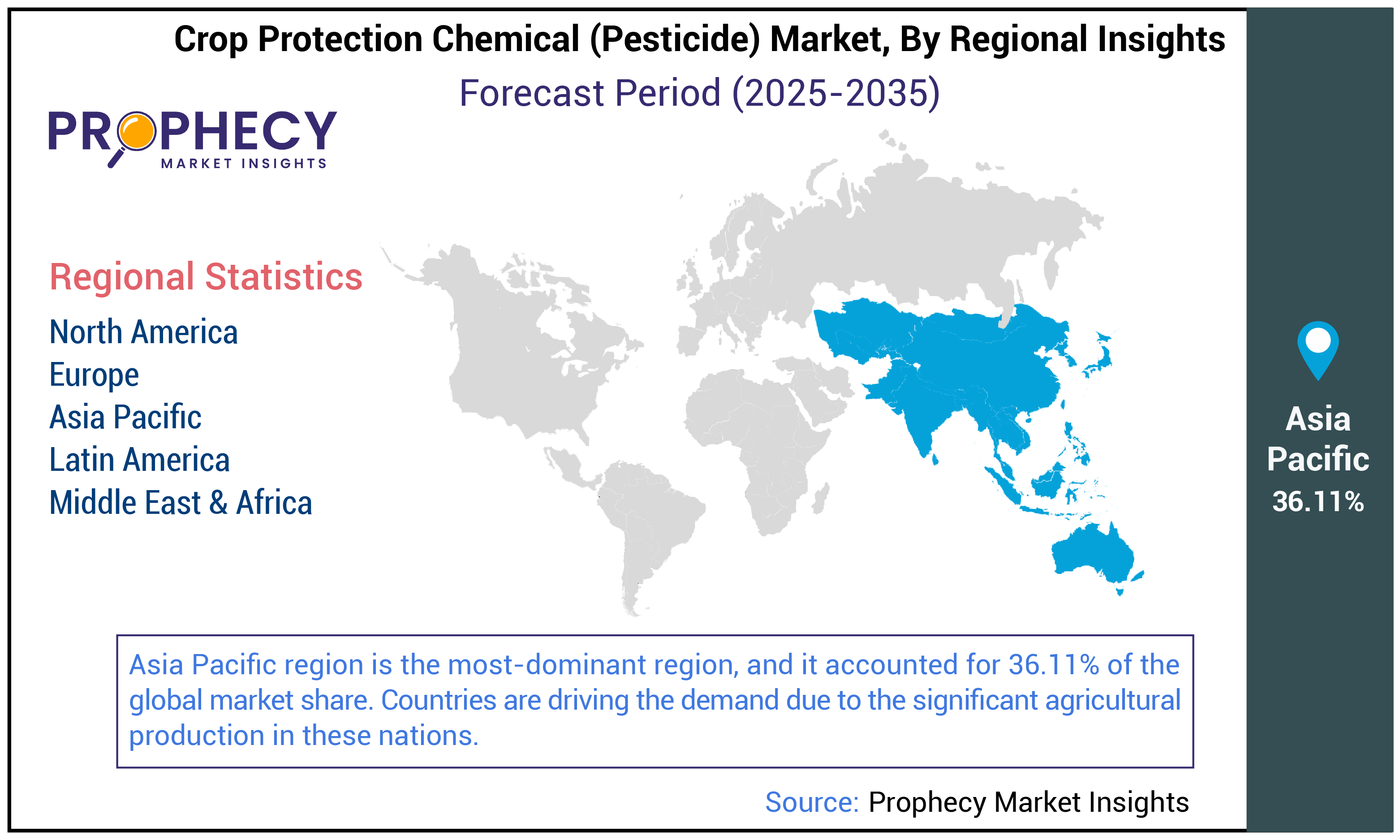
Geographically, the market is studied across North America, Europe, Asia Pacific, Latin America, and the Middle East & Africa.
Asia Pacific: This region is the most-dominant region, and it accounted for 36.11% of the global market share. Countries are driving the demand due to the significant agricultural production in these nations. Asia-Pacific is home of rice, wheat, and cotton farming sectors, which face considerable pest pressure, requiring extensive pesticide use. The increasing adoption of modern farming practices, government subsidies for crop protection products, and rising income levels in emerging economies are boosting demand, is estimated to propel region growth in crop protection chemicals market share.
- China Crop Protection Chemical (Pesticide) Market Insights:
China leads the Asia Pacific region for crop protection chemical (pesticide) market . China is global largest producer, consumer of pesticides, and wide agricultural sector, with key crops such as rice, wheat, corn, and cotton requiring extensive pest control. Growing government initiatives to invest in advanced agriculture technology, driving the adoption of both chemical pesticides, biopesticides, is anticipated to drive crop protection chemicals market growth.
North America: This region is the second dominant region in the market, driven by the large-scale agricultural operations in the U.S. and Canada. The U.S. is one of the largest consumers of pesticides globally, driven by the high demand for crop protection in crops such as corn, soybeans, and wheat. The advanced farming technology, large agribusinesses, and well-established distribution networks is contributing to propel region’s expansion in crop protection chemicals market size.
- U.S. Crop Protection Chemical (Pesticide) Market Insights:
U.S. dominated in North America region for crop protection chemical (pesticide) market . The U.S. has a highly advanced agricultural industry, with large-scale farming of crops such as corn, soybeans, wheat, and cotton, which require significant pesticide use. The country has a long-established history of pesticide use, supported by extensive research and development efforts in agrochemicals, is projected to boost crop protection chemicals market share.
Europe: This is a significant region in the crop protection chemical (pesticide) market growth, driven by both traditional agricultural practices and the growing emphasis on sustainable, eco-friendly farming. The growing demand for crop protection chemicals, need to maintain high-quality crop yields and strengths regulation surged the adoption of biopesticides, integrated pest management, which aim to reduce pesticide usage and promote organic farming, is appraised to boost crop protection chemicals market share.
- Germany Crop Protection Chemical (Pesticide) Market Insights:
Germany holds the largest share in Europe for crop protection chemical (pesticide) market . It leads the region due to its strong agricultural industry, with significant production of cereals, fruits, and vegetables, all requiring extensive pest management. Germany is focusing on adopting sustainable agricultural practices and has a significant demand for both conventional pesticides, biopesticides, is attributed to impel crop protection chemicals market growth.
Crop Protection Chemical (Pesticide) Market Report Scope:
|
Attribute |
Details |
|
Market Size 2025 |
USD 85.3 Billion |
|
Projected Market Size 2035 |
USD 137.5 Billion |
|
CAGR Growth Rate |
5.4% (2025-2035) |
|
Base year for estimation |
2024 |
|
Forecast period |
2025 – 2035 |
|
Market representation |
Revenue in USD Billion & CAGR from 2025 to 2035 |
|
Regional scope |
North America - U.S. and Canada Europe – Germany, U.K., France, Russia, Italy, Spain, Netherlands, and Rest of Europe Asia Pacific – China, India, Japan, Australia, Indonesia, Malaysia, South Korea, and Rest of Asia-Pacific Latin America - Brazil, Mexico, Argentina, and Rest of Latin America Middle East & Africa – GCC, Israel, South Africa, and Rest of Middle East & Africa |
|
Report coverage |
Revenue forecast, company share, competitive landscape, growth factors, and trends |
Segmentation:
By Product:
- Insecticides
- Biopesticides
- Herbicides
- Fungicides
- Others
By Crop Type:
- Cereals & Grains
- Oilseeds & Pulses
- Fruits & Vegetables
- Others
By Source:
- Synthetic Chemicals
- Biologicals
By Mode of Application:
- Foliar Spray
- Soil Treatment
- Seed Treatment
- Others
By Region:
- North America
- U.S.
- Canada
- Europe
- Germany
- U.K.
- France
- Russia
- Italy
- Spain
- Netherlands
- Rest of Europe
- Asia Pacific
- China
- India
- Japan
- Australia
- Indonesia
- Malaysia
- South Korea
- Rest of Asia Pacific
- Latin America
- Brazil
- Mexico
- Argentina
- Rest of Latin America
- Middle East & Africa
- GCC
- Israel
- South Africa
- Rest of Middle East & Africa
Global Crop Protection Chemical Pesticide Competitive Landscape & Key Players
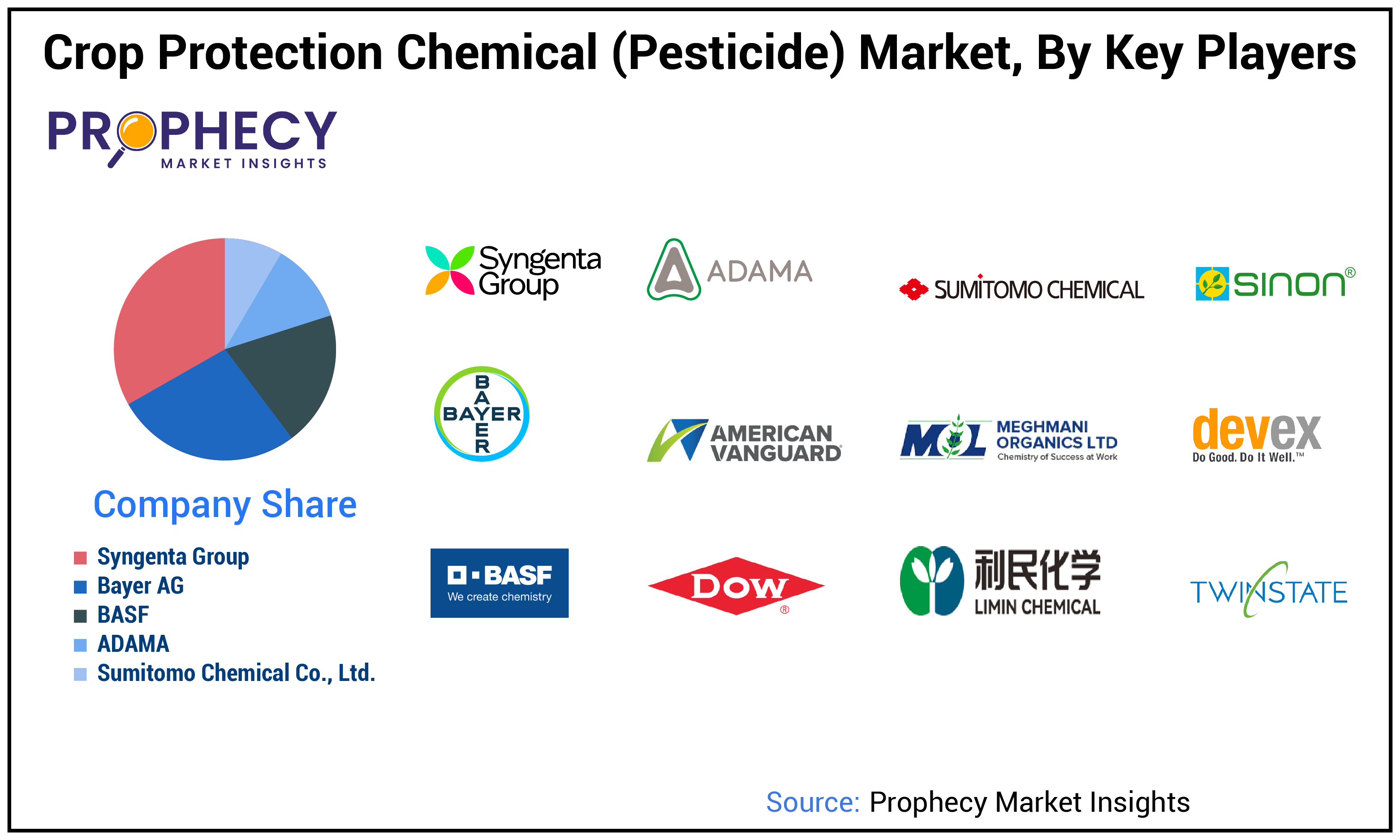
Syngenta Group, Bayer AG, BASF, and others, are the principal companies working in the crop protection chemical (pesticide) market. This companies are actively expanding its biopesticide and sustainable solutions portfolio through their partnerships and collaboration to meet growing demand for eco-friendly alternatives. The companies are focusing on technological advancements, and farming practices, through their acquisition, is projected to impel crop protection chemicals market growth.
Crop Protection Chemical (Pesticide) Market Companies:
- Syngenta Group
- Bayer AG
- BASF
- ADAMA
- Sumitomo Chemical Co., Ltd.
- American Vanguard Corporation
- Dow
- Devex
- Limin Group Co., Ltd
- Meghmani Organics Ltd
- Sinon Corporation
- Twin State Inc.
- Meister Media Worldwide
- Rallis India Limited.
- Anupam Rasayan India Limited
View an Additional List of Companies in the Crop Protection Chemical (Pesticide) Market
Global Crop Protection Chemical Pesticide Recent News
- In August 2024, Crystal Crop Protection Limites, launched Proclaim XTRA, its latest insecticide specially formulated for maize and soyabean. Proclaim XTRA was designed to provide effective protection against of caterpillar especially Spodoptera spp. suchas Fall Army worm. This ensures prolonged crop safety and help farmers to maximize yield during the crop cycle. This innovative solution aimed to enhance crop health and productivity, which enhance farmers’ product.
- In June 2024, BASF Agriculture Solution launched its new rice fungicide, known as Cevya in China. Cevya was first and latest isopropanol triazole fungicide registered on rice in China, which aimed to offer new solution to manage disease resistance in rice and maximize yield, income. This product introduction aligns with BASF’s commitment to sustainable agriculture by reducing crop losses, improving yields, and minimizing environmental impact.
- In June 2023, Bayer CropScience and Crystal Crop Protection limited collaborated to enhance the productivity of Rice and Cotton farmers in India. This collaboration aimed to provide Bayer’s Crystal access to newer innovation and Crystal based on their manufacturing, development strength helped bring new solutions to the Indian market. Through this collaboration, companies launched Curbix Pro and Kollar products, which aimed to help farmers to tackling plant hoppers, ensuring best crop protection practices were implemented.
Analyst View:
The rising global food demand, rises the need for crop protection chemicals, and integration of precision agriculture tools, is anticipated to drive crop protection chemical (pesticide) market growth. The growing adoption of biopesticides, increased frequency of extreme weather events has led to the spread of pests and diseases into new regions, driving demand for new pesticides, is projected to fuel crop protection chemicals market growth.
More Related Reports
Paint Protection Films Market
Single-use Bioprocessing Probes and Sensors Market
Embolic Protection Devices Market
Hearing Protection Equipment Market
Data Protection Market
Global Crop Protection Chemical Pesticide Company Profile
|
Company Name |
Bayer AG |
|
Headquarter |
Leverkusen, Germany |
|
CEO |
Bill Anderson |
|
Employee Count (2024) |
99,723 employees |
Global Crop Protection Chemical Pesticide Highlights
FAQs
Crop protection chemical (pesticide) market size was valued at USD 85.3 Billion in 2025 and is expected to reach USD 137.5 Billion by 2035 growing at a CAGR of 5.4%.
Product, crop type, source, mode of application, and region are the segmentation for the crop protection chemical (pesticide) market.
North America, Asia Pacific, Europe, Latin America, and the Middle East & Africa. Asia Pacific is expected to dominate the market.
The key players operating in the crop protection chemical (pesticide) market include Syngenta Group, Bayer AG, BASF, ADAMA, Sumitomo Chemical Co., Ltd., American Vanguard Corporation, Dow, Devex, Limin Group Co., Ltd., Meghmani Organics Ltd., Sinon Corporation, Twin State Inc., Meister Media Worldwide, Rallis India Limited., and Anupam Rasayan India Limited