Asia Pacific Renewable Drones Market Overview
- By 2035, the Asia Pacific renewable drones market size is contemplated to enlarge at a valuation of USD 69.9 Billion.
- In 2025, the Asia Pacific renewable drones market valuation was USD 3.5 Billion.
- Asia Pacific renewable drones market is developing at a CAGR of 35.55%.
Renewable drones are innovative flying machines without human pilots, whose energy source is or they are simply by energy renewable. They are, for instance, used for the solar and wind farm, and their main activities are inspection, supervision, maintenance, etc. Such drones become very important for the sector of green energy since they provide a number of benefits. They are in a position to encourage the energy sector to increase productivity, reduce the cost of the inspection phase, ensure the safety of the workers since they can avoid the risk of manual checks, and also allow the sector to achieve exact results through the employment of highly advanced sensor and photographic technologies.
The Asia Pacific renewable drones market is expanding quickly as a result of the high need for energy, major solar and wind infrastructure investments, and the strong government backing of green technologies. The transition is being driven by China, India and Japan, supported by good policy and the decline in the cost of renewable energy. The usage what of new drone technologies such as Al, thermal imaging, and live data transmission-is not more only enhancing the supplier's safety and efficiency while they inspect and maintain renewable energy assets but also making drones a key player in the area's clean energy growth.
The renewable drone market in the Asia-Pacific region is poised for significant growth, primarily due to the increasing solar and wind energy projects, supportive government policies targeting green energy, and the need for efficient inspection solutions. Several technological improvements in drones such as the hybrid-electric propulsion, solar-powered UAVs, Al-based navigation, and BVLOS capabilities are making drones more capable and extending their range. The market is anticipated to expand very quickly with growing use of self-guided and data-based operations. The growth will have a very big impact on facilitating the clean energy change of the area.
Recession Risk and Tariff Analysis:
- The Asia Pacific renewable drones market is susceptible to recession-associated risks and tariff difficulties that may affect the expansion of the market. The disputes in trade, particularly between the United States and China, have resulted in not only higher tariffs but also export restrictions for several drone components such as batteries and sensors; thus, the cost of production has gone up and the supply chain has also been interrupted.
- In the case of an economic downturn, money put into green energy projects might slump. As the drone use may be delayed and also the need for it might go down. Such intertwined forces, although the potential is still robust for the long run, might hold the temporary increase in the market.
Impact of Generative AI on Asia Pacific Renewable Drones Market:
- Generative Al is a big reason the Asia Pacific renewable drones market is getting better. Drones can now use Al to look at inspection data by themselves, find problems such as defects or inefficiencies, and make a detailed report for maintenance. This way, the need for manual work is minimized, the correctness is raised, and the process of making decisions becomes faster.
- The Al adoption in the region has put China, India, and Japan ahead, and GenAl is now revolutionizing drone technology by making it more smart, fast, and large-scale. This in turn, has helped drones to be used more extensively in monitoring and maintaining renewable energy assets as their deployment in these areas has been effortless.
Asia Pacific Renewable Drones Market Drivers & Restraints
Key Drivers:
Rising Energy Demand can drive the Expansion of Market
The growing need for energy in the region is the main reason for the increasing of the Asia Pacific renewable drones market growth. The fast urbanization, population growth, and industrial development in countries such as China, India, and the Southeast Asian countries have greatly increased the demand for energy that is both reliable and sustainable. To satisfy the increasing demand, while cutting carbon dioxide emissions, the public and private sectors are making major investments in solar and wind power projects of large scale. Such energy distribution networks need to be checked regularly and efficiently, which is making the use of unmanned aerial vehicles (UAVs) popular as a rapid, economical, and secure method to keep energy assets in the area.
- For Instance, according to the data published by Energy Tracker Asia, the energy transition of the countries in the Asia-Pacific region is a story of extremes. While Asia remains home to 82% of the global coal power and has the biggest gas expansion plans, it is also the only region on track with the goal of tripling renewable energy capacity by 2030.
Restrains:
The Market Growth can be Hindered by Regulatory Barriers
Regulations obstacles in the Asia Pacific renewable drones market are caused by the fragmented and inconsistent drone laws in the various countries of the region, with a special focus on Beyond Visual Line of Sight (BVLOS) operations, airspace permissions and data handling rules. These inconsistencies produce postponements in project approvals and make it more difficult for the drone service providers to operate across borders.
- Counterbalance Statements: Certainly, one effective way to address the issue is crafting locally standardized drone operations frameworks parallel to EASA, the EU's drone administration system. Also, such a clientele's works could be supported by guidelines made unequivocally for Beyond Visual Line of Sight (BVLOS) flying, a simplified licensing process, and the establishing of official test corridors by government bodies.
Opportunities & Trends:
Rise of BVLOS and AI-Powered Operations can be Driven the Market Growth in Future
The Asia Pacific renewable drones market is witnessing the adoption of Beyond Visual Line of Sight (BVLOS) and Al-powered operations as a major future trend. These technologies empower drones to efficiently and autonomously explore large renewable energy locations such as wind farms and solar parks. The use of BVLOS enables long-distance operations without the need for continuous visual monitoring, whereas Al-based systems facilitate instant decision-making, easy maneuvering, and data handling. When regional governments slowly lift airspace restrictions, put money into drone corridors and digital infrastructure, the turning point that comes from the use of AI and BVLOS is anticipated to change radically the way renewable energy inspections are carried out by going over different geographical areas, that is, these inspections will be not only quicker, but also safer and more scalable.
Asia Pacific Renewable Drones Market Segmentations & Regional Insights
Drone types, solution, payload capacity, application, end user, and country are the divisions of the Asia Pacific renewable drones market.
By Drone Types:
Multirotor, and fixed wings are drone types including in the Asia Pacific renewable drones market. Multirotor drones have the most Asia Pacific renewable drones market share for the reason of its capacity to hover, do vertical takeoffs and landings, and accurately navigate around intricate infrastructure such as wind turbine blades and solar panels.
Due to their longer flight endurance and efficiency, fixed-wing drones are preferred for rapidly covering wide regions, including remote wind installations or enormous solar farms. However, they are less suitable for in-depth, stationary inspections than multi-rotors. Fixed-wing drones make up the second-largest category.
By Solution:
End-to-end, and point solution are solution for which market is categorized. End-to-end solutions have the biggest Asia Pacific renewable drones market share since they provide a complete package that includes drone hardware, software, analytics, and maintenance. This appeals to big renewable energy operators looking for integrated, scalable, and efficient inspection services.
The second most popular are point solutions, which are favored by smaller businesses or those with particular inspection requirements that want flexibility or cheaper upfront expenses. However, they frequently need more integration and don't have the same operational efficiency as end-to-end services.
By Payload Capacity:
5 kg, 5-15 kg, 15-25 kg, and >25 kg is payload capacity of the Asia Pacific renewable drones market. The 5–15 kg payload capacity segment has the largest Asia Pacific renewable drones market share due to the fact it provides the best balance between flight endurance and the capacity to carry vital sensors like thermal imaging, LiDAR, and high-resolution cameras, making it appropriate for the majority of solar and wind inspection tasks across a variety of terrains.
In bigger or more complicated renewable energy projects, where heavier payloads such as multi-sensor systems or extended-range batteries are needed for longer flights and greater data collecting, the 15–25 kg segment comes in second.
By Application:
By application, the market is categorized into aerial surveying and mapping, delivery and logistics, inspection and monitoring, agriculture, and others. Inspection and monitoring has the most Asia Pacific renewable drones market share on account of the region's fast growth in wind and solar energy infrastructure, which necessitates frequent, precise, and effective asset assessments.
Although its use is more restricted after installation than continuous inspections, aerial surveying and mapping is the second-largest application. It is mainly utilized during the planning and development stages of renewable projects to gather topographic data, evaluate the suitability of the land, and assist with construction layout.
By End User:
On the account of end user, the market can be categorized into solar energy companies, wind energy companies, utility providers, and others. Due to the quick and widespread adoption of solar power in the Asia Pacific area, particularly in nations such as China, India, and Australia, solar energy businesses now enjoy the greatest market share in the renewable drones market.
Using drones to examine turbine blades, identify wear, and minimize maintenance downtime, wind energy businesses come in second. The size and ease of deploying drones above solar fields gives solar energy companies a competitive advantage in the market, even if wind projects are also expanding.
By Country:
On the virtue of country, the market is categorized into China, India, Japan, Australia, Indonesia, Malaysia, South Korea, and Rest of Asia Pacific. China leads the world in installed solar and wind capacity and has a robust domestic drone manufacturing sector, which have contributed to its significant investments in renewable energy, giving it the highest Asia Pacific renewable drones market share. Due to China's aggressive green energy goals, lenient drone laws, and extensive use of cutting-edge UAV technology in wind parks and solar farms, drone-based inspections are now both scalable and reasonably priced.
Asia Pacific Renewable Drones Market Report Scope:
|
Attribute |
Details |
|
Market Size 2025 |
USD 3.5 Billion |
|
Projected Market Size 2035 |
USD 69.9 Billion |
|
CAGR Growth Rate |
35.55% (2025-2035) |
|
Base year for estimation |
2024 |
|
Forecast period |
2025 – 2035 |
|
Market representation |
Revenue in USD Billion & CAGR from 2025 to 2035 |
|
Regional scope |
Asia Pacific – China, India, Japan, Australia, Indonesia, Malaysia, South Korea, and Rest of Asia Pacific |
|
Report coverage |
Revenue forecast, company share, competitive landscape, growth factors, and trends |
Segmentation:
By Drone Types:
- Multirotor
- Fixed Wings
By Solution:
- End-to-End
- Point Solution
By Payload Capacity:
- 5 kg
- 5-15 kg
- 15-25 kg
- >25 kg
By Application:
- Aerial Surveying and Mapping
- Delivery and Logistics
- Inspection and Monitoring
- Agriculture
- Others
By End User:
- Solar Energy Companies
- Wind Energy Companies
- Utility Providers
- Others
By Country:
- China
- India
- Japan
- Australia
- Indonesia
- Malaysia
- South Korea
- Rest of Asia-Pacific
Asia Pacific Renewable Drones Market Competitive Landscape & Key Players
Manufacturers of renewable drones in the Asia Pacific area are concentrating on creating long-range, AI-powered drones, partnering with energy firms, entering new markets, and providing comprehensive solutions to expedite inspections. To effectively grow operations, they are also investing in local staff training, enhancing BVLOS capabilities, and taking advantage of government incentives. The key players operating in the Asia Pacific renewable drones market include, XAG Co., Ltd.?, MICRODRONES, IdeaForge Technology Ltd, Asteria.co.in, and others.
Asia Pacific Renewable Drones Market Companies:
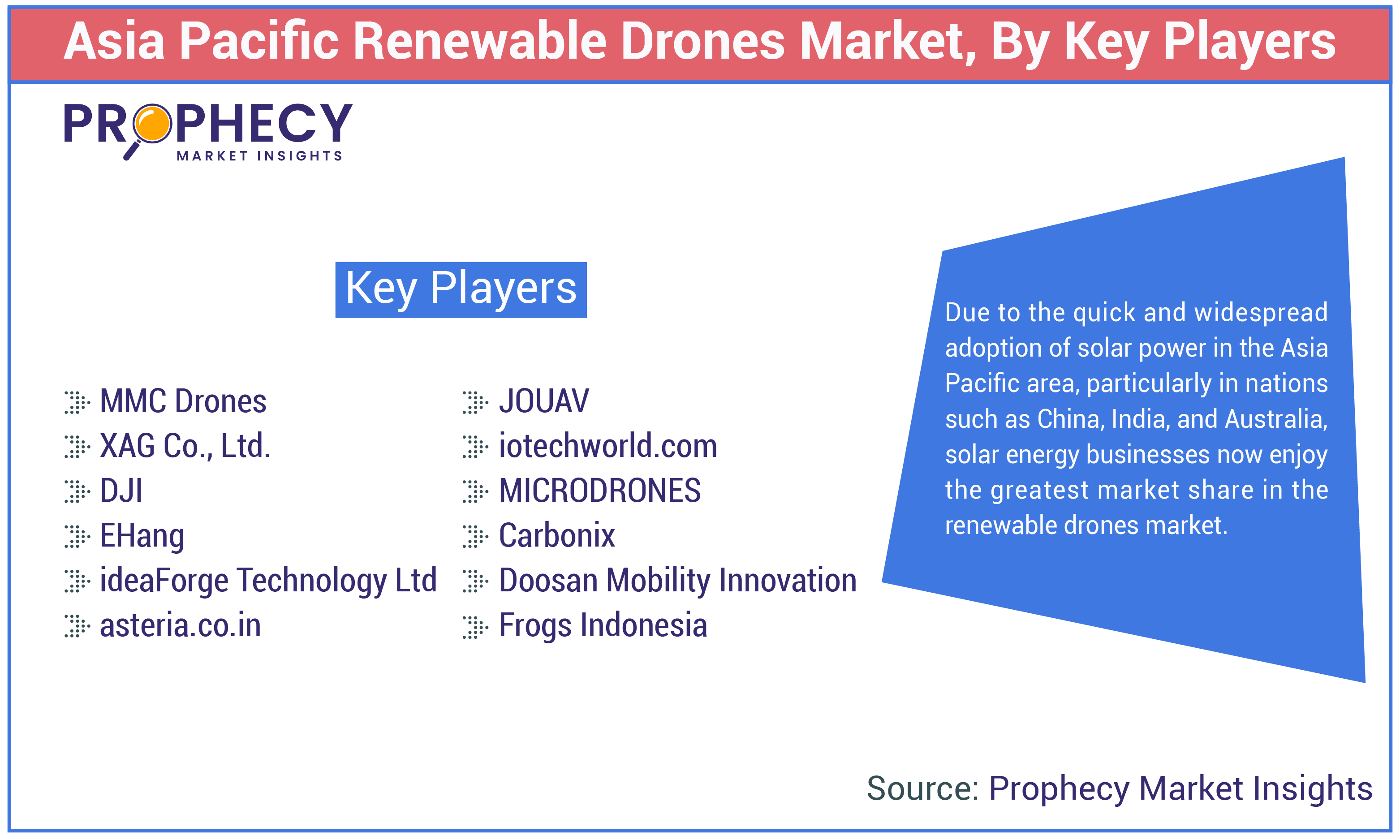
- MMC Drones
- XAG Co., Ltd.
- DJI
- EHang
- ideaForge Technology Ltd
- asteria.co.in
- JOUAV
- iotechworld.com
- MICRODRONES
- Carbonix
- Doosan Mobility Innovation
- Frogs Indonesia
Asia Pacific Renewable Drones Market Recent News
- In June 2025, Boson Cell has introduced the 18350 B-30A and 21700 B-50A models for EVs, drones, and renewable energy systems, marking the beginning of India's first domestic production of lithium-ion cells. These cells are designed to reduce dependency on imports by providing 1,000 recharge cycles, which is three times more than Chinese competitors. By 2030, Boson hopes to increase indigenous clean-tech capabilities and take 10% of the Indian battery market.
- In September 2024, the first drone powered by a hydrogen fuel cell in India, the Avi MALE, is unveiled by AvironiX Drones. The Avi-MALE, India's first drone fueled by a hydrogen fuel cell, was presented by AvironiX Drones, marking a significant milestone for the country's drone sector. With a remarkable 5-meter wingspan, this state-of-the-art Medium Altitude Long Endurance (MALE) VTOL drone raises the bar for efficiency and endurance, particularly in isolated locations without runway access.
Analyst View:
With the use of cutting-edge technology including artificial intelligence (AI), thermal imaging, and high-resolution sensors, renewable drones that are powered by or support green energy are transforming the operations of solar and wind farms by making inspections safer, more precise, and more affordable.
Rising energy consumption, significant investments in renewable infrastructure, and robust government backing in nations such as China, India, and Japan are all contributing to the market's rapid expansion in the Asia Pacific region. Drones are becoming a vital instrument in the region's clean energy transition thanks to technological breakthroughs including autonomous and BVLOS capabilities, and hybrid-electric and solar-powered drones that increase efficiency and scalability.
More Related Reports
LiDAR Drones Market
Racing Drones Market
Drones in Energy Market
Delivery Drones Market
Commercial Drones Market
Asia Pacific Renewable Drones Market Company Profile
|
Company Name |
MMC Drones |
|
Headquarter |
Shenzhen, China |
|
CEO |
Lu Zhihui |
|
Employee Count |
500 Employees |
FAQs
Asia Pacific renewable drones market size was valued at USD 3.5 Billion in 2025 and is expected to reach USD 69.9 Billion by 2035 growing at a CAGR of 35.55%.
Drone types, solution, payload capacity, application, end user, and country are the segmentation for the Asia Pacific renewable drones market.
The market is segmented by countries China, India, Japan, Australia, Indonesia, Malaysia, South Korea, and Rest of Asia Pacific. China region is expected to dominate the Market.
The key players operating the Asia Pacific renewable drones market include MMC Drones, XAG Co., Ltd., DJI, EHang, ideaForge Technology Ltd, asteria.co.in, JOUAV, iotechworld.com, MICRODRONES, Carbonix, Doosan Mobility Innovation, and Frogs Indonesia.