Healthcare Digital Twin Market Overview
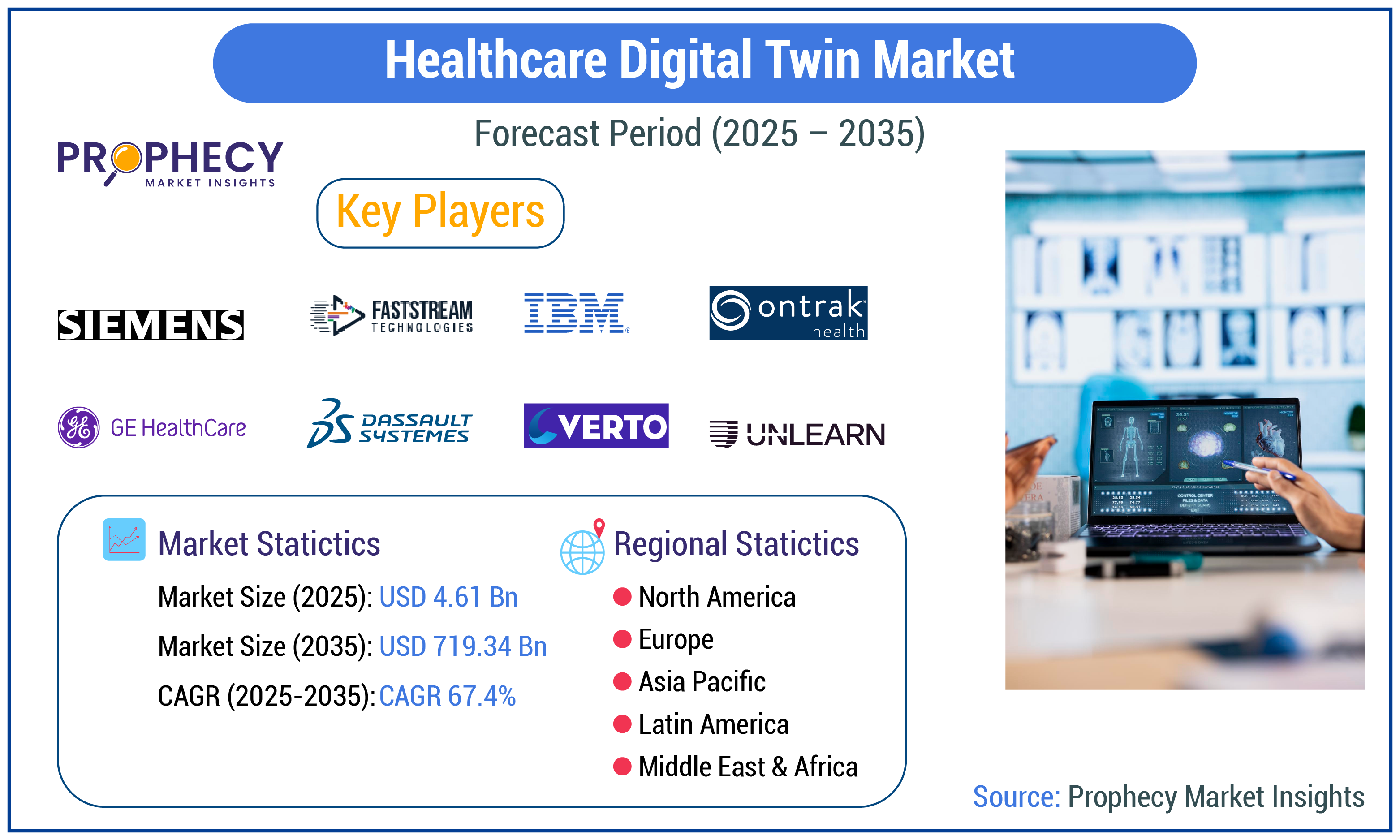
- By 2035, the healthcare digital twin market size is expected to grow at a valuation of USD 719.34 Billion.
- The market’s valuation in 2024 was USD 2.8 Billion.
- Target market is developing at a CAGR of 67.4%.
A healthcare digital twin is a computer-generated model of a person, organ, or biological system that simulates and forecasts possible health outcomes using real-time health data. The improved simulation techniques, increasing demand for personalized medicine, cost reductions associated with faulty equipment, improved operational efficiency, adoption of advanced technologies, increased support from the government is boosting the healthcare digital twin market growth. In addition to this, healthcare digital twin enables predictive analytics, improved clinical decision making, enhanced medical training, remote patient monitoring, and disease modeling and epidemic management, further contributing in the market diversification.
Impact of AI on Healthcare Digital Twin Market:
AI plays a critical role in analyzing this data to personalize treatment plans, enable early disease detection, and optimize overall patient care by providing insights and predictive capabilities that would not be possible with traditional methods alone. A healthcare digital twin is a virtual representation of a patient created using real-time health data by healthcare providers, enabling it to simulate various scenarios and predict potential health outcomes.
Healthcare Digital Twin Market Drivers & Restraints
Key Drivers of Target Market:
Increasing Demand for Personalized Medicine and Care is Expected to Pitch the Market Growth
A "one-size-fits-one" approach to healthcare delivery is essentially provided by the increasing demand for personalized medicine, which propels the healthcare digital twin market by making it possible to create virtual patient replicas that enable customized treatment plans based on individual patient data. This leads to more accurate diagnoses, optimized treatment strategies, and improved patient outcomes. For this purpose, companies are launching products for the personalized medicine and care of patients.
- For instance, in May 2023, Ontrak Inc, a leading AI-powered and technology-enabled healthcare company, announced the launch of its pioneering Mental Health Digital Twin (MHDT) technology. This innovative advancement in mental health care delivery seamlessly fused human empathy with data-driven insights to provide personalized, precise, and effective care for individuals struggling with mental health challenges.
Restraints:
Data Privacy and Security and Security Concerns are Obstructing the Market Growth
The sensitive nature of patient data raises privacy and security issues for the healthcare digital twin business. Inadequate data standardization can lead to inconsistent models and inaccurate predictions. Data flow is impeded by integration issues with current healthcare systems. If the underlying data is not diverse, there is a chance of skewed results. Furthermore, system efficiency may be impacted by the difficulty of handling massive amounts of real-time data.
- Counterbalance Statements: Utilizing strong data encryption, rigorous access restrictions, and uniform data protocols, and implementing varied datasets and sophisticated AI methods to reduce bias and improve model precision, are possible solutions to this concern.
Opportunities:
Amalgamation of Advanced Treatments with Healthcare Digital Twin Unlocks the Growth Potential
Healthcare digital twins that incorporate cutting-edge technologies such as artificial intelligence (AI), machine learning (ML), the Internet of Medical Things (IoMT), and big data analytics greatly boost market expansion by facilitating highly individualized patient care, accurate treatment planning, predictive analytics, and increased operational efficiency, all of which improve patient outcomes and lower costs throughout the healthcare system.
- For instance, in August 2024, LG Innotek, announced that it would partner with Ansys, the world's top engineering simulation company, to expand the application of ‘Digital Twin’ technology to all its processes with the help of Artificial Intelligence (AI), and Machine Learning (ML). In collaboration with Ansys, LG Innotek conducted a trial application of its ‘Digital Twin’ technology to some development and production processes and had achieved tangible results. The company planned to utilize 'Digital Twin' in the development and production of its entire product range, including autonomous driving components and sensing devices.
Healthcare Digital Twin Market Segmentations & Regional Insights
The market is categorized into services, digital twin types, application, end-user, and region.
Services
By services, the market is classified into emergency services, departmental services, supply chain services, and others. The departmental services segment is attributed to lead the market as it encompasses a wide range of applications within a healthcare facility, including managing bed capacity, staff scheduling, optimizing operating room usage, and facilitating data-driven decision-making for improved patient care and cost efficiency.
Digital Twin Type
On the basis of digital twin type, the market is divided into component twins, asset twins, system twins, and process twins. The asset twins segment holds the biggest healthcare digital twin market share as it focuses on managing and optimizing individual medicinal devices and assets within a healthcare system, which is a key area of concerns for hospitals and clinics.
Application
According to application, the market is sub-segmented into personalized medicine, healthcare workflow optimization and asset management, medical device design and testing, drug discovery and development, and others. The personalized medicine segment is dominating with the highest growth rate due to its potential to reduce patient outcomes and reduce side effects.
- For instance, in November 2023, Twin Health, a startup based in IIT Madras’ research park, had developed an innovative approach to monitor an individual's health by creating a digital twin. Twin Health's method of creating a digital twin through AI and leveraging daily precision nutrition guidance had shown promising results in reversing type 2 diabetes and improving overall health. The study highlighted the potential of personalized health monitoring and medicine, and intervention strategies for individuals with metabolic disorders.
End-User
According to end-user, the market is branched into hospitals and clinics, biopharmaceutical companies, medical device companies, research institutions, and others. The hospitals and clinics segment is projected to rule over the market as digital twins can help optimize hospital operations, such as staff and bed shortages, and improve patient care.
- For instance, in February 2024, Dassault Systèmes, announced its collaboration with the Saint-Louis Hospital AP-HP on an airflow simulation and augmented reality experience to better understand the respiratory transmission of viruses and optimize patient care. Dassault Systèmes created a unique learning experience featuring a digital twin of the hospital’s dialysis unit that enabled physicians and nurses to see exactly how virus particles could circulate through the air, and understand the roles of ventilation and masks.
Region
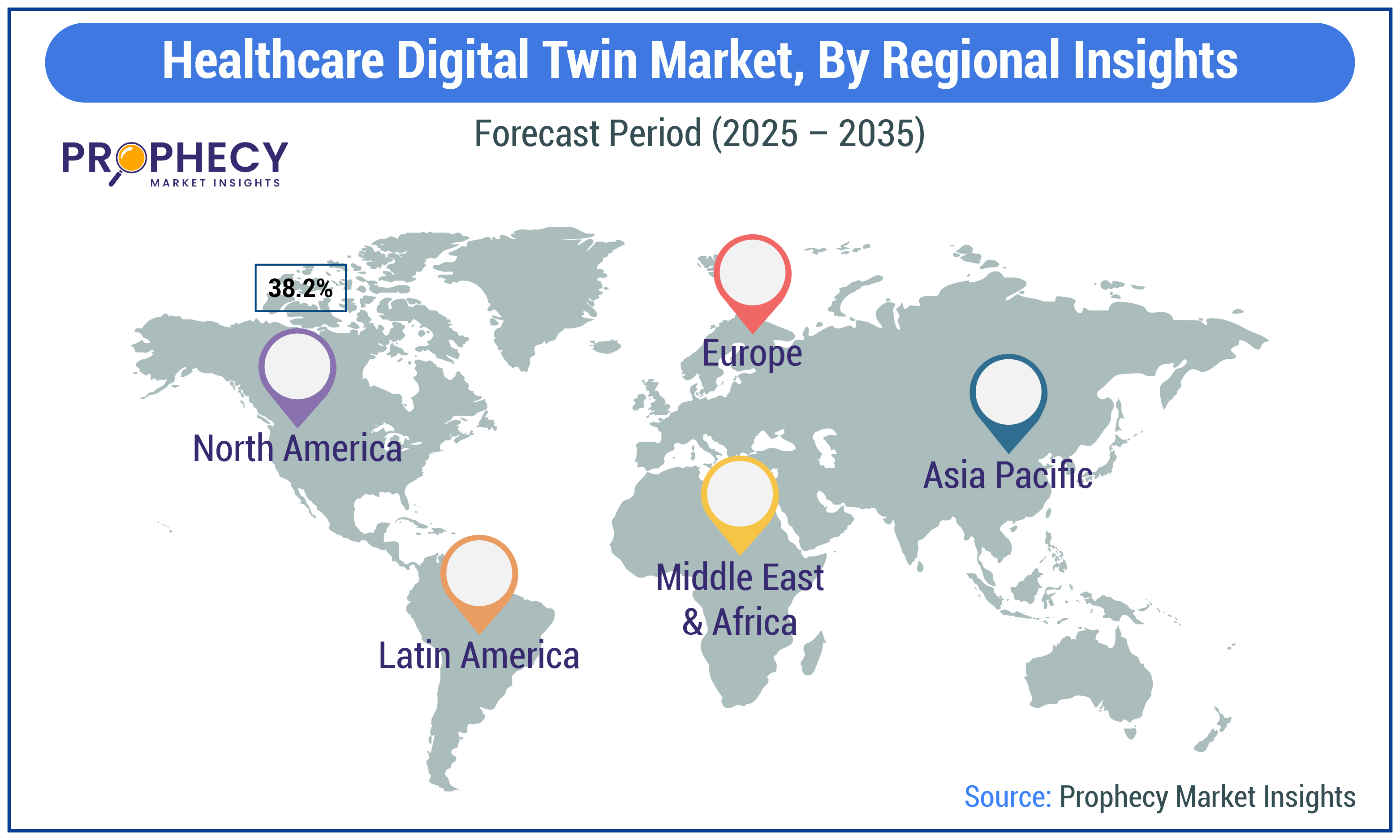
Geographically, the market is catalogued into North America, Europe, Asia Pacific, Latin America, and the Middle East & Africa.
North America: This is the region which has the largest healthcare digital twin market with an estimated share of around 38.2%. The region’s growth is attributed to the high adoption rates of digital healthcare solutions, significant investments in advanced medical technologies, strong technology companies, such as Microsoft, and high patient awareness.
- For instance, in April 2023, Accenture had made a strategic investment, through Accenture Ventures, in Virtonomy, a provider of data-driven simulations that used existing patient data and digital twin technology to bring life-saving medical devices to market more quickly. Accenture’s investment would help Virtonomy further extended its capabilities to medical technology (MedTech) companies globally and powered the future of medical device design.
Europe: This region has the fastest growing market. The growth is driven by the region’s significant presence of established healthcare technology companies, robust digital infrastructure, growing collaboration among market players, government support, and increased research and development activities.
- For instance, Dassault, a European company launched a digital twin, called Emma. The ‘Emma Twin’ was developed using anonymous health data with the express purpose of conducting an infinite number of tests to glean more insight into various diseases and therapies. ‘Emma’ has documented her participation in ongoing research trials and medical innovations through LinkedIn.
Healthcare Digital Twin Market Report Scope:
|
Attribute |
Details |
|
Market Size 2025 |
USD 4.61 Billion |
|
Projected Market Size 2035 |
USD 719.34 Billion |
|
CAGR Growth Rate |
67.4% (2025-2035) |
|
Base year for estimation |
2024 |
|
Forecast period |
2025 – 2035 |
|
Market representation |
Revenue in USD Billion & CAGR from 2025 to 2035 |
|
Regional scope |
North America - U.S. and Canada Europe – Germany, U.K., France, Russia, Italy, Spain, Netherlands, and Rest of Europe Asia Pacific – China, India, Japan, Australia, Indonesia Malaysia, South Korea, and Rest of Asia Pacific Latin America - Brazil, Mexico, Argentina, and Rest of Latin America Middle East & Africa – GCC, Israel, South Africa, and Rest of the Middle East & Africa |
|
Report coverage |
Revenue forecast, company share, competitive landscape, growth factors, and trends |
Segmentation:
By Services:
- Emergency Services
- Departmental Services
- Supply Chain Services
- Others
By Digital Twin Types:
- Component Twins
- Asset Twins
- System Twins
- Process Twins
By Application:
- Personalized Medicine
- Healthcare Workflow Optimization and Asset Management
- Medical Device Design and Testing
- Drug Discovery and Development
- Others
By End User:
- Hospitals and Clinics
- Biopharmaceutical Companies
- Medical Device Companies
- Research Institutions
- Others
By Region:
- North America
- U.S.
- Canada
- Europe
- Germany
- U.K.
- France
- Russia
- Italy
- Spain
- Netherlands
- Rest of Europe
- Asia Pacific
- China
- India
- Japan
- Australia
- Indonesia
- Malaysia
- South Korea
- Rest of Asia Pacific
- Latin America
- Brazil
- Mexico
- Argentina
- Rest of Latin America
- Middle East & Africa
- GCC
- Israel
- South Africa
- Rest of the Middle East & Africa
Healthcare Digital Twin Market Competitive Landscape & Key Players
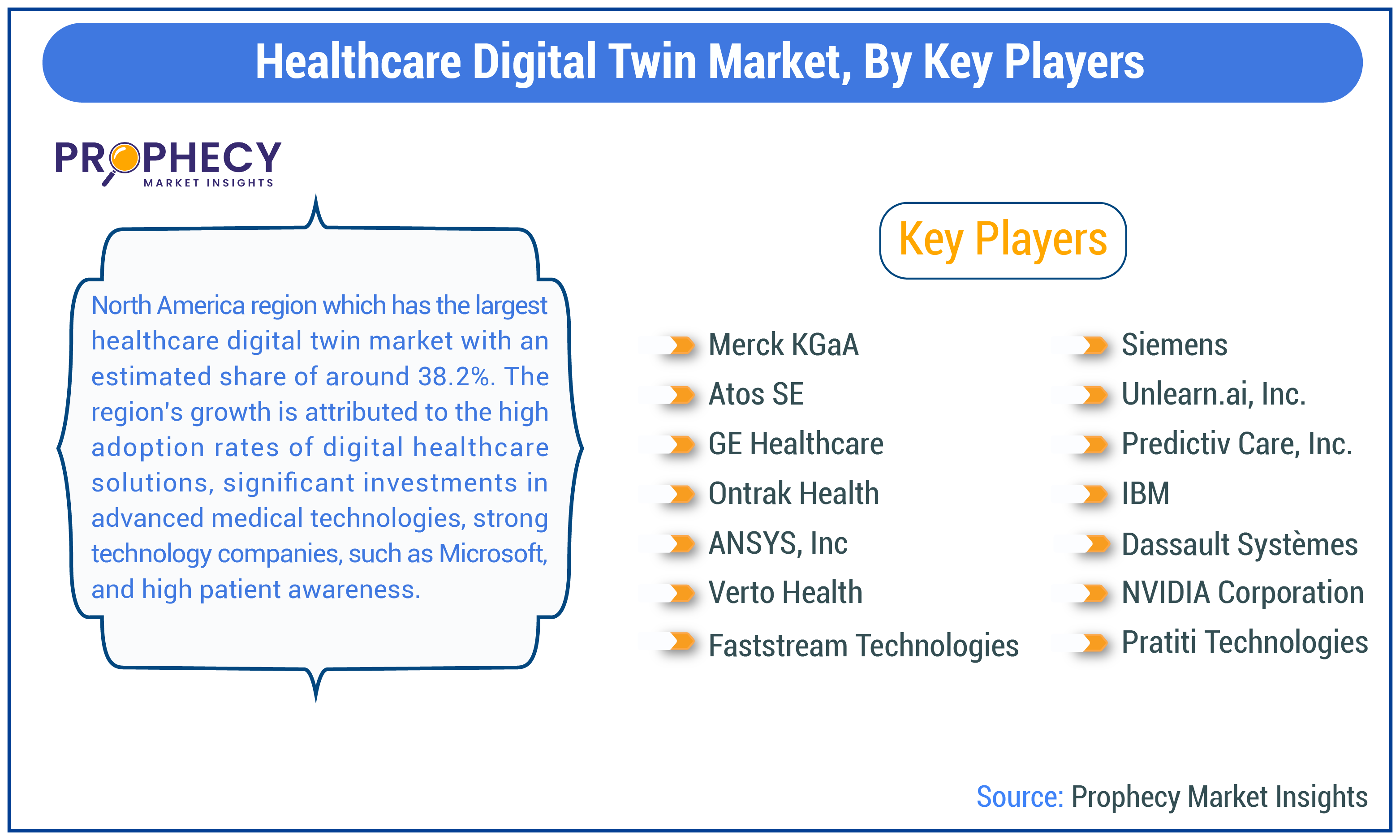
The prominent players in the market are adopting strategies, such as focusing on personalized medicine, remote patient monitoring, predictive analytics, and drug development simulations for driving market expansion. The companies operating in the market are Merck KGaA, Atos SE, Siemens, Dassault Systèmes, GE Healthcare, and others.
- Merck KGaA
- Atos SE
- GE Healthcare
- Ontrak Health
- ANSYS, Inc
- Verto Health
- Siemens
- Faststream Technologies
- Unlearn.ai, Inc.
- Predictiv Care, Inc.
- IBM
- Dassault Systèmes
- NVIDIA Corporation
- Pratiti Technologies
View an additional list of companies in the Healthcare Digital Twin Market
Healthcare Digital Twin Market Recent News
- In November 2024, Fujitsu announced that it had developed Policy Twin, a new digital twin technology to simulate the social impact of local government policies. Fujitsu would start offering Policy Twin to support effective and efficient service delivery in municipal preventive healthcare services. Fujitsu’s newly developed technology recreates previously successful local government policies on a digital twin and uses data to generate new policy candidates and gauge effectiveness.
- In November 2021, Fraunhofer Institutes presented the first prototype for digital twins of patients. This prototype revolutionized the very foundation of personalized and cost-optimized treatment, opening up new perspectives. It had already been tested at University Hospital Frankfurt. This prototype of a digital patient model marked the start of a new era in patient treatment.
Analyst View:
The healthcare digital twin market is growing as a result of enhanced simulation techniques, rising demand for individualized medication, lower costs related to malfunctioning equipment, higher operational efficiency, adoption of cutting-edge technology, and more government backing.
More Related Reports
Healthcare Biometric Market
Artificial Intelligence in Healthcare Market
Big Data in Healthcare Market
AI in Healthcare Market
Digital Health Market
Healthcare Digital Twin Market Company Profile
|
Company Name |
Merck KGaA |
|
Headquarter |
Darmstadt, Germany |
|
CEO |
Mrs. Belén Garijo |
|
Employee Count (2024) |
62,908 Employees |
Healthcare Digital Twin Market Highlights
FAQs
Healthcare digital twin market size was valued at USD 4.61 Billion in 2025 and is expected to reach USD 719.34 Billion by 2035 growing at a CAGR of 67.4%.
The market is segmented into services, digital twin types, application, end user, and region.
The market is segmented by region North America, Asia Pacific, Europe, Latin America, and the Middle East & Africa. North America is expected to dominate the Market.
The key players operating in the healthcare digital twin market include Merck KGaA, Atos SE, Siemens, Dassault Systèmes, GE Healthcare, Ontrak Health, ANSYS, Inc, Verto Health, Faststream Technologies, Unlearn.ai, Inc., Predictiv Care, Inc., IBM, NVIDIA Corporation, and Pratiti Technologies.