Global Artificial Intelligence In Healthcare Overview
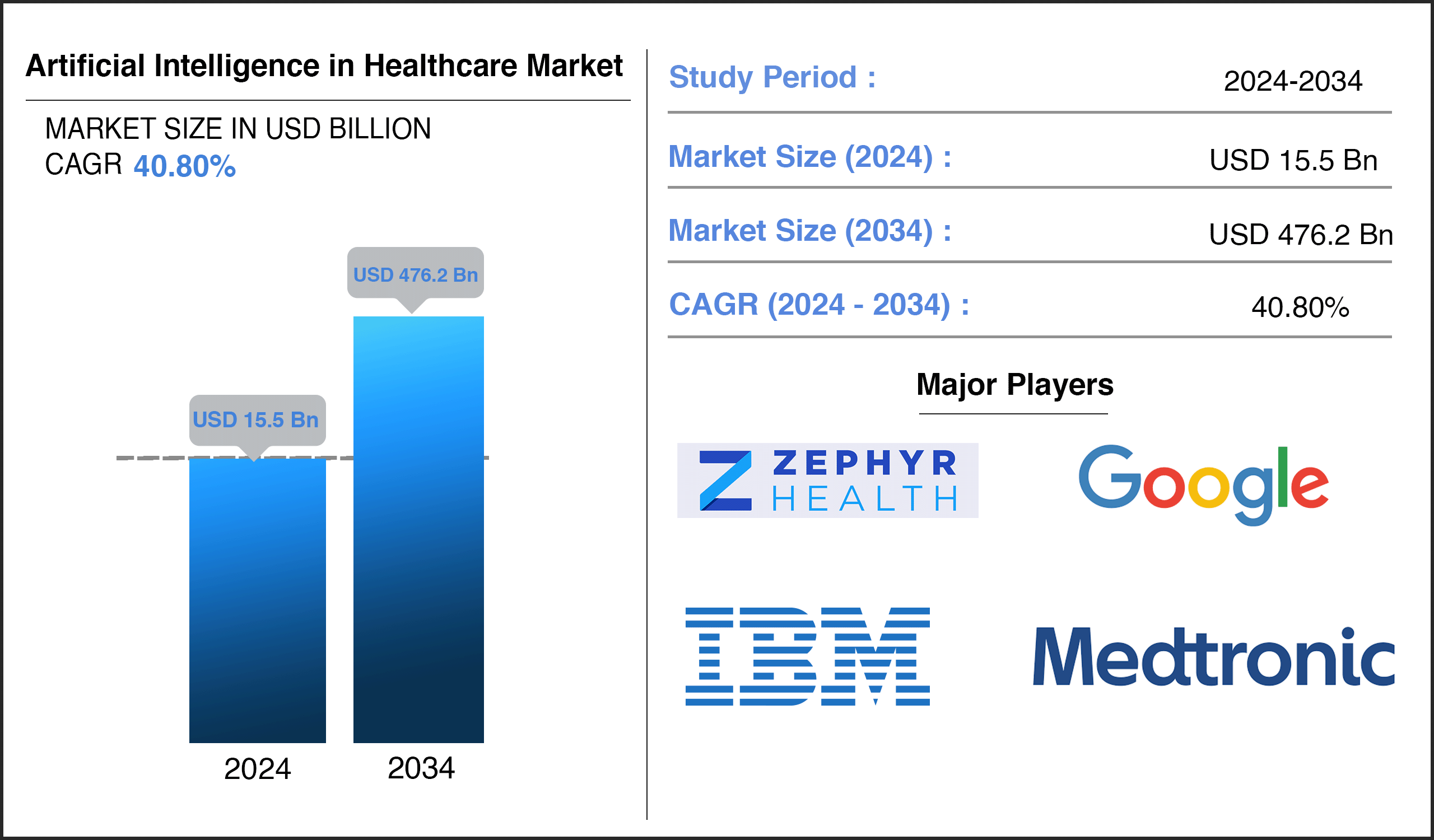
Artificial Intelligence in Healthcare Market accounted for USD 15.5 Billion in 2024 and is estimated to be USD 476.2 Billion by 2034 and is anticipated to register a CAGR of 40.80%.
Artificial intelligence are the computational models that are able to perform tasks that require human intelligence, for instance, visual perception, speech recognition, translation between languages and decision making. The artificial intelligence in healthcare gives machine the ability to learn and improve without the humans or new programming. The artificial intelligence technologies also include management of big data, pattern identification, and eliminating bias.
For More Report Details, Download Free Sample PDF
Global Artificial Intelligence In Healthcare Drivers & Restraints
The increasing application of Artificial Intelligence technologies, from pharma drug development to patient care such as, managing medical records and others data, virtual nurses, design treatment path, precision medicine, and health monitoring is expected to foster the artificial intelligence in healthcare market.
Furthermore, the doctor-population ratio concern is also expected to favor the artificial intelligence market. The artificial intelligence also aids to improve the basic healthcare facilities, which also helps the doctors to invest more time on the critical cases.
Additionally, increasing research and development in healthcare is expected to boost the growth of artificial intelligence market. The artificial intelligence also involves analysis of structured data such as genetic data, and imaging data.
Global Artificial Intelligence In Healthcare Segmentations & Regional Insights
Artificial intelligence in healthcare market has been segmented on the basis of solution, technology, application, end user, and region.
The solution segment of the global artificial intelligence in healthcare market includes hardware, software & services.
On the basis of technology, the global artificial intelligence in healthcare market has been segmented into Speech recognition, Querying Method, Natural Language Processing, Machine Learning, and Context Aware Processing.
On the basis of application, the global artificial intelligence in healthcare market has been segmented into imaging & diagnostics, drug discovery, lifestyle management & monitoring, emergency room & hospital management, insights & risk analytics, wearable, virtual assistants, others.
On the basis of end-user, the global artificial intelligence in healthcare market has been segmented into hospital, pharmaceutical organizations, diagnostic centers, clinics.
Regional Insights:
On the basis of region, the target market has been segmented into North America, Europe, Asia Pacific, Latin America, and Middle East & Africa. North America is expected to account major market share as compared to that of other regions.
Global Artificial Intelligence In Healthcare Competitive Landscape & Key Players
The key players operating in the artificial intelligence in healthcare include IBM Corporation, Google, Inc., NVIDIA Corporation, Microsoft Corporation, iCarbonX, Next IT Corp., CloudMex Inc., Atomwise Inc., Zephyr Health Inc., Medtronic Plc., Koninkiljke Philips N.V., and Oncora Medical, Inc.
Global Artificial Intelligence In Healthcare Recent News
Recent News:
- In September 2023, Merck Inc., annnounced strategic collaborations with Exscientia and BenevolentAI to enhance their AI-enabled drug development capabilities. They will focus specifically on developing drug candidates for the fields of immunology, neurology and oncology.
- In November 2023, Wipro, announced partnership with NVIDIA to accelerate AI adoption by healthcare companies. This collaboration is expected to enhance Medicare, Medicaid and other platforms with the help of AI.
- In October 2023, ZS, announced the launched of the ZIDYN Connected Health solution enabling biopharmaceutical companies, healthcare providers and payers to gain health insights, promoting patient engagement and conducting connected research with the help of AI.
- In October 2021, Medtronic received CE Mark approval for the Hugo Robotic Assisted Surgical System (RAS) for use in general surgical procedures in Europe. Hugo RAS received CE marking in October 2021 for urological and gynecological treatment. Together with general surgery, these indications account for more than 80% of all robot-assisted surgeries performed worldwide.
- In May 2020, the MIT-IBM Watson AI Lab encouraged the use of AI technology in research projects on the economic and health consequences of the pandemic. Similarly, Qventus introduced AI-based patient flow automation systems including critical resource control, hospital stay optimization, and Covid-19 scenario planning, and creating critical care capabilities. Special care for patients at its medical facilities.
Global Artificial Intelligence In Healthcare Highlights
FAQs
Artificial Intelligence in Healthcare Market is segmented, By Solution (Hardware, and Software & Services), By Technology (Speech Recognition, Querying Method, Natural Language Processing, Machine Learning, and Context Aware Processing) By Application (Imaging & Diagnostics, Drug Discovery, Lifestyle Management & Monitoring, Emergency Room & Hospital Management, Insights & Risk Analytics, Wearable, Virtual Assistants, and Others) and By End User (Hospital, Pharmaceutical Organizations, Diagnostic Centers, and Clinics)
The increasing research and development in the artificial intelligence field is the major driver of artificial intelligence in healthcare market. For instance, in October 2017, IBM Corporation partnered with University of California, in order to enhance the quality of life through artificial intelligence.
The key players operating in the global market of artificial intelligence in healthcare include IBM Corporation, Google, Inc., NVIDIA Corporation, Microsoft Corporation, iCarbonX, Next IT Corp., CloudMex Inc., Atomwise Inc., Zephyr Health Inc., Medtronic Plc., Koninkiljke Philips N.V., and Oncora Medical, Inc.