Global Trade Finance Market Overview
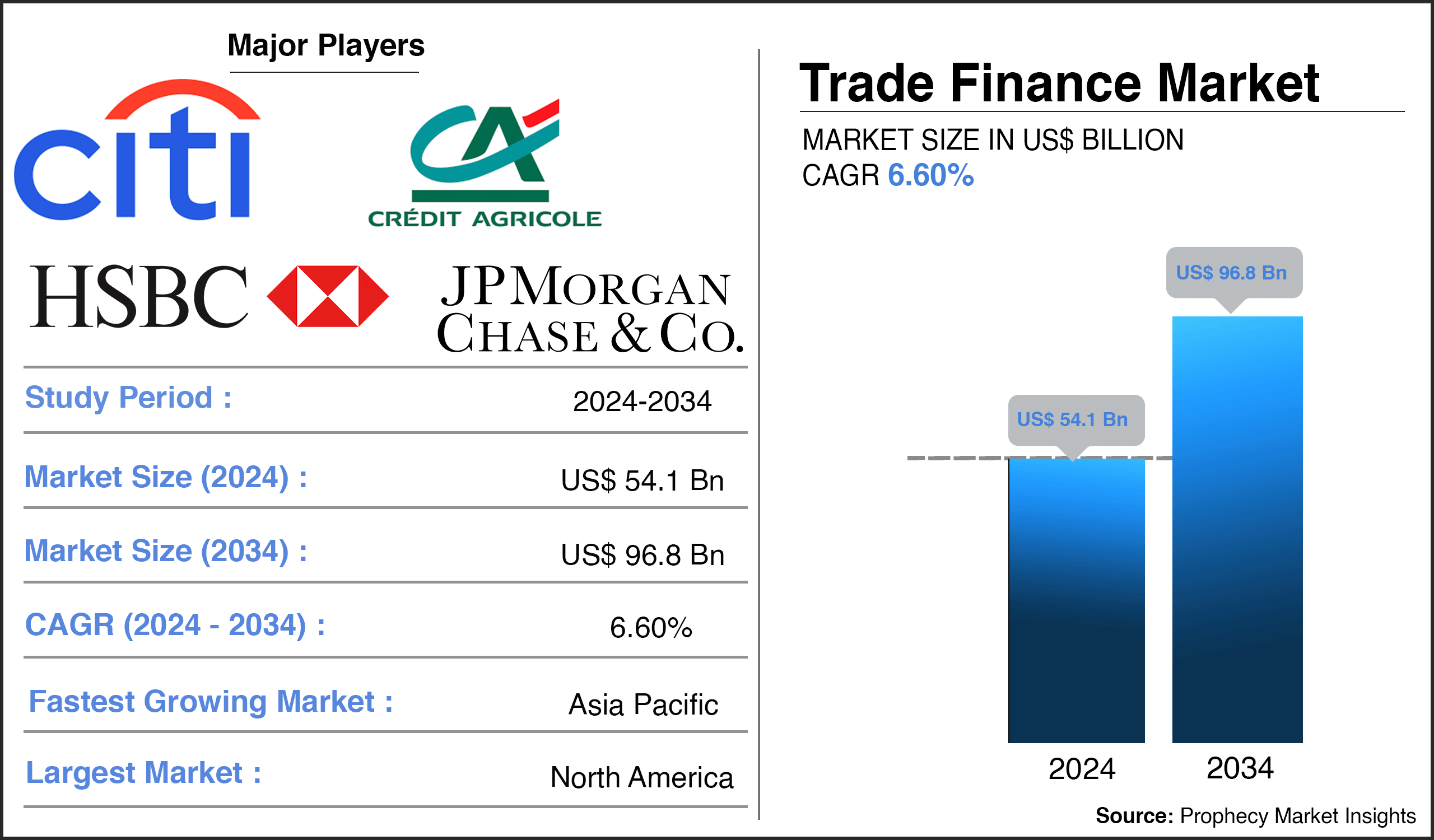
Trade Finance Market Size was valued at USD 54.1 Billion in 2024 and is projected to grow at a CAGR of 6.60% to reach USD 96.8 Billion by 2034
Trade Finance is the financing of international trade flows, acting as an intermediary between importers and exporters to mitigate the risks involved in transactions and enhance working capital efficiency in businesses. It deals with activities related to financing of domestic and international trade. Trade finance includes issuing letters of credit (LCs), receivables and invoice finance, credit agency, export finance, bank guarantees, insurance, and others. It is used by buyers, sellers, manufacturers, importers, and exporters to ease financing activities and deals with the way cash, credit, investments, and other assets are used for trade. The key advantage of trade finance is that it facilitates an easy way to arrange short-term finance.
The market's expansion is aided by the quickening pace of globalization and the expanding amount of international commerce. Businesses require effective and safe cross-border finance solutions to expand into global markets. The need for trade financing is rising as a result of supply networks becoming more extensive across borders. The trade financing sector is increasing thanks to elements including new trade agreements and heightened competition. The escalation of trade disputes and expensive execution also bolster the market's growth. The trade finance sector offers prospects for market expansion due to its integration with blockchain technology.
Global Trade Finance Market Drivers & Restraints
Trade Finance Market Drivers:
Technological advancements
- The development of technologies such as optical character recognition (OCR) to read container numbers, radio frequency identification (RFID) quick response (QR) codes to identify and trace shipments, blockchain, and enhancing digitization of trade documents drive the trade finance market growth. Advancements in technology, switching from traditional banking methods for documentation to ease the paperwork, and efficient enhancement in the trade finance industry provide opportunities for the market.
- In addition, strategic formulation, along with the adoption of structuring and pricing tools, offers some other growth opportunities to the market. Bank support for firms' ability to mitigate payment risk by purchasing trade credit insurance boosts market growth.
Growing sustainable finance
- The rising incorporation of environmental, social, and governance (ESG) concepts is an ongoing development of sustainable finance in the trade financing sector. Decisions on trade financing are increasingly taking sustainability into account from businesses and financial institutions. Green bonds and loans with an ESG component are the most widely used sustainable trade finance vehicles. Growing awareness of social and environmental problems led to the adoption of sustainable finance practices in the trade financing sector.
Trade Finance Market Restrains:
High cost of trade financing products
- The high cost and complexity of trade financing products, especially for small and medium-sized firms (SMEs) and businesses operating in developing nations, is one of the main obstacles to the global trade finance industry. SMEs and businesses in these areas have difficulty obtaining trade financing because of their short credit history, absence of collateral, and elevated perceived risks. Due to this, there is now a trade finance gap, which limits the market's potential for growth by making it difficult for many enterprises to obtain the funding they need to engage in international commerce.
Global Trade Finance Market Segmentations & Regional Insights
Trade Finance Market is segmented based on Product Type, Services Providers, Application and region:
Product Type Insights:
- Guarantees:
Guarantees give the exporter's bank a financial guarantee from a bank. Usually, the importer's bank assures payment of the import duties. This reduces by doing this, the exporter's raiment is reduced.
- Letter of Credit:
An official instrument provided by the bank (importer's bank) assures payment to the exporter (beneficiary) upon satisfying specified requirements, usually entailing the production of particular shipment-related documentation. This safeguards the interests of both parties: the importer obtains the items as defined in the documentation, and the exporter is paid after fulfilling the requirements.
- Documentary Collection:
This is a less costly option than Letters of Credit in which the exporter gives their bank instructions to pay the importer's bank once the import is shipped. Only upon payment or receipt of a bill of exchange are the papers provided to the importer. Banks do not, however, take on the credit risk in documentary collections, in contrast to LCs.
- Supply Chain Finance:
This all-inclusive financial service controls the movement of products, data, and money along a supply chain. It involves funding suppliers and customers, allowing for more efficient cash flow and maximizing working capital for participating companies.
- Others:
This category includes products that meet certain requirements in international trade transactions, such as forfeiting, advance payment guarantees, and standby letters of credit.
Among the segments mentioned above, the one that dominated the market is the Letter of credit segment, as it guarantees that the seller will get money only after presenting compliant shipping documentation, offering a safe way to conduct business internationally.
Services Providers Insights:
- Banks:
Historically, conventional banks have been the main suppliers of trade financing services. They use their global network of correspondent banks to ease cross-border transactions and provide various products, such as guarantees and LCs.
- Trade Finance Houses:
These specialty organizations that only deal with trade financing provide flexible solutions and competitive rates, especially for smaller enterprises or niche markets that might not be eligible for regular bank products.
Among the segments mentioned above, the one that dominated the market is the banks segment, as banks provide many trade finance services, such as Export financing, trade credit insurance, and letters of credit.
Application Insights:
- Energy:
Trade finance largely finances the import and export of commodities like coal, oil, and gas in the global energy industry.
- Finance:
Trade finance is essential to the smooth operation of global financial exchanges, including the trading of securities and foreign currencies.
- Transport:
Trade finance is required for the purchase of automobiles, ships, and aircraft and for the accelerated payment of freight due to the transportation of products over international boundaries.
- Power Generation:
Trade financing solutions are needed for the import and export of fuels and equipment for power generation projects.
- Healthcare:
Trade financing is necessary for the exchange of commodities such as copper, iron ore, and building supplies.
- Metals and Non Metallic Minerals:
The trade in commodities like iron ore, copper, and construction materials relies on trade finance.
- Renewables:
The expanding renewable energy industry uses trade finance to fund project development and equipment imports.
- Others:
Trade financing is used in several sectors not explicitly covered here, including manufacturing, consumer products, and agriculture.
Trade Finance Market Regional Insights
- North America market is estimated to witness a significantly high revenue share over the forecast period, because of its strong financial system, reputable banks, healthy economy, and sizable amount of international commerce.
- Asia Pacific market is estimated to witness the largest revenue share because of the widespread emergence of fintech start-ups and digital trade finance platforms that provide inventive solutions to enterprises involved in global trade.
- Europe market finds lucrative market opportunities because sustainable finance and environmental, social, and governance (ESG) issues in trade financing are gaining traction.
- The Latin American market is growing gradually due to the different legal frameworks and economic situations. Latin American trade finance providers provide solutions that address the unique issues that firms in the area confront, such as political unpredictability and currency instability
- The Middle East and & Africa market is an emerging market. As a result of the countries in the region's strategic positioning for trade routes, investments in infrastructure, and efforts to diversify their economies, the market is growing. Consumer financing is essential for promoting both domestic and international commerce.
Trade Finance Market Report Scope:
|
Segments Covered in the Report:
This report forecasts revenue growth at global, regional, and country levels and provides an analysis of the latest industry trends and opportunities in each of the sub-segments from 2024 to 2034. For the purpose of this study, has segmented the Trade Finance Market report based on Product Type, Services Providers, Application and region:
Trade Finance Market, By Product Type:
- Guarantees
- Letter of Credit
- Documentary Collection
- Supply Chain Finance
- Others
Trade Finance Market, By Services Providers:
- Banks
- Trade Finance Houses
Trade Finance Market, By Application:
- Energy
- Finance
- Transport
- Power Generation
- Healthcare
- Metals and Non Metallic Minerals
- Renewables
- Others
Trade Finance Market, By Region:
- North America
- U.S.
- Canada
- Europe
- Germany
- UK
- France
- Russia
- Italy
- Rest of Europe
- Asia Pacific
- China
- India
- Japan
- South Korea
- Rest of Asia Pacific
- Latin America
- Brazil
- Mexico
- Rest of Latin America
- Middle East & Africa
- GCC
- Israel
- South Africa
- Rest of Middle East & Africa
Global Trade Finance Market Competitive Landscape & Key Players
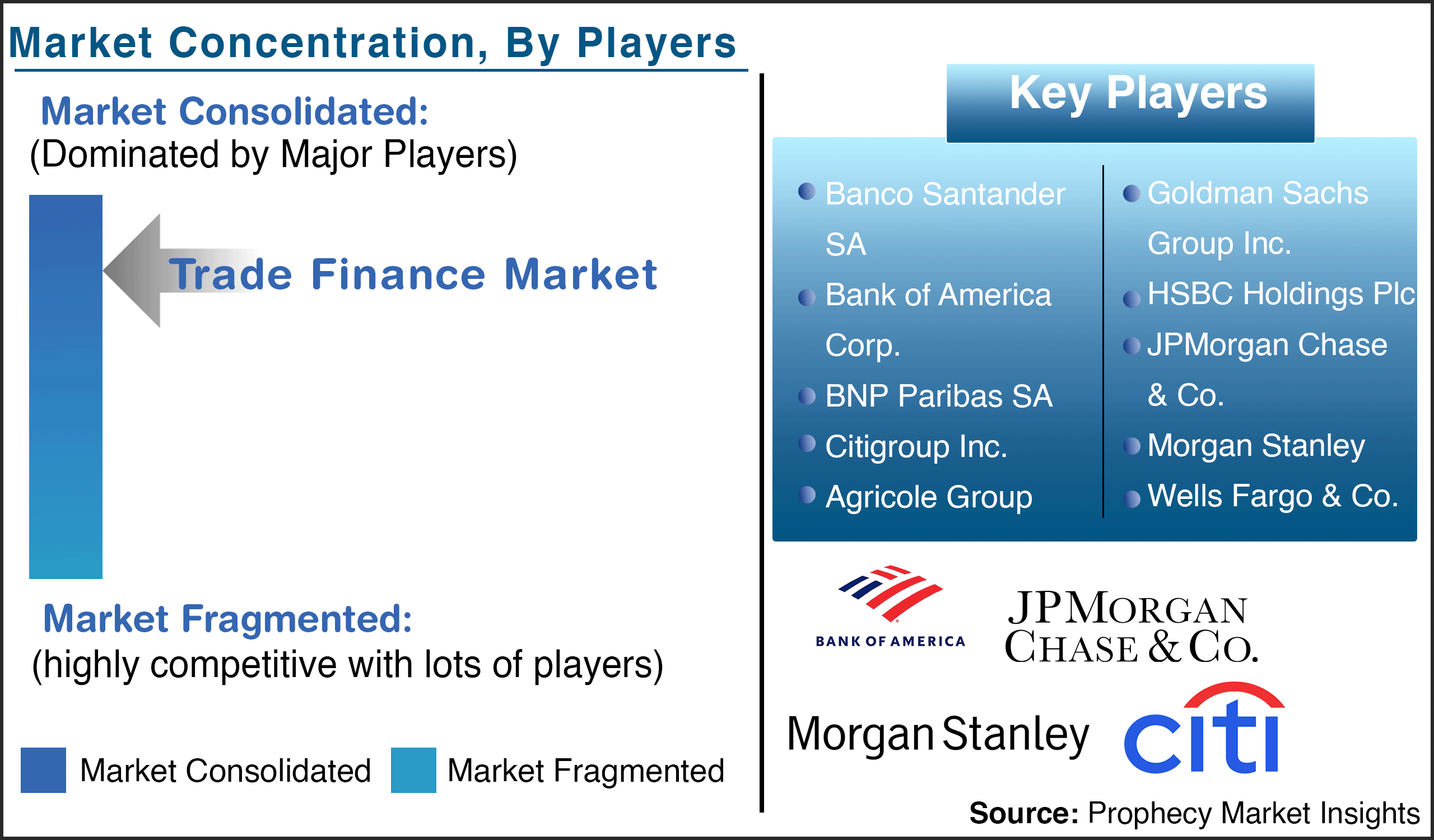
The key players operating the Trade Finance Market includes Banco Santander SA, Bank of America Corp., BNP Paribas SA, Citigroup Inc., Agricole Group, Goldman Sachs Group Inc., HSBC Holdings Plc, JPMorgan Chase & Co., Morgan Stanley, and Wells Fargo & Co.
Global Trade Finance Market Recent News
- In September 2023, Standard Chartered announced the launch of a sustainability-focused trade loan for its financial institution clients, allowing them to offer additional liquidity to support ESG-related trade flows. By giving financial institutions worldwide "much-needed" cash, the loan offer would hasten the borrowers' attempts to fulfill their net zero and sustainability goals.
- In December 2022, MUFG Bank, Ltd. (MUFG), the premier bank of Japan, announced that it had completed an INR 450 crore sustainable trade financing facility for Tata Power, one of India's top integrated power firms. For the solar projects under TP Kirnali Limited (TPKL), this financial facility was given. TPKL, which was founded in 2020, is a wholly-owned subsidiary of the sustainable energy platform Tata Power Renewable Energy Limited (TPREL). TPKL will use the money to create capacity for renewable energy production. This is the first sustainable trade financing facility that MUFG has made available in India.
Global Trade Finance Market Company Profile
- Banco Santander SA
- Bank of America Corp.
- BNP Paribas SA
- Citigroup Inc.
- Agricole Group
- Goldman Sachs Group Inc.
- HSBC Holdings Plc
- JPMorgan Chase & Co.
- Morgan Stanley
- Wells Fargo & Co.
Global Trade Finance Market Highlights
FAQs
The Trade Finance Market report segments the market been segmented on the been segmented on the basis of product type, services providers, application, and region.
The development of technologies such as optical character recognition (OCR) to read container numbers, radio frequency identification (RFID) and quick response (QR) codes to identify and trace shipments, blockchain, and enhancing digitization of trade documents drive the trade finance market growth.
Europe is expected to grow at the fastest growth rate during the forecast period
The leading players operating in the Trade Finance Market includes Banco Santander SA, Bank of America Corp., BNP Paribas SA, Citigroup Inc., Agricole Group, Goldman Sachs Group Inc., HSBC Holdings Plc, JPMorgan Chase & Co., Morgan Stanley and Wells Fargo & Co.