Global Surface Treatment Chemicals Market Overview
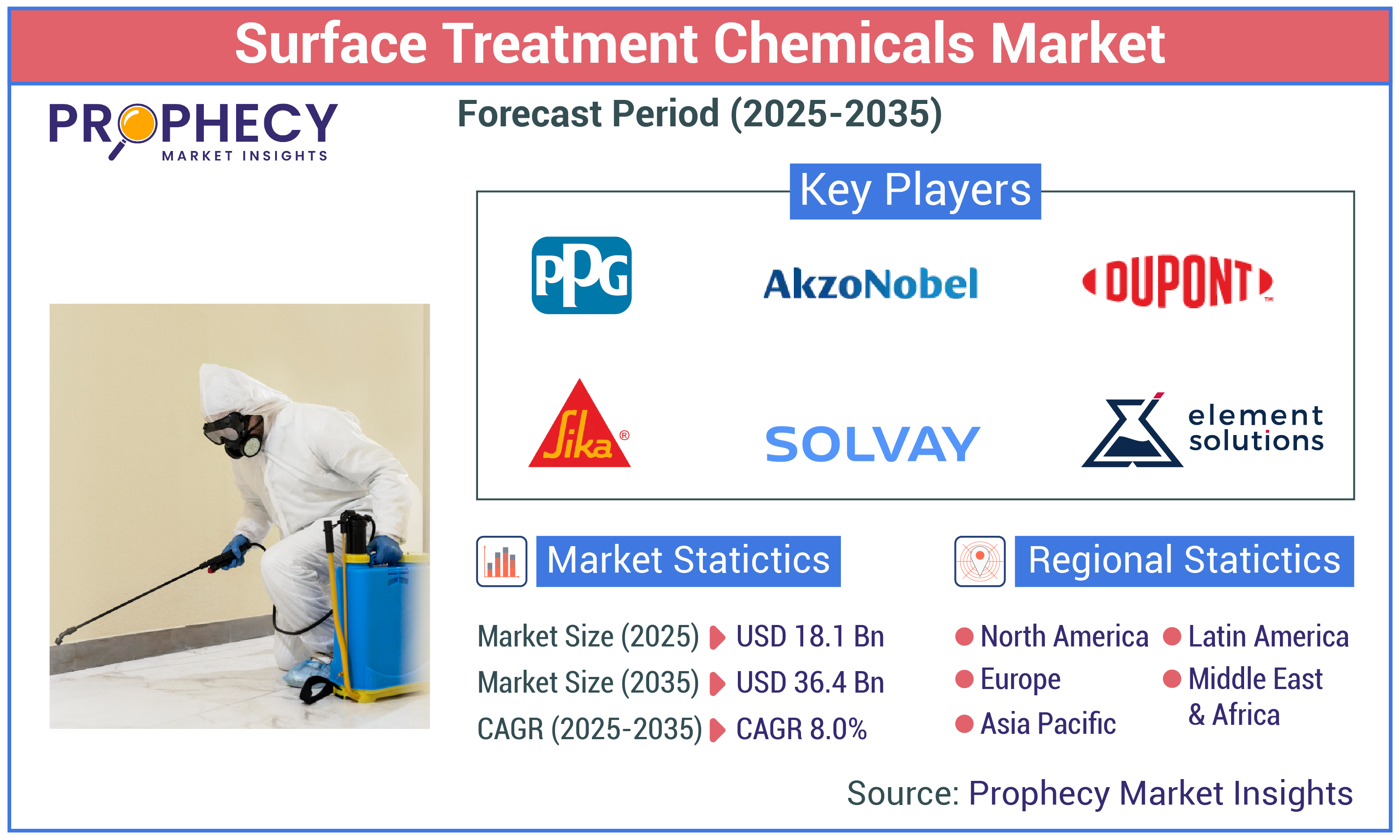
- Surface treatment chemicals market size is expected to expand at a valuation of USD 36.4 Billion, by 2035.
- In 2024, the market valuation was USD 16.9 Billion.
- Surface treatment chemicals market is developing at a CAGR of 8.0%.
Surface treatment chemicals are used to modify the surface properties of materials, enhancing its durability, appearance, or specific characteristics such as corrosion resistance. This is achieved through chemical processes that alter the surface composition or structure. These treatments are crucial for various applications, including enhancing adhesion, protecting against environmental damage, and improving functionality. These enhance material durability and appearance, and can be used for cleaning, protecting, or modifying surfaces in various industries. Advantages include improved corrosion resistance, enhanced wear resistance, and enhanced aesthetics.
The surface treatment chemicals market is experiencing growth due to several factors, including, the rapid industrialization and urbanization, the rising automotive sector which heavily relies on surface treatment chemicals for pre-treatment and coating applications to enhance paint adhesion, corrosion resistance, and durability, the need to protect materials from corrosion and other environmental degradation, and the growing demand in sustainability.
The market’s augmentation is also stimulated by the development of advanced coatings, including nanocoatings, and the use of high-performance polymers are enhancing material properties, growing demand for environmentally friendly treatments and stricter regulations are encouraging the adoption of greener alternatives such as water-based coatings and non-toxic plating solutions, and increasing infrastructure projects, particularly in developing economies, require surface treatment chemicals for various applications.
Recession Risk and Tariff Analysis:
- The surface treatment chemicals market is at danger from a recession as it lowers industrial production in industries including construction, automotive, and aerospace. The market may expand more slowly, investment may decline, and chemical procurement budgets may become more constrained if there is less demand for processed metals and components.
- Global commerce is impacted by the moderate to high import taxes seen in many locations, according to a tariff study of the surface treatment chemicals industry. Tariffs are imposed by nations to safeguard its own chemical industries, which has an impact on supply chains and prices. Trade agreements and regulatory compliance are important factors that affect competitive positioning and market accessibility.
Impact of Generative AI on Surface Treatment Chemicals Market:
- Through improved molecular design and predictive modelling, generative AI is speeding up research and development, revolutionizing the market for surface treatment chemicals. It makes it possible to formulate high-performance and environmentally friendly compounds more quickly by simulating reactions and streamlining procedures.
- Additionally, AI-driven insights improve supply chain forecasts, quality assurance, and manufacturing efficiency. Generative AI also helps with regulatory compliance by forecasting environmental effects. All things considered, it increases competitiveness, speeds up time to market, and encourages innovation in a market that is becoming more and more concerned with sustainability and performance optimization.
Global Surface Treatment Chemicals Market Drivers & Restraints
Key Drivers:
The Rising Urbanization is Expected to Pitch the Market Expansion
The surface treatment chemicals market growth is driven by growing urbanization, which raises demand for long-lasting, aesthetically pleasing, and corrosion-resistant materials in consumer products, automotive, construction, and infrastructure. As cities expand, additional structures, transit networks, and industrial facilities are created, necessitating the use of treated metal, glass, and plastic materials. Chemicals used for surface treatment improve these materials' durability, security, and aesthetics. The necessity for efficient surface finishing solutions in manufacturing processes is further fueled by the increased demand for electronics and appliances brought on by urban lifestyles.
- For instance, according to the data published by World Bank Group, in order to fulfill the World Bank's purpose of eradicating poverty and promoting shared prosperity on a habitable world, more livable cities must be built. Currently, 4.4 billion people, or more than half of the world's population, reside in urban areas. This trend is predicted to continue, with nearly seven out of ten people living in cities by 2050, when the urban population is predicted to more than quadruple.
Environmental Impact of Surface Treatment Chemicals is Hindering the Market Expansion
The surface treatment chemicals market's influence on the environment as a result of the usage of dangerous materials such as heavy metals and volatile organic compounds is one of the main drawbacks of surface treatment chemicals. These substances can pollute soil and water through improper disposal or unintentional discharge, endangering ecosystems and public health. Furthermore, processing these materials frequently calls for stringent safety precautions and regulatory compliance, which can be difficult, particularly for small producers, and could result in infractions and environmental liabilities.
- Counterbalance Statements: Adopting green chemical techniques, creating non-toxic and bio-based substitutes, and enhancing waste treatment systems are the answers. Risks can also be reduced by improved worker training and more stringent enforcement of environmental laws. Working together, industry and regulatory agencies can decrease the environmental impact of chemical processes and promote sustainable innovation.
Opportunities & Trends:
Advancements in Metal Coating is Opening Up Growth Opportunities for the Impending Years
Coatings innovations, including protective metal coatings, greatly contribute to the market expansion for surface treatment chemicals by improving the performance, corrosion resistance, and durability of materials in challenging environments. The automobile, aerospace, construction, and marine sectors all have a strong need for these advancements. Better coatings fulfil more stringent safety and environmental regulations, increase product lifespans, and lower maintenance costs. Advanced surface treatment chemicals are becoming more and more necessary to support these coatings as businesses look for more effective, high-performing, and environmentally responsible solutions.
- For instance, according to the data published by Central Wisconsin Finishing, it is impossible to overestimate the importance of protective metal coatings when taking into account its influence on various sectors. These coatings shield car bodywork against corrosion caused by road salt or corrosive chemicals in the transportation and automotive production industries. By protecting aircraft parts from external elements such as dampness and harsh chemicals encountered during flights, protective metal coatings serve a crucial function in aviation. In the oil and gas sector, protective metal coatings are essential due to the severe conditions that are faced during drilling, extraction, and transportation.
Global Surface Treatment Chemicals Market Segmentations & Regional Insights
The surface treatment chemicals market is segmented into chemical type, base material, formulation type, application, end-use industry, and region.
By Chemical Type:
Stemming from chemical type, the market is divided into cleaning agents, coatings, conversion coatings, plating chemicals, and surface modifiers. The plating chemicals segment is holding the upper hand in the surface treatment chemicals market share. This is due to its widespread use in various industries such as transportation, industrial machinery, and construction for applications such as corrosion resistance and decorative finishes.
The coatings segment is the chemical type which is experiencing significant growth, in the target market. This is due to the diverse range of applications for coatings across various industries.
By Base Material:
Depending upon base material, the market is sub-segmented into metals, plastics, and others. The metals segment is ruling over the target market. This is due to the extensive use of metals in various industries, including automotive, construction, and manufacturing, where surface treatment chemicals are crucial for enhancing performance, durability, and aesthetics.
The plastics segment is the fastest growing base material, in the surface treatment chemicals market. This is due to its requirement in various industries, and advancements in electroplating, the use of surfactants, and the need for improved paint ability and adhesion contribute to this high demand.
By Formulation Type:
Based on formulation type, the market is trifurcated into liquid, powder, and gel. The liquid segment is dominating the surface treatment chemicals market share. This is due to several factors, including the versatility of liquid formulations for various applications and its ability to be easily applied to different substrates. Liquid surface treatment chemicals are also more accessible and widely used, making it a dominant choice in many industries.
The powder segment is the second dominating formulation type, in the target market. This is due to the versatility and effectiveness of powder coatings in various applications such as automotive and construction. These offer a durable, protective, and aesthetically pleasing finish.
By Application:
On the basis of application, the market is classified into metal processing, plastic processing, glass processing, textile processing, and others. The metal processing segment is the superior application in the surface treatment chemicals market share. This is due to is extensive use in key industries, corrosion protection, increased volume of usage, favorable regulatory standards, and its widespread use in large-scale, chemically intensive, and performance-critical industries.
The plastic processing segment is the second superior application, in the target market. This is due to the increasing use of plastics across various applications and the need for enhanced surface properties. Plastics, being versatile and lightweight, find extensive use in packaging, automotive, construction, and more, but often require surface treatment for better adhesion, printability, and durability.
By End-Use Industry:
According to end-use industry, the market is pigeonholed into automotive, aerospace, industrial equipment, electronics, marine, and others. The automotive segment is leading the surface treatment chemicals market. This is due to factors, such as, the high volume of vehicle production and the need for surface treatments to enhance durability, corrosion resistance, and the overall performance of automotive components.
The aerospace segment is the second leading end-user, in the target market. This is due to the stringent requirements for surface treatment in aerospace components, which are crucial for safety and performance in critical applications.
Regional Insights:
Geographically, the market is studied across North America, Europe, Asia Pacific, Latin America, and the Middle East & Africa.
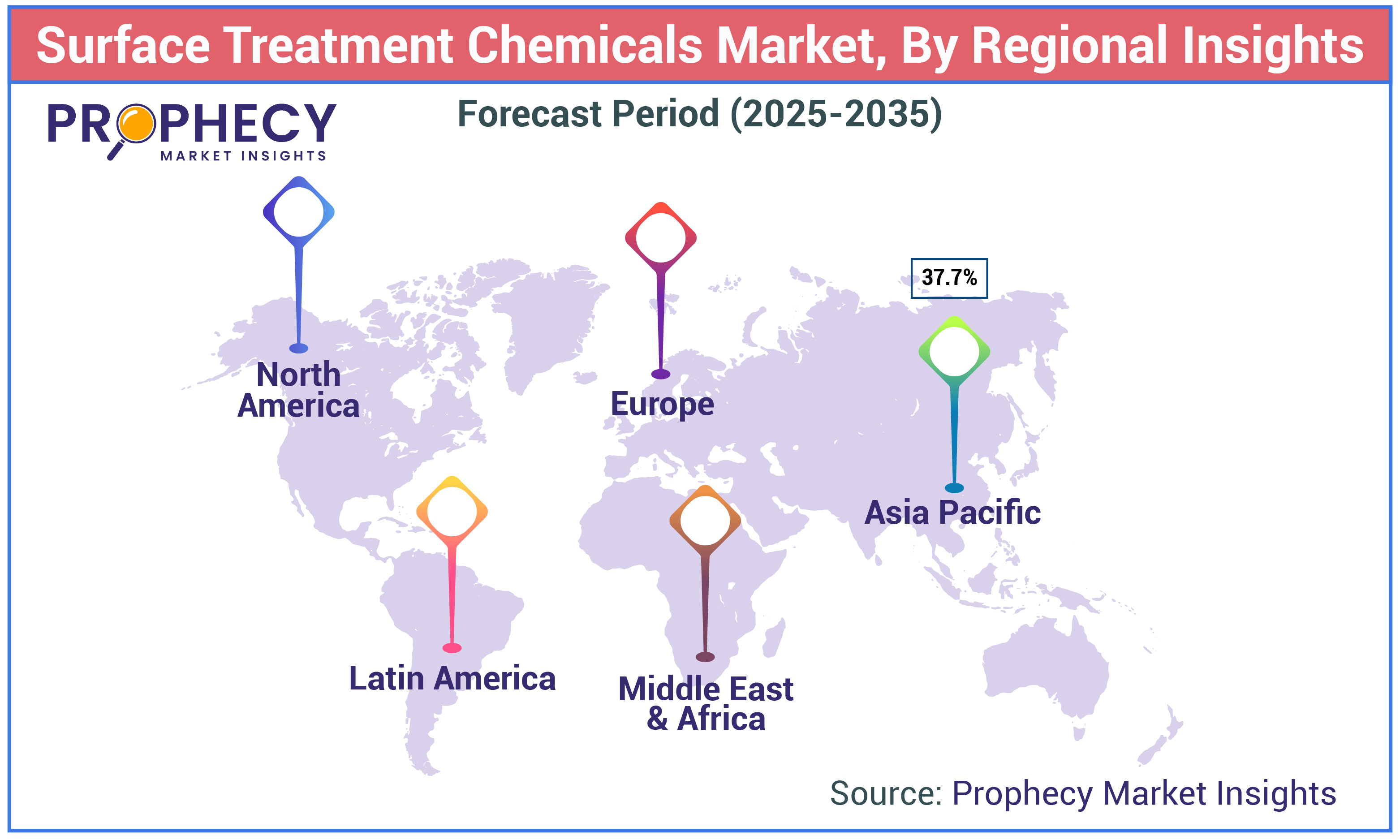
Asia Pacific: This is the region which is in charge of the surface treatment chemicals market, with an estimated share of 37.7%, in the recent years. This is due to a confluence of factors, such as, this region’s rapid growth in industrialization and technological advancements, strong automotive, electronics, and aerospace industries in the region, growing construction sector, especially in China, also contributes significantly to the demand for surface treatment chemicals, the global manufacturing hub of Asia Pacific, and the government initiatives to attract investments from international companies.
- China Surface Treatment Chemicals Market Insights:
The surface treatment chemicals market in China is the most influential market, in the recent years. This is due to this country’s focus on developing smart cities and modernizing infrastructure creates a constant need for advanced construction chemicals, strong manufacturing sector and well-developed supply chain infrastructure facilitate the production and distribution, strict regulations on VOC emissions exist, the overall demand for surface treatment chemicals, particularly in the construction and automotive industries, and the presence of key industries in need for surface treatment chemicals.
North America: This is the region which has the surface treatment chemicals market, growing with the highest CAGR, during the forecast period, in the recent years. This is due to a number of factors, such as, this region’s strong manufacturing sector, a mature construction industry, and a high demand for electronic devices. The region's advanced manufacturing facilities in automotive, aircraft, and electronics contribute significantly to the demand for surface treatment chemicals. Additionally, the recovery of the construction sector from the COVID-19 pandemic and the ongoing development of new infrastructure further fuel market growth.
- U.S. Surface Treatment Chemicals Market Insights:
The surface treatment chemicals market in the U.S. is the fastest growing market, in the recent years, during the forecast period. This is due to this country’s strong industrial base, supporting a variety of manufacturing processes that require surface treatment chemicals for finishing, corrosion protection, and other applications, diverse industries in the U.S., major player in the automotive industry, and the demand for surface treatment chemicals in this sector is significant due to its role in enhancing durability, aesthetics, and functionality of vehicles, and a major consumer of specialty chemicals.
Europe: The region which has the surface treatment chemicals market experiencing subsequent amount of growth, in the recent years, is Europe. This is due to a confluence of factors, such as, this region’s robust manufacturing sector, particularly in industries such as automotive, aerospace, and electronics, which heavily rely on these chemicals, environmental awareness are prompting companies to use surface treatment chemicals, rising industrialization and urbanization, technological advancements and presence of key market players.
- Germany Surface Treatment Chemicals Market Insights:
The surface treatment chemicals market in Germany is experiencing significant amount of growth, in the recent years. This is due to this country’s robust industrial base, strong automotive industry, and significant investment in construction projects. The country's leading position in the European construction chemicals market is further supported by its commitment to sustainable practices and adherence to stringent building regulations.
Surface Treatment Chemicals Market Report Scope:
|
Attribute |
Details |
|
Market Size 2025 |
USD 18.1 Billion |
|
Projected Market Size 2035 |
USD 36.4 Billion |
|
CAGR Growth Rate |
8.0% (2025-2035) |
|
Base year for estimation |
2024 |
|
Forecast period |
2025 – 2035 |
|
Market representation |
Revenue in USD Billion & CAGR from 2025 to 2035 |
|
Regional scope |
North America - U.S. and Canada Europe – Germany, U.K., France, Russia, Italy, Spain, Netherlands, and Rest of Europe Asia Pacific – China, India, Japan, Australia, Indonesia, Malaysia, South Korea, and Rest of Asia-Pacific Latin America - Brazil, Mexico, Argentina, and Rest of Latin America Middle East & Africa – GCC, Israel, South Africa, and Rest of Middle East & Africa |
|
Report coverage |
Revenue forecast, company share, competitive landscape, growth factors, and trends |
Segmentation:
By Chemical Type:
- Cleaning Agents
- Coatings
- Conversion Coatings
- Plating Chemicals
- Surface Modifiers
By Base Material:
- Metals
- Plastics
- Others
By Formulation Type:
- Liquid
- Powder
- Gel
By Application:
- Metal Processing
- Plastic Processing
- Glass Processing
- Textile Processing
- Others
By End-Use Industry:
- Automotive
- Aerospace
- Industrial Equipment
- Electronics
- Marine
- Others
By Region:
- North America
- U.S.
- Canada
- Europe
- Germany
- U.K.
- France
- Russia
- Italy
- Spain
- Netherlands
- Rest of Europe
- Asia Pacific
- China
- India
- Japan
- Australia
- Indonesia
- Malaysia
- South Korea
- Rest of Asia Pacific
- Latin America
- Brazil
- Mexico
- Argentina
- Rest of Latin America
- Middle East & Africa
- GCC
- Israel
- South Africa
- Rest of Middle East & Africa
Global Surface Treatment Chemicals Market Competitive Landscape & Key Players
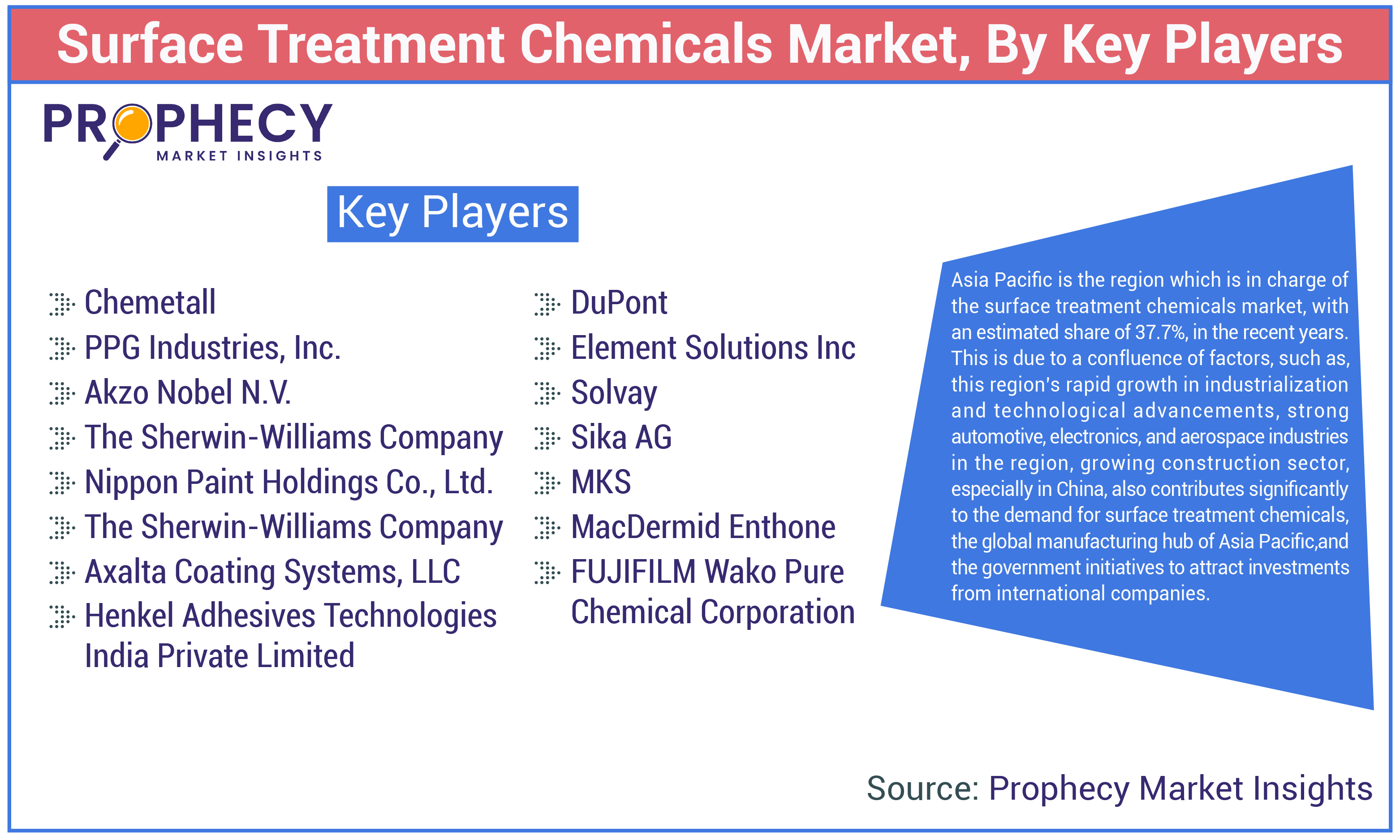
The prominent players operating in the market include, Chemetall, Henkel Adhesives Technologies India Private Limited, PPG Industries, Inc., and others. These key players are focusing on several key strategies, including expanding into new end-use industries, developing sustainable solutions, and leveraging technological advancements. These companies are also targeting specific segments, analyzing the competitive landscape, and adapting to emerging trends such as environmental regulations and the need for high-performance materials, for driving surface treatment chemicals market growth.
List of Key Players in the Market:
- Chemetall
- Henkel Adhesives Technologies India Private Limited
- PPG Industries, Inc.
- Akzo Nobel N.V.
- MKS
- Nippon Paint Holdings Co., Ltd.
- The Sherwin-Williams Company
- Axalta Coating Systems, LLC
- DuPont
- Element Solutions Inc
- Solvay
- Sika AG
- FUJIFILM Wako Pure Chemical Corporation
- The Sherwin-Williams Company
- MacDermid Enthone
View an Additional List of Companies in the surface treatment chemicals market
Global Surface Treatment Chemicals Market Recent News
Recent Developments:
- In September 2024, a worldwide provider of certified surface treatment technology, Vantage Speciality Chemicals, Inc. will exhibit and provide its full range of products at the 2024 SURFAIR Congress in Biarritz, France. Vantage, which has over 40 years of expertise in the aerospace and defence sector, produces REACH-compliant solutions that work with a variety of substrates and composites. Highlights of the portfolio include items that can help reduce volatile organic compounds (VOCs), coating removal innovations, and hexavalent chromium substitutes.
- In April 2024, Columbia Chemical, with its headquarters in Brunswick, Ohio, and Alufinish, with its headquarters in Andernach, Germany, were combining its talents to transform the sales and service capabilities in the U.S. market. By offering a distinctive combination of goods and services, this strategic partnership aimed to reach a wider customer base and establish new benchmarks for the sector. This partnership demonstrated the mutual dedication to providing innovation and quality. Combining the advantages would enable the treatment to provide unmatched service and promote more expansion of aluminium alloy surface treatment in the US market.
- In September 2023, for the coatings sector, Sun Chemical has introduced two new stir-in pigment preparations, eXpand Black ST 9005 and eXpand Yellow ST 1018. eXpand! Intense chroma, minimal dispersion, and great transparency were all blended in Yellow ST 1018 to create a new generation of automobile coating stylings. As there is less dispersion, the eXpand! Black ST 9005 stir-in solution produces exceptional jetness and a distinctive black hue.
- In November 2022, In Pinghu City, Zhejiang Province, China, the Surface Treatment worldwide business unit of BASF's Coatings division, which operates under the Chemetall name, celebrated the opening of its cutting-edge surface treatment manufacturing facility. The Pinghu site, which covers 60,000 square meters, is the largest surface treatment facility in the world and the first manufacturing facility owned by BASF. It is situated in the Dushan Port Economic Development Zone.
Analyst View:
The surface treatment chemicals market is expanding as a result of a number of factors, such as the need to protect materials from corrosion and other environmental degradation, the growing demand for sustainability, the fast industrialization and urbanization of the world, and the growing automotive industry, which significantly depends on surface treatment chemicals for pre-treatment and coating applications to improve paint adhesion, corrosion resistance, and durability.
The creation of advanced coatings, such as Nano coatings, and the use of high-performance polymers are also driving the market's expansion. Stricter regulations and the growing demand for eco-friendly treatments are pushing the adoption of eco-friendly alternatives such as water-based coatings and non-toxic plating solutions, and more infrastructure projects, especially in developing nations need surface treatment chemicals for a variety of purposes.
More Related Reports
Cleaning Chemicals in Healthcare Market
Phosphorus Acid Market
Personal Care Contract Manufacturing Market
Thermoplastic Vulcanizate (TPV) Market
Crop Protection Chemical (Pesticide) Market
Global Surface Treatment Chemicals Market Company Profile
|
Company Name |
Chemetall |
|
Headquarter |
Frankfurt am Main, Germany |
|
CEO |
Mr. Mauro Beccaro |
|
Employee Count (2024) |
2,500 Employees |
Global Surface Treatment Chemicals Market Highlights
FAQs
Surface treatment chemicals market size was valued at USD 18.1 Billion in 2025 and is expected to reach USD 36.4 Billion by 2035 growing at a CAGR of 8.0%.
Chemical type, base material, formulation type, application, end-use industry, and region are the segmentation for the Surface treatment chemicals market.
North America, Asia Pacific, Europe, Latin America, and the Middle East & Africa. Asia Pacific is expected to dominate the market.
The key players operating in the surface treatment chemicals market include Chemetall, Henkel Adhesives Technologies India Private Limited, PPG Industries, Inc., DuPont, Akzo Nobel N.V., MKS, Nippon Paint Holdings Co., Ltd., The Sherwin-Williams Company, Axalta Coating Systems, LLC, Element Solutions Inc, Solvay, Sika AG, FUJIFILM Wako Pure Chemical Corporation, The Sherwin-Williams Company, and MacDermid Enthone.