Global Speciality Fertilizer Market By Overview
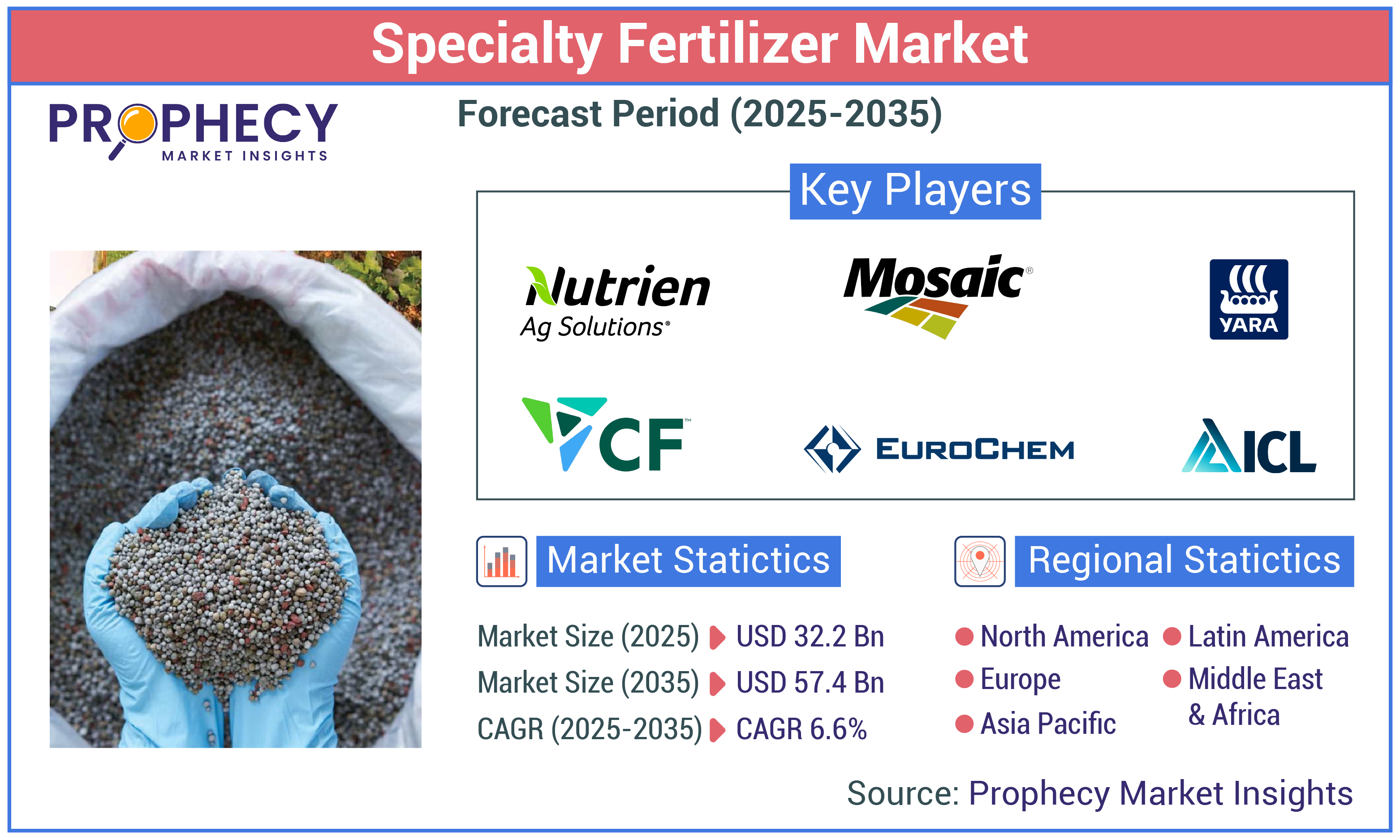
- Specialty fertilizer market size is expected to grow at a valuation of USD 57.4 Billion, by 2035.
- In 2024, the market valuation was USD 30.0 Billion.
- Specialty fertilizer market is developing at a CAGR of 6.6%.
Specialty fertilizers are specialized fertilizer products designed for specific plant needs, soil conditions, or agricultural practices. These differ from standard fertilizers in its formulation and application, offering tailored solutions for optimal plant growth and nutrient availability. These fertilizers include slow-release, fortified, water-soluble, and micronutrient formulations, among others. These offer advantages, such as, improved nutrient uptake, reduced environmental impact, and enhanced crop quality and yield. These are designed to address unique needs, optimizing growth and promoting sustainable agricultural practices.
Several key factors are driving the growth of the specialty fertilizer market, including, the rising global population, the rising demand for food production, the need for higher agricultural productivity, efforts to expand arable land and reclaim degraded soils, along with the adoption of modern farming techniques, growing environmental awareness and the need for sustainable agriculture.
The market’s augmentation is also stimulated by innovations in fertilizer formulations, application technologies, and controlled-release technologies, subsidies and support programs offered by governments to promote fertilizer use, growing adoption of precision agriculture, which involves targeted fertilizer applications based on specific crop needs and soil conditions, and the development of biodegradable coating materials and increasing research in controlled-release technology.
Recession Risk and Tariff Analysis:
- Declining farm earnings, lower crop prices, and ongoing supply chain disruptions pose economic threats to the specialty fertilizer market. Farmers' cautious purchases as a result of high input prices and affordability issues have affected demand. Despite these obstacles, forecasts suggest a possible rebound in 2025, propelled by calculated investments and innovations in technology.
- Specialty fertilizer tariffs are raising prices, producing market volatility, and upsetting global supply networks. Farmers' costs have increased due to U.S. import taxes on phosphate and nitrogen fertilizers, while potash exclusions provide little respite. Trade disputes, especially those involving China and Canada, increase uncertainty and have an effect on agricultural production and fertilizer supplies.
Impact of Generative AI on Specialty Fertilizer Market:
- Precision farming, better formulation design, and nutrient delivery system optimization are all made possible by generative AI, which is revolutionizing the specialty fertilizer business. AI systems evaluate crop requirements, soil health, and weather trends to provide customized fertilizer mixes that boost productivity and crop yields.
- Furthermore, generative AI speeds up research and development by modelling intricate chemical reactions, producing creative, environmentally beneficial fertilizer products. These developments lessen its negative effects on the environment, promote sustainable farming methods, and give businesses using AI-driven fertilizer and agricultural management solutions a competitive edge.
Global Speciality Fertilizer Market By Drivers & Restraints
Key Drivers:
Rising Global Population is Skyrocketing the Market Expansion
One of the main factors behind the specialty fertilizer market's expansion is the growing world population. Improving agricultural production is urgently needed as the need for food rises. Specialty fertilizers, such water-soluble and controlled-release varieties, provide focused nutrient delivery, increasing crop quality and yields. As these target certain soil and crop needs, these fertilizers are very useful in precision agriculture. With limited arable land and the necessity for sustainable farming practices, the adoption of specialty fertilizers is expected to continue rising to meet global food demands.
- For instance, according to the data published by worldometer, in 2025, the world's population is expected to rise at a pace of about 0.85% annually, down from 0.97% in 2020 and 1.25% in 2015. An estimated 70 million individuals are added to the population each year. The annual growth rate peaked at about 2% in the middle of the 1960s. Since then, the pace of rise has almost halved, and it will continue to decrease in the years to come. Therefore, the world's population will continue to increase in the twenty-first century, but considerably more slowly than in the recent past. In the forty years between 1959 (3 billion) and 1999 (6 billion), the world's population has doubled (100%).
Restraints:
The Risk of Nutrient Leaching is Hindering the Market Expansion
A significant drawback of the specialty fertilizer industry is the possibility of environmental pollution and nutrient loss from improper application. Aquatic habitats can be harmed by eutrophication brought on by the misuse or over application of fertilizers that are water soluble or high in micronutrients. Improper handling or storage can also reduce the efficacy and quality of fertilizer. In order to avoid long-term harm to soil and water resources, these environmental issues call into question the sustainability of using specialty fertilizers and need rigorous adherence to best agricultural practices.
- Counterbalance Statements: Farmers should use site-specific nutrient management programs and precision agricultural techniques to mitigate environmental threats. Leaching can be decreased by employing slow-release formulations and putting in place training programs on correct application techniques. Government rules and oversight programs can also guarantee the use of fertilizer in an ecologically friendly manner and promote industry best practices.
Opportunities & Trends:
Development of Chelated Fertilizers is Unlocking Growth Opportunities for the Impending Years
The creation of chelated fertilizers, which improve nutrient availability and absorption efficiency, particularly for micronutrients such as iron, zinc, and manganese, greatly propels the expansion of the specialty fertilizer market. By preventing nutrient precipitation in alkaline soils, chelation improves plant uptake. Modern intensive farming depends on increased crop yields and quality, which this invention promotes. Chelated fertilizers also decrease nutrient losses, which supports sustainable farming practices. The need for chelated fertilizers is anticipated to increase as soil-specific nutrition and precision farming gain popularity, propelling further market growth.
- For instance, according to the facts stated by ResearchGate, since micronutrients such as Fe, Cu, Zn, and Mn are stationary in plants, many farmers frequently overlook it. These nutrients are generally advised to be used in chelated forms for foliar application and as sulphate forms for soil treatment. These micronutrients are held in place by chelates, which are essentially claw-such as structures that slow down solubility and improve utilization. Ethylene Diamine Tetra Acetic Acid (EDTA), Diethylene Triamine Penta Acetic Acid (DTPA), Nitrilo Triacetic Acid (NTA), and EDDHA are examples of synthetic chelates. Organic chelates include citric acid, sulphuric acid, fulvic acid, formic acid, and succinic acid.
Global Speciality Fertilizer Market By Segmentations & Regional Insights
The specialty fertilizer market is segmented into type, crop type, technology, application, and region.
By Type:
On the groundwork of type, the market is sub-segmented into Ammonium Nitrate, UAN, phosphoric acid, monoammonium phosphate, monopotassium phosphate, potassium sulfate, and others. The ammonium nitrate segment is holding the superior position, in the specialty fertilizer market share. This is due to its balanced nutrient content, high application efficiency, versatility, and suitability for various climatic zones, making it a popular choice among farmers.
The Monoammonium Phosphate segment is the second superior type, in the target market. This is due to its high phosphorus content and ability to deliver both phosphorus and nitrogen to plants in a balanced ratio, making it valuable for various crop types and soils.
By Crop Type:
Appertaining from crop type, the market is pigeonholed into row crops, fruits & vegetables, turf & ornamentals, and others. The fruits & vegetables segment is dominating the target market. This is due to the higher sales price of these products, which is related to its perishable nature and higher export quantity. Additionally, the increasing demand for fruits and vegetables driven by consumer preference for healthy diets further fuels the demand for specialty fertilizers.
Row crops are the second dominating crop type, in the specialty fertilizer market. This is due to its high demand for nutrients, the widespread use of specialty fertilizers to improve yields, and the large acreage devoted to row crops.
By Technology:
Depending upon technology, the market is catalogued into controlled-release fertilizers, micronutrients, water soluble fertilizers, and liquid fertilizers. The water soluble fertilizers segment is attributed to lead the specialty fertilizer market share. This is due to its superior absorption rates and compatibility with modern irrigation systems, making it a popular choice for efficient nutrient delivery.
The liquid fertilizers segment is the second leading technology, in the target market. This is due to its technical advancement in nutrient delivery and efficiency in providing nutrients to crops. Liquid fertilizers are particularly strong in field crops such as rice, wheat, and cotton, driven by intensive cultivation practices.
By Application:
Stemming from application, the market is categorized into fertigation, foliar, soil, and others. The fertigation segment is in charge of the specialty fertilizer market share. This is due to its superior efficiency in delivering nutrients directly to the root zone through irrigation systems. In addition to this, fertigation can also reduce water usage by applying nutrients directly to the root zone, minimizing water runoff and leaching.
The soil segment is the application, which is experiencing steady growth, in the target market. This is due to its versatility, ability to deliver nutrients directly to roots, and long-lasting effects, making it suitable for various crops and farming practices.
Regional Insights:
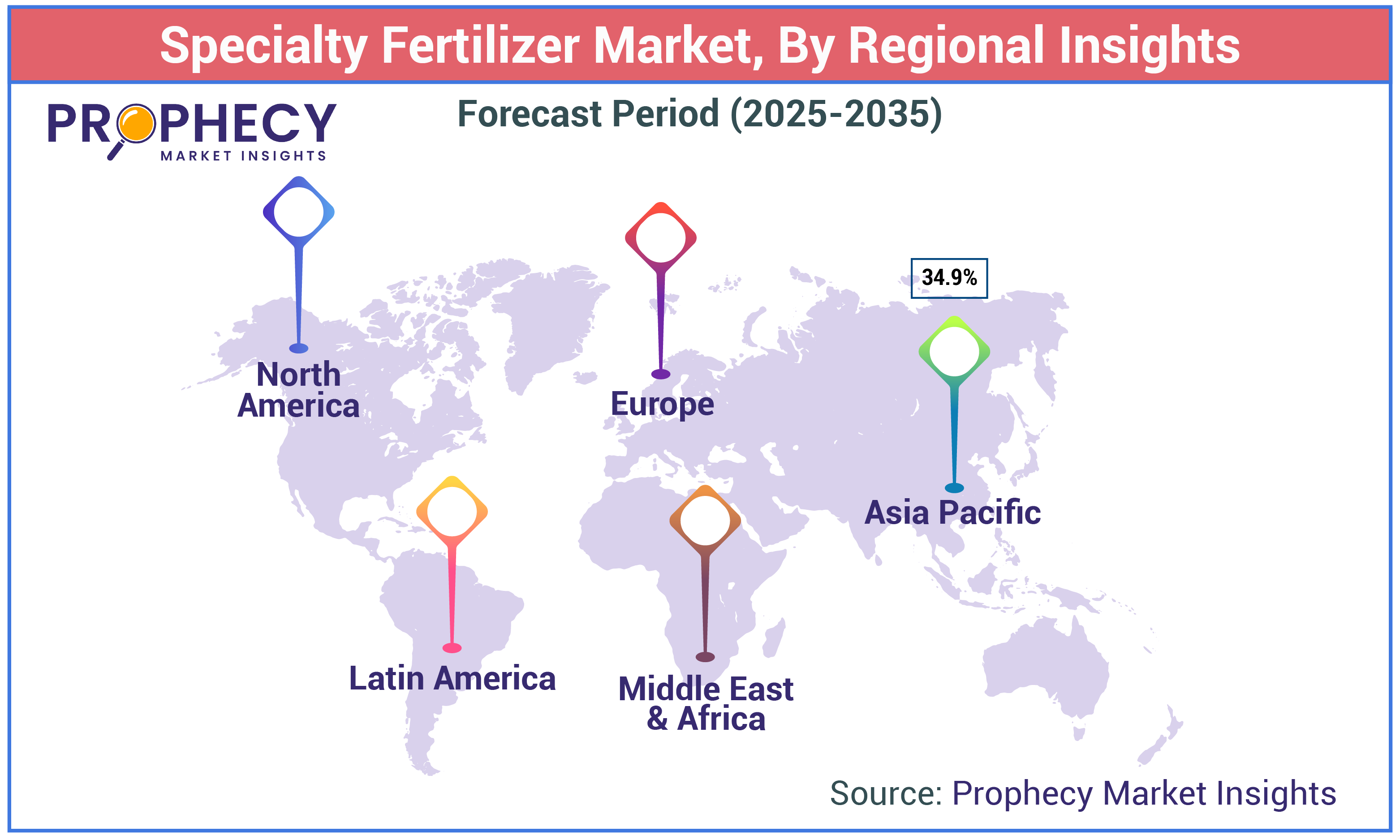
Geographically, the market is studied across North America, Europe, Asia Pacific, Latin America, and the Middle East & Africa.
Asia Pacific: This is the region which has the most ruling specialty fertilizer market, with an estimated share of approximately, 34.9%, in the recent years. This is due to a combination of factors, such as, this region’s large area of arable land, supporting high crop production, which drives demand for fertilizers, presence of major agricultural economies, favorable government policies and initiatives, including subsidies for fertilizer consumption, increasing adoption of precision farming and innovative fertilizer application methods enhances productivity, and the high production of cereals and other crops.
- China Specialty Fertilizer Market Insights:
The specialty fertilizer market in China is the most influential market, in the recent years. This is due to this country’s significant amount of agricultural land and a diverse range of crops, focus on high-value crops, such as fruits and vegetables, drives demand for specialty fertilizers, active promotion of sustainable farming practices by Chinese government, increasing adoption of precision agriculture techniques, advanced irrigation systems (such as drip irrigation), and other modern practices, growing awareness among farmers about the benefits of specialty fertilizers, focus on environmental protection and the need for improved fertilizer efficiency, and greenhouse cultivation.
North America: This is the region which has the specialty fertilizer market, growing with the highest CAGR, during the forecast period, in the recent years. This is due to a confluence of factors, such as, this region’s highly developed agricultural sector, with extensive use of advanced technologies such as precision farming, GPS-guided equipment, and data analytics, growing emphasis on sustainable agriculture, stringent environmental regulations, specific needs of different crops and soil types, and a robust distribution network.
- U.S. Specialty Fertilizer Market Insights:
The specialty fertilizer market in the U.S., is the fastest growing market, in the recent years, during the forecast period. This is due to this country’s substantial agricultural landscape, particularly in terms of irrigated cropland, increasing adoption of precision farming practices, such as variable rate technology (VRT), necessitates the use of specialty fertilizers, high-value crops, such as fruits, vegetables, and nuts, which often require specialized fertilizer formulations to optimize yield and quality, growing awareness among farmers about the importance of soil health and nutrient management, and a robust distribution network.
Europe: This is the region which has the specialty fertilizer market, growing with a considerate amount of growth rate. This is due to a confluence of factors, such as, this region’s dominating conventional fertilizers, sustainable agriculture, including the "Farm to Fork" strategy aiming to reduce nutrient losses, focus on efficiency and innovation in advanced processing facilities and developing innovative formulations to maximize nutrient availability, precise nutrient delivery, and presence of an established distribution network and manufacturing infrastructure.
- France Specialty Fertilizer Market Insights:
The specialty fertilizer market in France is the market which is experiencing significant amount of growth, in the recent years. This is due to this country’s diverse and significant agricultural sector, particularly in field crops and fruits, increasing focus on sustainable and efficient fertilization methods, including controlled release fertilizers, adoption of precision agriculture techniques, which enable more targeted and efficient application of specialty fertilizers, increasing support from French government, and a well-established distribution network and strong presence of major agricultural input suppliers.
|
Attribute |
Details |
|
Market Size 2025 |
USD 32.2 Billion |
|
Projected Market Size 2035 |
USD 57.4 Billion |
|
CAGR Growth Rate |
6.6% (2025-2035) |
|
Base year for estimation |
2024 |
|
Forecast period |
2025 – 2035 |
|
Market representation |
Revenue in USD Billion & CAGR from 2025 to 2035 |
|
Regional scope |
North America - U.S. and Canada Europe – Germany, U.K., France, Russia, Italy, Spain, Netherlands, and Rest of Europe Asia Pacific – China, India, Japan, Australia, Indonesia, Malaysia, South Korea, and Rest of Asia-Pacific Latin America - Brazil, Mexico, Argentina, and Rest of Latin America Middle East & Africa – GCC, Israel, South Africa, and Rest of Middle East & Africa |
|
Report coverage |
Revenue forecast, company share, competitive landscape, growth factors, and trends |
Segmentation:
By Type:
- Ammonium Nitrate
- UAN
- Phosphoric Acid
- Monoammonium Phosphate
- Monopotassium Phosphate
- Potassium Sulfate
- Others
By Crop Type:
- Row Crops
- Fruits & Vegetables
- Turf & Ornamentals
- Others
By Technology:
- Controlled-Release Fertilizers
- Micronutrients
- Water Soluble Fertilizers
- Liquid Fertilizers
By Application:
- Fertigation
- Foliar
- Soil
- Others
By Region:
- North America
- U.S.
- Canada
- Europe
- Germany
- U.K.
- France
- Russia
- Italy
- Spain
- Netherlands
- Rest of Europe
- Asia Pacific
- China
- India
- Japan
- Australia
- Indonesia
- Malaysia
- South Korea
- Rest of Asia Pacific
- Latin America
- Brazil
- Mexico
- Argentina
- Rest of Latin America
- Middle East & Africa
- GCC
- Israel
- South Africa
- Rest of Middle East & Africa
Global Speciality Fertilizer Market By Competitive Landscape & Key Players
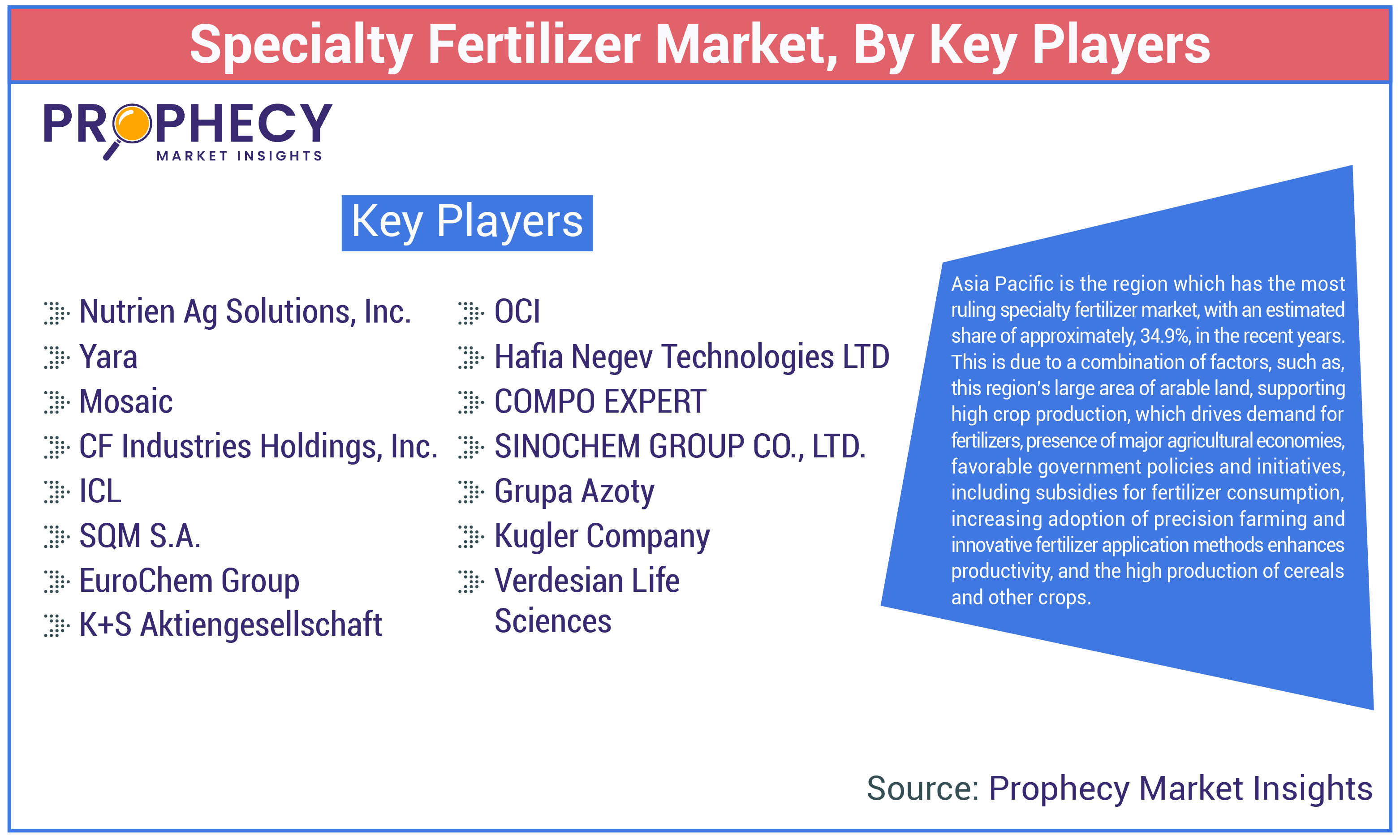
The key players operating in the market include, Nutrien Ag Solutions, Inc., Yara, Mosaic, and others. These key players are focusing on product innovation and research and development, strategic partnerships and collaborations, geographic expansion, sustainable practices and certifications, mergers and acquisitions, digital agriculture integration, and farmer education and advisory services, for driving specialty fertilizer market growth.
List of Key Players in the Market:
- Nutrien Ag Solutions, Inc.
- Yara
- Mosaic
- CF Industries Holdings, Inc.
- ICL
- SQM S.A.
- EuroChem Group
- K+S Aktiengesellschaft
- OCI
- Hafia Negev Technologies LTD
- COMPO EXPERT
- SINOCHEM GROUP CO., LTD.
- Grupa Azoty
- Kugler Company
- Verdesian Life Sciences
View an Additional List of Companies in the specialty fertilizer market
Global Speciality Fertilizer Market By Recent News
Recent Developments:
- In October 2024, the world's first weekly pricing for the various sustainable and specialty fertilizer markets which include water-soluble fertilizers, secondary and micronutrients, low-carbon fertilizers, organics, and organo-minerals were introduced by the international energy and commodities price reporting organization Argus. With the use of the new service's specific Nutrient Calculator, customers may determine the cost of customized specialty fertilizer products such as organic fertilizers by taking into account the nutrients and other characteristics of each product.
- In July 2024, Custom Ag Formulators (CAF), a North American supplier of farmers' customized agriculture formulations and products, was purchased by ICL for about USD 60 million. Along with a number of other specialty products, CAF provides a variety of liquid adjuvants and improved nutrition. The most recent Growing Solutions acquisition, which was made on the second of 2024, furthers ICL's declared objective of pursuing acquisitions to broaden its Growing Solutions product line and set up the company for future expansion into adjacent and new end markets.
- In June 2023, leading international specialty minerals manufacturer ICL announced the introduction of a new range of cutting-edge foliar and fertigation products in North America under its Nova brand of water-soluble fertilizers. Nova FINISH, Nova PULSE, Nova ELEVATE, and Nova FLOW are examples of flagship goods. This launch provided producers with cutting-edge foliar and fertigation solutions that address its particular concerns and strengthened focus on growing ICL's premium array of crop nutrition solutions.
- In May 2023, In order to boost yields and enhance quality, Yara International declared that it will construct a new production facility for specialty crop nutrition products and bio stimulants. For these goods, which are essential for attaining food security and halting climate change, the factory would rank among the biggest in the world.
- With the new facility, Yara would be able to expand its presence in one of the agricultural industries with the quickest rate of growth: specialty crop nutrition.
- In September 2022, with the introduction of eqo.x, a revolutionary quickly biodegradable release technology intended for open field agriculture, ICL, a prominent worldwide specialty minerals firm, ushered in a new era for controlled release urea. By decreasing nutrient loss and raising nutrient utilization efficiency (NUE) to 80%, a coating was developed that would enable farmers optimize agricultural crop performance while minimizing environmental effect. Additionally, the release method can assist lower the quantity and frequency of nitrogen treatments, offer uniform and predictable nutrient release, and enable higher or comparable yields with lower fertilizer rates.
Analyst View:
The market for specialty fertilizers is expanding due to a number of important factors, such as the growing world population, the need for food production, the need for increased agricultural productivity, initiatives to increase arable land and restore degraded soils, the use of modern farming methods, environmental consciousness, and the need for sustainable agriculture. Innovations in fertilizer formulations, application technologies, and controlled-release technologies, government subsidies and support programs to encourage fertilizer use, the growing use of precision agriculture which applies fertilizer in targeted ways depending on the needs of particular crops and soil conditions the development of biodegradable coating materials, and increased research in controlled-release technology are also driving the market's expansion.
More Related Reports
Biofertilizers Market
Fertilizer Additives Market
Potash Fertilizers Market
Organic fertilizers Market
Complex Fertilizers Market
Global Speciality Fertilizer Market By Company Profile
|
Company Name |
Nutrien Ag Solutions, Inc. |
|
Headquarter |
Saskatoon, Canada |
|
CEO |
Mr. Ken Seitz |
|
Employee Count (2024) |
2,946 Employees |
Global Speciality Fertilizer Market By Highlights
FAQs
Specialty fertilizer market size was valued at USD 32.2 Billion in 2025 and is expected to reach USD 57.4 Billion by 2035 growing at a CAGR of 6.6%.
Type, crop type, technology, application, and region are the segmentation for the target market.
North America, Asia Pacific, Europe, Latin America, and the Middle East & Africa. Asia Pacific is expected to dominate the market.
The key players operating in the specialty fertilizer market include Nutrien Ag Solutions, Inc., Yara, Mosaic, OCI, CF Industries Holdings, Inc., ICL, SQM S.A., EuroChem Group, K+S Aktiengesellschaft, Hafia Negev Technologies LTD, COMPO EXPERT, SINOCHEM GROUP CO., LTD., Grupa Azoty, Kugler Company, and Verdesian Life Sciences