Global Solar PV Power Market Overview
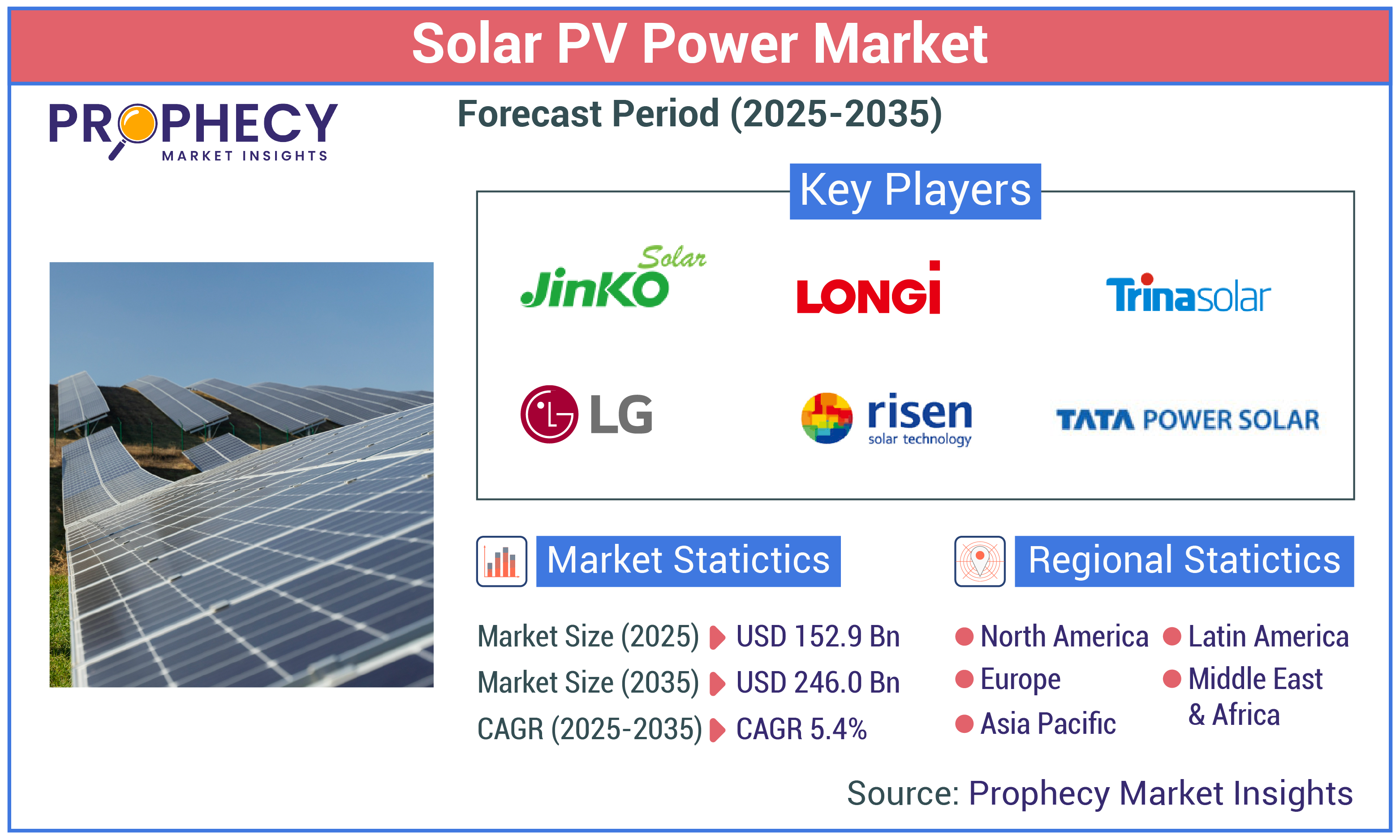
- Solar PV power market size is estimated to develop at a valuation of USD 246.0 Billion, by 2035.
- In 2024, the market valuation was USD 144.4 Billion.
- Solar PV power market is growing at a CAGR 5.4%.
In the context of solar energy, PV power refers to photovoltaic power, which is the electricity generated by solar photovoltaic (PV) systems. These systems use semiconductor materials, such as silicon, to directly convert sunlight into electricity through the photovoltaic effect. Solar PV power offers numerous advantages, including being a renewable and clean energy source, reducing reliance on fossil fuels, and decreasing electricity bills. Solar PV also provides energy independence, low maintenance costs, and can even increase property value.
The rising industrialization and urbanization, supportive government initiatives, such as, tax rebates, subsidies, and renewable portfolio standards (RPS), ambitious renewable energy goals, incentives offered by governments, such as tax credits and rebates for installing solar panels, the declining costs of solar panels, increasing awareness of climate change and the need to reduce greenhouse gas emissions, global energy demand , and industrial and residential adoption of solar PV power are factors driving the growth of solar PV power market growth.
The market’s expansion is also stimulated by ongoing research and development have led to improvements in solar panel efficiency, advances in manufacturing processes have resulted in lower production costs for solar panels, and developments in battery storage and grid integration technologies enhance the reliability and flexibility of solar PV systems, addressing concerns about intermittency and grid stability.
Impact of Generative AI on Solar PV Power Market:
- Through improved grid integration, energy production prediction, and panel layout optimization, generative AI is revolutionizing the solar PV power business. AI increases productivity and lowers operating expenses by examining weather trends and consumer data.
- Additionally, it makes predictive maintenance possible, which reduces downtime and increases the lifespan of equipment. The solar PV industry is predicted to develop significantly as AI-driven solutions proliferate, increasing the dependability and affordability of renewable energy.
Global Solar PV Power Market Drivers & Restraints
Key Drivers:
Rising Urbanization is Fostering the Market Expansion
The solar PV power market growth is being driven by rising urbanization, which is raising energy consumption in crowded places. Urban environments allow for decentralized energy generation by providing a large number of rooftop and façade areas for solar systems. Through this integration, carbon emissions are decreased, energy resilience is increased, and sustainable urban development is promoted. Government subsidies and developments in solar technology further promote adoption, making solar photovoltaics (PV) an essential part of supplying expanding cities' energy demands.
- For instance, according to the data published by World Bank Group, in order to fulfill the World Bank's purpose of eradicating poverty and promoting shared prosperity on a habitable world, more livable cities must be built. Currently, 4.4 billion people, or more than half of the world's population, reside in urban areas. This trend is predicted to continue, with nearly seven out of ten people living in cities by 2050, when the urban population is predicted to more than quadruple.
The Dependence on Weather of Solar PV Power is Obstructing the Market Expansion
The solar PV power market's reliance on weather and daylight availability is one of its main drawbacks. An intermittent energy supply results from solar panels producing little or no electricity on overcast or dark days. Particularly in areas with little sunshine, this unpredictability presents problems for grid stability and reliable electricity distribution. Integrating solar energy into traditional grids without adequate storage or backup systems can strain energy infrastructure, limiting solar PV’s effectiveness in meeting continuous electricity demands.
- Counterbalance Statements: Using cutting-edge energy storage technologies, such as lithium-ion or flow batteries, can help mitigate intermittency by storing extra energy for use during periods of low sunshine. Furthermore, creating hybrid systems and smart grids that integrate solar with other renewable energy sources can increase the dependability of solar PV systems and guarantee a steady power supply.
Opportunities & Trends:
Introducing Next-Generation Photovoltaics is Opening Up Growth Opportunities for the Upcoming Years
The introduction of next-generation photovoltaics, such organic PVs and perovskite solar cells, is expected to completely transform the solar PV power market. These cutting-edge technologies allow for integration into a variety of surfaces, including windows and textiles, due to its increased efficiency, flexibility, and lightweight designs. It also promises less of an impact on the environment and simpler manufacturing. Next-generation PVs will increase solar adoption in the commercial, industrial, and residential sectors as innovation propels better performance and scalability, hastening the shift to cleaner energy and fostering long-term market expansion.
-
For instance, according to the data published by ResearchGate, the goal of research into new materials or next-generation photovoltaics, including quantum dots, organic-inorganic hybrids, and nanomaterials, is to develop solar cells with higher efficiencies and lower costs. For instance, quantum dot solar cells have the potential to reach efficiencies above 30% by employing multiple exciton generation (MEG), which enables a single photon to generate multiple electron-hole pairs.
Global Solar PV Power Market Segmentations & Regional Insights
The solar PV power market is segmented into grid type, technology, deployment, end-user, and region.
By Grid Type:
Contingent to Grid Type, the market is bifurcated into on-grid, and off-grid. The on-grid segment is attributed to rule over the solar PV power market share. This is due to the widespread availability and lower costs associated with on-grid systems, coupled with supportive policies such as net metering. While off-grid systems are growing, particularly in areas without grid access, its higher initial costs and reliance on battery storage currently limit its overall market dominance.
The off-grid solar PV is the second dominating grid type in the target market. This is due to its lower operating and maintenance costs, and the ease of installation and integration with existing grid infrastructure. Off-Grid systems, while offering energy independence, often have higher initial costs and more complex installations compared to on-grid systems.
By Technology:
On the foundation of technology, the market is divided into monocrystalline silicon, thin film, multicrystalline silicon, and others. The monocrystalline silicon segment is the technology leading the target market. This is due to its high efficiency and durability, making it a preferred choice for both rooftop and large-scale solar installations.
The multicrystalline segment is the second leading technology in the solar PV power market. This is due to its cost-effectiveness and wider availability compared to Monocrystalline Silicon.
By Deployment:
Appertaining from deployment, the market is sub-segmented into ground mounted, rooftop, and others. The ground mounted segment is the deployment which is dominating the solar PV power market share. This is due to its cost-effectiveness and ability to generate large quantities of power. These systems are often installed on large, open areas, allowing for the deployment of extensive solar arrays.
The rooftop segment is the fastest growing deployment in the target market. This is due to the increased adoption of solar panels on residential and commercial buildings, offering advantages such as easy installation, lower maintenance costs, and potential government incentives.
By End-User:
Stemming from end-user, the market is categorized into residential, commercial, utility, and others. The utility segment is expected to govern the solar PV power market share. This is due to the scale and efficiency of large-scale utility projects, which are easier and faster to construct than traditional power plants. The increasing number of utility-scale solar projects globally, driven by government incentives and declining technology costs, further contributes to this dominance.
The utility segment is the end-user, experiencing subsequent amount of growth, in the target market. This is due to the significant scale and efficiency advantages of utility-scale solar projects.
Regional Insights:
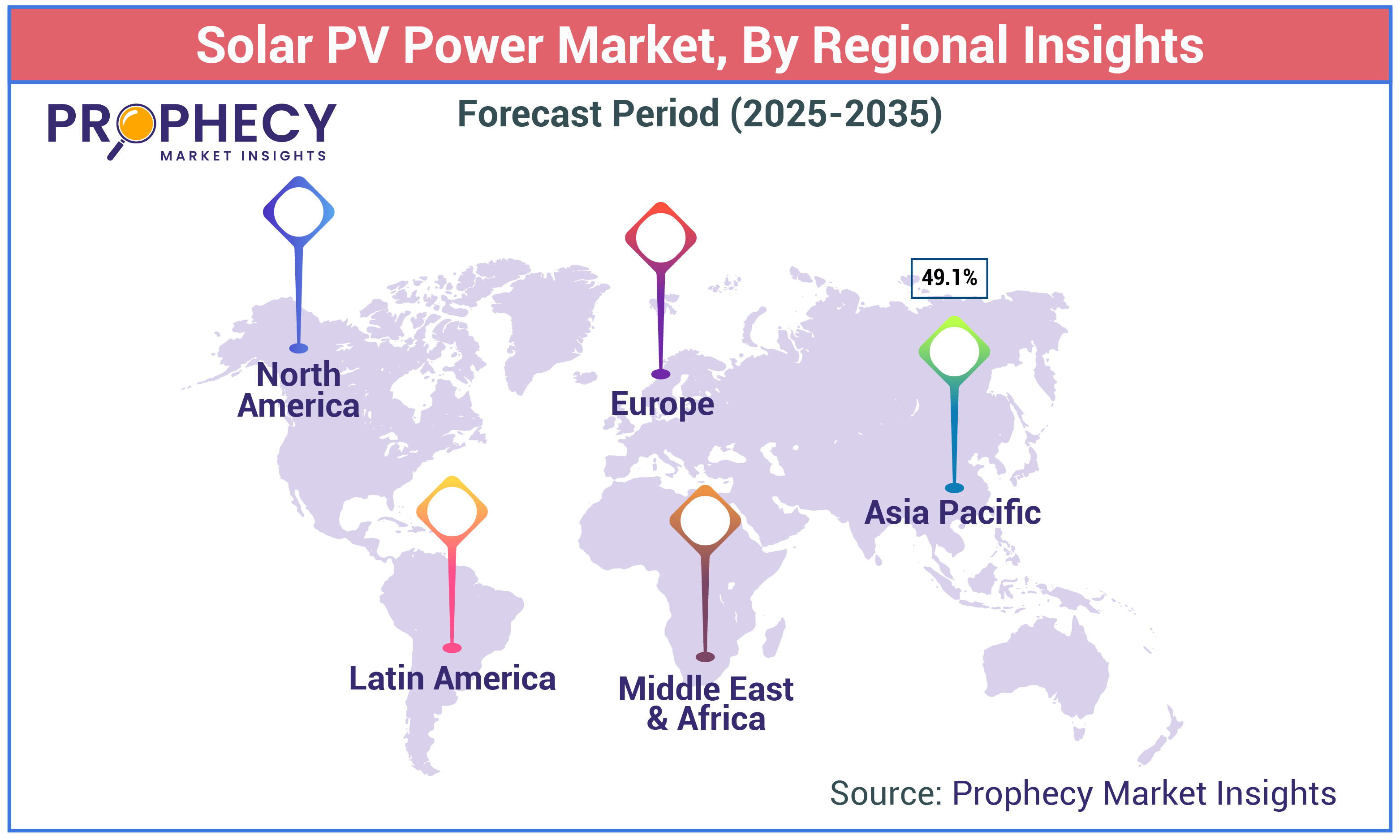
Geographically, the market is studied across North America, Europe, Asia Pacific, Latin America, and the Middle East & Africa.
Asia Pacific: This is the region which holds the superior position in the solar PV power market, with an estimated share of approximately, 39.1%, in the recent years. This is due to a variety of factors, such as, this region’s ambitious renewable energy targets and provide production-linked incentives to promote solar PV adoption, this region’s manufacturing hub for solar panel manufacturers, significant foreign investments and government-backed programs, combination of strong manufacturing capacity and government support has led to a significant decrease in solar PV costs, rapid urbanization and economic growth of this region.
- China Solar PV Power Market Insights:
The solar PV power market in China is the most influential market, in the recent years. This is due to a combination of factors, such as, this country’s vast landmass offers numerous opportunities for large-scale solar power projects, China is the world's largest producer of solar panels, and is committed to increasing its share of renewable energy in its energy mix, with ambitious targets for solar and wind power generation. Moreover, the Chinese government has implemented various initiatives to promote renewable energy, and China has implemented a significant number of solar energy projects, including large-scale utility-scale solar farms and distributed solar power systems for residential and commercial use.
Europe: This is the region which has the solar PV power market, growing with the fastest growth rate, during the forecast period, in the recent years. This is due to this region’s actively transitioning to renewable energy sources, including solar, to reduce reliance on fossil fuels and meet climate targets, the rapid expansion of large-scale solar projects, and technological advancements in solar PV panels are also contributing to the growth of the market in Europe. Additionally, governments and power companies in Europe are providing subsidies and incentives to promote solar energy production and consumption.
- Germany Solar PV Power Market Insights:
The solar PV power market in Germany is the fastest growing market, during the forecast period, in the recent years. This is due to numerous factors, such as, this country’s strong government commitment to renewable energy and various incentive schemes to promote solar installations. Germany has the largest installed capacity, and the country's solar PV capacity has seen substantial growth in recent years. Additionally, the country has implemented incentive schemes to encourage the installation of solar PV systems, both for residential and commercial/industrial applications.
North America: The region which has the solar PV power market experiencing significant growth, in the recent years, is North America. This is due to a variety of factors, such as, this region’s increasing demand for sustainable energy, supportive policies and regulations, and significant private investment in the sector. In addition to this, North America’s significant private investment is flowing into the solar sector, falling costs of solar PV technologies, development of energy storage solutions, such as batteries, and the improvements in grid integration technologies allow solar PV to be seamlessly connected to the power grid.
- U.S. Solar PV Power Market Insights:
The solar PV power market in the U.S. is growing with the highest CAGR, in the recent years. This is due to this country’s large overall electricity demand, creating a significant market for solar PV generation, a substantial increase in its installed solar PV capacity, and private investments and government programs such as tax credits and feed-in tariffs. Furthermore, the U.S. has set ambitious renewable energy goals, including a target of a 100% clean energy economy, which further drives the expansion of solar PV.
Competitive Landscape:
The prominent players operating in the market include, Jinko Solar Co., Ltd., LONGi, Trinasolar, and others. These key players are focusing on key strategies, such as, government incentives, increasing demand for renewable energy, and sustainability concerns among businesses. Companies also focus on improving panel efficiency, reducing production costs, and developing integrated energy solutions. Digital marketing and building strong relationships with government entities are also crucial for success, for driving solar PV power market growth.
Solar PV Power Market Report Scope:
|
Attribute |
Details |
|
Market Size 2025 |
USD 152.9 Billion |
|
Projected Market Size 2035 |
USD 246.0 Billion |
|
CAGR Growth Rate |
5.4% (2025-2035) |
|
Base year for estimation |
2024 |
|
Forecast period |
2025 – 2035 |
|
Market representation |
Revenue in USD Billion & CAGR from 2025 to 2035 |
|
Regional scope |
North America - U.S. and Canada Europe – Germany, U.K., France, Russia, Italy, Spain, Netherlands, and Rest of Europe Asia Pacific – China, India, Japan, Australia, Indonesia, Malaysia, South Korea, and Rest of Asia-Pacific Latin America - Brazil, Mexico, Argentina, and Rest of Latin America Middle East & Africa – GCC, Israel, South Africa, and Rest of Middle East & Africa |
|
Report coverage |
Revenue forecast, company share, competitive landscape, growth factors, and trends |
Segmentation:
By Grid Type:
- On-Grid
- Off-Grid
By Technology:
- Monocrystalline Silicon
- Thin Film
- Multicrystalline Silicon
- Others
By Deployment:
- Ground Mounted
- Rooftop
- Others
By End-User:
- Residential
- Commercial
- Utility
- Others
By Region:
- North America
- U.S.
- Canada
- Europe
- Germany
- U.K.
- France
- Russia
- Italy
- Spain
- Netherlands
- Rest of Europe
- Asia Pacific
- China
- India
- Japan
- Australia
- Indonesia
- Malaysia
- South Korea
- Rest of Asia Pacific
- Latin America
- Brazil
- Mexico
- Argentina
- Rest of Latin America
- Middle East & Africa
- GCC
- Israel
- South Africa
- Rest of Middle East & Africa
Global Solar PV Power Market Competitive Landscape & Key Players
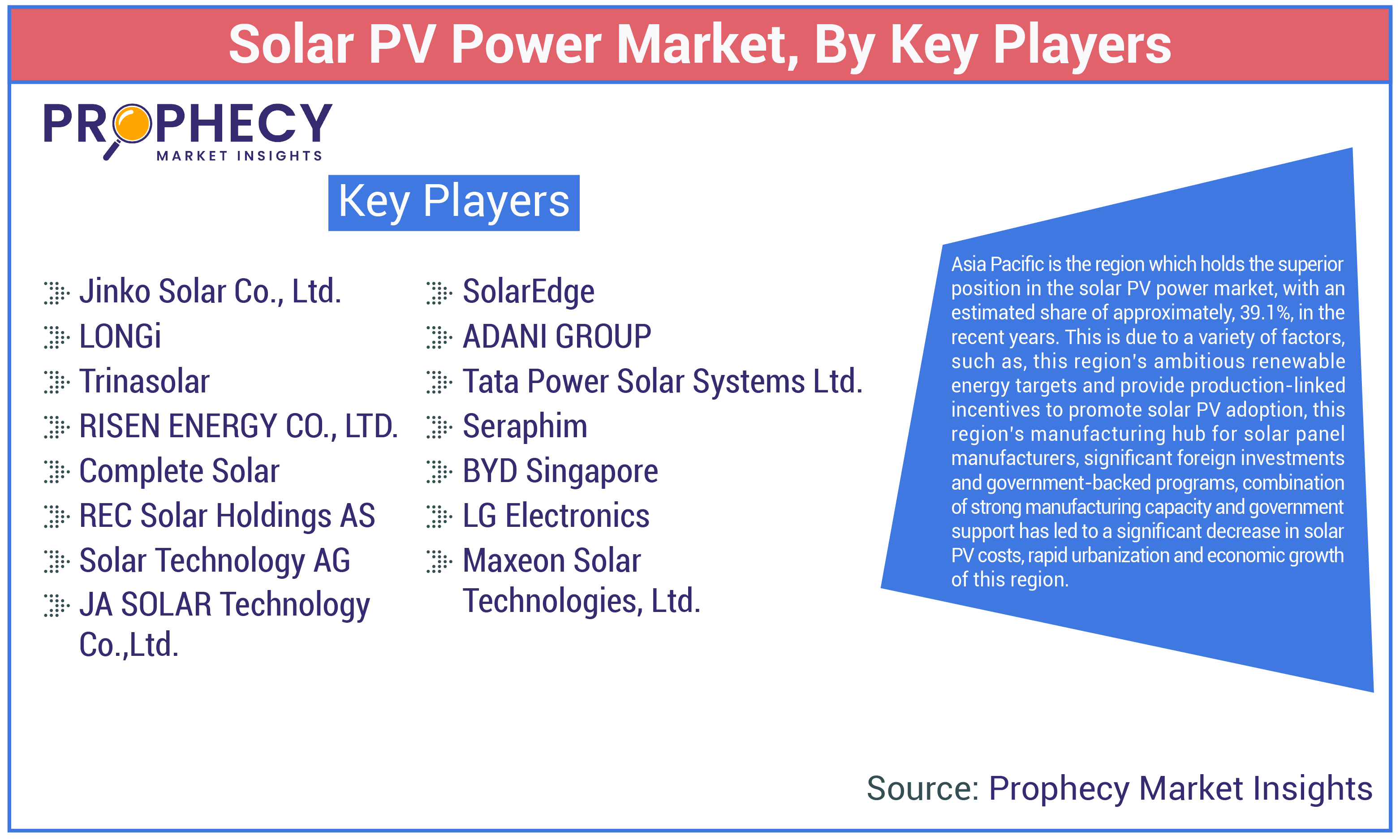
The prominent players operating in the market include, Jinko Solar Co., Ltd., LONGi, Trinasolar, and others. These key players are focusing on key strategies, such as, government incentives, increasing demand for renewable energy, and sustainability concerns among businesses. Companies also focus on improving panel efficiency, reducing production costs, and developing integrated energy solutions. Digital marketing and building strong relationships with government entities are also crucial for success, for driving solar PV power market growth.
List of Key Players in the Market:
- Jinko Solar Co., Ltd.
- LONGi
- Trinasolar
- JA SOLAR Technology Co.,Ltd.
- RISEN ENERGY CO., LTD.
- Complete Solar
- REC Solar Holdings AS
- Solar Technology AG
- SolarEdge
- ADANI GROUP
- Tata Power Solar Systems Ltd.
- Seraphim
- BYD Singapore
- LG Electronics
- Maxeon Solar Technologies, Ltd.
View an Additional List of Companies in the Solar PV Power Market
Global Solar PV Power Market Recent News
- In November 2024, With Donald Trump in the White House and a crucial COP29 starting next week in Baku, Azerbaijan, the Global Solar Council is leading the global solar industry in celebrating reaching 2 TW of installed solar PV capacity. Recent years have seen an exponential increase in the use of solar energy, which has resulted in sharp price drops that have made solar the most affordable energy source for consumers in many nations worldwide.
- In November 2024, Imperial Star Solar, a Texas-based producer of solar PV modules built in the United States, and Suniva, the biggest and most established producer of high-efficiency monocrystalline silicon solar cells in the United States, announced the signing of a multi-year strategic sourcing agreement. The deal states that Imperial Star would integrate Suniva's American-made solar cells into its American-made solar modules, which will go on sale in the first half of 2025.
- In September 2024, a multi-megawatt pilot installation of GE Vernova Inc.'s new 6 MVA, 2000-volt direct current utility-scale inverter was announced for North America. The objective of this effort was to accelerate the shift to renewable energy and decarbonization while also significantly lowering the cost of solar energy. On this project, the organization was working with an industry PV module provider and Shoals Technologies Group. Shoals Technologies would offer the electrical balance of system solutions, while GE Vernova would supply the 2000 Vdc inverter for the solar park. The other collaborating supplier would provide the PV modules.
- In December 2022, the 6.2 MWp ground-mounted solar power plant project was officially acquired by the Technique Solaire organization. This ground-mounted park, is traversed by the Himalayas, generates 7,500 MWh of green power annually, which is equal to the consumption of 32,000 Indians. Our first project in India (5MW), which is also in the same state, is quite similar to this one.
Analyst View:
The solar PV power market is growing due to a number of factors, including rising industrialization and urbanization, supportive government initiatives such as tax rebates, subsidies, and renewable portfolio standards (RPS), government incentives, the decreasing cost of solar panels, growing awareness of climate change and the need to reduce greenhouse gas emissions, global energy demand, and the adoption of solar PV power by homes and businesses. Other factors driving the market's growth include continuous research and development that has increased the efficiency of solar panels, improvements in manufacturing techniques that have reduced the cost of producing solar panels, and advancements in battery storage and grid integration technologies that improve the dependability and adaptability of solar PV systems, allaying worries about intermittency and grid stability.
More Related Reports
Solar PV Modules and Inverters Market
Solar Rooftop Market
Solar Photovoltaic (PV) Market
Solar Control Window Films Market
Global Solar PV Power Market Company Profile
|
Company Name |
Jinko Solar Co., Ltd. |
|
Headquarter |
Shanghai, China |
|
CEO |
Mr. Xiande Li |
|
Employee Count (2024) |
57,000 Employees |
Global Solar PV Power Market Highlights
FAQs
Solar PV power market size was valued at USD 152.9 Billion in 2025 and is expected to reach USD 246.0 Billion by 2035 growing at a CAGR of 5.4%.
Grid Type, technology, deployment, end-user, and region are the segmentation for the Solar PV Power Market.
North America, Asia Pacific, Europe, Latin America, and the Middle East & Africa. Asia Pacific is expected to dominate the market.
The key players operating in the Solar PV power market include Jinko Solar Co., Ltd., LONGi, Trinasolar, SolarEdge, JA SOLAR Technology Co.,Ltd., RISEN ENERGY CO., LTD., Complete Solar, REC Solar Holdings AS, Solar Technology AG, ADANI GROUP, Tata Power Solar Systems Ltd., Seraphim, BYD Singapore, LG Electronics, and Maxeon Solar Technologies, Ltd.