Global Photovoltaics Modules Market By Overview
- Photovoltaics modules market size is anticipated to develop at a rate of USD 172.4 Billion, by 2035.
- The photovoltaics modules market valuation was USD 51.4 Billion, in 2024.
- The market is mounting at a CAGR 12.9%.
Photovoltaic (PV) modules, commonly known as solar panels, are the devices that convert sunlight directly into electricity using the photovoltaic effect. This are made up of many individual solar cells, usually composed of semiconductor materials such as silicon, which generate electric current when exposed to sunlight. These cells are connected together and encapsulated within protective layers of glass, plastic, and a robust frame to survive in environmental conditions. The electricity produced by photovoltaics modules is direct current (DC), which can be used to power electrical devices, charge batteries, or be converted into alternating current (AC) for use in homes and industries through an inverter. Photovoltaics modules are a key component of solar power systems and play a vital role in generating clean, renewable energy, reducing reliance on fossil fuels.
The global push towards reduces greenhouse gas emissions, rising demand for renewable energy, drives the adoption of solar power, and supportive government policies, initiatives, is anticipated to drive photovoltaics modules market growth. Technological innovation to improve energy efficiency, and provide effective solution for off-grid power in remote, undeserved region, is estimated to impel photovoltaics modules market growth.
Innovative installation combing with farming, growing urbanization, and expansion in emerging markets, is significantly create new opportunities for photovoltaics modules market growth. Growing investment in solar energy to meet their sustainability targets, expansion of energy storage integration, and domestic manufacturing incentives, is expected to boost photovoltaics modules market growth.
Recession Risk & Tarriff Analysis of Photovoltaics Modules Market:
- The photovoltaic modules market faces moderate recession risk, as economic downturns can slow investments in solar projects, particularly in the residential and commercial sectors. Consumers may delay solar adoption due to budget constraints, and financing for large-scale solar farms may become harder to secure.
- Tariffs play a significant role in the photovoltaics module market, especially in countries that import large volumes of solar products. Tariffs imposed by the U.S. on Chinese modules aim to boost domestic manufacturing but also raise the cost of solar installations. Such trade barriers can disrupt supply chains, create pricing uncertainty, and influence sourcing strategies.
Impact of Generative AI on Photovoltaics Modules Market:
- In product design, AI-driven simulation tools help to develop more efficient solar cell structures and materials, accelerating R&D and reducing prototyping costs. In manufacturing, AI algorithms enable predictive maintenance, quality control through image analysis, and process optimization, leading to higher yields and reduced waste. On the deployment side, AI models support more accurate forecasting of solar irradiance, energy output, and system performance, which improves planning and grid integration.

Global Photovoltaics Modules Market By Drivers & Restraints
Key Drivers:
Rapid Urbanization Is Predicted to Market Growth
Rapid urbanization is emerging as a significant driver of growth in the photovoltaic (PV) modules market, especially as cities expand and energy demand surges. This urban shift puts huge pressure on energy infrastructure, leading cities and governments to seek clean, decentralized, and sustainable power solutions. Urban areas are increasingly turning to rooftop solar installations, building-integrated photovoltaics (BIPV), and solar canopies to power homes, commercial buildings, schools, hospitals, and public transport infrastructure.
Photovoltaics modules can be installed on rooftops and vacant urban land, making them ideal for dense environment, in which space is limits and energy consumption is high. As cities aim for carbon neutrality and smart city development, the integration of solar PV with energy storage, smart grids, and IoT-based energy management systems is becoming the standard. Thus, rapid urbanization focused on shift toward localized, rooftop solar power generation, resulting to boost photovoltaics modules market growth.
- For instance, according to data published by Our World in Data, in December 2024, more than 4 billion people now live in urban areas. This shift is set to continue, with the urban population expected to more than double by 2050, at which point nearly 7 in 10 people will live in cities. In most high-income countries, across Western Europe, the Americas, Australia, Japan, and the Middle East, more than 80% of the population lives in urban areas. Across most upper-middle-income countries, in Eastern Europe, East Asia, North and Southern Africa, and South America, 50% to 80% of people live in urban areas.
Restraints:
High Initial Investment Costs can Deploy Market Growth
This includes expenses for purchasing solar panels, inverters, mounting structures, installation labor, and permits. For many residential and small commercial users, the initial investment can be a significant barrier, making solar less accessible despite its long-term benefits. Also, the cost of integrating storage systems or upgrading electrical infrastructure can add to the financial burden.
- Counterbalance Statements: Governments globally offer financial incentives such as tax credits, subsidies, rebates, and low-interest loans, which reduce the net investment required. Innovative financing options such as solar leases, power purchase agreements (PPAs), and solar programs community enable users to adopt solar energy with little to no upfront payment, contributing to solar power more affordable and financially attractive.
Opportunities & Trends:
Growing Solar Power Installation Fuels Market Augmentation
As countries push to meet their renewable energy targets and reduce greenhouse gas emissions, solar energy has become the fastest-growing renewable power source. The increasing number of installations, on rooftops, farmlands, industrial sites, and large-scale solar parks, which translates the need for photovoltaics modules. Developing nations are embracing solar to expand electricity access in off-grid and rural areas, which boosting the demand for modular, cost-effective PV systems. Corporate sustainability commitments are continuously installing solar panel, especially in the commercial and industrial segment. This surge in installations creates opportunity for photovoltaics module manufacturers, is projected to boost photovoltaics modules market share.
- For instance, according article published by SolarPower Europe in June 2024, in 2023, global solar yearly installation grew by 87% from the previous year. In 2023, brought 447 GW of new solar compared to the 239 GW installed in 2022, bringing the world’s total solar capacity to 1.6 TW. In the global market, there were 80% of installations concentrated in top 10 markets. China was dominated in global solar growth, which installed 57% of the global solar in 2023. The global aimed to achieve 2 TW of total solar in 2024 year, after reaching 1 TW in 2022. By 2028, the world could be installing 1 TW of solar a year.
Global Photovoltaics Modules Market By Segmentations & Regional Insights
The photovoltaics modules market is segmented into product type, end-user, and region.
By Product Type:
Based on product type, the market is segmented into polycrystalline silicon, and single crystal silicon. Monocrystalline silicon is the leading segment in the photovoltaics modules market share. These modules are made from a single, continuous crystal structure, which gives them a uniform appearance and have higher efficiency. Their larger performance, especially in limited space and low-light conditions, makes them highly suitable for residential rooftops, commercial installations, and premium solar projects, is estimated to boost segment’s expansion in photovoltaics modules size.
Polycrystalline silicon is second leading segment in the market. It is most widely used due to their lower manufacturing cost. This are generally having lower efficiency compared to monocrystalline modules but are popular in large-scale utility projects in which space is less of a constraint and cost is a priority, is projected to fuel segment’s growth in photovoltaics modules market share.
By End-User:
Residential, commercial, industrial, are segmented by end-user in the market. The industrial is the largest and most dominant segment in market. These installations involve large solar farms that supply electricity to the grid and serve large-scale power needs, often under long-term contracts with utilities or governments. The scale of these projects allows for lower per-watt costs and optimized land use, making them highly efficient and economically viable. Growing energy demand, clean energy targets, and policy support, leads to the segment’s expansion in photovoltaics modules market share.
The residential segment is the second most dominant. Driven by increasing electricity prices, environmental awareness, and government incentives, landowners are increasingly adopting rooftop solar panels to reduce their energy bills and carbon footprint. Technological advancements, attractive financing models, and net metering policies have encouraged photovoltaics modules adoption, resulting to drive photovoltaics modules market share in given segment.
Regional Insights:
Geographically, the market is studied across North America, Europe, Asia Pacific, Latin America, and the Middle East & Africa.
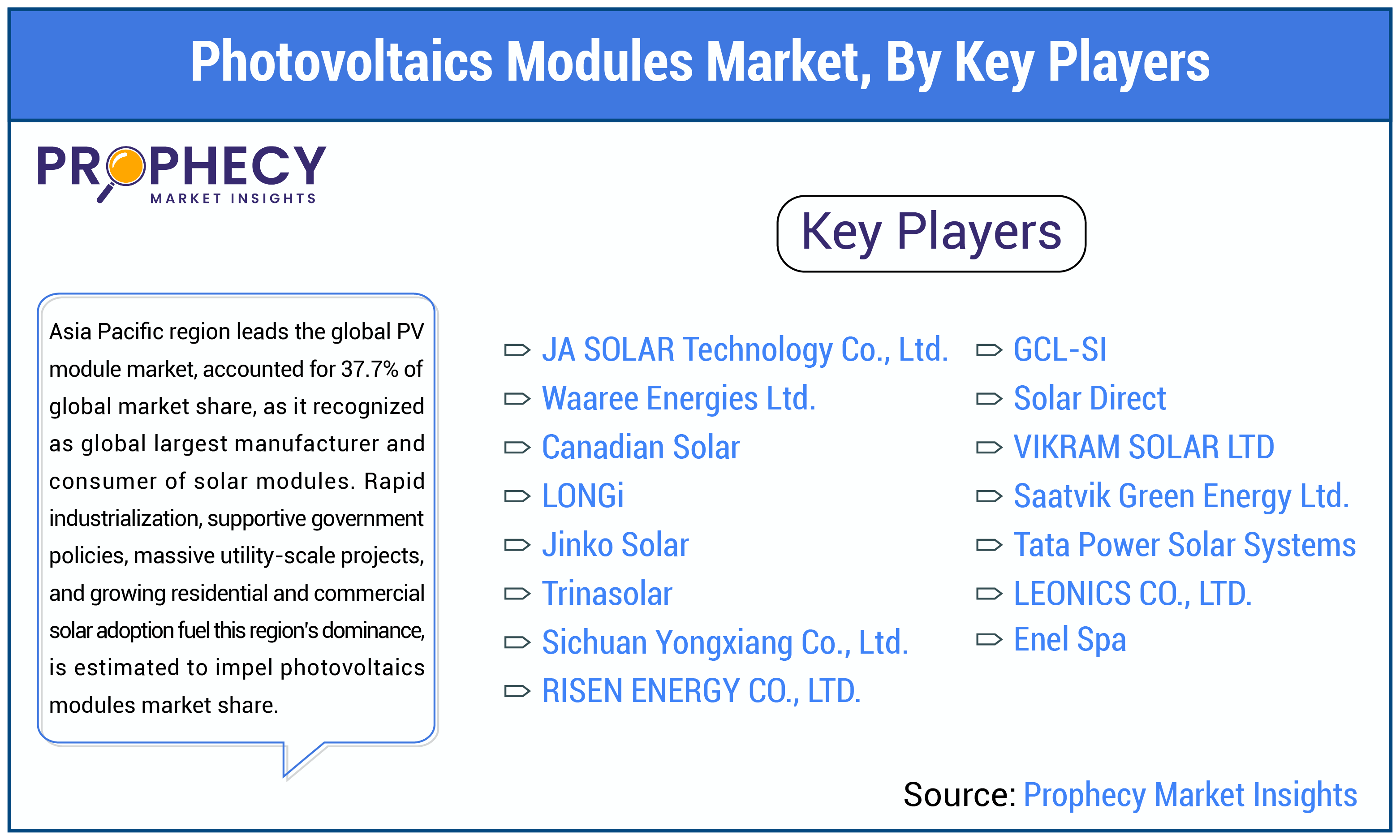
Asia Pacific: This region leads the global PV module market, accounted for 37.7% of global market share, as it recognized as global largest manufacturer and consumer of solar modules. Rapid industrialization, supportive government policies, massive utility-scale projects, and growing residential and commercial solar adoption fuel this region’s dominance, is estimated to impel photovoltaics modules market share.
- China Photovoltaics Modules Market Insights:
China is the leader in the Asia-Pacific region and globally for photovoltaic modules. It dominates both in manufacturing and installation capacity. China hosts many of the largest solar panel manufacturers, benefiting from vast economies of scale, government subsidies, and supportive policies aimed at expanding renewable energy. The country has also invested heavily in large-scale solar farms and rooftop installations, making it the biggest consumer and exporter of photovoltaics modules globally, contributing to photovoltaics modules market growth.
North America: This region holds the second-largest share, with the presence of major key market player. Strong policy support, increased domestic manufacturing capacity, and rising demand for clean energy solutions in residential, commercial, and utility sectors contribute to the region’s growth in photovoltaics modules market size.
- U.S. Photovoltaics Modules Market Insights:
U.S. leading country in North America region for target market. The U.S. have strong growth in residential rooftop solar, commercial projects, and large utility-scale solar farms. Increased investments in solar technology innovation, with policies in renewable integration, is anticipated to drive photovoltaics modules market share.
Europe: This region plays a significant role in the market, driven by strong government commitments to renewable energy and climate. Countries such as Germany, Spain, Italy, and the Netherlands are leading solar adopters, with increasing installations in both residential and utility-scale segments. Europe focuses heavily on sustainability, energy security, and reduces carbon emissions, which fuels steady demand for photovoltaics module, is projected to boost region growth in photovoltaics modules market share.
- Germany Photovoltaics Modules Market Insights:
The Germany is dominating country in Europe in target market, as it is recognized for its pioneering role in solar energy adoption. The country has established robust policy frameworks and renewable energy targets that have encouraged widespread solar installations across residential, commercial, and utility sectors. Germany is investing in solar innovation and manufacturing, is expected to pitch photovoltaics modules market size.

Photovoltaics Modules Market Report Scope:
|
Attribute |
Details |
|
Market Size 2025 |
USD 56.9 Billion |
|
Projected Market Size 2035 |
USD 172.4 Billion |
|
CAGR Growth Rate |
12.9% (2025-2035) |
|
Base year for estimation |
2024 |
|
Forecast period |
2025 – 2035 |
|
Market representation |
Revenue in USD Billion & CAGR from 2025 to 2035 |
|
Regional scope |
North America - U.S. and Canada Europe – Germany, U.K., France, Russia, Italy, Spain, Netherlands, and Rest of Europe Asia Pacific – China, India, Japan, Australia, Indonesia, Malaysia, South Korea, and Rest of Asia-Pacific Latin America - Brazil, Mexico, Argentina, and Rest of Latin America Middle East & Africa – GCC, Israel, South Africa, and Rest of Middle East & Africa |
|
Report coverage |
Revenue forecast, company share, competitive landscape, growth factors, and trends |
Segmentation:
By Product Type:
- Polycrystalline Silicon
- Single Crystal Silicon
By End-User:
- Residential
- Commercial
- Industrial
By Region:
- North America
- U.S.
- Canada
- Europe
- Germany
- U.K.
- France
- Russia
- Italy
- Spain
- Netherlands
- Rest of Europe
- Asia Pacific
- China
- India
- Japan
- Australia
- Indonesia
- Malaysia
- South Korea
- Rest of Asia Pacific
- Latin America
- Brazil
- Mexico
- Argentina
- Rest of Latin America
- Middle East & Africa
- GCC
- Israel
- South Africa
- Rest of Middle East & Africa
Global Photovoltaics Modules Market By Competitive Landscape & Key Players
JA SOLAR Technology Co., Ltd., Waaree Energies Ltd., Canadian Solar, and others, are the principal companies working in the photovoltaics modules market. The key players in this market are leveraging technology, cost-effective solutions, and diverse modules offerings to strengthen their market position. Key companies are increasingly investing in technological advancements and advanced collection systems to enhance quality and expand module potential, through their acquisition, is anticipated to drive photovoltaics modules market growth.
Photovoltaics Modules Market Companies:
- JA SOLAR Technology Co., Ltd.
- Waaree Energies Ltd.
- Canadian Solar
- LONGi
- Jinko Solar
- Trinasolar
- Sichuan Yongxiang Co., Ltd.
- RISEN ENERGY CO., LTD.
- GCL-SI
- Solar Direct
- VIKRAM SOLAR LTD
- Saatvik Green Energy Ltd.
- Tata Power Solar Systems
- LEONICS CO., LTD.
- Enel Spa
View an Additional List of Companies in the Photovoltaics Modules Market
Global Photovoltaics Modules Market By Recent News
- In May 2025, The Ministry of New and Renewable Energy released draft guidelines for the series approval of Solar Photovoltaic Modules for testing in laboratories. These guidelines aimed to help manufacturers and testing labs prepare and evaluate solar modules as per the Solar Systems, Devices, and Components Goods Order, 2025. The objective was to ensure consistency, safety, and quality in module manufacturing by defining rules for testing product families and handling changes in design or materials.
- In May 2025, Waaree Engines signed USD 176 million agreement with U.S.-based independent power producer to supply 596 MW solar modules. This module was manufactured at Waaree Solar Americas' facility in Brookshire, Texas, and were scheduled for delivery during FY 202627 across four projects. This agreement highlights Waaree commitment to building a resilient, robust, and technologically advanced clean energy supply chain in the US.
- In March 2025, Trinasolar announced to development of global first industrial-standard solar photovoltaics modules aimed to deliver over 800W of maximum power. The 3.1m2 modules, produced with 210mm x 105mm perovskite/silicon tandem solar cells, had achieved peak power output of 808W. This monumental for perovskite/silicon tandem solar modules was a significant step in industrialization of tandem modules.
Analyst View:
Photovoltaics modules market is driven by the global push towards reduces greenhouse gas emissions, rising demand for renewable energy, and increasing the adoption of solar power. Technological innovation to improve energy efficiency, and provide effective solution for off-grid power in remote, undeserved region, is estimated to impel photovoltaics modules market growth. Innovative installation combing with farming, growing urbanization, and expansion in emerging markets, is anticipated to boost photovoltaics modules market share.
More Related Reports
Commercial Insulation Market
WiFi / 802.11 Modules Market
Solar PV Modules and Inverters Market
Electric Commercial Vehicle Market
Commercial and Corporate Cards Market
Global Photovoltaics Modules Market By Company Profile
|
Company Name |
LONGi |
|
Headquarter |
Xi'an, Shaanxi, China |
|
CEO |
Li Zhenguo |
|
Employee Count |
60,601 employees |
Global Photovoltaics Modules Market By Highlights
FAQs
Photovoltaics modules market size was valued at USD 56.9 Billion in 2025 and is expected to reach USD 172.4 Billion by 2035 growing at a CAGR of 12.9%.
Product type, end-user, and region are the segmentation for the target market.
North America, Asia Pacific, Europe, Latin America, and the Middle East & Africa. Asia Pacific is expected to dominate the market.
The key players operating in the photovoltaics modules market include JA SOLAR Technology Co., Ltd., Waaree Energies Ltd., Canadian Solar, LONGi, Jinko Solar, Trinasolar, Sichuan Yongxiang Co., Ltd., RISEN ENERGY CO., LTD., GCL-SI, Solar Direct, VIKRAM SOLAR LTD., Saatvik Green Energy Ltd., Tata Power Solar Systems, LEONICS CO., LTD., and Enel Spa.