Global Photovoltaic Offgrid Inverter Market Overview
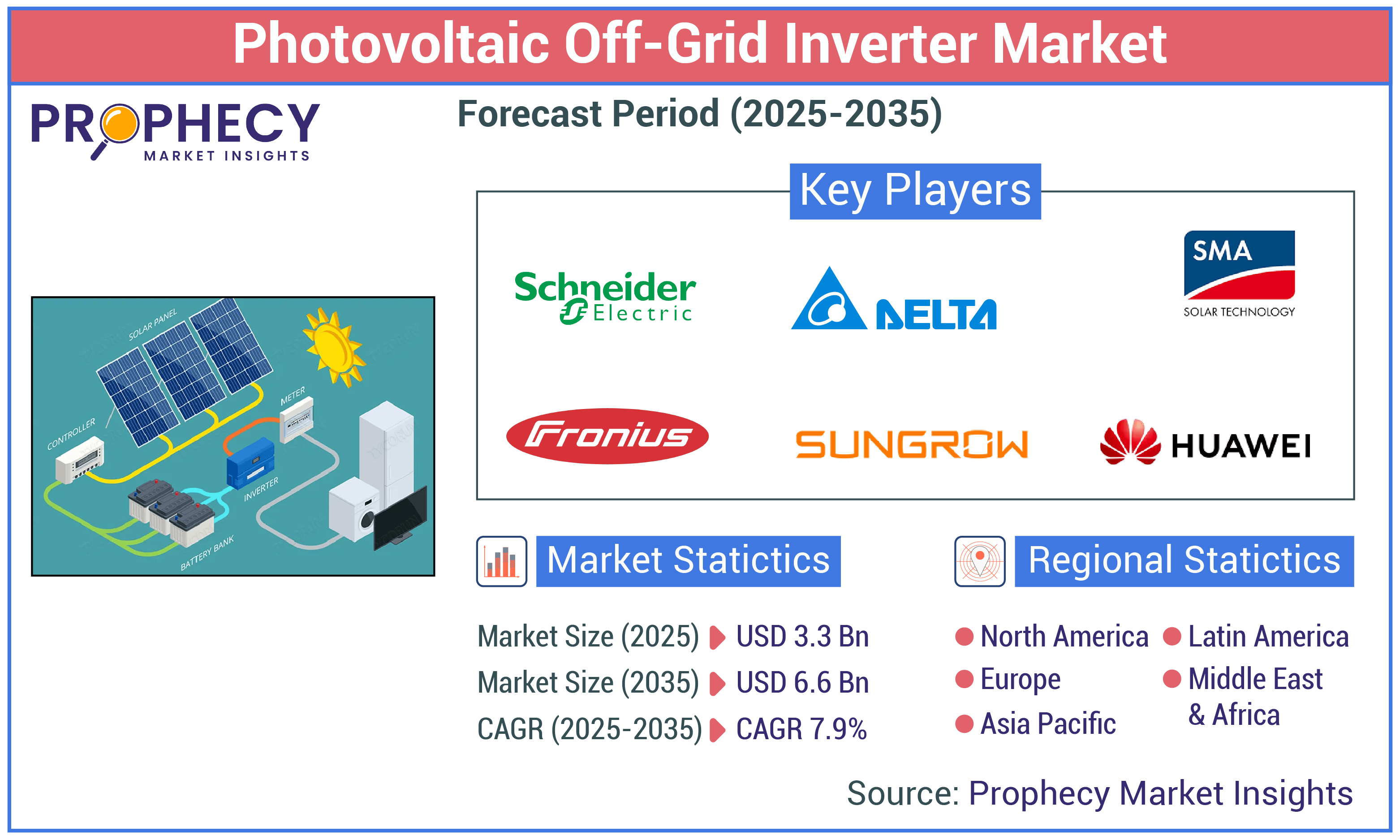
- Photovoltaic off-grid Inverter market size is anticipated to develop at a rate of USD 6.6 Billion, by 2035.
- The valuation of the market was accounted for USD 3.1 Billion in 2024.
- Photovoltaic off-grid inverter market is expanding at a CAGR 7.9%.
A photovoltaic off-grid inverter is a crucial component in standalone solar power systems that operate independently of the traditional electrical grid. Its primary function is to convert the direct current (DC) electricity generated by solar panels into alternating current (AC) electricity, which is compatible with household appliances and other electrical devices. Off-grid inverters are designed to manage energy supply in remote or off-grid locations in which connection to the utility grid is unavailable, unreliable, or too costly. The use of photovoltaic off-grid inverters is common in rural electrification, remote cabins, telecom towers, and emergency backup power systems.
Rapid urbanization, industrialization is driving the need for reliable energy storage solutions, integration with smart grids, IoT to enable real-time data analysis, and surging adoption of renewable energy sources, is anticipated to drive photovoltaic off-grid inverter market growth. Grwoing demand for rural electrification, and growing adoption of solar panels for energy generation, drives the demand for off-grid solar solutions, is projected to boost photovoltaic off-grid inverter market growth.
Expansion in emerging economic, and government investment in electricity grids, can create future opportunities for battery storage market growth. Innovations in inverter efficiency, battery management, smart grid integration, growing focus on combining off-grid inverter with other renewable sources, and increasing government support, is expected to pitch photovoltaic off-grid inverter market growth.
Recession Risk and Tarriff Analysis on Photovoltaic Off-grid Inverter Market:
- A global or regional economic recession could impact the photovoltaic off-grid Inverter market by reducing investments in renewable energy projects and infrastructure upgrades. During downturns, both consumers and businesses tend to delay high-cost purchases such as solar-plus-storage systems. Government funding for clean energy may also squeeze, affecting utility-scale projects and slowing market momentum temporarily.
- Tariffs on imported raw materials such as semiconductors, metals, and finished inverters can increase manufacturing costs, affecting pricing and profitability. Countries imposing high import duties may slow market growth locally by making products less affordable.
Impact of Generative AI on Photovoltaic Off-grid Inverter Market:
- AI-powered tools enable rapid optimization of inverter designs for improved energy conversion efficiency and durability, reducing development time and costs. In production, AI algorithms can help to automate quality control and predictive maintenance, minimizing downtime and extending product lifespan.
- AI enhances off-grid energy systems by enabling smarter load management and real-time performance monitoring, which optimizes battery usage and power distribution. These advancements make off-grid solar solutions more reliable, cost-effective, and user-friendly.
Global Photovoltaic Offgrid Inverter Market Drivers & Restraints
Key Drivers:
Growing Adoption of Solar Pannels Is Projected to Boost Market Growth
As solar photovoltaic (PV) technology becomes more affordable and efficient, an increasing number of residential, commercial, and remote users are shifting to solar power as a sustainable energy source. This surge in solar panel installations directly fuels demand for off-grid inverters, which are essential components that convert the DC electricity generated by solar panels into usable AC electricity in locations without access to the main power grid. Off-grid solar systems are particularly valuable in rural and remote areas in which grid connectivity is unreliable or unavailable, which provides a reliable, clean, and independent power supply. Advancements in solar panel technology have led to higher efficiency and longer lifespan, making solar energy a more cost-effective and attractive alternative to traditional fossil fuels. Thus, growing investment to adopt renewable energy sources, is anticipated to drive photovoltaic off-grid inverter market growth.
- For instance, according article published by SolarPower Europe in June 2024, in 2023, global solar yearly installation grew by 87% from the previous year. In 2023, brought 447 GW of new solar compared to the 239 GW installed in 2022, bringing the world’s total solar capacity to 1.6 TW. In the global market, there were 80% of installations concentrated in top 10 markets. China was dominated in global solar growth, which installed 57% of the global solar in 2023. The global aimed to achieve 2 TW of total solar in 2024 year, after reaching 1 TW in 2022. By 2028, the world could be installing 1 TW of solar a year.
Restraints:
Market Hindered by High Initial Investment Costs
Photovoltaic off-grid inverters, especially integrated with renewable energy systems and advanced control technologies, can be expensive. The high upfront costs for residential, commercial, and utility-scale systems may discourage adoption, particularly in developing economies or cost-sensitive sectors, resulting to limits target market growth.
- Counterbalance Statements: Falling prices of lithium-ion batteries, economies of scale in inverter manufacturing, supportive government subsidies, tax credits, and financing schemes are lowering the total system cost. In many regions, long-term energy savings and demand charge reductions defend the investment, which improves return on investment (ROI).
Opportunities & Trends:
Growing Government Investment in Electricity Grids Surge Market Growth
Many global governments are investing heavily to improve energy access, especially in rural and remote areas in which extending the centralized grid is costly, time-consuming, or technically difficult. In these cases, off-grid solar systems equipped with photovoltaic inverters to offer an effective alternative, which enables reliable electricity supply without the need for extensive grid expansion. Government funding, subsidies, and supportive policies is transforming rural electrification and renewable energy which help to reduce the financial barriers for adopting off-grid solar solutions such initiatives often include incentives for installing solar panels and inverters, training programs to develop local technical expertise, and partnerships with private companies to accelerate deployment. As governments prioritize clean energy transitions and aim to meet climate targets, the photovoltaic of-grid become crucial part, is projected to boost photovoltaic off-grid inverter market share.
- For instance, investment in electricity grids increased by 8% in 2022, with advanced and emerging economics are supporting to investment and enables electrification of buildings, industry, and transport. The European Union action plan predicted to invest USD 633 billion in the electricity grid by the end of 2030. In which USD 434 billion is aim to invest for the distribution grid, including USD 184 billion for digitalization. China’s State Grid Corporation invested of USD?77 billion in transmission in 2023, with the total nationwide investment was USD 442 billion, Japan invested USD 155.5 Billion in 2022, to encourage new power grid technologies, energy-efficient homes and other carbon footprint-reduction technologies.
Global Photovoltaic Offgrid Inverter Market Segmentations & Regional Insights
The photovoltaic off-grid inverter market is segmented into type, power rating, output phase, application, sales channel, and region.
By Type:
Based on type, the market is divided into pure sine wave inverters, modified sine wave inverters, and square wave inverters. The highest photovoltaic off-grid inverter market share is held by pure sine wave inverters, which are perfect for sensitive electronics and high-end appliances since they can provide clean, steady, and high-quality power that is comparable to grid electricity.
Although modified sine wave inverters are less efficient and may eventually damage some devices, they are the second most popular segment because they provide a less expensive option with simpler circuitry, making them appropriate for simple applications in remote or low-budget solar installations.
By Power Rating:
Up to 1 kW, 1–10 kW, 10–100 kW, and others are divided by power rating in the market. In the photovoltaic off-grid inverter market, the 1–10 kW power rating category has the biggest photovoltaic off-grid Inverter market share as it successfully balances cost and power capacity, making it perfect for small-scale commercial and residential solar applications with modest energy demands.
The growing need for off-grid power solutions in larger commercial, industrial, and institutional settings where higher energy output is required for machinery, equipment, or backup systems particularly in developing nations and remote infrastructure projects has led to the second-largest segment, the 10–100 kW category.
By Output Phase:
On the basis of output phase, the market is classified into single phase, and three phase. Due to its extensive usage in residential and small-scale business applications, where energy demand is often modest and single-phase power is frequently supported by grid infrastructure, the single-phase sector has biggest photovoltaic off-grid inverter market share.
The second-largest market is three-phase, which is becoming more popular in medium-to-large commercial, agricultural, and industrial applications where heavy-duty machinery has to run more smoothly, with larger power loads, and with improved efficiency.
By Application:
Under application, the market is categorized into residential, commercial, and industrial. Due to the increasing use of solar energy in off-grid residences, especially in rural and isolated locations without dependable grid connectivity, the residential sector now maintains the greatest market share in the photovoltaic off-grid inverter market.
The growing demand for affordable and sustainable power solutions in off-grid businesses such as telecom towers, retail stores, and remote offices where a steady supply of energy is essential for operations and cost savings over diesel generators is a powerful motivator has propelled the commercial segment to the second-most dominant position.
By Sales Channel:
On the account of sales channel, the market is categorized into OEMs (original equipment manufacturers), and aftermarket. Since the majority of inverters are incorporated straight into new solar system packages during first installation, especially in residential and commercial projects, OEMs (Original Equipment Manufacturers) have the biggest market share in the photovoltaic off-grid inverter market.
Due to the increased need for aged inverter replacement, upgrades, and maintenance in off-grid systems, particularly in areas with early solar adoption and inadequate technical support infrastructure, the aftermarket is the second most important channel and has been expanding significantly.
Regional Insights:
Geographically, the market is studied across North America, Europe, Asia Pacific, Latin America, and the Middle East & Africa.
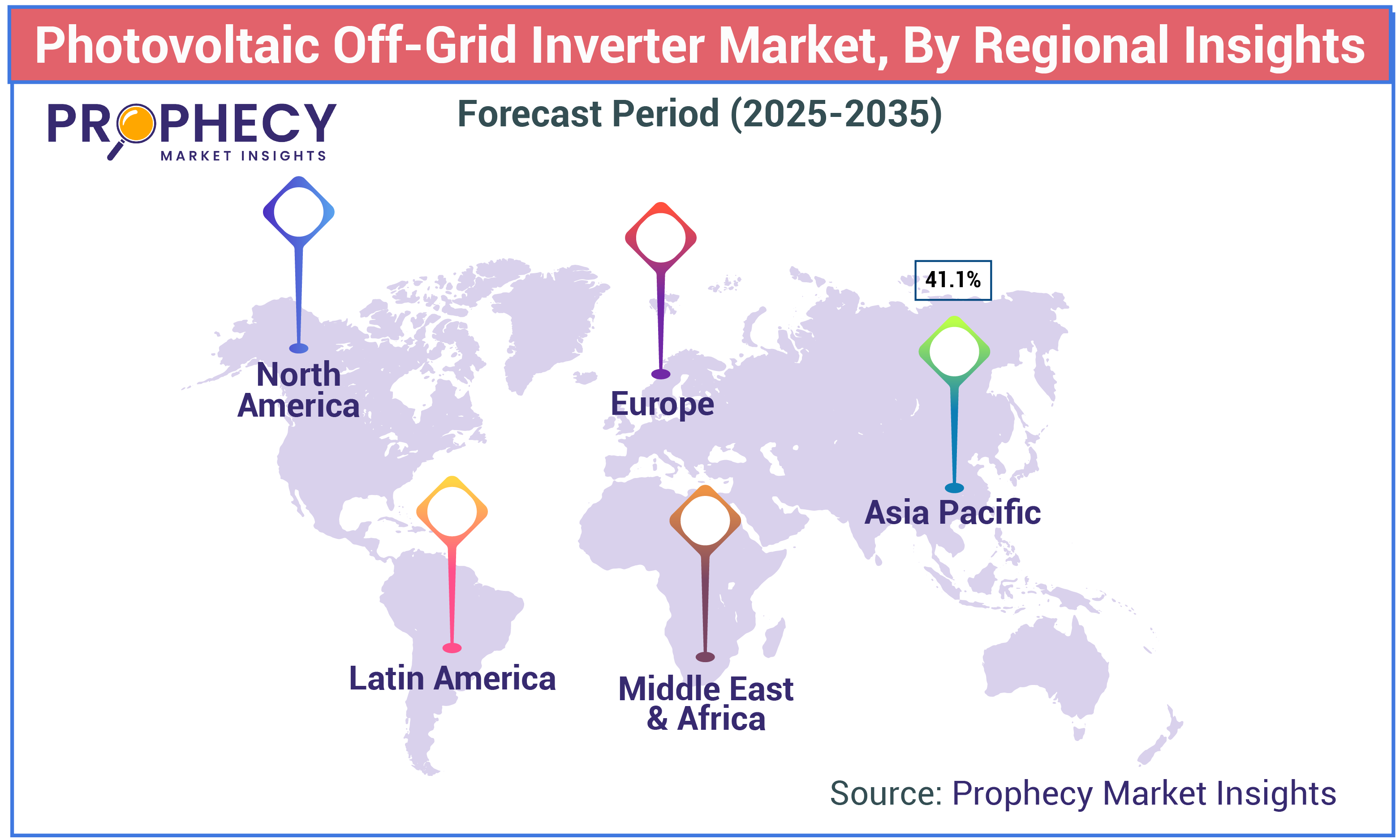
Asia Pacific: This region leads the market with 41.1% of total market share, driven by massive investments in renewable energy infrastructure and its role as a leading manufacturer of batteries and inverter technologies. Government-backed initiatives for grid modernization, carbon neutrality goals, and rural electrification projects further fuel demand with strong residential and commercial energy storage adoption, is estimated to compel photovoltaic off-grid inverter market size.
- China Photovoltaic Off-grid Inverter Market Insights:
China is the dominating country in the Asia Pacific region for the target market. Massive investments in renewable energy projects, particularly solar and wind, which create a huge demand for energy storage solutions to manage intermittency. China is also a global manufacturing hub for batteries and inverters, enabling cost-effective production and rapid technological advancement, is anticipated to drive photovoltaic off-grid storage market growth.
North America: This region holds the second largest share of the market, driven by rapid growth in residential solar-plus-storage systems, commercial energy storage adoption, and utility-scale battery projects supported by federal tax credits and state-level clean energy mandates. The rise of smart grids, electric vehicles, and peak demand challenges continues to accelerate demand for photovoltaic off-grid inverter, resulting to propel photovoltaic off-grid inverter market size.
- U.S. Photovoltaic Off-grid Inverter Market Insights:
The U.S. is the dominant country in North America for the market. The growth is fueled by favorable government incentives. There is strong adoption of residential solar-plus-storage systems, with utility-scale projects that require large-capacity inverters. The country’s focus on grid modernization and the increasing integration of electric vehicles, contributing to boost photovoltaic off-grid inverter market size.
Europe: This is a significant and fast-growing region in the market, driven by the continent's strong commitment to decarbonization, renewable energy integration, and grid modernization. Countries are leading the charge with widespread adoption of residential solar-plus-storage systems and growing investments in utility-scale battery projects. The increasing invests in clean energy infrastructure, including off-grid solutions for remote locations, agricultural applications, and backup power, is anticipated to drive photovoltaic off-grid inverter market share.
- Germany Photovoltaic Off-grid Inverter Market Insights:
Germany is the leading country in Europe for photovoltaic off-grid inverter. Germany has high adoption rates of residential solar and energy storage, supported by government subsidies and favorable regulations. Increasing investments in smart grid technology and large-scale energy storage, is projected to boost photovoltaic off-grid inverter market share.
Photovoltaic Off-grid Inverter Market Report Scope:
|
Attribute |
Details |
|
Market Size 2025 |
USD 3.3 Billion |
|
Projected Market Size 2035 |
USD 6.6 Billion |
|
CAGR Growth Rate |
7.9% (2025-2035) |
|
Base year for estimation |
2024 |
|
Forecast period |
2025 – 2035 |
|
Market representation |
Revenue in USD Billion & CAGR from 2025 to 2035 |
|
Regional scope |
North America - U.S. and Canada Europe – Germany, U.K., France, Russia, Italy, Spain, Netherlands, and Rest of Europe Asia Pacific – China, India, Japan, Australia, Indonesia, Malaysia, South Korea, and Rest of Asia-Pacific Latin America - Brazil, Mexico, Argentina, and Rest of Latin America Middle East & Africa – GCC, Israel, South Africa, and Rest of Middle East & Africa |
|
Report coverage |
Revenue forecast, company share, competitive landscape, growth factors, and trends |
Segmentation:
By Type:
- Pure Sine Wave Inverters
- Modified Sine Wave Inverters
- Square Wave Inverters
By Power Rating:
- Up to 1 kW
- 1–10 kW
- 10–100 kW
- Others
By Output Phase:
- Single Phase
- Three Phase
By Application:
- Residential
- Commercial
- Industrial
By Sales Channel:
- OEMs (Original Equipment Manufacturers)
- Aftermarket
By Region:
- North America
- U.S.
- Canada
- Europe
- Germany
- U.K.
- France
- Russia
- Italy
- Spain
- Netherlands
- Rest of Europe
- Asia Pacific
- China
- India
- Japan
- Australia
- Indonesia
- Malaysia
- South Korea
- Rest of Asia Pacific
- Latin America
- Brazil
- Mexico
- Argentina
- Rest of Latin America
- Middle East & Africa
- GCC
- Israel
- South Africa
- Rest of Middle East & Africa
Global Photovoltaic Offgrid Inverter Market Competitive Landscape & Key Players
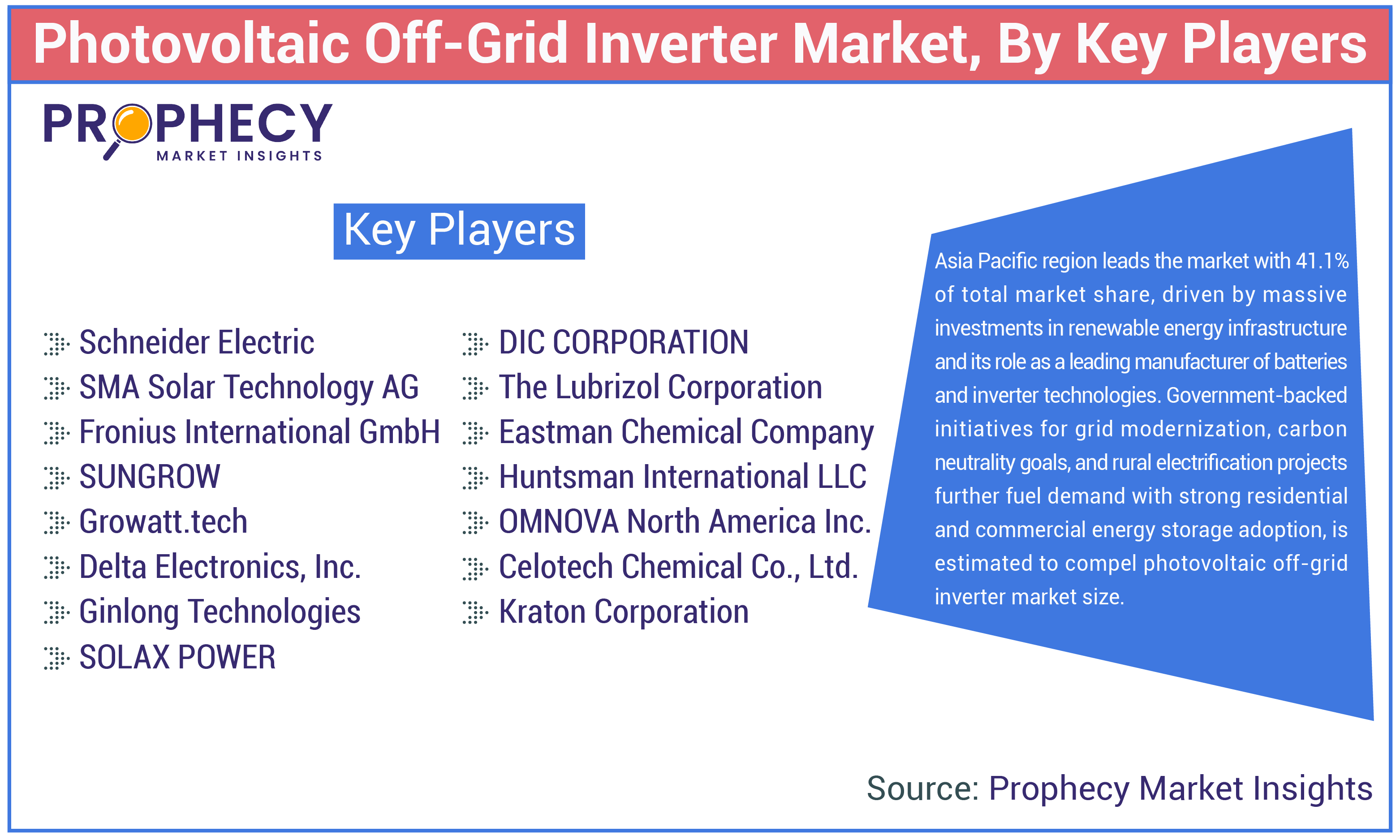
The main key players operating in the photovoltaic off-grid inverter market are, Schneider Electric, SMA Solar Technology AG, Fronius International GmbH, and others. These companies are constantly innovating, expanding their product portfolios, and optimizing production processes to meet the evolving demands of consumers, through their collaboration or partnerships. Companies are investing in introduce innovative electric storage products, resulting to propel photovoltaic off-grid inverter market growth.
Photovoltaic Off-grid Inverter Market Companies:
- Schneider Electric
- SMA Solar Technology AG
- Fronius International GmbH
- SUNGROW
- Growatt.tech
- Delta Electronics, Inc.
- Ginlong Technologies
- SOLAX POWER
- Victron Energy
- Outbackpower
- Mr. Solar
- ENF Ltd.
- SunWatts
- DMX Power
- Huawei Technologies Co., Ltd.
View an Additional List of Companies in the Photovoltaic Off-grid Inverter Market
Global Photovoltaic Offgrid Inverter Market Recent News
- In April 2025, Tigo launched new solution for off-grid residential photovoltaic applications. This Off-Grid Solar package includes module-level power optimizer, inverter, battery, and automatic transfer switch. It also includes DC-couple configurations of 20 kWh or 40 kWh of energy storage. The high performance Off-Grid Solar package aimed to address complex and custom configuration.
- In February 2025, Chinese inverter manufacturer Deye launched new single-phase off-grid inverter for residential PV systems. This Off-Grid Inverter aimed to boost IP65 protection level, enabled for highly resident to water and dust, which was ideal for diverse environmental conditions. The new inverter has AC output power ranging from 3.6 kW to 6 kW. The systems featured for a maximum efficiency of 97.6% and a European efficiency rate of 96.5%.
- In October 2024, Livguard launched Hybrid Series and Off-grid Series inverter, which was designed for high efficiency with transformer less technology, was made more reliable and compact. Liveguards solar solution, such as Off-grid solution, On-grid solution, Hybrid solution and Lithium ESS were aimed to offer various mode operation for battery and grid preference, higher ROI, uninterrupted use of solar energy for saving and backup.
- In December 2022, Growatt launched its new SPF 6000 ES Plus inverter for residential off-grid solar power systems. The inverter string input reached to 16A, which was compatible with 500W + large power PV modules. The inverter designed with duel MPP trackers for house with rooftop areas, which support panel installation at different orientations and aimed to higher energy generation.
Analyst View:
The photovoltaic off-grid inverter market driven by rapid urbanization, industrialization and rising demand for effective energy storage system. Growing adoption of solar panel in residential, commercial use, increasing government investment in electricity grid, and advancement in others solutions, is predictable to pitch photovoltaic off-grid inverter market growth.
More Related Reports
Solar Photovoltaic (PV) Market
Photovoltaic Transparent Glass Market
Microgrid Market
Grid Connected Battery Energy Storage Market
Smart Grid Communications Market
Global Photovoltaic Offgrid Inverter Market Company Profile
|
Company Name |
SUNGROW |
|
Headquarter |
Hefei, Anhui, China |
|
CEO |
Cao Renxian |
|
Employee Count |
13,697 Employees |
Global Photovoltaic Offgrid Inverter Market Highlights
FAQs
Photovoltaic off-grid inverter market size was valued at USD 3.3 Billion in 2025 and is expected to reach USD 6.6 Billion by 2035 growing at a CAGR of 7.9%.
Type, power rating, output phase, application sales channel, and region are the segmentation for the target market.
North America, Asia Pacific, Europe, Latin America, and the Middle East & Africa. North America is expected to dominate the market.
The key players operating in the photovoltaic off-grid inverter market include Schneider Electric, SMA Solar Technology AG, Fronius International GmbH, SUNGROW, Growatt.tech, Delta Electronics, Inc., Ginlong Technologies, SOLAX POWER, Victron Energy, Outbackpower, Mr. Solar, ENF Ltd., SunWatts, DMX Power, and Huawei Technologies Co., Ltd.