Global Next Generation Payment Technology Market Overview
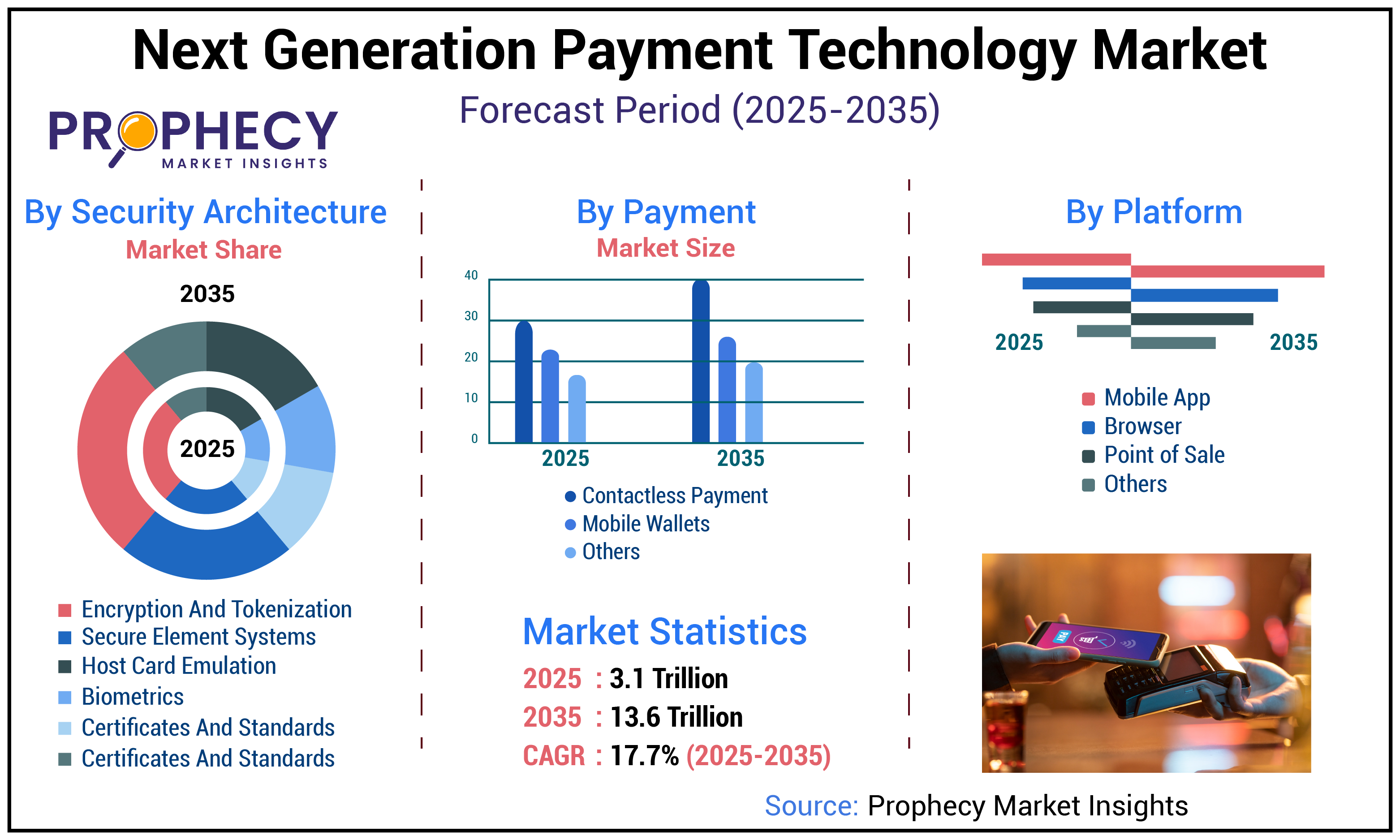
- Next generation payment technology market size is expected to expand at a rate of USD 13.6 Trillion, by 2035.
- In 2024, the market valuation was USD 2.6 Trillion.
- Next generation payment technology market is developing at a CAGR 17.7%.
Next-generation payment technology refers to innovative methods and systems that are transforming financial transactions, encompassing technologies such as contactless payments, mobile wallets, blockchain, biometrics, and tokenization, aiming for greater convenience, security, and flexibility. It offers several advantages, including security, convenience, accessibility, better customer experience, biometric authentication, enhanced customer experience, and improved efficiency.
The next-generation payment technology market growth is driven by increasing digital payments adoption, the rise of e-commerce and mobile commerce, and the demand for enhanced security and fraud prevention measures. In addition to this, the rising preference of consumers for fast and convenient payment methods, and active promotion of digital payments and financial inclusion by the government also contributes in the market expansion.
The market’s diversification is also pitched by the increasing use of artificial intelligence and machine learning to enhance security, detect fraud, and personalize payment experiences, and the regulatory initiatives promoting open banking and interoperability are enabling new payment methods and enhancing the payment ecosystem. Moreover, blockchain technology is being explored for its potential to create more secure and transparent payment systems, thus also contributing in the target market expansion.
Impact of Generative AI on Next Generation Payment Technology Market:
- Generative AI is revolutionizing the market for next-generation payment technologies by automating consumer interactions, improving fraud detection, and customizing payment experiences. Real-time analysis of transaction trends by AI-driven algorithms lowers fraud and boosts security. In order to improve user verification and reduce friction, it also makes adaptive authentication possible.
- Furthermore, AI enables virtual assistants and sophisticated chatbots for smooth financial assistance. Growth in contactless and AI-powered financial transactions is fueled by generative AI, which improves efficiency, streamlines risk management, and spurs innovation as digital payments advance.
Global Next Generation Payment Technology Market Drivers & Restraints
Key Drivers:
Increasing Adoption of Digital Payments is Boosting the Market Expansion
The next-generation payment technology market growth is driven by the growing use of digital payments, which increases demand for contactless, quick, and secure transaction solutions. Advances in NFC, QR codes, and blockchain-based payments are fueled by the preference of businesses and customers for digital wallets, mobile payments, and AI-driven verification. This change is accelerated by the expansion of e-commerce, efforts to promote financial inclusion, and laws that encourage cashless economies. In order to provide smooth, effective, and safe payment experiences globally, payment providers are innovating with biometric authentication and AI-powered fraud prevention as digital transactions increase.
- For instance, according to the data published by MageComp LLP, in 2024, UPI was the most popular digital payment method, accounting for 83% of all digital payments. Globally, credit and debit cards account for 40% of digital transactions. Digital wallets such as PayPal, Apple Pay, and Google Pay make up 50% of global e-commerce transactions. China leads in QR code payments, accounting for 40%. Contactless payments make up 45% of in-store transactions. Thus, proving the increasing adoption of digital payments globally.
Restraints:
Cybersecurity Threats Faced by Next Generation Payment Technology is Restricting the Market Growth
Cybersecurity risks are a significant drawback of the market for next-generation payment technologies. Cybercriminals take advantage of weaknesses as digital payments increase, resulting in financial fraud, identity theft, and data breaches. Sensitive financial data is compromised by sophisticated hacking tactics that target mobile wallets, NFC transactions, and QR code payments. Malware threats and phishing attempts also provide serious difficulties. Although consumers and businesses must constantly update security measures, it is challenging to provide 100% protection due to the constantly changing nature of cyber threats, which affects adoption rates and confidence.
- Counterbalance Statements: Businesses should use end-to-end encryption, multi-factor authentication, and AI-powered fraud detection to reduce cybersecurity threats. Protection is improved via biometric authentication, blockchain-based secure transactions, and routine security audits. Programs to educate consumers about phishing and secure online payment methods additionally aid in lowering vulnerabilities, guaranteeing more secure and dependable next-generation payment systems.
Opportunities & Trends:
Increasing Use of Artificial Intelligence in Next Generation Payments is Expected to Fuel the Market Expansion in the Future Generations
The growing application of AI in next-generation payments, which improves security, fraud detection, and transaction efficiency, drives the next generation payment technology market expansion. Artificial intelligence (AI)-powered computers examine payment trends instantly, stopping fraud and enhancing risk control. Processing payments is made more efficient by intelligent automation, which lowers mistakes and delays. Additionally, AI improves user experience by powering voice-activated payments, tailored financial services, and biometric access. AI technology is propelling innovation in blockchain transactions, digital wallets, and predictive analytics, which speeds up the adoption of safe and easy payment methods.
- For instance, in February 2025, according to article published by Fintech Finance Awards Website, AI is developing as a key component of the upcoming generation of next generation payments as businesses want to use technology to successfully handle operational difficulties. Beyond straightforward work automation, artificial intelligence is already addressing more complicated issues in contemporary treasury and payment systems, such as addressing common problems such as customer service, expediting payment processing, generating data in real-time, and preventing fraud.
Global Next Generation Payment Technology Market Segmentations & Regional Insights
The next generation payment technology market is segmented into payment type, technology type, platform, security architecture, end-user, and region.
By Payment Type:
Based on payment type, the market is bifurcated into contactless payments, and mobile wallets. The contactless payments are attributed to dominate the next generation payment technology market share. This is due to its broader adoption and convenience, encompassing various technologies such as NFC, RFID, and QR codes.
The mobile wallets segment is the payment type which is expected to hold the second largest target market due to its convenience and ease of use, and it offers advanced security features such as, encryption, tokenization, and biometric authentication.
By Technology Type:
Under technology type, the market is divided into EMV chip, Near Field Communication, Magnetic Secure Transmission, Bluetooth Low Energy, and Others. The Others or the QR code is the technology type which is holding the superior position in the next generation payment technology market share. This is due to its cost-effectiveness and ease of implementation, increasing use of smartphones, and the rise of contactless payment due to the COVID-19 pandemic.
The Near Field Communication (NFC) is the technology type which is growing rapidly in the next generation payment technology market. This is due to its convenience, security, and interoperability with a wide variety of devices and payment terminals.
By Platform:
According to platform, the market is trifurcated into browser, mobile app, and point of sale. The mobile app is the platform which is expected to govern the next generation payment technology market growth. This is due to its convenience, versatility, and widespread adoption, especially for e-commerce and digital transactions.
The browser segment is the second leading platform in the target market. This is due to its ubiquitous nature, ease of access, and integration with various online activities, making it a convenient and widely used interface for digital transactions.
By Security Architecture:
Stemming from security architecture, the market is sub-segmented into encryption and tokenization, secure element systems, host card emulation, biometrics, certificates and standards, and Others. The encryption and tokenization segment is influencing the next generation payment technology market size. This is due to its effectiveness in protecting sensitive payment data and preventing fraud.
By End-User:
On the basis of end-user, the market is catalogued into retail and commercial, enterprise, healthcare, hospitality, and others. The retail and commerce segment is the end-user which is holding a superior position in the next generation payment technology market share. This is due to the increasing adoption of digital payments for convenience, efficiency, and the rise of e-commerce. In addition to this, the rise of online shopping, the convenience of mobile payments, and the need for faster and more secure transactions are also contributing in the segment’s growth.
Regional Insights:
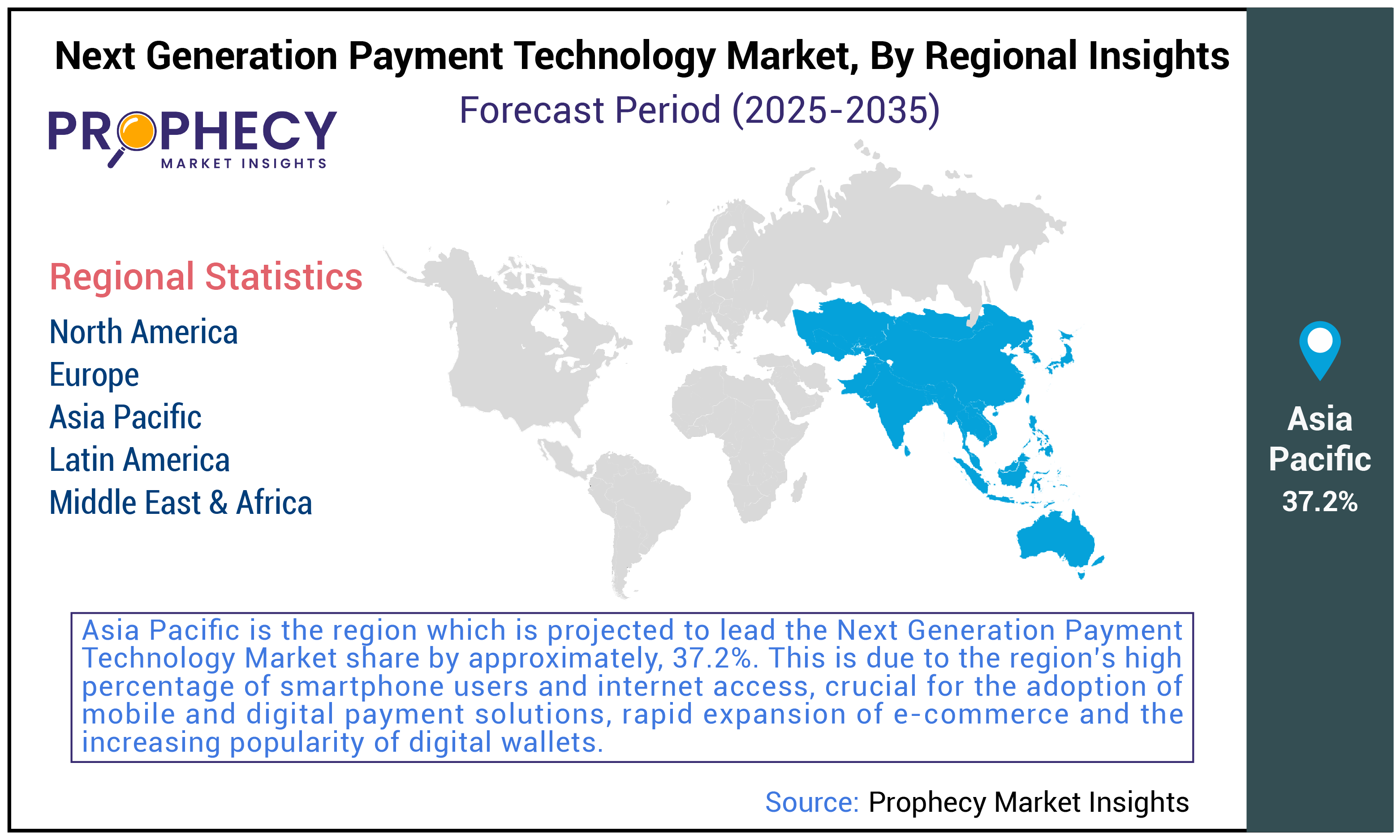
Geographically, the market is studied across North America, Europe, Asia Pacific, Latin America, and the Middle East & Africa.
Asia Pacific: This is the region which is projected to lead the next generation payment technology market share by approximately, 37.2%. This is due to the region’s high percentage of smartphone users and internet access, crucial for the adoption of mobile and digital payment solutions, rapid expansion of e-commerce and the increasing popularity of digital wallets, and the rise of fintech companies and innovative payment solutions tailored to local preferences. Furthermore, Governments in the Asia-Pacific region are actively promoting cashless payments, and the rise of on-demand services such as ride-hailing and food delivery has increased the need for real-time payment processing solutions, further driving the target market growth.
- China Next Generation Payment Technology Market Insights:
The next generation payment technology market in China is the largest market, in the recent years. This is due to China’s massive uptake of digital payment platforms, with Alipay and WeChat Pay becoming integral to daily transactions, a robust digital infrastructure, including high smartphone penetration, which facilitates the use of digital payment methods, and government initiatives promoting cashless transactions. Additionally, the thriving e-commerce industry in both China and a high adoption rate of digital wallets, is also fueling its market growth.
North America: This is the region which has the next generation payment technology market growing with the fastest growth rate, during the forecast period, in the recent years. This is due to its robust digital economy, widespread adoption of digital payment solutions, and the presence of major technology firms innovating in the space. In addition to this, the rise of on-demand services such as ride-hailing and food delivery has increased the need for real-time payment processing solutions, and favorable government initiatives also contribute in the region’s market growth.
- U.S. Next Generation Payment Technology Market Insights:
The next generation payment technology market in the U.S. is growing with the highest CAGR, during the forecast period, in the recent years. This is due to its well-developed digital infrastructure, including high smartphone penetration and internet access, which supports the adoption of mobile and digital payment methods, and increasing consumer demand for safer payment options. Additionally, the U.S. payment landscape is highly competitive, with various players innovating and offering new payment solutions, and it has a relatively stable regulatory environment that supports the target market growth.
Europe: This is the region which has the third largest next generation payment technology market, in the recent years. This is due to factors, such as, the European Union's efforts to create a unified payment solution and the growing adoption of digital payments. In addition to this, Europe has a supportive regulatory environment, a push for digital transformation, and a growing demand for convenient and secure payment solutions, further driving its growth in the target market.
- Germany Next Generation Payment Technology Market Insights:
The next generation payment technology market in Germany is experiencing considerable amount of growth, in the recent years. This is due to Germany’s largest economy in Europe, which translates to a larger potential market for digital payments. Other than this, Germany also has a well-developed digital infrastructure, supporting the growth of digital payment technologies, and a number of strong domestic players in the payment industry, which could contribute to a higher market share.
Next Generation Payment Technology Market Report Scope:
|
Attribute |
Details |
|
Market Size 2025 |
USD 3.1 Trillion |
|
Projected Market Size 2035 |
USD 13.6 Trillion |
|
CAGR Growth Rate |
17.7% (2025-2035) |
|
Base year for estimation |
2024 |
|
Forecast period |
2025 – 2035 |
|
Market representation |
Revenue in USD Trillion & CAGR from 2025 to 2035 |
|
Regional scope |
North America - U.S. and Canada Europe – Germany, U.K., France, Russia, Italy, Spain, Netherlands, and Rest of Europe Asia Pacific – China, India, Japan, Australia, Indonesia, Malaysia, South Korea, and Rest of Asia-Pacific Latin America - Brazil, Mexico, Argentina, and Rest of Latin America Middle East & Africa – GCC, Israel, South Africa, and Rest of Middle East & Africa |
|
Report coverage |
Revenue forecast, company share, competitive landscape, growth factors, and trends |
Segmentation:
By Payment Type:
- Contactless Payment
- Mobile Wallets
By Technology Type:
- EMV Chip
- Near Field Communication
- Magnetic Secure Transmission
- Bluetooth Low Energy
- Others
By Platform:
- Browser
- Mobile App
- Point of Sale
By Security Architecture:
- Encryption and Tokenization
- Secure Element Systems
- Host Card Emulation
- Biometrics
- Certificates and Standards
- Others
By End-User:
- Retail and Commerce
- Enterprise
- Healthcare
- Hospitality
- Others
By Region:
- North America
- U.S.
- Canada
- Europe
- Germany
- U.K.
- France
- Russia
- Italy
- Spain
- Netherlands
- Rest of Europe
- Asia Pacific
- China
- India
- Japan
- Australia
- Indonesia
- Malaysia
- South Korea
- Rest of Asia Pacific
- Latin America
- Brazil
- Mexico
- Argentina
- Rest of Latin America
- Middle East & Africa
- GCC
- Israel
- South Africa
- Rest of Middle East & Africa
Global Next Generation Payment Technology Market Competitive Landscape & Key Players
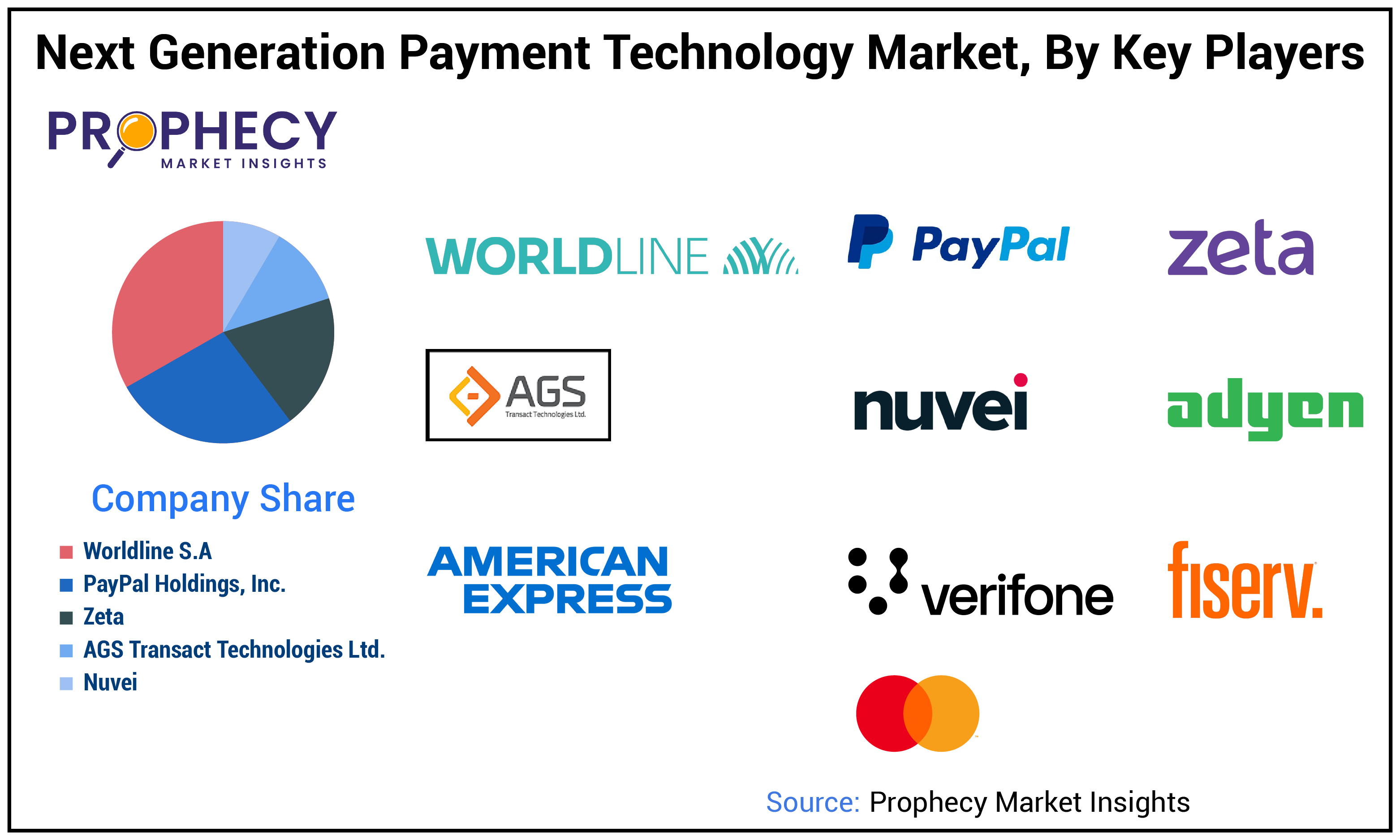
The companies operating in the market include, Worldline S.A, PayPal Holdings, Inc., Zeta, and others. These key market players are leveraging strategies such as content marketing, social media engagement, influencer partnerships, data-driven marketing, and building strong brands while also focusing on customer experience and data-driven marketing, for driving next generation payment technology market growth.
Next Generation Payment Technology Market Companies:
- Worldline S.A
- PayPal Holdings, Inc.
- Zeta
- AGS Transact Technologies Ltd.
- Nuvei
- Adyen
- American Express Company
- VeriFone, Inc.
- Fiserv, Inc.
- Thales
- Ingenico
- Mastercard
View an Additional List of Companies in the Next Generation Payment Technology Market
Global Next Generation Payment Technology Market Recent News
- In April 2025, the first wave of iQmetrix's next-generation technology suite included the introduction of iQ Payments, an end-to-end, embedded, mobile-first payments solution. Together with iQmetrix's storefront and retail management technologies, this payments solution would let merchants stay ahead of quickly changing trends and create the store of the future.
- In April 2025, full-service payment technology firm Aurora Payments announced the introduction of Network Tokenization, a cutting-edge solution that replaced private cardholder information with dynamic tokens issued by the network and incorporated into its ARISE Payment Platform. In addition to making PCI compliance easier, this development helped merchants, software partners, and ISOs decrease fraud, boost approval rates, and save processing costs.
- In April 2025, an innovative payment method created especially for students and Gen Z customers has been launched by Timbuckdo, a prominent social commerce company. In collaboration with Decentro, the fastest-growing Fintech Infrastructure Platform in India, the new platform was created with the goal of offering a cost-effective shopping experience that would enable both markets to maximize its spending while taking advantage of exclusive offers and a hassle-free shopping experience.
- In February 2025, Mastercard and Payrails, a payment technology startup, partnered to promote innovation that is suited to the requirements of big businesses and speed up the digital payment revolution. The two organizations sought to offer effective payment solutions through this alliance so that multinational corporations could increase flexibility, simplify complicated transactions, and streamline financial processes.
- In January 2025, leading omnichannel international payment platform PXP, a creative industry disruptor, announced the release of PXP Unity, a technological platform that is revolutionizing the industry. PXP signaled a change in payments by providing a single integration into an ecosystem of commerce that improves, streamlines, and connects company. With only one integration with PXP, it promises to revolutionize and empower merchants with next-generation point-of-sale and online services, giving it greater control over its transaction data, intelligent routing choices, and a library of readily integrated services that it can use as required.
Analyst View:
The next generation payment technology market is expanding due to the growing use of digital payments, the expansion of e- and mobile commerce, and the need for more security and fraud prevention measures. The industry is also growing as a result of customers' growing demand for quick and easy payment options and the government's aggressive support of digital payments and financial inclusion. Additionally contributing to the market's diversification are the growing applications of AI and machine learning to improve security, identify fraud, and customize payment experiences, and the regulatory efforts supporting open banking and interoperability that are opening up new payment options and strengthening the payment ecosystem.
More Related Reports
Next- Generation Storage Market
Next-Generation Anode Materials Market
Next-generation Products in Tobacco Market
Next-Generation Biofuels Market
Next-Generation Sequencing Informatics Market
Global Next Generation Payment Technology Market Company Profile
|
Company Name |
Worldline S.A |
|
Headquarter |
France |
|
CEO |
Mr. Gilles Grapinet |
|
Employee Count (2024) |
18,000 Employees |
Global Next Generation Payment Technology Market Highlights
FAQs
Next Generation Payment Technology Market size was valued at USD 3.1 Trillion in 2025 and is expected to reach USD 13.6 Trillion by 2035 growing at a CAGR of 17.7%.
Payment type, drug type, technology type, platform, security architecture, end-user, distribution channel, and region are the segmentation for the next generation payment technology market.
North America, Asia Pacific, Europe, Latin America, and the Middle East & Africa. Asia Pacific is expected to dominate the Next Generation Payment Technology Market .
The key players operating in the next generation payment technology market include Worldline S.A, PayPal Holdings, Inc., Zeta, Fiserv, Inc., AGS Transact Technologies Ltd., Nuvei, Adyen, American Express Company, VeriFone, Inc., Thales, Ingenico, and Mastercard.