Global MEMSBased Oscillators Market By Overview
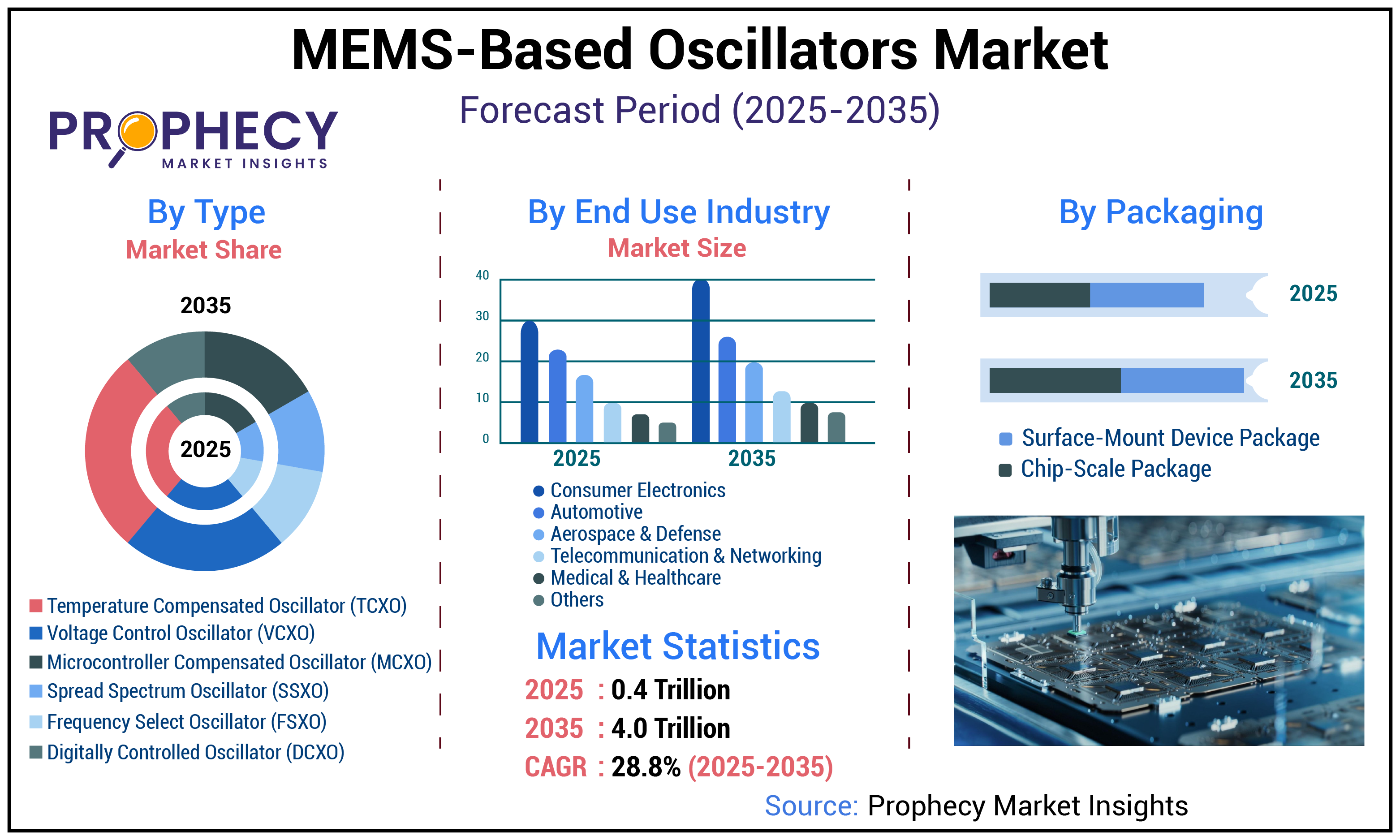
- MEMS-based oscillators market size is expected to expand at a rate of USD 4.0 Trillion, by 2035.
- In 2024, the market valuation was USD 0.3 Trillion.
- MEMS-based oscillators market is growing at a CAGR 28.8%.
MEMS-based oscillators are timing devices that use microelectromechanical systems (MEMS) technology to generate highly stable reference frequencies, offering advantages such as smaller size, lower power consumption, and better resilience to vibration and shock compared to traditional quartz crystal oscillators. It offers advantages, such as, low cost, small size, and high vibration resistance, making it suitable for portable and wearable electronics, while also having some trade-offs in frequency stability compared to traditional quartz oscillators.
The trend towards smaller and lighter electronic devices, especially in consumer electronics and wearables, and the increased use of MEMS oscillators in automotive and aerospace applications are contributing in driving the MEMS-based oscillators market growth. Moreover, MEMS oscillators are compatible with standard semiconductor processes, making it easier to integrate into electronic systems, and thus being cost-effective.
The market’s augmentation is also stimulated by the deployment of 5G networks, the increasing adoption of autonomous vehicles, and the rapid growth of IoT and wearable devices, which require precise timing and low-power operation, are driving demand for MEMS oscillators in these sectors. In addition to this, the growing adoption of RF MEMS technology in consumer electronics and LTE networks contributes to the overall growth of the MEMS-based oscillators market.
Impact of Generative AI on MEMS-Based Oscillators Market:
- The MEMS-based oscillators market is being impacted by generative AI since it speeds up design optimization, shortens time-to-market, and makes predictive maintenance possible through sophisticated modeling. It improves simulation precision and aids in the creation of small, energy-efficient devices.
- AI-driven insights are also enhancing demand forecasting and supply chain management, which promotes creativity and competitive advantage. In order to fulfill new performance and customization needs, generative AI is essential to the evolution of MEMS oscillator capabilities in sectors such as telecommunications and the Internet of Things.
Global MEMSBased Oscillators Market By Drivers & Restraints
Key Drivers:
The Rising Use of MEMS Sensors in Automotive Industry is Expected to Influence the Market Expansion
The automotive industry's growing use of MEMS sensors, especially in infotainment, advanced driver assistance systems (ADAS), and in-vehicle networking, calls for accurate timing components. MEMS oscillators satisfy this need by providing excellent precision and dependability, which are necessary for smooth synchronization and communication in these systems. These are perfect for automotive applications due to its resistance to severe environmental factors including mechanical stress and extremely high or low temperatures. Thus, the increasing use of MEMS sensors in automotive industry directly drives the MEMS-based oscillators market growth.
- For instance, according to the facts stated by Millennium Semiconductors, in the automobile sector, Microelectromechanical Systems (MEMS) sensors have revolutionized the field by providing previously unthinkable sophisticated features. These little yet potent devices combine electrical and mechanical parts on a microscopic level, providing excellent signal processing, actuation, and sensing capabilities. MEMS sensors are becoming an essential component of contemporary car systems as the automotive industry moves toward more safety, electrification, automation, and linked vehicles.
Restraints:
The Sensitive Packaging of MEMS Oscillators is Limiting the Market Expansion
Sensitivity to packaging-induced stress is a drawback of MEMS-based oscillators that may affect their long-term performance and frequency stability. Mechanical strain brought on by manufacturing stress, heat cycling, or board-level soldering might eventually cause frequency drift or decreased dependability. Applications needing extremely accurate timing, such high-frequency communication systems or aircraft, make this problem crucial. MEMS oscillators may perform worse in harsh settings than some quartz-based competitors, when low frequency fluctuation is essential, even if it is resilient in many other situations.
- Counterbalance Statements: Manufacturers can employ on-chip temperature correction and sophisticated stress-isolated packaging techniques to address stress caused by packing. Maintaining frequency accuracy is further aided by the oscillator design's use of stress-relieving components and real-time calibration algorithms. These enhancements increase the dependability of MEMS oscillators, particularly in applications requiring high performance or environmental requirements.
Opportunities & Trends:
Rapid Growth of IoT and Wearables is Expected to Unlock Growth Opportunities of the Target Market in the Future
The MEMS-based oscillators market is being greatly boosted by the quick growth of wearable technology and the Internet of Things. These oscillators are perfect for battery-dependent and space-constrained applications due to its small size, low power consumption, and great dependability. The demand for accurate timing solutions has increased by 60% as IoT devices spread, and MEMS oscillators are able to satisfy this demand due to its stability and resilience. MEMS oscillator usage is also being fueled by the expansion of the wearable technology sector, which highlights the need for compact, energy-efficient components.
- For instance, according to the article published by SiTime Corporation, the convergence of people, devices, and data across the web is the primary driver of the Internet of Things' (IoT) tremendous expansion. As items move from the laptop to the pocket to the body, wearable technology will have a significant impact on future growth. In terms of the quantity of units sold annually, activity trackers top this market, followed by smart watches, wearable cameras, medical monitoring and gadgets, and smart glasses. Improvements in MEMS and sensor technologies, wireless communication, and new power-saving capabilities make these devices possible.
Global MEMSBased Oscillators Market By Segmentations & Regional Insights
The MEMS-based oscillators market is segmented into type, packaging type, band, end use industry, and region.
By Type:
According to type, the market is categorized into voltage control oscillator (VCXO), temperature compensated oscillator (TCXO), microcontroller compensated crystal oscillators (MCXO), spread spectrum oscillator (SSXO), frequency select oscillator (FSXO), and digitally controlled oscillator (DCXO). The TCXO segment is expected to rule over the MEMS-based oscillators market share. This is due to its superior performance characteristics, including stability in harsh environments, improved aging resistance, and enhanced vibration tolerance, making it suitable for a wide range of applications.
The VCXO segment is the fastest growing type of the MEMS-based oscillators market. This is due to its ability to modulate frequency with a control voltage, making it suitable for applications requiring frequency tuning.
By Packaging Type:
Based on packaging type, the market is branched into surface-mount device package, and chip-scale package. The surface-mount device package segment is holding the superior position in the MEMS-based oscillators market share. This is due to its cost-effectiveness and ease of integration into existing manufacturing processes, especially in high-volume applications such as consumer electronics and mobile devices.
Chip-scale packages, are the packaging type, experiencing steady growth, in the MEMS-based oscillators market. This is due to its capability to offer a higher integration density compared to SMD packages, and are popular in applications where space is a constraint, such as in mobile devices.
By Band:
On the premise of band, the market is bifurcated into MHz and kHz. The MHz band is the most dominating segment in the MEMS-based oscillators market. This is due to the increasing demand for high-precision and stable timing solutions in applications such as telecommunications, automotive electronics, and consumer electronics.
The kHz band is the second dominating segment in the MEMS-based oscillators market. This is due to its use in applications requiring lower frequencies and lower power consumption, such as timing and synchronization in mobile devices and IoT applications.
By End Use Industry:
Stemming from end use industry, the market is categorized into telecommunication & networking, automotive, aerospace & defense, consumer electronics, medical and healthcare, and others. The consumer electronics is the end user which is influencing the MEMS-based oscillators market share. This is due to the increasing integration of these oscillators in smartphones, wearables, and other portable devices, which require low power consumption and small footprints.
The automotive segment is the end use industry which has second largest MEMS-based oscillators market share. This is due to the increasing demand for MEMS sensors in safety systems and advanced driver-assistance systems (ADAS).
Regional Insights:
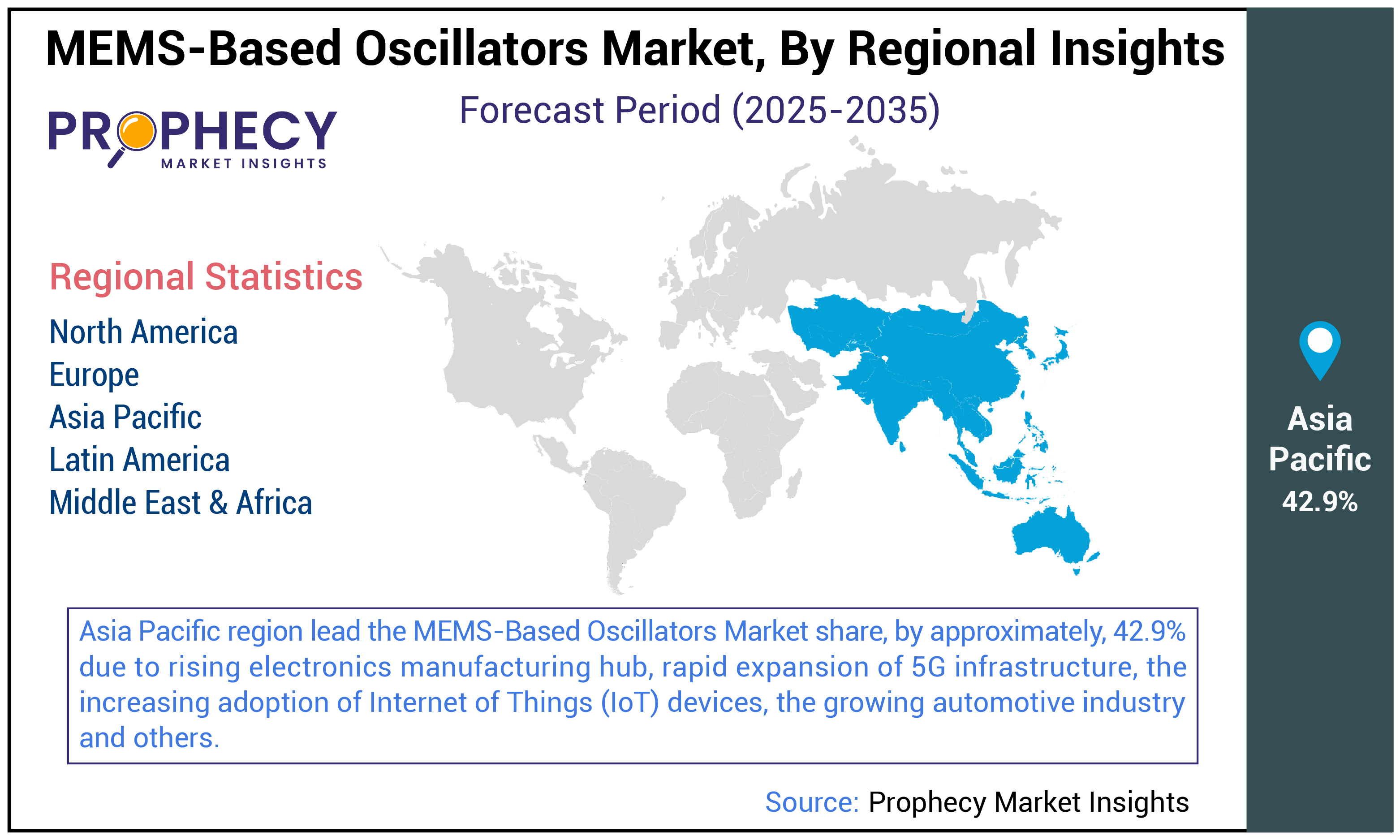
Geographically, the market is studied across North America, Europe, Asia Pacific, Latin America, and the Middle East & Africa.
Asia Pacific: This is the region which is projected to lead the MEMS-based oscillators market share, by approximately, 42.9%. This is due to this region’s electronics manufacturing hub, rapid expansion of 5G infrastructure and the increasing adoption of Internet of Things (IoT) devices and smart wearables, the growing automotive industry, a robust supply chain ecosystem and advanced manufacturing capabilities, especially in semiconductor fabrication, Government initiatives supporting electronics manufacturing and technological innovation, and he presence of key market players in this region.
- China MEMS-Based Oscillators Market Insights:
The MEMS-based oscillators market in China is the most governing market, in the recent years. This is due to China’s electronics manufacturing hub, expansion of 5G infrastructure, the rise of IoT devices, and the increasing use of automotive electronics, and the Chinese government's efforts to promote domestic microchip production and reduce reliance on foreign parts. Additionally, the increasing smartphone and consumer electronics production, also contribute in driving the market growth.
North America: This is the region which has the MEMS-based oscillators market growing with the fastest growth rate, during the forecast period, in the recent years. This is due to this region’s strong position as a hub for technological innovation and adoption, supported by a robust semiconductor manufacturing infrastructure, and major manufacturers such as Maxim Integrated Products Inc., Microchip Technology Inc., and SiTime Corporation. Moreover, the growth of industries such as telecommunications, automotive, aerospace, and defense also contribute in its market expansion.
- U.S. MEMS-Based Oscillators Market Insights:
The MEMS-based oscillators market in the U.S. is growing rapidly, in the recent years, during the forecast period. This is due to various factors, such as, the advancements in telecommunications, automobiles, aerospace, and defense industries, which are major consumers of MEMS oscillators, and emerging applications such as 5G networks, autonomous vehicles, and IoT devices. Moreover, presence of prominent market players in this country, also drive the market expansion.
Europe: The region which is experiencing significant amount of MEMS-based oscillators market growth, in the recent years, is Europe. This is due to a variety of factors, such as, this region’s strong focus on industrial automation, automotive applications, and telecommunications infrastructure, coupled with stringent quality standards and regulatory frameworks that encourage high-precision MEMS timing solutions.
- Germany MEMS-Based Oscillators Market Insights:
The MEMS-based oscillators market in Germany is experiencing considerate amount of growth, in the recent years. This is due to this region’s robust automotive industry, particularly the development of advanced driver-assistance systems (ADAS), electric vehicles, and autonomous driving technologies, focus on industrial modernization and Industry 4.0 initiatives, and adoption of MEMS oscillators in industrial automation, automotive applications, and telecommunications infrastructure.
MEMS-Based Oscillators Market Report Scope:
|
Attribute |
Details |
|
Market Size 2025 |
USD 0.4 Trillion |
|
Projected Market Size 2035 |
USD 4.0 Trillion |
|
CAGR Growth Rate |
28.8% (2025-2035) |
|
Base year for estimation |
2024 |
|
Forecast period |
2025 – 2035 |
|
Market representation |
Revenue in USD Trillion & CAGR from 2025 to 2035 |
|
Regional scope |
North America - U.S. and Canada Europe – Germany, U.K., France, Russia, Italy, Spain, Netherlands, and Rest of Europe Asia Pacific – China, India, Japan, Australia, Indonesia, Malaysia, South Korea, and Rest of Asia-Pacific Latin America - Brazil, Mexico, Argentina, and Rest of Latin America Middle East & Africa – GCC, Israel, South Africa, and Rest of Middle East & Africa |
|
Report coverage |
Revenue forecast, company share, competitive landscape, growth factors, and trends |
Segmentation:
By Type:
- Voltage Control Oscillator (VCXO)
- Temperature Compensated Oscillator (TCXO)
- Microcontroller Compensated Oscillator (MCXO)
- Spread Spectrum Oscillator (SSXO)
- Frequency Select Oscillator (FSXO)
- Digitally Controlled Oscillator (DCXO)
By Packaging Type:
- Surface-Mount Device Package
- Chip-Scale Package
By Band:
- MHz
- KHz
By End Use Industry:
- Telecommunication & Networking
- Automotive
- Aerospace & Defense
- Consumer Electronics
- Medical and Healthcare
- Others
By Region:
- North America
- U.S.
- Canada
- Europe
- Germany
- U.K.
- France
- Russia
- Italy
- Spain
- Netherlands
- Rest of Europe
- Asia Pacific
- China
- India
- Japan
- Australia
- Indonesia
- Malaysia
- South Korea
- Rest of Asia Pacific
- Latin America
- Brazil
- Mexico
- Argentina
- Rest of Latin America
- Middle East & Africa
- GCC
- Israel
- South Africa
- Rest of Middle East & Africa
Global MEMSBased Oscillators Market By Competitive Landscape & Key Players
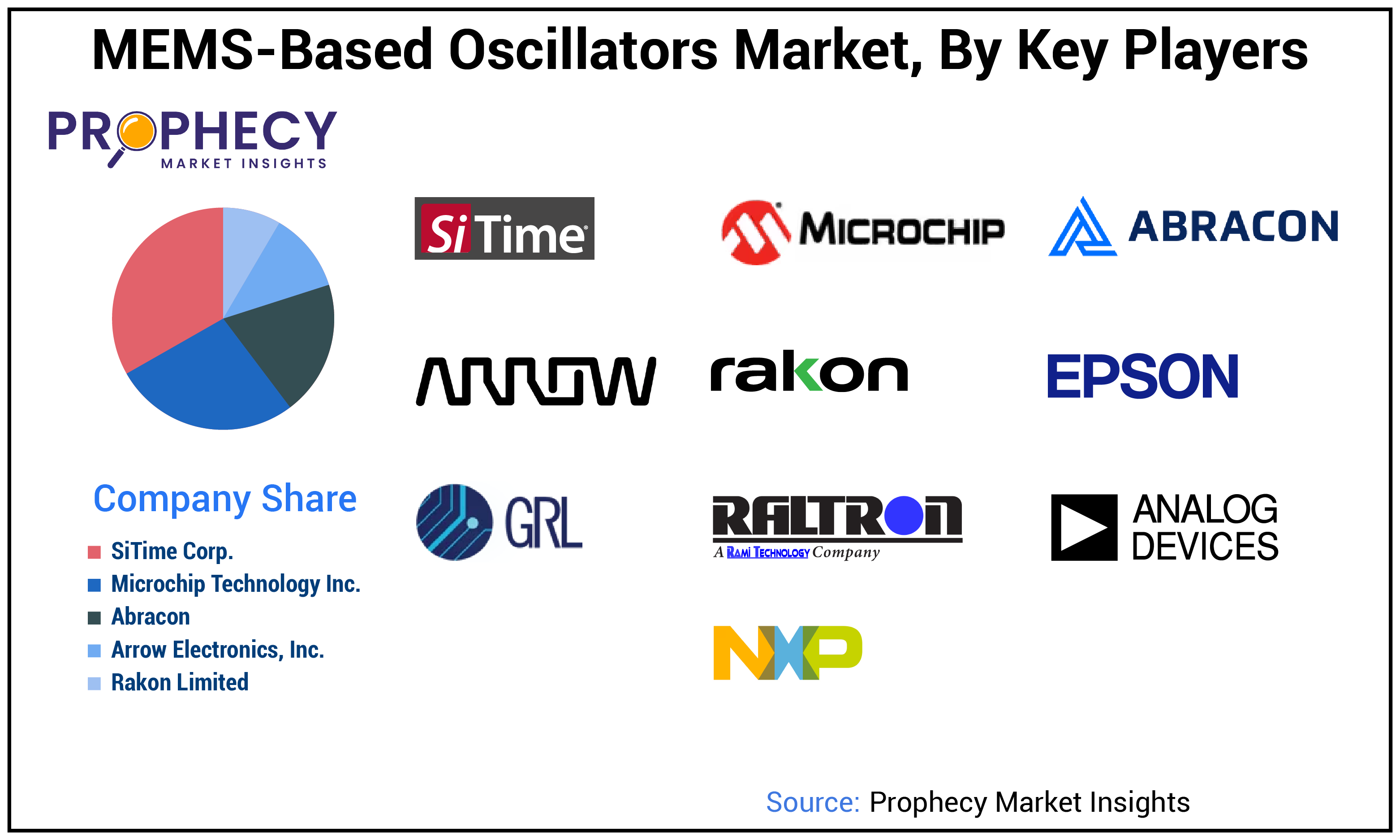
The key players operating in the market include, SiTime Corp., Microchip Technology Inc., Abracon, and others. These key players are focusing on miniaturization and performance, expanding the applications, strategic alliances and partnerships, and an increased focus on innovation, such as, AI and automation, for driving MEMS-based oscillators market growth.
MEMS-Based Oscillators Market Companies:
- SiTime Corp.
- Microchip Technology Inc.
- Abracon
- Arrow Electronics, Inc.
- Rakon Limited
- Daishinku Corp.
- Seiko Epson Corporation
- GRANITE RIVER LABS INC.
- Raltron Electronics Corporation
- Analog Devices, Inc.
- NXP Semiconductors
- JAUCH QUARTZ FRANCE
- SHENZHEN YANGXING TECHNOLOGY CO., LTD.
- HM International
- KYOCERA Corporation
View an Additional List of Companies in the MEMS-Based Oscillators Market
Global MEMSBased Oscillators Market By Recent News
- In January 2025, Leading Timing, Power, and RF solutions provider Abracon had introduced a wide range of MEM oscillators that span more than 50 product series and include more than 1,700 individual part numbers in order to help satisfy the demands of the modern electronics-based industries and the changing needs of engineers.
- In January 2025, SiTime unveiled SiT5977, a 156.25MHz oscillator based on mems that is ±1ppb/°C for data center network timing. It could drive networks up to 800G using LVDS outputs with 80fs phase jitter. The 3.5 x 5 mm box included what was billed as "the world's most accurate silicon temperature sensor."
- In August 2024, Jauch Quartz introduced a 24-hour turnaround fast-track MEMS oscillator design. The usage of silicon-based MEMS oscillators, or microelectromechanical systems, in electronics development is growing. These oscillators are a prominent timing solution on the market due to new, lower component sizes and higher quality standards including accuracy, temperature, and long-term stability.
- In April 2024, the Chorus series of clock generators for AI datacenter applications was unveiled by precision timing provider SiTime Corporation. Compared to standalone oscillators and clocks, this novel MEMS-based clock-system-on-a-chip (ClkSoC) family provided 10X enhanced performance in half the space. Chorus' novel method streamlined system clock architecture and reduced design time by up to six weeks by combining clock, oscillator, and resonator technologies into a single integrated chip.
Analyst View:
The MEMS-based oscillators market is expanding due in part to the trend toward lighter and smaller electronics, particularly in wearables and consumer electronics, and the growing usage of MEMS oscillators in automotive and aerospace applications. Additionally, MEMS oscillators are inexpensive as it may be easily integrated into electrical systems due to its compatibility with conventional semiconductor techniques.
Demand for MEMS oscillators in these industries is being driven by the rollout of 5G networks, the growing use of driverless cars, and the explosive rise of wearable technology and the Internet of Things, all of which need accurate timing and low power consumption.Furthermore, the MEMS-based oscillators market's overall growth is aided by the increasing use of RF MEMS technology in consumer electronics and LTE networks.
More Related Reports
High Voltage Aluminum Electrolytic Capacitors Market
Automotive MEMS Sensors Market
MEMS Sensors and Actuators Market
Low Voltage (LV) and Medium Voltage (MV) Switchgear Market
Medium-voltage Inverters Market
Global MEMSBased Oscillators Market By Company Profile
|
Company Name |
SiTime Corp. |
|
Headquarter |
Santa Clara, California, United States |
|
CEO |
Mr. Rajesh Vashist |
|
Employee Count (2024) |
395 Employees |
Global MEMSBased Oscillators Market By Highlights
FAQs
MEMS-based oscillators market size was valued at USD 0.4 Trillion in 2025 and is expected to reach USD 4.0 Trillion by 2035 growing at a CAGR of 28.8%.
Type, packaging type, band, end use industry, and region are the segmentation for the MEMS-based oscillators market.
North America, Asia Pacific, Europe, Latin America, and the Middle East & Africa. Asia Pacific is expected to dominate the market.
The key players operating in the MEMS-based oscillators market include SiTime Corp., Microchip Technology Inc., Abracon, Raltron Electronics Corporation, Arrow Electronics, Inc., Rakon Limited, Daishinku Corp., Seiko Epson Corporation, GRANITE RIVER LABS INC., Analog Devices, Inc., NXP Semiconductors, JAUCH QUARTZ FRANCE, SHENZHEN YANGXING TECHNOLOGY CO., LTD., HM International, and KYOCERA Corporation.