Global MEMS Sensors And Actuators Overview
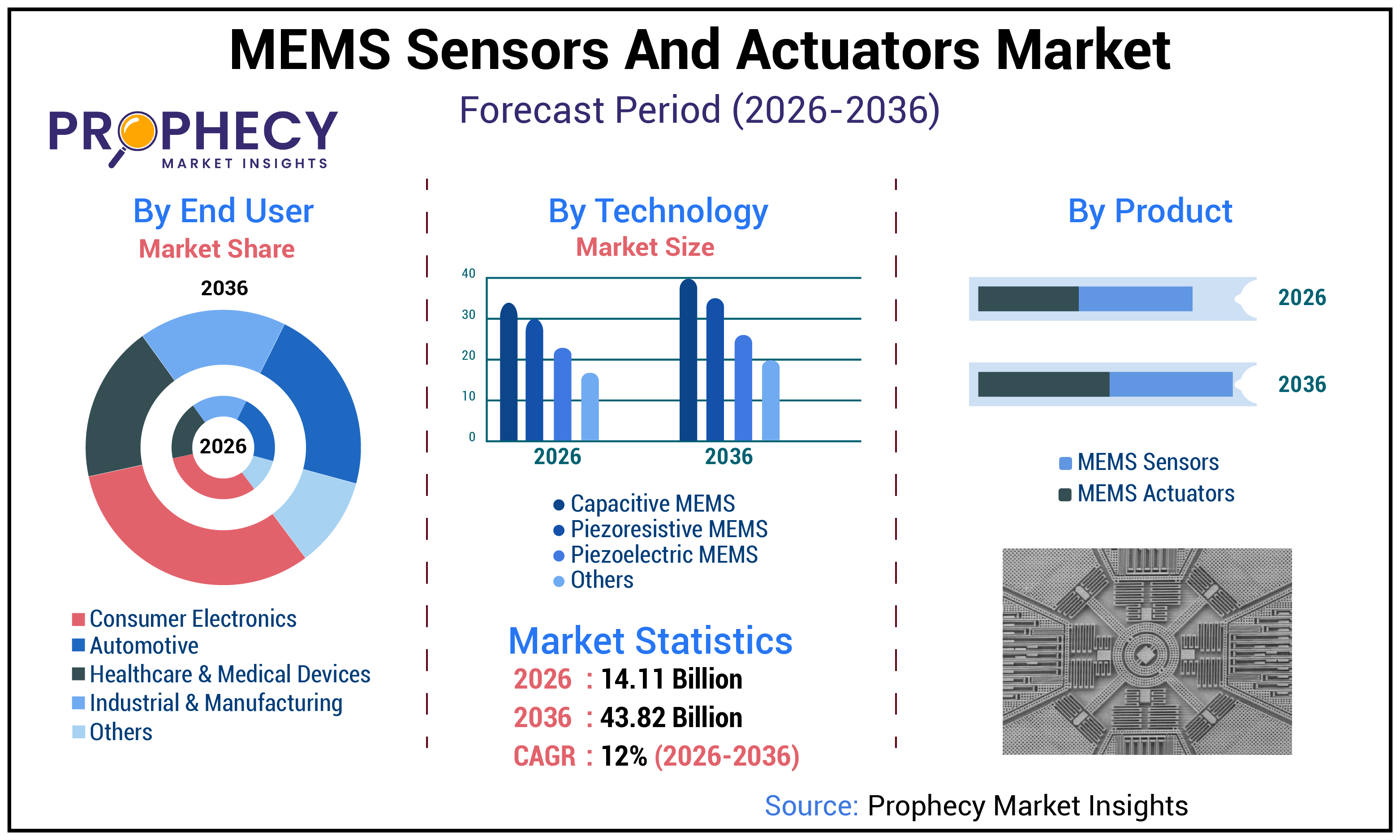
- 2025 Market Size: USD 12.60 Billion
- 2035 Projected Market Size: USD 43.82 Billion
- CAGR (2026-2036): 12%
- Asia Pacific: Largest Market in 2025
MEMS (Micro-Electro-Mechanical Systems) sensors and actuators are small-scale devices made on semiconductor wafers that integrate tiny mechanical parts with electronic circuits to sense, measure, or control physical parameters such as motion, pressure, sound, temperature, or fluid flow. MEMS sensors detect changes in the environment (e.g., acceleration, pressure, vibration), whereas MEMS actuators carry out operations as moving micro-mirrors, controlling micro valves, or switching RF signals.
Among their essential advantages are: extremely small size, low power consumption, high accuracy, fast response time, low production cost as a result of mass fabrication, and compatibility with electronics, thus they are perfect for use in smartphones, automotive systems, medical devices, industrial automation, and IoT applications.
The MEMS sensors and actuators market is rapidly expanding due to the increased demand for miniaturized, low-power, and high-performance components in consumer electronics, automotive safety systems, industrial automation, and medical devices. The proliferation of IoT, wearable technology, and smart home products is generating immense demand for compact sensors.
On the other hand, the automotive trends, such as ADAS, airbag systems, and electric vehicles, are creating the need for sophisticated MEMS-based motion and pressure sensing. In contrast to that, the growth in robotics, drones, and semiconductor manufacturing, along with the advancements in wafer-level packaging and sensor fusion technologies, is speeding up the adoption and making it possible to deliver higher performance at a lower cost.
Mechanism of MEMS Sensors and Actuators:
- MEMS sensors and actuators function via microscopic mechanical components as beams, diaphragms, cantilevers, or membranes made of silicon through semiconductor processes.
- In sensors, these minuscule components receive stimuli from nature (pressure, acceleration, sound, or temperature) and react by deformation or displacement of the component, which is then changed into an electrical signal by capacitive, piezoresistive, piezoelectric, or thermal sensing mechanisms.
- In actuators, the manner is opposite: microstructures receive electrical energy to produce movement or force by electrostatic, piezoelectric, thermal, or magnetic actuation principles.
- Such a close coupling of mechanical motion and electronic control yields devices that are very sensitive, quick, and energy-saving, and can be used in a large variety of fields.
Current Industry Dynamics & Insights:
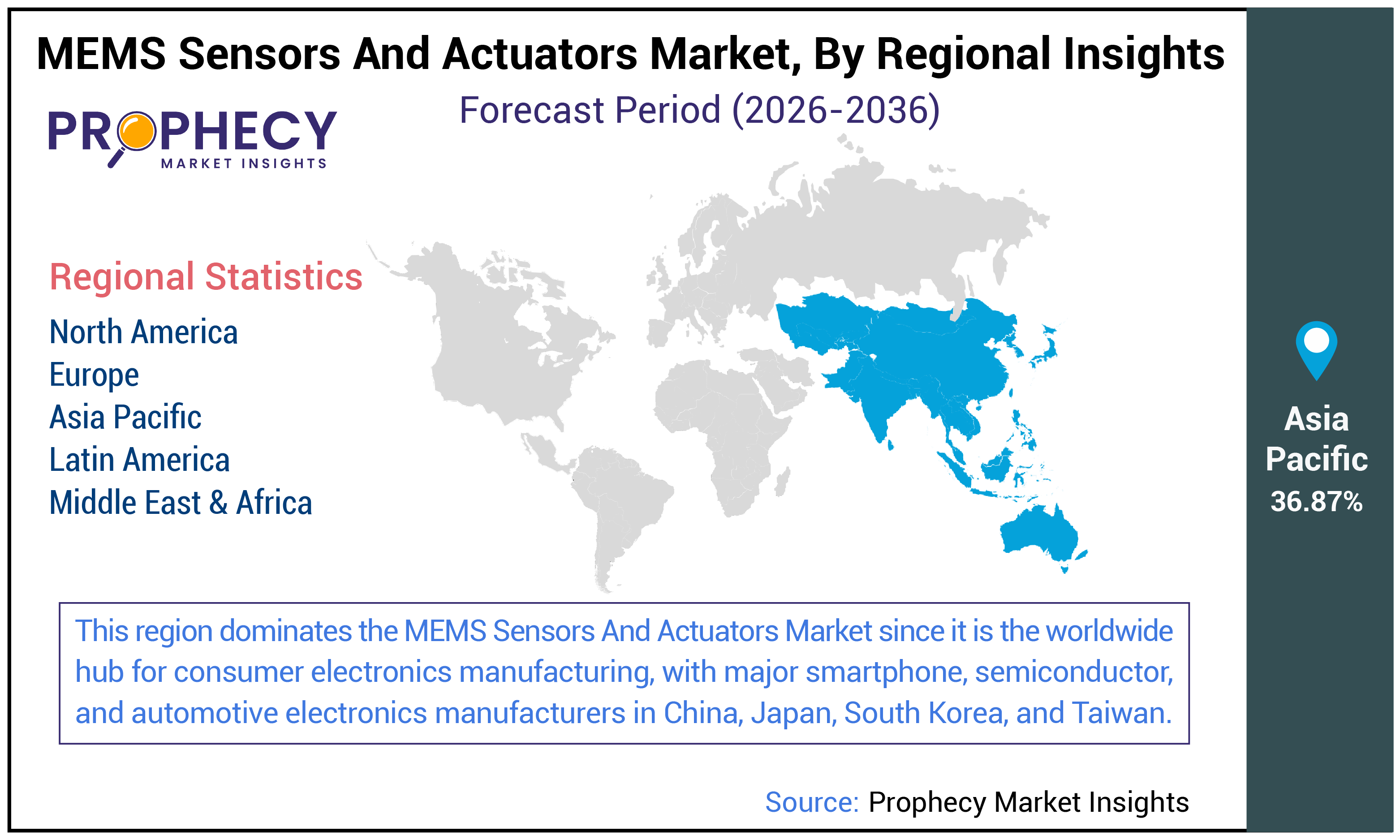
- Asia Pacific has the largest regional share in the market, with almost 36.87%.
- North America is second dominating region in the market.
- By Product, MEMS Sensors dominates the MEMS sensors and actuators market.
Global MEMS Sensors And Actuators Drivers & Restraints
Drivers and Restraints:
|
Drivers |
Restraints |
Opportunities & Trends |
|
|
|
Key Drivers:
Rising Demand for IoT Devices and Smart Home Automation
The growing need for IoT devices and smart home automation is the main factor behind the expansion of the MEMS sensors and actuators market. As the market requires a large number of small, low-power components that can keep on monitoring in a non-intrusive way motion, temperature, pressure, sound, and environmental conditions.
To name a few, smart speakers, home security systems, thermostats, wearable, and connected appliances use multiple MEMS sensors to enable real-time data collection and automated responses. The manufacturers are embedding MEMS technologies more and more as IoT devices get smarter and more popular in order to get higher performance, lower power consumption, easy connectivity, and smaller size-which is a direct way of increasing the market growth.
- For Instance, according to data published by IoT Analytics GmbH, the number of connected IoT devices reached 18.5 billion in 2024, representing a 12% growth over 2023. The number of connected IoT devices is expected to grow 14% year-over-year to 21.1 billion by the end of 2025.
Restraints:
Supply-Chain Dependency on Specialized Foundries
MEMS sensors and actuators market expansion is constrained due to the reliance of the supply chain on highly specialized MEMS foundries, which produce MEMS with unique equipment, customized process, and dedicated cleanroom capabilities that only a few global foundries have. Such a situation leads to production bottlenecks, extended lead times, increased manufacturing costs, and susceptibility to disruptions, particularly during periods of high demand.
- Counterbalance Statements: It is a viable option for companies to diversify their supply sources by engaging with several foundries, investing in fab-lite or modular manufacturing models, and using standardized MEMS process platforms (such as SOI-based or modular MEMS processes) to lessen customization and enhance scalability. The reinforcement of local manufacturing and the securing of long-term capacity agreements can also help to alleviate supply risks and foster stable market growth.
Opportunities & Trends:
Integration of AI/edge processing for Smart Sensing
One of the biggest future trends of MEMS-based smart sensing is the integration of AI and edge processing which basically allows sensors to locally analyze data, have less latency, and operate with more intelligence and energy saving. With the help of machine learning algorithms incorporated directly into sensor modules or companion chips, MEMS devices can find the patterns, do anomaly detection, and initiate the actions without the need of continuous cloud connection.
This is extremely important for such applications as predictive maintenance, autonomous systems, wearable, smart home devices, industrial automation, etc., where immediate decision-making is a must. Since AI-powered sensors can offer more precise, context-aware, and less data transmission demanding MEMS Sensors, they will be able to substantially elevate the functionalities and worth of MEMS technologies thus leading to the growth of next-generation markets.
Global MEMS Sensors And Actuators Segmentations & Regional Insights
Product, technology, material, end user, and region are the divisions of the MEMS sensors and actuators market.
By Product:
MEMS sensors, and MEMS actuators are product on which MEMS sensors and actuators market is segmented. MEMS sensors dominate the MEMS sensors and actuators market since they are widely utilized in high-volume consumer electronics such as smartphones, wearable, laptops, and IoT devices, all of which require many motion, pressure, audio, and environmental sensors. Their widespread use in car safety systems, industrial monitoring, medical devices, and smart home applications contributes to their dominance through enormous unit shipments and continual capability updates.
MEMS actuators are the second-largest segment, due to their increased use in micro-mirrors for projectors and LiDAR, RF MEMS switches for 5G, and microvalves/micropumps in medical and microfluidic applications. However, their market share remains minimal since actuator designs are more sophisticated, application-specific, and produced in lower volumes than MEMS sensors, which are widely used and standardized.
By Technology:
From the perspective of technology, the MEMS sensors and actuators market is divided into capacitive MEMS, piezoresistive MEMS, piezoelectric MEMS, and others. Capacitive MEMS technology dominates the MEMS sensors and actuators market share due to its low power consumption, high sensitivity, excellent stability, and compatibility with cost-effective CMOS fabrication. Its scalability and dependability make it the ideal MEMS Sensors for consumer electronics, vehicle safety systems, and IoT devices.
Piezoresistive MEMS is the second most popular technology, due to its excellent performance in high-accuracy pressure sensing, harsh-environment applications, and industrial/automotive systems where robustness and linearity are critical. Although piezoelectric MEMS is quickly expanding for actuators, microphones, and energy harvesting, its size remains limited due to increasing material complexity and more specialized applications.
By Material:
Silicon, polymers & flexible substrates, ceramic, and others are material of the MEMS sensors and actuators market. Silicon dominates the MEMS sensors and actuators market share since it is the fundamental material for MEMS manufacture, providing great mechanical strength, stability, compatibility with CMOS technologies, and scalability for mass production. Silicon is used to make nearly all high-volume MEMS products, including accelerometers, gyroscopes, pressure sensors, microphones, and micro mirrors, due to its precision and cost-efficiency.
Ceramic materials are the second most popular sector, particularly in high-temperature, high-pressure, and chemically hostile settings where silicon may not function well. Ceramics have high temperature resistance and long-term durability, making them perfect for industrial, aeronautical, and automotive applications. While polymers and flexible substrates are becoming more common in wearable and biomedical devices, they are still relatively modest due to poor performance and limited adoption in crucial applications.
By End User:
Consumer electronics, automotive, healthcare & medical devices, industrial & manufacturing, and others are end users of the MEMS sensors and actuators market. Consumer electronics dominates the MEMS sensors and actuators market share given that smartphones, tablets, laptops, wearable, hearable, and smart home devices use multiple MEMS components such as accelerometers, gyroscopes, microphones, pressure sensors, and environmental sensors resulting in extremely high shipment volumes that far outstrip other industries. Continuous improvements in motion sensing, audio quality, and miniaturization reinforce their dominance.
Automotive is the second-largest end user, driven by the increasing usage of MEMS sensors in ADAS, airbags, tire pressure monitoring, vehicle stability systems, and electric vehicle components. The transition to self-driving and linked vehicles is boosting demand, making automobiles the next major growth engine after consumer electronics.
Regional Insights:
Geographically, the MEMS sensors and actuators market is studied across North America, Europe, Asia Pacific, Latin America, and the Middle East & Africa.
Asia Pacific: This region dominates the MEMS sensors and actuators market since it is the worldwide hub for consumer electronics manufacturing, with major smartphone, semiconductor, and automotive electronics manufacturers in China, Japan, South Korea, and Taiwan. The region benefits from high-volume manufacturing capability, robust supply chains, big consumer markets, and significant investments in IoT, smart devices, and automotive electronics.
- China MEMS Sensors and Actuators Market Insights:
China leads the APAC MEMS sensors and actuators market due to its massive consumer electronics manufacturing ecosystem, extensive MEMS production capacity, strong supply chain integration, and high domestic demand for smartphones, wearables, IoT devices, and automotive electronics. China's rapid industrial automation and developing EV sector strengthen its leadership.
North America: This is the second-largest market, driven by high demand for advanced automotive systems, industrial automation, medical devices, and aerospace applications, as well as the existence of major MEMS developers and R&D facilities. Its technological leadership and early adoption of advanced sensing systems continue to help it maintain a considerable market position.
- U.S. MEMS Sensors and Actuators Market Insights:
The U.S. dominates North America, owing to its strong R&D base, leadership in sophisticated automotive, aerospace, medical device, and industrial automation technologies, and the presence of key MEMS developers and semiconductor businesses. The U.S. also benefits from early adoption of high-performance sensing technologies and substantial expenditures in next-generation MEMS and AI-integrated sensing systems.
Europe: The MEMS sensors and actuators market in Europe is expanding due to high demand from automobile manufacturers, industrial automation businesses, and medical device developers, which is aided by the region's emphasis on safety standards, Industry 4.0 adoption, and superior engineering capabilities.
- Germany MEMS Sensors and Actuators Market Insights:
Germany leads the European market since it is home to top automobile OEMs, industrial automation behemoths, and sensor manufacturers, making it a major center for high-performance MEMS production and application. Its excellent engineering knowledge, advanced manufacturing facilities, and emphasis on innovation help it maintain its regional leadership.
MEMS Sensors and Actuators Market Report Scope:
|
Attribute |
Details |
|
Market Size 2026 |
USD 14.11 Billion |
|
Projected Market Size 2036 |
USD 43.82 Billion |
|
CAGR Growth Rate |
12% (2026-2036) |
|
Base year for estimation |
2025 |
|
Forecast period |
2026- 2036 |
|
Market representation |
Revenue in USD Billion & CAGR from 2026 to 2036 |
|
Regional scope |
North America - U.S. and Canada Europe – Germany, U.K., France, Russia, Italy, Spain, Netherlands, and Rest of Europe Asia Pacific – China, India, Japan, Australia, Indonesia, Malaysia, South Korea, and Rest of Asia-Pacific Latin America - Brazil, Mexico, Argentina, and Rest of Latin America Middle East & Africa – GCC, Israel, South Africa, and Rest of Middle East & Africa |
|
Company Landscape |
Market Share Analysis of Companies Heat Map Analysis Company Overview, Products Overview Financial Information, Key Highlights Business Strategies Overview SWOT Analysis |
|
Report coverage |
Revenue forecast, company share, competitive landscape, growth factors, and trends |
|
Value Added Data Infosets |
Besides fundamental market insights such as the size of the market, growth rate, segmentation, regional study, and key players, our reports carry value-added data sets such as trade flow (import-export) analysis, production and consumption overview, price trend evaluation, supply and value chain mapping, and raw material availability. Moreover, we provide strategic tools as PESTLE and Porter’s Five Forces analysis, examination of the regulatory landscape, as well as monitoring of technology and innovation thereby providing a comprehensive overview which facilitates sensible and anticipatory decision-making. |
Segmentation:
By Product:
- MEMS Sensors
- Accelerometers
- Gyroscopes
- Others
- MEMS Actuators
- Microvalves & Micropumps
- RF MEMS Switches & Tuners
- Others
By Technology:
- Capacitive MEMS
- Piezoresistive MEMS
- Piezoelectric MEMS
- Others
By Material:
- Silicon
- Polymers & Flexible Substrates
- Ceramic
- Others
By End User:
- Consumer Electronics
- Automotive
- Healthcare & Medical Devices
- Industrial & Manufacturing
- Others
By Region:
- North America
- U.S.
- Canada
- Europe
- Germany
- U.K.
- France
- Russia
- Italy
- Spain
- Netherlands
- Rest of Europe
- Asia Pacific
- China
- India
- Japan
- Australia
- Indonesia
- Malaysia
- South Korea
- Rest of Asia Pacific
- Latin America
- Brazil
- Mexico
- Argentina
- Rest of Latin America
- Middle East & Africa
- GCC
- Israel
- South Africa
- Rest of Middle East & Africa
Global MEMS Sensors And Actuators Competitive Landscape & Key Players
MEMS Sensors and Actuators companies can grow by expanding their product portfolios with more miniaturized, low-power, and multifunctional sensors, investing in advanced fabrication technologies like wafer-level packaging and monolithic integration, and forming strategic partnerships with consumer electronics, automotive, and industrial OEMs to secure long-term demand. Companies are also working on developing AI-enabled and edge-processing smart sensors, improving supply chain resilience through multi-foundry collaborations, and targeting high-growth industries such as IoT, EVs, healthcare diagnostics, and autonomous systems.
MEMS Sensors and Actuators Market Companies:
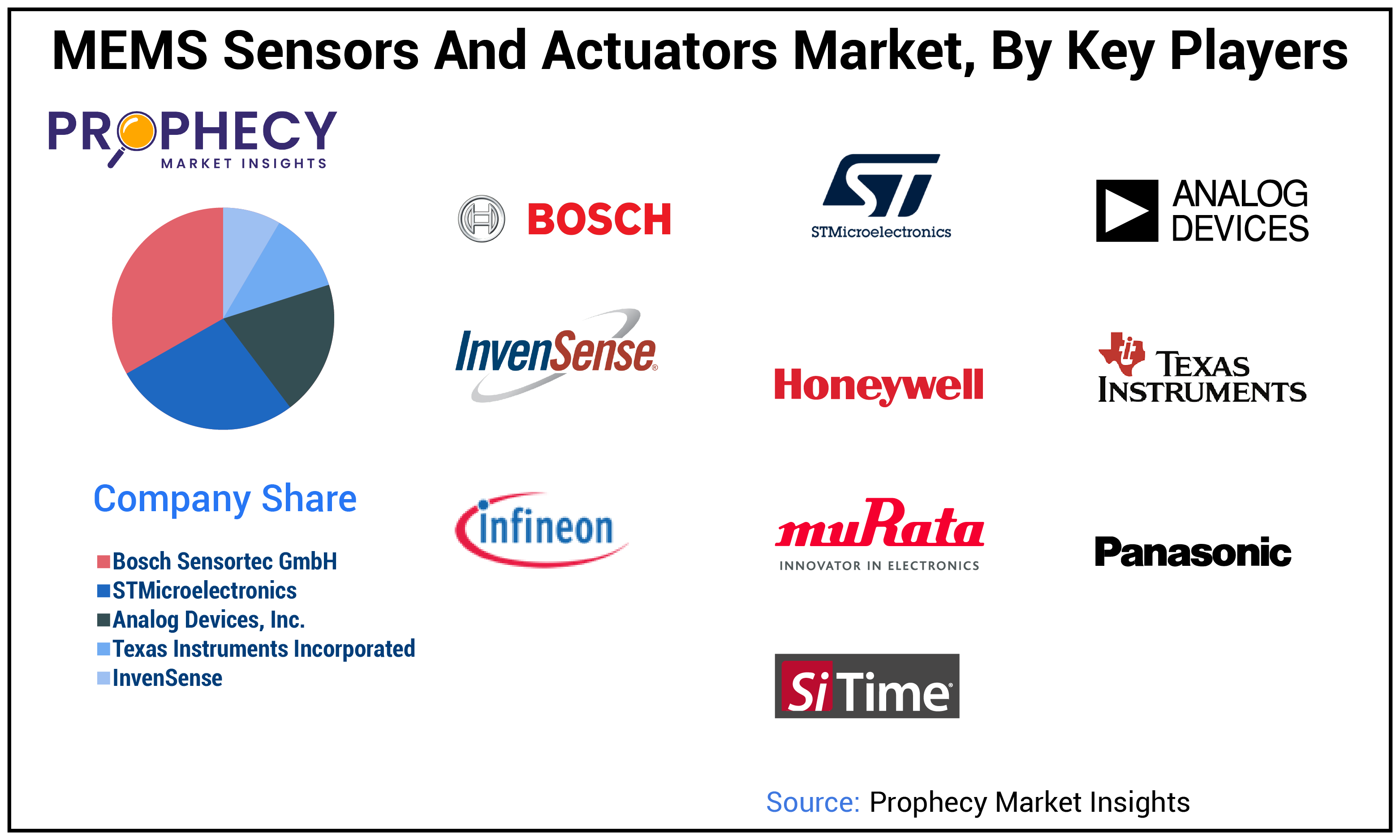
- Bosch Sensortec GmbH
- STMicroelectronics
- Analog Devices, Inc.
- Texas Instruments Incorporated
- InvenSense
- Honeywell International Inc.
- TE Connectivity
- Murata Manufacturing Co., Ltd.
- Infineon Technologies AG
- SUMITOMO PRECISION PRODUCTS Co., Ltd.
- ROHM CO., LTD.
- Panasonic Corporation
- Safran Group
- Goermicro
- SiTime Corp.
View an Additional List of Companies in the MEMS Sensors and Actuators Market
Global MEMS Sensors And Actuators Recent News
- In January 2024, A.M. Fitzgerald & Associates, LLC, a microelectromechanical systems (MEMS) product development firm, and Sumitomo Precision Products Co., Ltd. MEMS Infinity, a full-service MEMS silicon wafer foundry, announced a strategic and technical partnership to accelerate the commercialization of thin-film PZT MEMS chip technology.
- In September 2023, Sheba Microsystems Inc., a global leader in MEMS technologies, has announced the release of a revolutionary new product: the MEMS Autofocus Actuator for Active Athermalization in Embedded Vision Cameras, which will be used in automotive, action, drones, machine vision, security and surveillance, and mobile robots.
Analyst View:
MEMS sensors and actuators are miniature semiconductor-based devices that use microscopic mechanical structures and electronics to detect or regulate physical factors such as motion, pressure, sound, and temperature. Their ultra-small size, low power consumption, great accuracy, and low production costs make them indispensable in smartphones, automotive systems, medical devices, industrial automation, and Internet of Things applications.
The market is quickly expanding because to increased demand for tiny, high-performance components in consumer electronics, automotive safety systems, IoT devices, wearables, smart homes, robots, and drones. Advances in wafer-level packaging, sensor fusion, and semiconductor manufacturing are hastening adoption by improving performance, increasing integration, and lowering total system costs.
Analysis of Sources:
Primary Sources:
- In-depth interviews
- Company-specific data
- Surveys and questionnaires
- Focus group discussions (FGDs)
- Others
Secondary Sources:
- National Institute of Standards and Technology (NIST)
- NASA Technical Reports Server (NTRS)
- U.S. Department of Energy (DOE)
- Others
More Related Reports
Biometric Sensors Market
Disposable Medical Sensors Market
Oil & Gas Sensors Market
Automotive MEMS Sensors Market
Magnetic Sensors Market
Global MEMS Sensors And Actuators Company Profile
|
Company Name |
Product Portfolio |
|
STMicroelectronics |
MEMS and Sensors |
|
InvenSense |
MEMS and Magnetic Sensors |
|
Bosch Sensortec GmbH- |
microelectromechanical systems (MEMS) based sensors and solutions |
|
Honeywell International Inc. |
MEMS Sensor Technology |
|
TE Connectivity |
MEMS Accelerometers |
Global MEMS Sensors And Actuators Highlights
FAQs
MEMS sensors and actuators market size was valued at USD 14.11 Billion in 2026 and is expected to reach USD 43.82 Billion by 2036 growing at a CAGR of 12%.
Product, technology, material, end user, and region are the segmentation for the MEMS sensors and actuators market.
Increasing demand for advanced safety features and autonomous driving in the automotive industry, the need for enhanced performance in consumer electronics as smartphones and AR/VR headsets, and so on are some of the MEMS sensors and actuators market growth drivers.
North America, Asia Pacific, Europe, Latin America, and the Middle East & Africa. Asia Pacific is expected to dominate the MEMS sensors and actuators market.
The key players operating the MEMS sensors and actuators market include Bosch Sensortec GmbH, STMicroelectronics, Analog Devices, Inc., TEXAS INSTRUMENTS INCORPORATED, InvenSense, Honeywell International Inc., TE Connectivity, Murata Manufacturing Co., Ltd., SilexPro, SUMITOMO PRECISION PRODUCTS Co., Ltd., ROHM CO., LTD., PANASONIC CORPORATION, Safran Group, Goermicro, and SiTime Corp.