Global Intelligent Braking Systems Market Overview
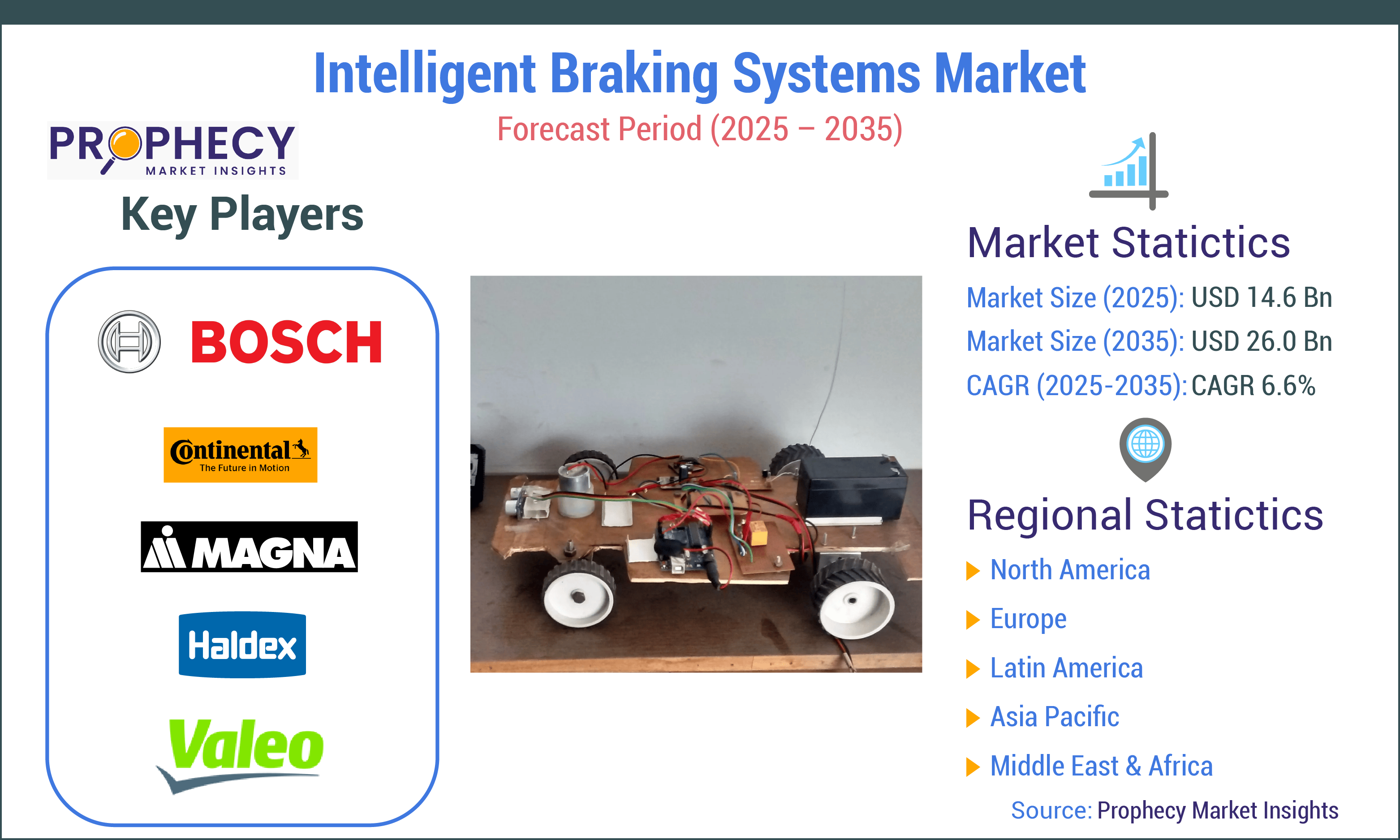
- Intelligent braking systems market size is expected to expand at a rate of USD 26.0 Billion, by 2035.
- In 2024, the market valuation was USD 13.6 Billion.
- Intelligent braking systems market is growing at a CAGR 6.6%.
Intelligent braking systems are advanced vehicle braking technologies that go beyond basic braking by incorporating sensors and electronic control units to enhance safety and efficiency. These systems use data from sensors to assess the driving environment, anticipate potential hazards, and automatically apply the brakes to reduce the risk of accidents. It offers advantages, including improved safety, enhanced driver control, and increased efficiency. These systems use advanced sensors and algorithms to optimize braking performance in various conditions, reducing stopping distances, preventing wheel lock-up, and assisting in collision avoidance.
The intelligent braking systems market is experiencing growth due to factors, such as, due to the rising vehicle production, implementation of more stringent regulations on government regarding vehicle safety, particularly concerning braking performance and accident prevention, consumers are increasingly prioritizing vehicles equipped with advanced safety features, rise of electric and hybrid vehicles is boosting the demand for regenerative braking systems, and increasing adoption of intelligent braking systems in commercial vehicles.
The market’s augmentation is also stimulated by innovations in braking technology, such as autonomous emergency braking (AEB), anti-lock braking systems (ABS), and electronic stability control (ESC), are driving the market. In addition to this, consumer awareness and safety concerns about road accidents are prompting a higher demand for vehicles with advanced safety technologies such as intelligent braking systems.
Recession Risk and Tariff Analysis:
- Due to economic uncertainty and high implementation costs, the market for intelligent braking systems (IBS) is vulnerable to recessionary threats. IBS adoption may be slowed during recessions since customers may place a higher value on price than cutting-edge safety features. Nonetheless, strict safety laws and the development of electric and driverless cars continue to fuel demand, reducing some of the effects of the recession.
- Intelligent braking system (IBS) tariffs have the potential to have a big effect on the global vehicle industry. Price and adoption rates may be impacted by higher production costs brought on by high import taxes on parts such as sensors and electronic control units. Tariff reductions, on the other hand, can improve market accessibility and encourage the global integration of IBS in automobiles.
Impact of Generative AI on Intelligent Braking Systems Market:
- Design, simulation, and real-time decision-making are all being improved by generative AI, which is revolutionizing the intelligent braking systems (IBS) sector. It hastens the creation of sophisticated brake algorithms, which improves the precision with which systems anticipate and react to challenging driving situations.
- Numerous braking circumstances may be simulated using AI-generated models, increasing system safety and dependability. Furthermore, by minimizing system mistakes, generative AI helps to optimize the processing of sensor data. Costs are decreased, R&D efficiency is increased, and IBS integration in autonomous cars is supported by this breakthrough.
Global Intelligent Braking Systems Market Drivers & Restraints
Key Drivers:
Rising Adoption of Electric Cars is Propelling the Market Expansion
The intelligent braking systems market growth is due to the growing popularity of electric vehicles. Advanced braking systems such as regenerative braking, which complement IBS to increase economy and safety, are crucial to electric cars (EVs). Manufacturers are incorporating sophisticated technologies to improve control, lower energy loss, and guarantee smoother operation as EVs become more and more popular. IBS is a vital part of EV development and is growing in demand worldwide as a result of this trend, which promotes further innovation in braking technology.
- For instance, according to the data published by Global Change Data Lab, Electric vehicle sales began slowly but are now rapidly increasing in several areas. In 2023, around one out of every five new automobiles sold worldwide were electric. 3. In China, it was about 40%, while in Norway, it was over 90%.
Restraints:
The Dependence of Intelligence Breaking System on Complex Sensors is limiting the Market Growth
Intelligent braking systems’ (IBS) reliance on intricate sensor and software integration is one drawback, which occasionally results in malfunctions or incorrect readings of real-time data. Environmental elements that impede sensors, such as heavy rain, snow, or debris, might lower the accuracy and efficacy of the system. Vehicle safety may be jeopardized by delayed or needless braking caused by inaccurate data. Furthermore, relying too much on automation might make drivers less alert, which would raise the stakes in circumstances where manual intervention is essential.
- Counterbalance Statements: Reliability may be increased by strengthening sensor resilience with waterproof designs and redundant sensing systems. Real-time diagnostics and routine software upgrades guarantee that systems remain correct. By including driver alerts and semi-automatic overrides, safety is maintained even in the event of sensor failure or erratic driving circumstances.
Opportunities & Trends:
Technological Advancements in Intelligent Braking Systems is Opening Up Growth Opportunities for the Future Generations
Future market expansion is being greatly aided by technological developments in intelligent braking systems (IBS). Advancements including machine learning algorithms, AI-powered decision-making, and better sensor integration increase response times, braking precision, and adaptation to challenging driving conditions. New safety standards are being set by features such as adaptive cruise control, predictive braking, and vehicle-to-everything (V2X) communication integration. In addition to enhancing vehicle performance, these advancements meet customer demand for advanced driver-assistance systems (ADAS) and regulatory trends. The need for advanced IBS will increase as cars get smarter and more self-sufficient, making it a vital component of transportation systems of the future.
Global Intelligent Braking Systems Market Segmentations & Regional Insights
The intelligent braking systems market is segmented into component, product type, vehicle type, application, distribution channel, and region.
By Component:
Contingent to component, the market is sub-segmented into ultrasonic sensor, solenoid valve, dc motor, single acting pneumatic cylinder, and others. The ultrasonic sensors is the most dominating component in the intelligent braking systems market share. This is due to its widespread use in various applications, including distance detection, obstacle avoidance, and collision prevention. The combination of cost-effectiveness and the ability to reliably detect objects in the surrounding environment makes it a popular choice for intelligent braking systems.
The solenoid valve is the second dominating component in the target market. This is due to its importance in controlling airflow in pneumatic systems, which are commonly used in automatic braking systems, especially for tasks such as parking assist and emergency braking.
By Product Type:
Appertaining from product type, the market is divided into anti-lock braking system (ABS), electronic braking system (EBS), and others. The anti-lock braking system (ABS) is the leading product type in the intelligent braking systems market share. This is due to the widespread adoption of ABS in vehicles due to its effectiveness in preventing wheel lock-up during braking, thereby enhancing steering control and reducing accident risk. ABS also plays a crucial role in meeting stringent safety regulations and increasing consumer demand for safety features.
The electronic braking system (EBS) is the second leading product type in the intelligent braking systems market. This is due to its importance for enhancing vehicle stability and preventing skidding or loss of control during cornering or evasive maneuvers.
By Vehicle Type:
On the foundation of vehicle type, the market is trifurcated into passenger cars, commercial vehicles, and electric vehicles. The passenger cars segment is attributed to rule over the intelligent braking systems market share. This is due to factors, such as, rising safety regulations, consumer demand for advanced features, and the increasing adoption of electric vehicles. This trend is expected to continue, with passenger cars also expected to see the highest growth in the market.
Commercial vehicles is the fastest growing vehicle type, in the target market. This is due to the growing road freight industry, increased investments in construction and public transportation, and stringent safety regulations for these vehicles.
By Application:
Depending upon application, the market is classified into aircraft, automotive, industrial equipment, trains, and others. The automotive segment is expected to govern the intelligent braking systems market size. This is due to the sheer volume of passenger vehicles produced globally, and the increasing implementation of safety regulations and advanced technologies such as ABS, EBD, ESC, and AEB in cars.
The train segment is the application experiencing subsequent growth. This is due to a combination of factors, including the increasing demand for efficient and safe rail transportation, the growing urbanization and associated investments in public transport, and the development of innovative braking technologies such as electronically controlled pneumatic brakes.
By Distribution Channel:
Based on distribution channel, the market is categorized into OEM, aftermarket, and others. The OEM (Original Equipment Manufacturer) segment is the most influential distribution channel. This is due to the fact that vehicle manufacturers directly integrate these systems into new vehicles, driving demand from the outset. While the aftermarket (including retail and wholesale) is significant for replacements and upgrades, it lags behind OEM in overall volume due to the continuous flow of new vehicles with integrated systems.
The aftermarket segment is the fastest growing segment in the target market. This is due to the increasing number of vehicles on the road and the need for replacement or upgrades as it ages.
Regional Insights:
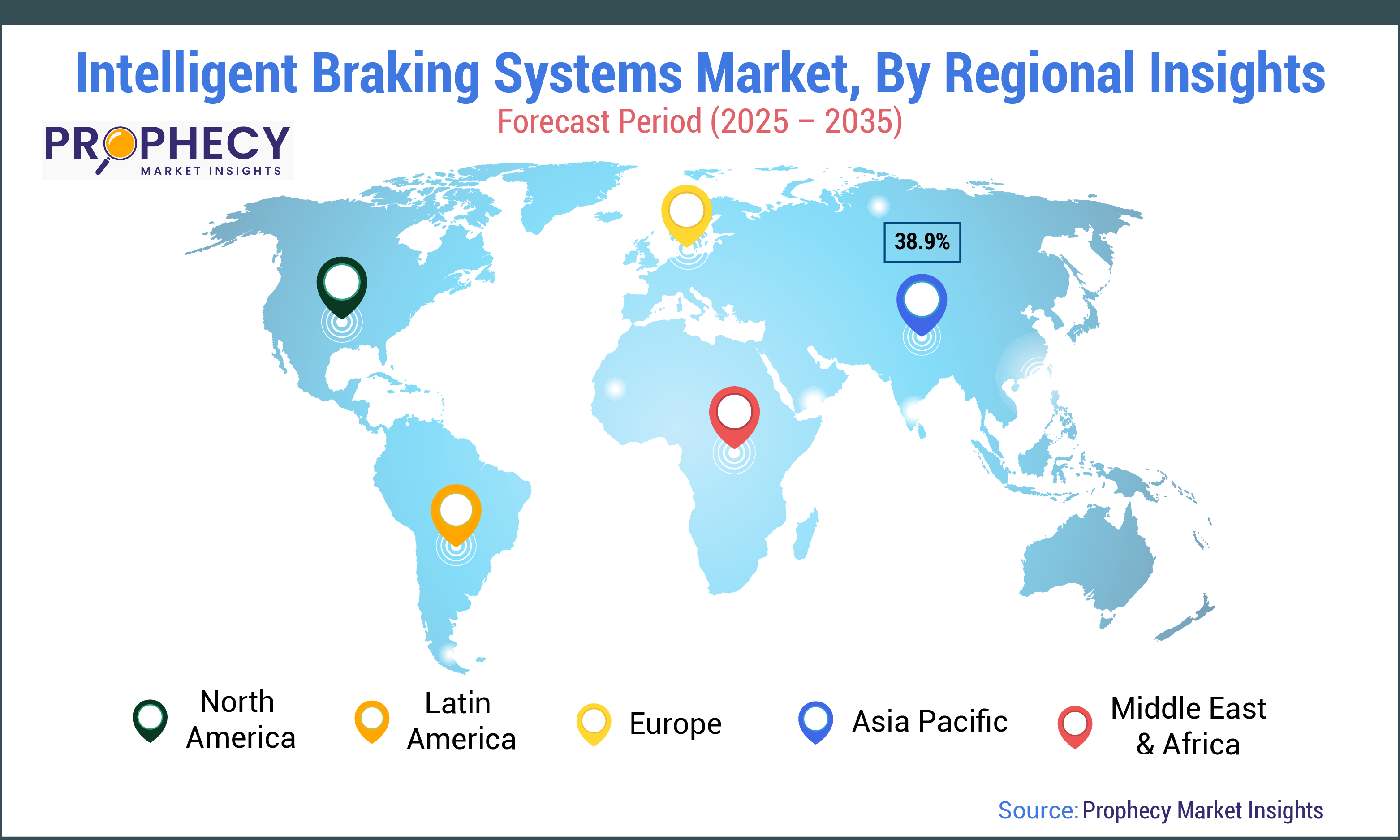
Geographically, the market is analyzed across North America, Europe, Asia Pacific, Latin America, and the Middle East & Africa.
Asia Pacific: This is the region which holds the superior intelligent braking systems market share by approximately, 38.9%, in the recent years. This is due to a combination of factors, including a large and rapidly growing automotive industry, rising vehicle sales, increasing adoption of safety features, and a focus on road safety due to growing traffic issues and accidents. Moreover, the region's strong automotive manufacturing base, coupled with major automakers, further fuels this dominance. Additionally, the increasing adoption of advanced safety features such as ABS and ESC, along with growing demand for safer and more affordable vehicles, contribute to the high demand for intelligent braking systems.
- China Intelligent Braking Systems Market Insights:
The intelligent braking systems market in China is the most governing market, in the recent years. This is due to various factors, such as, this country’s massive vehicle production, strong internal demand, and growing electric vehicle adoption, which drives the need for advanced safety features such as automatic emergency braking. China's extensive manufacturing network also enables the widespread implementation of these systems. Moreover, the rise of electric vehicles (EVs) in China requires sophisticated braking systems, including regenerative braking, which are often integrated with intelligent braking systems.
Europe: This is the region which has the intelligent braking systems market growing with the fastest growth rate, during the forecast period, in the recent years. This is due to a combination of factors, such as, European countries have implemented regulations that mandate the installation of advanced driver-assistance systems (ADAS), it boasts a robust automotive industry with leading manufacturers, OEMs in Europe are actively investing in the research and development of advanced brake systems, increasing focus on safety and sustainability, and high exports in this region.
- Germany Intelligent Braking Systems Market Insights:
The intelligent braking systems market in Germany is growing with the highest CAGR, during the forecast period, in the recent years. This is due to this country’s strong emphasis on road safety and stringent regulations, including mandating the installation of advanced driver-assistance systems (ADAS) such as autonomous emergency braking (AEB) in new vehicles, a robust automotive industry with major manufacturers and suppliers, technological development in various areas, and a high level of disposable income in Europe also allows for the purchase of vehicles with more advanced features, including intelligent braking systems.
North America: The region which has the intelligent braking systems market experiencing significant growth, in the recent years, is North America. This is due to a combination of factors, including stringent safety regulations, a strong established automotive industry, and a growing demand for advanced technologies such as electronic brake systems. The region's market is also driven by the increasing adoption of electric and hybrid vehicles, further fueling the need for efficient and modern braking solutions.
- U.S. Intelligent Braking Systems Market Insights:
The intelligent braking systems market in the U.S. is experiencing considerate amount of growth, in the recent years. This is due to several factors, including a robust manufacturing infrastructure, significant technological innovation capabilities, and a growing adoption of advanced braking systems, especially in electric and autonomous vehicles. Moreover, the US market is seeing a surge in demand for electric and autonomous vehicles, has a strong focus on vehicle safety regulations, which encourages the adoption of advanced braking systems, and consumers in the US increasingly favor vehicles with advanced safety features, further boosting the demand for intelligent braking systems.
Intelligent Braking Systems Market Report Scope:
|
Attribute |
Details |
|
Market Size 2025 |
USD 14.6 Billion |
|
Projected Market Size 2035 |
USD 26.0 Billion |
|
CAGR Growth Rate |
6.6% (2025-2035) |
|
Base year for estimation |
2024 |
|
Forecast period |
2025 – 2035 |
|
Market representation |
Revenue in USD Billion & CAGR from 2025 to 2035 |
|
Regional scope |
North America - U.S. and Canada Europe – Germany, U.K., France, Russia, Italy, Spain, Netherlands, and Rest of Europe Asia Pacific – China, India, Japan, Australia, Indonesia, Malaysia, South Korea, and Rest of Asia-Pacific Latin America - Brazil, Mexico, Argentina, and Rest of Latin America Middle East & Africa – GCC, Israel, South Africa, and Rest of Middle East & Africa |
|
Report coverage |
Revenue forecast, company share, competitive landscape, growth factors, and trends |
Segmentation:
By Component:
- Ultrasonic Sensor
- Solenoid Valve
- DC Motor
- Single Acting Pneumatic Cylinder
- Others
By Product Type:
- Anti-Lock Braking System (ABS)
- Electronic Braking System (EBS)
- Others
By Vehicle Type:
- Passenger Cars
- Commercial Vehicles
- Electrical Vehicles
By Application:
- Aircraft
- Automotive
- Industrial Equipment
- Train
- Others
By Distribution Channel:
- OEM
- Aftermarket
- Others
By Region:
- North America
- U.S.
- Canada
- Europe
- Germany
- U.K.
- France
- Russia
- Italy
- Spain
- Netherlands
- Rest of Europe
- Asia Pacific
- China
- India
- Japan
- Australia
- Indonesia
- Malaysia
- South Korea
- Rest of Asia Pacific
- Latin America
- Brazil
- Mexico
- Argentina
- Rest of Latin America
- Middle East & Africa
- GCC
- Israel
- South Africa
- Rest of Middle East & Africa
Global Intelligent Braking Systems Market Competitive Landscape & Key Players
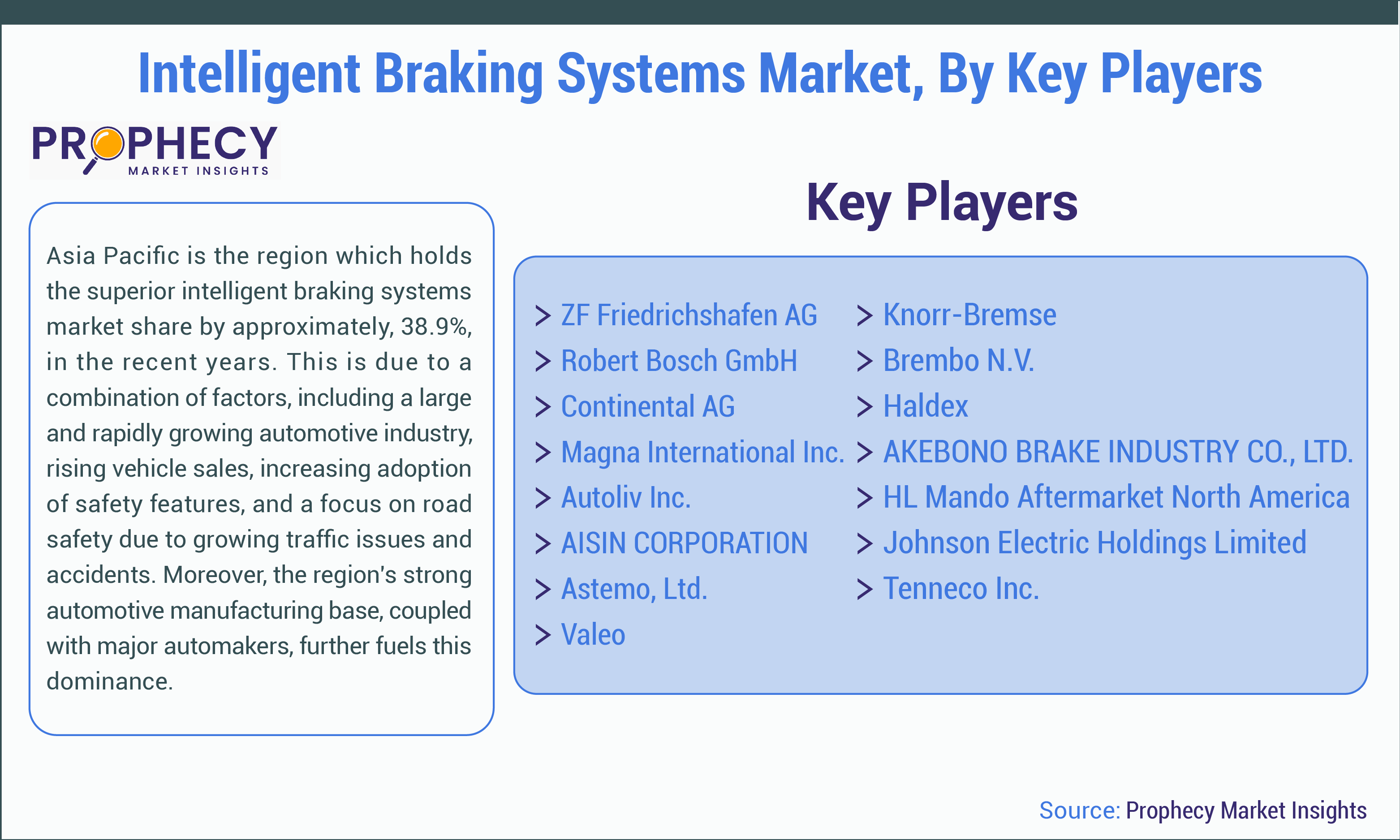
The key players operating in the market include, ZF Friedrichshafen AG, Robert Bosch GmbH, Continental AG, and others. These key players are focusing on technological advancements, regulatory compliance, and market expansion to drive growth. Specifically, this includes investing in research and development for improved systems, addressing concerns such as pollution and high replacement costs, and adapting to the needs of the EV market and the rise of electric two-wheelers, for driving intelligent braking systems market growth.
Intelligent Braking Systems Market Companies:
- ZF Friedrichshafen AG
- Robert Bosch GmbH
- Continental AG
- Magna International Inc.
- Autoliv Inc.
- AISIN CORPORATION
- Astemo, Ltd.
- Valeo
- Knorr-Bremse
- Brembo N.V.
- Haldex
- AKEBONO BRAKE INDUSTRY CO., LTD.
- HL Mando Aftermarket North America
- Johnson Electric Holdings Limited
- Tenneco Inc.
View an Additional List of Companies in the Intelligent Braking Systems Market
Global Intelligent Braking Systems Market Recent News
- In April 2025, The Electro-Mechanical Brake (EMB) system, a cutting-edge Brake-by-Wire (BbW) technology that offers software-defined chassis integration and improves safety, comfort, and serviceability, was introduced by Nexteer Automotive. The business deliberately expanded into "Motion-by-Wire" chassis control and developed a modular, high-precision braking system by utilizing its technological building blocks.
- In April 2025, The Electronic Brake Performance Monitoring System (EBPMS) was introduced by Samsara Inc., the creator of the Connected Operations Platform, to assist fleet operators in adhering to the Driver and Vehicle Standards Agency's (DVSA) new regulations that are about to take effect. These regulations require fleets to execute four burdened brake performance evaluations annually using roller brake tests (RBTs), which is time-consuming and expensive.
- In December 2024, Brembo, a world leader in the design, development, and manufacturing of braking solutions, and Michelin, a prominent tire manufacturer and cutting-edge composites expert, inked a global agreement to fully utilize its clever solutions in order to transform vehicle performance and provide drivers with the highest standards of comfort and safety.
- In August 2021, a smart braking electric brake booster motor that significantly increases vehicle energy economy and substantially reduces emergency braking lengths was introduced by Johnson Electric. Now in mass production, the motor is found in a number of the top-selling electric cars in North America.
Analyst View:
The intelligent braking systems market is expanding due to a number of factors, including increased vehicle production, stricter government regulations pertaining to vehicle safety, consumers' preference for cars with cutting-edge safety features, the rise of electric and hybrid vehicles, which is driving up demand for regenerative braking systems, and the growing use of intelligent braking systems in commercial vehicles. Advances in braking technology, including electronic stability control (ESC), anti-lock braking systems (ABS), and autonomous emergency braking (AEB), are also propelling the industry. Additionally, there is a growing demand for cars with cutting-edge safety features such intelligent braking systems due to consumer awareness and safety concerns about traffic accidents.
More Related Reports
Cognitive Electronic Warfare System Market
Electronic Medical Record Market
Electronic Chemicals Market
Automotive Electronic Control Unit Market
Electronic Film Market
Global Intelligent Braking Systems Market Company Profile
|
Company Name |
ZF Friedrichshafen AG |
|
Headquarter |
Friedrichshafen, Germany |
|
CEO |
Dr. Holger Klein |
|
Employee Count (2024) |
161,631 Employees |
Global Intelligent Braking Systems Market Highlights
FAQs
Intelligent braking systems market size was valued at USD 14.6 Billion in 2025 and is expected to reach USD 26.0 Billion by 2035 growing at a CAGR of 6.6%.
Component, product type, vehicle type, application, distribution channel, and region are the segmentation for the target market.
North America, Asia Pacific, Europe, Latin America, and the Middle East & Africa. Asia Pacific is expected to dominate the market.
The key players operating in the intelligent braking systems market include ZF Friedrichshafen AG, Robert Bosch GmbH, Continental AG, Knorr-Bremse, Magna International Inc., Autoliv Inc., AISIN CORPORATION, Astemo, Ltd., Valeo, Brembo N.V., Haldex, AKEBONO BRAKE INDUSTRY CO., LTD., HL Mando Aftermarket North America, Johnson Electric Holdings Limited, and Tenneco Inc.