Global Hyperlocal Services Market Overview
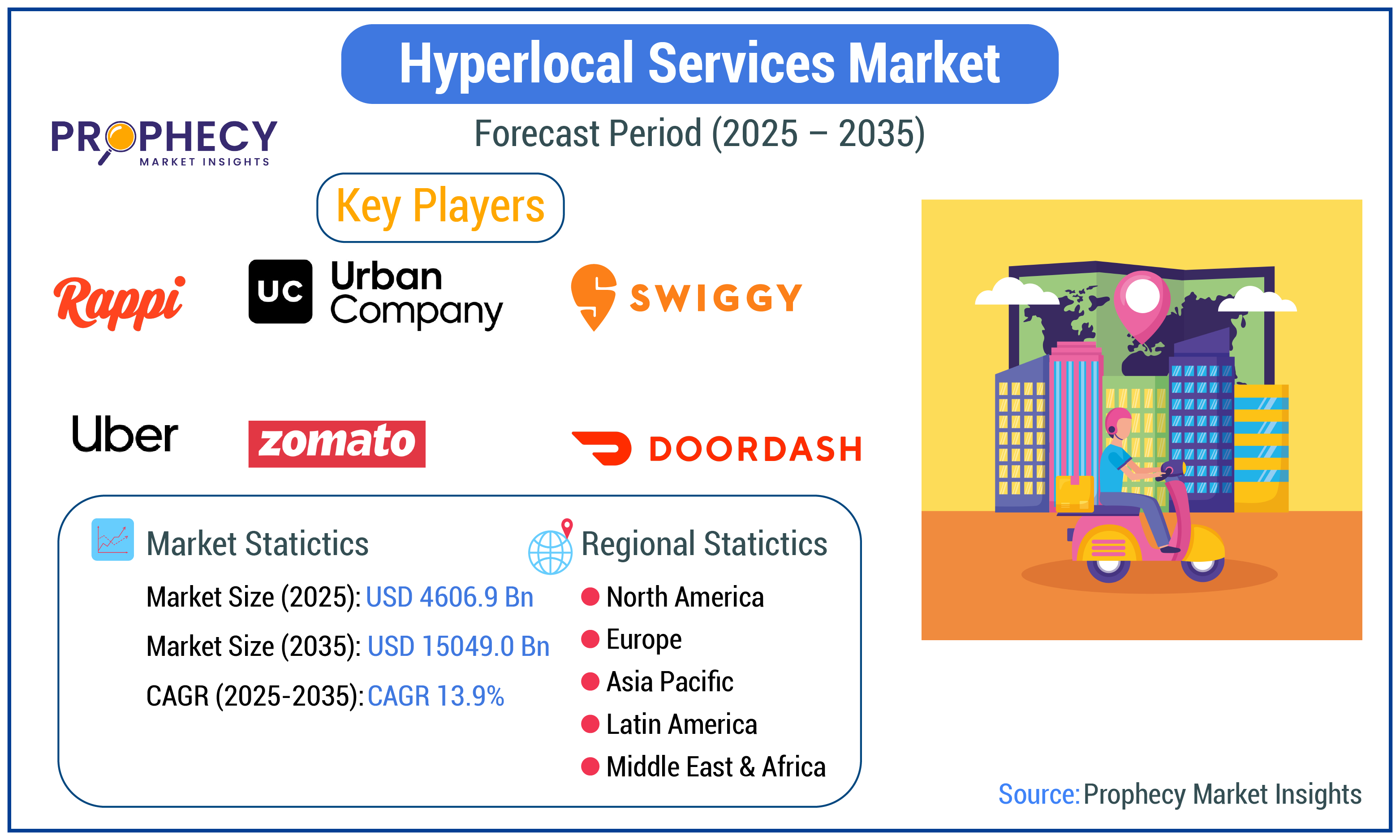
- By 2035, hyperlocal services market size is contemplated to enlarge at a valuation of USD 15049.0 Billion.
- In 2024, the hyperlocal services market valuation was USD 4013.9 Billion.
- Hyperlocal services market is developing at a CAGR of 13.9%.
Hyperlocal services are delivery and service offerings that take place over a limited geographical area to service an immediate need by customers. Hyperlocal services include food delivery, home services, grocery supply and services, and logistics services. Hyperlocal services connect local businesses with local consumers through digital platforms to provide speed, convenience and value.
The hyperlocal services market is growing rapidly from increasing smartphone adoption, and desire for instant delivery. Today's consumers place more value on convenience, speed, and personalization, which is causing businesses to shift towards localized service delivery models. The COVID-19 pandemic drove greater reliance on digital services and increased dependency on goods and services delivered to people's homes. New business models from startups through to established companies are utilizing location-based technologies to satisfy consumer expectations for efficient, real-time and consumer-driven local services.
The prospects for hyperlocal service provision look bright with advances in AI, real-time tracking, and automation of logistics functions. The expansion of hyperlocal service provision into rural and tier-2 cities accelerated by the creation of sustainable logistics solutions will further propel growth. As the needs and preferences of the consumer continue to evolve, hyperlocal service provision and platforms will enhance personalization of offerings and expand last mile connections.
Recession Risk & Tariff Analysis:
- In a recession, reduced consumer spending can affect hyperlocal services, particularly non-essential categories such as food delivery or beauty services directly. The situation can lead to declining order volumes, increased competition, smaller margins, and possibly force smaller service providers to reduce their resource levels or exit the hyperlocal market all together. Customer retention, efficiency and operating costs are vital to survival.
- Hyperlocal services are mainly for domestic consumption and tariffs are mainly on imported goods such as electronics, fuel, or packaged food. Tariffs can inflate the costs for the currency that is regularly delivered. This will affect pricing and profitability for service providers who deliver those goods. The threat of new tariffs brings uncertainty and if a service providers supply chain is disrupted, the service provider may need to source locally or rely on direct delivery pricing models.
Impact of Generative AI on Hyperlocal Services Market:
- Generative AI can maximize the value of hyperlocal services through predicting demand patterns and optimizing service delivery routes. Real-time intelligence ensures that hyperlocal platforms can leverage resources, increase customer satisfaction and maintain commercial viability in the fast-paced, geographic-based service ecosystem.
- Hyperlocal platforms are able to exploit generative AI to analyze user behavior in order to deliver relevant recommendations, whilst also matching customers with the right service provider. Generative AI also help significantly improve chat support through AI-generated responses, while tailored recommendations create increased user engagement, loyalty, and repeat usage - creating new growth opportunities through optimal customer experiences and personalized attention and refined service data.
Global Hyperlocal Services Market Drivers & Restraints
Key Drivers:
Rising Smartphone Penetration and Internet Accessibility to propel market growth.
With smartphones and the Internet, an essential element has come that has enabled the hyperlocal services market-the user-demand services need to be more readily served. Mobile applications are used for food ordering, grocery purchases, home repairs, and other local services. Digital connectivity enables users to promptly place orders, track them in real time, and pay cashless, thereby increasing the customer experience and allowing the rapid growth of other such services even in metropolitan and semi-urban areas.
- For instance, according to the Telecom Regulatory Authority of India (TRAI), over 800 million internet subscribers were there in India in 2023, thus bringing superior access to digital service delivery across different parts of the country and hence proliferating hyperlocal services.
Restraints:
Operational Challenges and Workforce Dependency restraints the market:
The hyperlocal services marketplace is primarily dependent on a large, often informal workforce which is used to provide delivery and services in a timely manner, making their performance a limitation. Managing service availability, training, and retention of delivery workers or service personnel creates operational challenges. Disrupted customer experience and brand reputation may occur due to high turnover of service staff, and operational inefficiencies with deliveries due to labor controls. It may also pose continuous challenges of balancing real-time demand with worker allocation, especially in peak times, inclement weather, or disruptive market conditions.
- Counterbalance Statements: In consideration of this, companies have made and are making investments in AI workforce management platforms, gig worker incentive structures, and flexible training programs. New tracking, feedback, and automation will improve efficiency with gig economy workers, but also provide for consistent service quality and staff allocation during based on demand forecasts and regional performance.
Opportunities & Trends:
Expansion into Tier 2 and Tier 3 Cities can fuel market growth
A forward-looking opportunity in the hyperlocal services market is to expand into tier 2 and tier 3 cities, where digital adoption and usage are growing at a very fast pace. As smartphone usage increases and the demand for convenience rises, residents of these smaller cities are also now taking advantage of app-based delivery and home services. One crucial trend is the localization of offerings, specifically localization of the product, language, pricing, etc. This localization has opened up a new customer base and allowed hyperlocal platforms to scale in regions beyond just metropolitan areas.
Global Hyperlocal Services Market Segmentations & Regional Insights
By type, end-user and region are the divisions of the hyperlocal services market.
By Type:
Based on type, the market is divided into food ordering, grocery ordering, utility services, pet food and medicines, and others. The market is dominated by the utility services segment. Businesses in the utilities industry are using advances in service delivery and digital media marketing to draw in both residential and business clients. Additionally, the increasing use of efficient internet marketing and promotion strategies fuels the strong demand for residential utility services, which in turn fuels market expansion.
Food ordering comes second. Over the course of the forecast period, the food ordering category is anticipated to increase at the fastest rate. The need for food is constant throughout the day, and it is a daily necessity. Additionally, food delivery services are boosting category growth by providing customizable food and beverage alternatives in response to changing consumer tastes.
By End-User:
Residential and commercial are end-user of the hyperlocal services market. Residential segments dominate the hyperlocal services market share. According to estimates, the residential segment holds the largest market share. Convenience is becoming more and more important to residential consumers. Hyperlocal services offer speedy access to vital services such as home maintenance, repairs, saving users time and effort and promoting segment growth.
The second-dominant segment is commercial. The commercial section is growing at a rapid pace. Flexible delivery options are necessary for commercial premises in order to adjust to shifting company needs. Hyperlocal services have the flexibility to respond swiftly to seasonal demands, and special discounts, making them critical for firms looking to stay competitive.
Regional Insights:
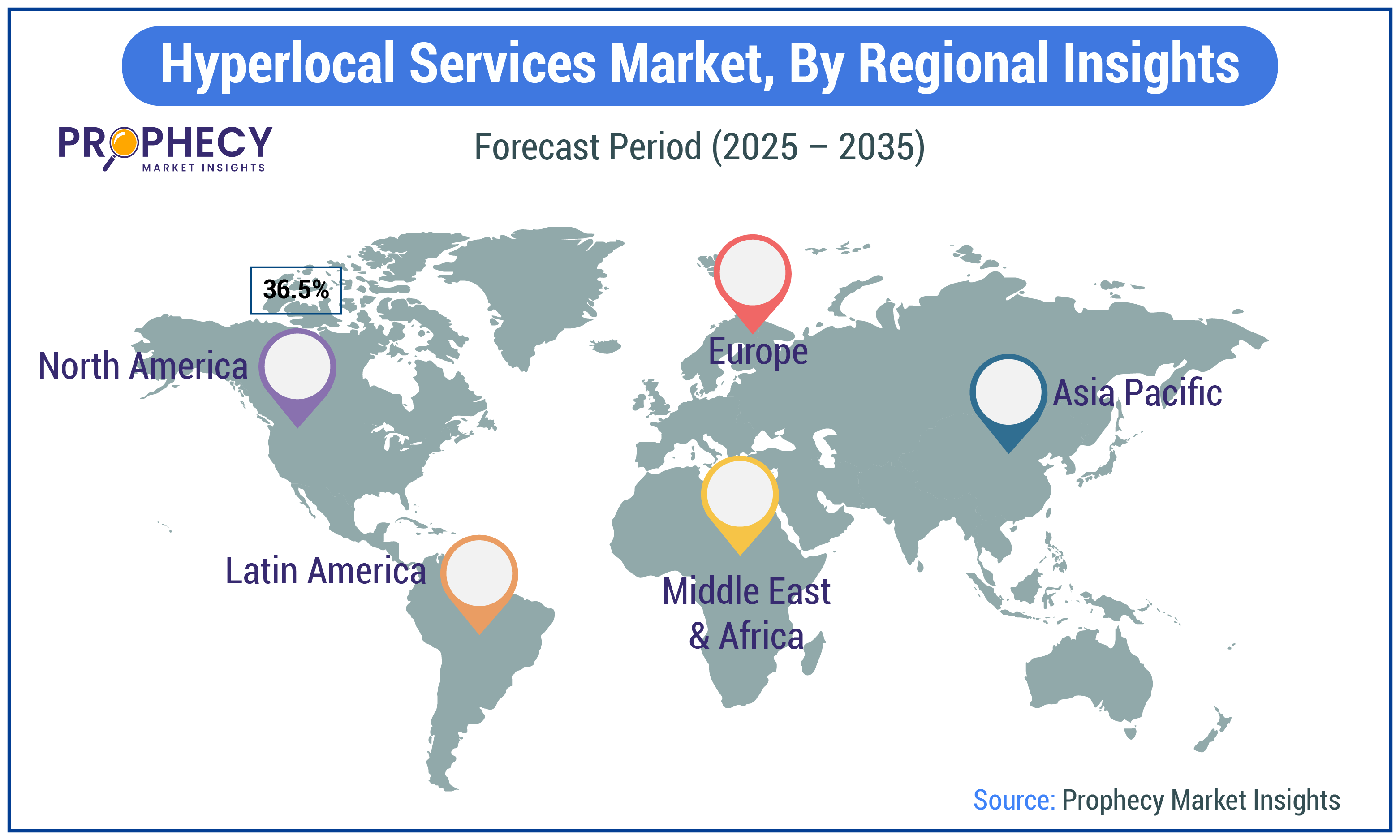
Geographically, the hyperlocal services market is studied across North America, Europe, Asia Pacific, Latin America, and the Middle East & Africa.
North America: This region dominates the hyperlocal services market with 36.5% share, mainly due to some of the highest levels of smartphone ownership and digital infrastructure, as well as many on-demand applications already in place. Demand is growing aggressively in North America, due to the mature e-commerce market as well as food delivery and home services markets, where consumer spending in a developed urban economy is extremely high.
- U.S. Hyperlocal Services Market Insights:
Hyperlocal services are no stranger to the United States, where digital infrastructure and widespread adoption of app-based services have enabled major cities to fully utilize services such as DoorDash, Uber, and TaskRabbit. Convenience and the ability to receive last-mile delivery, at a cost to the customer, have resulted in high consumer demand and interest while allowing the U.S. to become the first global ground for hyperlocal innovation.
Asia Pacific: The region that ranks second is Asia-Pacific, with significant growth anticipated through consumer internet access, urbanization, and the burgeoning middle class. The hyperlocal services market in the region is overly dominated by India and China, with a high demand for food delivery, ride-hailing applications, and grocery applications. Investments, government policies, and support for a flourishing digital economy will only facilitate growth in the area more quickly.
- India Hyperlocal Services Market Insights:
India is the leading hyperlocal services market in the Asia Pacific region, due in large part to the growing tech-savvy population, and a functional digital transaction adoption. The services of companies such as Swiggy, Zomato, and Dunzo are used every day by millions of consumers. Demand in Tier 1 and Tier 2 cities is strong, with continued interest in quick commerce, home service, and hyperlocal delivery platforms, increasing in popularity.
Europe: This region is growing in the hyperlocal services market due to a greater level of technology-aware consumers and logistic networks, with major economies such as the UK, Germany, and France showing rapidly increasing adoption of hyperlocal platform-based services across retail, healthcare, and B2B/B2C services. With greater consumer focus on the environment, sustainability, and supporting local businesses will ultimately influence consumer behavior towards available sustainable hyperlocal options.
- U.K. Hyperlocal Services Market Insights:
The U.K. is among the most significant contributors to Europe’s hyperlocal services market given its urban population and participation in digital convenience. Major players such as Deliveroo and Just Eat dominate food delivery, with local service applications seeing success in most major cities in the U.K. The logistical capabilities, smartphone penetration and customers need for on-demand solutions has prompted growth for the hyperlocal services market.
Hyperlocal Services Market Report Scope:
|
Attribute |
Details |
|
Market Size 2025 |
USD 4606.9 Billion |
|
Projected Market Size 2035 |
USD 15049.0 Billion |
|
CAGR Growth Rate |
13.9% (2025-2035) |
|
Base year for estimation |
2024 |
|
Forecast period |
2025 – 2035 |
|
Market representation |
Revenue in USD Billion & CAGR from 2025 to 2035 |
|
Regional scope |
North America - U.S. and Canada Europe – Germany, U.K., France, Russia, Italy, Spain, Netherlands, and Rest of Europe Asia Pacific – China, India, Japan, Australia, Indonesia, Malaysia, South Korea, and Rest of Asia-Pacific Latin America - Brazil, Mexico, Argentina, and Rest of Latin America Middle East & Africa – GCC, Israel, South Africa, and Rest of Middle East & Africa |
|
Report coverage |
Revenue forecast, company share, competitive landscape, growth factors, and trends |
Segmentation:
By Type:
- Food Ordering
- Grocery Ordering
- Utility Services
- Pet Food
- Medicines
- Others
By End-User:
- Residential
- Commercial
By Region:
- North America
- U.S.
- Canada
- Europe
- Germany
- U.K.
- France
- Russia
- Italy
- Spain
- Netherlands
- Rest of Europe
- Asia Pacific
- China
- India
- Japan
- Australia
- Indonesia
- Malaysia
- South Korea
- Rest of Asia Pacific
- Latin America
- Brazil
- Mexico
- Argentina
- Rest of Latin America
- Middle East & Africa
- GCC
- Israel
- South Africa
- Rest of Middle East & Africa
Global Hyperlocal Services Market Competitive Landscape & Key Players
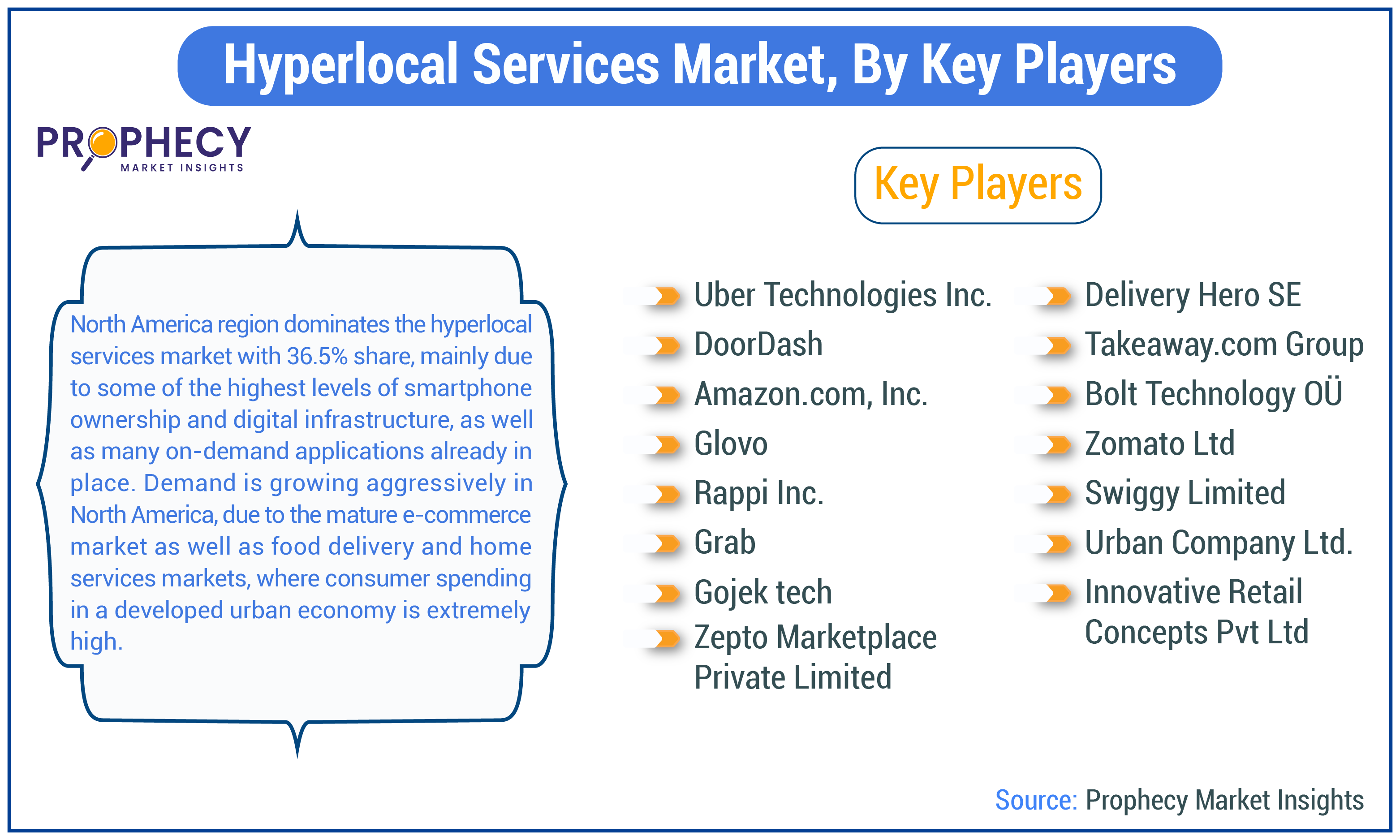
The prominent players operating in the market include, Uber Technologies Inc., DoorDash, Amazon.com, Inc., Glovo, Rappi Inc., Grab, Gojek tech, Delivery Hero SE, Takeaway.com Group, and others. E-commerce platforms offer companies a trove of data on consumer preferences, behaviors, and buying habits. Marketing initiatives, product development, and, on a general scale, business decisions all rely on the data to custom-make their service offerings to the precise specifications of the consumer. Meanwhile, by investing in e-retailing, large companies also get to physically integrate their online and offline channels to ensure a seamless shopping experience.
Hyperlocal Services Market Companies:
- Uber Technologies Inc.
- DoorDash
- Amazon.com, Inc.
- Glovo
- Rappi Inc.
- Grab
- Gojek tech
- Delivery Hero SE
- Takeaway.com Group
- Bolt Technology OÜ
- Zomato Ltd
- Swiggy Limited
- Urban Company Ltd.
- Zepto Marketplace Private Limited
- Innovative Retail Concepts Pvt Ltd
View an Additional List of Companies in the Hyperlocal Services Market
Global Hyperlocal Services Market Recent News
- In May 2024, Uber India tried to engineering a new level of hyperlocal delivery system for local retailers. Via two-wheeler, this company dispatches orders from those local stores to consumers in nine cities across India.
- In May 2024, Reliance Retail, a division of Reliance Industries Limited, conducted a pilot for rush delivery of groceries and FMCGs in some parts of Mumbai, India. Apart from partnering with local retailers who opted into the JioMart Partner program, the company intends to utilize its network of stores and warehouses to execute these orders.
Analyst View:
In this fast-moving business, hyperlocal services have been greatly aided by penetration of the smartphone, digital payments aiding the need for instant, location-driven solutions, emerging trends now include expansion to non-metro areas and partnering with hyperlocal vendors to strengthen last mile connectivity. Increasing opportunities are now being created in tier 2 and 3 cities, with growing demand for consumer personalization. However, barriers to growth remain in fields such as workforce management, operational challenges, and quality inconsistencies; going forward, these need to be addressed to enable growth, both sustainable and scalable, across geographies.
More Related Reports
Well Abandonment Services Market
Well Cementing Services Market
Healthcare Analytical Testing Services Market
Professional Services Automation Software Market
Managed Security Services Market
Global Hyperlocal Services Market Company Profile
|
Company Name |
Zomato LTD |
|
Headquarter |
Gurgaon, Haryana, India |
|
CEO |
Deepinder Goyal |
|
Employee Count |
8,244 Employees |
Global Hyperlocal Services Market Highlights
FAQs
Hyperlocal services market size was valued at USD 4606.9 Billion in 2025 and is expected to reach USD 15049.0 Billion by 2035 growing at a CAGR of 13.9%.
Type, end-user, and region are the segmentation for the hyperlocal services market.
North America, Asia Pacific, Europe, Latin America, and the Middle East & Africa. North America is expected to dominate the market.
The prominent players operating in the market include, Uber Technologies Inc., DoorDash, Amazon.com, Inc., Glovo, Rappi Inc., Grab, Gojek tech, Delivery Hero SE, Takeaway.com Group, Bolt Technology OÜ, Zomato Ltd, Swiggy Limited, Urban Company Ltd., Zepto Marketplace Private Limited, and Innovative Retail Concepts Pvt Ltd.