Global Healthcare Packaging Market By Overview
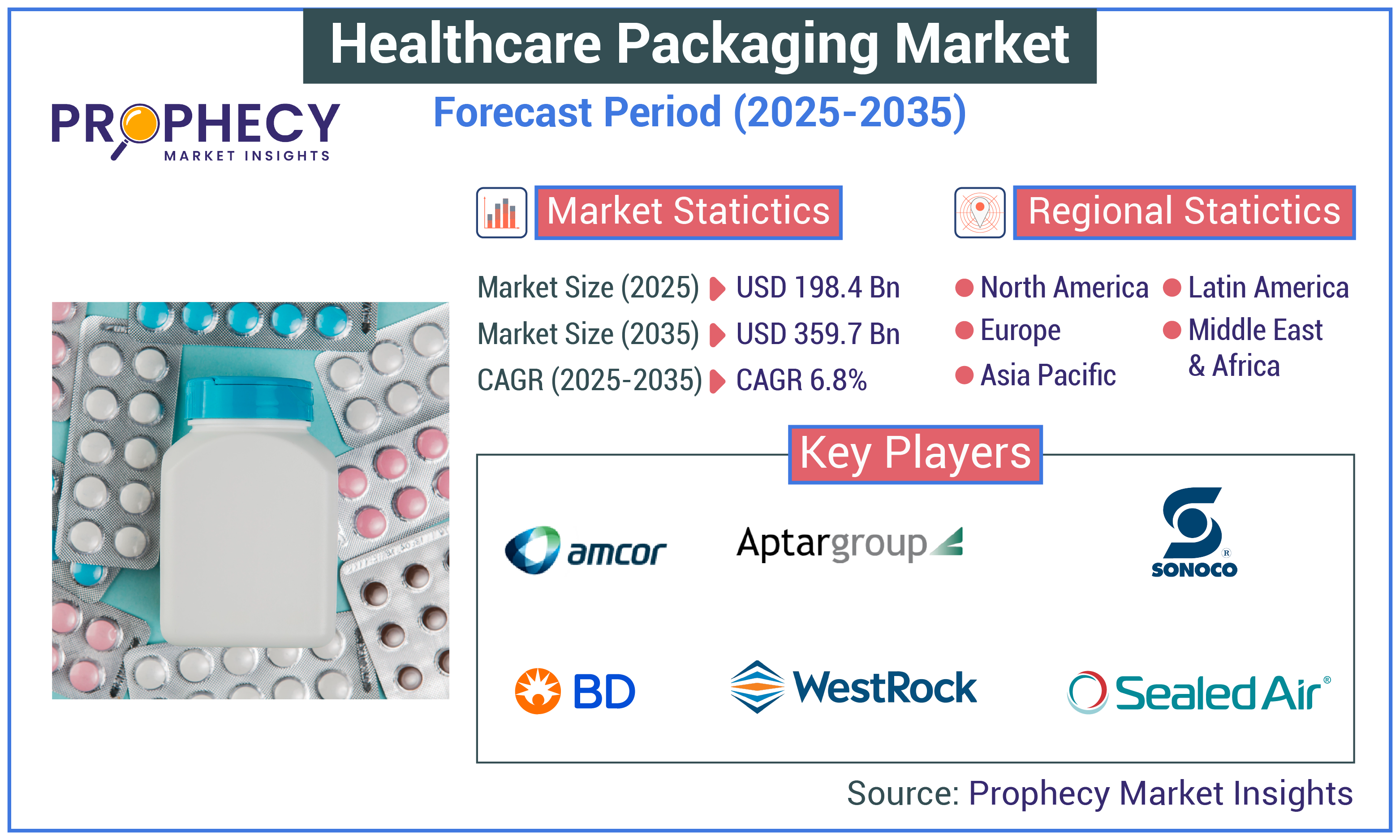
- By 2035, healthcare packaging market size is contemplated to enlarge at a valuation of USD 359.7 Billion.
- In 2024, the healthcare packaging market valuation was USD 187.5 Billion.
- Healthcare packaging market is developing at a CAGR of 6.8%.
Healthcare packaging encompasses the technical structures and materials used to collect, protect, and supply medical products, pharmaceuticals, and devices. As an integral extension of the product, the package ensures a complete and filled stock keeping unit is appropriate for patient use. It manages the integrity, sterility, and safety for the patient. It meets regulatory standards while still providing functionality, usability, and traceability throughout the healthcare model, including hospitals, clinics, and pharmacies.
The growth of healthcare packaging is directly correlated to worldwide growing healthcare needs, increased pharmaceuticals production in relation to the global costs of deliveries in medical and healthcare treatments technologies. Increased life expectancy of the aging population, the increase of people living with chronic disease, and the global increase in regulatory requirements directly influence the development of safe, tamper-evident and child-safe packaging. Development in biological, compostable, and sustainable materials–combined with tech such as the Internet of Things (IoT), smart / intelligent packaging–as well as accelerating access to healthcare in developing/underdeveloped regions of the world will continue to expand the market rate of growth across the span of pharmaceuticals, diagnostics, and medical device sectors.
The future of healthcare packaging includes sustainability issues, as well as more smart packaging technologies and personalized medicine. An increased used of biodegradable, compostable materials, RFID (Radiofrequency identification), and patient-centered designs. The advancement of digital healthcare devices/radiological or biometric diagnostics will influence how packaging develops, and may use pallet optimization criteria in how supply chain logistics are managed, end user experience, user interaction, stakeholder and regulatory compliance in a global context.
Recession Risk & Tariff Analysis:
- Recession creates risk to the healthcare packaging market as a potential reduction in spending on healthcare services could mean postponements to elective treatments and tightening of budgets within pharmaceutical manufacturers. While there is always a level of health need that is going to be necessary, investments in new packaging technologies and purchases for non-essential health products will slow down, causing slower growth across the market.
- Restriction of trade and interaction tariffs are limiting opportunities for supply chains to source advanced technologies from other countries. In cases companies may inevitably choose to limit source to local suppliers of materials or packaging products, change business strategies to include localization of production or pass the costs along to customers which impacts their profit performance and global market share position.
Impact of Generative AI on Healthcare Packaging Market:
- Generative AI can create rapid prototypes and optimize design options for healthcare packaging. It can streamline packaging design processes by evaluating user needs and regulatory requirements and then choosing the best, efficient, user-friendly, and compliant packaging designs based on needs. This speeds up product design and development, lowers development costs, and allows for customized packaging for drugs or devices specific to demographics or uses.
- Generative AI is also useful in the predictive analytics of packaging supply chain actions, identifying risks of disruptions, and making better decisions about packaging logistics. And better address quality control in packaging when packaging material or packaging processes have anomalies over time, developing repeatable, results-oriented actions to ensure continual compliance of healthcare packaging to lower waste and provide better identification in the viability and traceability of healthcare action in packing-based systems.
Global Healthcare Packaging Market By Drivers & Restraints
Key Drivers:
Rising Demand for Pharmaceutical and Medical Products is changing the dynamics of the market
The ever-growing population, increasing chronic diseases, and expanding access to health are driving demand for pharmaceuticals and medical devices, and this will continue to do so now and in the future. All of this means that we require consistent and regulated packaging that is safe and reliable. Healthcare packaging is primary to the integrity of the product packaged, transporting via controlled and cold chain logistics, as well as the safety of the patient. Therefore, we can see that evolving drug delivery formats and personalizing for patients continues to add additional pressure and need for packaging technology that is creative and protective, which is underlining the growth of the healthcare packaging market.
- For instance, according to data published by WHO, the proportion of the world's population over 60 years will nearly double from 12% to 22%, between 2015 and 2050. This rise in population is causing increased pharmaceutical manufacturing, which indirectly signals growth in healthcare packaging needs.
Restraints:
Stringent Regulatory Compliance and Approval Delays to repel market growth:
Healthcare-related packaging is regulated with severe standards by regulatory bodies such as the FDA, EMA, and WHO. The regulations cover multiple aspects of the product such as safety, sterility, and traceability. But the approval timeline is lengthy and can cost a lot to comply with. To make matters even worse, global standards are constantly changing and therefore increase complexity.
Manufacturers who have historically operated within a single region now grapple with understanding the complexity of current and emerging regulations across multiple jurisdictions. Increasing complexity increases time-to-market, slows innovation and thus ultimately drives up the cost of packaging development, all of which is more burdensome for SMEs, start-ups, etc., that lack regulatory experience and resources.
- Counterbalance Statements: While the regulatory landscape may be difficult to navigate, these standards advance patient safety and product integrity, while helping to establish trust in the healthcare system. Companies that successfully focus on coordinating regulation and innovation will often be rewarded with a competitive advantage, which will ultimately facilitate entering into global markets quicker and with long-term resiliency through quality compliant packaging solutions.
Opportunities & Trends:
Emergence of Smart, Sustainable Solutions for Personalized Healthcare is a rising trend:
The healthcare packaging market is growing tremendously owing to an increase in biopharmaceuticals and personalized medicine which demand highly specialized, secure, and temperature sensitive packaging. This is occurring at the same time that health care packaging is changing due to trends away from standard, printed packaging and toward smart packaging technology (e.g., RFID, QR codes) with real-time tracking capabilities. While sustainability still presents a challenge, the focus on using recyclable plastics and biodegradable films is accelerating. Altogether, these approaches help to enhance patient safety, enable cold chain logistics, and satisfy global sustainability objectives.
Global Healthcare Packaging Market By Segmentations & Regional Insights
By material, packaging, packaging format, packaging function, end-user, and region are the divisions of the healthcare packaging market.
By Material:
Based on material, the healthcare packaging market is divided into glass, plastic, metal, paper and paperboard. By a large proportion, plastic represents the largest healthcare packaging market share due to its malleability, cost-effectiveness, and durability. Polymeric plastic packaging guarantees product protection, product continuity during the delivery process, eliminating risks of contamination from moisture and air, a tamper-evident packaging design, and lightweight delivery.
Paper and paperboard are second-top packaging materials on the list based on an environmentally friendly and recyclability aspect. The use of paper and paperboard materials is mainly in secondary and tertiary packaging components such as secondary carton packaging, labels, and inserts. As sustainable packaging continues to gain traction, we are starting to see more healthcare providers use paper-based packaging solutions to reduce their impact on the environment while still using effective solution for functionality.
By Packaging:
Based on the packaging, the healthcare packaging market is divided into primary packaging, secondary packaging, and tertiary packaging. The primary packaging has highest healthcare packaging market share. Primary packaging protects the product from environmental elements that could jeopardize its safety and effectiveness, such as light, moisture, and contamination. Features that make it easier and more precise to dispense the product are frequently found in primary packaging.
The second most important market sector is secondary packaging. Secondary packing lowers the chance of damage by adding an additional layer of protection during storage and transit. Healthcare products can be handled and distributed more effectively with the help of secondary packaging.
By Packaging Format:
Based on the packaging format, the healthcare packaging market is divided into flexible packaging, and rigid packaging. Products in rigid packaging are proven to be the market leaders. Rigid packaging is extremely strong and stable, making it ideal for protecting sensitive healthcare supplies. It offers strong defense against physical harm while being stored and transported. Tamper-evident elements, which are crucial for guaranteeing the integrity and safety of medical supplies, can be incorporated into rigid packaging.
The second-largest market sector is packaging that is semi-rigid and flexible. Flexible packaging is a more economical option than rigid packaging since it utilizes less material. As a result of the decreased weight, transportation expenses are also decreased. It is easier to handle and store.
By Packaging Function:
Protective packaging, tamper- evident packaging, temperature-controlled packaging, child-resistant packaging, and others are packaging function of the healthcare packaging market. Protective packaging dominates the healthcare packaging market share since it guarantees product integrity while being stored and transported. It protects pharmaceutical and medical products from physical impacts, contamination, and environmental factors. As it sustains sterility and efficacy throughout the supply chains, protective packaging is the most utilized packaging function in healthcare.
Temperature-controlled packaging comes in second due to the growth in biologics, vaccines, and other temperature-sensitive drugs. It sustains thermal conditions in the course of the logistics process, with the central aim to prevent degradation of the biomedical product to secure product safety. The expanding global cold chain distribution of products has made this packaging function priceless in terms of preserving pharmaceutical efficacy and compliance.
By End-User:
Pharma companies, medical-device manufacturers, hospital & clinics, diagnostic centers, and others are end-user of the healthcare packaging market. The pharmaceutical industry has the largest healthcare packaging market share. Pharmaceutical manufacturers are in constant need of packaging that prevents tampering, secures the product, and is compliant with regulations. Pharmaceutical firms require performance to not only secure their products but extend the life of the product, maintain product efficacy, and to use packaging technologies that they can leverage in global distribution channels for tablets, injectables, and biologics.
The medical device industry is the second largest segment in regard to healthcare packaging market share and relies on sterile and durable packaging systems to protect instruments, implants, and diagnostic devices. The packaging system must be able to protect the device from contamination and mechanical damage while still being easy to navigate and use. The increasing demand for minimally-invasive medical devices and continuing growth of global regulatory standards has increased the size of the packaging needs of the medical device companies.
Regional Insights:
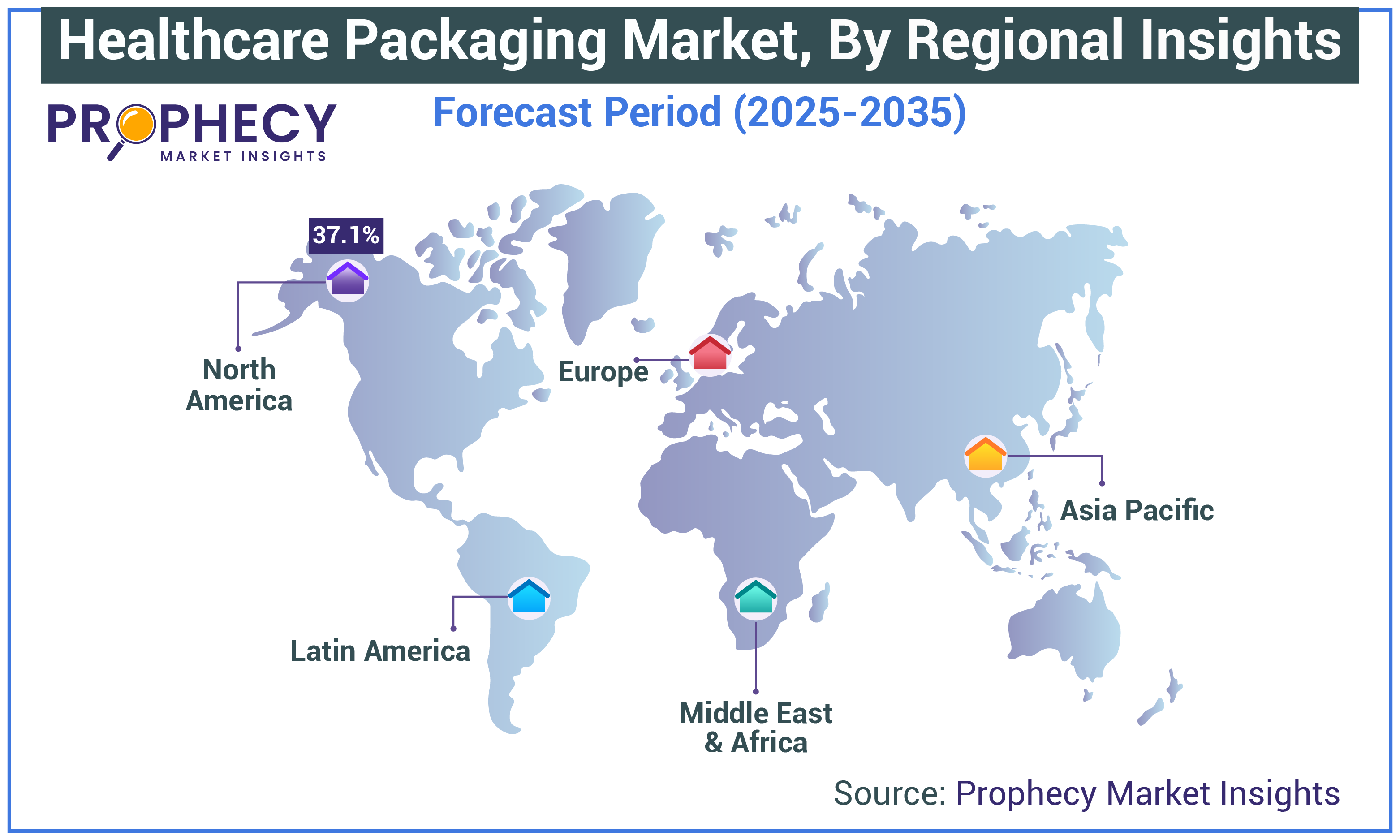
Geographically, the healthcare packaging market is studied across North America, Europe, Asia Pacific, Latin America, and the Middle East & Africa.
North America: This region as a significant region in healthcare packaging market growth with 37.1% market share, continues to dominate the market due to its excellent healthcare infrastructure, high spending on pharmaceuticals, and high regulatory standards. With the large presence of a lot of pharmaceutical and medical device manufacturers in combination with an ever-expanding desire for innovative and sterile packaging for medical products, North America is mostly to continue its dominance in healthcare packaging.
- U.S. Healthcare Packaging Market Insights:
U.S. leads the market largely due to the country's size in medical products industry, advanced medical technology, and FDA regulatory conditions. Continued medication expenditure, strong R&D capability, and multiple large packaging companies help foster ongoing creativity and demand for safe, regulatory, compliant and efficient packaging solutions.
Europe: This region comes in second and is a significant region. Strong healthcare systems, an increasing elderly population, and a long-standing history of high standards for packaging set Europe apart. Significant countries such as Germany, France, and the UK are substantial contributors. With an increasing emphasis on patient safety, sustainability, and pharmaceutical innovation, there is a market demand for high-quality compliant packaging materials across all of Europe.
- Germany Healthcare Packaging Market Insights:
Germany leads the European healthcare packaging market as a result of having a high-level pharmaceutical manufacturing sector with high standards. Germany has a structured healthcare system and is in compliance with regulations. Germany continues to invest in advanced technology packaging. Germany is heavily invested in patient safety, automation, and sustainability as part of its brand reinforcement in the European market.
Asia Pacific: This is is quickly standing out as an emerging market based on increased expanding access to healthcare, both growing pharmaceutical production and increasing medical tourism. An array of countries including China, India, and Japan is emerging from the crowd. All of these countries have other growing investments into healthcare infrastructure and packaging technology as well, making the Asia Pacific region a strategic foothold for global manufacturers.
- China Healthcare Packaging Market Insights:
China will continue to be a leading company for the Asia Pacific healthcare packaging market due to rapid global healthcare growth, rising pharmaceutical exports, growing demand for domestic products, along with being the chief country in patient and graphical healthcare packaging. Growth in China's healthcare expenditures measured against packaging spending will create future needs for packaging.
Healthcare Packaging Market Report Scope:
|
Attribute |
Details |
|
Market Size 2025 |
USD 198.4 Billion |
|
Projected Market Size 2035 |
USD 359.7 Billion |
|
CAGR Growth Rate |
6.8% (2025-2035) |
|
Base year for estimation |
2024 |
|
Forecast period |
2025 – 2035 |
|
Market representation |
Revenue in USD Billion & CAGR from 2025 to 2035 |
|
Regional scope |
North America - U.S. and Canada Europe – Germany, U.K., France, Russia, Italy, Spain, Netherlands, and Rest of Europe Asia Pacific – China, India, Japan, Australia, Indonesia, Malaysia, South Korea, and Rest of Asia-Pacific Latin America - Brazil, Mexico, Argentina, and Rest of Latin America Middle East & Africa – GCC, Israel, South Africa, and Rest of Middle East & Africa |
|
Report coverage |
Revenue forecast, company share, competitive landscape, growth factors, and trends |
Segmentation:
By Material:
- Glass
- Plastic
- Metal
- Paper and Paperboard
By Packaging:
- Primary Packaging
- Secondary Packaging
- Tertiary Packaging
By Packaging Format:
- Flexible Packaging
- Rigid Packaging
By Packaging Function:
- Protective Packaging
- Tamper- evident Packaging
- Temperature-Controlled packaging
- Child-resistant packaging
- Others
By End-User:
- Pharma companies
- Medical device manufacturers
- Hospital & clinics
- Diagnostic centers
- Others
By Region:
- North America
- U.S.
- Canada
- Europe
- Germany
- U.K.
- France
- Russia
- Italy
- Spain
- Netherlands
- Rest of Europe
- Asia Pacific
- China
- India
- Japan
- Australia
- Indonesia
- Malaysia
- South Korea
- Rest of Asia Pacific
- Latin America
- Brazil
- Mexico
- Argentina
- Rest of Latin America
- Middle East & Africa
- GCC
- Israel
- South Africa
- Rest of Middle East & Africa
Global Healthcare Packaging Market By Competitive Landscape & Key Players
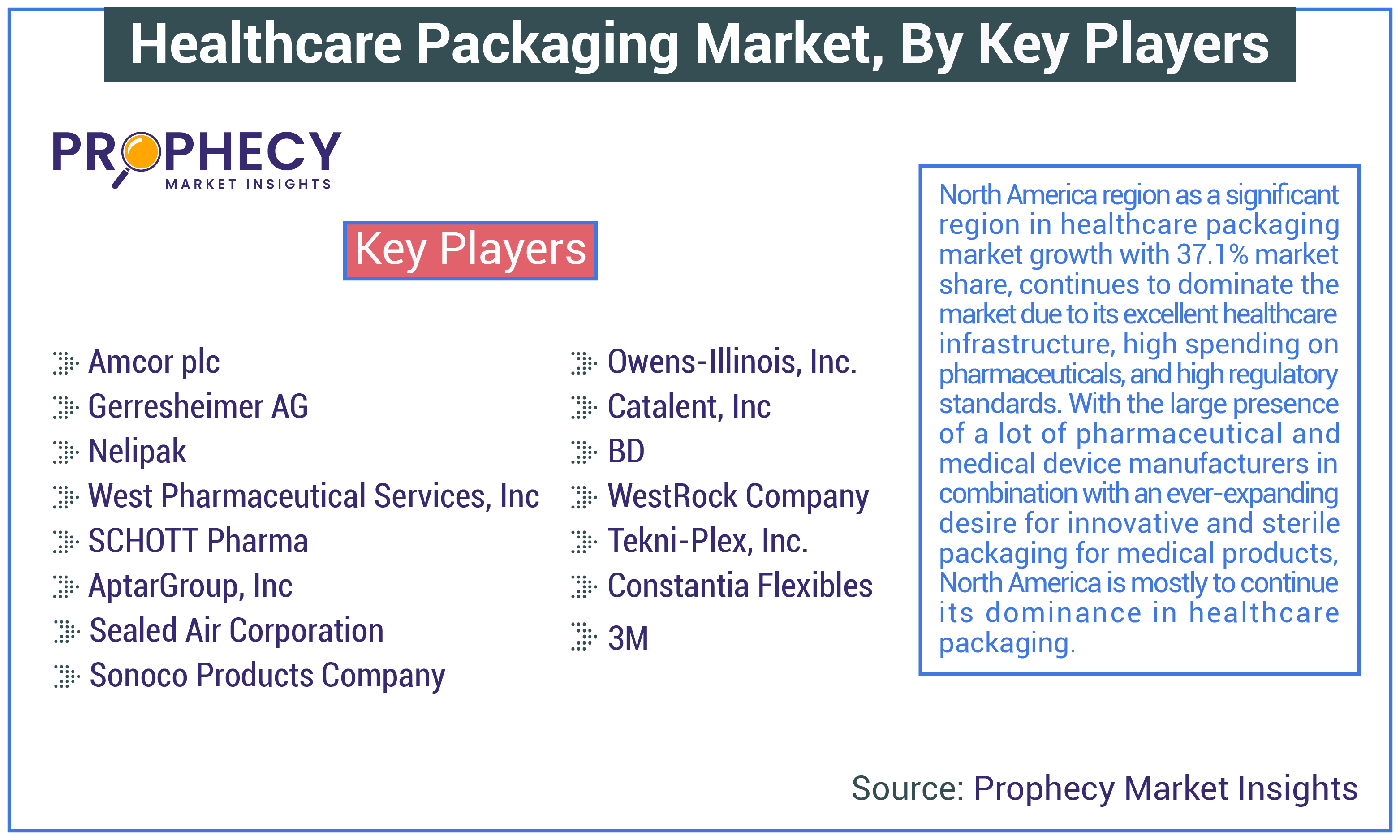
The prominent players operating in the market include, Amcor plc, Gerresheimer AG, Nelipak, West Pharmaceutical Services, Inc, SCHOTT Pharma, AptarGroup, Inc, Sealed Air Corporation. The market for healthcare packaging is extremely competitive and fragmented worldwide. The few market companies control the majority of the market in terms of market share since they provide creative packaging for the packaging sector. These significant industry participants are constantly concentrating on innovation and increasing their client base across geographical boundaries. The goal of many other significant industry participants is to provide creative and cutting-edge packaging solutions.
Healthcare Packaging Market Companies:
- Amcor plc
- Gerresheimer AG
- Nelipak
- West Pharmaceutical Services, Inc
- SCHOTT Pharma
- AptarGroup, Inc
- Sealed Air Corporation
- Sonoco Products Company
- Owens-Illinois, Inc.
- Catalent, Inc
- BD
- WestRock Company
- Tekni-Plex, Inc.
- Constantia Flexibles
- 3M
View an Additional List of Companies in the Healthcare Packaging Market
Global Healthcare Packaging Market By Recent News
- In December 2024, Nelipak Healthcare Packaging opened its first flexible packaging production site in North America, which is located in Winston-Salem, North Carolina. The new facility is a 110,000 square foot facility that was built to meet the market needs for healthcare packaging solutions in the Americas and serves as a flagship site for the company in the Americas.
- In May 2023, Schott Pharma introduced prefilled syringes that deliver deep cold medications. These syringes are comprised of sophisticated polymers. The syringes are made of a sophisticated pharmaceutical-grade polymer to prevent contamination since these medications are kept and delivered on dry ice.
Analyst View:
The healthcare packaging industry is growing rapidly, and the increase in pharmaceutical demand and the aging population of the world, as well as growing driving forces that are focused on increased patient safety, are helping speed the change. Positioning of the sector supports smart packaging technologies and sustainable package materials, driven by regulatory forces and environmental pressures.
Trends toward biopharmaceuticals and personalized medicine are expanding opportunities for innovative packaging. There are some noteworthy restraints in the sector. Complying with regulatory requirements is very important, as well as the cost of materials and the product approval timeline which can be lengthy. Overall, the sector is positioned for continued growth and transformation in the coming years through innovation, digital integration, and global healthcare expansion.
More Related Reports
Healthcare Electronic Data Interchange Market
Healthcare Biometric Market
Artificial Intelligence in Healthcare Market
Healthcare Finance Solutions Market
Smart Healthcare Products Market
Global Healthcare Packaging Market By Company Profile
|
Company Name |
Amcor plc |
|
Headquarter |
Zürich, Switzerland |
|
CEO |
Peter Konieczny |
|
Employee Count |
41,000 Employees |
Global Healthcare Packaging Market By Highlights
FAQs
Healthcare packaging market size was valued at USD 198.4 Billion in 2025 and is expected to reach USD 359.7 Billion by 2035 growing at a CAGR of 6.8%.
Material, packaging, packaging format, packaging function, end-user and region are the segmentation for the healthcare packaging market.
North America, Asia Pacific, Europe, Latin America, and the Middle East & Africa. North America is expected to dominate the market.
The prominent players operating in the market include, Amcor plc, Gerresheimer AG, Nelipak, West Pharmaceutical Services, Inc, SCHOTT Pharma, AptarGroup, Inc, Sealed Air Corporation, Sonoco Products Company, Owens-Illinois, Inc., Catalent, Inc, BD, WestRock Company, Tekni-Plex, Inc., Constantia Flexibles, and 3M.