Global Glucose Monitoring Devices Market Overview
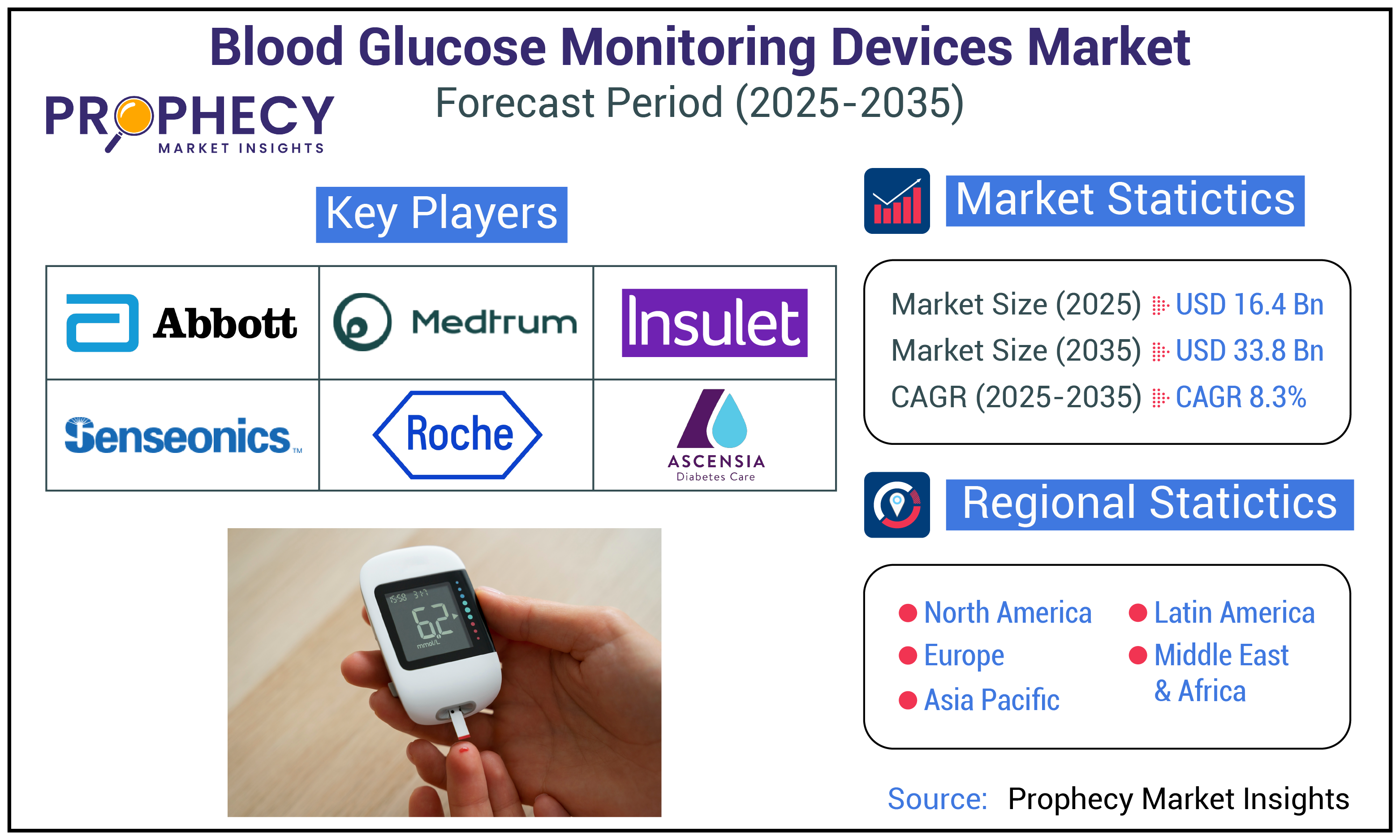
- By 2035, the blood glucose monitoring devices market share to surpass USD 33.8 Billion.
- The market size was calculated at USD 14.9 Billion within 2024.
- The target market is developing at a CAGR of 8.3%.
The quantity of glucose (sugar) in the blood is measured using blood glucose monitoring equipment, commonly referred to as a blood glucose meter. It's a little, handheld gadget that may be utilized in medical facilities or at home. The increasing prevalence of diabetes, rising awareness of the importance of regular glucose monitoring, technological advancements such as smart watch-based apps, and stringent regulations to ensure the safety and accuracy of devices are factors propelling the blood glucose monitoring devices market growth. In addition to this, blood glucose monitoring devices also help people with diabetes manage blood sugar levels with very few complications, further contributing to market diversification.
Influence of AI on Blood Glucose Monitoring Devices Market:
- Artificial intelligence (AI) in conjunction with a blood glucose monitoring device, especially a continuous glucose monitor (CGM), can greatly improve diabetes management by tracking glucose levels in real-time, forecasting future variations, and providing tailored advice to proactively prevent hypoglycemia or hyperglycemia, ultimately improving the quality of life for diabetic patients.
Global Glucose Monitoring Devices Market Drivers & Restraints
Key Drivers of Target Market:
High Prevalence of Diabetes is Influencing the Market Expansion
The market for blood glucose monitoring devices is growing as a direct result of the increasing prevalence of diabetes as more people with the disease require tools to regularly check their blood sugar levels, which increases demand for devices such as traditional glucose meters and continuous glucose monitors (CGMs), which are crucial for managing diabetes effectively and avoiding complications.
- For Instance, in March 2024, according to an article published by NCBI, diabetes is recognized as a significant factor in both mortality and morbidity worldwide, affecting various demographics regardless of geographic location, age group, or gender. It is alarming that the prevalence of diabetes is anticipated to increase to 643 Million (11.3%) by 2030 and 783 Million (12.2%) by 2045.
Restraints:
High Cost of Blood Glucose Monitoring Devices is Limiting the Market Growth
The cost of blood glucose monitoring equipment can prevent low-income individuals from using it. Regular calibration and upkeep raise the price and complexity. Patient compliance is decreased by invasive techniques such as finger pricking, which are uncomfortable. Inaccurate insulin dosage and health hazards can also result from inaccurate devices.
- Counterbalance Statements: To increase accessibility, governments and non-profits might provide financial aid. Improvements in AI-powered and non-invasive monitoring techniques can improve precision and user comfort.
Opportunities:
Integrating Advanced Technologies with Blood Glucose Monitoring Devices can Unlock Growth Opportunities
The market for blood glucose monitoring devices can expand by incorporating cutting-edge technologies, such as artificial intelligence (AI), the Internet of Things (IoT), and non-invasive sensors, which improve accuracy, convenience, and real-time data tracking. Users may prevent issues by managing their blood sugar levels proactively with the use of AI-powered predictive analytics. IoT-enabled gadgets provide smooth communication between smartphones and medical systems, enhancing patient compliance and monitoring. Furthermore, advancements such as needle-free sensors for continuous glucose monitoring (CGM) draw more customers, growing the market.
- For instance, in January 2025, Samsung announced substantial progress in developing non-invasive blood glucose monitoring technology for smartwatches. This technology aimed to eliminate the need for traditional needle-based blood sugar testing, potentially transforming the traditional method of monitoring glucose levels. The system utilized advanced optical sensing technology combined with AI algorithms to measure blood glucose levels through the skin.
Global Glucose Monitoring Devices Market Segmentations & Regional Insights
The blood glucose monitoring devices market is segmented into product type, testing site, application, end user, and region.
By Product Type
Based on product type the market is trifurcated into self-monitoring devices, continuous monitoring devices, and others. The self-monitoring blood glucose monitoring device is projected to dominate the market as it is affordable, easy to use, and widely accessible, allowing individuals to conveniently monitor blood sugar levels at home.
By Testing Site
According to the testing site, the market is divided into fingertip testing, alternate site testing, and others. The fingertip testing segment holds the largest blood glucose monitoring devices market share as it is a preferred site, it is more accurate and reliable and is less painful as well.
- For instance, in July 2024, Babson Diagnostics, a science-first healthcare technology company, is excited and proud to announce the launch of its groundbreaking blood testing service. BetterWay blood testing represents a significant advancement in an essential medical service, providing a patient-preferred experience and enabling high-quality testing in more convenient settings. BetterWay was a unique lab test that used fingertip testing, eliminating the need for phlebotomists, needles, and blood vials, and thereby enhancing diagnostic lab efficiency.
By Application
By application, the market is sub-segmented into type 1 diabetes, type 2 diabetes, and others. The type 2 diabetes segment has the governing market as it is the most common type of diabetes, which results in the increasing adoption of monitoring devices. Additionally, new products with less invasive technologies are also contributing to the market’s growth.
- For instance, in July 2023, Dexcom developed a Type 2 diabetes monitor for those who do not need insulin, a 15-day sensor, and a cash-pay option for patients not covered by Medicare and health insurers who want daily decision support. With the number of diabetes-affected Americans numbering more than 37 million, according to the U.S. Centers for Disease Control, healthcare technology developers and researchers seek to enhance the prevention, early detection, management,t and care of diabetes.
End-User
On the basis of end-users, the market is branched into hospitals and clinics, home care settings, diagnostic centers, and others. The hospitals and clinics segment is attributed to rule over the market due to the high volume of diabetic patients, the necessity of precise and timely glucose level monitoring for the best possible care, the sophisticated technology hospitals utilize to successfully manage diabetes, and the growing emphasis on patient outcomes in a clinical environment.
- For instance, in August 2024, BayCare announced a partnership with chronic disease management company Cadence to implement a remote patient monitoring and responsive virtual care program. The program would combine BayCare Medical Group’s expert clinical team with a robust technology platform to provide proactive and preventive health care to seniors with chronic conditions, such as, diabetes, throughout Florida’s Tampa Bay and West Central regions.
Region
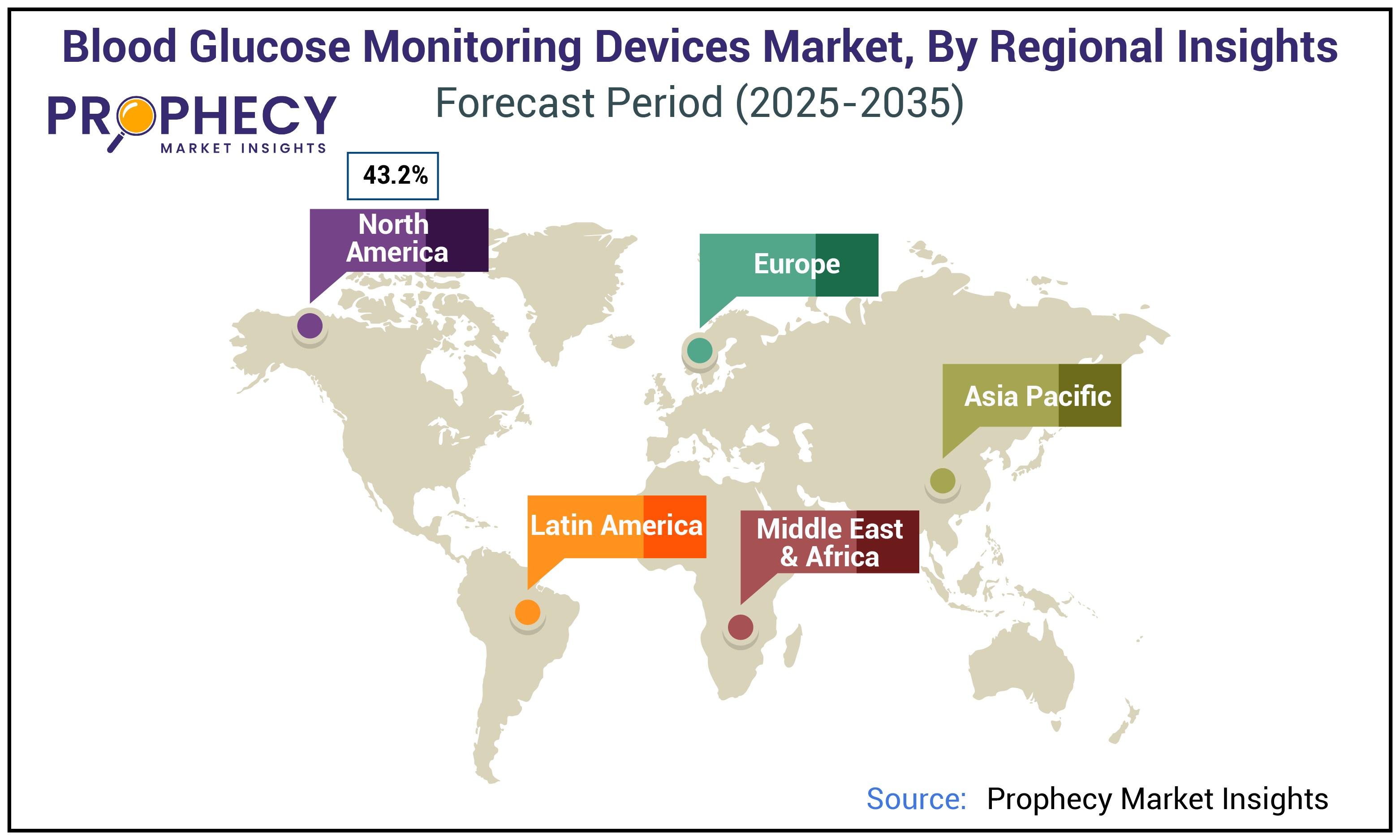
Geographically, the market is grouped into North America, Europe, Asia Pacific, Latin America, and the Middle East & Africa.
North America: This is the region that is expected to have the leading blood glucose monitoring devices market with an estimated share of 43.2%. This is due to the high prevalence of diabetes in this region, its well-established healthcare infrastructure, favorable reimbursement policies, growing adoption of advanced technologies, and growing awareness about diabetes management.
- For instance, in June 2024, Abbott announced U.S. Food and Drug Administration (FDA) clearance for two new over-the-counter continuous glucose monitoring (CGM) systems, Lingo and Libre Rio, which were based on Abbott's world-leading FreeStyle Libre continuous glucose monitoring technology. The newly cleared systems had been intentionally designed to meet different needs.
Europe: This is the region, which is expected to have the fastest-growing market during the forecast period. This is due to the rising prevalence of diabetes across this region, primarily driven by an aging population, lifestyle changes leading to increased obesity, and growing awareness about the need for regular blood glucose sugar monitoring among diabetic individuals.
- For instance, in February 2024, Dexcom launched its real-time continuous glucose monitoring (CGM) system Dexcom ONE+ in Europe. This system consisted of a water-resistant sensor to measure blood glucose, a transmitter that sent CGM readings, and a Dexcom One smartphone-compatible app. The system allowed for real-time monitoring of blood glucose by both the user and up to ten additional people to allow for shared monitoring.
Blood Glucose Monitoring Devices Market Report Scope:
|
Attribute |
Details |
|
Market Size 2025 |
USD 16.4 Billion |
|
Projected Market Size 2035 |
USD 33.8 Billion |
|
CAGR Growth Rate |
8.3% (2025-2035) |
|
Base year for estimation |
2024 |
|
Forecast period |
2025 – 2035 |
|
Market representation |
Revenue in USD Billion & CAGR from 2025 to 2035 |
|
Regional scope |
North America - U.S. and Canada Europe – Germany, U.K., France, Russia, Italy, Spain, Netherlands, and Rest of Europe Asia Pacific – China, India, Japan, Australia, Indonesia Malaysia, South Korea, and Rest of Asia Pacific Latin America - Brazil, Mexico, Argentina, and Rest of Latin America Middle East & Africa – GCC, Israel, South Africa, and Rest of the Middle East & Africa |
|
Report coverage |
Revenue forecast, company share, competitive landscape, growth factors, and trends |
Segmentation:
By Product Type:
- Self-Monitoring Devices
- Blood glucose meter
- Testing Strips
- Lancets
- Continuous Monitoring Devices
- Sensors
- Transmitter and Receiver
- Insulin Pumps
- Others
By Testing Site:
- Fingertip Testing
- Alternate Site Testing
- Others
By Application:
- Type 1 Diabetes
- Type 2 Diabetes
- Others
By End-User:
- Hospitals and Clinics
- Home Care Settings
- Diagnostic Centers
- Others
By Region:
- North America
- U.S.
- Canada
- Europe
- Germany
- U.K.
- France
- Russia
- Italy
- Spain
- Netherlands
- Rest of Europe
- Asia Pacific
- China
- India
- Japan
- Australia
- Indonesia
- Malaysia
- South Korea
- Rest of Asia Pacific
- Latin America
- Brazil
- Mexico
- Argentina
- Rest of Latin America
- Middle East & Africa
- GCC
- Israel
- South Africa
- Rest of the Middle East & Africa
Global Glucose Monitoring Devices Market Competitive Landscape & Key Players
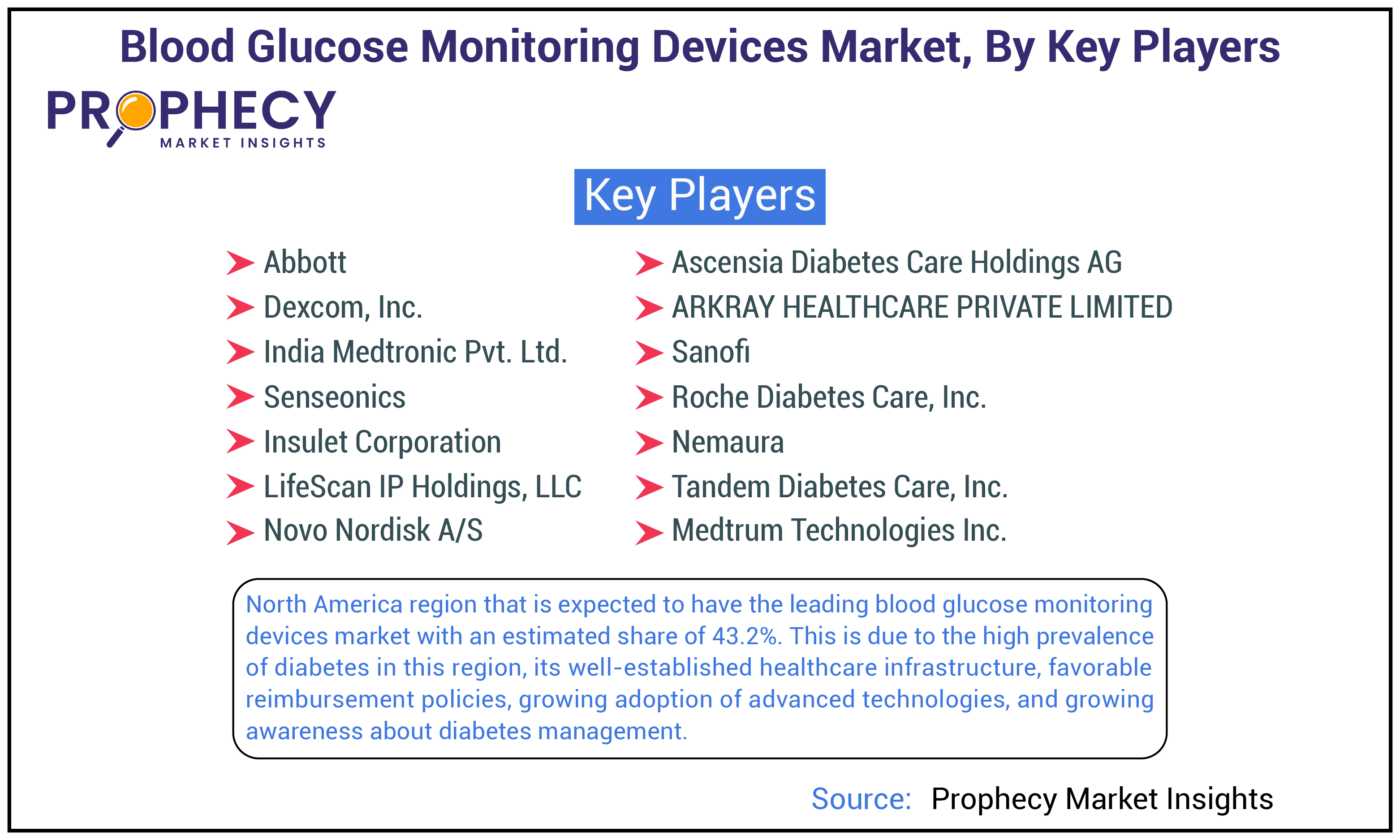
The companies operating in the market are Abbott, Dexcom, Inc., India Medtronic Pvt. Ltd., Senseonics, Roche Diabetes Care, Inc., and others. The key players are adopting strategies such as product innovation, partnerships, marketing, and adopting new technologies for the diversification of the market.
Blood Glucose Monitoring Devices Market Companies:
- Abbott
- Dexcom, Inc.
- India Medtronic Pvt. Ltd.
- Senseonics
- Insulet Corporation
- LifeScan IP Holdings, LLC
- Novo Nordisk A/S
- Ascensia Diabetes Care Holdings AG
- ARKRAY HEALTHCARE PRIVATE LIMITED
- Sanofi
- Roche Diabetes Care, Inc.
- Nemaura
- Tandem Diabetes Care, Inc.
- Medtrum Technologies Inc.
View an Additional List of Companies in the Blood Glucose Monitoring Devices Market
Global Glucose Monitoring Devices Market Recent News
- In November 2024, Beurer India Pvt. Ltd. launched the GL 22 Blood Glucose Monitor. According to the company’s statement, the launch marked Beurer’s commitment to providing innovative and user-friendly health monitoring solutions tailored for the Indian market, aligning with its ambitious expansion plans across the country. This blood glucose monitor combined German precision with advanced technology designed to meet local needs.
- In November 2024, Medtronic plc, announced U.S. Food and Drug Administration (FDA) clearance for its new InPen app featuring missed meal dose detection, paving the way for the launch of its Smart MDI system with the Simplera continuous glucose monitor (CGM). The company's Smart MDI system combined its InPen smart insulin pen with its newest Simplera CGM, the company's first disposable, all-in-one CGM that was half the size of previous Medtronic CGMs.
Analyst View:
The market for blood glucose monitoring devices is expanding due to a number of factors, including the rising prevalence of diabetes, increased awareness of the value of routine glucose monitoring, technological advancements such as apps for smart watches, and strict regulations to guarantee the accuracy and safety of devices.
More Related Reports
Bloodlines Market
Blood Transfusion Market
Blood Cell Separation Market
Blood Testing Market
Glucose Biosensors Market
Global Glucose Monitoring Devices Market Company Profile
|
Company Name |
Abbott |
|
Headquarter |
Chicago, Illinois, U.S. |
|
CEO |
Mr. Robert B. Ford |
|
Employee Count (2024) |
114,000 Employees |
Global Glucose Monitoring Devices Market Highlights
FAQs
Blood glucose monitoring devices market size was valued at USD 16.4 Billion in 2025 and is expected to reach USD 33.8 Billion by 2035 growing at a CAGR of 8.3%.
The market is segmented into product type, testing site, application, end-user, and region.
The market is segmented by region North America, Asia Pacific, Europe, Latin America, and the Middle East & Africa. North America is expected to dominate the market.
The key players operating in the blood glucose monitoring devices market include Abbott, Dexcom, Inc., India Medtronic Pvt. Ltd., Senseonics, Roche Diabetes Care, Inc., Insulet Corporation, LifeScan IP Holdings, LLC, Novo Nordisk A/S, Ascensia Diabetes Care Holdings AG, ARKRAY HEALTHCARE PRIVATE LIMITED, Sanofi, Nemaura, Tandem Diabetes Care, Inc., and Medtrum Technologies Inc.