Global Gas To Liquid GTL Overview
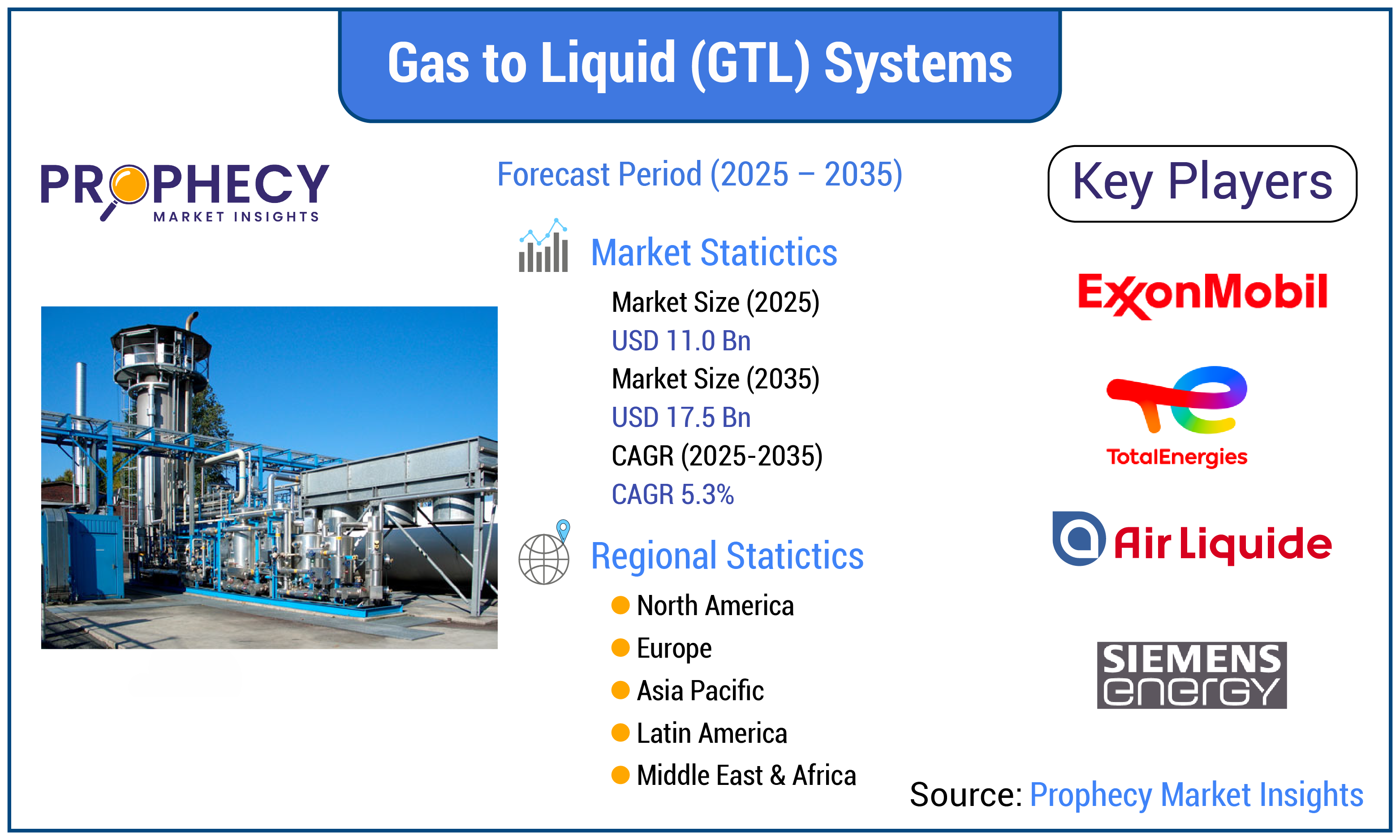
- Gas to liquid (GTL) systems market size is expected to expand at a rate of USD 17.5 Billion, by 2035.
- In 2024, the target market valuation was USD 10.5 Billion.
- Gas to liquid (GTL) systems market is growing at a CAGR 5.3%.
Gas-to-liquids (GTL) systems refer to the process of converting natural gas into liquid fuels and other products. The process involves a series of chemical reactions that transform the gaseous hydrocarbons, primarily methane, into longer-chain hydrocarbons such as gasoline, diesel, and other fuels. These systems offer advantages, such as, reduced emissions, diversification of energy sources, and the ability to monetize stranded gas reserves. These systems also produce cleaner fuels with lower sulfur content and fewer impurities compared to traditional petroleum-based fuels.
The rising urbanization, increasing global energy demand, leading to a greater demand for all types of energy sources, including liquid fuels produced from natural gas via GTL technology, increased natural gas production is a key factor, as GTL processes utilize natural gas as the feedstock to produce various liquid fuels, liberalization of the energy market, fluctuating gas prices, and the need to utilize "stranded gas" (associated gas) are contributing to the gas to liquid systems market growth.
The market’s expansion is also pitched by ongoing research and development in GTL technologies which are improving efficiency and reducing costs, making the process more economically viable. In addition to this, as environmental concerns and regulations intensify, the demand for cleaner-burning fuels such as GTL alternatives to traditional crude oil-based fuels is increasing. GTL fuels are known to produce fewer pollutants compared to conventional fuels.
Recession Risk and Tariff Analysis:
- The gas-to-liquid (GTL) systems market is more vulnerable to recessions as a result of trade disputes, fluctuating oil prices, and a decline in global fuel consumption. Producers are cutting down on expenditure due to tariffs and low LNG prices, and economic uncertainty is delaying investments, which might halt the growth and profitability of GTL projects. ?
- In the gas-to-liquid (GTL) systems market, tariff analysis assesses import/export taxes, tariffs, and trade laws that impact GTL goods and technology. It helps stakeholders improve pricing strategies, investment choices, and supply chain logistics in international GTL commerce by identifying cost implications, regional competitiveness, and market entrance hurdles.
Impact of Generative AI on Gas to Liquid (GTL) Systems Market:
- The gas to liquid systems market is greatly impacted by generative AI as it improves design simulation, predictive maintenance, and process optimization. By anticipating equipment breakdowns and improving resource use, it enhances operational efficiency and facilitates quicker research and development using AI-generated chemical route models.
- Furthermore, strategic decision-making is supported by AI-driven market forecasting, and personnel costs and time are decreased by automating data analysis and documentation. In a continually changing energy sector, these innovations help GTL enterprises stay competitive, innovate, and reduce costs.
Global Gas To Liquid GTL Drivers & Restraints
Key Drivers:
Rising Urbanization is Expected to Pitch the Market Growth
The gas to liquid (GTL) systems market is driven by rising urbanization, which raises demand for efficient energy sources and greener fuels in growing cities. GTL fuels meet the growing demand for dependable electricity and low-emission mobility in metropolitan areas. With GTL technology, premium, sulfur-free diesel and other fuels may be produced as an alternative to crude oil. This promotes the use and expansion of GTL systems worldwide by enhancing air quality, supporting urban sustainability goals, and complying with legal requirements.
- For instance, according to the data published by World Bank Group, in order to fulfill the World Bank's purpose of eradicating poverty and promoting shared prosperity on a habitable world, more livable cities must be built. Currently, 4.4 billion people, or more than half of the world's population, reside in urban areas. This trend is predicted to continue, with nearly seven out of ten people living in cities by 2050, when the urban population is predicted to more than quadruple.
Restraints:
The Technological Complexity of Gas to Liquid Systems is limiting the Market Expansion
The technological complexity of the Gas to Liquid (GTL) systems industry, which necessitates highly specialized infrastructure, expert personnel, and exact operating conditions, is one of its main drawbacks. The complex nature of Fischer-Tropsch synthesis and associated procedures makes system dependability and consistent output quality difficult. Scalability and market penetration may be slowed by this complexity, particularly in areas with a lack of highly developed technological know-how. Furthermore, GTL plant maintenance and troubleshooting frequently necessitate prolonged downtime and professional assistance, which lowers overall productivity and operational efficiency.
- Counterbalance Statements: Businesses might invest in modular GTL modules, which make deployment and maintenance easier, to address this. Technical obstacles can be lowered by working with academic institutions to teach the workforce and improve automation through AI-driven monitoring. Establishing global knowledge-sharing platforms also promotes best practices and enhances technological understanding across the industry.
Opportunities & Trends:
Advances in Gas to Liquid Technology for Environmentally Friendly Fuel Synthesis is Opening Up Growth Opportunities for the Future Generations
Cleaner, more effective fuel generation from natural gas is made possible by advancements in Gas to Liquid (GTL) technology, which drives market expansion for environmentally friendly fuel synthesis. The sustainability and performance of GTL are improved by advancements in reactor design, carbon capture integration, and catalyst efficiency. Global initiatives to lessen reliance on crude oil and greenhouse gas emissions are aided by these advancements. Governments and businesses view GTL as a dependable substitute in response to regulatory challenges and growing environmental consciousness, which will propel further investment, uptake, and growth in the GTL systems market.
- For instance, in December 2023, according to the article published by Elsevier, GTL technology uses a variety of raw resources, including natural and related petroleum gases, biomass, and other materials. The advancement of gas-to-liquid technology based on Fischer-Tropsch synthesis, liquid hydrocarbon mixture reforming, and contemporary methods for feed gas purification are taken into consideration. With the help of methane fermentation bacteria, cellulosic anaerobic organisms break down organic household trash, sludge, and waste materials including manure, straw, grain, and sawdust to create biological gas. Thus, helping in the synthesis of environmentally friendly fuel and further fueling the GTL systems market growth.
Global Gas To Liquid GTL Segmentations & Regional Insights
Gas to liquid (GTL) systems market is segmented into product type, technology, scale of operation, feedstock, application, end-use industry, and region.
By Product Type:
On the foundation of product type, the market is bifurcated into synthetic fuels, and lubricants. The synthetic fuels segment is the dominating product type in the gas to liquid systems market share. This is due to its widespread use in various applications including transportation, industry, and heavy-duty equipment.
The lubricants segment is the second dominating product type in the target market size. This is due to the fact that these lubricants offer advantages such as increased efficiency, safety, and equipment lifespan, making it in high demand.
By Technology:
Dependent on technology, the market is branched into fischer-tropsch synthesis, and non-fischer-tropsch technology. The Fischer Tropsch synthesis is expected to lead gas to liquid systems market share. This is due to its well-established and mature technology which is used to convert syngas into a wide range of liquid hydrocarbons, including fuels and chemicals.
The non-fischer-tropsch technology is the second leading technology in the gas-to-liquid systems market. This is due to the fact that it provides a viable alternative for converting syngas into liquid fuels and chemicals, offering a more environmentally friendly option compared to traditional GTL processes.
By Scale of Operation:
Stemming from scale of operation, the market is divided into small-scale GTL systems, and medium-scale GTL systems. The medium-scale GTL systems is the most governing scale of operation in the gas-to liquid systems market growth. This is due to its cost-effectiveness, increased flexibility, utilization of stranded gases, and reduced capital costs.
The small-scale GTL systems are the fastest growing scale of operation in the target market. This is largely due to factors such as increased interest in small-scale GTL for renewable energy applications and the feasibility of these systems for remote locations or smaller operators.
By Feedstock:
On the basis of feedstock, the market is pigeonholed into natural gas, biogas, and others. The natural gas segment is projected to rule over the gas-to-liquid systems market share. This is due to its abundance, relatively low cost, and suitability for the steam methane reforming (SMR) process used to produce syngas, a key intermediate in GTL. While biogas is growing rapidly, natural gas's established infrastructure and proven technology give it a significant advantage.
The biogas segment is the feedstock experiencing steady growth. This is due to the fact that biogas, particularly when upgraded to biomethane, offers a sustainable and renewable alternative to natural gas.
By Application:
Appertaining from application, the market is classified into fuel oil, lubricating oil, process oil, and others. The fuel oil segment is holding the superior position in the gas-to-liquid systems market share. This is due to the widespread use of fuel oil in boilers and other machinery that generate heat and energy for various manufacturing processes, and its role in increasing the efficiency and reliability of these systems.
The lubricating oil is the second superior application, in the target market. This is due to the growing demand for high-performance lubricants across various industries, especially the automotive sector, where GTL-produced lubricants offer advantages such as reliability, safety, and extended equipment life.
By End-Use Industry:
According to end-use industry, the market is sub-segmented into transportation fuels, industrial applications, and others. The industrial applications hold the largest gas-to-liquid systems market share. This is due to the fact that GTL-derived fuel oil, a key component of industrial applications, is widely used in boilers and machinery to generate heat and energy for manufacturing.
The transportation fuels is the second largest end-use industry in the target market. This is due to its advantages, such as, increased fuel stability and reduced emissions. GTL fuels are also increasingly seen as a sustainable alternative to conventional diesel, further boosting its adoption in transportation.
Regional Insights:
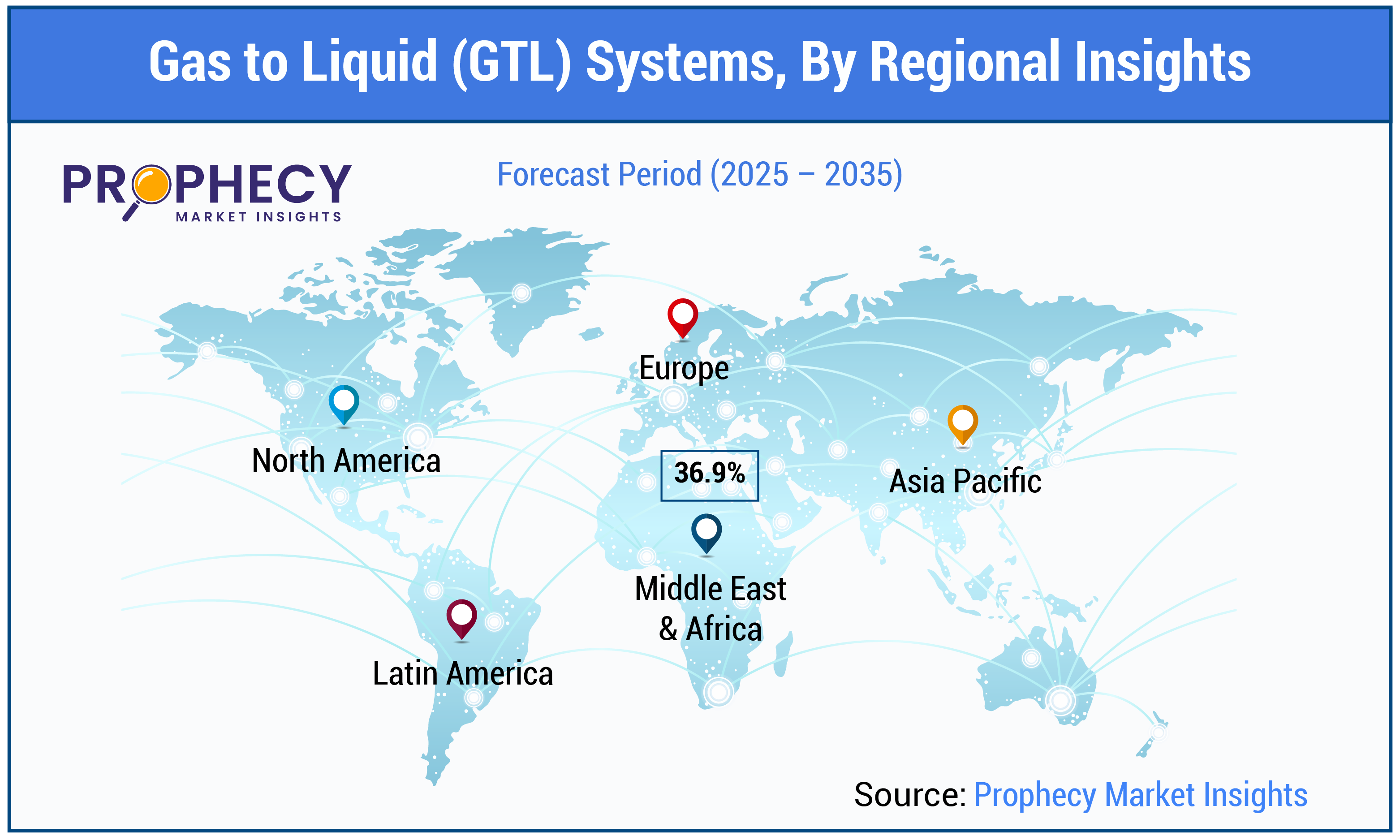
Geographically, the market is studied across North America, Europe, Asia Pacific, Latin America, and the Middle East & Africa.
Middle East & Africa: This is the region which holds the upper hand in the gas to liquid systems market share, by approximately, 36.9%, in the recent years. This is due to a confluence of factors, such as, this region’s abundant hydrocarbon reserves, ease and affordability of extracting and processing natural gas in the region contribute to a competitive cost advantage for GTL production, presence of several major GTL plants, increasing energy demand and the expansion of the transportation industry, and government policies that support the exploration of conventional and unconventional natural gas reserve
- Saudi Arabia Gas to Liquid (GTL) Systems Market Insights:
The gas to liquid systems market in Saudi Arabia, is the most influential market, in the recent years. This is due to several factors, including, this country’s substantial oil and gas reserves, favorable geology and infrastructure allow for relatively low-cost extraction of natural gas, actively pursuing diversification away from reliance on oil, increasing energy demand in the region, particularly for transportation and industrial applications, drives the need for alternative fuels such as GTL, and increasing investment in developing the necessary infrastructure for GTL production, including gas processing plants and transportation pipelines.
North America: This is the region which has the gas to liquid systems market growing with the fastest growth rate, during the forecast period, in the recent years. This is due to a combination of factors, such as, this region’s abundant natural gas reserves, a growing demand for cleaner energy sources, and government support for related infrastructure and technology development. Moreover, the region benefits from significant investments in oil and gas infrastructure, including pipelines and LNG export facilities, which facilitate the production and transportation of natural gas and GTL products, and there is a strong demand for GTL systems by various industries.
- U.S. Gas to Liquid (GTL) Systems Market Insights:
The gas to liquid systems market in the U.S., is the fastest growing market, during the forecast period, in the recent years. This is due to the fact that the U.S. possesses significant natural gas reserves, making it a strong candidate for GTL production, which relies on natural gas as its raw material. Moreover, the increasing demand for GTL fuels as a sustainable alternative to traditional diesel and the use of GTL-derived fuels in various industries, are also contributing in its market growth.
Asia Pacific: This is the region which has the gas to liquid systems market growing significantly, in the recent years. This is due to number of factors, such as, this region’s rapid industrialization, robust manufacturing activities, a growing healthcare sector, and increased urbanization. These factors collectively lead to a surge in demand for industrial gases, including those used in GTL processes, across various sectors such as steel, electronics, chemicals, and food processing. Moreover, governments are actively promoting the development of new infrastructure and expanding manufacturing capacity.
- China Gas to Liquid (GTL) Systems Market Insights:
The gas to liquid systems market in China is experiencing considerate amount of growth, in the recent years. This is due to several factors, such as, its large energy consumption and production, significant investments in oil and gas infrastructure, and a growing petrochemical industry. These factors create a substantial demand for GTL systems, which convert natural gas into liquid fuels, such as gasoline and diesel. Moreover, the ongoing urbanization and industrialization in China create a need for efficient oil and gas distribution and storage systems, including GTL technologies.
Gas to Liquid (GTL) Systems Market Report Scope:
|
Attribute |
Details |
|
Market Size 2025 |
USD 11.0 Billion |
|
Projected Market Size 2035 |
USD 17.5 Billion |
|
CAGR Growth Rate |
5.3% (2025-2035) |
|
Base year for estimation |
2024 |
|
Forecast period |
2025 – 2035 |
|
Market representation |
Revenue in USD Billion & CAGR from 2025 to 2035 |
|
Regional scope |
North America - U.S. and Canada Europe – Germany, U.K., France, Russia, Italy, Spain, Netherlands, and Rest of Europe Asia Pacific – China, India, Japan, Australia, Indonesia, Malaysia, South Korea, and Rest of Asia-Pacific Latin America - Brazil, Mexico, Argentina, and Rest of Latin America Middle East & Africa – GCC, Israel, South Africa, and Rest of Middle East & Africa |
|
Report coverage |
Revenue forecast, company share, competitive landscape, growth factors, and trends |
Segmentation:
By Product Type:
- Synthetic Fuels
- Lubricants
By Technology:
- Fischer-Tropsch Synthesis
- Non-Fischer-Tropsch Technology
By Scale Of Operation:
- Small-Scale GTL Systems
- Medium-Scale GTL Systems
By Feedstock:
- Natural Gas
- Biogas
- Others
By Application:
- Fuel Oil
- Lubricating Oil
- Process Oil
- Others
By End-Use Industry:
- Transportation Fuels
- Industrial Applications
- Others
By Region:
- North America
- U.S.
- Canada
- Europe
- Germany
- U.K.
- France
- Russia
- Italy
- Spain
- Netherlands
- Rest of Europe
- Asia Pacific
- China
- India
- Japan
- Australia
- Indonesia
- Malaysia
- South Korea
- Rest of Asia Pacific
- Latin America
- Brazil
- Mexico
- Argentina
- Rest of Latin America
- Middle East & Africa
- GCC
- Israel
- South Africa
- Rest of Middle East & Africa
Global Gas To Liquid GTL Competitive Landscape & Key Players
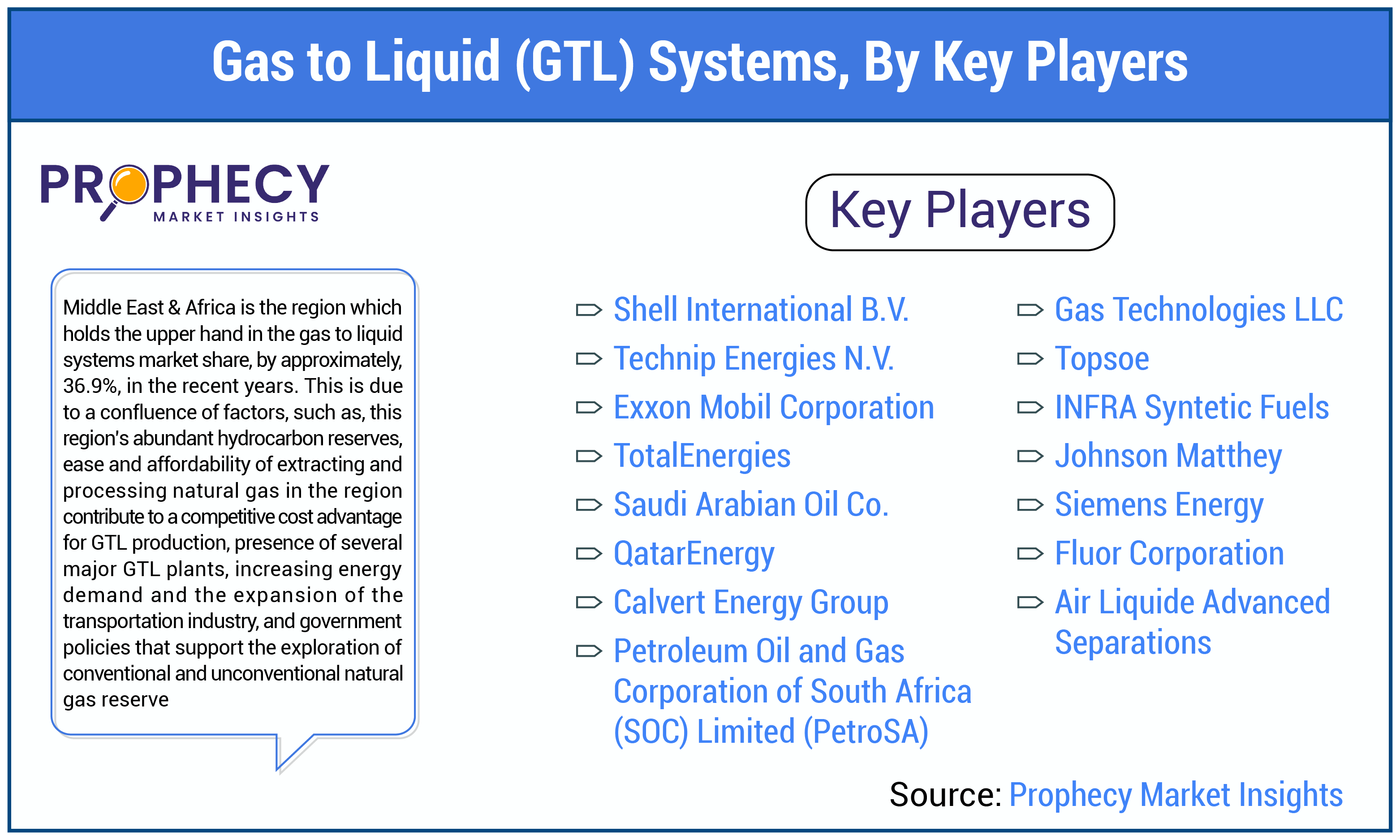
The key players operating in the market include, Shell International B.V., Technip Energies N.V., Petroleum Oil and Gas Corporation of South Africa (SOC) Limited (PetroSA), and others. These key players are focusing on technological advancements, expanding market reach, and leveraging partnerships. These companies also focus on developing cleaner and more sustainable fuels, mitigating carbon emissions, and utilizing advanced catalysts and reactors to optimize conversion efficiency, for driving gas to liquid (GTL) systems market growth.
Gas To Liquid (GTL) Systems Market Companies:
- Shell International B.V.
- Technip Energies N.V.
- Petroleum Oil and Gas Corporation of South Africa (SOC) Limited (PetroSA)
- Exxon Mobil Corporation
- TotalEnergies
- Saudi Arabian Oil Co.
- QatarEnergy
- Calvert Energy Group
- Gas Technologies LLC
- Topsoe
- INFRA Syntetic Fuels
- Johnson Matthey
- Air Liquide Advanced Separations
- Siemens Energy
- Fluor Corporation
View an Additional List of Companies in the Gas To Liquid (GTL) Systems Market
Global Gas To Liquid GTL Recent News
- In March 2025, the ground-breaking LS20 mobile liquid hydrogen system, an end-to-end liquefaction and storage system, was introduced by GenH2, a pioneer in the hydrogen infrastructure solutions sector. Through pilot projects and testing, the novel mobile liquefaction unit provides a space-optimized, fully integrated liquid hydrogen solution that can be utilized for a variety of purposes, including energy backup, transportation, and expediting the usage of liquid hydrogen. Additionally, it will serve as a laboratory for evaluating insulation, materials, thermodynamic characteristics, and application use cases.
- In February 2025, Plug Power, a US-based firm that specializes in hydrogen, claims to have introduced the first spot pricing system for liquid green hydrogen. Through the program, purchasers may acquire liquid green hydrogen whenever it needs it from Plug's production facilities without having to sign long-term take-or-pay contracts. To purchase the hydrogen, buyers will still need to sign a spot deal with Plug.
- In August 2023, Performance Food Group, Inc. (PFG), one of the biggest food and foodservice distribution companies in North America, Hyzon Motors Inc., a high-power hydrogen fuel cell technology developer and global supplier of zero-emission heavy-duty fuel cell electric vehicles, and Chart Industries, Inc., a leading global manufacturer of highly engineered equipment serving multiple applications in the clean energy and industrial gas market, announced the successful completion of Hyzon's first commercial run with a liquid hydrogen fuel cell electric vehicle (LH2 FCEV).
- In December 2021, in an effort to lessen its reliance on oil product imports and extract value from its own gas, Uzbekistan started its first gas-to-liquids plant, a USD 3.6 billion operation. 1.5 million tonnes of synthetic liquid fuels, including kerosene, diesel, liquefied petroleum gas, and naphtha from natural gas, will be produced annually at the UzGTL factory in the southeast Qashqadaryo province.
Analyst View:
The gas to liquid systems market is expanding due to a number of factors, including the need to use "stranded gas" (associated gas), fluctuating gas prices, liberalization of the energy market, increased natural gas production, rising urbanization, and rising global energy demand, which increases demand for all forms of energy sources, including liquid fuels made from natural gas via GTL technology. Continuous research and development in GTL technologies, which are increasing productivity and cutting expenses, is another factor driving the market's growth and making the procedure more financially feasible.Furthermore, the need for cleaner-burning fuels, such GTL substitutes for conventional crude oil-based fuels, is growing as environmental restrictions and concerns become more pressing.
More Related Reports
Fire and Gas Detection System Market
Medical Gases Market
Oil and Gas Accumulators Market
Liquefied Petroleum Gas Market
Cryogenic Gas Market
Global Gas To Liquid GTL Company Profile
|
Company Name |
Shell International B.V. |
|
Headquarter |
The Hague, The Netherlands |
|
CEO |
Mr. Wael Sawan |
|
Employee Count (2024) |
96,000 Employees |
Global Gas To Liquid GTL Highlights
FAQs
Gas to liquid (GTL) systems market size was valued at USD 11.0 Billion in 2025 and is expected to reach USD 17.5 Billion by 2035 growing at a CAGR of 5.3%.
Product type, technology, scale of operation, feedstock, application, end-use industry, and region are the segmentation for the target market.
North America, Asia Pacific, Europe, Latin America, and the Middle East & Africa. Middle East & Africa is expected to dominate the market.
The key players operating in the gas to liquid (GTL) systems market include Shell International B.V., Technip Energies N.V., Petroleum Oil and Gas Corporation of South Africa (SOC) Limited (PetroSA), Gas Technologies LLC, Exxon Mobil Corporation, TotalEnergies, Saudi Arabian Oil Co., QatarEnergy, Calvert Energy Group, Topsoe, INFRA Syntetic Fuels, Johnson Matthey, Air Liquide Advanced Separations, Siemens Energy, and Fluor Corporation