Global Collaborative Robot Cobot Market Overview
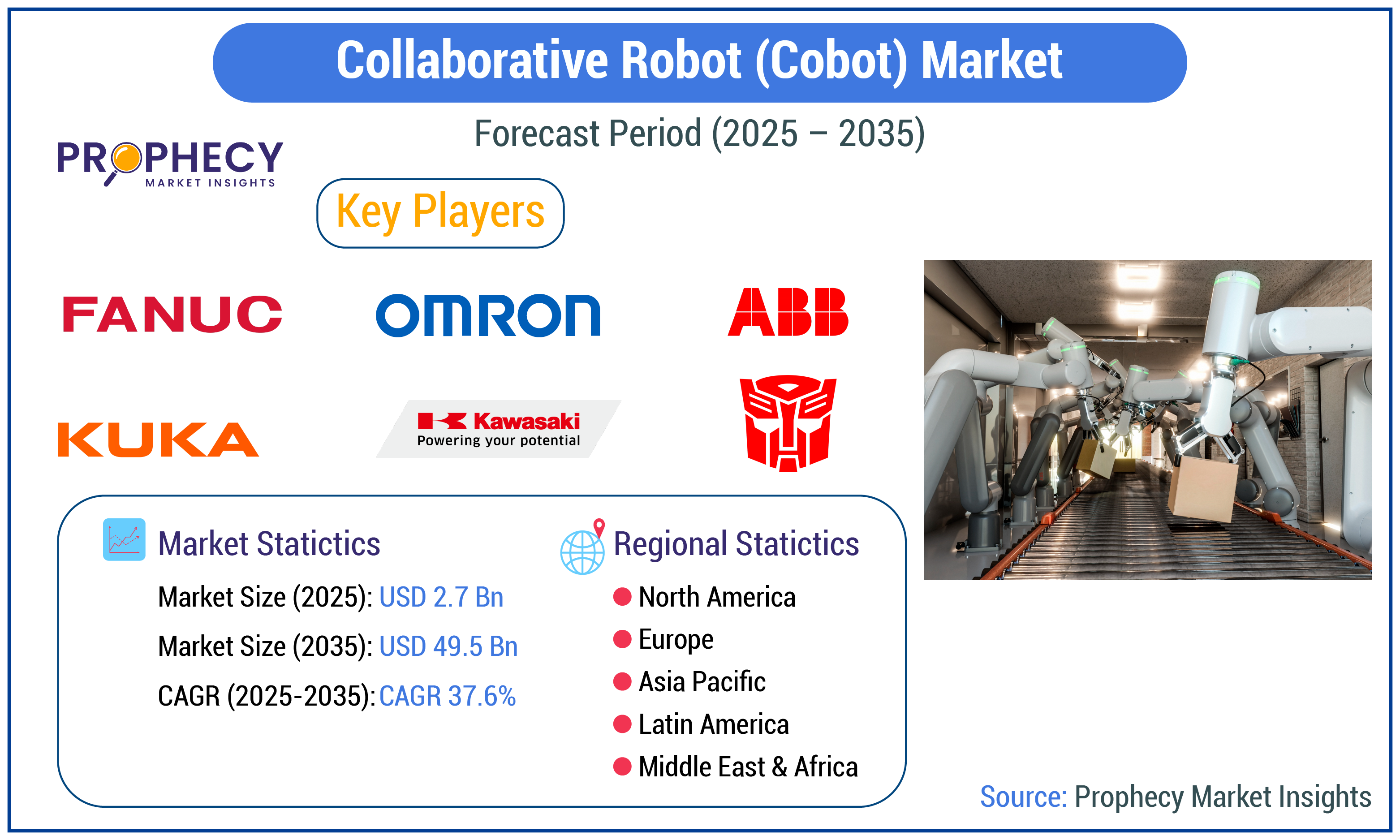
- By 2035, the collaborative robot market size is projected to develop at a rate of USD 49.5 Billion.
- In 2024, the market valuation was USD 2.1 Billion.
- The market is mounting at a CAGR 37.6%.
Collaborative robot is also known as, cobot, is a type of robot which is specially designed to work alongside humans in shared workspace, which interact safely with humans. These robots are lightweight, flexible, and equipped with advanced sensors and safety features, such as force detection, and vision system. Collaborative robots are used in various industries, such as healthcare, welding, packaging, material handling, manufacturing, and others. Collaborative robots can be programmed easily, and adapted to different tasks, which can make it versatile and cost-effective for small or initial setup business.
Cobot can improve efficiency and reduce costs of tasks, resulting to increasing demand for automation industries, to provide extensive solution, without need for extensive infrastructure, resulting to drive target market growth. Increasing adoption by small-& middle-sized automation industries, and rising adoption of industry 4.0, such as IoT, big data, is expected to drive collaboration robot market share.
Enhanced safety features in collaborative workspace to operate safety cages, leading to the expansion of the target market. The integration of artificial intelligence & machine learning algorithms, to make real time decision, and growing human-robot collaboration to distribute tasks between human and robots, is projected to growth of collaborative market size.
Impact of Generative AI on Collaborative Robot Market:
The market for collaborative robots is expected to be significant, which driving innovation and expanding the capabilities of cobots after integration of artificial intelligence (AI). AI can generate new content, designs and solutions based on learned pattern, and deep learning algorithms. AI can help cobot to adapt and learn new environment and help to adjust its movements and operations. The AI algorithms can translate human’s natural language into code for cobots to perform specific tasks, which makes cobot more accessible.
Global Collaborative Robot Cobot Market Drivers & Restraints
Key Drivers:
Growing Adoption of Cobot in Automation is anticipated to Drive Target Market Growth
The increasing demand for cobots in manufacturing, and other industrial fields, are expected to play significant role in the driving collaborative market growth. Cobots are highly integrated in industries, where labor shortage, and skill gaps occurs, thus replace human workers with cobots. Technological improvements in robotic technology, such as AI-powered cobots, machine learning, and advanced sensors, are enhancing the capabilities of cobots. These advancements allow cobots to perform more complex tasks with higher precision and adaptability environment, making them suitable for Industry 4.0 technologies, is anticipated to drive collaborative robot market share.
- For instance, according to data published by TECMAN ROBOT, INC., the adoption of cobot automation is rapidly accelerating in industries such as, manufacturing, logistics, and packaging. These industries are increasingly focus on cobots to enhance efficiency and meet rising production demands. Collaborative robots offer the ideal balance between affordability, adaptability, and safety, making them particularly appealing to small-to-medium enterprises (SMEs), hold automation without repairing their operations. The rising demand is responsible for adoption of cobot in automation, and it is projected to grow at 35% by 2030.
Restraints:
Market Hindered by Technical Complexity and Integration Challenges
Integration of cobots into existing manufacturing and operational processes can be difficult to manufacturer. Many companies face challenges with compatibility, programming, and adaption to different workflows, which can limits the target market growth.
- Counterbalance Statements: Advanced cobots are designed with easy programs and adaptable to different industries, manufacturing, and tasks. Many manufacturers now offer intuitive interfaces and easy integration tools, which reduces the complexity during work, and deployment.
Opportunities & Trends:
Growing Human-Robot Collaboration will Create Significant Opportunities
Growing human-robot collaboration in the cobot can create significant opportunity for business, technology developers, and workers. Cobot are designed to work side by side with humans, by enhancing overall productivity rate in industries, such as manufacturing, industries, and healthcare. Cobot are designed to assists repetitive activation, heavy lifting, and other high physically damaging risk, which reduces the workplace injuries risks. The growing human-robot collaboration trend, led to the development of affordable robotic solution for small & medium size business. As the humanoid robots are becoming more affordable, and accessible, it can be deployed by small business to automate task and reduce labor costs, leading to the expansion of share in collaborative robot market.
- For instance, according to article published by Association for Advancing Automation, in November 2024, this article state that, humanoid robots are rapidly expanding, and driven by significant reduction in production cost of high-specification humanoid robots. It was more affordable, with improved manufacturing efficiencies, which reduced 40% costs associated with developing and deploying of this robots. Humanoid robots are rapidly shaping the future of industry, with Boston Dynamic launched Atlas, Agility Robotics launched Digit, and Tesla launched Tesla optimus. This robotics can create significant opportunities, making it ideal for industries such as logistics and manufacturing or labor-intensive tasks.
Global Collaborative Robot Cobot Market Segmentations & Regional Insights
The collaborative robot market is segmented into component, payload capacity, application, end-user, and region.
By Component:
On the basis of component, the market is segmented into hardware, software. The target market is dominated by hardware segment, as the hardware contains primary components such as robot arm, controller, are the major system to operation. These are the physical components of robots, which are require for movement, manipulation, and task execution, resulting to the target market’s growth for this segment.
The fastest growing segment in the market is software, as it enables smart operations, seamless integration into existing system, and interaction with the environment. The growing demand for easy to use programming tools, and AI-powered capabilities, is projected to segment’s growth in collaborative market share.
By Payload Capacity:
Based on payload capacity, the target market is divided into up to 5 kg, 5-10 kg, 10-25 kg, and above 25 kg. Up to 5kg segment dominates collaborative robot market share, as it is widely used in industries such as small assembly, quality control, electronics, and pick & place applications. As these tasks require robots to handle lightweight items, which can lead to dive segment’s growth in collaborative robot market.
The 5-10 Kg segment is anticipated as fastest growing segment in the market. The segment’s expansion is driven sue to rapidly use in applications that require handling of heavier items and more complex tasks.
By Application:
On the basis of application, the market is classified into welding, loading & unloading, material handling, packaging & palletizing, and others. Material handling segment hold the largest collaborative robot market share, as the cobots are widely applicable in electronics, automotive, and others industries. Cobots are used for tasks such as unloading, loading, sorting, transporting materials, is expected to drive segment’s growth in cobot market share.
Packaging & palletizing segment holds the second dominant collaborative robot market share. The target market is driven by the increasing deployment of cobots to handle packaging products into boxes, stacking items on pellets and preparing goods for shipment.
By End-User:
Under end-user, the market is categorized into automotive, metals & machining, and plastic & polymers, electronics, furniture & equipment, healthcare, and others. The market is dominated by the automotive segment, as collaborative robots are main component in assembly, welding, material handling, and painting. Cobots help to performing repetitive tasks, by reduces human errors and improve operational efficiency, leading to growth of segment in target market size.
The electronics is the fastest growing segment in collaborative robot market. Cobots are increasingly adopting automation solutions due to global labor shortage, and used to soldering, testing and other delicate task, is anticipated to drive segment’s growth in collaborative robot market.
Regional Insights:
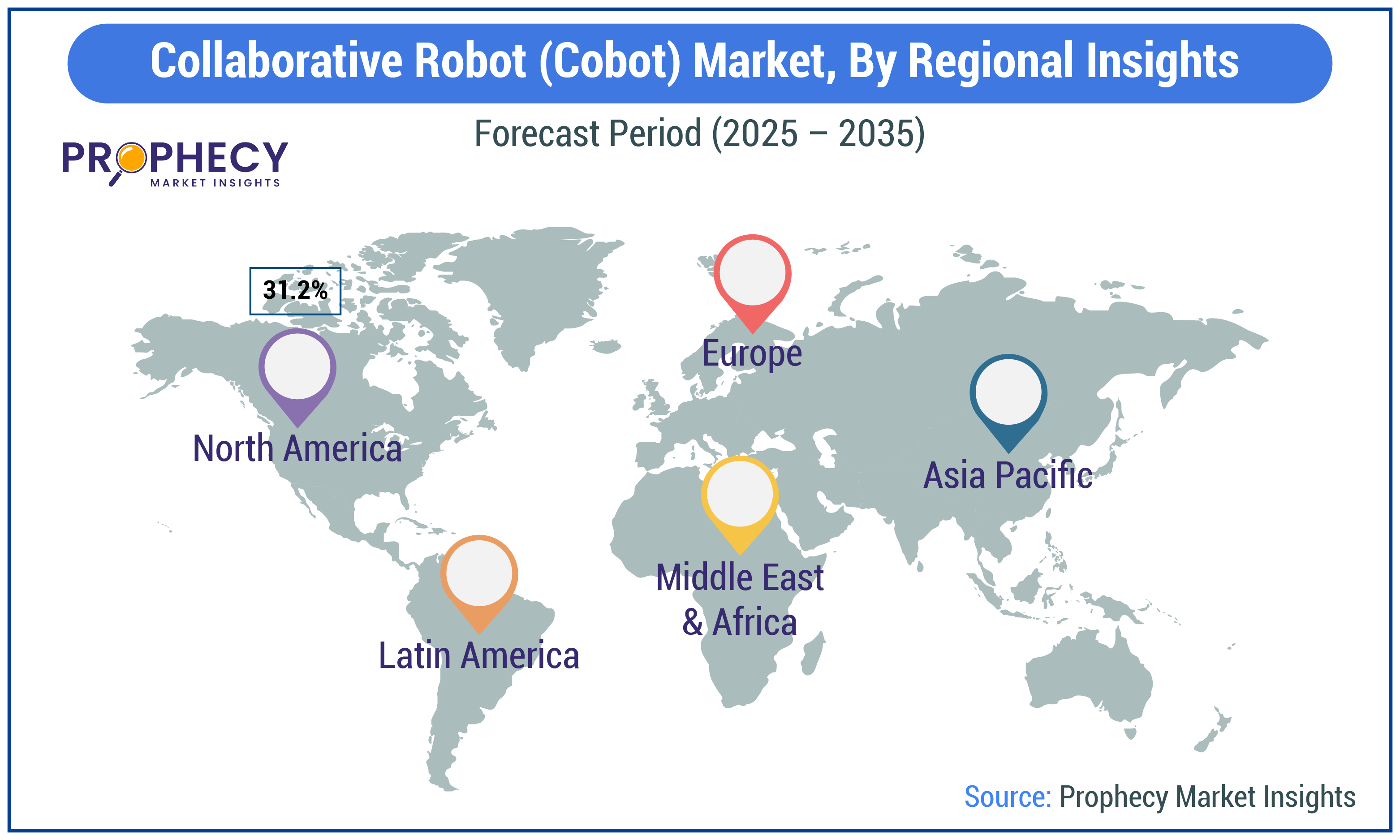
Geographically, the market is studied across North America, Europe, Asia Pacific, Latin America, and the Middle East & Africa.
North America: This region hold largest collaborative robot market share, due to the high adoption of automation technologies in automotive, healthcare, and consumer goods industry. This region facing shortage of skilled labor, which results for the adoption of automotive solutions such as cobots to reduce dependency on human error, leading to region growth in collaborative robot market share.
- U.S. Collaborative Robot Market Insights:
The market for collaborative robot has experienced significant growth in recent years, and is expected to continuous growth. U.S. is the global leader in automation, robotics, and advanced manufacturing technologies. The growing use of cobot in industrial tasks, and lack of skilled labor, is making the U.S. a dominant player in the cobot market.
Asia Pacific: This region is the fastest growing region in target market, driven by rapid industrialization in emerging countries. The growing demand for cobots, in electronics, manufacturing industries, to improve productivity of operations, and reduce labor costs is anticipated to growth of region in target market size.
- China Collaborative Robot Market Insights:
China is the most leading country in Asia Pacific region for collaborative robot market. The target market is driven due to, China contain largest manufacturing hub, especially for electronics, automotive, consumer goods, and textiles industries. The growing manufacturing industries, rises the demand for cobot to reduce labor cost, and improve operational costs, is anticipated to drive target market growth.
Europe: This is another strong market for cobots, as is rapidly growing from forecast period. The well-established industries, with the increasing focus on automation, and growing industry 4.0, rises the demand for collaborative robots, particularly in the automotive, metals & machining, and electronic industries, is projected to region growth over the forecast period.
- Germany Collaborative Robot Market Insights:
Germany has experienced highest growing CAGR in the Europe region, for the collaborative robot market. The increasing demand for collaborative robots is particularly high in automotive manufacturing and precision engineering, where automation is important for improving efficiency and ensuring high-quality production, leading to growth of target market in this country.
Collaborative Robot Market Report Scope:
|
Attribute |
Details |
|
Market Size 2025 |
USD 2.7 Billion |
|
Projected Market Size 2035 |
USD 49.5 Billion |
|
CAGR Growth Rate |
37.6% (2025-2035) |
|
Base year for estimation |
2024 |
|
Forecast period |
2025 – 2035 |
|
Market representation |
Revenue in USD Billion & CAGR from 2025 to 2035 |
|
Regional scope |
North America - U.S. and Canada Europe – Germany, U.K., France, Russia, Italy, Spain, Netherlands, and Rest of Europe Asia Pacific – China, India, Japan, Australia, Indonesia, Malaysia, South Korea, and Rest of Asia-Pacific Latin America - Brazil, Mexico, Argentina, and Rest of Latin America Middle East & Africa – GCC, Israel, South Africa, and Rest of Middle East & Africa |
|
Report coverage |
Revenue forecast, company share, competitive landscape, growth factors, and trends |
Segmentation:
By Component:
- Hardware
- Robot Arm
- Controller
- Teach Pendant
- End-Effector
- Vision System
- Sensors
- Software
- PolyScope
- Decode
- RobotStudio
- Others
By Payload Capacity:
- Up To 5 Kg
- 5-10 Kg
- 10-25 Kg
- Above 25 Kg
By Application:
- Welding
- Loading & Unloading
- Material Handling
- Packaging & Palletizing
- Others
By End-User:
- Automotive
- Metals & Machining
- Plastic & Polymers
- Electronics
- Furniture & Equipment
- Healthcare
- Others
By Region:
- North America
- U.S.
- Canada
- Europe
- Germany
- U.K.
- France
- Russia
- Italy
- Spain
- Netherlands
- Rest of Europe
- Asia Pacific
- China
- India
- Japan
- Australia
- Indonesia
- Malaysia
- South Korea
- Rest of Asia Pacific
- Latin America
- Brazil
- Mexico
- Argentina
- Rest of Latin America
- Middle East & Africa
- GCC
- Israel
- South Africa
- Rest of Middle East & Africa
Global Collaborative Robot Cobot Market Competitive Landscape & Key Players
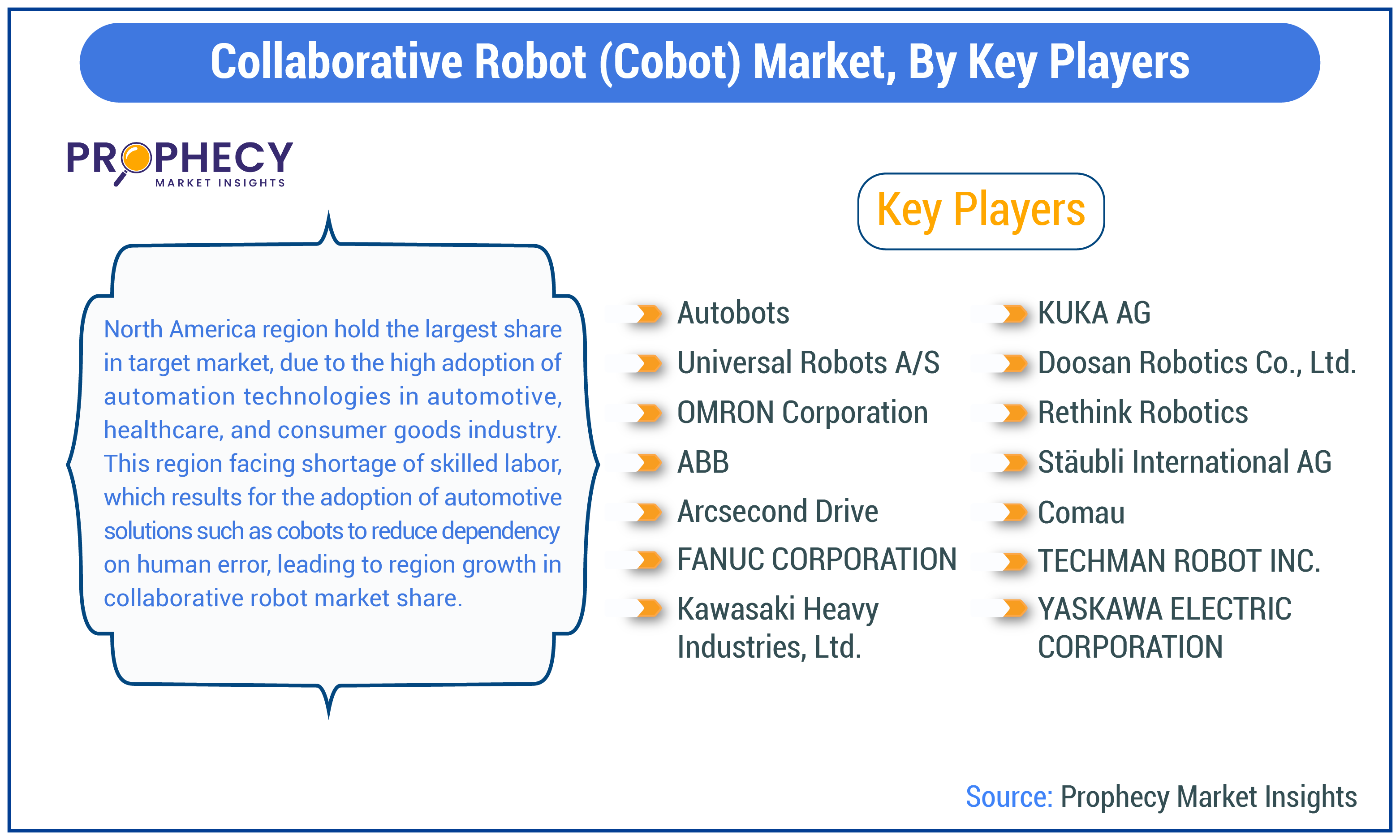
Autobots, Universal Robots A/S, OMRON Corporation, and among others, are the major key players which are operating in collaborative robot market. This companies are integrating collaborative robots in human tasks, to reduce labor cost, and manufacturing cost, is anticipated to drive target market growth. The major key players are focused to launching new cobot, with more affordable costs, with improved work operations, is projected to growth of market share in collaborative robots.
Collaborative Robot (Cobot) Market Companies:
- Autobots
- Universal Robots A/S
- OMRON Corporation
- ABB
- Arcsecond Drive
- FANUC CORPORATION
- TECHMAN ROBOT INC.
- Kawasaki Heavy Industries, Ltd.
- KUKA AG
- Doosan Robotics Co., Ltd.
- Rethink Robotics
- Stäubli International AG
- YASKAWA ELECTRIC CORPORATION
- Comau
View an Additional List of Companies in the Collaborative Robot (Cobot) Market
Global Collaborative Robot Cobot Market Recent News
- In March 2025, Beaumont ISD’s Career Center received USD 77,000 donation from the Controlled Fluids, In. for the collaborative robot. This donation aimed to provide hands-on experience in STEM fields (science, technology, engineering, and mathematics). The donation focused to help students to gain real-world exposure to tools and technology used in engineering, fluid power, and industrial hydraulics for the future innovations in automation.
- In November 2024, Dobot introduced SafeSkin, a revolutionary contactless pre-collision safety technology, was redefining safety standards in human-robot collaboration. This innovation enhances cobot safety by providing real-time responses to potential obstacles, allowing manufacturers to increase production speed without compromising the safety of operators. SafeSkin employed Dobot’s proprietary pre-collision sensing technology, which detects obstacles within 10–20 cm and stops the robot before contact occurs. This system aimed to empowers manufacturers to accelerate automation safely with improved efficiency solution for Industry 4.0.
- In November 2024, Collaborative Robotics launched their new robot, known as Proxie. The first highly adaptable collaborative robot, aimed to meet increasing demand for material handling tasks. Proxie aimed to represent as the future of automation, combination of advanced AI, mobility and modular manipulation system, which was designed to support human-robot collaboration.
- In September 2024, Kawaski Robotics launched the new CL Series of intelligent collaborative robots, at IMTS in Chicago. The CL Series cobots, the new industrial robotic solution featured for applications such as welding, machine tending and material removal flexibility and advanced capabilities with diverse needs. This robot was developed win patnership with NEURA Robotics, which was aimed to offer industrial large scale performance and speed with maximum safety and flexibility advantages of human/robot collaborations.
- In October 2024, Universal Robots, introduced UR AI Accelerator, a ready to use hardware and software toolkit created to enable the development of AI-powered cobot applications. It was designed to help developers to build AI applications, in research, and commercial application. The toolkit aimed to bring AI acceleration to Universal Robots' (UR) next-generation software platform, known as PolyScope X and was powered by NVIDIA Isaac accelerated libraries and AI models, running on the NVIDIA Jetson AGX Orin system-on-module. The toolkit also include newly developed Orbbec Gemini 335Lg 3D camera.
Analyst View:
The collaborative robot (cobot) market is experiencing significant growth and transformation, driven by advancements in automation, robotics technology, and the increasing need for efficiency in industrial and manufacturing processes. The rise of industry 4.0 and the increasing integration of artificial intelligence (AI) and machine learning algorithms, which help cobot to operate in suitable environment, resulting to growth of collaborative robot market size.
More Related Reports
Surgical Robots Market
Robotics Market
Humanoid Robot Market
Robotic Welding Market
Industrial and Collaborative Robots Market
Global Collaborative Robot Cobot Market Company Profile
|
Company Name |
OMRON Corporation |
|
Headquarter |
Kyoto, Japan |
|
CEO |
Junta Tsujinaga |
|
Employee Count (2024) |
28,450 Employees |
Global Collaborative Robot Cobot Market Highlights
FAQs
Collaborative robot (Cobot) market size was valued at USD 2.7 Billion in 2025 and is expected to reach USD 49.5 Billion by 2035 growing at a CAGR of 37.6%.
Component, payload capacity, application, end-user, and region are the segmentation for the target market.
North America, Asia Pacific, Europe, Latin America, and the Middle East & Africa. North America is expected to dominate the market.
The key players operating in the collaborative robot market include Autobots, Universal Robots A/S, OMRON Corporation, ABB, Arcsecond Drive, FANUC CORPORATION, TECHMAN ROBOT INC., Kawasaki Heavy Industries, Ltd., KUKA AG, Doosan Robotics Co., Ltd., Rethink Robotics, Stäubli International AG, YASKAWA ELECTRIC CORPORATION, and Comau.