Global CMOS Camera Module Market Overview
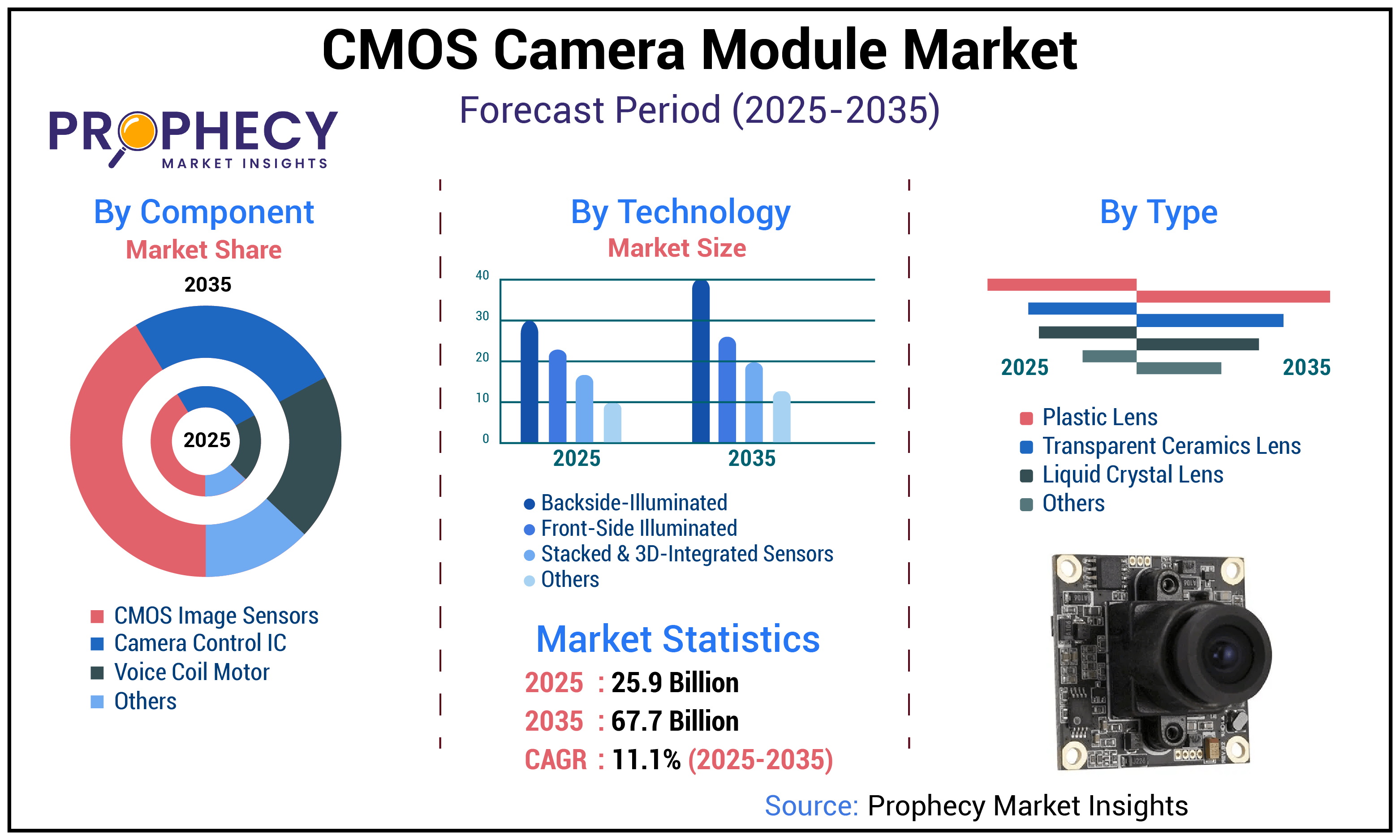
- CMOS camera module market size is expected to expand at a rate of USD 67.7 Billion, by 2035.
- In 2024, the market valuation was USD 24.4 Billion.
- CMOS camera module market is growing at a CAGR 11.1%.
A CMOS (Complementary Metal-Oxide-Semiconductor) camera module is a device that captures images or videos, utilizing a CMOS image sensor to convert light into electrical signals. These modules are commonly used in digital cameras, mobile phones, and other imaging devices. These devices offer several advantages, including low power consumption, high frame rates, high resolution, and low cost compared to other image sensor technologies such as CCD (Charge-Coupled Device). These features make CMOS cameras well-suited for a wide range of applications, from smartphones and webcams to industrial inspection and machine vision.
The CMOS camera module market is experiencing strong growth due to the increasing demand for smartphones with multiple cameras, both front and rear, the growth of AR/VR applications requires high-quality camera modules for complex computer vision tasks such as object and spatial mapping, the increasing adoption of automotive systems, the expansion of surveillance systems, and ongoing advancements in sensor technology.
The market’s diversification is also stimulated by the incorporation of cameras into a wide range of IoT devices, including smart home appliances, improvements in CMOS sensor technology, including higher resolution, better low-light performance, and increased power efficiency, the integration of AI into image processing enhances camera capabilities, and the development of 3D sensing technologies further expands the applications of camera modules.
Recession Risk and Tariff Analysis:
- Due to a decline in smartphone shipments and consumer expenditure, which lowers demand for image components, the CMOS camera module industry is at risk of a recession. These issues are made worse by supply chain interruptions and geopolitical unrest, which might lead to the first market drop in more than 10 years, a 7% decline.
- Tariff analysis on the CMOS camera module market looks at regional tax laws, import taxes, and trade barriers that affect the flow of cross-border components. It affects production choices, supply chain dynamics, and pricing tactics. While advantageous trade agreements increase CMOS module makers' global competitiveness and market expansion, high tariffs may encourage localization.
Impact of Generative AI on CMOS Camera Module Market:
- Through improvements in image processing, defect identification, and design optimization, generative AI is revolutionizing the market for CMOS camera modules. It cuts down on development time and expenses by enabling automated testing, quality control, and camera function simulation.
- AI-generated data enhances computer vision application training, resulting in better performance in surveillance, automobile, and smartphone systems. In the quickly changing image industry, generative AI also fosters innovation in small, high-resolution module designs for new AR/VR and IoT devices, advancing technology and fostering competitive differentiation.
Global CMOS Camera Module Market Drivers & Restraints
Key Drivers:
Increasing Adoption of Smart Phones is stimulating the Market Augmentation
High-quality image has become a major consumer demand, and the growing use of smartphones is a major factor driving the CMOS camera module market growth. Manufacturers continuously integrate advanced camera features such as multi-lens setups, high megapixel counts, and AI-enhanced photography, all relying on CMOS sensors. Compact, effective, and high-performance camera modules are becoming more and more necessary as smartphones take the place of traditional cameras for daily usage. Growing smartphone penetration in developing regions further fuels demand, expanding the market and encouraging continuous innovation in CMOS camera technologies.
-
For instance, according to the data published by Semrush Inc, Globally, there are around 6.84 billion cellphones. Over the past five years, the number of smartphone users worldwide has grown by at least 5% annually. Globally, there are more than 10.47 billion IoT connections. 94.2% of all internet-accessing devices are smartphones. There are around 7.21 billion cellphones in the world. To put it in perspective, that number represents around 90% of the world's population of 8 billion.
Restraints:
The Vulnerability to Rapid Technological Obsolescence is Obstructing the Market Expansion
Rapid technical obsolescence is a significant drawback of the CMOS camera module market. Camera module technologies rapidly become obsolete due to the constant need for updates in consumer electronics, which results in shorter product lifecycles and more e-waste. This makes it difficult for producers to maintain quality and dependability while keeping up with changing standards. Fast innovation cycles can also put strain on supply networks, leading to irregular production and delivery schedules. This can harm a brand's reputation and make it more difficult to remain sustainable over the long run in a market that is extremely competitive.
- Counterbalance Statements: Businesses may use modular camera designs to reduce obsolescence, which enable simple updates without requiring the replacement of complete systems. Product longevity can be increased by putting an emphasis on firmware-based improvements and implementing standardized interfaces. Predictive trend analysis and cooperative R&D also assist manufacturers in anticipating future needs, guaranteeing more sustainable and future-proof CMOS module development.
Opportunities & Trends:
Integration of Artificial Intelligence with Image Processing is Fueling the Market Expansion
The CMOS camera module market is expected to develop in the future due to the integration of AI with image processing, which makes it possible for sophisticated features such as intelligent focusing, low-light improvement, and real-time scene identification. AI algorithms enhance user experiences in security equipment, automobile systems, and smartphones by improving picture quality, noise reduction, and object identification. The need for high-performance CMOS sensors that can do challenging AI tasks is fueled by this integration. AI-powered photography is driving innovation and expanding the range of applications for CMOS camera modules worldwide as it becomes commonplace across devices.
For instance, according to the article published by ResearchGate, AI has a significant impact on image processing by offering innovative methods and uses. GANs are AI image processing techniques that integrate a generator and discriminator neural network. These are useful in many areas, such as healthcare, where it improves early illness detection, personalized treatment regimens, and diagnostic accuracy. AI has also demonstrated exceptional proficiency in recognizing anomalies, illnesses, and medical professionals in the fields of radiography, pathology, and dermatology. AI in image processing has made it possible for robots to recognize and assess visual information similarly to humans.
Global CMOS Camera Module Market Segmentations & Regional Insights
The CMOS camera module market is segmented into component, type, technology, pixel resolution, application, end-user, and region.
By Component:
Depending on component, the market is sub-segmented into camera control IC, CMOS image sensors, voice coil motor, and others. The CMOS image sensors segment is expected to dominate the CMOS camera module market share. This is primarily due to the increasing demand for high-resolution imaging in consumer electronics such as smartphones and tablets. CMOS image sensors offer a combination of high performance, low power consumption, and cost-effectiveness, making it a preferred choice for a wide range of applications.
The camera control IC segment is the second dominating component in the CMOS camera module market. This is due to the fact that Camera Control ICs are essential for managing the camera's functions, including image processing, controlling the lens, and interfacing with the rest of the device.
By Type:
Stemming from type, the market is trifurcated into plastic lens, transparent ceramics lens, and liquid crystal lens. The plastic lens segment is expected to lead the CMOS camera module market. This is due to its lower cost, ease of production, and suitability for mass market applications such as smartphones and general cameras. While Transparent Ceramics and Liquid Crystal Lenses offer advantages such as improved image quality or focusing capabilities, its higher manufacturing costs and specialized applications make it less dominant in the overall market.
The transparent ceramic lens segment is the second leading type in the CMOS camera module market. This due to its advantages, such as, higher refractive index, superior temperature stability, and robustness compared to plastic lenses, making it suitable for applications demanding higher performance and durability, such as automotive, medical, and security.
By Technology:
Appertaining from technology, the market is divided into backside-illuminated, front-side illuminated, and stacked & 3d-integrated sensors. The backside-illuminated segment is holding the superior position in the CMOS camera module market share. This is due to its superior image quality and performance advantages, especially in low-light conditions and mobile devices, compared to front-illuminated (FSI) and stacked/3D-integrated sensors.
The front-side illuminated segment is the second superior technology, in the CMOS camera module market. This is due to its lower cost, mature manufacturing processes, and suitability for certain applications where image quality demands aren't as high as those requiring back-side illumination (BSI) technology.
By Pixel Resolution:
According to pixel resolution, the market is branched into below 8 MP, 8 MP to 13 MP, and above 13 MP. The above 13 MP segment is the most governing pixel resolution in the CMOS camera module market. This is due to the increasing demand for high-quality imaging, particularly in smartphones and other applications such as machine vision and security. This is driven by consumers wanting better image quality for photography and videography, and the use of high-resolution cameras in industries such as machine vision.
The 8 MP to 13 MP segment is the pixel resolution experiencing steady growth, in the CMOS camera module market. This is due to the growing demand for improved image quality in various applications such as consumer electronics, automotive, and security.
By Application:
On the premise of application, the market is catalogued into smartphone, camera, and others. The smartphone segment is the application which has the largest CMOS camera module market share. This is due to the widespread adoption of smartphones and the increasing integration of sophisticated camera technology within them, along with the high demand for mobile photography.
The camera segment is the application which has the second largest market. This is due to the increasing demand for high-quality camera technology in various devices, including digital cameras, camcorders, and professional photography equipment.
By End-User:
Contingent to end-user, the market is categorized into automotive, consumer electronics, healthcare, industrial, and others. The consumer electronics segment is attributed to rule over the CMOS camera module market size. This is due to the widespread use of smartphones, tablets, and other devices that require high-quality imaging, and the constant innovation in camera technologies by manufacturers. The growing popularity of multi-camera setups in mobile devices further contributes to the demand for these modules.
The consumer electronics segment is the fastest growing end-user, in the CMOS camera module market. This is due to the high demand for camera modules in smartphones, tablets, and other devices.
Regional Insights:
Geographically, the market is studied across North America, Europe, Asia Pacific, Latin America, and the Middle East & Africa.
Asia Pacific: This is the region which has the most ruling CMOS camera module market share, by approximately 34.1%, in the recent years. This is due to a combination of factors, such as, this region’s large and rapidly growing smartphone market drives demand for camera modules, with consumers increasingly seeking higher-resolution and more advanced imaging capabilities, automotive industry's focus on advanced driver-assistance systems (ADAS) and autonomous vehicles, a strong manufacturing infrastructure, competitive pricing by local manufacturers, investments in smart city initiatives, and enhanced adoption of AI and machine learning (ML) technologies.
- China CMOS Camera Module Market Insights:
The CMOS camera module market in China is the most influential market, in the recent years. This is due to this country’s major manufacturing hub of smartphones and other consumer electronics, increasing adoption of smartphones and other devices with advanced camera features, robust economic growth and rising disposable incomes contribute to a larger market for consumer electronics, and increased focus on technological innovation, including advancements in camera technology, further fuels the demand for high-quality camera modules.
North America: This is the region which has the CMOS camera module market, growing with the fastest growth rate, during the forecast period, in the recent years. This is due to a confluence of factors, such as, a robust technology infrastructure, a strong consumer electronics industry, and a leading presence of camera module manufacturers and innovative companies.
The region's advanced technology infrastructure and innovative companies drive the development and adoption of camera module technologies. Additionally, North America benefits from a strong consumer electronics market, particularly for smartphones and automotive applications, further fueling demand for camera modules.
- U.S. CMOS Camera Module Market Insights:
The CMOS camera module market in the U.S., is the market growing with the highest CAGR, during the forecast period, in the recent years. This is due to several factors, such as, this country’s high concentration of companies that are at the forefront of camera module innovation, strong demand for high-quality imaging across various sectors, including consumer electronics, automotive applications, and security systems, a robust infrastructure and efficient distribution networks, presence of major technology companies and automotive manufacturers, and a strong in security camera module applications.
Europe: This region has the CMOS camera module market which is experiencing consequent amount of growth, in the recent years. This is due to various factors, such as the growing consumer electronics market, the rise of advanced imaging in smartphones, and increasing demand for camera modules in IoT devices and smart home appliances. Moreover, the increasing adoption of IoT devices and smart home appliances, many of which incorporate cameras for security and other applications, the growing importance of ADAS (Advanced Driver Assistance Systems) and autonomous vehicles, and technological advancements are driving the market growth.
- Germany CMOS Camera Module Market Insights:
The CMOS camera module market in Germany is the market which is experiencing significant growth, in the recent years. This is due to a variety of factors, such as, this country’s well-established manufacturing sector, including a significant presence in electronics and automotive industries, German engineers’ expertise in precision manufacturing and technology, key automotive hub, a robust manufacturing infrastructure, including advanced production lines and quality control systems, increased research and development, and presence of several key players.

|
Attribute |
Details |
|
Market Size 2025 |
USD 25.9 Billion |
|
Projected Market Size 2035 |
USD 67.7 Billion |
|
CAGR Growth Rate |
11.1% (2025-2035) |
|
Base year for estimation |
2024 |
|
Forecast period |
2025 – 2035 |
|
Market representation |
Revenue in USD Billion & CAGR from 2025 to 2035 |
|
Regional scope |
North America - U.S. and Canada Europe – Germany, U.K., France, Russia, Italy, Spain, Netherlands, and Rest of Europe Asia Pacific – China, India, Japan, Australia, Indonesia, Malaysia, South Korea, and Rest of Asia-Pacific Latin America - Brazil, Mexico, Argentina, and Rest of Latin America Middle East & Africa – GCC, Israel, South Africa, and Rest of Middle East & Africa |
|
Report coverage |
Revenue forecast, company share, competitive landscape, growth factors, and trends |
Segmentation:
By Component:
- Camera Control IC
- CMOS Image Sensors
- Voice Coil Motor
- Others
By Type:
- Plastic Lens
- Transparent Ceramics Lens
- Liquid Crystal Lens
By Technology:
- Backside-Illuminated
- Front-Side Illuminated
- Stacked & 3D-Integrated Sensors
By Pixel Resolution:
- Below 8 MP
- 8 MP To 13 MP
- Above 13 MP
By End-User:
- Automotive
- Consumer Electronics
- Healthcare
- Industrial
- Others
By Region:
- North America
- U.S.
- Canada
- Europe
- Germany
- U.K.
- France
- Russia
- Italy
- Spain
- Netherlands
- Rest of Europe
- Asia Pacific
- China
- India
- Japan
- Australia
- Indonesia
- Malaysia
- South Korea
- Rest of Asia Pacific
- Latin America
- Brazil
- Mexico
- Argentina
- Rest of Latin America
- Middle East & Africa
- GCC
- Israel
- South Africa
- Rest of Middle East & Africa
Global CMOS Camera Module Market Competitive Landscape & Key Players
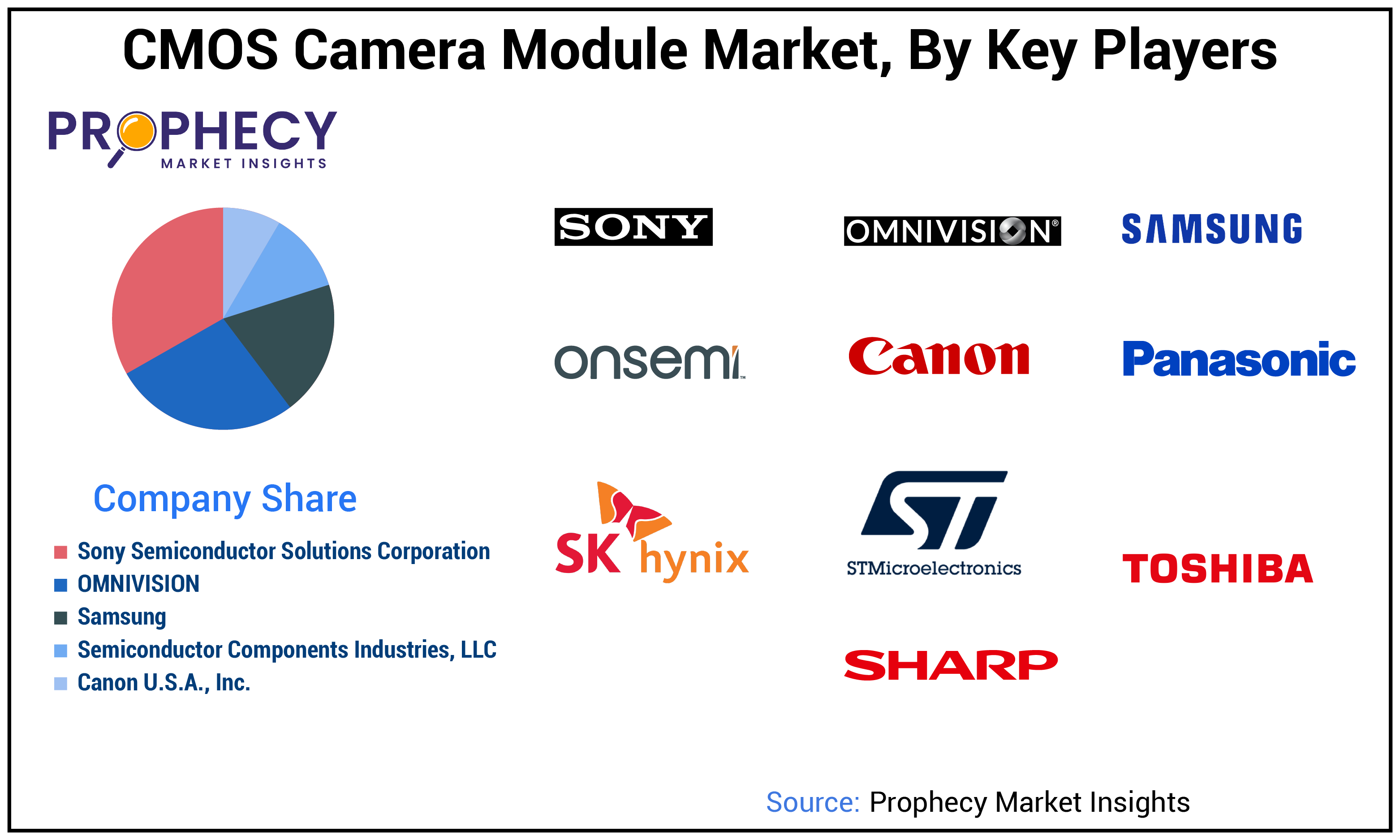
The prominent players operating in the market include, Sony Semiconductor Solutions Corporation, OMNIVISION, Samsung, and others. These key players are focusing on innovation in camera technologies, expanding into new applications such as IoT and automotive, and leveraging partnerships to reach wider markets. It also emphasizes cost optimization and quality control to remain competitive, for driving CMOS camera module market growth.
CMOS Camera Module Market Companies:
- Sony Semiconductor Solutions Corporation
- OMNIVISION
- Samsung
- Semiconductor Components Industries, LLC
- Canon U.S.A., Inc.
- Panasonic Corporation of North America
- SK hynix INC.
- STMicroelectronics
- TOSHIBA ELECTRONIC DEVICES & STORAGE CORPORATION
- SHARP CORPORATION
- TechInsights Inc.
- Ams-OSRAM AG
- E-con Systems
- GPixel
- VALEO
View an Additional List of Companies in the CMOS Camera Module Market
Global CMOS Camera Module Market Recent News
- In November 2024, the imx925 stacked CMOS image sensor with a global shutter and back-illuminated pixel structure will soon be available, according to a statement from Sony Semiconductor Solutions Corporation (SSS). With a high effective megapixel count of 24.55 and fast processing speed of 394 frames per second, this new device is ideal for capturing industrial equipment. With the Pregius S global shutter technology enabled by SSS's innovative pixel structure, the new sensor product offers a small form factor, low noise, and excellent image capabilities.
- In October 2024, The first device in the industry to process and output RAW*2 and YUV*3 pictures concurrently, the ISX038 CMOS image sensor for automobile cameras, is set to be released soon, according to Sony Semiconductor Solutions Corporation (SSS). The novel sensor device can process and output RAW and YUV pictures concurrently and has a patented ISP*4 built in. While YUV photos are supplied for infotainment applications such as drive recorders and augmented reality (AR), RAW images are necessary for external environment identification and recognition in advanced driver-assistance systems (ADAS) and autonomous driving systems (AD).
- In April 2024, based on the most recent OMNIVISION 8 million image sensor OX08D10, SZ Sensing TECH CO., LTD introduced the first in-car camera module in the industry. This module can help intelligently upgrade the automotive industry while also effectively meeting the demands of autonomous driving (AD) and advanced driving assistance systems (ADAS) for higher resolution and image quality. The first brand-new 2.1 micron TheiaCel employing OMNIVISION was OX08D10. Using OmniVision's DCG technology High Dynamic Range (HDR) and a next-generation Lateral Overflow Integrated Capacitor (LOFIC), an 8-megapixel CMOS image sensor
- In March 2024, The VC MIPI IMX900 is a brand-new industrial MIPI camera module from Vision Components. The Sony Starvis IMX900 CMOS global shutter sensor with 3.2 MPixel, 2048 x 1536 resolution, 2.25 µm pixel size, and 100 fps frame rate are features of the camera. The camera has a trigger-in/flash-trigger output and can function in both color and monochrome. It is sensitive to light up to the near infrared (NIR) and has a wide imaging range.
Analyst View:
High-quality camera modules are needed for complex computer vision tasks such as object and spatial mapping in AR/VR applications, the market for CMOS camera modules is expanding rapidly due to the growing demand for smartphones with multiple cameras, both front and rear, the expansion of surveillance systems, the growing use of automotive systems, and continuous improvements in sensor technology.
The use of cameras in a variety of Internet of Things (IoT) devices, such as smart home appliances, advancements in CMOS sensor technology, such as improved resolution, low-light performance, and power efficiency, the incorporation of AI into image processing to enhance camera capabilities, and the creation of 3D sensing technologies to further expand the applications of camera modules all contribute to the market's diversification.
More Related Reports
Dashboard Camera Market
High Speed Camera Market
Medical Cameras and Microscopes Market
Molecular Imaging Market
Delivery Drones Market
Global CMOS Camera Module Market Company Profile
|
Company Name |
Samsung |
|
Headquarter |
Suwon-Si, South Korea |
|
CEO |
Mr. Jun Young-Hyun |
|
Employee Count (2024) |
267,860 Employees |
Global CMOS Camera Module Market Highlights
FAQs
CMOS camera module market size was valued at USD 25.9 Billion in 2025 and is expected to reach USD 67.7 Billion by 2035 growing at a CAGR of 11.1%.
Component, type, technology, pixel resolution, application, end-user, and region are the segmentation for the CMOS camera module market.
North America, Asia Pacific, Europe, Latin America, and the Middle East & Africa. Asia Pacific is expected to dominate the market.
The key players operating in the CMOS camera module market include Sony Semiconductor Solutions Corporation, OMNIVISION, Samsung, TOSHIBA ELECTRONIC DEVICES & STORAGE CORPORATION, Semiconductor Components Industries, LLC, Canon U.S.A., Inc., Panasonic Corporation of North America, SK hynix INC., STMicroelectronics, SHARP CORPORATION, TechInsights Inc., Ams-OSRAM AG, E-con Systems, GPixel, and VALEO