Global Bus Infotainment System Market Overview
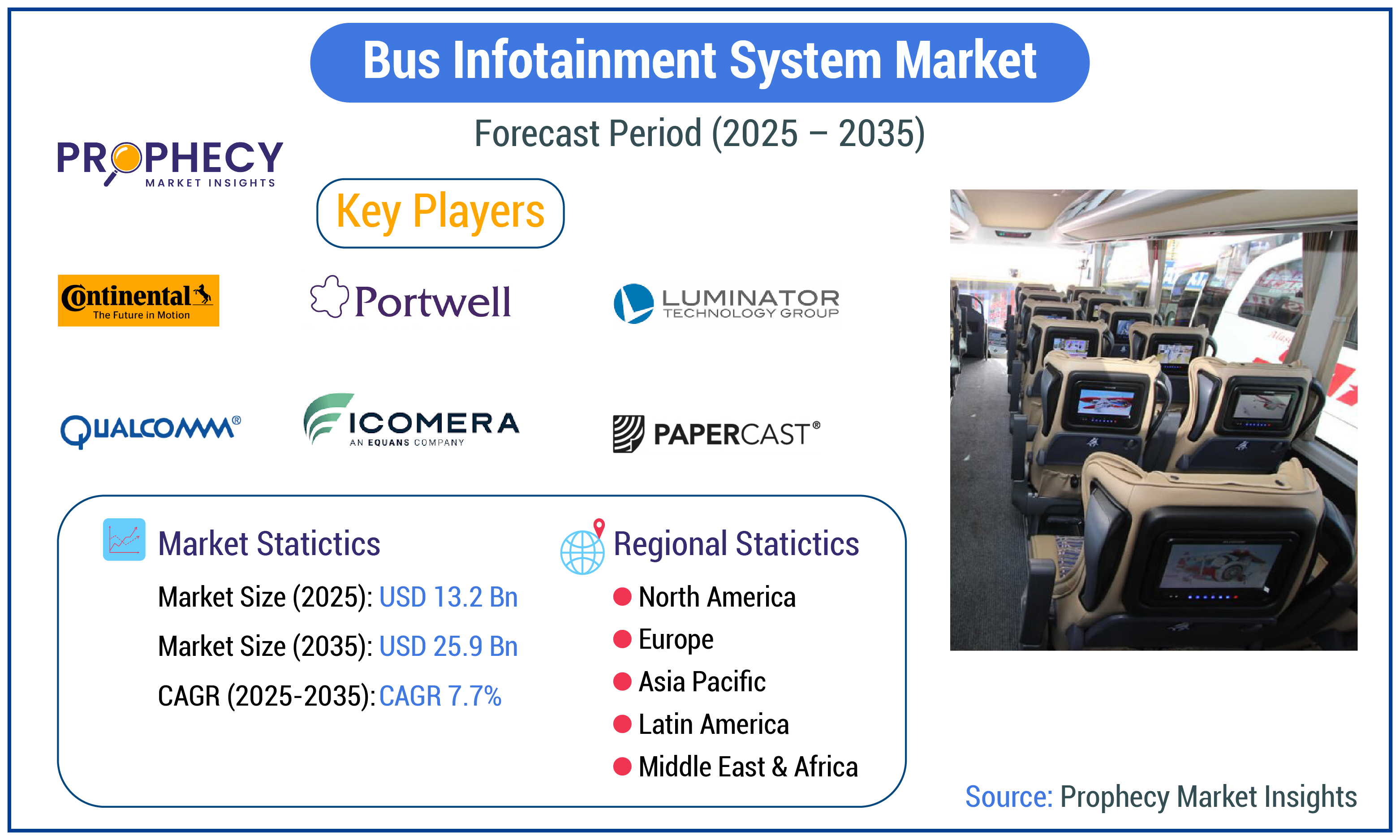
- Bus infotainment system market size is forecasted to develop at a valuation of USD 25.9 Billion, by 2035.
- In 2024, the bus infotainment system market revenue was USD 12.7 Billion.
- Bus infotainment system market is expanding at a CAGR 7.7%.
A bus infotainment system is a technology that enhances the passenger experience by providing information and entertainment, such as news, weather, destination facts, advertisements, and digital streams. A bus infotainment system provides passengers with various entertainment and informational features, enhancing its travel experience. Its advantages include increased passenger satisfaction, improved communication, and potentially increased revenue through advertising.
The rapidly increasing urbanization, increasing passenger demand for more enjoyable and comfortable travel experience, the rising need for comfort during longer commutes for positive experience, integration of features, such as, music streaming, video playback, navigation, and smartphone integration, rising awareness for passenger safety, facilitation of vehicle-to-vehicle communication, and data-driven decision making are factors driving the bus infotainment system market growth.
The rise of smart cities and smart transportation solutions drives the demand for integrated infotainment systems that can provide real-time information and enhance the overall travel experience, 5G connectivity, cloud computing, and AI-powered features are enabling new possibilities for infotainment systems, offering more advanced functionalities and personalized experiences, and enhanced connectivity and user experience are factors further stimulating the market augmentation.
Recession Risk and Tariff Analysis:
- Reduced expenditures in public transportation, supply chain interruptions, and a decline in consumer spending on non-essential improvements put the bus infotainment system market at the risk of a recession. Economic downturns might affect demand by delaying fleet modernizations and technology adoption. Companies may shift focus to essential systems, slowing innovation and market expansion temporarily.
- Bus infotainment system market’s tariff study looks at import taxes, levies, and trade laws that impact system parts such screens, CPUs, and connection modules. It assists producers in determining advantageous markets, streamlining supply chains, and estimating overall landing costs. Strategic planning and competitive pricing in the implementation of global infotainment systems are ensured by an understanding of tariffs.
Impact of Generative AI on Bus Infotainment System Market:
- The bus entertainment system market is undergoing a change thanks to generative AI, which makes it possible for highly customized and flexible user experiences. Artificial intelligence (AI) systems may customize information, entertainment, and material in real-time by examining passenger preferences, travel trends, and contextual data. This improves customer happiness and engagement.
- Generative AI-powered advanced voice assistants enhance convenience and safety by enabling natural, hands-free interactions. Additionally, AI-powered system diagnostics and predictive maintenance increase operational effectiveness and decrease downtime. These innovations position generative AI as a key driver in the evolution and growth of smart, connected bus infotainment solutions.
Global Bus Infotainment System Market Drivers & Restraints
Key Drivers:
Rapidly Increasing Urbanization is Skyrocketing the Market Expansion
Rapid urbanization is significantly propelling the growth of the bus infotainment system market. As cities expand, there's an increased demand for efficient and connected public transportation solutions. Bus infotainment systems enhance passenger experience by providing real-time updates, entertainment, and connectivity features. These systems support smart city initiatives by facilitating better fleet management and route optimization, thereby improving service reliability and operational efficiency. Consequently, the integration of advanced infotainment technologies in buses is becoming essential to meet the evolving needs of urban commuters.
- For instance, according to the data published by World Bank Group, in order to fulfill the World Bank's purpose of eradicating poverty and promoting shared prosperity on a habitable world, more livable cities must be built. Currently, 4.4 billion people, or more than half of the world's population, reside in urban areas. This trend is predicted to continue, with nearly seven out of ten people living in cities by 2050, when the urban population is predicted to more than quadruple.
Restraints:
Data Privacy and Security Concerns are Limiting the Market Expansion
Data security and privacy issues are a significant drawback in the market for bus entertainment systems. These systems often gather and send real-time information on passengers, routes, and use trends. It is susceptible to breaches, illegal data access, and hacking in the absence of strong cyber security defenses. These dangers have the potential to undermine user confidence, discourage adoption, and lead to non-compliance with regulations. Ensuring smooth digital experiences while protecting private data across linked networks and third-party service integrations is a problem.
- Counterbalance Statements: To safeguard infotainment systems, use secure authentication procedures, end-to-end encryption, and frequent software upgrades. Perform recurring compliance inspections and security audits. Make sure vendors adhere to international cybersecurity requirements and train stakeholders on data management procedures. Together, these actions improve user confidence, system integrity, and long-term market viability.
Opportunities & Trends:
Integration of Smart Power Ignition with Bus Infotainment Systems is Unlocking Growth Opportunities in the Future
The bus infotainment system market growth is expected to increase considerably when smart power ignition is integrated with bus infotainment systems. By reducing battery waste and ensuring that infotainment systems only turn on when the bus engine begins and safely shut down when the engine stops, this technology improves system dependability. Such efficient power control lowers maintenance requirements and promotes energy efficiency. As public transportation increasingly adopts connected and sustainable solutions, smart power ignition becomes essential for seamless, eco-friendly, and passenger-centric bus infotainment experiences.
- For instance, according to the data published by Portwell, Inc., The infotainment system will be notified to boot up after the bus engine has started by the bus information system, which is connected with the smart power ignition system. In order to guarantee that the entertainment system will shut down securely, power should be delayed for the necessary number of minutes after the bus engine has stopped. By using smart power ignition, the bus battery is kept from being intelligently depleted.
Global Bus Infotainment System Market Segmentations & Regional Insights
The bus infotainment system market is segmented into offering, bus type, technology, user interface, application, and region.
By Offering:
On the premise of type, the market is bifurcated into hardware and software. The hardware segment is expected to rule over the bus infotainment system market share. This is due to the increasing demand for advanced in-bus entertainment and connectivity features, such as high-quality displays, speakers, and audio/video playback systems.
The software segment is the second superior offering in the target market. This is due to its necessity or powering these hardware devices and providing features such as interactive interfaces, multimedia playback, and connectivity with other devices.
By Bus Type:
Contingent to bus type, the market is sub-segmented into intercity buses, intracity buses, school buses, and others. The intracity buses or transit buses are the dominating segment in bus infotainment system market share. This is due to the widespread adoption of infotainment systems in urban public transportation to enhance passenger experience and improve operational efficiency. Intracity buses, also known as city buses, are used for local travel within a city or metropolitan area, and are a crucial part of urban public transport, and therefore see significant investment in smart technology and infotainment systems.
The school buses segment is the second dominating bus type in the bus infotainment system market. This is due to the increasing awareness and implementation of technology in school transport, and government policies and incentives supporting the use of electric school buses.
By Technology:
According to technology, the market is divided into LCD, LED, OLED, and others. The LCD segment is the leading technology in the bus infotainment system market share. This is due to its cost-effectiveness, widespread availability, and suitability for various bus applications, including passenger information displays, entertainment screens, and video walls.
The LED segment is the second leading technology in the target market. This is due to its advantages such as brightness, high contrast, and good performance in brightly lit environments, which are beneficial for bus applications.
By User Interface:
Stemming from user interface, the market is catalogued into touchscreen interfaces, voice-controlled interfaces, remote control systems, and others. The touchscreen interfaces are the governing user interface in the bus infotainment system market size. This is due to the fact that it offers a user-friendly, intuitive way to interact with the system, and are cost-effective to implement compared to voice-controlled interfaces.
The voice-controlled interfaces segment is the fastest growing user interface in the target market. This is due to its enhanced safety, technological advancements, and growing consumer preference.
By Application:
Contingent to application, the market is classified into passenger entertainment, passenger information systems, fleet management solutions, real-time tracking and monitoring, emergency communication systems, and others. The passenger information systems is the influential application in the bus infotainment system market growth. This is due to the increasing demand for reliable real-time information about schedules, delays, and other travel updates, enhancing passenger experience and comfort.
The fleet management solutions segment is the application which is experiencing steady growth. This is due to its importance to help manage vehicle operations, track assets, and optimize routes, driving operational efficiency.
Regional Insights:
Geographically, the market is analyzed across North America, Europe, Asia Pacific, Latin America, and the Middle East & Africa.
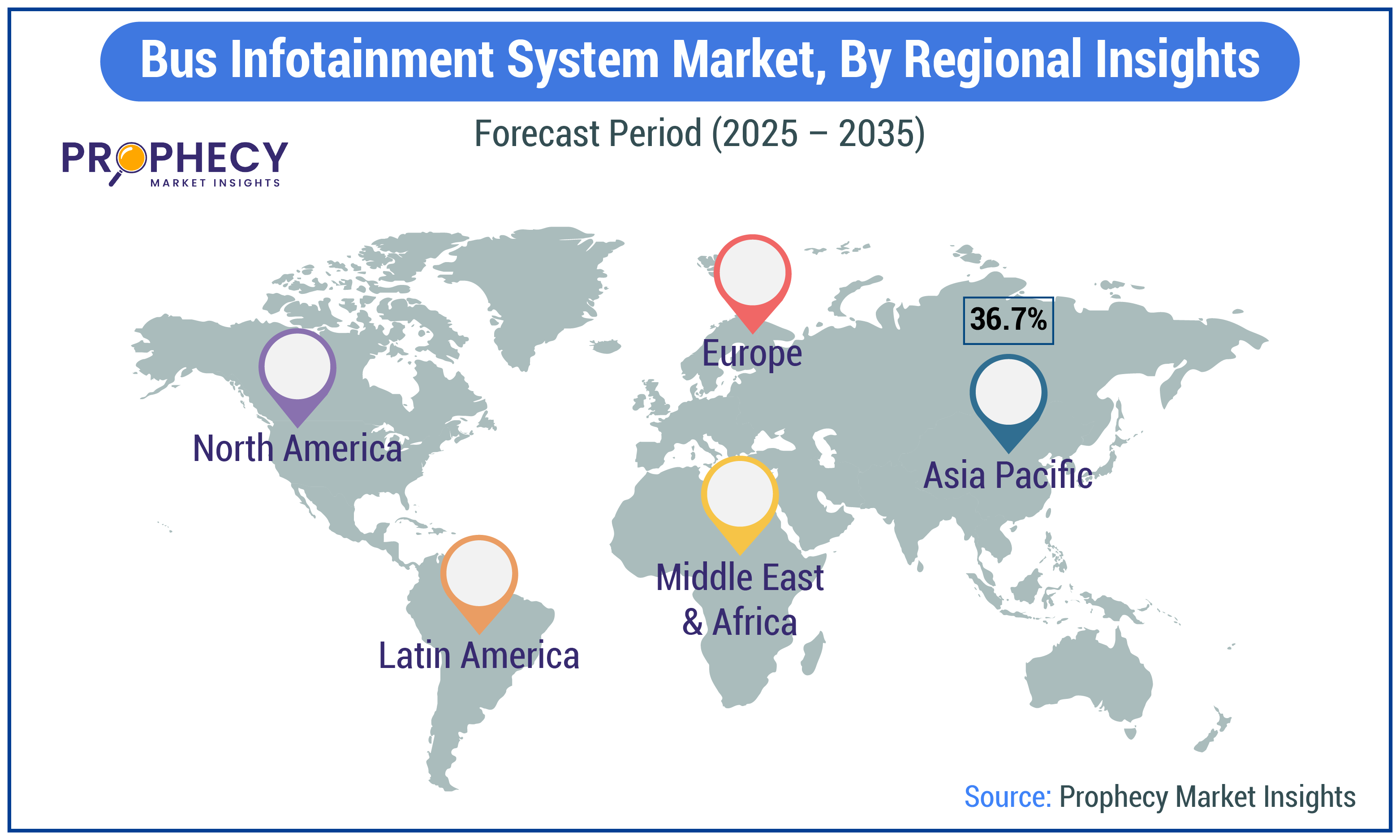
Asia Pacific: This is the region which is holding the upper hand in the bus infotainment system market share by approximately 36.7%, in the recent years. This is due to a combination of factors, such as, this region’s rapid urbanization and increasing public transportation, a rise in the adoption of technology across various industries, including transportation, and a burgeoning commercial vehicle sector. In addition to this, specific countries of this region, are experiencing strong growth in the bus market, further fueling demand for infotainment systems.
- China Bus Infotainment System Market Insights:
The bus infotainment system market in China has the largest market, in the recent years. This is primarily due to this country’s massive automotive industry and high consumer demand for connected vehicles. This is further fueled by significant investments in new technology development, the presence of both domestic and international manufacturers, and growing preference for vehicles with advanced infotainment features. Additionally, the Chinese government's support for connected vehicle technologies contributes to the market's growth.
North America: This is the region which has the bus infotainment system market, growing with the highest CAGR during the forecast period. This is due to a confluence of factors, such as, this region’s strong presence of major bus manufacturers and a high demand for buses equipped with advanced infotainment features. The increasing desire for enhanced passenger experiences and technological advancements in infotainment systems further contribute to this growth.
- U.S. Bus Infotainment System Market Insights:
The bus infotainment system market in the U.S. is the fastest growing market, in the recent years. This is due to this country’s robust automotive sector, strong technology ecosystem, and high demand for advanced in-vehicle features such as AI-powered voice assistants, AR displays, and enhanced connectivity. The US also has a large and diverse fleet of buses, including transit buses, school buses, and long-haul buses, which contribute to the market demand.
Europe: The region which is attributed to have the third dominating bus infotainment system market, in the recent years, is Europe. This is due to a variety of factors, such as, this region’s increasing urbanization, the adoption of electric buses, and stringent emission regulations, all driving the demand for efficient and sustainable transportation solutions in urban areas. The region also benefits from a strong automotive industry, with major players working on advanced infotainment technologies and collaborating with software companies, further fueling market growth.
- Germany Bus Infotainment System Market Insights:
The bus infotainment system market in Germany is experiencing significant amount of market growth, in the recent years. This is primarily due to its strong automotive industry, including major manufacturers such as Volkswagen and BMW, and a focus on advanced vehicle technology. Germany also leads in passenger car production within the EU, with over 29% of the total market share. The country's commitment to innovation and its extensive manufacturing infrastructure contribute to its growth in the target market.
Bus Infotainment System Market Report Scope:
|
Attribute |
Details |
|
Market Size 2025 |
USD 13.2 Billion |
|
Projected Market Size 2035 |
USD 25.9 Billion |
|
CAGR Growth Rate |
7.7% (2025-2035) |
|
Base year for estimation |
2024 |
|
Forecast period |
2025 – 2035 |
|
Market representation |
Revenue in USD Billion & CAGR from 2025 to 2035 |
|
Regional scope |
North America - U.S. and Canada Europe – Germany, U.K., France, Russia, Italy, Spain, Netherlands, and Rest of Europe Asia Pacific – China, India, Japan, Australia, Indonesia, Malaysia, South Korea, and Rest of Asia-Pacific Latin America - Brazil, Mexico, Argentina, and Rest of Latin America Middle East & Africa – GCC, Israel, South Africa, and Rest of Middle East & Africa |
|
Report coverage |
Revenue forecast, company share, competitive landscape, growth factors, and trends |
Segmentation:
By Offering:
- Hardware
- Head Unit
- Radios
- Others
- Software
- Wi-Fi
- Power Management
- Others
By Bus Type:
- Intercity Buses
- Intracity Buses
- School Buses
- Others
By Technology:
- LCD
- LED
- OLED
- Others
By User Interface:
- Touchscreen Interfaces
- Voice-Controlled Interfaces
- Remote Control Systems
- Others
By Application:
- Passenger Entertainment
- Passenger Information Systems
- Fleet Management Solutions
- Real-Time Tracking and Monitoring
- Emergency Communication Systems
- Others
By Region:
- North America
- U.S.
- Canada
- Europe
- Germany
- U.K.
- France
- Russia
- Italy
- Spain
- Netherlands
- Rest of Europe
- Asia Pacific
- China
- India
- Japan
- Australia
- Indonesia
- Malaysia
- South Korea
- Rest of Asia Pacific
- Latin America
- Brazil
- Mexico
- Argentina
- Rest of Latin America
- Middle East & Africa
- GCC
- Israel
- South Africa
- Rest of Middle East & Africa
Global Bus Infotainment System Market Competitive Landscape & Key Players
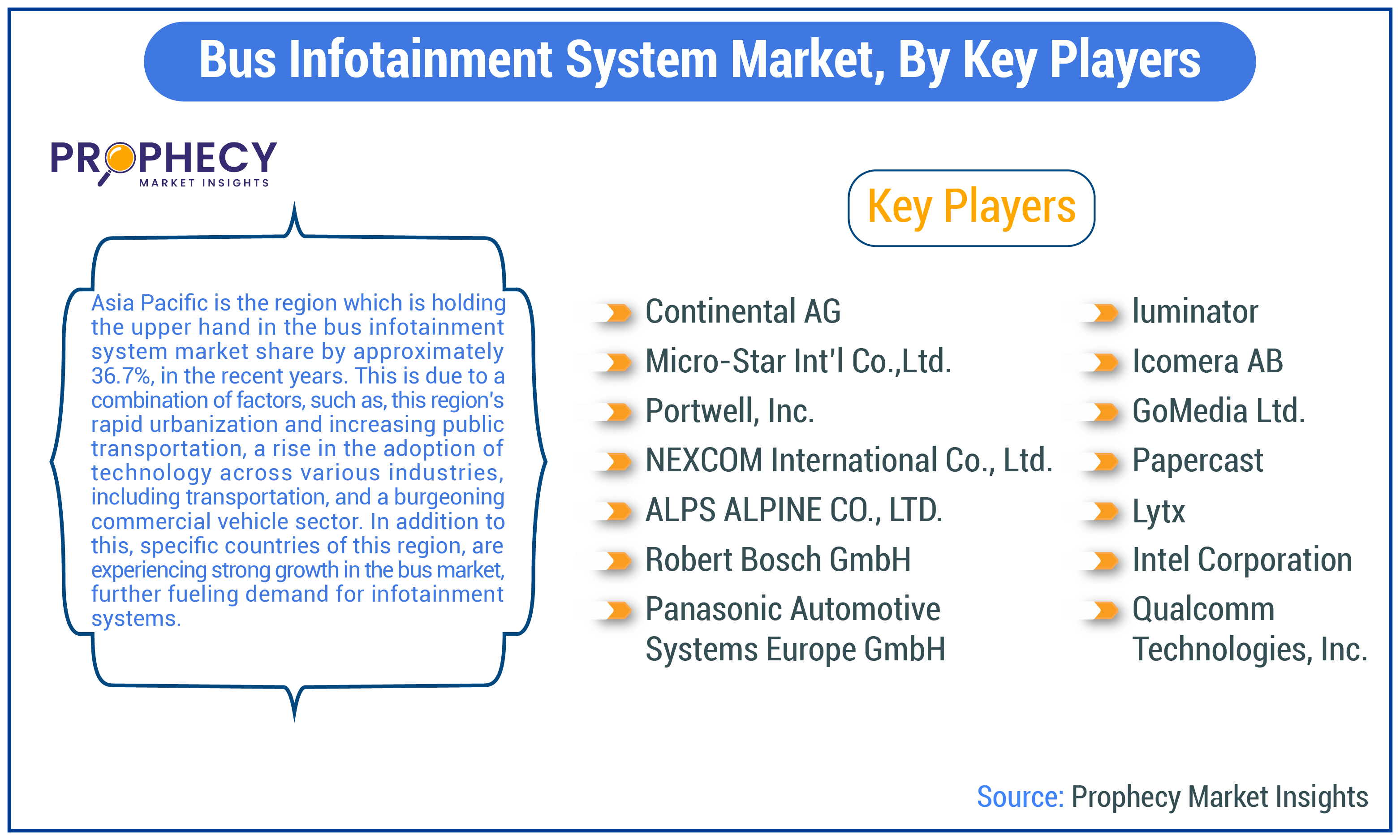
The key players operating in the market include, Continental AG, Panasonic Automotive Systems Europe GmbH, Micro-Star Int’l Co.,Ltd., and others. These key players focusing on several key strategies, including enhancing passenger comfort and experience, integrating technology, and leveraging digital marketing. It also emphasizes building strategic partnerships, expanding reach through digital channels, and creating experiential marketing campaigns, for driving bus infotainment system market growth.
Bus Infotainment System Market Companies:
- Continental AG
- Panasonic Automotive Systems Europe GmbH
- Micro-Star Int’l Co.,Ltd.
- Portwell, Inc.
- NEXCOM International Co., Ltd.
- luminator
- Icomera AB
- GoMedia Ltd.
- Papercast
- ALPS ALPINE CO., LTD.
- Robert Bosch GmbH
- Lytx
- Qualcomm Technologies, Inc.
- Intel Corporation
View an Additional List of Companies in the Bus Infotainment System Market
Global Bus Infotainment System Market Recent News
- In July 2024, Vianova, a leader in real-time passenger information and infotainment, and Safety Vision, a top supplier of mobile video surveillance systems, have established a collaboration to improve ridership overall and transportation safety. Safety Vision was given the non-exclusive right to market and incorporate Vianova's cutting-edge infotainment platform and onboard signage with its mobile video surveillance systems under the terms of this new arrangement.
- In September 2023, the Smart Bus, which represented the pinnacle of passenger transportation solutions, was unveiled at Busworld Azimut. In an interconnected world with growing demands for safety and entertainment. Second, at BusWorld 2023, Azimut will introduce the AOD BusPad+, which it says will "redefine on-board entertainment for public transport passengers, offering a plethora of streaming content and the opportunity to cast personal content on individual embedded screens." At Busworld, the new MirrorCam Digital Rearview was being shown.
- In August 2023, At the APTA Expo 2023 in Orlando, Florida, USA, NEXCOM demonstrated its Edge AI Computing Solutions for Smart Public Bus Transit and Smart Public Rail Transit, and its Passenger Infotainment Solution and Video Surveillance Solution. Don't forget to stop by NEXCOM at Booth #1406 next to the Hall WA3 Entrance. The buses might make advantage of AVL using GNSS and 5G to offer intelligent traffic systems (ITS) and smart public transportation.
- In April 2021, Orasis Pharmaceuticals, an emerging ophthalmic pharmaceutical company focused on reshaping vision possibilities, announced that the U.S. Food and Drug Administration (FDA) had approved QLOSI (pilocarpine hydrochloride ophthalmic solution) 0.4% for the treatment of presbyopia in adults. QLOSI was expected to be commercially available in the U.S. in the first half of 2024.
Analyst View:
The bus infotainment system market is growing due to a number of factors, including the fast increasing rate of urbanization, the growing demand from passengers for a more comfortable and enjoyable travel experience, the increasing need for comfort during longer commutes for a positive experience, the integration of features such as music streaming, video playback, navigation, and smartphone integration, the growing awareness of passenger safety, the facilitation of vehicle-to-vehicle communication, and data-driven decision making.
The need for integrated infotainment systems that can offer real-time information and improve the overall travel experience is being driven by the emergence of smart cities and smart transportation solutions. Additionally, 5G connectivity, cloud computing, and AI-powered features are opening up new possibilities for infotainment systems, providing more sophisticated functionalities and personalized experiences. Finally, improved connectivity and user experience are factors that are further driving the market augmentation.
More Related Reports
Automobile Infotainment System Market
Bus Door System Market
Bus Amplifier Market
In-Vehicle Infotainment Market
Patient Infotainment Terminals Market
Global Bus Infotainment System Market Company Profile
|
Company Name |
Continental AG |
|
Headquarter |
Hanover, Germany |
|
CEO |
Mr. Nikolai Setzer |
|
Employee Count (2024) |
200,000 Employees |
Global Bus Infotainment System Market Highlights
FAQs
Bus infotainment system market size was valued at USD 13.2 Billion in 2025 and is expected to reach USD 25.9 Billion by 2035 growing at a CAGR of 7.7%.
Offering, bus type, technology, user interface, application, and region are the segmentation for the target market.
North America, Asia Pacific, Europe, Latin America, and the Middle East & Africa. Asia Pacific is expected to dominate the market.
The key players operating in the bus infotainment system market include Continental AG, Panasonic Automotive Systems Europe GmbH, Micro-Star Int’l Co.,Ltd., Papercast, Portwell, Inc., NEXCOM International Co., Ltd., luminator, Icomera AB, GoMedia Ltd., ALPS ALPINE CO., LTD., Robert Bosch GmbH, Lytx, Qualcomm Technologies, Inc., and Intel Corporation.