Global Biological Polymer Film Market Overview
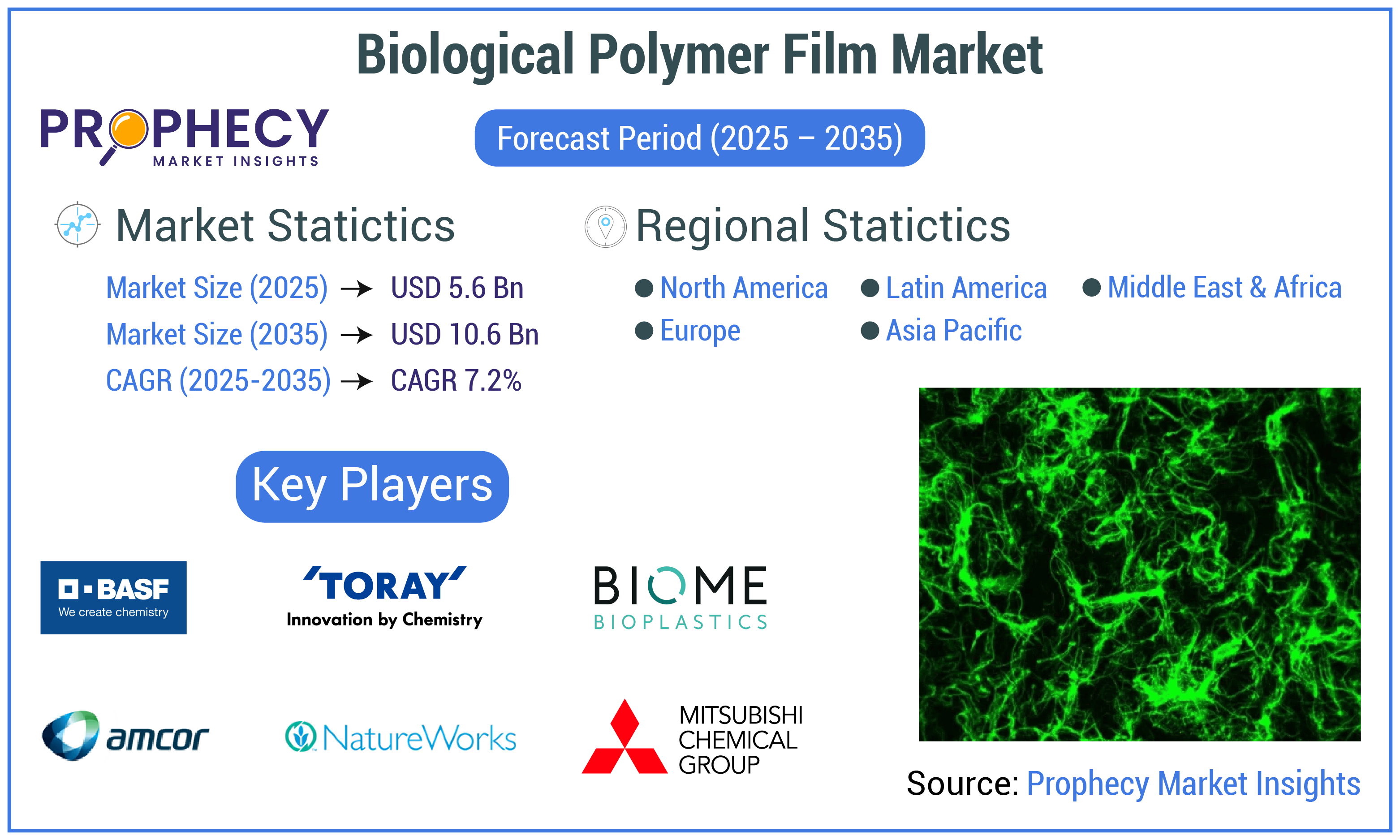
- Biological polymer film market size is expected to develop at a rate of USD 10.6 Billion, by 2035.
- In 2024, the target market valuation was USD 5.3 Billion.
- Biological polymer film market is growing at a CAGR of 7.2%.
A biological polymer film is a thin film composed of materials derived from living organisms or renewable sources, often with biodegradable properties. These films are typically made from natural polymers including starch, cellulose, or protein, offering an alternative to synthetic plastic films. It offers advantages such as biodegradability and renewability, making it a sustainable alternative to traditional plastics. These can be derived from renewable resources and are often eco-friendly, with reduced global warming potential. These films also exhibit good mechanical properties, including resistance to moisture, oxygen, and solute movement.
The biological polymer film market is experiencing growth due to factors including, growing awareness of plastic pollution and its detrimental effects on the environment, rising demand for sustainable packaging in industries such as, food and beverages, pharmaceuticals, and agriculture, rising urbanization and industrialization, and growing application of biopolymers in diverse industries.
The market’s augmentation is also stimulated by technological innovations in the biological polymer films, government initiatives and policies promoting the use of biodegradable materials and regulating plastic waste, need for eco-friendly packaging in the food and beverage industry, and rapid growth of e-commerce is creating a need for durable and sustainable packaging materials.
Recession Risk and Tariff Analysis:
- High manufacturing costs, fluctuating raw material prices, and competition from less expensive polymers provide recession risks to the biological polymer film business. Price-sensitive industries may see a decline in demand during economic downturns. Nonetheless, long-term growth potential might be maintained by mitigating effects through sustainability trends and regulatory assistance.
- Global trade dynamics are impacted by the moderate to high import taxes found in non-producing areas, according to a tariff study of the biological polymer film industry. While rising economies encounter cost hurdles, nations with robust domestic sectors levy protective tariffs. The competitiveness and market accessibility of sustainable biopolymer film products are greatly impacted by harmonized tariff schedules.
Impact of Generative AI on Biological Polymer Film Market:
- Through improved product design, formulation optimization, and material innovation, generative AI is revolutionizing the biological polymer film sector. Artificial intelligence (AI) models can forecast mechanical, biodegradable, and polymer behavior, saving time and money on R&D. It helps create environmentally friendly films with specific functions for application in biomedicine, agriculture, and packaging. Supply chain effectiveness and demand forecasts are also enhanced by AI-driven market analysis. Innovation, sustainability, and competitiveness are all increased in the biopolymer film sector by this technological integration.
Global Biological Polymer Film Market Drivers & Restraints
Key Drivers:
The Rapidly Rising Urbanization is stimulating the Market Augmentation
The biological polymer film market is driven by rising urbanization, which raises demand for waste reduction, food preservation, and ecological packaging. The need for environmentally friendly substitutes for traditional plastics is fueled by the rising use of packaged products among urban populations. Films made of biological polymers provide compostable and biodegradable alternatives that support urban sustainability objectives. Smart cities also encourage green laws and policies that support biopolymers, which accelerates market uptake. In the fields of packaging, agriculture, and healthcare, this urbanization spurs innovation and increased uses.
- For instance, according to the data published by World Bank Group, in order to fulfill the World Bank's purpose of eradicating poverty and promoting shared prosperity on a habitable world, more livable cities must be built. Currently, 4.4 billion people, or more than half of the world's population, reside in urban areas. This trend is predicted to continue, with nearly seven out of ten people living in cities by 2050, when the urban population is predicted to more than quadruple.
Restraints:
Limited Functional Performance of Biological Polymer Film is Restricting the Market Expansion
Limited functional performance in comparison to traditional plastic films is a significant drawback of the biological polymer film market. These biopolymers are less appropriate for long-term packaging or protective applications as these frequently have inferior barrier qualities against moisture, gases, and UV light. Additionally, under certain climatic circumstances, its mechanical strength and durability may deteriorate more quickly, compromising the integrity and shelf life of the product. Despite the environmental advantages, this limits its market dominance by preventing its use in sectors that demand high-performance materials.
- Counterbalance Statements: Researchers are creating hybrid biopolymer composites by combining natural polymers with additives or nanomaterial to get around performance restrictions. Multilayer film architectures and sophisticated coating processes improve mechanical and barrier qualities. These developments increase biopolymer films' robustness and usability, opening up new applications for it in demanding packaging settings.
Opportunities & Trends:
Advancements in Biopolymers is Opening up Growth Opportunities in the Future Generations
Improvements in biopolymer performance, functionality, and scalability are expected to further propel the biological polymer film market. Films are now more competitive with conventional plastics thanks to advancements in polymer chemistry that improve strength, flexibility, and barrier qualities. Innovations in green synthesis techniques and bio-based feedstock guarantee sustainable manufacturing. Better compost ability and biodegradability also address environmental issues and follow international regulatory trends. These advancements establish biopolymer films as a crucial element of a circular, environmentally sustainable economy by expanding its application areas in packaging, agriculture, and healthcare.
- For instance, according to the data published by ResearchGate, biopolymers have opened up new possibilities for creating environmentally friendly composites with improved degradation and recyclability. For sustainable development, biopolymers are crucial in the automotive, packaging, electrical, and electronic industries. Future advancements in renewable and biodegradable materials will mostly concentrate on improving product qualities and scaling up low-cost production. Biotechnological fermentation or chemical synthesis can be used to create biopolymers from a variety of renewable resources that are high in carbohydrates. Thus advancements in biopolymers will fuel the biological polymer film market growth.
Global Biological Polymer Film Market Segmentations & Regional Insights
The biological polymer film market is segmented into material type, biodegradability, thickness, functionality, application, and region.
By Material Type:
Based on material type, the market is sub-segmented into starch-based films, cellulose-based films, chitosan-based films, and protein-based films. The starch-based films segment is attributed to dominate the biological polymer film market share. This is due to the abundance, low cost, and good film-forming capabilities of starch. Starch, a polysaccharide readily sourced from various plant-based sources, is cost-effective and provides a strong base for creating films.
The cellulose-based films are the second dominating material type in the target market. This is due to the fact that cellulose is abundant, renewable, and biodegradable, making it an attractive eco-friendly alternative for various applications, particularly in food packaging.
By Biodegradability:
Stemming from biodegradability, the market is bifurcated into compostable films, and non-biodegradable films. The non-biodegradable films segment is leading the target market share. This is due to its established industrial infrastructure and lower cost compared to biodegradable alternatives. These films, made from traditional polymers such as polyethylene (PE), polypropylene (PP), and polyethylene terephthalate (PET), are generally cheaper to produce and have well-established production processes.
The compostable films segment is the second leading biodegradability, in the biological polymer film market. This is due to its established infrastructure, low cost, high performance, wider availability, and long-term usage.
By Thickness:
On the groundwork of thickness, the market is divided into below 20 micrometers, 20 to 50 micrometers, 50 to 100 micrometers, and above 100 micrometers. The 20 to 50 micrometers is holding the superior position in the biological polymer film market share. This is due to a combination of factors, including its suitability for various applications and ease of manufacturing. Within this range, the films can be manufactured with good mechanical properties while still being flexible and adaptable for different uses.
The 50 to 100 micrometers segment is the second superior thickness, in the target market. This is due to a combination of factors, including cost-effectiveness, ease of manufacturing, and versatility in applications. Films within this range are readily available and can be manufactured in various forms, including thick films or sheets, making it a practical choice for various applications.
By Functionality:
Appertaining from functionality, the market is branched barrier films, and conductive films. The barrier films segment is ruling over the biological polymer film market share. This is due to its widespread use in packaging for food, pharmaceuticals, and other goods where preserving product integrity is crucial. The growing demand for food safety and shelf life extension drives significant demand for barrier films, especially in the food and beverage industry.
The conductive films segment is the fastest growing functionality, in the target market. This is due to its versatility and growing demand in various applications, including flexible electronics, sensors, and energy storage. Its ability to combine electrical conductivity with the benefits of biological polymers, such as biodegradability and renewability, makes it a strong contender in the market.
By Application:
Depending upon application, the market is pigeonholed into food packaging, medical packaging, agriculture films, cosmetic packaging, and others. The food packaging segment is the governing application in the biological polymer film market size. This is due to the increasing demand for sustainable and eco-friendly alternatives to traditional plastics in food packaging. Biopolymers such as starch, cellulose, and PLA offer biodegradable and compostable options for packaging.
The cosmetic packaging segment is experiencing steady growth in the target market. This is due to the increasing use of biodegradable films in personal care products, especially for travel-sized and single-use packaging. The rising demand for convenient and eco-friendly packaging options in the cosmetics industry fuels this growth.
Regional Insights:
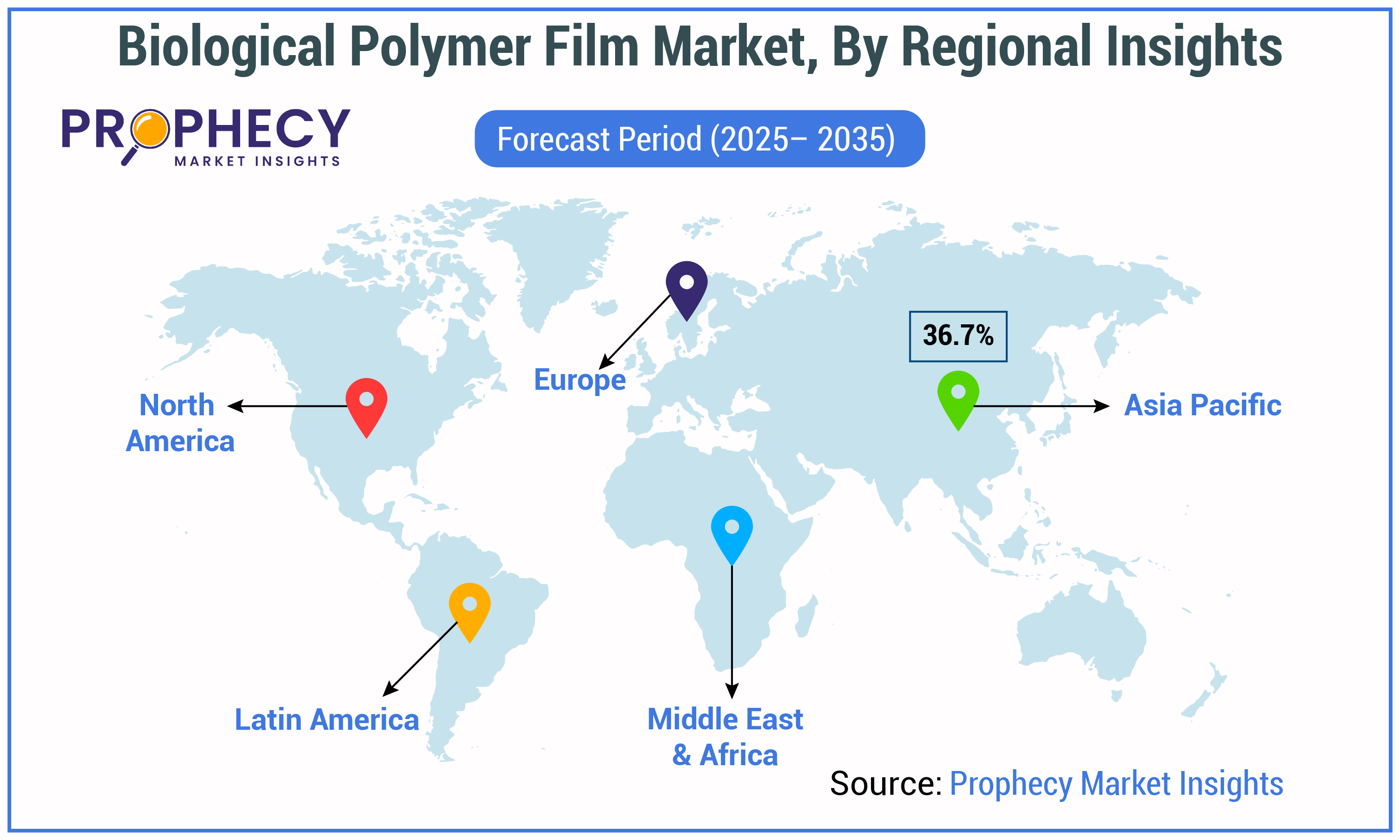
Geographically, the market is studied across North America, Europe, Asia Pacific, Latin America, and the Middle East & Africa.
Asia Pacific: This is the region which has the biological polymer film market, with an estimated share of 36.7%, in the recent years. This is due to a combination of factors, such as, this region’s expanding food and beverage industries, coupled with a boom in e-commerce, rising environmental awareness and government regulations targeting plastic waste, robust manufacturing infrastructure, developing nations such as India and China are key drivers of growth, with increasing disposable incomes and a burgeoning middle class, and large population and increasing urbanization also contribute to the high demand for packaged goods and the need for eco-friendly alternatives.
- China Biological Polymer Film Market Insights:
The biological polymer film market in China is the most influential market, in the recent years. This is due to this country’s government and companies including Sumitomo Seika are actively promoting green chemistry and sustainable materials such as biopolymers, its growing demand of non-alcoholic beverages and packaged food products, leading to increased demand for bio-PET film in packaging applications, growing public awareness and government initiatives to reduce single-use plastics, and increased research and development efforts in the region to improve the performance and properties of bio-based polymers.
Europe: This is the region which has the biological polymer film market, growing with the fastest growth rate, during the forecast period, in the recent years. This is due to a confluence of factors, such as, this region’s strong regulatory framework and growing awareness of the environmental impact of traditional plastics, increased use of biopolymers in packaging, especially in sectors such as food and beverages, well-developed infrastructure for producing and processing biopolymers, rising research and development of new biopolymers by European institutions, and the use of biopolymers in various industries.
- Germany Biological Polymer Film Market Insights:
The biological polymer film market in Germany is growing with the fastest growth rate, during the forecast period, in the recent years. This is due to this country’s strong pharmaceutical market and has a significant packaging industry, major chemical and plastic producers contributing to the availability and development of biological polymer films, increasing focus on sustainability and environmental regulations, including the use of biodegradable plastics, presence of prominent vendors, including Gerresheimer AG and Schott AG, are based in Germany, and its pharmaceutical research and innovation hub.
North America: The region which has the biological polymer film market, experiencing significant amount of growth, in the recent years, is North America. This is due to a number of factors, such as, this region’s growing awareness of environmental issues, including plastic pollution, supportive government policies, including green procurement policies and regulations, increasing investments in bio-based plastics and its derivatives in the U.S. and Canada, rise of e-commerce has created a need for efficient and reliable packaging materials, and its several industrial applications.
- U.S. Biological Polymer Film Market Insights:
The biological polymer film market in the U.S., is experiencing subsequent amount of growth, in the recent years. This is due to its strong demand for PVC films, particularly in the medical industry, leader in research and development of new biological polymers, funding and incentives for PHA research and development, presence of major players in the PHA industry, such as Danimer Scientific and Newlight Technologies, are based in the U.S., and the increasing focus on sustainable solutions, driving demand for biodegradable and renewable materials such as bio-PET films.
Biological Polymer Film Market Report Scope:
|
Attribute |
Details |
|
Market Size 2025 |
USD 5.6 Billion |
|
Projected Market Size 2035 |
USD 10.6 Billion |
|
CAGR Growth Rate |
7.2% (2025-2035) |
|
Base year for estimation |
2024 |
|
Forecast period |
2025 – 2035 |
|
Market representation |
Revenue in USD Billion & CAGR from 2025 to 2035 |
|
Regional scope |
North America - U.S. and Canada Europe – Germany, U.K., France, Russia, Italy, Spain, Netherlands, and Rest of Europe Asia Pacific – China, India, Japan, Australia, Indonesia, Malaysia, South Korea, and Rest of Asia-Pacific Latin America - Brazil, Mexico, Argentina, and Rest of Latin America Middle East & Africa – GCC, Israel, South Africa, and Rest of Middle East & Africa |
|
Report coverage |
Revenue forecast, company share, competitive landscape, growth factors, and trends |
Segmentation:
By Material Type:
- Starch-based Films
- Cellulose-based Films
- Chitosan-based Films
- Protein-based Films
By Biodegradability:
- Compostable Films
- Non-biodegradable Films
By Thickness:
- Below 20 Micrometers
- 20 To 50 Micrometers
- 50 To 100 Micrometers
- Above 100 Micrometers
By Functionality:
- Barrier Films
- Conductive Films
By Application:
- Food Packaging
- Medical Packaging
- Agriculture Films
- Cosmetic Packaging
- Others
By Region:
- North America
- U.S.
- Canada
- Europe
- Germany
- U.K.
- France
- Russia
- Italy
- Spain
- Netherlands
- Rest of Europe
- Asia Pacific
- China
- India
- Japan
- Australia
- Indonesia
- Malaysia
- South Korea
- Rest of Asia Pacific
- Latin America
- Brazil
- Mexico
- Argentina
- Rest of Latin America
- Middle East & Africa
- GCC
- Israel
- South Africa
- Rest of Middle East & Africa
Global Biological Polymer Film Market Competitive Landscape & Key Players
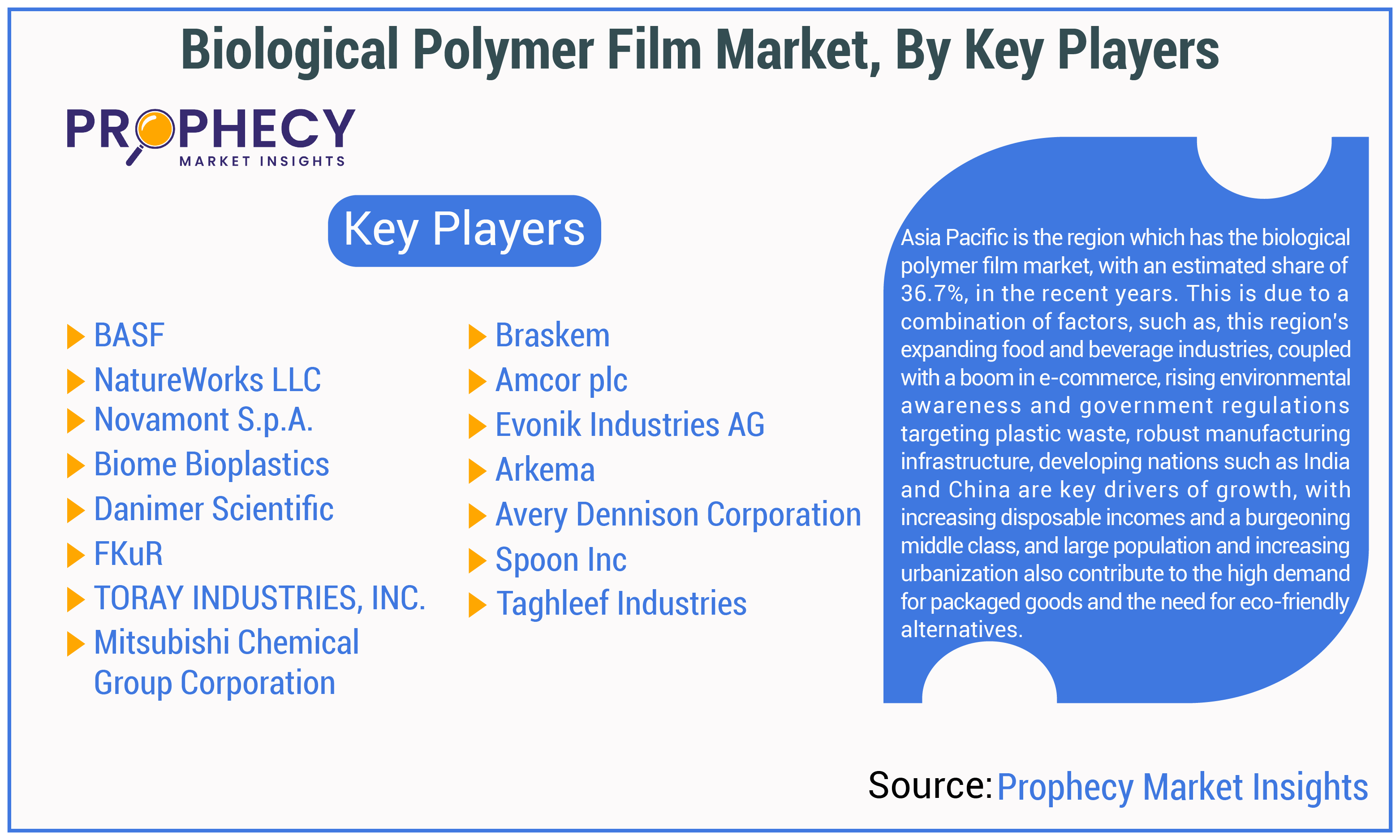
The key players operating in the market include, BASF, NatureWorks LLC, Novamont S.p.A., and others. These key players are adopting a variety of strategies to drive growth, including expanding its product portfolios, investing in research and development, and pursuing strategic partnerships and collaborations. Regulatory changes and increasing demand for sustainable solutions are also key drivers, for driving biological polymer film market growth.
Biological Polymer Film Market Companies:
- BASF
- NatureWorks LLC
- Novamont S.p.A.
- Biome Bioplastics
- Danimer Scientific
- FKuR
- Mitsubishi Chemical Group Corporation
- TORAY INDUSTRIES, INC.
- Braskem
- Amcor plc
- Evonik Industries AG
- Arkema
- Avery Dennison Corporation
- Spoon Inc
- Taghleef Industries
View an Additional List of Companies in the Biological Polymer Film Market
Global Biological Polymer Film Market Recent News
- In December 2024, Biodegradable granules, environmentally friendly dinnerware, and hygiene items made to satisfy a variety of industrial needs are just a few of the sustainable substitutes for single-use plastics that Greenworks Bio has produced. These creative solutions, created in partnership with CSIR-IICT, adhere to stringent compostability regulations in India while utilizing renewable resources such as starch and agricultural waste. India's goal to eradicate single-use plastics and promote a circular economy is supported by this project, which was a major step in combating plastic pollution.
- In December 2023, with the introduction of a new end-to-end licensed technology called CAPSULTM for the continuous manufacturing of polycaprolactone (PCL), a biodegradable polyester frequently used in the packaging, textile, horticultural, and agricultural industries, the Swiss technology company Sulzer was broadening its range of bioplastics. For the manufacturing of PCL grades of superior quality at reasonable prices, the CAPSULTM system provides excellent process performance.
- In August 2023, Terphane, a division of Tredegar Corporation, a world leader in speciality PET polyester films, and Origin Materials, Inc., the top carbon negative materials company in the world with a mission to facilitate the global transition to sustainable materials, announced a strategic partnership to create high-performance, sustainable bio-polymer films. A multi-year capacity reserve agreement was signed by Terphane as part of the cooperation to buy the advanced bio-polymer PEF for usage in film applications, such as high-value industrial applications and food and beverage packaging.
- In December 2022, Under the Common Research & Technology Development Hub (CRTDH), which is supported by the Department of Scientific & Industrial Research (DSIR), Ministry of Science and Technology, New Delhi, Deep Polymers Ltd. and IIT Guwahati (IITG) have signed a Memorandum of Agreement (MoA). Discussions of sustainable polymer-based technologies, collaborative research on biodegradable plastics, industrial workforce training in bio-based and biodegradable polymer development, creation of novel bioplastic-based formulations for specific applications, and contract-based studies on sustainable polymers were all included in the MoA's scope.
- In April 2020, Zymergen and Sumitomo Chemical, a biomanufacturing start-up in California, have created a transparent polymer film that may be used in touch sensors, screens, and printed electronics. Hyaline, the movie, is based on an unnamed novel fermentation-produced monomer. According to the partners, hyaline films are stronger and have higher transparency than synthetic ones. The third quarter was anticipated to see the start of sales.
Analyst View:
The market for biological polymer films is expanding as a result of several factors, such as increased environmental awareness of plastic pollution and its negative effects, growing demand for sustainable packaging in sectors such as agriculture, food and beverage, and pharmaceuticals, increased urbanization and industrialization, and expanding use of biopolymers in the various industries. Additional factors driving the market's expansion include technological advancements in biological polymer films, government programs and policies encouraging the use of biodegradable materials and controlling plastic waste, the need for environmentally friendly packaging in the food and beverage sector, and the explosive growth of e-commerce, which is driving a demand for sustainable and long-lasting packaging materials.
More Related Reports
Next Generation Display Materials Market
Polymers Market
Metamaterials Market
Agricultural Biological Market
Biological Safety Cabinet Market
Global Biological Polymer Film Market Company Profile
|
Company Name |
BASF |
|
Headquarter |
Ludwigshafen, Germany |
|
CEO |
Dr. Markus Kamieth |
|
Employee Count (2024) |
111,822 Employees |
Global Biological Polymer Film Market Highlights
FAQs
Biological polymer film market size was valued at USD 5.6 Billion in 2025 and is expected to reach USD 10.6 Billion by 2035 growing at a CAGR of 7.2%.
Material type, biodegradability, thickness, functionality, application, and region are the segmentation for the target market.
North America, Asia Pacific, Europe, Latin America, and the Middle East & Africa. Asia Pacific is expected to dominate the market.
The key players operating in the Biological Polymer Film Market include BASF, NatureWorks LLC, Novamont S.p.A., Braskem, Biome Bioplastics, Danimer Scientific, FKuR, Mitsubishi Chemical Group Corporation, TORAY INDUSTRIES, INC., Amcor plc, Evonik Industries AG, Arkema, Avery Dennison Corporation, Spoon Inc, and Taghleef Industries