Global Next Generation Display Materials Market Overview
- 2025 Market Size: USD 172.2 Billion
- 2036 Projected Market Size: USD 390.6 Billion
- CAGR (2026-2036): 7.8%
- Asia Pacific: Largest Market in 2025
Next Generation Display Materials are advanced substances that cover quantum dots, OLEDs, micro-LEDs, graphene, and flexible substrates used to make less power-consuming, better-performing, and more visually attractive display technologies. These materials enable a device to have features such as higher brightness, better color accuracy, faster response times, and thinner, flexible, or even transparent panels. Some of the benefits are an impeccable visual experience, lower energy consumption, longer product lifetimes, and more expansive design possibilities for the materials' use in smartphones, TVs, automotive displays, wearable, and augmented reality devices.
The increase in the next generation display materials market is largely influenced by the need for high-resolution, energy-efficient, and flexible displays in consumer electronics, automotive, and wearable devices. The evolutions of OLED, micro-LED, and quantum dot technologies are becoming the main factors for excellent visual performance and design flexibility.
Moreover, the popularity of smart devices, electric vehicles with state-of-the-art infotainment systems, and augmented or virtual reality applications is intensifying the market growth. The demand for light, strong, and eco-friendly materials is also a major factor in the market’s expansion.
Innovations in Next Generation Display Materials:
- Intelligent improvements in the field of Next Generation Display Materials are largely about their better performance, increased flexibility, and being more eco-friendly by the use of cutting-edge material science.
- Some of the significant changes are the use of quantum dots for more accurate color reproduction, micro-LEDs for higher brightness and longer lifespan, and organic light-emitting diodes (OLEDs) for extremely light, foldable, and energy-saving type of devices.
- In the meantime, scientists are employing graphene and nanomaterial to make the gadgets more electrically conductive and transparent, while hybrid and bio-based materials are being created to have a lower environmental footprint.
- These innovations are leading to the creation of foldable screens, transparent displays, and visually immersive experiences in consumer electronics, automotive, and wearable industries.
Current Industry Dynamics & Insights:
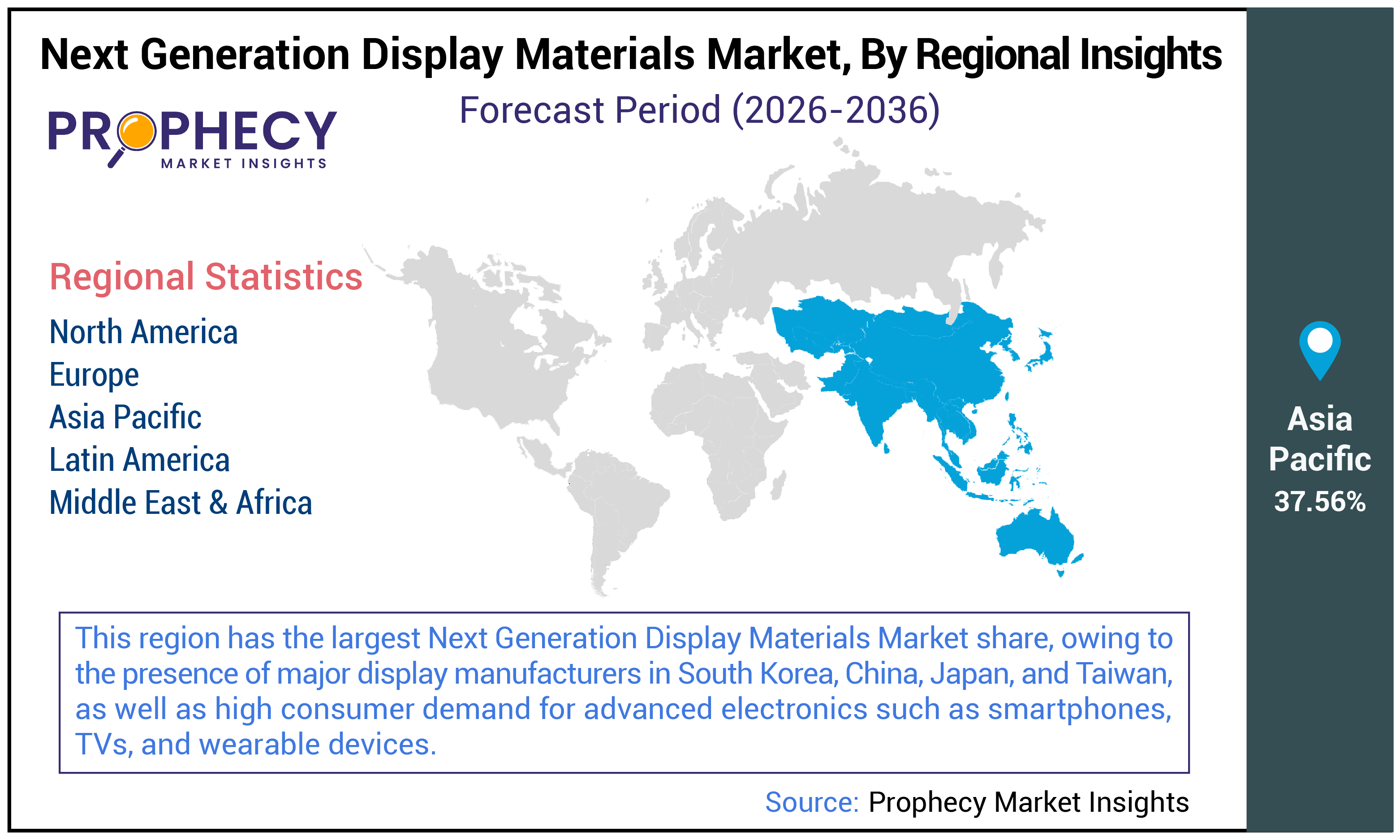
- Asia Pacific has the largest regional share in the market, with almost 37.56%.
- North America is second dominating region in the market.
- By technology, OLED displays dominate the next generation display materials market growth.
Global Next Generation Display Materials Market Drivers & Restraints
Drivers and Restraints:
|
Drivers |
Restraints |
Opportunities & Trends |
|
|
|
Key Drivers:
Rising Disposable Incomes and Evolving Lifestyles
The next generation display materials market is a result of increased disposable incomes and changing lifestyles, which in turn create consumer demand for sophisticated, top-quality electronic devices with enhanced visual features.
As consumers pay more attention to appearance, entertainment, and smart connectivity, the demand for such products as ultra-HD TVs, foldable smartphones, smart watches, and AR/VR gadgets is exponentially growing. Therefore, this move to high-tech and visually immersive experiences is forcing producers to adopt the use of cutting-edge display materials as OLEDs, micro-LEDs, and quantum dots, thus leading to a quicker market growth.
- For instance, according to article published by Euromonitor, global disposable income rise by 8.8% in 2023, driven by growth in Asia Pacific and North America. By 2040, disposable income growth is projected by 2.6% with emerging and developing regions leading the expansion.
- In Asia Pacific, real growth of 49.8% in consumer spending over 2023-2040, which is higher than North America. In 2023, the global wealthy population expanded by 6.4%, driven by an addition of 2.4 billion individuals, mainly from the U.S., Germany, the U.K. and France.
Restraints:
Supply Chain Constraints for Rare Raw Materials
Limited supply of rare raw materials (such as indium, gallium, and rare-earth elements) for advanced display materials due to supply chain constraints may slow down the Next generation display materials market in a way that production delays, increased costs, and dependence on a few suppliers result. These deficits hamper the mass production of the technology and hence have a significant impact on price stability.
- Counterbalance Statements: To be able to tackle this problem, enterprises are turning their attention to recycling materials, creating alternative compounds, shortening supply chains, and implementing eco-friendly sourcing measures, which will not only lessen the need for these scarce elements but also provide a safer and cheaper way of production.
Opportunities & Trends:
Emergence of Hybrid Display Technologies Combining OLED and Micro-LED Features
Hybrid display technologies that integrate OLED and micro-LED characteristics are the next big thing in the next generation display materials market. The goal of these hybrids is to take OLED’s beneficial properties as flexibility, high contrast, and color richness and combine them with micro-LED’s advantages such as high brightness, long life, and low power consumption.
Besides higher performance, these combinations could also lead to longer lifetimes and lower power consumptions thus, they are perfect for next-generation devices as foldable smartphones, AR/VR headsets, automotive displays, and smart TVs. The researchers are moving forward, and the hybrid displays will have an impact on the visual quality and design possibilities in the future.
Global Next Generation Display Materials Market Segmentations & Regional Insights
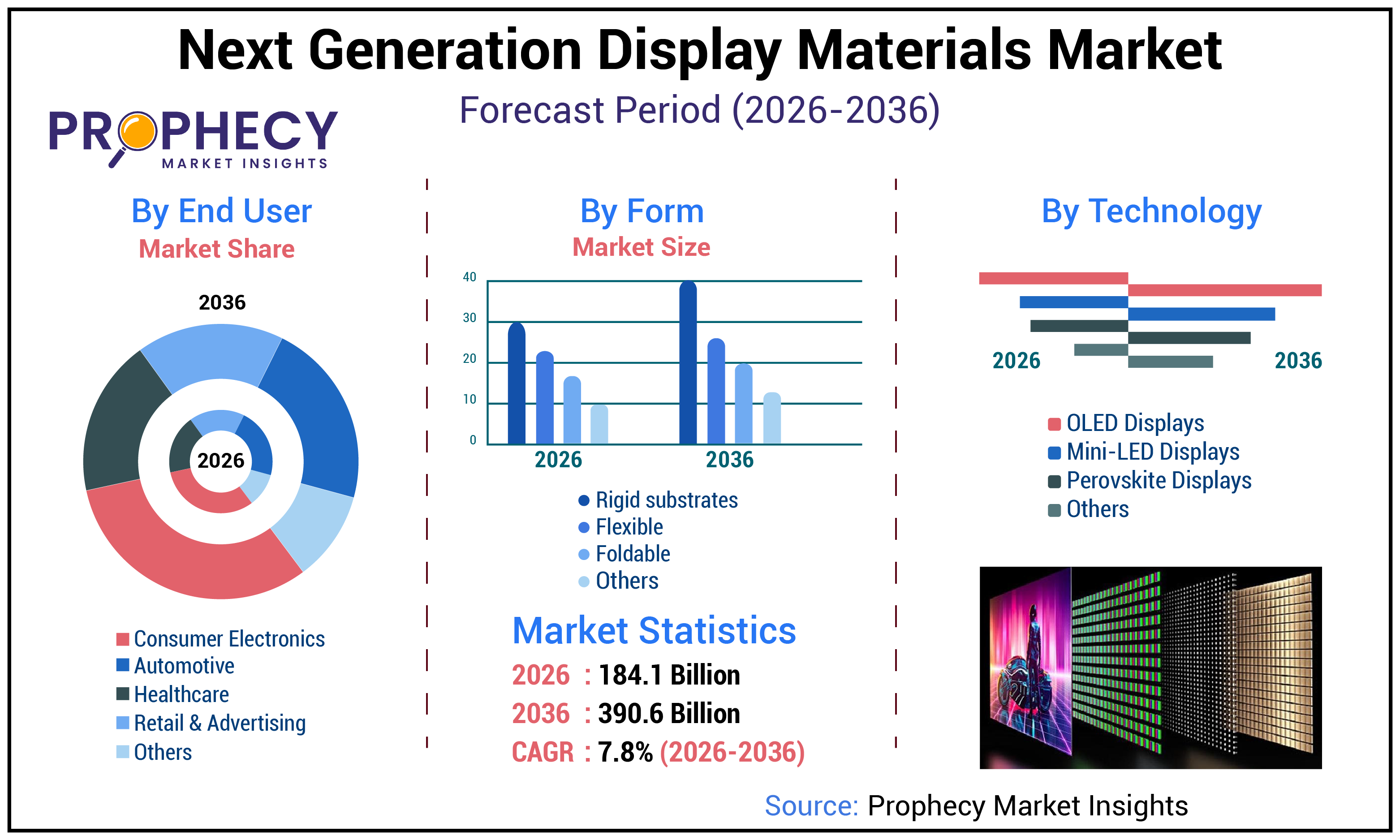
Technology, form, end user, and region are the divisions of the next generation display materials market.
By Technology:
OLED displays, mini-LED displays, perovskite displays, and others are technology on which next generation display materials market is segmented. OLED technology presently dominates the next generation display materials market share due to its improved color quality, flexibility, thinner form factor, and extensive application in smartphones, TVs, and wearable devices.
Mini-LED is the second most common technology, driven by its higher brightness, longer lifespan, and decreased risk of burn-in compared to OLED, making it increasingly popular in high-end TVs, laptops, and gaming displays where durability and brightness are critical.
By Form:
Based on the form, the next generation display materials market is divided into rigid substrates, flexible, foldable, and others. Rigid substrates currently dominate the next generation display materials market share due to their established manufacturing infrastructure, reduced production costs, and extensive use in traditional flat-panel displays such as televisions, monitors, and smartphones.
Flexible substrates are the second most popular form, driven by the increased demand for lightweight, bendable, and energy-efficient displays in smartphones, wearable, and automotive applications, as well as breakthroughs in OLED and polymer-based materials that open up new design options.
By End User:
The next generation display materials market on the account of end user is categorized into consumer electronics, automotive, healthcare, retail & advertising, and others. The consumer electronics segment dominates the next generation display materials market share due to the widespread need for high-performance displays in smartphones, televisions, laptops, tablets, and wearable devices.
The second-largest segment is automotive, where innovative display materials are increasingly being employed in digital dashboards, infotainment systems, and heads-up displays to improve user experience, safety, and aesthetics in modern electrified and connected automobiles.
Regional Insights:
Geographically, the next generation display materials market is studied across North America, Europe, Asia Pacific, Latin America, and the Middle East & Africa.
Asia Pacific: This region has the largest next generation display materials market share, owing to the presence of major display manufacturers in South Korea, China, Japan, and Taiwan, as well as high consumer demand for advanced electronics such as smartphones, TVs, and wearable devices.
- South Korea Next Generation Display Materials Market Insights:
South Korea leads the Asia-Pacific next generation display materials market, owing to the presence of industry leaders such as Samsung Display and LG Display, both of which are pioneers in OLED and flexible display technologies.
North America: This is the second-largest region, driven by increased adoption of OLED and micro-LED technologies in consumer electronics and automotive, as well as significant investments in research, innovation, and high-end display applications across industries.
- U.S. Next Generation Display Materials Market Insights:
The U.S. leads the market in North America, owing to high demand for premium electronic products, considerable expenditures in micro-LED and quantum dot technologies, and the presence of important businesses and research institutions focused on next-generation display improvements.
Europe: The next generation display materials market in Europe is expanding due to the increased use of advanced display technologies in the automotive, industrial, and consumer electronics sectors, as well as a significant emphasis on energy-efficient and sustainable materials.
- Germany Next Generation Display Materials Market Insights:
Germany leads the European market due to its leading automotive industry, strong R&D ecosystem, and technological advances in display integration for vehicles, industrial equipment, and premium electronic devices, which are supported by collaborations between manufacturers and research institutes.
Next Generation Display Materials Market Report Scope:
|
Attribute |
Details |
|
Market Size 2026 |
USD 184.1 Billion |
|
Projected Market Size 2036 |
USD 390.6 Billion |
|
CAGR Growth Rate |
7.8% (2026-2036) |
|
Base year for estimation |
2025 |
|
Forecast period |
2026 – 2036 |
|
Market representation |
Revenue in USD Billion & CAGR from 2026 to 2036 |
|
Regional scope |
North America - U.S. and Canada Europe – Germany, U.K., France, Russia, Italy, Spain, Netherlands, and Rest of Europe Asia Pacific – China, India, Japan, Australia, Indonesia, Malaysia, South Korea, and Rest of Asia-Pacific Latin America - Brazil, Mexico, Argentina, and Rest of Latin America Middle East & Africa – GCC, Israel, South Africa, and Rest of Middle East & Africa |
|
Company Landscape |
Market Share Analysis of Companies Heat Map Analysis Company Overview, Products Overview Financial Information, Key Highlights Business Strategies Overview SWOT Analysis |
|
Report coverage |
Revenue forecast, company share, competitive landscape, growth factors, and trends |
|
Value Added Data Infosets |
Besides fundamental market insights such as the size of the market, growth rate, segmentation, regional study, and key players, our reports carry value-added data sets such as trade flow (import-export) analysis, production and consumption overview, price trend evaluation, supply and value chain mapping, and raw material availability. Moreover, we provide strategic tools as PESTLE and Porter’s Five Forces analysis, examination of the regulatory landscape, as well as monitoring of technology and innovation thereby providing a comprehensive overview which facilitates sensible and anticipatory decision-making. |
Segmentation:
By Technology:
- OLED Displays
- Mini-LED Displays
- Perovskite Displays
- Others
By Form:
- Rigid substrates
- Flexible
- Foldable
- Others
By End User:
- Consumer Electronics
- Automotive
- Healthcare
- Retail & Advertising
- Others
By Region:
- North America
- U.S.
- Canada
- Europe
- Germany
- U.K.
- France
- Russia
- Italy
- Spain
- Netherlands
- Rest of Europe
- Asia Pacific
- China
- India
- Japan
- Australia
- Indonesia
- Malaysia
- South Korea
- Rest of Asia Pacific
- Latin America
- Brazil
- Mexico
- Argentina
- Rest of Latin America
- Middle East & Africa
- GCC
- Israel
- South Africa
- Rest of Middle East & Africa
Global Next Generation Display Materials Market Competitive Landscape & Key Players
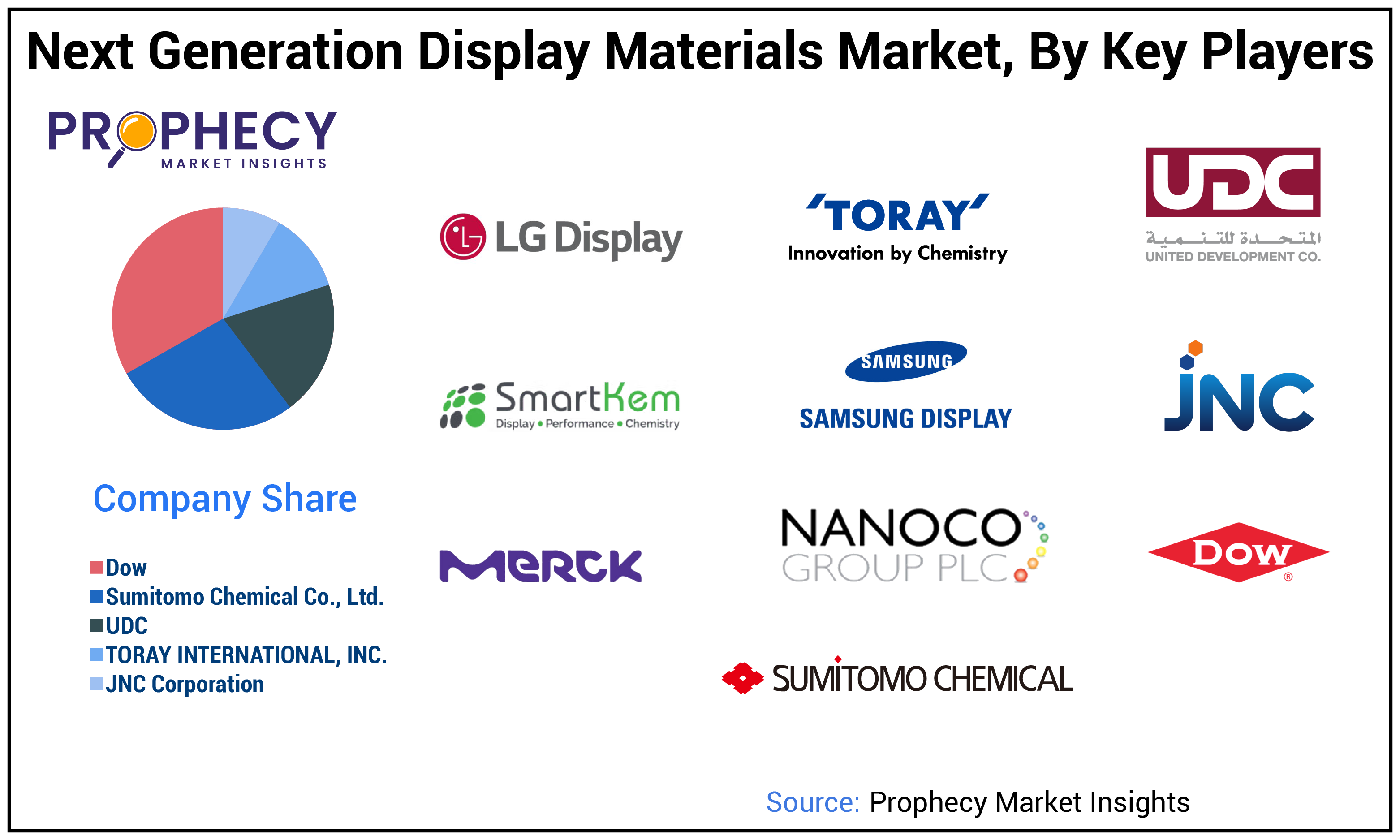
Companies in the next generation display materials market include ongoing R&D to improve material performance, energy efficiency, and flexibility, as well as strategic partnerships with electronics and semiconductor manufacturers to accelerate commercialization.
Companies are also concentrating on expanding production capacity, adopting sustainable and recyclable materials, and diversifying product portfolios to fulfill the needs of future technologies as foldable and transparent displays.
Next Generation Display Materials Market Companies:
- Dow
- Sumitomo Chemical Co., Ltd.
- UDC
- TORAY INTERNATIONAL, INC.
- JNC Corporation
- Smartkem Ltd.
- Nanoco Group plc
- Merck KGaA
- Shoei Electronic Materials, Inc.
- SAMSUNG DISPLAY
- LG DISPLAY CO., LTD
- AUO Corporation
- Seoul Semiconductor
- Smartkem Ltd.
- QustomDot BV
View an Additional List of Companies in the Next Generation Display Materials Market
Global Next Generation Display Materials Market Recent News
- In May 2025, Samsung Display will participate in Display Week 2025, organized by the Society for Information Display. The company will demonstrate next-generation display technologies, including greatly improved Electroluminescence Quantum Dot (EL-QD) prototypes that garnered the "Distinguished Paper Award" from SID.
- In November 2024, Applied Materials, Inc. unveiled the MAX OLED solution, a unique OLED pixel architecture and innovative display manufacturing process that aims to deliver the superior OLED displays found in high-end smartphones to tablets, PCs, and eventually TVs.
Analyst View:
The next generation display materials market is expanding rapidly in response to rising demand for high-resolution, energy-efficient, and flexible displays in consumer electronics, automotive, and wearable. Advanced materials such as OLEDs, micro-LEDs, quantum dots, and graphene allow for brighter, smaller, and more durable screens with improved color and efficiency.
The market's growth is further fueled by the growing popularity of smart gadgets, electric vehicles with advanced infotainment systems, and AR/VR technologies, as well as the quest for lightweight, sustainable, and high-performing display materials.
Analysis of Sources:
Primary Sources:
- In-depth interviews
- Company-specific data
- Surveys and questionnaires
- Focus group discussions (FGDs)
- Others
Secondary Sources:
- Information Technology & Innovation Foundation (ITIF)
- European Commission
- Others
More Related Reports
Next Generation Cancer Diagnostics Market
Next Generation Payment Technology Market
Industrial Next Generation Refrigerants Market
Photomask for Display Market
Automotive Display Systems Market
Global Next Generation Display Materials Market Company Profile
|
Company Name |
Product Portfolio |
|
Merck KGaA |
Display Solutions |
|
Sumitomo Chemical Co., Ltd. |
LC and OLED Displays |
|
UDC |
OLED (PHOLED) Technology and Universal PHOLED Materials |
|
TORAY INTERNATIONAL, INC. |
OLED Displays, Circuit and RGB Materials for LCD Displays |
|
Kyulux, Inc |
Next Generation TADF and Hyperfluorescence OLED |
Global Next Generation Display Materials Market Highlights
FAQs
Next generation display materials market size was valued at USD 184.1 Billion in 2026 and is expected to reach USD 390.6 Billion by 2036 growing at a CAGR of 7.8%.
Technology, form, end user, and region are the segmentation for the next generation display materials market.
The demand for superior features like high resolution, energy efficiency, brightness, and flexibility, as well as the rising consumer preference for advanced devices, better user experiences, and so on are some of the next generation display materials market growth drivers.
North America, Asia Pacific, Europe, Latin America, and the Middle East & Africa. Asia Pacific is expected to dominate the next generation display materials market.
The key players operating the next generation display materials market include Dow, Sumitomo Chemical Co., Ltd., UDC, TORAY INTERNATIONAL, INC., JNC Corporation, Smartkem Ltd., Nanoco Group plc, Merck KGaA, SAMSUNG DISPLAY, LG DISPLAY CO., LTD, AUO Corporation, Seoul Semiconductor, Smartkem Ltd., and QustomDot BV.