Global Automotive Rubber Hose Market Size
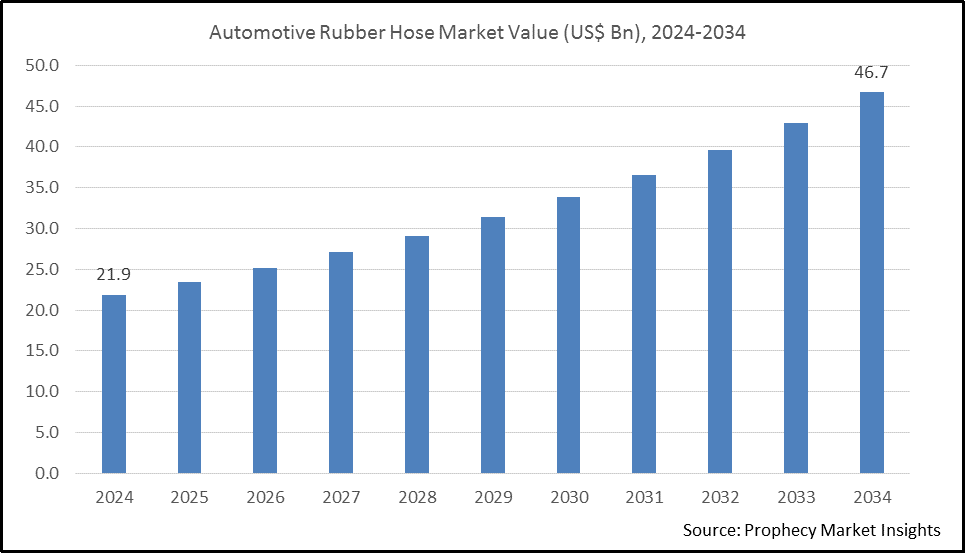
Automotive Rubber Hose Market was estimated to be worth US$ 21.9 billion in 2024 and is expected to increase at a compound annual growth rate (CAGR) of 8.7% to US$ 46.7 billion by 2034.
Automotive rubber hoses use specific rubber compositions to control fluids, gasses, and pressure in automotive systems. For cars, rubber hose is an essential part of the air conditioning and heating systems. Because of their exceptional flexibility and durability, they are made of materials containing rubber. They can tolerate high temperatures as well as high pressure. These are installed to improve the cars' performance. Excellent quality, lightweight rubber hoses are in great demand in the business. Vehicles can run more fuel-efficiently if these rubber hoses are used. Because of all of these reasons, the market share of automotive rubber hoses is anticipated to expand and develop significantly.
Rubber hoses are widely used in cars for many different functions, such as gasoline, power steering, coolant, and brake lines. The growth of the automotive industry and increased vehicle manufacture are the main factors driving the need for rubber hoses. One of the main factors propelling the automotive rubber hose business is the increasing need for durable and lightweight rubber hoses. Manufacturers are looking for lighter materials to lighten their cars since fuel economy and environmental concerns are becoming more and more crucial considerations. Vehicle manufacturers are looking for rubber hoses that are lighter and more flexible. Rubber hose manufacturers will need to think outside the box in order to keep up with this trend, focusing on developing new materials and technologies.
The cost of manufacturing and profitability, which can be impacted by fluctuations in the price of rubber and other raw materials, is a significant barrier to the target market's expansion. Additionally, as electric vehicles become more common over time, some hose types used in conventional fuel-powered vehicles may see a decline in demand.