Global Automotive Industry AGV Market Overview
- Automotive industry AGV market size is expected to develop at a valuation of USD 14.4 Billion, by 2035.
- In 2024, the market valuation was USD 5.4 Billion.
- Automotive industry AGV market is growing at a CAGR 10.3%.
In the automotive industry, AGV stands for automated guided vehicle, and it refers to a system of driverless vehicles that move materials and goods within a manufacturing facility. These AGVs, often mobile robots, operate autonomously, following predetermined paths to transport parts, components, and finished products between various stages of the production process. These offer advantages, such as, reduced labor costs, increased safety, and enhanced productivity. AGVs automate repetitive tasks, free up human workers for more complex jobs, and reduce the risk of accidents associated with manual material handling.
The automotive industry AGV market is expected to grow due to the increasing demand for automation and efficiency to optimize production processes, and AGVs offer a robust solution for material handling and logistics within manufacturing plants, reduced labor costs and enhanced safety with material handling and transportation within the manufacturing environment, and favorable government support and Industry 4.0 initiatives to modernize manufacturing processes, improve competitiveness, and foster innovation.
The market’s expansion is also pitched by improvements in AGV technologies, such as AI-driven navigation systems, enhance its capabilities and make it more reliable and efficient, and AGVs are becoming increasingly flexible and adaptable, capable of navigating complex environments and performing a wider range of tasks. Moreover, stricter regulations and a growing emphasis on workplace safety are pushing manufacturers to implement AGVs in the automotive industry.
Recession Risk and Tariff Analysis:
- The automotive industry's investment in automated guided vehicles (AGVs) may be stifled by recession threats. Economic downturns frequently result in lower demand for automobiles, which forces automakers to restrict output and postpone automation initiatives. AGV adoption is impacted by this delay as businesses are prioritizing short-term cost-cutting measures over long-term automation plans. Recession-related personnel cuts and supply chain interruptions can also make it more difficult to install and maintain AGV systems, which will further slow market expansion.
- Tariff analysis for automotive industry AGV market looks at trade laws and import taxes that have an impact on AGV systems and parts. While advantageous trade agreements promote market development, high tariffs on robotics and automation equipment can raise manufacturing costs. Changes in tariffs have an immediate effect on pricing policies, investment choices, and global supply networks.
Impact of Generative AI on Automotive Industry AGV Market:
- Smarter design, real-time decision-making, and autonomous navigation are all made possible by generative AI, which is transforming the automobile industry's AGV market. By predicting maintenance requirements, optimizing AGV routes, and adjusting to changing production conditions, it increases productivity and decreases downtime. AGV performance in intricate automotive processes is improved by AI-generated simulations, which also speed up product development and customization. Furthermore, generative AI promotes safer and more effective human-AGV collaboration. In order to promote innovation and competitiveness in AGV systems as industries transition to Industry 4.0, generative AI integration is essential.
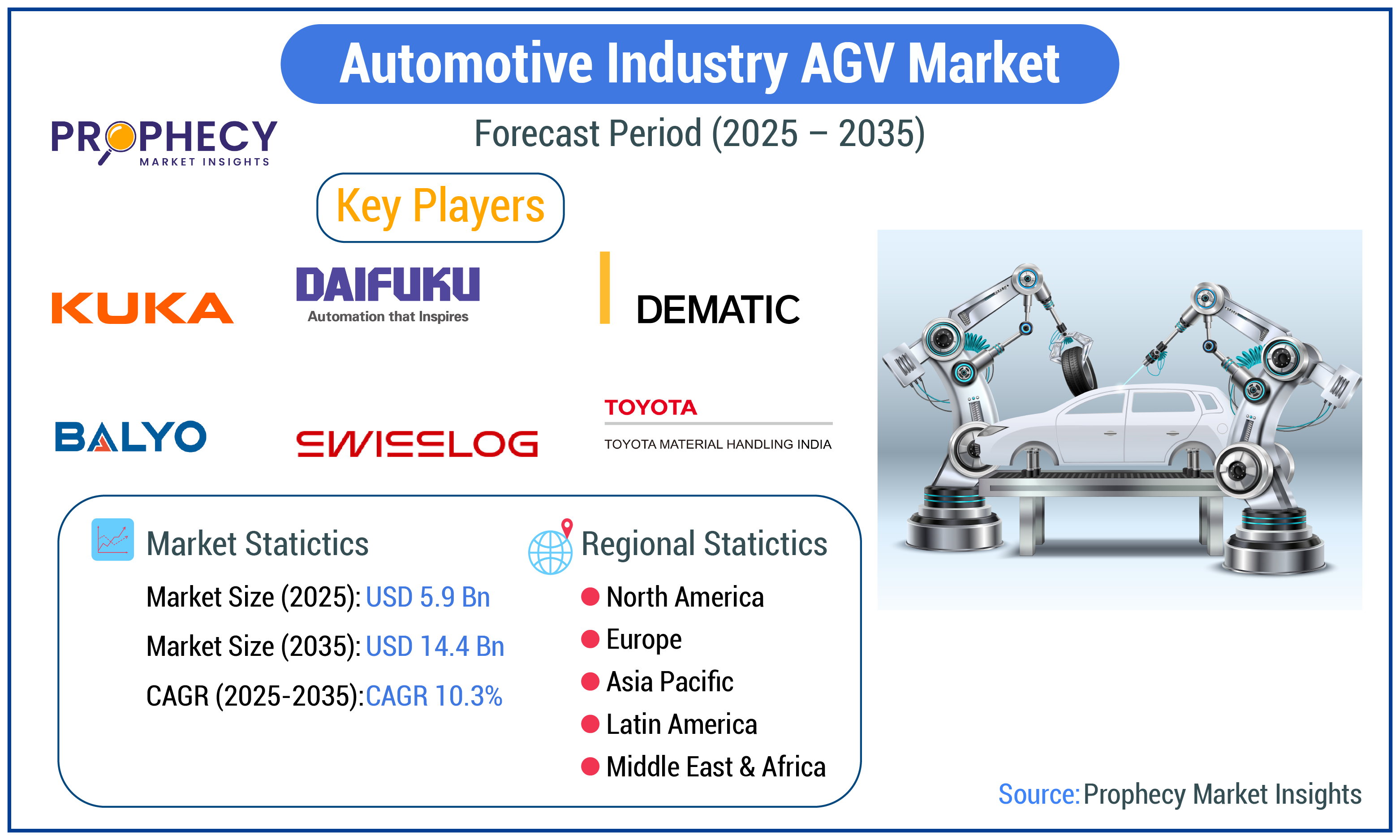
Global Automotive Industry AGV Market Drivers & Restraints
Key Drivers:
Rising Need for Automation is Propelling the Market Expansion
One of the main factors behind the growth of the automotive industry's AGV market is the growing need for automation. AGVs provide effective material handling and simplified operations as manufacturers work to increase production, lower labor costs, and maintain consistent quality. AGVs improve safety, reduce human error, and guarantee on-time component delivery in assembly processes. Automobile manufacturers are making significant investments in AGV technology in order to satisfy the demands of high-volume production and operational efficiency objectives as a result of the transition to smart factories and Industry 4.0.
- For instance, according to the data published by flair.hr., Automation alters our world, making things quicker and more efficient than before. Nowadays, half of the task can be automated. 37% of jobs in human resources are routinely mechanized. Recruiting technologies will be used more often, according to 97% of businesses. 54% of HR professionals perceive automation as a tool for greater work focus, not a job threat. Lack of application status updates deters 80% of job applicants, but it is 3.5 times more probable to reapply if it receives one. Scaling AI use cases to generate corporate value is a major goal, according to 78% of CEOs. 15.7% of 20–24-year-olds are in jobs with significant automation risk.
Restraints:
Rigidity and Limited Flexibility of Automotive Industry AGV is Hindering the Market Expansion
System stiffness and a lack of adaptability in dynamic conditions are two significant drawbacks of the automobile industry's AGV market. Unexpected changes, including modified floor plans, human intervention, or new production requirements, are frequently difficult for AGVs to adjust to. Workflows may be hampered by this rigidity, particularly in low-volume, high-mix automobile production settings. The potential advantages of automation in quick-paced automobile manufacturing facilities can also be diminished by inefficiencies caused by integration with current legacy systems and a lack of real-time response.
- Counterbalance Statements: Manufacturers may solve this by implementing AI-powered AGVs that have real-time navigation and adaptive learning capabilities. Modular system implementation makes it simpler to reconfigure for changing production requirements. Situational awareness is improved by integrating AGVs with IoT and sophisticated sensors, which allows for improved response and coordination with other industrial systems for more efficient operations.
Opportunities & Trends:
Integration of Artificial Intelligence with AGV is Opening Up Growth Opportunities for the Future Generations
The automotive industry's AGV market is expected to increase greatly in the future due to the integration of artificial intelligence (AI) with AGVs. By facilitating adaptive navigation, real-time decision-making, and effective route optimization in intricate production settings, AI improves AGV capabilities. By lowering downtime and boosting operational efficiency, it facilitates predictive maintenance. AI also enhances safety by preventing collisions and detecting obstacles more accurately. AI-powered AGVs will be crucial for scalable, intelligent automation and competitive advantage as automakers move toward smart factories and Industry 4.0.
- For instance, according to the facts stated by The Robotics Team, Automated Guided Vehicles, or AGV robots, are self-driving vehicles made to carry out tasks or move products in a variety of industrial environments. An essential component of AGV systems, navigation guarantees effective mobility within a facility. AGV navigation has advanced significantly since the introduction of artificial intelligence (AI), improving overall performance, flexibility, and adaptability.
Global Automotive Industry AGV Market Segmentations & Regional Insights
The automotive industry AGV market is segmented into product type, battery type, payload, navigation technology, and region.
By Product Type:
On the basis of product type, the market is divided into tow vehicles, unit load carriers, forklift trucks, and assembly line vehicle. The tow vehicles segment is expected to rule over the automotive industry AGV market share. This is due to its ability to move heavier loads over longer distances and handle multiple trailers, making it versatile for a wide range of applications.
The unit load carriers is the product type which is experiencing steady growth, in the automotive industry AGV market. This is due to its efficiency in handling large, heavy loads and its widespread applicability in various manufacturing, warehousing, and logistics settings.
By Battery Type:
Based on battery type, the market is sub-segmented into lead battery, lithium-ion battery, nickel-based battery, and others. The lithium-ion battery segment is leading the automotive industry AGV market share. This is due to its established technology and cost-effectiveness, the superior characteristics of lithium-ion batteries, such as higher energy density, longer lifespan, faster charging times, and better performance in demanding environments, are driving the shift towards its adoption in AGVs.
The lead battery segment is the second leading battery type, in the automotive industry AGV market. This is due to its cost-effectiveness, established infrastructure, and proven reliability.
By Payload:
Stemming from payload, the market is trifurcated into light-duty AGVs, medium-duty AGVs, and heavy-duty AGVs. The medium-duty AGVs is holding the upper hand in the automotive industry AGV market share. This is due to its versatility in handling a wide range of payloads commonly found in automotive manufacturing and logistics, such as components, sub-assemblies, and finished vehicles.
The light-duty AGVs segment is the fastest growing payload, in the automotive industry AGV market. This is due to its versatility in handling a wide range of lighter loads and their ability to integrate into existing production lines, enhancing efficiency and reducing labor costs.
By Navigation Technology:
Dependent on navigation technology, the market is bifurcated into laser guidance, and vision guidance. The laser guidance segment is the dominating navigation technology, in the automotive industry AGV market. This is due to its superior accuracy and flexibility in complex industrial environments. Laser-guided AGVs use laser scanners to map and navigate, enabling precise path tracking and obstacle avoidance. While vision guidance is also used, laser guidance is often preferred for its reliability and adaptability in various industrial settings.
The vision guidance segment is the second dominating navigation technology, in the automotive industry AGV market. This is due to the growing need for intelligent routing solutions and advancements in computer vision and related software. Vision-guided AGVs excel at adapting to dynamic environments and improving safety by detecting obstacles and other moving equipment.
By Application:
On the foundation of application, the market is sub-segmented into pick & place, packaging & palletizing, and assembly & storage. The assembly & storage application is the governing segment, in the automotive industry AGV market growth. This is due to the critical role AGVs play in streamlining assembly line processes and managing inventory within automotive manufacturing facilities.
The pick and place AGV segment is the second dominating application, in the automotive industry AGV market. This is due to its ability to automate repetitive and precise tasks in assembly line operations, enhancing efficiency and accuracy while minimizing human error and workplace injuries.
By End-Use Industry:
Appertaining from end-use industry, the market is classified into automotive, metals & heavy machinery, food & beverages, chemical, healthcare, e-commerce, and others. The e-commerce segment is holding the superior position, in the automotive industry AGV market size. This is due to the he rapid expansion of e-commerce and the need for efficient warehousing and distribution. While the automotive industry also utilizes AGVs, particularly in manufacturing and assembly, the e-commerce sector's reliance on automated systems for order fulfillment and fast delivery is fueling its dominance.
The automotive segment, is the second leading end-use industry, in the automotive industry AGV market. This is due to the automotive industry's extensive use of AGVs for streamlining manufacturing and assembly processes.
Regional Insights:
Geographically, the market is studied across North America, Europe, Asia Pacific, Latin America, and the Middle East & Africa.
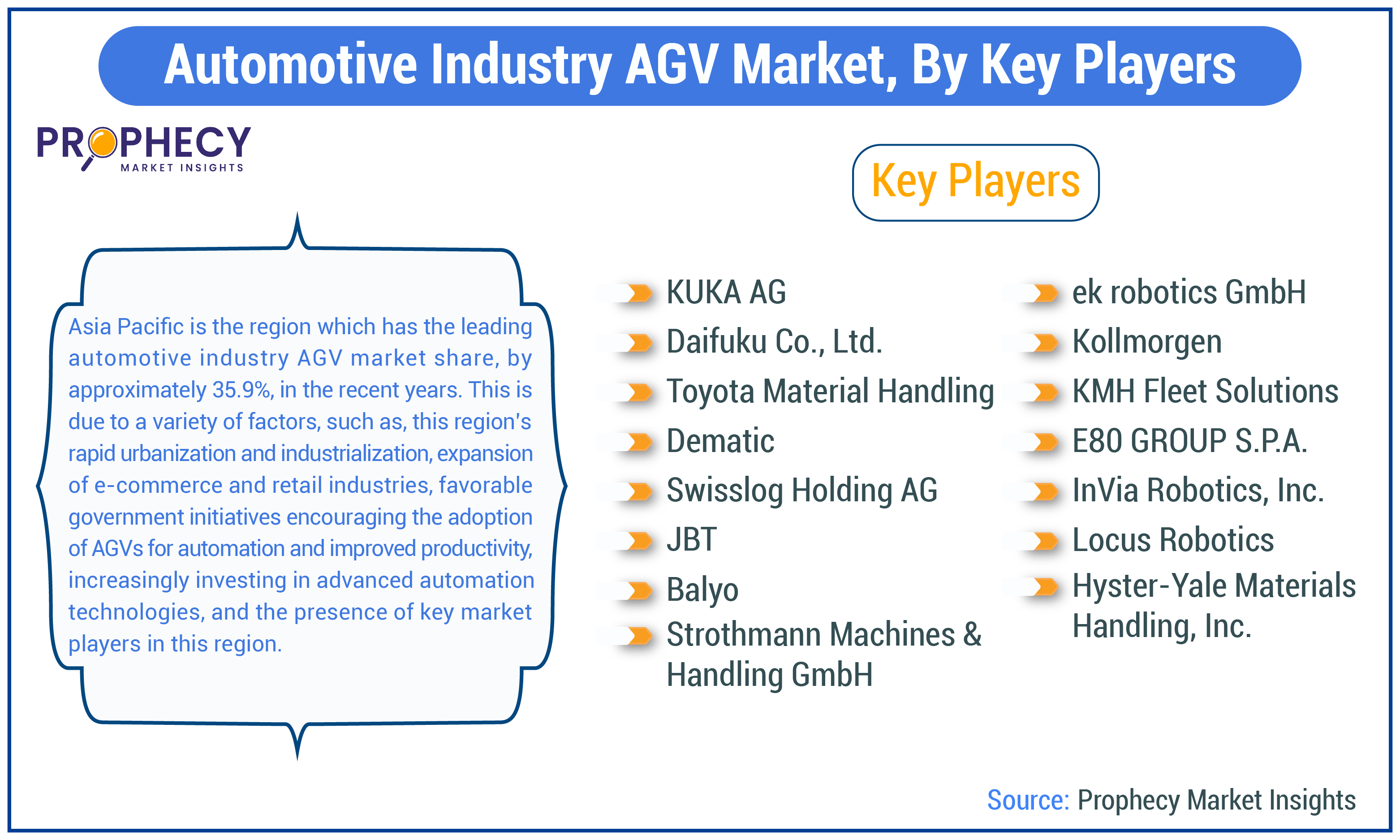
Asia Pacific: This is the region which has the leading automotive industry AGV market share, by approximately 35.9%, in the recent years. This is due to a variety of factors, such as, this region’s rapid urbanization and industrialization, expansion of e-commerce and retail industries, favorable government initiatives encouraging the adoption of AGVs for automation and improved productivity, increasingly investing in advanced automation technologies, and the presence of key market players in this region.
- China Automotive Industry AGV Market Insights:
The automotive industry AGV market in China, is the most governing market, in the recent years. This is primarily due to its robust manufacturing industry, rapid expansion of e-commerce in China has led to a surge in warehousing automation, its government actively promotes industrial automation and Industry 4.0 adoption, providing a supportive environment for AGV development and deployment, and the presence of most advanced manufacturing sites globally, contributing to the need for sophisticated automation solutions such as AGVs.
North America: This is the region which has the automotive industry AGV market growing with the fastest growth rate, during the forecast period, in the recent years. This is due to a confluence of factors, such as, the region's advanced technological infrastructure, high adoption of automation across various industries, and the growing need for efficient warehousing and distribution solutions. Moreover, the increasing demand for efficient warehousing and distribution solutions in North America, strong economy, coupled with its focus on technological innovation and Industry 4.0 initiatives, also contribute in its market growth.
- U.S. Automotive Industry AGV Market Insights:
The automotive industry AGV market in the U.S. is market growing with the highest CAGR, during the forecast period, in the recent years. This is due to its significantly strong economy, a robust manufacturing sector, including a significant automotive industry, rapid growth of e-commerce has increased the demand for automation in logistics, warehousing, and order fulfillment, including in the automotive supply chain, and the higher labor costs in the U.S. incentivize businesses to adopt automated solutions such as AGVs to improve efficiency and reduce operational expenses.
Europe: The region which has the automotive industry AGV market experiencing considerate amount of market growth, in the recent years, is Europe. This is due to a combination of factors, such as, this region’s high labor costs and focus on automation and sustainability. The robust automotive manufacturing industry and the growth of e-commerce also contribute to the demand for AGVs in Europe. Additionally, the presence of global warehousing and distribution operations, and developed 3PL networks further drive the adoption of AGVs in the region.
- Germany Automotive Industry AGV Market Insights:
The automotive industry AGV market in Germany is the market experiencing subsequent amount of growth, in the recent years. This is due to this country’s major global hub for automotive manufacturing, high adoption rates of automation technologies, Germany’s strong focus on technology and innovation, driving the demand for AGVs in various applications, high labor costs and stringent labor regulations, and increasingly focusing on energy-efficient solutions and reducing its carbon footprint.

Automotive Industry AGV Market Report Scope:
|
Attribute |
Details |
|
Market Size 2025 |
USD 5.9 Billion |
|
Projected Market Size 2035 |
USD 14.4 Billion |
|
CAGR Growth Rate |
10.3% (2025-2035) |
|
Base year for estimation |
2024 |
|
Forecast period |
2025 – 2035 |
|
Market representation |
Revenue in USD Billion & CAGR from 2025 to 2035 |
|
Regional scope |
North America - U.S. and Canada Europe – Germany, U.K., France, Russia, Italy, Spain, Netherlands, and Rest of Europe Asia Pacific – China, India, Japan, Australia, Indonesia, Malaysia, South Korea, and Rest of Asia-Pacific Latin America - Brazil, Mexico, Argentina, and Rest of Latin America Middle East & Africa – GCC, Israel, South Africa, and Rest of Middle East & Africa |
|
Report coverage |
Revenue forecast, company share, competitive landscape, growth factors, and trends |
Segmentation:
By Product Type:
- Tow Vehicles
- Unit Load Carriers
- Forklift Trucks
- Assembly Line Vehicles
By Battery Type:
- Lead Battery
- Lithium-Ion Battery
- Nickel-based Battery
- Others
By Payload:
- Light-Duty AGVs
- Medium-Duty AGVs
- Heavy-Duty AGVs
By Navigation Technology:
- Laser Guidance
- Vision Guidance
By Application:
- Pick & Place
- Packaging & Palletizing
- Assembly & Storage
By End-Use Industry:
- Automotive
- Metals & Heavy Machinery
- Food & Beverages
- Chemical
- Healthcare
- E-Commerce
- Others
By Region:
- North America
- U.S.
- Canada
- Europe
- Germany
- U.K.
- France
- Russia
- Italy
- Spain
- Netherlands
- Rest of Europe
- Asia Pacific
- China
- India
- Japan
- Australia
- Indonesia
- Malaysia
- South Korea
- Rest of Asia Pacific
- Latin America
- Brazil
- Mexico
- Argentina
- Rest of Latin America
- Middle East & Africa
- GCC
- Israel
- South Africa
- Rest of Middle East & Africa
Global Automotive Industry AGV Market Competitive Landscape & Key Players
The key players operating in the market include, KUKA AG, Daifuku Co., Ltd., Toyota Material Handling, and others. These key players are focusing on increasing automation, leveraging technology such as AI and IoT, and offering solutions such as hybrid AGVs and automation-as-a-service. These company also prioritize R&D, modular systems, and enhanced safety features, while also focusing on marketing communications, social media, and content marketing, for driving automotive industry AGV market growth.
Automotive Industry AGV Market Companies:
- KUKA AG
- Daifuku Co., Ltd.
- Toyota Material Handling
- Dematic
- Swisslog Holding AG
- JBT
- Strothmann Machines & Handling GmbH
- Hyster-Yale Materials Handling, Inc.
- Balyo
- ek robotics GmbH
- Kollmorgen
- KMH Fleet Solutions
- E80 GROUP S.P.A.
- InVia Robotics, Inc.
- Locus Robotics
View an Additional List of Companies in the Automotive Industry AGV Market
Global Automotive Industry AGV Market Recent News
- In June 2023, German automated guided vehicle (AGV) maker EK Robotics has announced the release of its Medi Move model series for the international healthcare market. The new robot, which is made of stainless steel and features a lifting table for taking up and dumping down items, is meant to operate logistics in hospitals around-the-clock. According to reports, Medi Move robots can transport to hospital rooms, sterile departments, and nursing facilities by traversing many floors and underground route networks.
- In December 2022, Kollmorgen Automation and Front AGV, a Swedish automated guided vehicle (AGV) integrator and designer, have partnered to provide AGV solutions. Front AGV is a member of the automation business 3Button business AB, which specializes in cutting-edge robotic solutions for the food, automotive, and consumer sectors. The group's mandate include a variety of production line operations, including picking, packing, palletizing, machine tending, assembly, and labeling.
- In December 2022, the latest sensor modules from Vision-on-Chip (VoC) processor manufacturer Inuitive, the M4.5S and M4.3WN, have been released. Being constructed around the NU4000 VoC processor and combining depth sensing and image processing with artificial intelligence (AI) and visual simultaneous localization and mapping (VSLAM) capabilities, the modules were designed to be readily integrated into robot and drone systems. According to Inuitive, this was done to provide the machines a "human-such as visual understanding." These tracking and navigational VSLAM capabilities are particularly well-suited to automated guided vehicle (AGV) and autonomous mobile robot (AMR) systems.
- In February 2022, In order to address the increasing demand from a variety of sectors, Siemens teamed up with two technical firms in the UK, AR Controls and Parmley Graham, to manufacture smart automated guided vehicles (AGVs). For the AGVs, Parmley Graham, an industrial automation company located in Gateshead, will supply hardware requirements, organize kit-formed bills of materials, and source additional third-party goods.
Analyst View:
The growing need for automation and efficiency to streamline production processes, the fact that AGVs provide a reliable solution for material handling and logistics in manufacturing facilities, lower labor costs and increased safety in material handling and transportation in the manufacturing environment, as well as the positive government support and Industry 4.0 initiatives to modernize manufacturing processes, boost competitiveness, and encourage innovation, are all factors driving the growth of the automotive industry AGV market. AGVs are becoming more flexible and adaptable, able to navigate complex environments and carry out a wider range of tasks. Advances in AGV technologies, such as AI-driven navigation systems, also contribute to the market's growth by improving its capabilities and making it more dependable and efficient.
More Related Reports
Automotive Night Vision System Market
E-Commerce Automotive Aftermarket
Automotive Power Management IC (PMIC) Market
Automotive Electronic Control Unit Market
Automotive Door Handle Sensors Market
Global Automotive Industry AGV Market Company Profile
|
Company Name |
KUKA AG |
|
Headquarter |
Augsburg, Germany |
|
CEO |
Mr. Peter G. Mohnen |
|
Employee Count (2024) |
15,000 Employees |
Global Automotive Industry AGV Market Highlights
FAQs
Automotive industry AGV market size was valued at USD 5.9 Billion in 2025 and is expected to reach USD 14.4 Billion by 2035 growing at a CAGR of 10.3%.
Product type, battery type, payload, navigation technology, application, end-use industry, and region are the segmentation for the automotive industry AGV market.
North America, Asia Pacific, Europe, Latin America, and the Middle East & Africa. Asia Pacific is expected to dominate the market.
The key players operating in the automotive industry AGV market include KUKA AG, Daifuku Co., Ltd., Toyota Material Handling, Balyo, Dematic, Swisslog Holding AG, JBT, Strothmann Machines & Handling GmbH, Hyster-Yale Materials Handling, Inc., ek robotics GmbH, Kollmorgen, KMH Fleet Solutions, E80 GROUP S.P.A., InVia Robotics, Inc., and Locus Robotics