Global Asphalt Paving Machines Market Overview
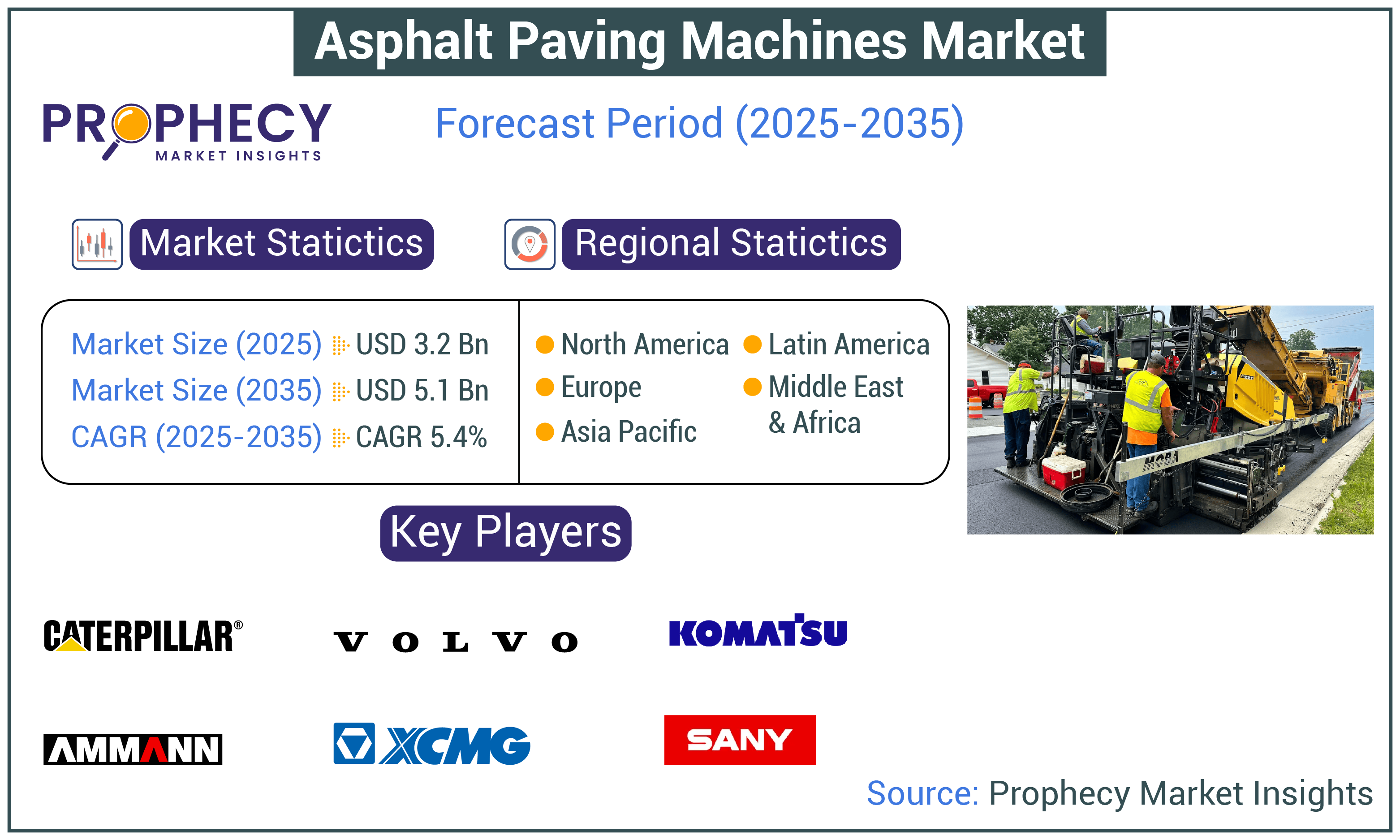
- Asphalt paving machines market size is expected to expand at a valuation of USD 5.1 Billion, by 2035.
- In 2024, the target market valuation was USD 3.0 Billion.
- The asphalt paving machines market is growing at a CAGR 5.4%.
Asphalt paving machines, also known as asphalt pavers, are construction equipment used to lay asphalt evenly and smoothly onto road surfaces, bridges, parking lots, and other areas. Asphalt paving machines, or road pavers, expedite road construction by efficiently laying asphalt, leading to faster projects, smoother surfaces, and potentially cost savings. In addition to this, it provides high quality and durable road surface, provides enhanced safety. Is versatile and environment friendly, and has noise-reducing properties.
The global asphalt paving machines market growth is primarily driven by increasing infrastructure development, urbanization, and the rising demand for efficient and durable road paving solutions, particularly in developing economies. Furthermore, the market growth is also promoted by the favorable government policies and investments in infrastructure development, innovation in pavement materials, and attractive financing options and flexible payment terms to make ownership of asphalt paving machines more feasible for contractors.
Innovations in asphalt paving technology, such as automated systems, advanced sensors, and precision engineering, are enhancing the efficiency and performance of these machines, and the rise of smart city developments, with its focus on efficient transportation networks, is also contributing to the growth of the target market.
Recession Risk & Tariff Analysis:
- Due to its reliance on public infrastructure spending, which may decrease during economic downturns, the asphalt paving machines industry is subject to a modest risk of recession.
- Ongoing urbanization and government-supported road construction initiatives, however, can somewhat counteract this effect. Tariff changes present a serious problem since they raise production costs and lower profit margins, especially for imported steel and machinery parts. To be competitive, market participants must manage these risks by diversifying their supply chains and using cost-cutting measures.
Impact of Generative AI on Asphalt Paving Machines Market:
- By improving design optimization, predictive maintenance, and operational efficiency, generative AI is transforming the market for asphalt paving equipment. Manufacturers may use AI-driven diagnostics to save downtime, create more intelligent automation features, and model and enhance machine performance.
- In road building projects, AI-driven data analysis also facilitates improved decision-making by guaranteeing accuracy and economy. Thus, in response to the increasing need for intelligent construction solutions, generative AI is stimulating innovation, increasing productivity, and encouraging sustainable practices throughout the asphalt paving sector.
Global Asphalt Paving Machines Market Drivers & Restraints
Key Drivers:
Rapid Urbanization is Expected to Pitch the Market Expansion
The asphalt paving machines market growth is driven by rapid urbanization, which increases the demand for large road networks, highways, and urban infrastructure to support expanding urban populations. Modern paving equipment is required to maintain effective and long-lasting road surfaces due to the increase in building activity. The need for asphalt pavers is being further increased by the significant infrastructure expenditures being made in emerging nations, especially in the Asia-Pacific area. The industry is also growing as a result of government attempts to improve transportation networks.
- For instance, according to the data published by World Bank Group, in order to fulfill the World Bank's purpose of eradicating poverty and promoting shared prosperity on a habitable world, more livable cities must be built. Currently, 4.4 billion people, or more than half of the world's population, reside in urban areas. This trend is predicted to continue, with nearly seven out of ten people living in cities by 2050, when the urban population is predicted to more than quadruple.
Restraints:
Environmental Impact Caused by Asphalt Paving Machines is Limiting the Market Growth
The environmental effect of pollutants and particulate matter emitted during the paving process is a significant drawback of the asphalt paving machines industry. These pollutants put workers' and the local population's health at risk and contribute to air pollution. Furthermore, using conventional machinery that runs on fossil fuels increases carbon emissions. Stricter environmental requirements are forcing manufacturers and contractors to adopt greener solutions, which may demand specific expertise from operators and maintenance staff and present issues with technical adaption.
- Counterbalance Statements: Manufacturers could include emission-reduction technology and use electric or hybrid paving equipment to meet environmental issues. Operators can acquire the skills necessary to operate cutting-edge environmentally friendly equipment through training programs. Furthermore, utilizing real-time monitoring systems and low-emission asphalt mixes guarantees regulatory compliance and reduces the environmental impact of paving operations.
Opportunities & Trends:
Digital Revolution of Asphalt Paving Machines is Opening Up Growth Opportunities in the Upcoming Years
Precision, automation, and operating efficiency will all be improved by the digital revolution in asphalt paving machines, which is expected to fuel the target market expansion. Smarter paving is made possible by technologies such as GPS, IoT, AI, and real-time data analytics, which also increase quality control and minimize material waste. Predictive maintenance is made possible by digital integration, which reduces downtime and increases equipment longevity. These developments expedite acceptance and propel notable expansion in the asphalt paving machines market by supporting sustainable building methods, satisfying changing regulatory requirements, and appealing to infrastructure developers seeking affordable, data-driven solutions.
- For instance, according to the facts stated by EAPA, the most recent advancements in robotics, machine-to-machine communication, sensors, big data, artificial intelligence, and electrification, among other areas, are accompanied by the asphalt industry's own digital revolution in recent times. Through these disruptive technologies, the industry is making significant progress in increasing and multiplying production efficiency while minimizing its impact on the environment.
Global Asphalt Paving Machines Market Segmentations & Regional Insights
The asphalt paving machines market is segmented into product type, engine type, paving rage, power, application, end user, and region.
By Product Type:
Based on product type, the market is classified into tracked pavers, wheeled pavers, compact pavers, hybrid pavers, and others. The tracked pavers is the product type which is expected to rule over the asphalt paving machines market share. This is due to its superior traction and stability on various terms making it ideal for diverse construction sites. Its superior performance, coupled with ongoing technological advancements, has cemented its position as the preferred choice for many contractors.
The wheeled pavers is the product type which is holding the second leading position in the target market. This is due to its superior mobility and maneuverability, making it ideal for smaller projects, urban paving, and repair work.
By Engine Type:
Under engine type, the market is branched into diesel engine, electric engine, and hybrid engine. The diesel engines segment is projected to govern the target market growth. This is due to its reliability, power, and cost-effectiveness for heavy-duty applications, though electric and hybrid options are gaining traction.
The hybrid engines is the engine type which is holding the second dominating position in the asphalt paving machines market. This is due to the growing need for reduced emissions and fuel efficiency, and the increasing adoption of electric and hybrid technologies in the construction industry.
By Paving Range:
According to paving range, the market is sub-segmented into less than 1.5 M, 1.5 M to 2.3 M, 2.4 M to 2.55 M, and above 2.55 M. The above 2.55 M is the dominating paving range in the asphalt paving machines market share. The main reason for this domination is the widespread use of bigger asphalt pavers in major infrastructure projects, such building highways and motorways, where effectively covering larger surface areas is essential.
The 2.4 M to 2.55 M is the paving range which is growing with the highest CAGR, in the target market. The main factor contributing to this segment's growth is its widespread use in major infrastructure projects and highway building around the globe.
By Power:
On the foundation of power, the market is pigeonholed into up to 75 HP, 75-110 HP, 110 - 150 HP, and more than 150 HP. The more than 150 HP segment is holding the superior position in the asphalt paving machines market size. This is due to its use in large-scale highway and motorway construction projects, where wider paving widths are needed for efficiency. These machines often incorporate advanced technologies such as automation and data analytics, further increasing their appeal to construction companies.
The 110-150 HP segment is the power experiencing steady growth, in the target market. This is due to its ability to offer a balance of power and efficiency for a wide range of paving projects, from medium to large-scale road construction.
By Application:
Stemming from application, the market is bifurcated into highway and urban road. Highway is the application which is influencing the asphalt paving machines market share. This is due to the continuous expansion and maintenance of transportation infrastructure of highways networks globally. Moreover, it is durable and cost-effective, and it requires large-sized paving width machines.
The urban road is the application which is growing rapidly, in the target market. This is due to the increased urbanization and infrastructure development, road construction and repair, smart city initiatives, and technological advancements.
By End-User:
Appertaining from end user, the market is divided into residential, commercial, industrial, and others. The industrial segment is attributed to lead the asphalt paving machines market growth. This is mostly as it works directly on a variety of paving projects, which calls for effective and superior paving equipment to guarantee long-lasting surfaces and satisfy project deadlines. The need for asphalt pavers is maintained among these companies by the ongoing expansion of commercial and infrastructural development projects.
Regional Insights:
Geographically, the market is studied across North America, Europe, Asia Pacific, Latin America, and the Middle East & Africa.
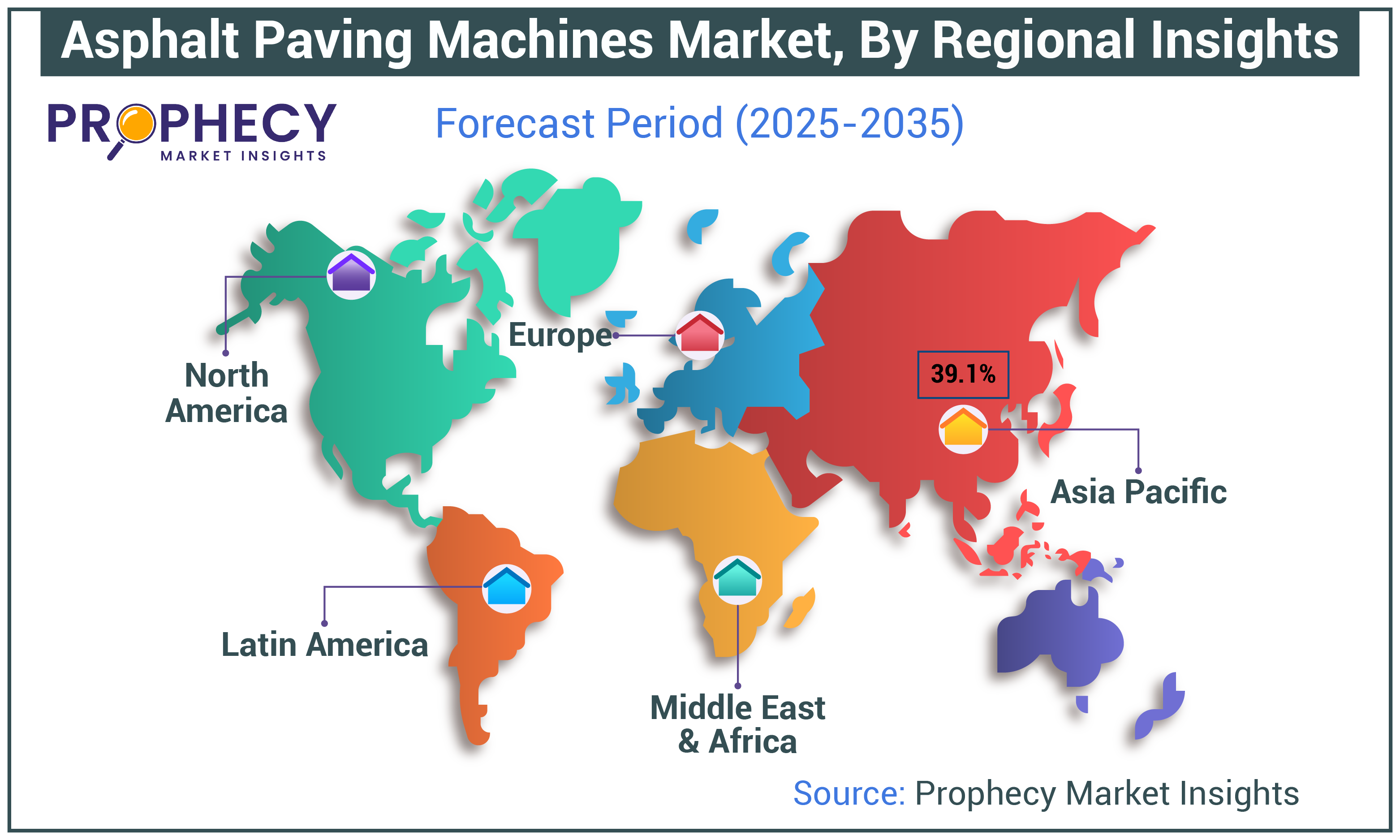
Asia Pacific: This is the region which is holding the superior position in the asphalt paving machines market share by approximately 39.1%. This is due to various factors, such as, governments in the region are investing heavily in road and highway construction, rapid urbanization leads to increased demand for new roads and infrastructure, and few countries of this region are major market players, with the growing economies and infrastructure needs driving strong demand.
- China Asphalt Paving Machines Market Insights:
The asphalt paving machines market in China is the market holding the upper hand, in the recent years. This is due to China's ongoing infrastructure projects, including road and highway construction, its thriving construction industry, both in urban and rural areas, government initiatives and investments in infrastructure development, and China’s rapid urbanization and population growth are driving increased demand for road construction and maintenance.
Europe: This is the region which has the asphalt paving machines market, growing with the fastest growth rate, during the forecast period, in the recent years. This is due to the region’s growing investments in road and highway construction, particularly in developing economies, the need to maintain and repair existing road networks, the increasing use of recycled asphalt and other sustainable materials, and rapid urbanization in many parts of the world is leading to increased demand for road infrastructure.
- Germany Asphalt Paving Machines Market Insights:
The asphalt paving machines market in Germany is the fastest growing market, during the forecast period, in the recent years. This is due to Germany’s strong emphasis on engineering excellence, technological innovation in road construction equipment, and robust infrastructure development programs, with German manufacturers at the forefront of developing advanced paving technologies. Moreover, Germany is attributed to increased public and private investments in road and highway infrastructure development, thus causing market growth.
North America: This region is experiencing significant amount of asphalt paving machines market growth, in the recent years. This is due to this region’s mature infrastructure sector, a strong focus on upgrading existing road networks and expanding highway systems by governments, growing adoption of advanced paving technologies, presence of prominent market players, and the industry of this region is also shifting towards eco-friendlier construction equipment due to stringent environmental regulations and the need for reducing pollution levels.
- U.S. Asphalt Paving Machines Market Insights:
The asphalt paving machines market in U.S. is experiencing considerate amount of asphalt paving machines market growth, in the recent years. This is due to this country’s extensive infrastructure needs, robust construction industry, and government initiatives focused on road maintenance and infrastructure development. Moreover, the U.S. is not only a major consumer but also a producer of asphalt paving machines, asphalt is the preferred paving material in the U.S., and the need for road maintenance and repair operations, fuels the growth of the market.
Asphalt Paving Machines Market Report Scope:
|
Attribute |
Details |
|
Market Size 2025 |
USD 3.2 Billion |
|
Projected Market Size 2035 |
USD 5.1 Billion |
|
CAGR Growth Rate |
5.4% (2025-2035) |
|
Base year for estimation |
2024 |
|
Forecast period |
2025 – 2035 |
|
Market representation |
Revenue in USD Billion & CAGR from 2025 to 2035 |
|
Regional scope |
North America - U.S. and Canada Europe – Germany, U.K., France, Russia, Italy, Spain, Netherlands, and Rest of Europe Asia Pacific – China, India, Japan, Australia, Indonesia, Malaysia, South Korea, and Rest of Asia-Pacific Latin America - Brazil, Mexico, Argentina, and Rest of Latin America Middle East & Africa – GCC, Israel, South Africa, and Rest of Middle East & Africa |
|
Report coverage |
Revenue forecast, company share, competitive landscape, growth factors, and trends |
Segmentation:
By Product Type:
- Tracked Pavers
- Wheeled Pavers
- Compact Pavers
- Hybrid Pavers
- Others
By Engine Type:
- Diesel Engine
- Electric Engine
- Hybrid Engine
By Paving Range:
- Less Than 1.5 M
- 1.5 M To 2.3 M
- 2.4 M To 2.55 M
- Above 2.55 M
By Power:
- Up to 75 HP
- 75-110 HP
- 110-150 HP
- More than 150 HP
By Application:
- Road Construction
- Parking Lots
- Airports
- Highways
- Others
By End User:
- Residential
- Commercial
- Industrial
- Others
By Region:
- North America
- U.S.
- Canada
- Europe
- Germany
- U.K.
- France
- Russia
- Italy
- Spain
- Netherlands
- Rest of Europe
- Asia Pacific
- China
- India
- Japan
- Australia
- Indonesia
- Malaysia
- South Korea
- Rest of Asia Pacific
- Latin America
- Brazil
- Mexico
- Argentina
- Rest of Latin America
- Middle East & Africa
- GCC
- Israel
- South Africa
- Rest of Middle East & Africa
Global Asphalt Paving Machines Market Competitive Landscape & Key Players
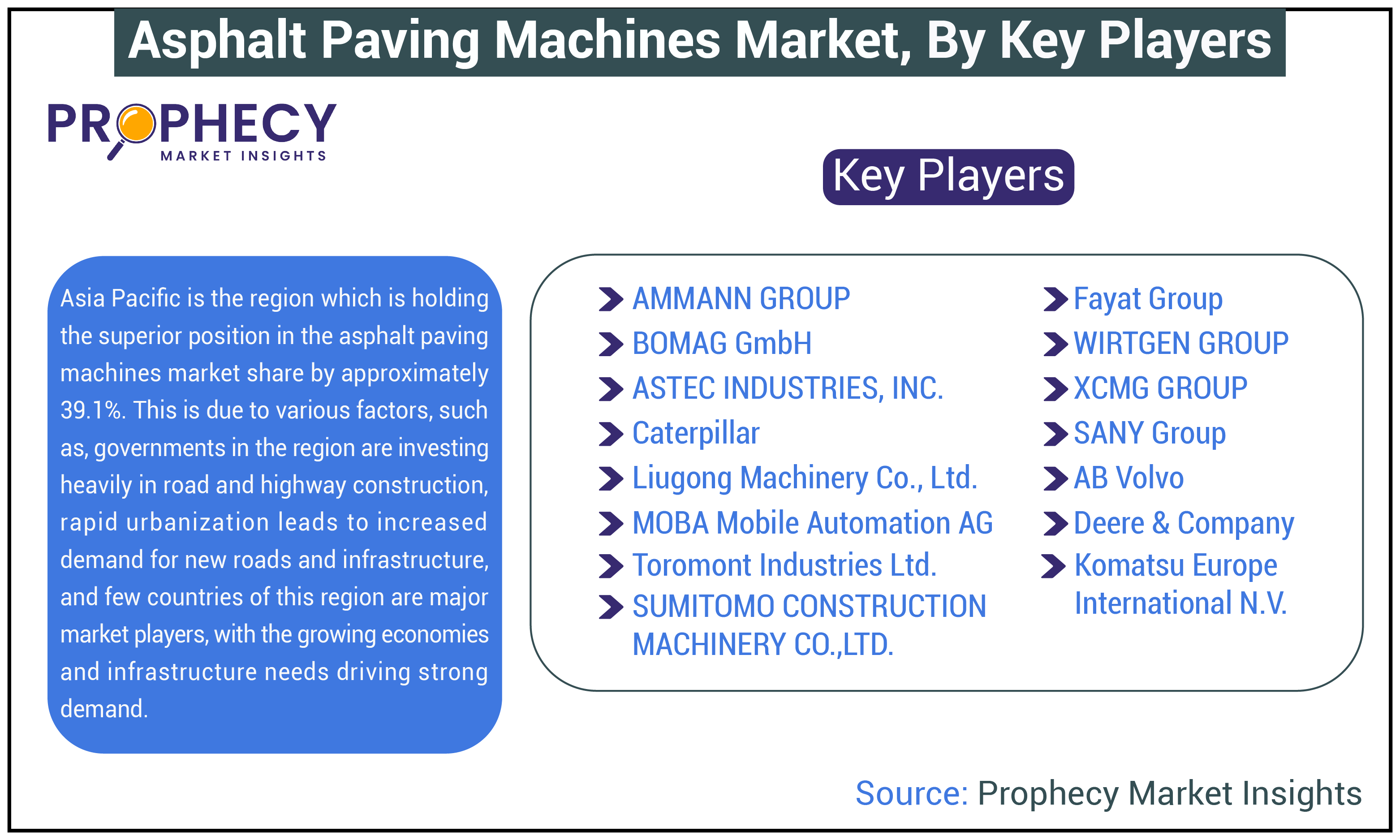
The key players operating in the market include, AMMANN GROUP, BOMAG GmbH, ASTEC INDUSTRIES, INC., and others. These key players are focusing on product innovation, technological advancements, strategic partnerships, and expanding into emerging markets, while also emphasizing sustainability and energy efficiency, for driving asphalt paving machines market growth.
Asphalt Paving Machines Market Companies:
- AMMANN GROUP
- BOMAG GmbH
- ASTEC INDUSTRIES, INC.
- Caterpillar
- Fayat Group
- MOBA Mobile Automation AG
- Toromont Industries Ltd.
- WIRTGEN GROUP
- XCMG GROUP
- SANY Group
- AB Volvo
- Deere & Company
- Komatsu Europe International N.V.
- Liugong Machinery Co., Ltd.
- SUMITOMO CONSTRUCTION MACHINERY CO.,LTD.
View an Additional List of Companies in the Asphalt Paving Machines Market
Global Asphalt Paving Machines Market Recent News
- In April 2025, Dynapac, a top manufacturer of advanced soil and asphalt rollers, light equipment, and pavers, and Leica Geosystems, a division of Hexagon, announced that its asphalt pavers' auto-steering and screed edge control capabilities are compatible with the Leica iCON pave solution. The Dynapac SD25 and XD25 Highway Paver series, a next-generation range of paving equipment scheduled to make its Bauma premiere, would offer this option.
- In March 2024, the MC-Max Asphalt Paving and MC-Max Milling systems are the most recent advancements in Topcon Positioning Systems' road construction and resurfacing technologies. The systems provide sophisticated feature sets, adaptability, and simpler setups to boost productivity in cold milling and asphalt paving applications for construction firms and projects of all sizes.
- In October 2022, the Horizontal Steering Control version 2.10 of the Trimble Roadworks Paving Control Platform for Vögele Navitronic asphalt pavers was released by Trimble. Trimble made significant progress toward machine control autonomy with the inclusion of Horizontal Steering Control and autonomous screed width control for Vögele pavers.
- In January 2020, Volvo Construction Equipment was scheduled to introduce the P5110B tracked and P5170B wheeled pavers, two new models for its North American lineup, at ConExpo-Con/Agg 2020. The machines, designed for both heavy commercial and light highway jobs, provided robust performance, significant fuel savings, and ease of maintenance.
Analyst View:
The worldwide asphalt paving machines market expansion is mostly due to urbanization, growing infrastructure development, and the growing need for long-lasting and effective road paving solutions, especially in emerging nations. Additionally, encouraging government policies and investments in infrastructure development, pavement material innovation, and flexible payment terms and attractive financing options all contribute to the market's growth by making it more affordable for contractors to own asphalt paving machines. Automated systems, sophisticated sensors, and precision engineering are some of the innovations in asphalt paving technology that are improving the effectiveness and performance of these machines. The emergence of smart city developments, which prioritize effective transportation networks, is also helping to expand the target market.
More Related Reports
Small Molecule Prefilled Syringes Market
Small-satellite Launch Service Market
Asphalt Plants Market
Asphaltene and Paraffin Inhibitors Market
Warm Mix Asphalt Additives Market
Global Asphalt Paving Machines Market Company Profile
|
Company Name |
AMMANN GROUP |
|
Headquarter |
Langenthal, Switzerland |
|
CEO |
Mr. Hans-Christian Schneider |
|
Employee Count (2024) |
3,600+ Employees |
Global Asphalt Paving Machines Market Highlights
FAQs
Asphalt paving machines market size was valued at USD 3.2 Billion in 2025 and is expected to reach USD 5.1 Billion by 2035 growing at a CAGR of 5.4%.
Product type, engine type, paving range, power, application, end user, and region are the segmentation for the target market.
North America, Asia Pacific, Europe, Latin America, and the Middle East & Africa. Asia Pacific is expected to dominate the market.
The key players operating in the Asphalt Paving Machines Market include AMMANN GROUP, BOMAG GmbH, ASTEC INDUSTRIES, INC., XCMG GROUP, Caterpillar, Fayat Group, MOBA Mobile Automation AG, Toromont Industries Ltd., WIRTGEN GROUP, SANY Group, AB Volvo, Deere & Company, Komatsu Europe International N.V., Liugong Machinery Co., Ltd., and SUMITOMO CONSTRUCTION MACHINERY CO., LTD.