Fire Protection Coatings Market Overview
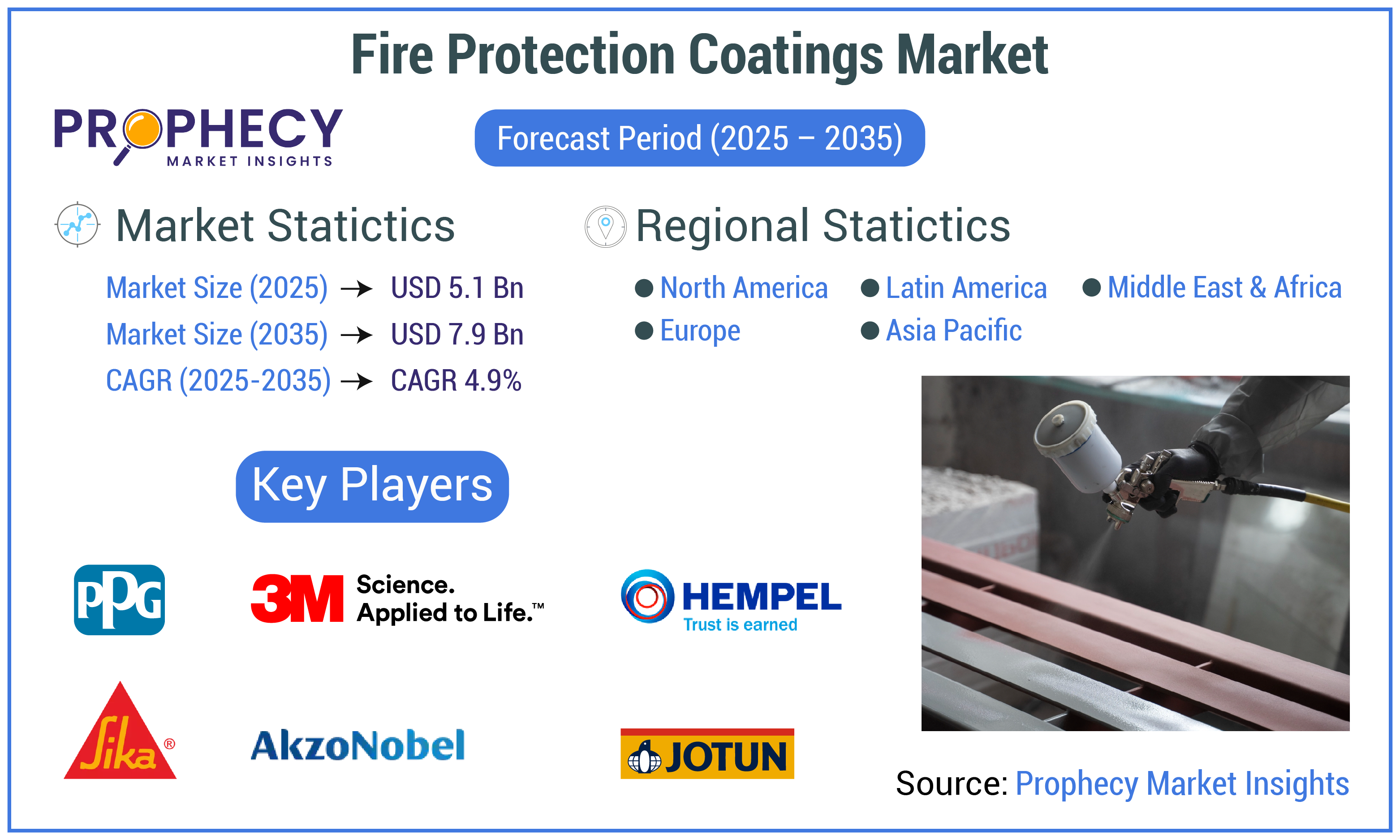
- The fire protection coatings market size is expected to develop at a rate of USD 7.9 Billion, by 2035.
- In 2024, the target market valuation was USD 4.9 Billion.
- Fire protection coatings market is growing at a CAGR of 4.9%.
Fire protection coatings are designed to protect materials and structures from the damaging effects of fire. These act as a barrier, either by delaying ignition, slowing the spread of flames, or insulating the underlying material from extreme heat. These are specialized materials applied to surfaces to enhance its resistance to fire, offering advantages such as delayed ignition, reduced flame spread, and lower heat release. These help to contain fires, minimize damage, and provide valuable time for evacuation, firefighting efforts, and property preservation.
The fire protection coatings market is experiencing growth due to a confluence of factors, including, the implementation of stricter fire safety regulations, which are prompting industries to adopt fire-resistant coatings, expansion of the construction sector, particularly in developing economies, is increasing the demand for fire-resistant coatings to protect buildings and infrastructure, and the rising urbanization and the development of megacities.
The market’s diversification is also pitched by advanced technologies such as nanotechnology, hybrid coatings, and eco-friendly formulations are further enhancing its performance, ease of application, and environmental impact, and lower volatile organic compounds (VOCs) and halogen-free formulations are being developed to reduce environmental impact and improve safety.
Recession Risk and Tariff Analysis:
- The fire protection coatings market is vulnerable to recession due to high prices, fluctuating raw material prices, and a decline in construction activity. Economic downturns can impede demand and postpone projects, particularly in industries where costs are high. Nonetheless, resilience and long-term economic potential are provided by strict safety requirements and the drive for sustainable, fire-resistant materials.
- Global differences in fire protection coating tariffs have an effect on market dynamics. Import taxes on vital raw materials such as steel and aluminum have raised production costs and caused supply chain disruptions in the United States. In order to lessen these difficulties, businesses are investigating local sourcing and production.
Impact of Generative AI on Fire Protection Coatings Market:
- Generative AI is revolutionizing the fire protection coatings market by enhancing formulation development, predictive maintenance, and application processes. AI-driven robotics ensure precise, uniform coating applications, improving efficiency and reducing labor costs.
- Additionally, AI-powered systems facilitate real-time quality control, identifying defects promptly and maintaining high product standards. These advancements enable manufacturers to scale production while adhering to stringent safety regulations, thereby driving market growth. However, the integration of AI also necessitates robust cybersecurity measures to safeguard against potential vulnerabilities in connected systems.
Fire Protection Coatings Market Drivers & Restraints
Key Drivers:
Rising Urbanization is Propelling the Market Expansion
The fire protection coatings market is being greatly boosted by growing urbanization. As cities grow, more residential, commercial, and industrial buildings are being built, which calls for more sophisticated fire prevention systems. The need for fire-resistant coatings to adhere to strict safety rules and safeguard assets is fueled by this expansion. Significantly, the Asia-Pacific area—particularly China and India is seeing fast urbanization, which is driving up the use of fire safety measures. Increased awareness of fire safety and advancements in fire-resistant materials support market growth even further.
- For instance, according to the data published by World Bank Group, in order to fulfill the World Bank's purpose of eradicating poverty and promoting shared prosperity on a habitable world, more livable cities must be built. Currently, 4.4 billion people, or more than half of the world's population, reside in urban areas. This trend is predicted to continue, with nearly seven out of ten people living in cities by 2050, when the urban population is predicted to more than quadruple.
Restraints:
Complexity of Regulatory Complexity is Restricting the Market Expansion
The difficulty of complying with regulations in many jurisdictions is a major drawback of the fire protection coatings business. Manufacturers looking to enter international markets face difficulties due to differing fire safety regulations and testing specifications. These discrepancies have the potential to raise administrative expenses and postpone product approvals. The technological difficulties are further increased by the need to guarantee uniform coating performance in a variety of environmental circumstances, including extremes in temperature and humidity. This may limit product adaptability and slow down innovation in developing next-generation, high-performance fire-resistant coatings.
- Counterbalance Statements: Businesses should work with international safety organizations and engage in global certification initiatives to get around the complexity of regulations. Consistent performance may be ensured by creating formulations that are globally adaptable and carrying out thorough environmental testing. Creating specialized compliance teams facilitates the certification process.
Opportunities & Trends:
Amalgamating Nanotechnology with Fire Protection is Opening Up Growth Opportunities for the Future Generations
The market for fire protection coatings is expected to increase greatly in the future due to the integration of nanotechnology with fire protection. Superior fire resistance is made possible by nanomaterials, which improve coatings' flame retardancy, thermal insulation, and structural stability. By more efficiently creating intumescent layers, these coatings help reduce heat transmission and structural damage during flames. Nano-enhanced coatings are also more resilient, lighter, and thinner, which makes it perfect for high-performance uses in the automotive, construction, and aerospace industries. This innovation propels market expansion by meeting changing safety regulations and sustainability objectives.
- For instance, according to the data published by NLM, Fire safety is one field where nanotechnology is always developing. Helmets, filters, and protective clothes are examples of items that include nanostructures for direct protection. Nanotechnology-based solutions are also utilized in components that lower the danger of fire and improve fire safety, such as building materials and structures, paints, coatings, or fire safety apparatus (e.g., fire detectors). New solutions, nevertheless, can also endanger environmental and public safety. Nanomaterials having hazardous characteristics may be released as a result of operation, combustion, and degradation processes.
Fire Protection Coatings Market Segmentations & Regional Insights
The fire protection coatings market is segmented into product type, end-use industry, and region.
By Product Type:
According to product type, the market is bifurcated into passive fire protection coatings and active fire protection coatings. The passive fire protection (PFP) coatings segment is dominating the fire protection coatings market share. This is due to the fact that PFP coatings are designed to resist or prevent the spread of fire without requiring any external activation, making it a crucial component of building safety.
The active fire protection coatings segment is the second dominating product type, in the target market. This is due to the fact that these are a widely used technology in various industrial applications. Intumescent coatings are designed to expand when exposed to heat, creating a protective char layer that insulates the material underneath and slows down heat transfer.
By End-Use Industry:
Contingent to end-use industry, the market is divided into oil & gas, buildings and construction, automotive, aerospace, marine, electrical & electronics, and others. The buildings and construction segment is leading the fire protection coatings market share. This is due to the increasing demand for fire-resistant materials in both residential and commercial buildings, fueled by stringent fire safety regulations and growing awareness of fire protection.
The oil & gas segment is the second leading end-use industry, in the fire protection coatings market. This is due to its facilities have a high risk of fire due to the flammable nature of its processes and equipment.
Regional Insights:
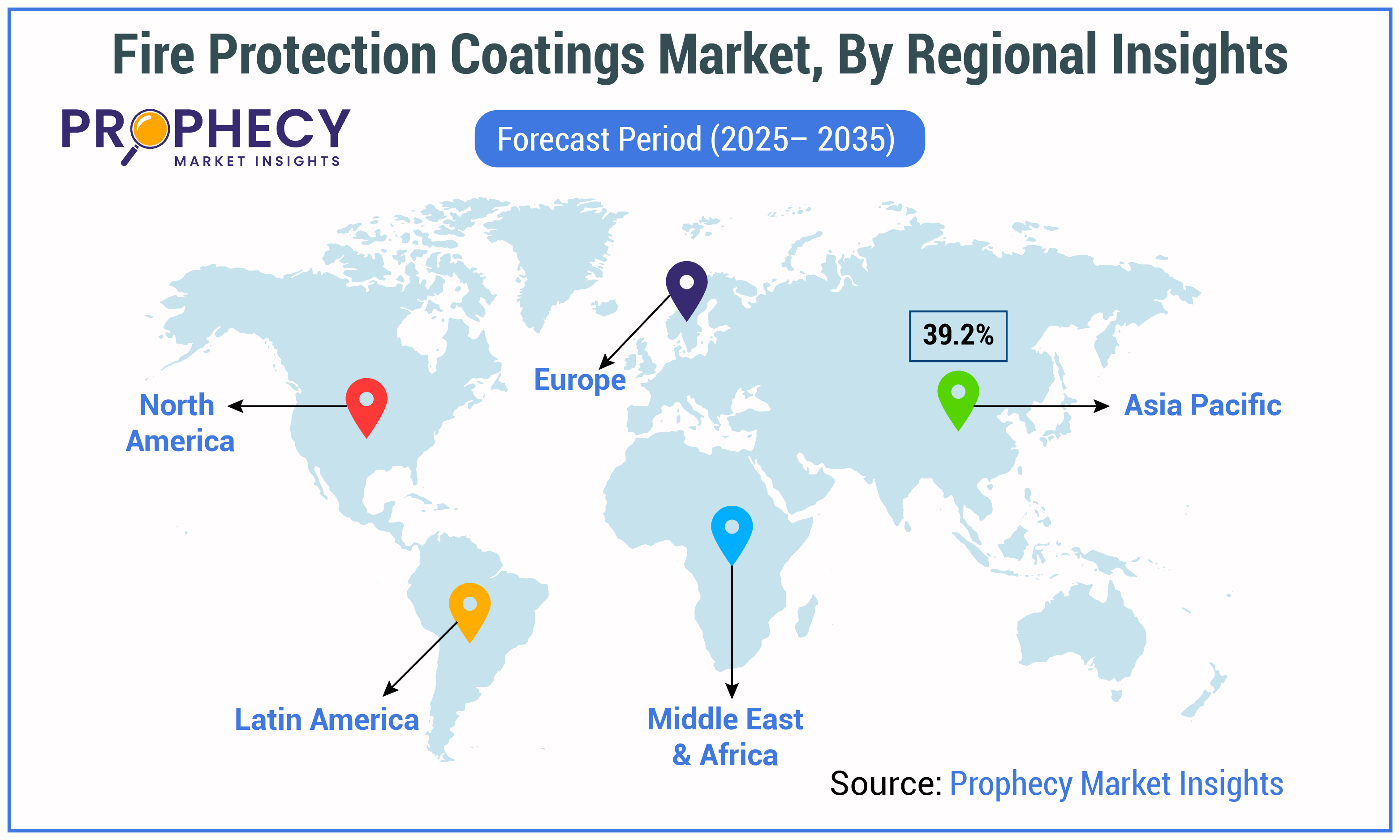
Geographically, the market is studied across North America, Europe, Asia Pacific, Latin America, and the Middle East & Africa.
Asia Pacific: This is the region which has the fire protection coatings market holding the upper hand in the recent years, with an estimated share of approximately 39.2%. This is due to a number of factors, such as this region’s ongoing expansion of urban areas and industrial facilities in the region necessitates fire protection measures, surge in construction activities, particularly in China and India, is a major driver for fire retardant coatings, increasing emphasis on fire safety regulations and standards in various countries, its large population and expanding infrastructure projects, and the rapid development of economies in Southeast Asia, driven by foreign investment.
- China Fire Protection Coatings Market Insights:
The fire protection coatings market in China is the most influential market, in the recent years. This is due to this country’s massive construction sector, including high-rise buildings and industrial facilities, necessitates extensive use of fire protection coatings to ensure safety and compliance, rapid urbanization in China leads to increased building development and a greater need for fire-resistant materials in residential and commercial buildings, and the strong industrial sector, particularly in manufacturing, also drives the demand for fire protection coatings to safeguard industrial infrastructure and equipment.
Europe: This is the region which has the fire protection coatings market growing with the fastest growth rate, during the forecast period, in the recent years. This is due to a combination of factors, such as, this region’s stringent fire safety regulations, a strong focus on infrastructure development and renovation projects, including energy-efficient building practices, growth of the industrial sector, especially in automotive and aerospace, has increased the demand for fire-resistant coatings, the increasing use of fire-resistant coatings in public buildings such as hospitals, theaters, and schools, and the faster development of commercial and industrial sectors in Eastern Europe.
- Germany Fire Protection Coatings Market Insights:
The fire protection coatings market in Germany is the fastest growing market, during the forecast period, in the recent years. This is due to this country’s robust construction sector, fueled by urbanization and infrastructure projects, stringent building codes and fire safety regulations that mandate the use of fire protection coatings in various construction projects, diverse industrial landscape, including automotive, chemical, and aerospace, increased awareness and emphasis on fire safety among the general public and businesses, and its commitment to sustainable building materials and energy-efficient building envelopes.
North America: This is the region which has the fire protection coatings market experiencing significant growth, in the recent years. This is due to a combination of factors, such as, this region’s strong emphasis on fire safety regulations and building codes, rapid strong emphasis on fire safety regulations and building codes, growing awareness of fire risks and the importance of fire safety among consumers and businesses, the rapidly growing industrial sector, and its dominance in fire protection coating technology and innovation, with manufacturers developing new and improved products to meet evolving safety standards.
- U.S. Fire Protection Coatings Market Insights:
The fire protection coatings market in the U.S. is experiencing considerate amount of growth, in the recent years. This is due to this country’s significantly more residential and commercial buildings compared to other North American countries, stringent building codes and regulations, mandating the use of fire-resistant coatings in various applications, the growing construction industry including both residential and commercial development, and the demand for innovative and user-friendly fire protection products.
Fire Protection Coatings Market Report Scope:
|
Attribute |
Details |
|
Market Size 2025 |
USD 5.1 Billion |
|
Projected Market Size 2035 |
USD 7.9 Billion |
|
CAGR Growth Rate |
4.9% (2025-2035) |
|
Base year for estimation |
2024 |
|
Forecast period |
2025 – 2035 |
|
Market representation |
Revenue in USD Billion & CAGR from 2025 to 2035 |
|
Regional scope |
North America - U.S. and Canada Europe – Germany, U.K., France, Russia, Italy, Spain, Netherlands, and Rest of Europe Asia Pacific – China, India, Japan, Australia, Indonesia, Malaysia, South Korea, and Rest of Asia-Pacific Latin America - Brazil, Mexico, Argentina, and Rest of Latin America Middle East & Africa – GCC, Israel, South Africa, and Rest of Middle East & Africa |
|
Report coverage |
Revenue forecast, company share, competitive landscape, growth factors, and trends |
Segmentation:
By Product Type:
- Passive Fire Protection Coatings
- Active Fire Protection Coatings
By End-Use Industry:
- Oil & Gas
- Buildings and Construction
- Automotive
- Aerospace
- Marine
- Electrical & Electronics
- Others
By Region:
- North America
- U.S.
- Canada
- Europe
- Germany
- U.K.
- France
- Russia
- Italy
- Spain
- Netherlands
- Rest of Europe
- Asia Pacific
- China
- India
- Japan
- Australia
- Indonesia
- Malaysia
- South Korea
- Rest of Asia Pacific
- Latin America
- Brazil
- Mexico
- Argentina
- Rest of Latin America
- Middle East & Africa
- GCC
- Israel
- South Africa
- Rest of Middle East & Africa
Fire Protection Coatings Market Competitive Landscape & Key Players
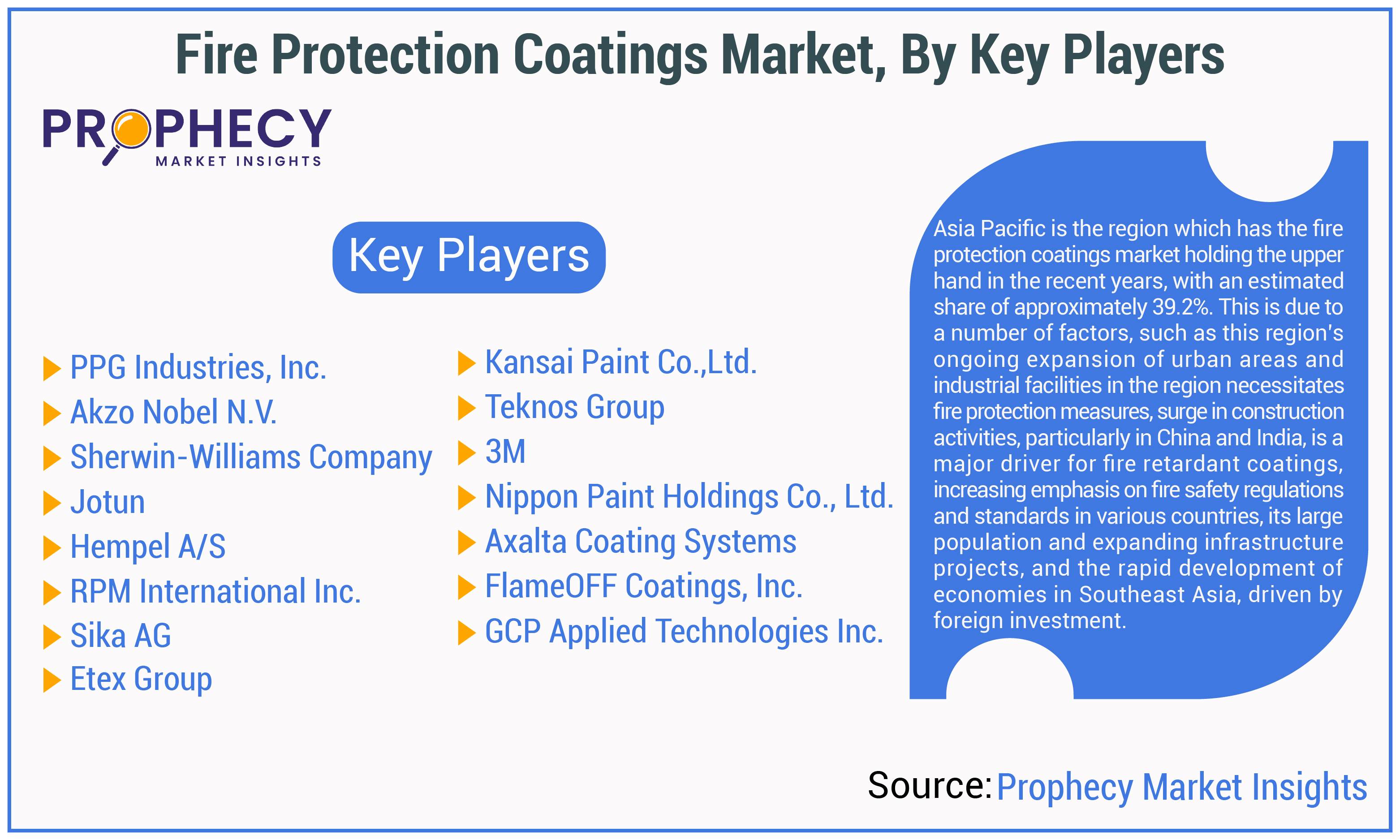
The prominent players operating in the market include, PPG Industries, Inc., Akzo Nobel N.V., Sherwin-Williams Company, and others. These key players are adopt strategies focusing on product innovation, regulatory compliance, and expanding market reach. These companies develop advanced coatings with enhanced performance and sustainability, ensuring these meet stringent fire safety standards and regulations. Additionally, these companies target key industries and regions with high growth potential, leveraging partnerships and mergers to broaden its market presence, for driving fire protection coatings market growth.
Fire Protection Coatings Market Companies:
- PPG Industries, Inc.
- Akzo Nobel N.V.
- Sherwin-Williams Company
- Jotun
- Hempel A/S
- RPM International Inc.
- Sika AG
- Etex Group
- Kansai Paint Co.,Ltd.
- Teknos Group
- 3M
- Nippon Paint Holdings Co., Ltd.
- Axalta Coating Systems
- FlameOFF Coatings, Inc.
- GCP Applied Technologies Inc.
View an Additional List of Companies in the Fire Protection Coatings Market
Fire Protection Coatings Market Recent News
- In March 2025, Hempafire Extreme 550, the company's newest PFP solution, was introduced by Hempel A/S, a prominent worldwide provider of coatings and fire safety solutions. This cutting-edge epoxy PFP coating offers remarkable durability and application efficiency along with up to four hours of fire protection. This PFP coating, which was created specifically for cellulosic fires, raises the bar for fire safety in commercial and industrial installations.
- In September 2024, The PPG Steelguard 951 epoxy intumescent fire prevention coating was introduced by PPG in North and Latin America. This foam minimised property damage and gave vital escape time by maintaining the structural integrity of structures during a fire. The commercial infrastructure industry, in particular sophisticated manufacturing, in nations including the US, Brazil, Mexico, Canada, Peru, and Colombia, was the target market for this product. This solution complemented contemporary building techniques with its strong, adaptable, and effective application qualities, provided up to four hours of fire protection, and passed rigorous testing criteria.
- In March 2024, Sherwin-Williams Protective & Marine's new FIRETEX FX7002 thin-film intumescent fire protection coating is made to satisfy the most exacting performance and aesthetic requirements of the modern commercial building sector. This solvent-based coating, which is intended for on-site applications, shields structural steel substrates. With authorized listings for a solvent-based acrylic that has one of the lowest coating thicknesses in the industry for steel beams at that duration, the FIRETEX FX7002 boasted the widest selection of beam listings available on the market for up to a two-hour fire-resistance rating.
Analyst View:
The fire protection coatings market is expanding as a result of a number of factors, such as the introduction of more stringent fire safety laws, which are forcing industries to use fire-resistant coatings; the growth of the construction industry, especially in developing nations, which is raising demand for fire-resistant coatings to safeguard infrastructure and buildings; and the emergence of megacities and increased urbanisation. Advanced technologies such as nanotechnology, hybrid coatings, and eco-friendly formulations are also contributing to the market's diversification. These technologies are improving its performance, ease of use, and environmental impact, while formulations free of halogen and lower volatile organic compounds (VOCs) are being developed to improve safety and lessen its impact on the environment.
More Related Reports
Passive Fire Protection Materials Market
Fire Trucks Market
Fire-Resistant Glass Market
Fire Rated Building Materials Market
Firestop Sealants Market
Fire Protection Coatings Market Company Profile
|
Company Name |
PPG Industries, Inc. |
|
Headquarter |
Pittsburgh, Pennsylvania, United States |
|
CEO |
Mr. Timothy M. Knavish |
|
Employee Count (2024) |
45,000 Employees |
Fire Protection Coatings Market Highlights
FAQs
Fire protection coatings market size was valued at USD 5.1 Billion in 2025 and is expected to reach USD 7.9 Billion by 2035 growing at a CAGR of 4.9%.
Product type, end-use industry, and region are the segmentation for the target market.
North America, Asia Pacific, Europe, Latin America, and the Middle East & Africa. Asia Pacific is expected to dominate the market.
The key players operating in the fire protection coatings market include PPG Industries, Inc., Akzo Nobel N.V., Sherwin-Williams Company, Kansai Paint Co.,Ltd., Jotun, Hempel A/S, RPM International Inc., Sika AG, Etex Group, Teknos Group, 3M, Nippon Paint Holdings Co., Ltd., Axalta Coating Systems, FlameOFF Coatings, Inc., and GCP Applied Technologies Inc.