Commercial Telematics Market Overview
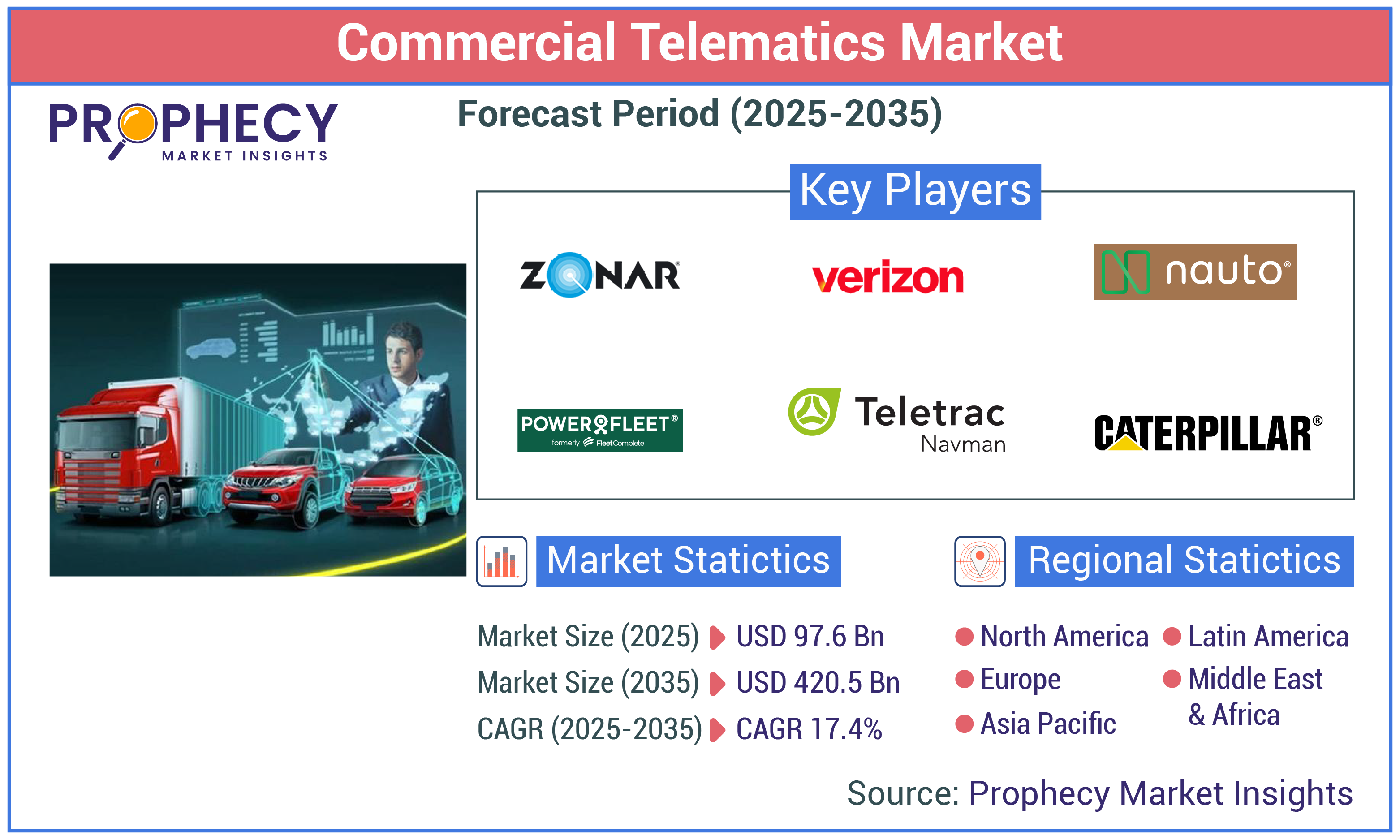
- Commercial telematics market size is anticipated to grow at a rate of USD 420.5 Billion, by 2035.
- In 2024, the commercial telematics market valuation was USD 85.4 Billion.
- The target market is increasing at a CAGR 17.4%.
Commercial telematics is known as the integration of telecommunications and monitoring technologies within commercial vehicles and fleets to enhance operational efficiency, safety, and management. It combines GPS tracking, vehicle diagnostics, and driver behavior analysis to collect and transmit real-time data about vehicle performance, location, fuel consumption, maintenance needs, and driver habits. This data can be analyzed by software, which provides fleet managers to optimize route planning, reduce costs and improve fuel efficiency.
Growing demand for business to optimize fleet operations, reduce costs, and government initiatives to implement telematics solutions, is anticipated to drive commercial telematics market growth. Growing focus on driver safety, risk management, and global shift towards suitability, carbon footprint reduction, is expected to propel commercial telematics market growth.
Technological advancement in IoT, AI, big data analytics, development of autonomous vehicles, and growth in emerging markets, is estimated to create new opportunities for commercial telematics market growth. The rise of usage-based insurance (UBI), continues development of smart cities, and innovation in predictive maintenance, is projected to boost commercial telematics market growth.
Recession Risk and Tariff Analysis for Commercial Telematics Market:
- The market is facing risk during recession, due to reducing spending on technology investment and focus on essential operations. Economic slowdowns can lead to decreased demand for fleet expansion, telematics upgrades, and logistics services, especially in industries with small profit margins.
- Triff can impact the market, with the growing global tensions and changes in global trade practices. Trade barriers could also disrupt the supply chain, leading to delays in the availability of critical components.
Impact of Generative AI on Commercial Telematics Market:
- AI can generate complex algorithms that continuously monitor sensor data, allowing for more proactive maintenance and reducing downtime. AI models can generate models based on historical and real-time time data, by analyzing patterns of wear, usage, and environmental factors, and help to predict potential failures before it can occur with greater precision.
- AI-powered telematics systems can process vast amounts of driver behavior data, by analyzing data such as speed, acceleration pattern and braking, which help to enhance driver training program and improve safety.
Commercial Telematics Market Drivers & Restraints
Key Drivers:
Rise in E-commerce Sector is Anticipated to Drive Target Market Growth
The rapid growth of the e-commerce sector is a significant driver of the commercial telematics market. As consumers increasingly shift to online platforms for shopping, the demand for fast, reliable, and cost-effective delivery services has surged. This has led to a sharp increase in the number of commercial vehicles used for last-mile delivery and logistics, directly fuelling the need for advanced telematics solutions. Fleet operators require real-time data on vehicle location, route optimization, driver behaviour, and delivery schedules to meet rising consumer expectations for quick and transparent service. Telematics enables companies to monitor fleet efficiency, reduce fuel consumption, and ensure on-time deliveries, which are critical to gaining a competitive edge in the e-commerce industry. Thus, the rapid growth in e-commerce sector, rises the need for connected vehicle technologies, such as commercial telematics, is anticipated to drive commercial telematics market growth.
- For instance, over 33% of the world’s population shopping online, e-commerce, in 2025 it is a valued of USD 6.8 trillion and will reach the USD 8 trillion mark by 2027. From the dedicated e-commerce platforms, and social media stores, around globally 897 billion people are shop online. There are over 28 million e-commerce stores are present globally, in which 52% of online shopper are looking for international products, 34% of shopper shop online at least once a week. The number of online shoppers will increase to 2.86 billion in 2026, reflecting the boost in e-commerce due to the increased internet penetration and convenience.
Increasing Focus on Predictive Maintenance and Insights is contributing to Market Expansion
Predictive maintenance involves leveraging data from telematics systems to predict failures before it can occur, which allows companies to take preventative decisions and avoid costly downtime of unexpected breakdowns. As telematics technology continues to advance, it provides more accurate and detailed data, such as vehicle health indicators, engine performance, tire pressure, fuel consumption, and other critical metrics. Telematics provide real-time insights into the performance of vehicles, drivers and routes, which have the ability to avoid major failures, reduce repair costs, enhance driver safety and expand vehicles lifespan. As more organizations recognize the importance of data-driven decision-making, which rises the adoption of predictive maintenance, and real-time monitoring. The global shift from reactive maintenance to predictive maintenance represent significant driver for commercial telematics market growth.
Restraints:
Data Security and Privacy Concerns Impede Market Growth
As telematics systems collect vast amounts of data related to vehicle location, driver behavior, and vehicle health, there are significant concerns regarding data privacy and cybersecurity. The data collected by telematics systems is highly sensitive, as it can include vehicle performance, location data, and operator behavior. Cybersecurity threats and data privacy issues may arise, leading to data breaches or unauthorized use.
- Counterbalance Statements: as cybersecurity offerings continues to evolve, telematics companies are implementing advanced encryption methods, secure communication channels, and compliance with data protection regulations. Increasing awareness and the adoption of security best practices, such as multi-factor authentication and end-to-end encryption, can secure cloud-based solutions.
Opportunities & Trends:
Integration of AI and IoT in Fleet Management Propels Market Expansion
The integration of AI and IoT, allow fleet operators to monitor real-time the performance of commercial vehicles. Sensors and IoT devices surrounded in vehicles that collect data on a variety of parameters such as engine temperature, fuel consumption, tire pressure, and location. AI algorithms can analyze this data to offer actionable insights, which can help fleet managers to optimize routes, improve fuel efficiency, and reduce downtime. By providing real-time monitoring of environmental conditions, operator behavior, and machine performance, AI and IoT technologies can significantly enhance safety of driver and vehicle. Telematics systems can alert operators and fleet managers, by detecting irregularities such as unsafe driving patterns, mechanical failures, or dangerous site conditions. Integration of AI and IoT in telematics is effectively reduces cost, and improve operational efficiency of vehicle, is expected to boost commercial telematics market share in upcoming years.
- For instance, according to article published in September 2024, this article states that, artificial intelligence (AI), and Internet of Things (IoT) are offering visions for the future of GPS vehicle tracking and telematics technology. AI-driven predictive maintenance advancing fleet management by enabling active repairs and minimizing vehicle downtime. AI algorithms leverage data from GPS tracking devices and a various sensors implanted in fleet vehicles, these sensors can help to monitor parameters such as engine temperature, oil pressure, tire wear, and brake performance. Vehicle location, speed, fuel consumption, and engine diagnostics data can be collected and transmit by IoT-enabled GPS vehicle tracking devices. This continuous data flow allows fleet managers to monitor the performance of every vehicle in real time.
Commercial Telematics Market Segmentations & Regional Insights
The commercial telematics market is segmented into offerings, system type, application, end-user, and region.
By Offerings:
Based on offerings, the market is classified into, hardware, hardware, software, and services. The market is dominated by hardware segment, as it is essential for telematics systems. Each vehicle requires hardware installation to enable tracking, data collection, and communication. As commercial fleets grow, especially in logistics, e-commerce, and public transport, each new vehicle added requires its own hardware setup, maintaining steady demand, resulting to propel segment growth in commercial telematics market share.
The software segment holds the second largest commercial telematics market share due to the rising demand for advanced fleet management platforms, analytics tools, route optimization systems, and real-time vehicle tracking solutions. Companies are relying heavily on telematics software for data visualization, predictive analytics, and AI-driven decision-making, contributing to segment’s expansion in commercial telematics market size.
By System Type:
Embedded, tethered, and smartphone integrate are classified by system type in the market. The embedded is most superior segment in the market. These are telematics systems that are built directly into the vehicle during manufacturing, which offer seamless integration, high reliability, and real-time data processing. Embedded systems are favored by OEMs and large fleet operators due to their advanced functionality, better connectivity, and compliance with regulatory standard, resulting to impel segment growth in commercial telematics market share.
By Application:
on the basis of application, the market is classified into fleet management, asset tracking, enhanced productivity, predictive maintenance, driver behavior monitoring, and others. The fleet management is leading segment in market, as it is primary application of telematics. Telematics systems provide fleet operators with the tools to track the location of each vehicle, monitor their usage, optimize routes, schedule maintenance, and ensure regulatory compliance, is anticipated to fuel segment’s development in commercial telematics market share.
Predictive maintenance is second leading segment in market. This application is crucial for minimizing unplanned downtime, extending equipment life, and reducing repair costs, by focusing on the maintenance side of operations, contributing to growth of segment in commercial telematics market size.
By End-User:
On the basis of end-user, the market is divided into, transportation & logistics, government agencies, vehicle manufacturers/dealers, media & entertainment, and others. The transportation & logistics segment is the most dominant end-user in the commercial telematics market. This dominance stems from the industry's strong dependance on fleet tracking, route optimization, fuel management, and delivery scheduling to enhance operational efficiency and reduce costs. As global e-commerce and cross-border shipping continue to grow, logistics companies increasingly adopt telematics to remain competitive and ensure timely deliveries, estimated to boost growth of segment in commercial telematics market share.
Regional Insights:
Geographically, the market is studied across North America, Europe, Asia Pacific, Latin America, and the Middle East & Africa.
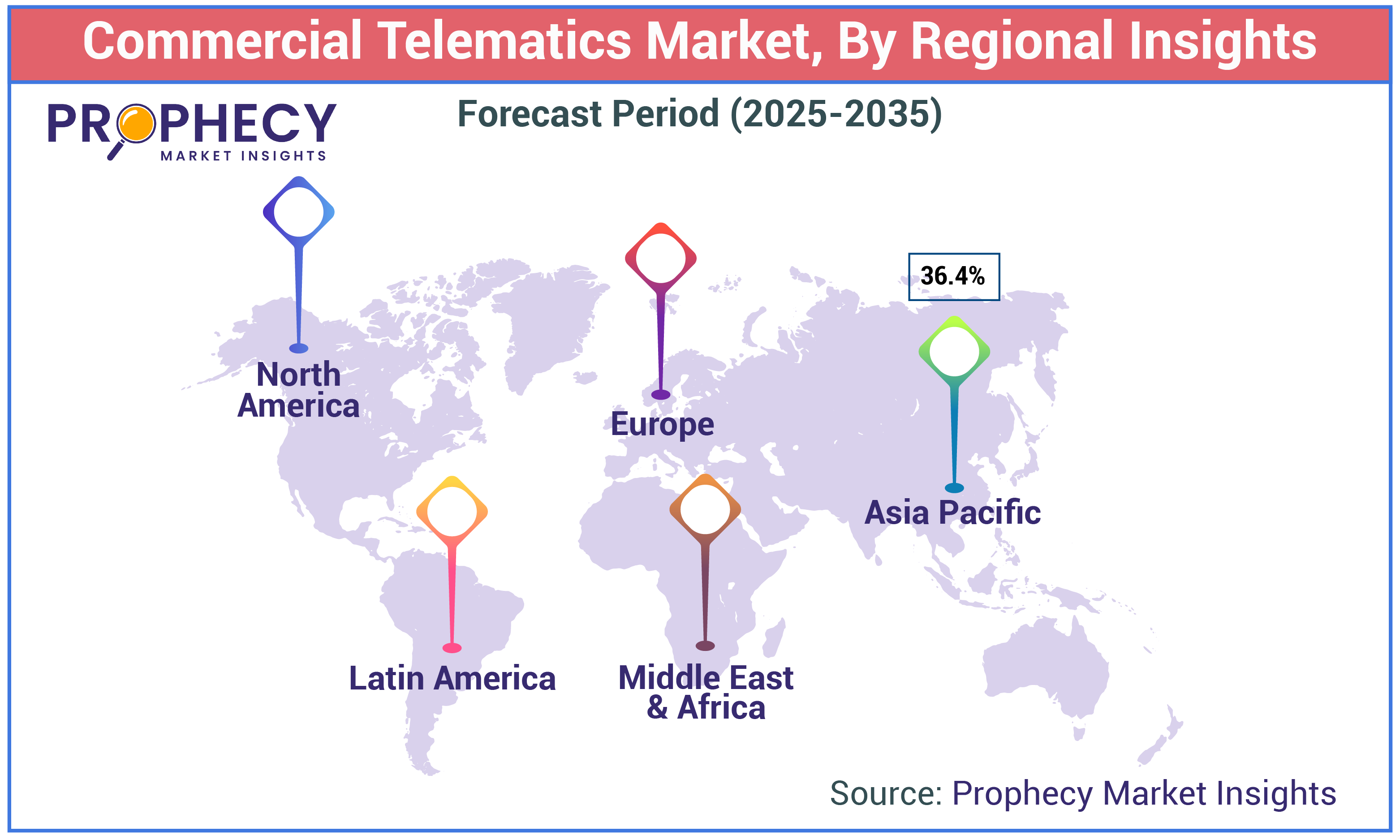
Asia Pacific: This region holds a substantial 36.4% share of the global commercial vehicle telematics market. Rapid urbanization, growing infrastructure, growth in transportation & logistics projects, agricultural advancement, growing technological adoption, and government initiatives for the adoption of smart technologies, is predicable to boost region growth in commercial telematics market share.
- China Commercial Telematics Market Insights:
The commercial telematics market in China has experienced significant growth in recent years and is expected to continuous growth. Growing infrastructure investment, ongoing urbanization, government stricter regulation, growing adoption of autonomous vehicles, and rapid industrialization, urbanization, can significantly drive the adoption of commercial telematics solutions, is predicted to growth of commercial telematics market share.
North America: This is the fastest growing region in market. The growing adoption of advanced technologies, the presence of major telematics providers, ongoing infrastructure projects, presence of key OEM & service providers, and stringent regulation around safety, fuel efficiency, and emissions, are expected to fuel region expansion in commercial telematics market size.
- U.S. Commercial Telematics Market Insights:
The U.S. is leading country in North America region for the market. It is leader in the development and adoption of advanced fleet management, it contains major telematics providers, stringent regulations related to emissions, safety, and fuel efficiency, resulting to drive target market growth.
Europe: This region is growing at steady rate in the market during the estimate period. The strong OEM presence, rapid digitalization in transportation, logistics sector, growing focus on advancement in commercial telematics solutions, is projected to fuel region growth in commercial telematics market share.
- Germany Commercial Telematics Market Insights:
Germany is the central country in Europe for the market, due to presence of largest original equipment manufacturers (OEM) manufacturers. Well-established automotive industry, strict safety regulations, leadership in industry 4.0, large transportation & logistics, and control in autonomous vehicle development, is probable to drive target market growth.
Commercial Telematics Market Report Scope:
|
Attribute |
Details |
|
Market Size 2025 |
USD 97.6 Billion |
|
Projected Market Size 2035 |
USD 420.5 Billion |
|
CAGR Growth Rate |
17.4% (2025-2035) |
|
Base year for estimation |
2024 |
|
Forecast period |
2025 – 2035 |
|
Market representation |
Revenue in USD Billion & CAGR from 2025 to 2035 |
|
Regional scope |
North America - U.S. and Canada Europe – Germany, U.K., France, Russia, Italy, Spain, Netherlands, and Rest of Europe Asia Pacific – China, India, Japan, Australia, Indonesia, Malaysia, South Korea, and Rest of Asia-Pacific Latin America - Brazil, Mexico, Argentina, and Rest of Latin America Middle East & Africa – GCC, Israel, South Africa, and Rest of Middle East & Africa |
|
Report coverage |
Revenue forecast, company share, competitive landscape, growth factors, and trends |
Segmentation:
By Offerings:
- Hardware
- GPS Trackers
- Sensors
- Telematics Control Units (TCUs)
- Software
- Fleet Management Software
- Safety Manage
- Telematic Productivity Software
- Telematics compliance Software
- V2X Software
- Others
- Services
- Professional Services
- Managed Services
By System Type:
- Embedded
- Tethered
- Smartphone Integrated
By Application:
- Fleet Management
- Asset Tracking
- Enhanced Productivity
- Predictive Maintenance
- Driver Behavior Monitoring
- Others
By End-User:
- Transportation & Logistics
- Government Agencies
- Vehicle Manufacturers/Dealers
- Media & Entertainment
- Others
By Region:
- North America
- U.S.
- Canada
- Europe
- Germany
- U.K.
- France
- Russia
- Italy
- Spain
- Netherlands
- Rest of Europe
- Asia Pacific
- China
- India
- Japan
- Australia
- Indonesia
- Malaysia
- South Korea
- Rest of Asia Pacific
- Latin America
- Brazil
- Mexico
- Argentina
- Rest of Latin America
- Middle East & Africa
- GCC
- Israel
- South Africa
- Rest of Middle East & Africa
Commercial Telematics Market Competitive Landscape & Key Players
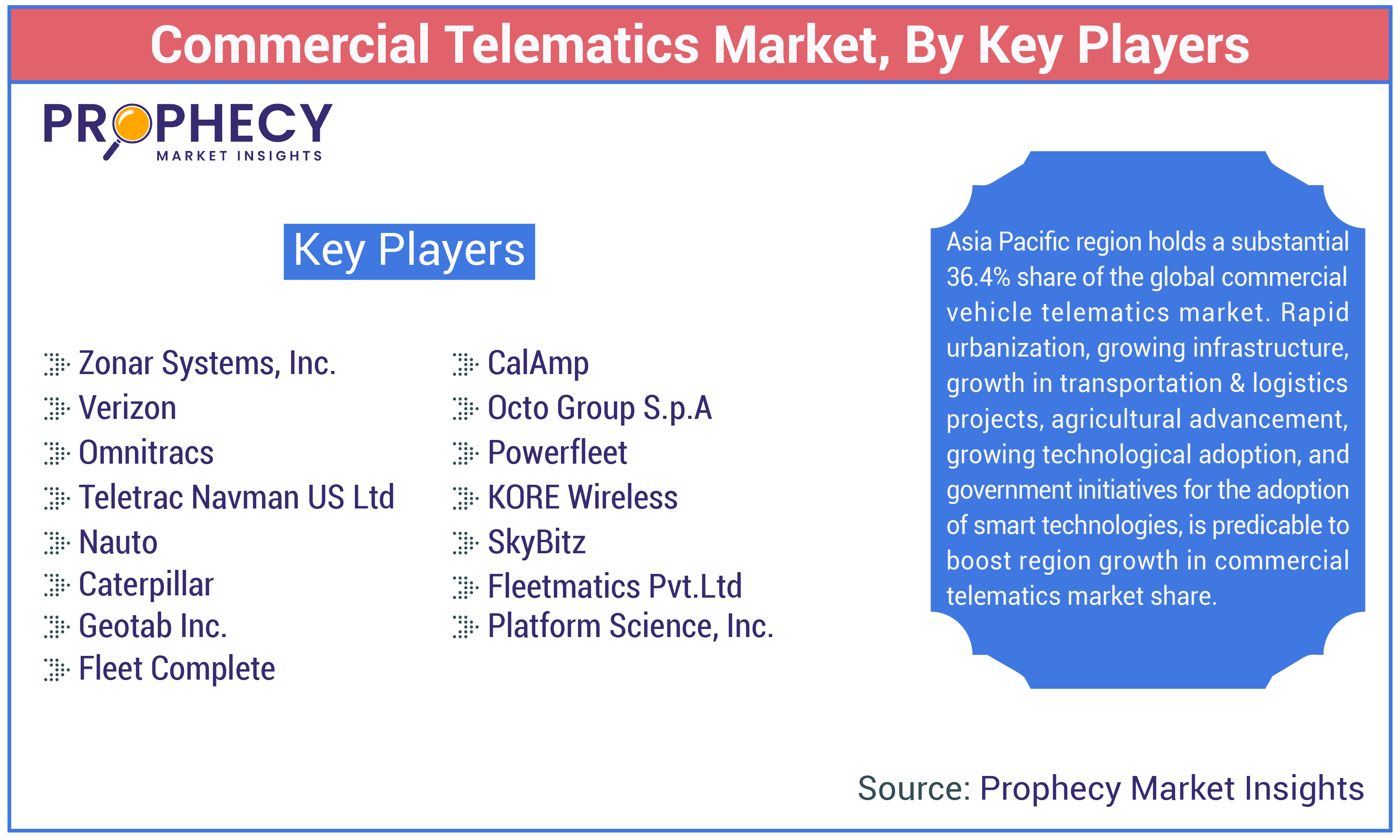
The major companies are active in the Commercial Telematics market are, Zonar Systems, Inc., Verizon, Omnitracs, and others. This companies are constantly innovating and developing new telematics solution through their strategic partnership and collaboration. The companies are focusing on enhance fleet management, reduce fuel consumption, and enhance portfolio through acquisition, is awaited to drive commercial telematics market growth.
Commercial Telematics Market Companies:
- Zonar Systems, Inc.
- Verizon
- Omnitracs
- Teletrac Navman US Ltd
- Nauto
- Caterpillar
- Geotab Inc.
- Fleet Complete
- CalAmp
- Octo Group S.p.A
- Powerfleet
- KORE Wireless
- SkyBitz
- Fleetmatics Pvt.Ltd
- Platform Science, Inc.
View an Additional List of Companies in the Commercial Telematics Market
Commercial Telematics Market Recent News
- In September 2024, Cummins Inc. announced a collaboration with Bosch Global Software and India’s KPIT to launch Eclipse CANought, a new open-source project for commercial vehicle telematics. This launched was a part of the Eclipse Software Defined Vehicle project, and Open Telematics initiative, which aimed to reduce telematics development costs which applied in commercial vehicles. Eclipse CANought, an initiative designed to simplify and secure access to the CAN bus, which was the backbone communication network interconnecting the vehicle's ECUs (Electronic Control Units).
- In September 2024, Platform Science and Trimble announce partnership, to acquire Trimble’s global transportation telematics business units. This partnership aimed to enhance driver experience, fleet safety, efficiency, and compliance by combining two advanced in-cab commercial vehicle ecosystems, which designed to provide consumers with wider portfolio solution. This collaboration focused to provide consumers with commercial mapping, transportation management, freight procurement and visibility solutions.
- In June 2024, ZF’s Commercial Vehicles Solution division launched a new trailer telematics solution with an integrated and simplified package. This solution aimed to improve uptime and performance by reducing costs for the trailer manufacturers, rental companies and fleets, which was designed to offer digitalization of trailer operations. Designed to obey with the latest GDPR (EU) and UN ECE regulation R141, ZF's trailer telematics solution was able to generate higher levels of efficiencies through real-time data-enriched operational insights
- In October 2023, Nauto, introduced new telematics capabilities by offering visibility into vehicle tracking, utilization, misuse and maintenance planning of commercial vehicles. This latest offering aimed to deliver telematics with advanced AI-powered driver, and vehicle safety capabilities, in a single device and software platform. This solution was already packed in commercial vehicle cabs, aimed to help fleet operators’ to reduce costs and maximize efficiencies.
Analyst View:
Technological advancements in telematics solution, growing demand for operational efficiency, cost management system, which rises the acceptance of telematics sensors in industries such as transportation & logistics, vehicle manufacturers/dealers, and driver safety management, is expected to drive target market growth. The ongoing digitalization in industries, growing demand for driver safety, growth in transportation sector, and increasing acceptance of fleet management to reduce unplanned downtime, ensuing to boost target market growth.
More Related Reports
Commercial or Corporate Cards Market
Electric Commercial Vehicle Market
Commercial Insulation Market
Commercial Aircraft Wet Lease ACMI Market
Commercial Aircraft Video Surveillance Systems Market
Commercial Telematics Market Company Profile
|
Company Name |
Omnitracs |
|
Headquarter |
Westlake, Texas, U.S. |
|
CEO |
Ray Greer |
|
Employee Count (2024) |
5,001-10,000 Employees |
Commercial Telematics Market Highlights
FAQs
Commercial telematics market size was valued at USD 97.6 Billion in 2025 and is expected to reach USD 420.5 Billion by 2035 growing at a CAGR of 17.4%.
Offerings, system type, application, end-user, and region are the segmentation for the target market.
North America, Asia Pacific, Europe, Latin America, and the Middle East & Africa. Asia Pacific is expected to dominate the market.
The key players operating in the commercial telematics market include Zonar Systems, Inc., Verizon, Omnitracs, Teletrac Navman US Ltd, Nauto, Caterpillar, Geotab Inc., Fleet Complete, CalAmp, Octo Group S.p.A, Powerfleet, KORE Wireless, SkyBitz, Fleetmatics Pvt.Ltd., and Platform Science, Inc.