Published Date: February 2025
Neurological disorder diagnostics is the process of evaluating and identifying neurological disorder by performing neurological examination, patient’s medical history, and diagnostic tests, such as MRI and CT scans for brain imaging tests. The demand for neurological diagnostics is rising due to the increasing incidence of neurological disorders, growing patients stress, increasing demand for technological advancements, and early disease diagnosis, further helping to drive target market growth.
Neurological Disorder Diagnostics Market Segmentation Analysis:
|
By Product |
Imaging Systems and In-Vitro Diagnostics |
|
By Disease Indication |
Strokes, Multiple Sclerosis, Neurodegenerative Diseases, Headaches, Sleep Disorder, and Others |
|
By End-User |
Hospitals, Specialty Clinics, Diagnostic Centers, and Ambulatory Care Centers |
Neurological Disorder Diagnostics Market Report Highlights:
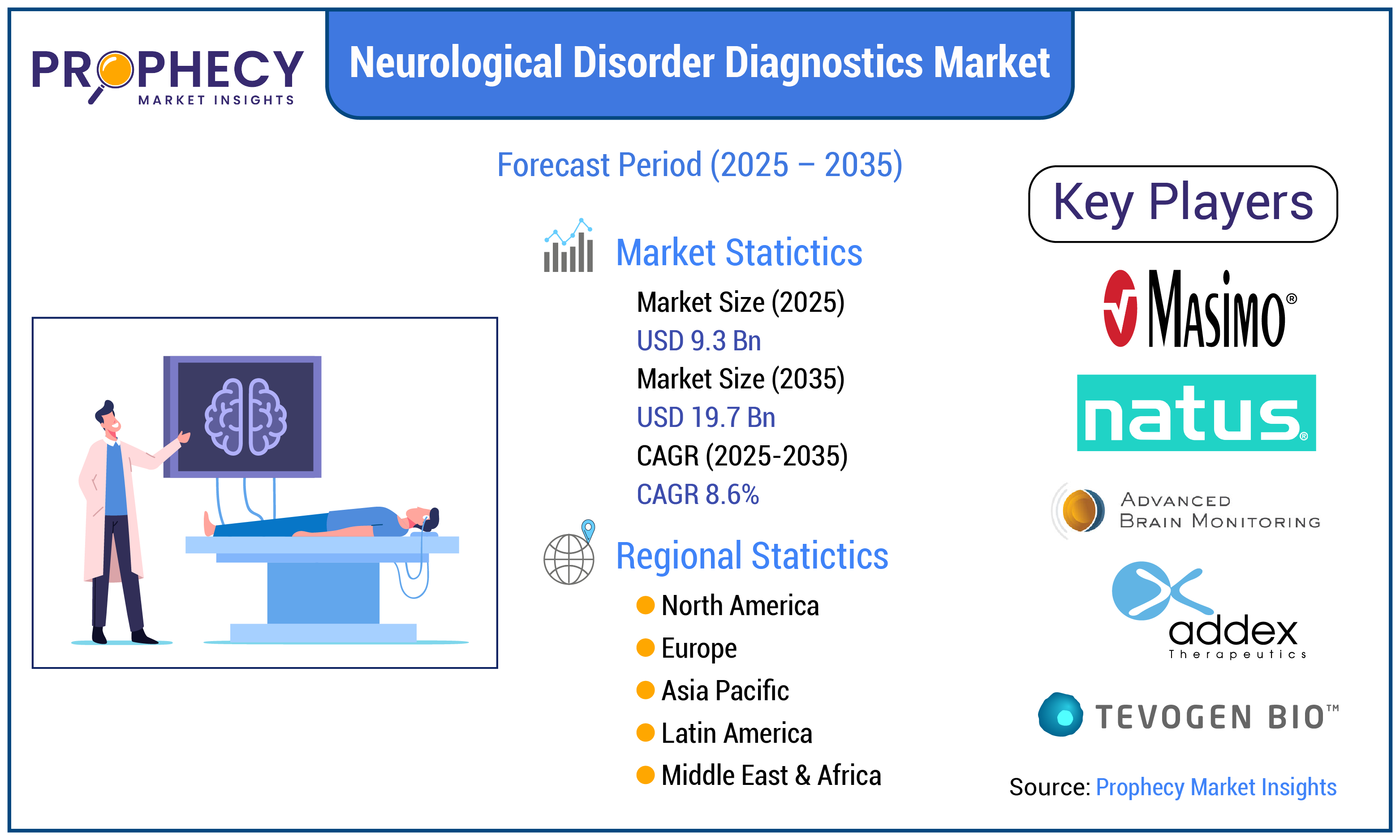
- By 2035, the target market is expected to increase at a rate of USD 19.7 Billion.
- In 2024, the neurological disorder diagnostics market systems size was worth USD 8.66 Billion.
- The market is expanding at a CAGR of 8.6%.
- By product, the market is being led by the imaging systems segment’s electroencephalogram (EEG) imaging system.
- On the basis of disease indication, the neurodegenerative disorder holds the dominant share in the market.
- Based on end-user, the hospitals segment is expected to dominate the market during the forecast period.
- North America is expected to dominate the market during the projected period.
- Asia Pacific is expected to witness fastest growth during the forecast period.
Neurological Disorder Diagnostics Market Dynamics:
|
Growth Factor |
Challenge Factor |
Market Trend |
|
Rising Neurological Disorders Prevalence |
Equipment’s High Cost |
Adoption of Brain-Computer Interfaces Technology |
Neurological Disorder Diagnostics Market Key Highlights:
- In February 2024: Philips launched their new Azurion neuro biplane system to speed up and improve invasive diagnosis and treatment of neurovascular patients. It is a new image-guided therapy system for diagnosis, image guidance, and therapy assessment solutions for patients with stroke and other neurovascular diseases. The new interventional system is aimed to design a new therapy to achieve better outcomes and enhance 2D & 3D imaging and x-ray detector positioning flexibility. Philips is also partnering with customers to improve productivity and access more sustainable and high-quality healthcare.
Neurological Disorder Diagnostics Market Report Analysis:
Diagnostic Tests for Neurological Disorders: Evaluating and diagnosing damage to the nervous system is complicated and complex. Many of the same symptoms happen in different combinations among the different disorders. Many disorders also don't have definitive causes, markers, or tests. That can make a diagnosis even harder. To diagnose a nervous system disorder, a healthcare provider starts with a complete medical history and physical exam. They may also use one or more of these tests:
- CT scan- This imaging test uses a combination of X-rays and computer technology to create detailed images of any part of the body, including bones, muscles, fat, and organs. CT scans are more detailed than general X-rays. They are used to diagnose disorders of the brain, spine, or other parts of the nervous system.
- Electroencephalogram (EEG) - This test records the brain's continuous electrical activity through electrodes attached to the scalp.
- MRI- This test uses a combination of large magnets, radio waves, and a computer to make detailed images of organs and structures within the body. MRI creates images with much more detail than CT scan without radiation.
- Electro diagnostic tests- such as electromyography (EMG) and nerve conduction velocity (NCV). These tests evaluate and diagnose disorders of the muscles and motor neurons. Electrodes are inserted into the muscle or placed on the skin overlying a muscle or muscle group. Electrical activity and muscle response are recorded.
- Positron emission tomography (PET) - This test uses a small amount of radioactive material, a camera, and a computer to see how well organs and tissues are working. This test may see the early onset of disease before imaging tests can.
- Arteriogram (angiogram) -This X-ray of the arteries and veins detects blockage or narrowing of the blood vessels.
- Spinal tap (lumbar puncture) -During this test, a special needle is placed into the lower back, into the spinal canal. This is the area around the spinal cord and nerves. The pressure in the spinal canal and brain can then be measured. A small amount of cerebrospinal fluid (CSF) can be removed and sent for testing to find out if there is an infection or other problems. CSF is the fluid that bathes the brain and spinal cord.
- Evoked potentials- This test records the brain's electrical response to visual, auditory, and sensory stimuli.
- Myelogram- This test uses dye injected into the spinal canal to make the structure clearly visible on X-rays. This test is used less commonly because MRI is widely available.
- Neurosonography- This test uses ultra-high-frequency sound waves. It allows the healthcare provider to analyze blood flow in cases of possible stroke. This includes carotid ultrasound and transcranial doppler.
- Ultrasound (sonography) - This imaging test uses high-frequency sound waves and a computer to make images of blood vessels, tissues, and organs. Ultrasounds are used to view internal organs as they function. They also assess blood flow through various vessels.
Browse ∼41 market data tables and ∼40 figures through ∼180 slides and in-depth TOC on “Neurological Disorder Diagnostics Market Size, Share, By Product (Imaging Systems and In-vitro Diagnostics), Disease Indication (Strokes, Multiple Sclerosis, Neurodegenerative Diseases, Headaches, Sleep Disorder, and Others), End-User (Hospitals, Specialty Clinics, Diagnostic Centers, and Ambulatory Care Centers), and Region - Trends, Analysis, and Forecast till 2035”
For more insights into the Neurological Disorder Diagnostics Market and its future trends, visit the link: https://www.prophecymarketinsights.com/market_insight/Global-Neurological-Disorder-Diagnostics-Market-758
Neurological Disorder Diagnostics Market Competitive Landscape:
The key players competing in the neurological disorder diagnostics market are Natus, ADDEX THERAPEUTICS, Advanced Brain Monitoring, Inc, Koninklijke Philips N.V, Tevogen Bio, Hitachi High-Tech Corporation, Masimo, NIHON KOHDEN CORPORATION, F. Hoffmann-La Roche Ltd, Medtronic, QURALIS CORPORATION, Atlantic Health System, Fujirebio, Siemens Healthineers AG, and ant-neuro.com.
|
Company Name |
GE Healthcare |
|
Headquarter |
Chicago, Illinois, U.S. |
|
CEO |
Peter J. Arduini |
|
Employee Count (2024) |
50,000 Employees |
We can customize every report - free of charge - including purchasing stand-alone sections or country-level reports
Custmoized Your ReportWe help clients to procure the report or sections of the report at their budgeted price. Kindly click on the below to avail
Request for Discount



Quick contact