Us Digital Agriculture Farming Market Overview
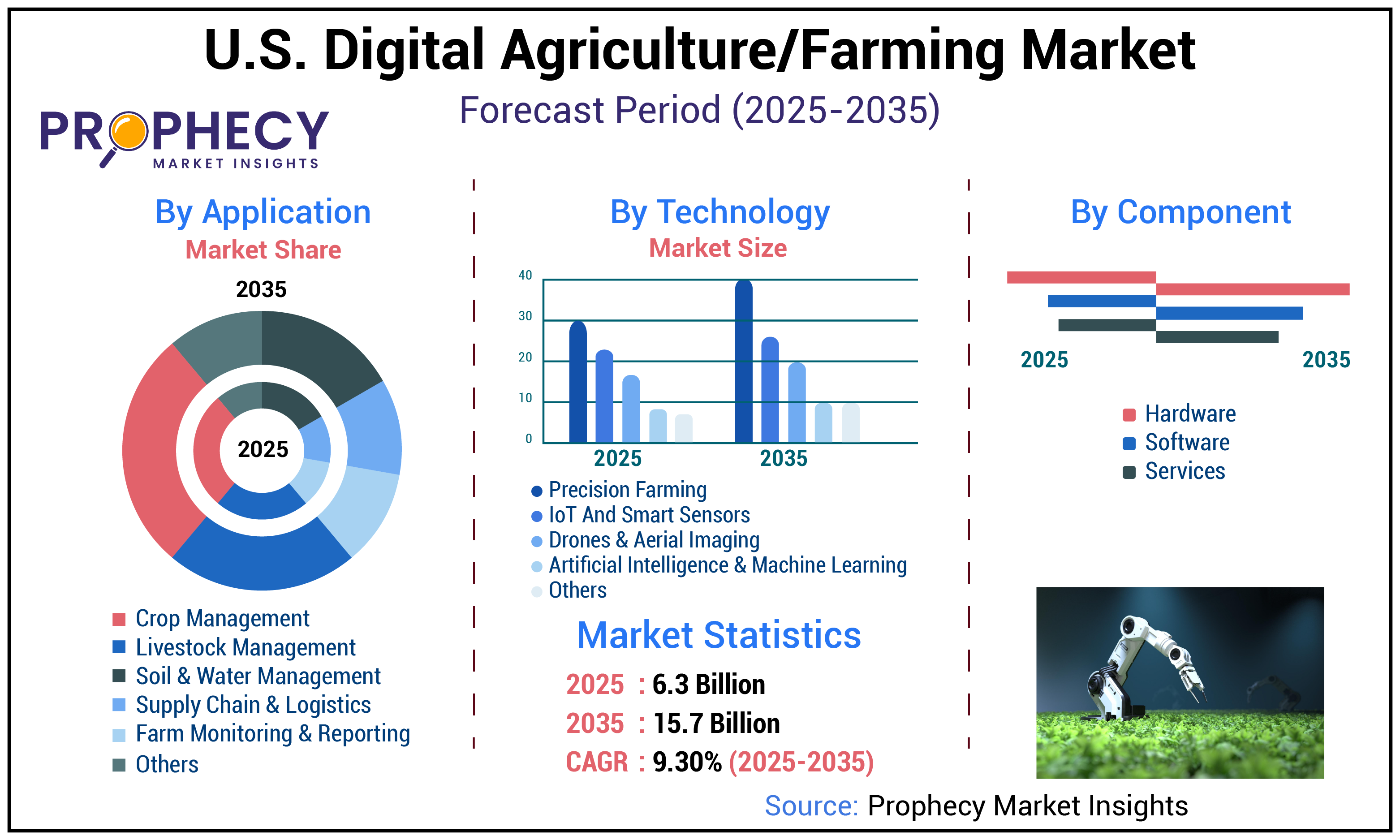
- 2025 Market Size: USD 6.3 Billion
- 2035 Projected Market Size: USD 15.7 Billion
- CAGR (2025-2035): 9.30%
Digital agriculture, often known as digital farming, is the use of cutting-edge technology such as loT sensors, drones, GPS, data analytics, and smart tools to farm land or care for animals. There are several advantages, ranging from increased agricultural yield, efficient use of water, fertilizers, and pesticides, cost savings, and improved sustainability to better risk management and more profit, all while causing less environmental damage.
One of the main reasons that the U.S. digital agriculture/farming market has experienced such a dramatic growth is the implementation of precision farming technologies in a very short time. Besides this, the market has also been positively affected by the big investments that have been made in agri-tech startups and by the general use of loT, drones, and Al to better the output and the efficiency of the processes. As the need for more sustainable farming practices continues to rise in the U.S., there exist many opportunities for technology-led solutions to address these challenges, resulting in increased adoption of digital tools in agriculture.
State of Adoption of Sustainable Farming Practices in the U.S.:
- Rising Adoption of Precision Agriculture: To support resource-efficient and environmentally friendly farming, farmers apply various digital tools, soil sensors, and GPS-guided machines, which enable them to lower the use of fertilizers, pesticides, and water.
- Government and Market-Driven Push: Growing consumer demand for organic and sustainably produced food, climate-smart agriculture initiatives, and USDA programs have made farmers make a shift to cover cropping, crop rotation, and reduced tillage.
- Integration of Renewable Energy & Carbon Farming: The use of mobile applications, software for farm management, and cloud-based solutions has been embraced to establish a connection between the farmers and the markets, supply chains, and advisory services.
Us Digital Agriculture Farming Market Drivers & Restraints
Drivers and Restraints:
|
Drivers |
Restraints |
Opportunities & Trends |
|
|
|
Key Drivers:
Rising Labor Shortages
Digitally-enabled agriculture market is booming due to steadily rising labor shortfall in the U.S. A farm that is badly in need of a skilled workforce will simply rely on automation, robotics, drones, and AI-powered machinery to fill the gap. The adoption of such technologies significantly lowers the need for human labor, but at the same time it also raises farmers' efficiency, accuracy, and scalability. So, as a result of these developments, digital farming solutions are becoming a necessity in order to keep up with the current labor challenges and their impact on productivity.
- For Instance, according to article published by Exploding Topics, The US has a labor shortage of 70%. The US has a labor force participation of 62.7%.
Restraints:
Rural Connectivity Gaps
Rural connectivity gaps are a major impediment to the digital agriculture market in the United States as they impose severe limitations on the utilization of loT devices, cloud-based platforms, and real-time data analytics, all of which require a stable internet connection. Consequently, there is a large number of farmers who are not technologically equipped to utilize advanced farming technologies adequately.
- Counterbalance Statements: It is crucial to increase the broadband infrastructure in the countryside in order to solve the problem. Multiple channels such as government programs, public-private collaborations, and satellite internet can make it a reality. As a result, farmers living far away from the centers would get not only access to but also the benefits of the digital revolution in farming.
Opportunities & Trends:
Increased Adoption of Climate-Smart and Regenerative Farming Practices
A major future trend of the United States digital agriculture market is set to be the increased use of climate-smart and regenerative farming practices. Farmers are looking for ways to slow down the climate change process, improve soil health and lower emissions but at the same time, they want to retain their productivity. Today farmers implement advanced technology to help precision and smart farming. They apply good methods and digital tools such as Al, IoT, and precision farming technics to optimize the use of inputs, to track their carbon footprints, and to allow them to engage in the carbon credit market, which makes sustainability a key factor not only for environmental but also for economic growth.
Us Digital Agriculture Farming Market Segmentations & Regional Insights
Component technology, application, and end user are the divisions of the U.S. digital agriculture/farming market.
By Component:
Hardware, software, and services are component on which U.S. digital agriculture/farming market is segmented. Hardware dominates the U.S. digital agriculture/farming market share, since technology such as drones, sensors, GPS systems, and automated machinery are at the heart of precision farming and are widely used to increase productivity and minimize worker reliance.
Software is the second most important component, due to the expanding usage of farm management systems, AI-driven analytics, and cloud-based solutions that convert hardware-generated data into actionable insights for decision-making and sustainability compliance.
By Technology:
Based on the technology, precision farming, IoT and smart sensors, drones & aerial imaging, artificial intelligence (AI) & machine learning (ML), and others are the segments of target market. The U.S. Precision farming dominates the U.S. digital agriculture/farming market due to how it combines numerous technologies GPS-guided equipment, variable rate application, and advanced analytics to increase yields, cut costs, and alleviate manpower constraints on large-scale farms.
IoT and smart sensors are the second most important technologies as they give real-time data on soil, weather, and crop conditions, which are the foundation of precision farming and enable more precise, data-driven agricultural methods.
By Application:
Crop Management, livestock management, soil & water management, supply chain & logistics, farm monitoring & reporting, and others are technology of the market. Crop management dominates the U.S. digital agriculture/farming market share due to the country's enormous cultivated acreage and strong demand for technology that optimize planting, fertilization, irrigation, and pest control to maximize yields and profitability.
The second-most popular application is livestock management, which is supported by the country's large-scale dairy and meat industries. Digital tools such as smart sensors, automated feeding systems, and health monitoring solutions are increasingly being used to improve efficiency, animal welfare, and productivity.
By End User:
Large-Scale farms, small & medium farms, agricultural cooperatives, government & research institutions, and others are end users of the U.S. digital agriculture/farming market. Large-scale farms dominate the U.S. digital agriculture/farming market size as they have the funds to invest in sophisticated technologies such as precision farming equipment, robots, and AI-driven platforms, as well as the benefits of efficiency and scalability.
Small and medium-sized farms are the second-most common end users, as increased access to low-cost IoT instruments, government support programs, and cooperative-based models encourage broader use of digital solutions to boost productivity and sustainability.
U.S. Digital Agriculture/Farming Market Report Scope:
|
Attribute |
Details |
|
Market Size 2025 |
USD 6.3 Billion |
|
Projected Market Size 2035 |
USD 15.7 Billion |
|
CAGR Growth Rate |
9.30% (2025-2035) |
|
Base year for estimation |
2024 |
|
Forecast period |
2025 – 2035 |
|
Market representation |
Revenue in USD Billion & CAGR from 2025 to 2035 |
|
Company Landscape |
Market Share Analysis of Companies Heat Map Analysis Company Overview, Products Overview Financial Information, Key Highlights Business Strategies Overview SWOT Analysis |
|
Report coverage |
Revenue forecast, company share, competitive landscape, growth factors, and trends |
|
Value Added Data Infosets |
Besides fundamental market insights such as the size of the market, growth rate, segmentation, regional study, and key players, our reports carry value-added data sets such as trade flow (import-export) analysis, production and consumption overview, price trend evaluation, supply and value chain mapping, and raw material availability. Moreover, we provide strategic tools as PESTLE and Porter’s Five Forces analysis, examination of the regulatory landscape, as well as monitoring of technology and innovation thereby providing a comprehensive overview which facilitates sensible and anticipatory decision-making. |
Segmentation:
By Component:
- Hardware
- Sensors
- Drones & UAVs
- Others
- Software
- Farm Management Software
- Analytics Platforms
- Others
- Services
- Consulting & Implementation
- Maintenance & Support
- Others
By Technology:
- Precision Farming
- IoT and Smart Sensors
- Drones & Aerial Imaging
- Artificial Intelligence (AI) & Machine Learning (ML)
- Others
By Application:
- Crop Management
- Livestock Management
- Soil & Water Management
- Supply Chain & Logistics
- Farm Monitoring & Reporting
- Others
By End User:
- Large-Scale Farms
- Small & Medium Farms
- Agricultural Cooperatives
- Government & Research Institutions
- Others
Us Digital Agriculture Farming Market Competitive Landscape & Key Players
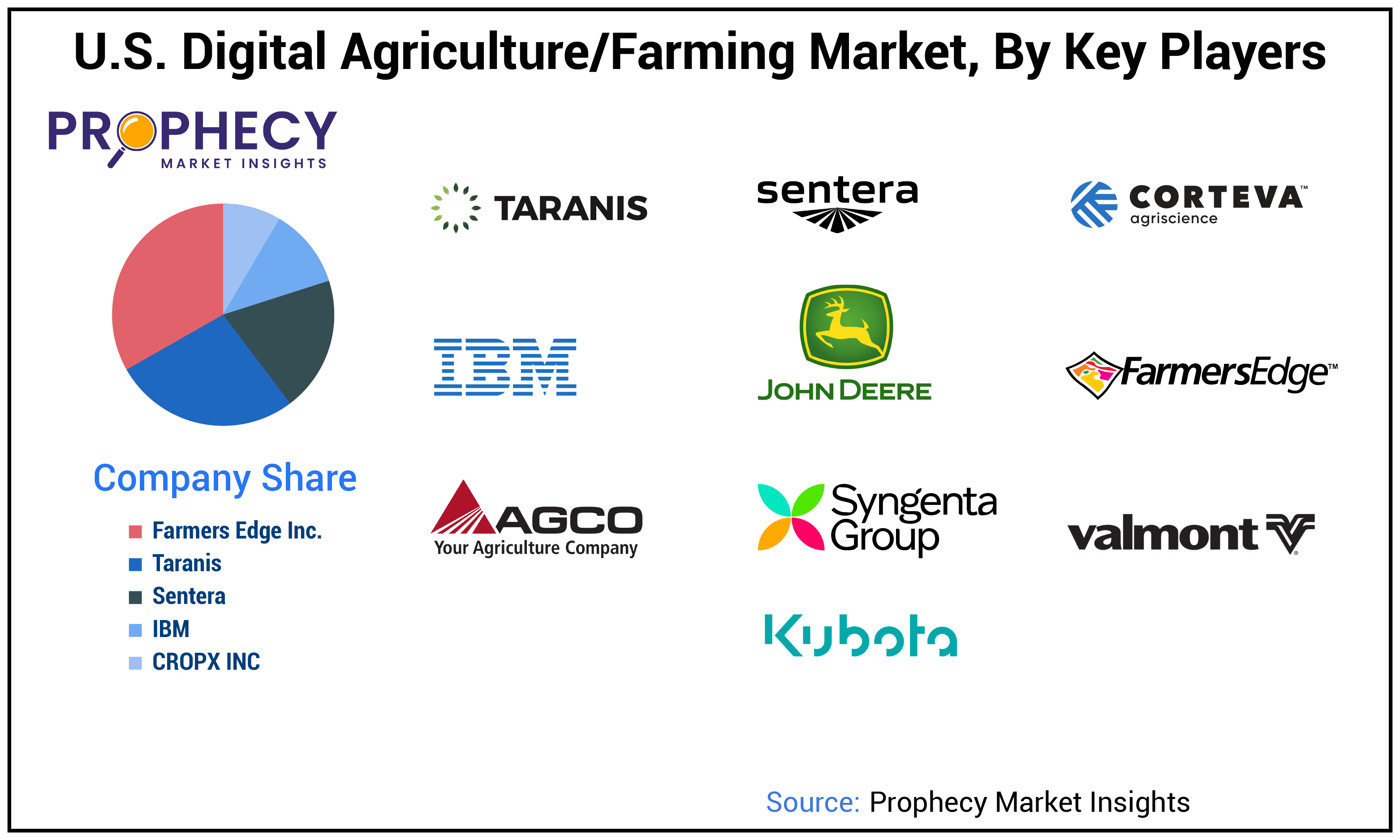
AGCO Corporation, Corteva Agriscience, KUBOTA CORPORATION, and others are among the top competitors in the US Digital Agriculture/Farming market. Digital agricultural firms grow through R&D, partnerships, low-cost solutions for small farmers, global growth, and technical developments that encourage sustainable farming adoption.
U.S. Digital Agriculture/Farming Market Companies:
- Farmers Edge Inc.
- Taranis
- Sentera
- IBM
- CROPX INC
- VALMONT INDUSTRIES, INC.
- SoftBank Group Corp.
- Deere & Company
- AGCO Corporation
- CNH Industrial N.V.
- KUBOTA Corporation
- Bayer AG
- Syngenta Crop Protection AG
- Corteva Agriscience
Us Digital Agriculture Farming Market Recent News
- In May 2025, The Food and Agriculture Organization of the United Nations (FAO), in partnership with Zhejiang University and Pinduoduo, has launched a dynamic Digital Agriculture Innovation Bootcamp aimed at empowering youth-led agripreneurs to drive digital transformation in the agrifood sector with the help of FAO staff.
- In July 2024, Syngenta Spain has created Cropwise, an innovative digital agricultural platform for farmers and specialists. This innovative tool combines modern digital technologies to give farmers with a full farm management system, ensuring long-term production and profitability.
Analyst View:
Digital agriculture, which uses technology such as IoT, AI, drones, and data analytics, enhances farming by boosting crop yields, optimizing resources, cutting costs, and promoting sustainability. Rising global food demand, limited arable land, and the need for ecologically friendly agricultural methods all contribute to market expansion. Smart technological developments, together with government aid and subsidies, are making adoption simpler, while farmers increasingly rely on digital solutions to enhance productivity, profitability, and resilience to climate change challenges.
Analysis of Sources:
Primary Sources:
- In-depth interviews
- Company-specific data
- Surveys and questionnaires
- Focus group discussions (FGDs)
- Others
Secondary Sources:
- Food and Agriculture Organization (FAO)
- World Bank
- European Commission (EC)
- Others
More Related Reports
Digital Oilfield Market
Digital Fluoroscopy System Market
Digital Health Market
Digital Pathology Market
Asia Pacific Digital Agriculture/Farming Market
Us Digital Agriculture Farming Market Company Profile
|
Company Name |
Product Portfolio |
|
Deere & Company |
Precision Ag Technology |
|
AGCO Corporation |
Precision Agriculture |
|
KUBOTA Corporation |
Smart Agriculture Solutions |
|
Syngenta Crop Protection AG |
Digital Farming |
|
Corteva Agriscience |
Technology and Precision Agriculture |
FAQs
U.S. digital agriculture/farming market size was valued at USD 6.3 Billion in 2025 and is expected to reach USD 15.7 Billion by 2035 growing at a CAGR of 9.30%.
Component, technology, application, and end user are the segmentation for the U.S. digital agriculture/farming market.
Increasing need for food security due to a rising global population, labor shortages, the economic pressure of rising input costs, and so on are some of the U.S. digital agriculture/farming market growth drivers.
Generative AI is influencing the U.S. digital agriculture/farming market by allowing improved crop modeling, automated farm planning, and predictive simulations, which assist farmers in optimizing resource usage, reducing risks, and making faster, data-driven choices for increased productivity and sustainability.
The key players operating the U.S. digital agriculture/farming market include Farmers Edge Inc., Taranis, Sentera, IBM, CropX Inc, ICRISAT, VALMONT INDUSTRIES, INC., SoftBank Group Corp, Deere & Company, AGCO Corporation, CNH Industrial N.V., KUBOTA CORPORATION, Bayer AG, Syngenta Crop Protection AG, and Corteva Agriscience.