Sustainable Agriculture Market Overview
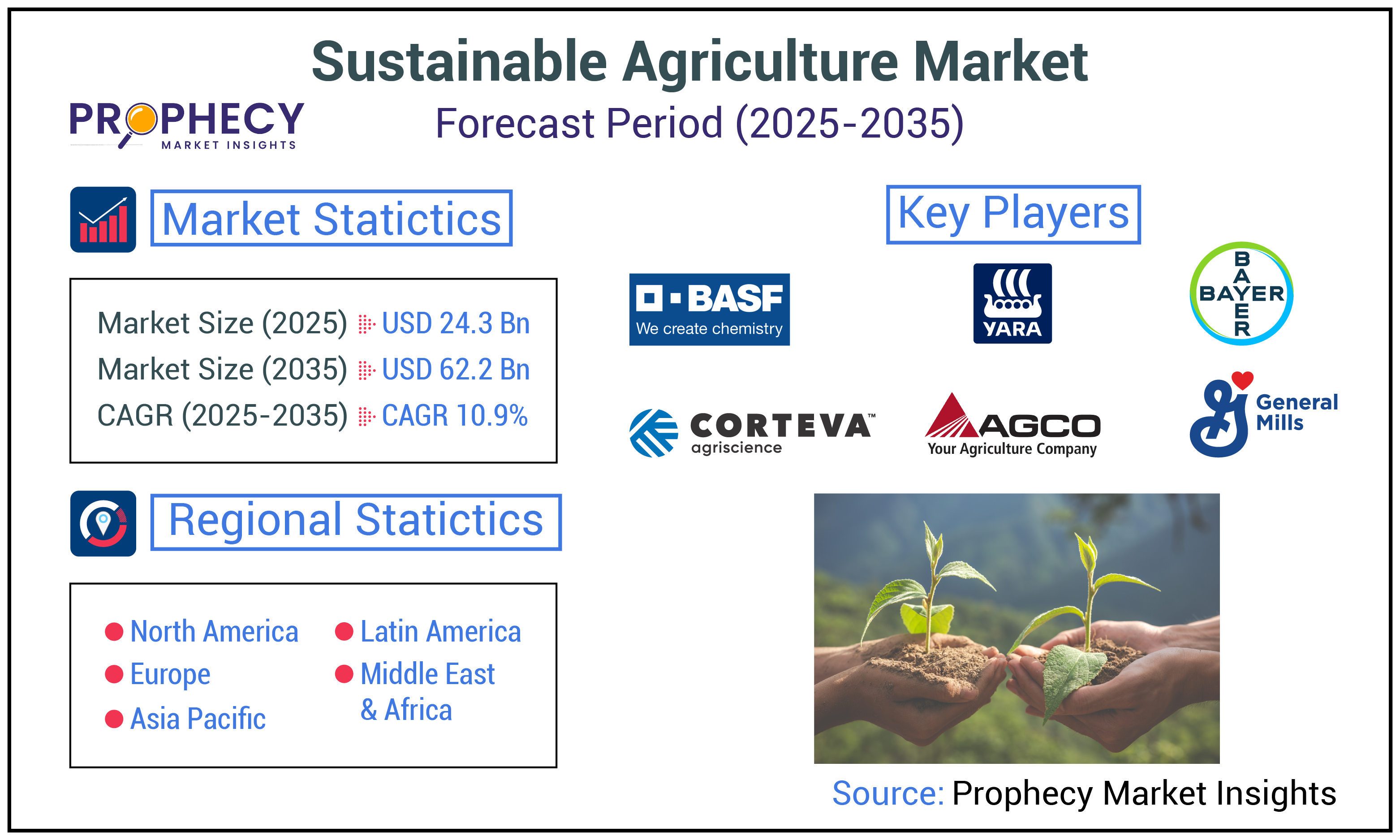
- By 2035, the sustainable agriculture market size is contemplated to enlarge at a valuation of USD 62.2 Billion.
- In 2024, the sustainable agriculture market valuation was USD 21.9 Billion.
- Sustainable agriculture market is developing at a CAGR of 10.9%.
Sustainable agriculture refers to a farming technique that primarily aims at producing food while preserving the environment, maintaining the financial stability of the farm, and improving the overall welfare of both farmers and the community. The key practices employed in this form of agriculture include crop rotation, organic farming, efficient use of water, and reduction in the use of chemicals. The major benefits which are at the center of attention are as follows: improved soil health, reduced environmental impact, increased biodiversity, improved food security, and long-term sustainable productivity.
The increase of the Sustainable Agriculture market has been influenced by the global awareness which is constantly rising and includes environmental degradation, climate change, and the need for eco-friendly farming practices. The use of organic products, the support of the government through the provision of subsidies and implementation of sustainable farming projects and the development of precision agriculture technologies are the main reasons for the increase in the adoption of the sector. Besides that, worries about health of the soil, water shortage, and loss of biodiversity are sources of the strong incentive for producers and consumers to turn to more sustainable and resilient agricultural systems.
The sustainability agriculture market is expected to thrive on the use of regenerative practices, adoption of smart agricultural technologies such as AI and IoT, and the use of controlled-environments such as vertical and hydroponic farming. The reason for these inventions is to conserve resources, which include water, land, and energy, and also increase production and climate and soil resilience. Besides these there are many other trends starting to gain prominence such as the use of biostimulants, implementation of blockchain in food traceability, and the integration of agroforestry.
Recession Risk & Tariff Analysis:
- The sustainable agriculture market is probably to be impacted negatively by the chances of recession as the spending of consumers on premium eco products might go down besides investments on farms being limited.
- On the other hand, higher tariffs, e.g. the ones on exports of the agricultural sector from Brazil, India, could upset international trade, cause sustainable farming technology to become more expensive and make the market less stable.
Impact of Generative AI on Sustainable Agriculture Market:
- Generative Al is changing the sustainable agriculture market. It can help farmers make better decisions with predictions, and it can even manage the farm automatically.
- Farms can be tailored with Al, good plan can grow through Al, a farm can help save water and energy and at the same time grow a farm with more increased health and quantity.
- These advances not only increase the efficiency of farms but also make them less vulnerable to environmental ravages and more so in times of scarce resources.
Sustainable Agriculture Market Drivers & Restraints
Key Drivers:
The Market is Experiencing Steady Growth due to Rising Demand for Organic & Chemical-Free Food
The growing desire for organic and chemical-free foods, is that consumers are becoming more aware of their health, environmental sustainability, and food safety. Nowadays, people are quite worried that the synthetic pesticides, fertilizers, and genetically modified organisms used in conventional agriculture will have a negative impact on their health; hence they are choosing foods that are naturally grown and minimally processed. This change in food habits, together with the increasing presence of organic goods in stores and on the internet, is considerably raising the need for eco-friendly farming methods that focus on good soil, a variety of life, and lower use of chemicals.
- For Instance, according to the data published by IFOAM -Organics International, the global organic farming area increased by over 20 million hectares in 2022, reaching 96 million hectares. The number of organic producers also saw a significant rise, surpassing 4.5 million. The sales of organic food reached nearly 135 billion euros in 2022.
Restraints:
The Growth of the Market can be Disrupt by Market Accessibility & Certification Barriers
Sustainable agriculture faces accessibility and certification barriers because of the high expense, complexity, and duration needed to get organic or eco-label certifications. The small and marginal farmers usually face difficulties in handling the paperwork, meeting compliance requirements, and going through the verification process which limits their ability to access premium markets and make more money.
- Counterbalance Statements: One possible answer to this issue could be governments or non-governmental organizations (NGOs supplying the necessary funds, offering their technical support, facilitating the certification processes and promoting group certifications. Group certifications privately in farmers' cooperatives or co-operative-based producers can help reduced costs as well as better market access for small-scale producers who are engaged in sustainable production.
Opportunities & Trends:
The Market can be Boosted by Expansion of Urban and Vertical Farming
Urban and vertical farming are set to become major market drivers in sustainable agriculture. As these methods allow for continuous production throughout the year without the use of pesticides, even in areas that are heavily populated and have little available land for farming. By using hydroponics, aeroponics, Al, automation, and LED lighting, these setups can reduce water consumption by as much as 95%, produce more food per square foot, and have lower transport emissions since the food is grown near the consumers.
The use of technology in agriculture has led to many benefits such as food security, resource efficiency, and sustainability. One such innovation is vertical farming. As urbanization increases and land becomes scarce, vertical farms are becoming more popular due to their ability to provide local fresh produce regardless of the area's size.
Sustainable Agriculture Market Segmentations & Regional Insights
Type, farming method, application, end user, and region are the divisions of the sustainable agriculture market.
By Type:
Conservation agriculture, organic agriculture, regenerative agriculture, precision agriculture, and others are type on which sustainable agriculture market is segmented. Organic agriculture has the most sustainable agriculture market share of the four major categories primarily due to its high consumer appeal, high cost, stringent certification requirements, and well-established market presence, especially in North America and Europe.
Precision agriculture, the second-largest industry, is growing quickly as a result of its use of cutting-edge technologies include IoT, GPS, drones, AI, and data analytics that allow for yield optimization, effective resource utilization, and robust backing from international government initiatives.
By Farming Method:
Based on the farming method, the sustainable agriculture market is divided into indoor farming, outdoor farming, urban agriculture, and others. Due to its extensive use in rural areas, well-established infrastructure, and less expensive setup expenses than controlled-environment techniques, outdoor farming has the highest sustainable agricultural market share.
Due to its resource efficiency, space optimization, and year-round production with little environmental impact, indoor farming especially vertical and greenhouse farming is the second-dominant segment and is becoming increasingly popular in urban areas. As a result, it is a major trend in areas with limited land and expanding urban populations.
By Application:
Crop production, livestock management, aquaculture, agroforestry, and others are application of the sustainable agriculture market. Since crop production is the backbone of global food systems and is where sustainable practices including precision agriculture, organic farming, and conservation methods are most widely used, it has the biggest sustainable agriculture market share.
The second most popular category is livestock management, which is fueled by rising worries about antibiotic usage, pollution, and animal welfare. Sustainable feed, pasture, and waste management techniques are being used more and more to increase output while lessening the negative environmental effects of animal husbandry.
By End User:
On the end user, sustainable agriculture market is categorized into commercial farmers, smallholder & marginal farmers, agribusiness corporations, research institutes & NGOs, and others. The largest sustainable agriculture market share is held by commercial farmers for the reason of their larger operations, improved access to capital, and sophisticated technologies that enable the effective application of sustainable practices consisting of organic farming, precision farming, and regenerative techniques.
The second-dominant group is smallholder and marginal farmers, who make up the bulk of the agricultural labor, particularly in Asia and Africa. They are embracing low-cost, sustainable strategies to boost resilience and production thanks to growing backing from governments, non-governmental organizations, and cooperatives.
Regional Insights:
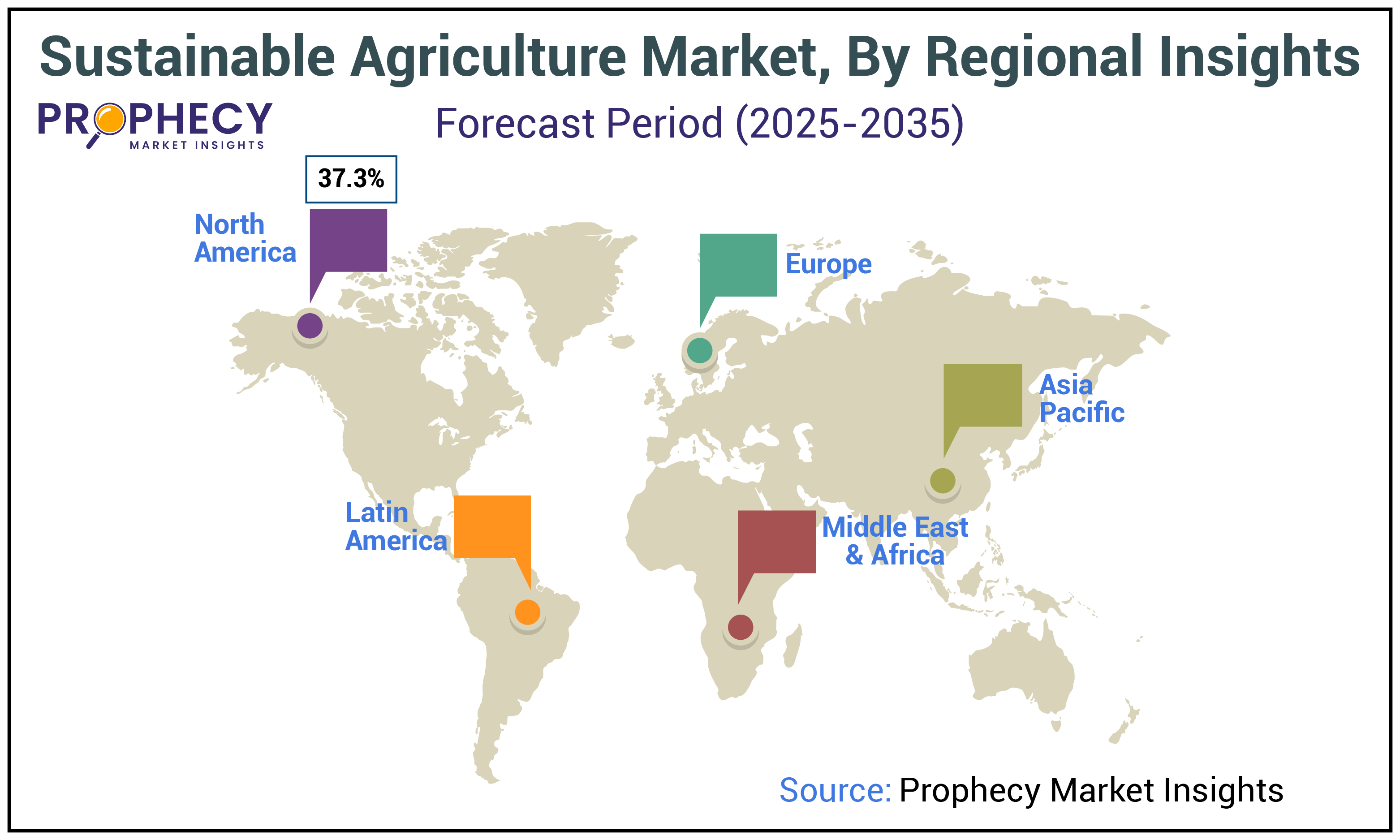
Geographically, the sustainable agriculture market is studied across North America, Europe, Asia Pacific, Latin America, and the Middle East & Africa.
North America: Due in large part to the early and broad adoption of sustainable farming methods consisting of organic and precision farming, robust regulatory support, high consumer demand for environmentally friendly food, and the presence of significant market players in the United States and Canada, North America has the largest sustainable agriculture market share accounting for 37.3%.
- U.S. Sustainable Agriculture Market Insights:
The U.S. leads the North American sustainable agriculture market by virtue of its sophisticated agri-tech infrastructure, high demand for organic and non-GMO products, extensive use of precision farming technologies, and strong legislative backing, including USDA conservation and sustainability programs.
Asia Pacific: The second-largest and fastest-growing area is Asia-Pacific, which is fueled by its extensive agricultural base, increased consumer consciousness, government efforts (particularly in China and India), and the expanding market potential among smallholder farmers.
- China Sustainable Agriculture Market Insights:
China dominates the Asia-Pacific (APAC) market attributable to its sizable agricultural industry, government-sponsored programs encouraging environmentally friendly farming, and growing domestic demand for sustainable, safe food. Furthermore, China leads the area in sustainable practices because to its large investments in rural development and agri-tech innovation.
Europe: Strong consumer demand for organic and environmentally friendly food, pro-business government initiatives consisting of the EU's Farm to Fork strategy, stringent environmental laws, established certification programs, and rising investments in agri-tech and green innovation are all factors propelling the European market for sustainable agriculture.
- Germany Sustainable Agriculture Market Insights:
With more than 22% of the European organic food market in 2024, Germany leads the pack among them on account of its sizable consumer base that places a high value on sustainability and health, its wide retail distribution network, and its strong legislative backing.
Sustainable Agriculture Market Report Scope:
|
Attribute |
Details |
|
Market Size 2025 |
USD 24.3 Billion |
|
Projected Market Size 2035 |
USD 62.2 Billion |
|
CAGR Growth Rate |
10.9% (2025-2035) |
|
Base year for estimation |
2024 |
|
Forecast period |
2025 – 2035 |
|
Market representation |
Revenue in USD Billion & CAGR from 2025 to 2035 |
|
Regional scope |
North America - U.S. and Canada Europe – Germany, U.K., France, Russia, Italy, Spain, Netherlands, and Rest of Europe Asia Pacific – China, India, Japan, Australia, Indonesia, Malaysia, South Korea, and Rest of Asia-Pacific Latin America - Brazil, Mexico, Argentina, and Rest of Latin America Middle East & Africa – GCC, Israel, South Africa, and Rest of Middle East & Africa |
|
Report coverage |
Revenue forecast, company share, competitive landscape, growth factors, and trends |
Segmentation:
By Type:
- Conservation Agriculture
- Organic Agriculture
- Regenerative Agriculture
- Precision Agriculture
- Others
By Farming Method:
- Indoor Farming
- Outdoor Farming
- Urban Agriculture
- Others
By Application:
- Crop Production
- Livestock Management
- Aquaculture
- Agroforestry
- Others
By End User:
- Commercial Farmers
- Smallholder & Marginal Farmers
- Agribusiness Corporations
- Research Institutes & NGOs
- Others
By Region:
- North America
- U.S.
- Canada
- Europe
- Germany
- U.K.
- France
- Russia
- Italy
- Spain
- Netherlands
- Rest of Europe
- Asia Pacific
- China
- India
- Japan
- Australia
- Indonesia
- Malaysia
- South Korea
- Rest of Asia Pacific
- Latin America
- Brazil
- Mexico
- Argentina
- Rest of Latin America
- Middle East & Africa
- GCC
- Israel
- South Africa
- Rest of Middle East & Africa
Sustainable Agriculture Market Competitive Landscape & Key Players
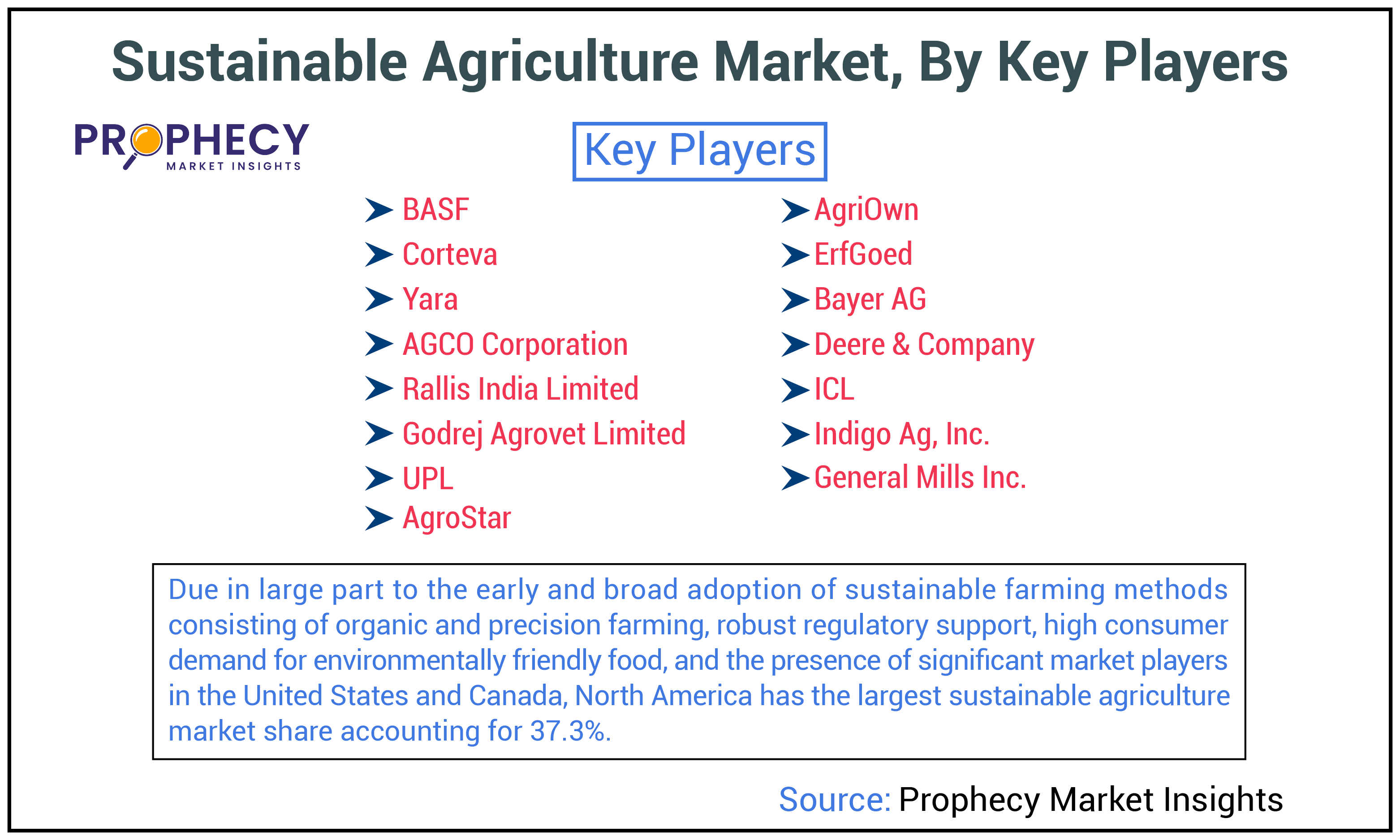
Sustainable agriculture companies adopt agri-tech innovations, expand into emerging markets, create strategic partnerships, secure certifications, and concentrate on climate-resilient crops and consumer education to meet rising demand and increase their efficiency. Such practices help these companies grow. The key players operating in the sustainable agriculture market include, BASF, Corteva, AgriOwn, Rallis India Limited, Godrej Agrovet Limited, and others.
Sustainable Agriculture Market Companies:
- BASF
- Corteva
- Yara
- AGCO Corporation
- Rallis India Limited
- Godrej Agrovet Limited
- UPL
- AgroStar
- AgriOwn
- ErfGoed
- Bayer AG
- Deere & Company
- ICL
- Indigo Ag, Inc.
- General Mills Inc.
View an Additional List of Companies in the Sustainable Agriculture Market
Sustainable Agriculture Market Recent News
- In June 2025, A company that works in the plant nutrition and crop protection sectors, Tropical Agrosystem (India) Pvt Ltd, has started a new project to support sustainable agriculture and empower farmers in order to guarantee long-term food security. The company's #SawalKalKaHai campaign aims to encourage consumers to make thoughtful, ethical food choices that benefit both people and the environment while also promoting ecologically friendly farming techniques.
- In April 2025, In Lichinga District, Niassa Province, We Effect formally launched the Sustainable Agriculture and Biodiversity Integration for Opportunity (SABIO) Project in collaboration with the Union of Farmers and Associations of Lichinga (União de Camponeses e Associações de Lichinga, or UCA). In an area that is becoming more susceptible to the impacts of climate change, the initiative, which is supported by the Liechtenstein Development Services (LED), intends to increase land production while preserving biodiversity and ecosystem services.
Analyst View:
By using techniques including crop rotation, organic farming, and less chemical usage, sustainable agriculture aims to provide food while protecting the environment, boosting farm profitability, and improving community well-being. Growing environmental consciousness throughout the world, government assistance, and advancements in precision agriculture are driving its market expansion.
In order to increase resource efficiency, productivity, and resilience, future developments include the use of regenerative farming, AI and IoT technology, vertical and hydroponic systems, and cutting-edge inventions consisting of biostimulants, blockchain for food traceability, and agroforestry.
More Related Reports
Sustainable Plastic Packaging Market
Europe Sustainable Aviation Fuel Market
Sustainable Marine Fuel Market
Sustainable Aviation Fuel Market
Sustainable Construction Materials Market
Sustainable Agriculture Market Company Profile
|
Company Name |
Deere & Company |
|
Headquarter |
Moline, Illinois, United States |
|
CEO |
John C. May |
|
Employee Count |
75,800 Employees |
Sustainable Agriculture Market Highlights
FAQs
Sustainable agriculture market size was valued at USD 24.3 Billion in 2025 and is expected to reach USD 62.2 Billion by 2035 growing at a CAGR of 10.9%.
Type, farming method, application, end user, and region are the segmentation for the sustainable agriculture market.
North America, Asia Pacific, Europe, Latin America, and the Middle East & Africa. North America is expected to dominate the market.
The key players operating the sustainable agriculture market include BASF, Corteva, Yara, AGCO Corporation, Rallis India Limited, Godrej Agrovet Limited, UPL, AgroStar, AgriOwn, ErfGoed, Bayer AG Deere & Company, ICL, Indigo Ag, Inc., and General Mills Inc.